We discuss here the Varieties of Democracy (V-Dem) Civil Society data, a new and unparalleled resource that captures multiple dimensions of civil society across more than 170 states since 1900. The value-added of the V-Dem civil society data is that it encompasses diverse indicators over an unprecedented geographic and temporal scope. This is possible because it has taken a store of detailed and rich human knowledge—the embedded knowledge of country experts—and transformed it into comparable time-series cross-sectional data that facilitates new forms of descriptive and theoretical inference.
Here we make prominent use of three new variables that allow us to gauge civil society strength and participation. However, the larger dataset allows researchers to track a range of new variables for many other aspects of civil society that heretofore, despite their relevance to important theoretical questions, have been difficult to gauge. These include concepts such as the degree to which decision-makers consult with civil society actors, the presence and nature of anti-system movements, state harassment and regulation of civil society organizations, the predominant organizational pattern of civil society organizations, and the degree to which civil society excludes both female and religious actors. Footnote 1
We begin with a discussion of the importance of civil society as a relatively new concept in comparative politics and the difficulty of testing general propositions about it due to the existing data environment. We then discuss the data generally and highlight two mid-range indices developed by V-Dem: the Core Civil Society Index (CCSI) and the Civil Society Participation Index (CSPI). With these basics established, we then report on a series of validity tests for the CCSI that demonstrate the level of dense historical nuance that the V-Dem data embodies, and then demonstrate the utility of the data by revisiting the debate on the strength of post-communist civil society. The V-Dem data show that civil society in the region exhibits a great deal of variation, that it is neither universally strong nor weak, and that greater caution is warranted in generalizing about civil society in the post-communist region.
The Emergence of Civil Society as a Key Concept in Comparative Politics
Civil society has been an important concept in both political theory and the study of regimes and regime change in modern political science. It played a critical role in the conceptualization of modern society in the political thought of the Scottish Enlightenment Footnote 2 and German Idealism. Footnote 3 It has also received a great deal of attention in contemporary critical theory. Footnote 4 However, in many regards the notion of civil society that we employ in political science today has two parents, the Italian Marxist Antonio Gramsci Footnote 5 and the French aristocrat Alexis de Tocqueville. Footnote 6 From Gramsci we continue to think of civil society as a realm of contestation, where organized social actors challenge the power of the state and other social forces. From Tocqueville we draw the notion that civil society is the integument of democracy. Instead of stoking reactionary nightmares of democracy as mob rule, Tocqueville explored how an engaged and organized citizenry enables more egalitarian, mass-based forms of rule.
In modern comparative politics civil society reemerged as a central concept of analysis in the 1980s to describe the reemergence of protest movements and underground organizations under authoritarian regimes. This analysis is neo-Gramscian in nature, in that it sees civil society as an emergent realm of contestation with dictatorship. What was novel about this approach was that civil society was posited to coexist with authoritarian regimes and that this held the potential to liberalize, if not democratize them. Among the earliest and most influential in this regard was Alfred Stepan who observed such development first-hand in Brazil in its resistance to military dictatorship. Footnote 7 In Eastern Europe, Andrew Arato made similar observations on the emergence of new oppositional social actors as the impetus for change in state socialist regimes. Footnote 8 This observation was significant because the essence of the state-socialist project was the abolition of civil society. Footnote 9
With the third wave of democratization this neo-Gramscian notion of a contentious civil society was integrated into influential actor-centered process models of democratic transition. O’Donnell and Schmitter refer to the response of social actors to new opportunities opened up by liberalization as “the exploding layers of society.” Footnote 10 Such mobilization is a decisive factor in the extension of liberalization into democratic transition. Przeworski takes this further, pinpointing whether civil society accepts the liberalization of constraints on speech and organization or whether it presses for further concessions as the key juncture in democratic transition. Footnote 11
The neo-Tocquevillian notion of civil society drew its inspiration from the study of mass political behavior and consideration of the forms of political culture most congruent with democracy. This line of reasoning was opened by Almond and Verba Footnote 12 who saw an expansive layer of activist citizenry as central to democracy and was advanced by Putnam, Footnote 13 whose account of civic participation and government performance across Italy placed associational life at the center of the forms of social capital necessary for effective governance. Inglehart and his collaborators Footnote 14 have linked a complex of values including citizen-level engagement with pro-democratic political cultures. While such foundational accounts of democratic political culture did not explicitly conceptualize this in terms of civil society, it has been recognized as such by others. Footnote 15
While there has been widespread adoption and acceptance of neo-Gramscian notions of an “insurgent civil society” as a fundamental actor in contemporary democratization and a neo-Tocquevillian notion of a “regularized civil society of social interests” as a critical sphere in durable democracy, there have also been a number of dissenting views. Several accounts have disputed the notion of cultural congruence with democracy, arguing that the causal relationship is inverted and that social trust and citizen engagement is less central to democratic success than theorized. Footnote 16 Others raise the specter of an activist civil society as a means for authoritarian mass movements to overthrow democracy. Footnote 17
The notion of a badly behaved and overactive civil society contradicts the idea that civil society mobilization is an essential element in overcoming the inertia of authoritarianism. Such controversies find strong echo in the literature on post-communist democratization where one set of scholars pose the problem of “weak” civil society as problematic for the building of durable democracy, Footnote 18 whereas as others have seen an active and engaged civil society as an mechanism for democratic consolidation Footnote 19 or as an essential component of defeating neo-authoritarian challenges to full democratization. Footnote 20
Our ability to settle such fundamental questions has been to some degree impeded because the data at our disposal is limited. Theories are advocated and refuted on the basis of a relatively small number of cases, by cross-sectional data that cannot capture the full political dynamics of such relationships, constrained samples which lead to concerns about bias on the basis of what has been omitted, or different sources that present different assessments of fundamental qualities. The V-Dem data goes a long way in remedying such problems by collecting data that was previously understood as too expensive to collect or even unobservable. The team has been able to do this by accessing the “embedded knowledge” of experts and rendering it visible for researchers. This represents a step forward in addressing many thorny, unresolved research questions. For instance, the literature on the strength of post-communist civil society and it ramifications lacks a consensus on whether civil society in the region is weak or developed. We will return to this particular question later, but before that it is worthwhile to document the state of the data environment prior to the publication of the new V-Dem data.
The Existing Data Environment
Until now, data to measure civil society has been difficult to collect and apply in cross-national analysis. The discussion that follows introduces the extant indicators and their limitations for doing time-series, cross-sectional type analysis. This is in no way meant to diminish the importance of the work of these authors, their measures, or the analyses based on them. Following this discussion, we then discuss the potential liabilities that data-poor environments can pose for making generalizable inference.
The most common measurement of civil society uses questions from the World Values Survey (WVS) on organizational and protest behavior. WVS and the various regional surveys and attitudinal barometers it has inspired are a major resource in the study of political culture. The surveys have now been conducted for over thirty years in six waves and have included as many as 50–60 countries in individual waves. Footnote 21 However, the WVS is only repeated every five years due to resource constraints, alternates two different questions on organizational behavior, and does not always include the same countries, posing major challenges for studying civil society in any sort of panel or country-year set up for a global sample.
Event history coding of protest is also an important means to study the development of civil societies in a small number of contexts over time. Such coding is very difficult and expensive to replicate over a large number of countries. The most extensive, ambitious, and sustained project of this sort has compiled annual data for four countries over a thirty year period. Footnote 22 Some have also examined the registration of new organizations from statistical annuals or registries on a national level but these figures are limited in that they do not track exit or activism, and are hard to collect in comparable terms across countries. Footnote 23
Several organizations have tried to remedy these problems by measuring different components across civil societies. One of the most ambitious is the Civicus Civil Society Index that looked at four different dimensions of civil society—“the organisational structure of civil society, civic engagement, perception of impact, practice of values and the enabling environment.” Footnote 24 The most recent Civicus CSI round covered 35 countries for the period 2008–2011. Footnote 25 Work on this measure has been suspended and has been replaced by the Civicus Civil Society Enabling Environment Index or EEI. Footnote 26
The EEI measures the “conditions that impact on the capacity of citizens… to participate and engage in the civil society arena in a sustained and voluntary manner.” The first report issued in 2013 included 108 countries. The measure is composed of 53 indicators compiled over the period from 2005–2012, which capture three major dimensions (socio-economic, socio-cultural, and governance) broken into 17 sub-dimensions. While very ambitious in scope and useful for policy-makers and activists, this measure, by its nature, has limited utility for statistical investigation except in basic cross-sectional analysis. Footnote 27
Two different organizations compiled a Global Civil Society Index. In 2002 the Center for the Study of Global Governance at the London School of Economics published rankings for 33 countries in Europe and the Americas circa 2000 Footnote 28 and the Center for Civil Society Studies at Johns Hopkins University published an index for sixteen countries also around 2000. Footnote 29 Disaggregated components were compiled for thirty-six countries in an updated version. Footnote 30
USAID’s Civil Society Organization Sustainability Index (CSOSI) examines six dimensions—the legal environment, organizational capacity, financial viability, advocacy, service provision, infrastructure, and public image—and ranks them on a scale from one to five. The CSOSI is an average of the components. They have compiled the index for post-communist Europe for the years 1997–2011 and for twenty countries in Sub-Saharan Africa in 2009–2011. Footnote 31
Freedom House’s Nations in Transit Footnote 32 also calculates a civil-society score for the post-communist countries. It ranks civil society on a scale from one to seven based on nine open-ended questions answered by experts. The ranking on the scale is originally determined by the author of an expert report and is then reviewed by outside readers and a board of academic advisors. Rankings are available for 1995 and 1997–2013. Footnote 33
The Bertelsmann Transformation Index produces 49 scalar measures using expert opinion which are then compiled into a series of indices which gauge the extent to which the countries in question have transformed into liberal democratic market systems. After a pilot study in 2003, it has been compiled biennially since 2006 for 129 developing and transitional countries. It has four indicators relevant to the study of civil society—organizational freedom, the presence of interest group networks, social self-organization, and a civil society tradition. Footnote 34
Last but not least, the International Institute of Social Studies in The Hague has created a set of “Indicators of Social Development” (ISD) that measure aspects of civil society. They have compiled a civic participation indicator for 209 countries at five year intervals from 1990 to 2010. Seventeen percent of the observations are missing. It is compiled from a variety of answers to values and attitudes surveys, data on international non-governmental organizations, the Civicus CSI, and data on communications technology. Footnote 35 The coverage of the sub-indicators is subject to a higher degree of missingness than the indicator itself. This problem is addressed through the use of percentile-matching techniques rather than imputation. Footnote 36 They have also compiled an indicator of “clubs and associations” from values and attitudes surveys. It is subject to a very high degree of missing observations—fifty-five percent. Footnote 37
Despite the valiant efforts of those who have sought to measure civil society prior to V-Dem, the paucity of data going back in time, limited coverage of countries, and the inconsistent coverage of the same factors hinders both good descriptive inference about and the conclusive testing of general propositions on the impact of civil society. Such problems immediately raise issues of sample bias. Are the results of tests the product of the properties of the particular countries or time periods for which we have limited data? Even renowned datasets like the World Values Survey, which strive to provide data from many regions of the globe, often over-represents Western societies, other rich societies, or those with a strong state and statistical capacity, at the expense of poorer areas and those with poorer statistical infrastructure. Given the constraints they face on funding, what they have accomplished is remarkable, but its limits represent a potential problem in supporting generalizable propositions.
Problems of sample bias are also a concern in the case of some of the most innovative theoretical work on civil society. Take for example Sheri Berman’s brilliant account of how the Nazis were able to take control of highly-developed civil-society organizations in Weimar Germany and use them to take power. Footnote 38 This is inference based on one—albeit highly influential—case. Similarly, Dylan Riley has also explored how civil society in the interwar period in Italy, Romania, and Spain constituted the “foundation of fascism.” Footnote 39 Both authors argue that active civil societies unchecked by political organization are at the root of these democratic breakdowns. Both use thickly-descriptive case analyses to convincingly demonstrate the causal links they theorize and for this reason the thesis they propound is influential. Yet at the same time, the theory is based on only four cases with no variation on the dependent variable.
But is civil society really a threat to democracy? Were the aristocratic enemies of democracy that Tocqueville rejected correct in hindsight? Or does the problem of selection on the dependent variable require us to be much more cautious about generalizing on this basis despite compelling within-case evidence? Such questions are now answerable using the V-Dem data and two working papers from the V-Dem team show that, on balance, civil society insulates democracies from breakdown. Bernhard, Hicken, Reenock and Lindberg, looking at a global sample from 1900 to 2010 show that civil society has a strong positive effect on democratic survival. Footnote 40 Cornell, Møller, and Skaaning directly look at the interwar period and find the same thing. Footnote 41 Both papers also show that the interaction of V-Dem civil-society variables with the degree of political party institutionalization is also not significant, so they provide no global or interwar evidence that political party strength (as perhaps the best indicator available of political organization) plays any mediating role on the impact of civil society on the survival of democratic regimes.
Thus V-Dem radically changes how we can study the impact of civil society on a range of outcomes. As noted earlier, and will be demonstrated later in our examination of the debate on civil society in post-communist Eurasia, the diversity of civil-society indicators and their coverage allows us to approach old questions with new resources and confidence in our findings. And with time, it will allow for the testing of new hypotheses on the impact of civil society on political life. We next present the V-Dem civil society data in its full scope.
The V-Dem Civil Society Data
Like all civil society researchers, we conceive of civil society as an essential intermediary sphere of the polity. It lies in the public space between the private sphere and the official sphere of the state. It is not the only set of actors that lie within the non-official public sphere—it shares this space with political society, a set of public actors who are consciously organized to contest the control of state power. While civil society has a degree of autonomy from the state (ranging from extensive to minimal), civil society is still regulated by the state. The state establishes a framework for the operation of civil society, and often intervenes in its life (though the degree of freedom of civil society is enhanced by less intervention). Footnote 42
Civil society is populated by groups of citizens organized to act in pursuit of their interests, broadly conceived (both material and ideal). We refer to these groups of self-organized interested citizens as civil-society organizations (CSOs). CSOs include, but are by no means limited to, interest groups, labor unions, religious organizations, foundations, think-tanks, social movements, professional associations, charities, and other non-governmental organizations.
It is essential to distinguish between the public and private spheres in understanding what constitutes a civil society organization. Both routine spiritual and economic activity are not civic but private. The productive activity of firms is not part of civil society, nor is the spiritual activity housed in religious institutions. However, when producers, workers, or people who share a set of spiritually-grounded, political, moral, or ethical beliefs organize on the basis of a shared set of interests and pursue their realization in the public space, such activity is assuredly part of civil society.
The existence of civil society is a necessary but not sufficient condition for democracy. This means that civil society is compatible with both authoritarian and democratic political systems. Some forms of dictatorship, specifically those that enforce a monopoly on political and civil organization, abolish civil society. However, such harsh political projects—the sorts of dictatorships that have inspired the label “totalitarian,” as well as some forms of authoritarianism in their harsher phases—are less common than dictatorships that permit some level of civil-society organization. Footnote 43
Despite a broadly-shared and well-developed conceptualization of civil society in the comparative politics literature, it has been difficult and expensive to collect comparable data on it across societies and time periods. Unlike other political and social indicators (e.g., voting behavior, economic performance, coups d’état), it is not easily observable. Yet at the same time there is considerable knowledge about the state of civil society in the academic community. In that sense, the problem that V-Dem faced was to extract a form of hard-to-access embedded knowledge and make it widely available in a form researchers could use. The issue was to turn something hard to observe because it was the province of experts into a more generally accessible form of knowledge.
The V-Dem dataset has compiled 350 separate indicators, seven different indices of democracy, Footnote 44 and 39 mid-level indices of democracy (e.g., rule of law, clean elections, etc.) for 173 sovereign states and territories for the period 1900 until today. Footnote 45 Given the importance of civil society in recent theorizing about regimes and regime change and the difficulty in testing falsifiable hypotheses with a high degree of external validity, our aim was to produce both a series of disaggregated indicators that get at different aspects of civil society, as well as indices of civil society strength that cover a global sample of countries over an extensive period of time.
The V-Dem response to digging out this broad range of new data was to rely on the in-depth knowledge embedded in responses from country experts to questions about fundamental characteristics of critical areas of democratic development for which it is difficult, prohibitively expensive, or impossible to collect observational data. In the process over 2,500 country experts worldwide have contributed ratings to V-Dem. Footnote 46 The country-expert data is combined into country-year estimates using a state-of-the-art Bayesian ordinal item-response theory model developed by the project’s methodologists. Footnote 47 The V-Dem civil society battery has ten questions that gauge different disaggregated aspects of civil society. In our discussion we will highlight five questions that were essential in building the two indices that we will employ in our discussion of civil society in post-communist Eurasia. In addition to those five questions, V-Dem also asked questions on the organizational characteristics of civil-society organizations, the presence and character of anti-system movements, and whether religious organizations were subject to discrimination in civil society. Footnote 48
The test that we frame below to further demonstrate the utility and novelty of the V-Dem data on civil society will use two indices that gauge the strength of civil society in somewhat different ways. The first of these gauges is what we think of as civil-society robustness, called the Core Civil Society Index (CCSI, v2xcs_ccsi). The second is a thick measure of the degree to which civil society participates in the political process, called the Civil Society Participation Index (CSPI, v2x_cspart).
We think of the robustness of civil society in terms of its ability to organize free of state constraints and how engaged the citizenry is in CSOs. We aggregate three of our indicators designed to this end to construct the CCSI, which allows us to distinguish robust from feeble civil societies. State constraints on civil society come via two different mechanisms. States may use the law to regulate the entry and exit of CSOs into the public space, determining who can organize and who cannot. A second mechanism is the direct repression of organizations and activists. These two in combination with each other constitute the organizational environment created by the state for civil society.
We capture these mechanisms using two questions from the civil-society battery. The first concerns the control of CSO entry and exit by the state (v2cseeorgs). The experts were asked to assess state control of CSO entry and exit on a five-point scale from zero to four with zero representing monopolistic control by the state authorities to 4 representing a lack of constraint. The second question concerned the level of state repression of CSOs (v2csreprss). Here the responses ran from zero to four with zero indicating active repression by the state to liquidate CSOs and four indicating substantively no government repression or harassment of CSOs.
The degree of citizen involvement in CSOs is gauged by a third question on the participatory environment in civil society (v2csprtcpt). The experts were asked to rate individual country-years from zero to three, with zero capturing situations in which the state sponsors all organizations, thus effectively exercising a monopoly on organization as in many state-socialist and state-corporatist regimes. Its maximum value is three for those societies in which there are many diverse CSOs and citizens are at least occasionally active in them.
The Civil Society Participation Index was designed to create a thicker indicator of the degree to which civil society organizations are engaged in the political process. It too uses the civil society participatory environment question discussed above but thickens it with three other V-Dem indicators. Two of these come from the civil-society battery. The first was a question designed to gauge the extent to which rulers routinely consult with CSOs on policies relevant to their members (v2cscnsult). The experts were asked to rate each country-year according to a three-point scale that runs from zero to two. Zero is indicative of a high degree of insulation of the government from CSOs and two indicative of regular consultation with CSOs on relevant policy issues. One is indicative of an intermediate level of consultation. This captures the extent to which civil society organizations are capable of translating their activism into impact at the level of policy.
The second additional question from the V-Dem civil society battery examines whether women are prevented from engagement in civil society (v2csgender). This is a five-point scale that runs from “almost always” to “almost never.” Footnote 49 Women’s participation is not only intrinsically interesting in itself, but also can function as an indicator of whether traditional status barriers are an impediment to participation in civil-society organizations in general. Finally, we also draw on one question from outside the civil-society battery, capturing the candidate nomination process within party organizations (v2pscnslnl). This indicator captures the extent to which candidate nomination is highly decentralized or made through party primaries. Footnote 50 This item was included to gauge the extent of citizen and CSO participation in the process of representative government selection beyond voting, and therefore captures the extent to which civil-society organizations are capable of translating their activism into influence on political society.
While the two measures are strongly correlated (.91), they do tap into slightly different aspects of civil society. Footnote 51 The CSPI is geared purely to capturing citizen and CSO participation and its effectiveness in conveying demands to the party system and state administration, while the CCSI also takes into account how state policy shapes citizen engagement. The latter controls for the effects of state harassment and legal regulation in facilitating or encouraging citizen participation. While such constraints are often minor in democracies, they are quite important under authoritarian conditions, especially in those cases in which the regime uses forms of democratic emulation as a means to secure compliance and to shore up its rule. Such considerations are important in gauging civil-society strength across countries both globally and in post-communist Eurasia where we deploy them later in the article in our tests.
Creating the V-Dem Civil Society Indices
Up until this point we have discussed the importance of civil society as a concept of central importance in the study of democracy and democratization, and how we used a subset of questions from the V-Dem data to create indices of civil-society strength. We now explain the technical details of how we tapped the rich vein of expert knowledge that allowed us to create the CCSI and CSPI to serve the needs of researchers looking for a single indicator that captures the relative strength of civil society across observations.
The construction of the indices was a two-step aggregation process. In the first stage, ordinal ratings provided by multiple country experts for the relevant variables are aggregated using a Bayesian measurement model. In the second stage, the output of these statistical models is aggregated into the indices using Bayesian factor analysis. The process by which this has been accomplished is highly transparent, for our civil-society indicators and the dataset as a whole. The full codebook includes the complete battery given to the experts and details the fashion in which higher-order indices were aggregated. Footnote 52 The process by which individual coder data was aggregated into latent variable estimates by the measurement model is all extensively documented and publicly available. Footnote 53 Because latent variable estimates include a degree of uncertainty, full posterior distributions for all variables are publicly available to allow researchers to verify that their findings are not a product of measurement error. We briefly review each stage of the construction of the civil-society variables used here.
Since country experts provided multiple ordinal ratings for each of the variables that constitute the indices, Footnote 54 the first measurement challenge is to aggregate the ordinal ratings into a unified, continuous, and reliable variable. Individual raters might vary with regard to the way they interpret the questions and in terms of their reliability and consistency. Thus, we utilize Bayesian item-response theory models to aggregate their diverse ratings. These models are useful because they incorporate the information encoded in the variation in raters’ perceptions, and in reliability levels across and within coders into the estimation process. Footnote 55 While this type of model has been widely used in political science to measure legislators’ ideology based on binary data, Footnote 56 their use in aggregating multi-rater ordinal data is much less common. Footnote 57
The main assumption underlying item-response theory is that the variable being measured is latent, i.e., cannot be measured directly, and that raters perceive the true value of the variable with some error. Importantly, the model utilizes coder ratings and patterns of disagreement across raters to estimate coder-level errors, and down weights the ratings provided by coders who are deemed less informative. The Bayesian framework allows us to estimate the country-year latent quantity of interest (e.g., the latent degree to which CSOs are harassed by the state in a given country-year), as well as simultaneously estimating the thresholds that separate the levels of the latent variable. Put differently, the model estimates country-year-level parameters that capture the latent variable of interest, along with thresholds differentiating the various levels of this latent variable. Footnote 58
Expert surveys pose a problem for social scientists in terms of cross-national comparability. Coders who vary in terms of their educational and cultural backgrounds might have different perceptions of the latent variable, and may, in addition, have different latent thresholds. Footnote 59 If these coders provide ratings for disjointed units, model estimates will be problematic since estimates for different countries will be based on different scales. In order to mitigate this problem, the V-Dem project has recruited a large number of bridge-coders, i.e., coders who serve as connecting units across previously disjointed countries. Extensive Monte Carlo simulations Footnote 60 provide strong evidence that bridge coders indeed improve model fit and greatly increase the degree of cross-national comparability. Footnote 61
In the second stage of the index construction, we generate the index scores using Bayesian factor analysis. As before, utilizing the Bayesian framework is advantageous since it allows us to generate uncertainty estimates for the index. All component variables loaded highly on the latent dimension, though the factor loadings are somewhat higher for the CCSI than the CSPI. Footnote 62
In thinking about how to assure ourselves that the data-generation process yielded valid indicators, we ran an extensive series of validity checks. In terms of macro-level face validity, we designed several basic tests that examined whether CCSI behaved in line with our expectations over large units of time and space. We also ran a series of discriminant validity checks that looked at the correlations between the CCSI and extant civil-society indicators, as well as other measures that captured dimensions similar to its component parts. Finally, we also ran a series of convergent validity checks exploring the correlations between the CCSI and variables to which we thought it should have a strong relationship. These exercises helped to build our confidence that the data was capturing the latent dimensions for which it was designed. Footnote 63 We next report on a series of micro-level validity checks that we ran to demonstrate how the data effectively capture detailed expert knowledge on national-level civil societies and make it available to the research community at large.
From Embedded to Transparent Knowledge
Our argument on why the V-Dem civil-society data is a unique and potentially game-changing development in the study of civil society is based on how it has taken an embedded and difficult to access body of knowledge and made it publically available to the research community at large. The difficulty of this challenge lies in the fact that there is no set of universally-available observables over a broad range of times and places that allows us to access the development of civil society in a comparative perspective. Knowledge about civil society in national contexts is widespread, yet at the same time still difficult to access because it is only at the disposal of individual scholars who have made time-intensive commitments to studying the role of the citizenry in politics.
V-Dem has been able to compile its range of civil-society indicators over a substantial period of time for many countries by accessing that expert knowledge and standardizing it. By asking multiple experts on national contexts the same set of questions about different aspects of civil society we were able to compile a set of at least five expert assessments of different aspects of civil society at different places and times. The measurement model then takes those raw assessments and generates a latent-variable estimate with confidence bounds that takes into account the different ways in which coders make their assessments of answers to the questions and how reliable their answers are in relation to the assessments given by the other coders. In this way the divergent assessments of coders across time and context are arrayed on the same scale, making geographic and temporal comparison possible.
To demonstrate that this process provides data that extracts a credible assessment of the development of civil society at the level of individual nation states in line with the kinds of knowledge possessed by country experts, we present the results of micro-level face-validity checks we performed for the CCSI. Here we examine the extent to which the CCSI is congruent with the historical development of civil society in particular countries. We should observe change over time in line with particular events related to the constraints on CSOs and levels of mobilization. We chose to examine Venezuela, Ghana, and Russia based on the expertise of team members.
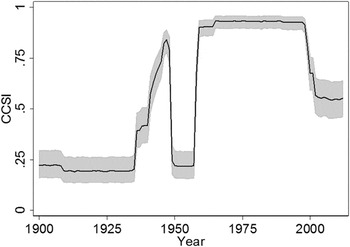
Venezuela’s CCSI for the period 1900–2012 is displayed in figure 1. It also includes the Bayesian confidence intervals generated by the measurement model which capture uncertainty about the point estimates. Footnote 64 The variation over time corresponds to three important periods. Before 1935, the country knew only military dictatorship, and civil society was tightly circumscribed. When General Gómez died in 1935, a series of transitional governments oversaw political liberalization, especially the growth of unions and political parties. This culminated in the Trienio of 1945–1948, considered by many to be Venezuela’s first attempt at democracy. This period saw the rapid organization of peasant leagues and the expansion of professional associations. It was quashed by a military coup in 1948, leading the political opposition to go underground or into exile until a durable transition to democracy in 1958–1959. This led to a period of great freedom for all sorts of civil society organizations, although they were heavily politicized along partisan lines.
The development of civil society in Venezuela, 1900–2012

The recent sharp decline corresponds to the government of Hugo Chávez Frías (1999–2013). The CCSI helps to illuminate this controversial period. Although his government repeatedly won elections and survived most referendums, civil society experienced many setbacks due to threats against union leaders, arrests of opposition politicians and judges, intimidation and harassment of NGOs and public employees, monitoring of political loyalties by governing-party officials and neighborhood activists, and progressive muffling of critical viewpoints in the media. Most of the change in the CCSI for Venezuela was due to two components: government attempts to repress CSOs (v2csreprss) and “moderate” government control over the entry and exit of CSOs into public life (v2cseeorgs). The level of participation (v2csprtcpt) remained consistent (“There are many diverse CSOs, but popular involvement is minimal”) Footnote 65 from 1959 to 2012. Venezuela saw growing CSO independence from parties in the early 1990s and sporadic mass mobilizations in the 2000s, but not much strengthening of civil society organizations in this last period.
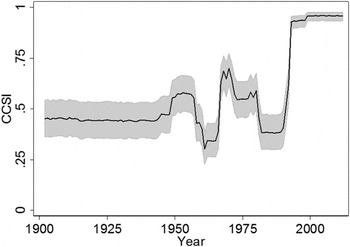
Figure 2 presents Ghana’s CCSI over time. In the early twentieth century under British colonial rule, the moderate CCSI scores reflect that civil-society organizations existed and operated with minimal interference as long as they did not challenge British rule. To that end the colonial authorities exercised a fair degree of control over which organizations were allowed to exist but otherwise were not unduly repressive nor did they particularly discourage participation in CSOs. The upward movement in the CCSI starting after World War II reflects an upsurge in activism due to the emergence of a broad-based national independence movement that succeeded in 1957.
The development of civil society in Ghana, 1900–2012

Soon after independence the new government under Kwame Nkrumah and the Convention People’s Party (CPP) called for national unity over pluralism and CSOs were subjected to increased levels of repression, including the infamous Preventive Detention Act in 1958 that gave the prime minister the power to detain individuals for up to five years without trial. Nkrumah, who was later declared president for life, tolerated no further political competition, and as Ghana became increasingly autocratic, civil society had less room to maneuver than even under colonial rule. This explains the sharp drop in the CCSI following independence.
We observe a positive change in the CCSI in 1967 following the military coup that overthrew Nkrumah in 1966, when the National Liberation Council took over and liberalized in anticipation of elections in 1969. This period of liberalization and fledgling democracy was terminated by another coup led by Lieutenant Colonel I. K. Acheampong in 1972. Continued stagnation and political gridlock led to two additional military coups led by Flight Lieutenant J.J. Rawlings in 1979 and 1981. Following the latter, Rawlings ushered in a longer period of nationalist-socialist rule by the Provincial National Defense Council (PNDC). The CCSI accurately captures this period when the Rawlings regime actively repressed CSOs and imposed tight controls on their entry and exit.
The CCSI grows rapidly starting in 1988–1989 when the Rawlings regime opened up political and civilian space and elections to local district assemblies were rolled out. By 1991, protests and demonstrations were allowed more or less freely in Ghana, and civil society no longer feared repression from the Rawlings regime. The CCSI reflects this rapid improvement that came with democratization in 1988 to 1992. Since then it has remained at high levels under Ghana’s new period of democratic stability.
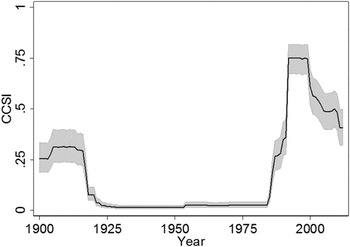
The CCSI for Russia (Tsarist, Soviet, and post-communist) is presented in figure 3. At the onset of the last century Tsarist Russia had a weakly developed civil society (reflected in a moderately low CCSI score) that left some latitude for organization by the nobility, the propertied, and professionals while denying it to workers, peasants, and minority nationalities. The CCSI improves slightly after the revolution of 1905 when a new constitution liberalized the rights of citizens to assemble and form associations. It then drops precipitously with the Revolution and Civil War period (1917–1921), when politics was highly chaotic and armed force ruled the day.
The development of civil society in Russia, 1900–2012

The institutionalization of Soviet rule in the 1920s kept the CCSI at very low levels for an extended period of time. Under the USSR, society was subjected to extensive etatization with the citizenry firmly under the control of state-sponsored transmission belt organizations. Beginning with the liberalization period of Glasnost and Perestroika under Gorbachev we see a sharp upturn in the CCSI due to a relaxation of state repression and control over the organizational realm. This period saw an upsurge in independent organizations, a marked increase in public demonstrations, protests, strikes, and the like, and a relaxation of controls on public discourse.
The upward trend continues after 1991 as the strength of civil society in Russia continued to grow in the period following the collapse of the Soviet Union and the onset of Yeltsin’s rule, stabilizing at its maximum level throughout the 1990s. The decline beginning in 2000 corresponds to Putin’s rule and his installation of a competitive authoritarian regime in Russia in which civil-society activity has been increasingly subjected to the heavy hand of the state anew, but at levels not nearly as harsh as under Soviet rule.
Having now documented to readers that we have successfully used the expert knowledge on which our variables and indices are based to present novel and comprehensive data on the development of national civil societies over time, we will now use them to examine a controversy in the literature on civil society. Among scholars of post-communist democratization there has been a long and determined debate over the impact of the communist experience on civil society. On the one hand, a group of scholars has seen a weak civil society as a potential impediment to successful democratization, while another set of scholars have argued that this concern is overstated.
How the V-Dem Data Can Contribute to Substantive Debates: Civil Society in the Post-communist World
Among those who agree on the relationship between civil society and democracy, there can be disagreements over the condition of civil society, and what this ultimately means for the fate of democracy. This is particularly manifest in the discussion of democratization in post-communist Eastern and Central Europe. On the one side there are a group of observers who see post-communist civil society as relatively weak compared to civil society in other regions, Footnote 66 and those who argue that the extant ways of measuring civil society through values and attitudes surveys miss parts of the picture, notably a vibrant development of civil society in the period since 1989. Footnote 67 Instead they pose alternative measurement strategies based on directly observable indicators such as protest-event coding, coordinated political activity by networks of CSOs, and the registration of new CSOs by the state.
Thus while there is good substantive justification to be concerned about the status of civil society among those interested in the study of democracy and its fate, the post-communist civil-society legacy debate points out the difficulties of coming to definitive answers because of the relative paucity of data. In one sense the two sides of this debate have been talking past each other due to radically different data sources. The findings that civil society is relatively weak is often based on data drawn from the answers to questions on organizational-joining behavior and propensity to protest drawn from global and regional value surveys and barometers. The contradictory position comes from event data coded from newspapers on CSO formation and activity. Rather than reiterate the potential pitfalls of both forms of data, we will examine what our indices, the CCSI and CSPI, say about the relative strength of civil society in various regions.
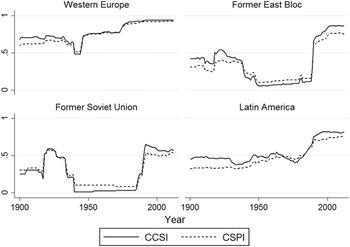
We first examine the data for the region in a comparative descriptive perspective. Figure 4 presents the development of the CCSI and CSPI in Western Europe, Latin America, the former East Bloc, and the former Soviet Union for the period 1900 to 2012. We have chosen Western Europe as a comparison as it is a neighboring region with a history of strong civil-society development in a global perspective and Latin America as an area with a recent history of regional democratization. It is clear from the outset that civil-society development in both post-communist regions lagged substantially below Western Europe during the period up to 1989. For most of the interwar and Cold War period it also lagged, but less profoundly, below Latin America, another region with a strong history of dictatorship. So historically, there is certainly evidence of a weak civil society on average in the post-communist countries, both before and during communism.
CCSI and CSPI over time in four selected regions

In the period after 1989 the levels of both indicators in the former East Bloc and the former Soviet Union increase dramatically. As in the post-communist regions, we see strong improvement with the recent global wave of democratization in Latin America, although starting about a decade earlier there in the mid-1970s. While the levels of the post-Soviet states lag behind the three others, those in the former East Bloc have come to exceed those of Latin America and are actually higher than all regions of the globe except for Western Europe and North America (not shown in the figure). Most notably for the debate on post-communist civil society, the strong differences between the mean scores for the former Soviet Union and the former East Bloc following 1989 seems to belie the idea of a uniform post-communist legacy.
In the statistical tests that follow we estimate the levels of CCSI and CSPI taking into account regional location as well as two factors thought to affect the strength of civil society. Footnote 68 The first of these is the existence of democracy itself and the second is the level of development. In this regard, our tests are very different from those that use micro-level data. In the most elaborate tests of that kind, the most important controls are also individual level (though some studies use multilevel models that incorporate national level data as well). Here we gauge how different regions are doing, controlling for their experience both in terms of economic and political development. Thus the work we present here is the first to engage in this debate at the macro-level.
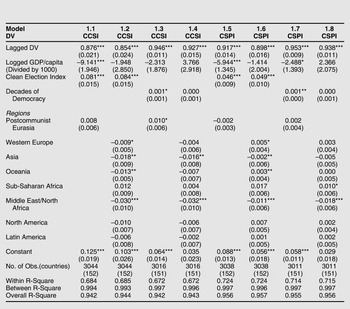
In table 1 we estimate the strength of civil society based on the level of development, Footnote 69 degree of democracy, and a series of regional dummies. Footnote 70 We also include a lagged dependent variable with the expectation that where an observation was in terms of the development of civil society in the recent past will strongly condition where it is at time t. We use a time-series cross-sectional design using random effects because of our desire to understand regional differences on the strength of civil society. In this regard the kind of inference we are drawing is descriptive, not causal. We are not trying to gauge why countries have different levels of CCSI or CPSI but to gauge the extent to which post-communist countries are different from the rest of the regions in the world. Our sample is confined to the post-1989 period, Footnote 71 the focus of the debate on the strength of post-communist civil society. The results are presented in table 1.
Relative strength of post-communist civil societies using random effects TSCS regressions

Two-tailed tests with robust standard errors in parentheses; ***p<.01, **p<.05, *p<.1
In controlling for democracy when the CCSI is the dependent variable it is essential to use a measure that does not explicitly use elements that might be partially captured by the CCSI, such as freedom of association. For that reason, our controls embody minimalist measures of democracy. We also control for different specifications of democracy. We examine both level of democracy and time spent under democracy. Thus for the quality of democracy models, we use the V-Dem Clean Elections Index (v2xel_frefair), which captures the extent that elections are free and fair and procedurally sound. Footnote 72 We believe that this measure proxies well for Schumpeter’s minimalist electoral notion of democracy. Footnote 73 We also run models to capture whether democracy has a developmental effect over time (assuming more time under democracy will allow civil society to potentially flourish). Because there is no theoretically justified cut-point to sort democratic from non-democratic practice using the Clean Elections Index, we use the binary coding by Boix, Miller, and Rossato (Reference Boix, Miller and Rosato2015) to estimate time spent under democracy. It too uses a minimalist, electoral specification of democracy. This allows us to control for the fact that when we compare the post-communist regions to areas of the world that democratized earlier, we capture that they are earlier in the process of the development of a democratic civil society.
Table 1 presents four sets of paired models. The first four use the CCSI and the second use the CSPI. In each quartet the two first models use a level specification of democracy and the second two use the developmental (time) specification. In the first model of each pair the inclusion of a dummy for the post-communist states gauges whether post-communist civil society is different from the rest of the sample. In the second model in each pair we include dummy variables for other world regions to gauge whether post-communist civil society (the reference category) is more vibrant than in other regions.
For the most part the post-communist dummy is insignificant and inconsistently signed. In model 1.3, it is positive and significant, but the lack of robustness across the four models leads us to discount it. When we compare the post-communist countries to other regions things are somewhat more interesting. Post-communist civil society outperforms that of both the Middle East and North Africa in all four models and Asia in the two CCSI models. Sub-Saharan Africa is significant and positive for the two CSPI models, indicating a higher level of participation controlling for development and democracy. The significant findings on other regional dummies are highly inconsistent and sporadic. So in this first general test we find that the strength of post-communist civil society is neither particularly strong nor weak in comparison to a global sample, and does relatively well compared to the Middle East and North Africa and Asia.
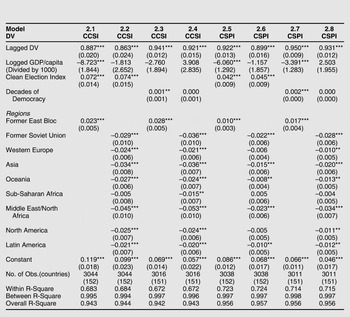
Given what we have seen in the descriptive data above and a large range of research that shows differing post-communist developmental trajectories between the countries of the former Soviet Union (FSU) and other post-communist countries, Footnote 74 we repeat our tests separating the FSU from former East Bloc countries (FEB). Footnote 75 In table 2 we repeat our tests with a dummy for the FEB countries and treating them as the excluded category.
Relative strength of former East Bloc civil societies using random effects TSCS regressions

Two-tailed tests with robust standard errors in parentheses; ***p<.01, **p<.05, *p<.1
Our results for the FEB countries are remarkably different than the previous set of regressions. The coefficient on the FEB regional dummy is consistently positive and significant, indicating that given the region’s economic and political development, civil society is highly developed from both the more structural perspective embedded in the Core Civil Society Index and the engagement perspective of the Civil Society Participation Index. It consistently outperforms the former Soviet Union, Asia, Oceania, the Middle East and North Africa, and Latin America. It even outperforms Western Europe and North America in three out of four tests. These results tell us that there is a great diversity among civil societies in the post-communist region. In that spirit, we now turn to our last set of regressions, this time using the FSU countries as the comparison group.
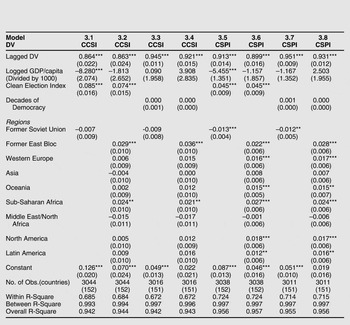
Table 3 repeats out tests focusing on the subsample of post-communist countries that were part of the FSU. The results for the FSU dummy diverge for the CCSI and CSPI. While all are negative only those for the latter are significant. This indicates that levels of civil-society participation are consistently lower for the FSU countries than the rest of the global sample. In terms of the tests that compare the FSU to other regions, when we gauge the strength of civil society using the CCSI, only the FEB and Sub-Saharan Africa dummies are consistently significant and positive. For the other regions the results are insignificant or inconsistent. However, when we turn to the CSPI most regions outperform the FSU, including, again, the FEB countries and Sub-Saharan Africa, Western Europe, Oceania, North America, and Latin America.
Relative strength of former Soviet Union civil societies using random effects TSCS regressions

Two-tailed tests with robust standard errors in parentheses; ***p<.01, **p<.05, *p<.1
We also ran a series of robustness estimations using the participatory environment variable common to both indicators. It largely confirms what we found here. The post-communist dummy remains insignificant, and the only region that consistently performs better given its level of development and democracy is Sub-Saharan Africa. For the FEB countries the result is insignificant with level of democracy in the regression, but significant and positive for duration under democracy. With regard to other regions, the FEB countries consistently outperform the FSU countries, Asia, and Middle East and North Africa. Finally, for the regressions gauging civil-society strength in the FSU the dummy is significant in both models with level of democracy and democratic duration. With regards to the other regions it is consistently weaker than the FEB countries, Western Europe, Sub-Saharan Africa, North America, and Latin America. The full results of these models are available in the on-line appendix in table A-4.
To sum up the results of this part of our investigation, the lack of findings for the post-communist countries in general hides great differences among those countries that shared a communist past. The null findings in the first set of models highlight that it is difficult to generalize about post-communist civil society. Instead what we see is a divide between those countries that were formerly part of the Soviet Bloc and those what were part of the Soviet Union. Footnote 76 The former, when we control for their economic and political development, have had great success in building post-communist civil societies. For the countries of the former Soviet Union, we can talk about a weak post-communist civil society at least from the perspective of citizen and CSO participation. Thus we conclude that there is no uniform post-communist malaise when it comes to civil society, but a set of two strongly diverging trajectories.
While we do not have time or space here to investigate the reasons behind the divergence between the two regions, the extant literature on legacies does provide some clues as to why this may be the case. Kopstein and Reilly attribute differences in democratic quality across the region to a process of diffusion of Western norms to those areas more geographically proximate to the West. Footnote 77 Darden and Grzymala-Busse explain differences in democratic practice as a product of norms conveyed by education between states that experienced independent statehood in the interwar and those which did not. Footnote 78 Bernhard as well as Vachudová explain such differences in democratic performance via the engagement of opposition movements at the moment of extrication from communism. Footnote 79 To the extent that these hypotheses conform to the spatial categories used in our regressions, they are plausible hypotheses and adjudicating between them must await a new round of testing.
Conclusion: The Gains of Making Embedded Knowledge Transparent
Since the emergence of civil society as an important substantive factor in our understanding of processes of democratization and the political life of democracy, our ability to pursue our theoretical insights have suffered from a shortfall of comprehensive and comparable data that would allow us to subject them to rigorous inferential testing to validate general knowledge about the effects of civil society. The problem was not that there was not widespread knowledge about civil society over a range of cases and time periods, but that the knowledge was maddeningly difficult to access. By using expert surveys and state of the art item-response theory techniques, V-Dem has made this deeply embedded knowledge available to the larger community of researchers over a range of indicators for the whole of the twentieth century and beyond.
Beyond its deployment in new lines of research as either the outcome of interest or an important causal factor, the availability of the data will allow us to avoid two potential pitfalls in the future. Instead of using constrained samples to make inference, we now have a data-rich environment. Thus we can avoid the pitfalls of sample bias. We illustrated the utility of the data in this regard by contrasting the findings of new V-Dem research on civil society and democratic survival with the historical work on “bad” civil society in interwar Europe. We now have substantial reason to doubt that the findings with regard to a set of influential cases in interwar Europe hold for the interwar period in general and for a more extensive global sample.
We can also see the importance of this in our testing of the proposition whether post-communist civil society is weak. In that debate the two sides have largely argued past each other on the basis of different forms of data that did not provide comprehensive coverage of the region or the ability to definitively compare the region to the rest of the globe. We examined the question in a new perspective using different data and addressing the issue at a macro-level. Our results do not confirm either position fully. Instead we show that there is substantial variation across former post-communist countries in terms of how civil society developed following the downfall of communism. Footnote 80 The differences seem to group intra-regionally. We show a sharp divide between the former East Bloc countries which have rapidly developed in terms of civil-society strength and those of the former Soviet Union which have lagged. Thus, using the data, we were again able to shed new light on a major controversy in the literature.
The second pitfall concerns omitted variable bias. In the future if researchers believe that civil society has substantial impact on outcomes of interest or that the status of civil society presents endogeneity concerns with regards to outcomes, there is now data to gauge different aspects of civil society as an independent variable or to control for it when trying to gauge the impact of other independent variables. Our findings on post-communist civil society have important implications for the future investigation of questions concerning post-communist politics with regard to omitted variable bias. One strong assumption about post-communist politics is that the shared starting point of these countries makes it reasonable to think about them in a most-similar-systems research design framework. Such frameworks facilitate the problem of control. Our research shows that there is substantial variation across the post-communist states in the development of civil society. This means that is not possible to assume that such states share the same legacy with regard to civil society. Thus future research into questions in which variation in civil society can function as a confounder need to take this diversity into account. This points out that the absence of data on civil society potentially has led in the past to omitted variable bias in estimating the effects of independent variables on outcomes.
The gains provided by the V-Dem data are not limited to the academic community. By making civil society and other key factors relevant to the study of regimes and politics in general, practitioners in the policy community also have a new and powerful tool at their disposal. V-Dem has not only made its data available to the academic community but has put the data online in a form that is much more accessible through online graphing tools for the policy community, and its use in classrooms by educators at all levels (including versions in French, Spanish, Russian, and Arabic). It includes a variety of different graphs, drill-down features, and motion charts. Footnote 81
By making embedded knowledge transparent, the data allows practitioners to get a sense of what the collective judgement of experts on how different aspects of democracy have developed over time in specific contexts. One of the comparative advantages of V-Dem is that it is based on the collective judgement of several experts, whose reliability and consistency has been evaluated in comparison to other expert coders through the measurement model. In that sense the data is less liable to individual coder bias. When practitioners make use of the confidence levels on the estimates that V-Dem provides, it also provides a greater degree of transparency about the degree to which they should be skeptical of our assessments. Of course, such distillations of knowledge are not a substitute for practitioners developing their own in-depth understanding, but they can serve as an aid in making sense of the particular problems they would like to address.
We close with a consideration on forms of knowledge in political science. Varieties of Democracy is an unprecedentedly extensive and comprehensive undertaking in comparative politics. It is unique in the ways that it brings together two sides of comparative politics—the large-n cross-national and the in-depth country specific. By utilizing the resources of those with in-depth country knowledge, V-Dem has been able to provide indicators on arenas of democratic political life for which we had little or no data in the past. In this sense it has taken an underutilized and, lately for a good part of the discipline, an underappreciated resource and has created something unprecedented. Utilizing the collective effort of literally thousands of colleagues it has been able to compile indicators for important aspects of politics such as civil society that until recently were seen as difficult to observe, if not unobservable. This accomplishment has been a product of both cutting-edge quantitative methods and the commitment of many comparativists to deeply understanding specific countries and regions. It is thus critical, despite the vast leaps and bounds that the discipline has taken in terms of quantitative methods and data collection in the last two decades, to not lose track of the importance of the passion and commitment that individual comparativists bring to the study of specific places. Without that store of knowledge, and its reproduction in future generations of scholars, our ability to undertake and successfully execute innovative data collection projects like V-Dem will not be possible. That embedded knowledge is the basis on which V-Dem’s ability to make heretofore murky areas legible to a wider audience.