Introduction
Cryptic and aposematic patterns are defences against visually oriented predators, and they are found in many organisms (Ruxton et al. Reference Ruxton, Sherratt and Speed2004). Cryptic colouration matches the substrate, which hinders the ability of the predator to differentiate between the two (Exnerová et al. Reference Exnerová, Stys, Fucilokova, Veselá, Svádová, Prokopová, Jarosik, Fuchs and Landová2006). Aposematic colouration is conspicuous and may indicate the presence of a toxic substance (Barnett et al. Reference Barnett, Constantine, Scott-Samnuel and Cuthiill2018) and acts as a signal to predators to avoid consuming this pattern in the future (Lindstedt et al. Reference Lindstedt, Boncoraglio, Cotter, Gilbert and Kilner2017). Alternatively, “aposematic” colouration may be a dishonest signal of toxin or unpalatability produced by a conspecific (automimicry) or heterospecific (Batesian mimicry) (reviewed in Caro & Ruxton Reference Caro and Ruxton2019).
Regardless of the visual strategy against predation, a fitness benefit is usually provided to the individual, which is translated as improved survival and perpetuation of the strategy in the population (Marples & Mappes Reference Marples and Mappes2011). Signalling efficacy of colouration for the prey depends on learning and prey-avoiding behaviours by predators regardless of the visual strategy of prey (Marples & Mappes Reference Marples and Mappes2011; Stevens & Ruxton Reference Stevens and Ruxton2012). Therefore, explaining the permanence of the aposematic pattern in relation to less obvious patterns is complex since predators lacking experience with the pattern will lead to the death on aposematic individuals (Exnerová et al. Reference Exnerová, Stys, Fucilokova, Veselá, Svádová, Prokopová, Jarosik, Fuchs and Landová2006, Marples & Mappes Reference Marples and Mappes2011). Therefore, quantitative estimates of the effectiveness of these two strategies require further research to elucidate the evolutionary mechanisms of these strategies (Ferrante et al. Reference Ferrante, Barone, Kiss, Bozóné-Borbáth and Lövei2017).
Lepidopteran caterpillars suffer high predation pressure because of their high exposure (Bianchini & Santos Reference Bianchini and Santos2005; Lövei & Ferrante Reference Lövei and Ferrante2017). This factor is reflected in the diversity of visually oriented predators, including birds (Heinrich & Collins Reference Heinrich and Collins1983), bugs and wasps (Dyer Reference Dyer1997), and in the diversity of caterpillar’s defence strategies (Carroll & Sherratt Reference Carroll and Sherratt2013, Greeney et al. Reference Greeney, Dyer and Smilanich2012), including a wide variety of colour patterns (Caro et al. Reference Caro, Sherratt and Stevens2016) and sequestration of plant chemicals to become unpalatable (Quintero & Bowers Reference Quintero and Bowers2018). Thus, both cryptic and aposematic colour patterns are found in these organisms.
The use of digital technology can help in the understanding of the evolution of the colour patterns of prey species and how predators see them (Stevens et al. Reference Stevens, Párraga, Cuthill, Partridge and Troscianko2007). Human evaluation is subjective and distinct from that of other organisms (Bergeron & Fuller Reference Bergeron and Fuller2018). Variation in light availability, for example, may bias the evaluation of prey colouration, compromising conclusions about trophic interactions between caterpillars and their predators (Tvardikova & Novotny Reference Tvardikova and Novotny2012). Digital photography can provide high accuracy in understanding colour patterns in nature, although digital algorithms are difficult to interpret (Stevens et al. Reference Stevens, Párraga, Cuthill, Partridge and Troscianko2007). An alternative to this difficulty is colour analysis by image processing using the red-green-blue (RGB) system. This system represents the reflectance of the pixels used for the formation of colour images in red, green and blue video monitors (Stevens et al. Reference Stevens, Párraga, Cuthill, Partridge and Troscianko2007).
The aim of our study was to identify if there are differences in predation risk on artificial caterpillar models with cryptic and aposematic colour patterns and determine whether predation on models with different colour patterns depends on the contrast with the substrate. We tested two hypotheses: (1) the two prey types suffer similar predation rates, assuming that predators have already been subjected to these visual defence patterns and have strategies to circumvent them or that both strategies are equally effective (Marples & Mappes Reference Marples and Mappes2011); (2) predation on the cryptic pattern will be greater the less their colour matches the background, whereas the aposematic mimic pattern will experience less predation the less their colour matches the background contrast (Arenas et al. Reference Arenas, Troscianko and Stevens2014, Aronsson & Gamberale-Stille Reference Aronsson and Gamberale-Stille2009), assuming that signalling efficiency depends on the contrast with background.
Materials and methods
Study site
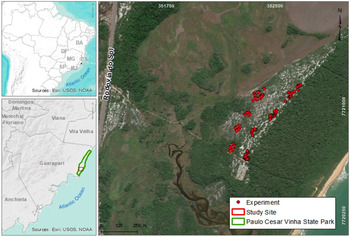
The study was conducted at Paulo César Vinha State Park (PEPCV), located between the north-east of the municipality of Guarapari and south of the municipality of Vila Velha (Figure 1), in the state of Espírito Santo, Brazil. The PEPCV has an area of ~1500 ha with great biological diversity that varies according to the environment, and it encompasses lagoons, dunes, floodplains and innumerable vegetation formations. According to the Koppën classification, the climate of the region is characterized as Am tropical monsoon, and the area has a mean annual rainfall between 1200–1300 mm and temperature of 18°C in the coldest month (Alvares et al. Reference Alvares, Stape, Sentelhas, De Moraes Gonçalves and Sparovek2013).
Location of Paulo Cesar Vinha State Park (PEPCV, green polygon) relative to Brazil, the state of Espírito Santo (ES) and the municipalities of Guarapari and Vila Velha, and aerial image showing the sampling site at PEPCV.

The park is part of a preserved Brazilian restinga (coastal shrubland) area, within the Atlantic Forest biome. Restinga is composed of herbaceous, shrub and tree formations that are influenced by flood patterns according to the water table (Magnago et al. Reference Magnago, Martins and Pereira2011). The experiment was carried out in a flooded open shrub area characterized by vegetation clumps spaced apart.
The study occurred at the end of winter (26–31 August 2018) and was replicated at the beginning of autumn (23–28 March 2019).
Caterpillar preparation
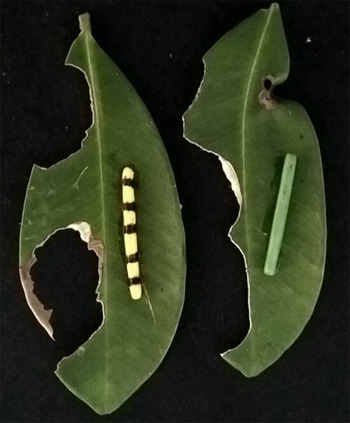
Caterpillars were produced using coloured plasticine (Roslin et al. Reference Roslin, Hardwick, Novotny, Petry, Andrew, Asmus, Barrio, Basset, Boesing, Bonebrake, Cameron, Dáttilo, Donoso, Drozd, Gray, Kik, Hill, Hopkins, Huand, Koane, Laird-Hopkins, Laukkanen, Lewis, Milne, Isaiah, Nakamura, Nell, Nichols, Prokurat, Katerina, Schmidt, Slade, Slade, Suchanková, Teder, Nouhuys, Vandvik, Weissflog, Zhukovich and Slade2017) (Acrilex®, Brazil, Figure 2). This material has been shown to be more weather resistant compared with the starch-based models. Because we did not observe individuals in the larval period on visits prior to the experiment, the colour patterns were based on lepidopteran species previously observed at the study site (Ascia monuste for cryptic models and Phoebis argant for aposematic models), taking into account the contrast with the substrate of the study site. According to Lövei & Ferrante (Reference Lövei and Ferrante2017), a superficial similarity to the prey is sufficient to obtain good results in terms of predation for artificial prey models.
Artificial caterpillar models (left: aposematic; right: cryptic) on their respective substrates.

Coloured blocks of plasticine (9 cm each) were mixed to obtain the desired colour patterns to make the models since the original factory colours have an unnatural tone. We used a 20-ml plastic syringe to standardize the size of the artificial caterpillars to a length of 2.5 cm and diameter of 0.3 cm, which is similar to what was used in previous studies (Ferrante et al. Reference Ferrante, Barone, Kiss, Bozóné-Borbáth and Lövei2017, Roslin et al. Reference Roslin, Hardwick, Novotny, Petry, Andrew, Asmus, Barrio, Basset, Boesing, Bonebrake, Cameron, Dáttilo, Donoso, Drozd, Gray, Kik, Hill, Hopkins, Huand, Koane, Laird-Hopkins, Laukkanen, Lewis, Milne, Isaiah, Nakamura, Nell, Nichols, Prokurat, Katerina, Schmidt, Slade, Slade, Suchanková, Teder, Nouhuys, Vandvik, Weissflog, Zhukovich and Slade2017). The models were then placed in Eppendorf tubes to prevent damage during fieldwork. Overall, 130 and 94 caterpillars were made for the experimental trials conducted in winter and autumn, respectively.
Sampling design
The experiment was set up along 650-m (winter) and 360-m (autumn) transects in flooding open shrub formation. For each period, all models (65 and 47 units of each colour pattern during the winter and autumn, respectively) were laid out in pairs on different leaves of the same plant with similar colouration and texture. For each period, all models were deposited on the same day to avoid abrupt temporal variation. The models were attached to shrub vegetation at ~1.5 m from the ground on the adaxial surface of the leaf using natural wax.
Our models (in winter and autumn) were set out in blocks spaced 100 m apart in order to isolate possible predator learning effects (Iniesta et al. Reference Iniesta, Ratton and Guerra2017). In each of the blocks, 10 pairs of artificial caterpillars (one cryptic and one aposematic mimic) were deposited 10 m apart. Each pair was deposited on the leaves of a single plant, and the caterpillars of the same pair were separated by at least 1 m. The artificial caterpillars were exposed for a period of 5 days and then collected together with the leaf on which they were attached. We considered as missing data when we did not find the plant and the leaf (14 artificial caterpillars). All missing models (10 cryptic and 10 aposematic) were considered predated (results are not altered whether these missing models are removed) by unknown predators. The samples were analysed in the laboratory with the help of a stereoscopic magnifying glass. We separated the types of predators more broadly between birds and arthropods. We used the marks observed on the models to recognize the predator type, determining if the shape was that of a beak, with superficial and straight marks, or mandible, with deep and asymmetric marks (Howe et al. Reference Howe, Lövei and Nachman2009; Low et al. Reference Low, Sam, McArthur, Posa and Hochuli2014).
Contrast between substrate and caterpillars
To compare the contrast between artificial caterpillars and their substrates, red, green and blue values (RGB system) (Gaitonde et al. Reference Gaitonde, Joshi and Kunte2018) were used to represent the reflectance of the pixels used to form colour images on the video monitors (Stevens et al. Reference Stevens, Párraga, Cuthill, Partridge and Troscianko2007). The models were photographed perpendicularly at 50 cm away from the camera (Nokia Lumia 640 XL, 13 megapixels, 4128 × 3096 pixel resolution), all under similarly controlled lighting conditions, with a lamp fixed at a distance of 30 cm. The samples from each point were photographed together on their respective substrate (Figure 2). The RGB system analysis was performed in the ImageJ® program (Schneider et al. Reference Schneider, Rasband and Eliceiri2012), selecting the largest possible leaf area under the model.
We photographed and analysed the RGB for 97 leaves in the winter and 85 leaves in the autumn. RGB analysis was not performed for 42 leaves (33 in the winter and 9 in the autumn) because plant (14) or leaf (20) were not found, or because the caterpillar detached from the leaf (8). For the caterpillars, we analysed the RGB system for a subset of 5 caterpillars of each model type at each period (winter, autumn). Here, we used only a subset of caterpillars considering that we made the models for each type at the same time and using the same mix of plasticine colours and material for each period. We then averaged these RGB for all the caterpillars of each combination of model type and period: cryptic in the winter (R = 108.3, G = 133.1, B = 97.2); cryptic in the autumn (R: 93.2, G: 94.0, B: 53.0); aposematic mimic in the winter (R = 168.4, G = 159.2, B = 102.7); aposematic mimic in the autumn (R = 123.9, G = 111.9, B = 67.0).
Data analysis
Predation and predator type analysis between cryptic and aposematic mimic models
The chi-square test (χ2) was performed to determine whether the colour pattern influences predation rate or if the phenomenon occurs at random; and to test for differences in predation rates between arthropods and birds. The Yates correction was used in the tests, since there were two samples with only two categories (predated or non-predated vs. aposematic or cryptic) or one sample (predated) with two categories (arthropods or birds) (Ayres & Ayres-Jr Reference Ayres and Ayres-Jr2007). This analysis was performed in BioEstat 5.3 considering a level of significance of 5% (Ayres & Ayres-Jr Reference Ayres and Ayres-Jr2007). A logistic regression analysis including sampling period as an additional predictor generated the same qualitative results (not shown).
Analysis of contrast between substrate and models
Contrast was considered the colour difference between the model and the leaf that served as substrate (measured by RGB values; Gaitonde et al. Reference Gaitonde, Joshi and Kunte2018). We measured contrast as the Euclidean distance between two colours in the RGB multivariate trichromatic colour space (Endler Reference Endler1990; see formula in Akkaynak et al. Reference Akkaynak, Allen, Mäthger, Chiao and Hanlon2013). Thus, a small value for colour distance mean a closer colour match between model and leaf (Porter Reference Porter2013).
We used a generalized linear model (GLM, binomial family) to determine the influence of contrast on the probability of predation. We built three models. For the first model, we performed a likelihood ratio test to evaluate the effect of background contrast, caterpillar model type (cryptic and aposematic mimic) and their interaction on the probability of predation of the caterpillar model. The covariate sampling period (winter and autumn) was also added to the model. We found a significant effect of the interaction between background contrast and model type upon the probability of predation (see Results). Then, we built two models to separately analyse the probability of predation of each caterpillar model type (cryptic and aposematic mimic) as a function of the background contrast. These analyses were performed in version 3.5.3 of the R program (R Core Team 2019).
Results
Does predation vary between cryptic and aposematic mimic models?
Of the 224 models, 25 (11.2%) were found detached from their substrate, although they were found on the ground just below the plant. Twenty models (8.9%) were not found and counted as predated by unknown predators. We had 14 missing data (6.3%) of which we did not find the plant. Overall, 34.8% of the models (cryptic and aposematic mimic) were predated (79 models), with 50.6% of these being aposematic models (40 models). There was no difference in predation between the cryptic and aposematic mimic models (χ² = 0.00, df = 1, P = 1.00).
Probability of predation of caterpillar models as a function of model type (cryptic or aposematic) and contrast between the colour of the model and substrate. The boxplots indicate the median, first and third quartiles (lower and upper hinges), and 1.5× inter-quartile range from the hinges (lower and upper whiskers) of the contrast values (Euclidean colour distance between the RGB multivariate trichromatic colour space of model and leaf) for each of the four groups represented: non-predated cryptic caterpillars, predated cryptic caterpillars, non-predated aposematic caterpillars, predated aposematic caterpillars.

A comparison of the two predator types (birds and arthropods) showed a significant difference in model predation (χ² = 29.90, df = 1, P < 0.0001), with 86.4% of the predated models (from those that were found) having arthropod marks (26 cryptic and 25 aposematic), and only 13.6% of the predated models having bird marks (3 cryptic and 5 aposematic mimic).
Is the contrast between substrate and model related to predation?
The probability of predation varied according with the interaction between model type and the contrast with the substrate (Likelihood ratio test, LRT = 13.22; P = 0.0003). For the cryptic model, the probability of predation was independent of the model-substrate contrast. That is, predation did not vary with differences in the colour between the cryptic model and the leaf that served as a substrate (Figure 3; LRT = 2.89; P = 0.089). For the aposematic mimic models, the probability of predation varied according to the contrast between the model and substrate (LRT = 5.48; P = 0.019). The higher the model-substrate contrast level, the higher the likelihood of predation on the aposematic mimic model (Figure 3; Estimate ± SE = 0.02 ± 0.01).
Discussion
Predation does not vary between cryptic and aposematic mimic models
Predation did not vary between the cryptic and aposematic mimic models as we predicted. A previous, similar study using artificial caterpillars in an urban park in Canada found that these two model types are partially consumed at similar rates by predators (Carroll & Sherratt Reference Carroll and Sherratt2013). However, our results contradict the higher predation on aposematic models in a temperate forest in Europe (Ferrante et al. Reference Ferrante, Barone, Kiss, Bozóné-Borbáth and Lövei2017). Many factors can influence the predation in caterpillar models, such as predator taxa, predator experience, environmental characteristics and similar efficiency between the strategies.
The majority of the caterpillar models were predated by arthropods. A simple explanation for the unvaried predation rates between cryptic and caterpillar models is that these caterpillars were predated by non-visually oriented insects, such as chemical-oriented ants. However, predation rates varied with the contrast with the background for aposematic models (see below), suggesting the models were partially predated by visually oriented insects, such as wasps and bugs (Dyer Reference Dyer1997). It is well known that yellow stimuli, such as the aposematic models used in this study, attract insects (Arnold et al. Reference Arnold, Stevenson and Belmain2016, Long et al. Reference Long, Flint and Lepper2011), including wasps (Lucchetta et al. Reference Lucchetta, Bernstein, Théry, Lazzari and Desouhant2008).
The predator experience hypothesis is another possible explanation for the similar predation rates between the caterpillar models at the study site. For example, Gendron & Staddon (Reference Gendron and Staddon1983) indicated that the formation of the search image increases the detection capacity of prey and may be an important factor that influences the rate of predation of cryptic prey. When the predator learns to identify the image, crypticity does not become an advantageous defence since the organisms become visible to whatever organism identified it. For aposematic mimic prey, the absence of learning or lack of knowledge of a predator increases predation on this colour pattern (Dell’Aglio et al. Reference Dell’Aglio, Stevens and Jiggins2016), thus evidencing the importance of previous encounters with the imposed colour pattern. However, to consider the predator experience hypothesis, we have to assume that visually oriented predators have already had contact with the colour pattern types in our study site and are able to overcome the defensive barriers, and that aposematic colour pattern signals unpalatability in caterpillars in our study site. Therefore, predators might not avoid our aposematic mimic models, since these models are not honestly signalling unpalatability.
Alternatively, the similarity in predation between the two model types may also be related to the high environmental complexity of the study site compared with adjacent environments and the habitat type (Langellotto & Denno Reference Langellotto and Denno2004; Seifert et al. Reference Seifert, Schulze, Dreschke, Frötscher and Fiedler2016). The vegetation structure at the experimental site is highly complex, and due to the high number of refuges, the apparent prey become attractive due to the ease of independently encountering their colour pattern, and they are consumed quickly. Poch & Simonetti (Reference Poch and Simonetti2013) found a greater rate of attack on artificial caterpillars in more complex environments and associated this finding with the greater biodiversity in these sites. Thus, a greater probability of occurrence of specialized predators was expected for both cryptic and aposematic colouration.
In addition to these factors, the position of the models in relation to the solar incidence can also influence the probability of a particular individual being predated (Arenas et al. Reference Arenas, Troscianko and Stevens2014). The degree of crypticity can vary according to several factors, such as daily variation, prey distance and variation in illumination (Endler Reference Endler, Hecht, Steere and Wallace1978), while aposematism may vary from species to species depending on previous relationships of the predator with the prey and its ability to consume it or not. Both colour patterns (cryptic and aposematic) may be equally effective in avoiding predation. The similar efficiency between the colour patterns in predation avoidance, predator taxa, learning and experience, and environmental characteristics (habitat complexity and solar incidence) are some of the factors that may explain these results. Finally, predation may be high at night, reducing the relevance of prey colouration to avoid predation (Ferrante et al. Reference Ferrante, Barone, Kiss, Bozóné-Borbáth and Lövei2017).
Contrast with the substrate increases predation on aposematic mimic models
A difference in predation probability was observed between the cryptic and aposematic mimic models in relation to the contrast between the models and the leaf substrate. This result supports the hypothesis that the colour defensive pattern is not an independent factor, but is probably connected to behaviour (micro-habitat selection, daily pattern of activity) (Ferrante et al. Reference Ferrante, Barone, Kiss, Bozóné-Borbáth and Lövei2017, Seifert et al. Reference Seifert, Schulze, Dreschke, Frötscher and Fiedler2016).
We predicted greater predation on cryptic models the less their colour matches the background, but the likelihood of predation on these models did not vary with the contrast between the model and the leaf substrate. Aposematic mimic caterpillars showed a higher probability of predation the greater the contrast between the model and the leaf substrate. This result is inconsistent with the expectation for aposematic colouration since prey that is more easily observed in the environment would have a lower chance of predation because their colouration indicates that they may contain a substance toxic to predators (Barnett et al. Reference Barnett, Constantine, Scott-Samnuel and Cuthiill2018).
Alternatively, this result suggests that the aposematic colour pattern may not act as a warning signal for some visually oriented predators as expected (Iniesta et al. Reference Iniesta, Ratton and Guerra2017). It is possible that both models are detected at similar levels by predators in our study area, but detection probability might increase above a threshold of contrast between model and leaf. The stability of high-contrast signals during the day might boost the chance of aposematic mimic models being predated above this threshold of contrast between model and leaf (Arenas et al. Reference Arenas, Troscianko and Stevens2014). Our results suggest that cryptic and aposematic colour patterns do not differ in their ability to avoid predation on caterpillars in a coastal region of Brazil and that micro-habitat use alters the likelihood of being predated in aposematic mimic caterpillars in environments dominated by arthropod predators.
Acknowledgements
We are grateful to Fundação de Amparo à Pesquisa e Inovação do Espírito Santo (FAPES) for providing Master’s scholarship to R.S. Oliveira (finance code: 88887.185553/2018-00), Coordenação de Aperfeiçoamento de Pessoal de Nível Superior – Brasil (CAPES) for the Postdoctoral scholarship to P. Diniz (finance code: 1789806), and National Council for Scientific and Technological Development (CNPq, finance code: 456446/2014-1) for financial help to this study.