INTRODUCTION
Syllids are a large group of polychaetes common in all types of marine environments, especially in shallow waters. The group is poorly known from Brazil. Around 80 species are known for the country (Amaral et al., Reference Amaral, Nallin and Steiner2006), but many more species are expected to occur along Brazilian territorial waters. This number has been substantially increased in the last years (Nogueira, Reference Nogueira2000; Nogueira et al., Reference Nogueira, San Martín and Amaral2001, Reference Nogueira, San Martín and Fukuda2004; Nogueira & San Martín, Reference Nogueira and San Martín2002; Fukuda & Nogueira, Reference Fukuda and Nogueira2006; Nogueira & Fukuda, Reference Nogueira and Fukuda2008), but these papers dealt exclusively with species occurring in São Paulo and, before the present study, out of those ~80 species, only 12 were recorded from the north-eastern part of Brazil and none from the state of Ceará (Amaral et al., Reference Amaral, Nallin and Steiner2006), where the syllid fauna has never been studied.
Yunda-Guarin (Reference Yunda-Guarin2007), investigating the effect of domestic sewage discharged by a submarine outfall on the benthic fauna off Fortaleza, capital of Ceará, found 26 species of syllids, obviously all new records for the area, including some new records for the country and, at least, three new species. All these species were identified at the Laboratório de Poliquetologia, Instituto de Biociências, Universidade de São Paulo.
In the present paper, we describe one of these new species, Syllis guidae sp. nov., the only new species of syllines found in that study; other papers describing new taxa and new records from the study area are in preparation.
MATERIALS AND METHODS
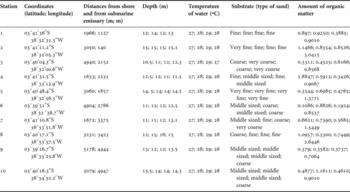
Samples were taken from ten randomly chosen stations off the coast of Fortaleza, ranging from 1633 to 5178 m from shore and 140 to 4947 m from the discharge of the submarine outfall. The coordinates, distances from shore and from the opening of the submarine outfall, depth and some abiotic parameters for each sampled station are listed in Table 1. Of those, S. guidae sp. nov., was found only at Stations 3, 6 and 8–10.
Data and abiotic features of the collection stations. In the cases of depth, temperature of water, substrate and amount of organic matter, data refer to the four collections made (see text), respectively. Data of temperature was approximated to the closest full centigrade degree.

Four collections were made at each station, on 28 September, 2004, 16 December, 2004, 28 March, 2005, and 5 July, 2005, from the research ship ‘Prof. Martins Filho’, belonging to the Instituto de Ciências do Mar, Universidade Federal do Ceará (Labomar–UFC). Three samples were taken from each station at each collection, with a 3.6 l Van Veen grab. Samples were immediately fixed in 4% formalin; animals were sorted to the least inclusive taxon possible under a stereomicroscope, washed, transferred to 70% ethanol, and identified to species.
Further analyses under stereo- and light microscopes were made from specimens permanently mounted on slides in glycerine jelly. For the examination under SEM, one specimen of S. guidae sp. nov., was dehydrated in progressively stronger solutions of ethanol, then critical point dried and covered with 25 nm of gold at Laboratório de Microscopia Eletrônica, Instituto de Biociências, Universidade de São Paulo (IB–USP), and examined and photographed under SEM at Laboratório de Microscopia Eletrônica, Museu de Zoologia, Universidade de São Paulo (MZUSP). Line drawings were made with the aid of a drawing tube, from slide mounted specimens.
Type material is deposited at the MZUSP, Brazil, and the Zoological Museum of the University of Copenhagen (ZMUC), Denmark.
TYPE SPECIES
Syllis monilaris Savigny in Lamarck, 1818.
DIAGNOSIS
Subpentagonal prostomium, with 1 pair of palps totally free from each other or fused at their bases, 3 antennae, 2 pairs of eyes and, sometimes, 1 pair of anterior eye spots. Peristomium usually shorter than segments, with 2 pairs of peristomial cirri. Border between prostomium and peristomium usually with conspicuous nuchal organs, represented by 1 pair of ciliated grooves. Antennae, peristomial cirri, dorsal cirri throughout and anal cirri moniliform. Ventral cirri short, digitiform. Parapodia with compound falcigers, some taxa with secondarily simple chaetae, due to fusion between shaft and blade or loss of blade; pseudospinigerous chaetae frequently present; dorsal and ventral simple chaetae usually present on posterior chaetigers. Pharynx with large tooth on anterior border or inserted slightly posteriorly to opening.
REMARKS
The diagnosis above agrees with that provided by Nogueira & San Martín (Reference Nogueira and San Martín2002), following earlier papers by San Martín (Reference San Martín1984, Reference San Martín1992, Reference San Martín, Ramos Sánchez, Alba Tercedor, Belles i Ros, Gosálbez i Noguera, Guerra Sierra, Macpherson Mayol, Martín Piera, Serrano Marino and templado González2003, among others), in considering Typosyllis Langerhans, 1879 as a junior synonym of Syllis and, therefore, the presence of secondarily simple chaetae as a variable character within the genus.
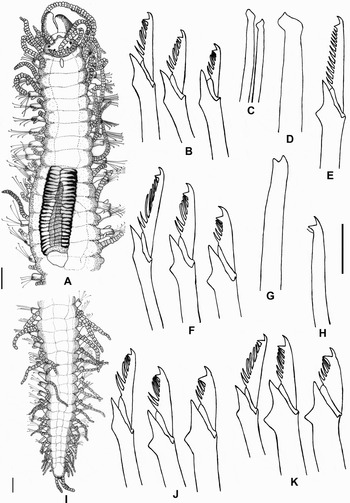
Syllis guidae sp. nov., holotype (MZUSP 602): (A) anterior end, dorsal view; (B) anterior falcigers, chaetiger 2; (C) anterior aciculae, chaetiger 2; (D) posterior acicula; (E) falciger from penultimate segment; (F) falcigers from shortly after proventricle, chaetiger 15; (G) dorsal simple chaeta; (H) ventral simple chaeta; (I) posterior end, dorsal view; (J) midbody falcigers; (K) posterior body falcigers. Scale bars: A, I, 100 µm; B–H, J–K, 10 µm.

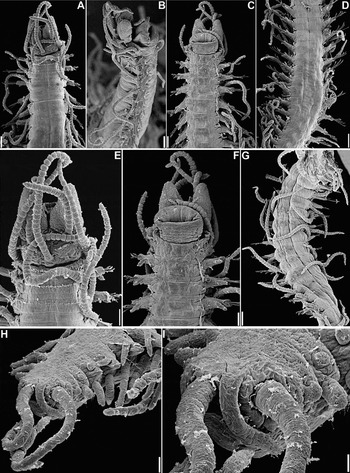
Syllis guidae sp. nov. (A) anterior end, dorsal view; (B) anterior end, right lateral view; (C) anterior end, ventral view; (D) midbody segments, ventral view; (E) closer view of the anterior end, dorsal view; (F) closer view of the anterior end, ventral view; (G) midbody segments, dorsal view; (H) posterior end, ventral view; (I) closer view of the posterior end, ventral view. Scale bars: A–C, 60 µm; D, 90 µm; E–F, 40 µm; G, 100 µm; H, 20 µm; I, 10 µm.

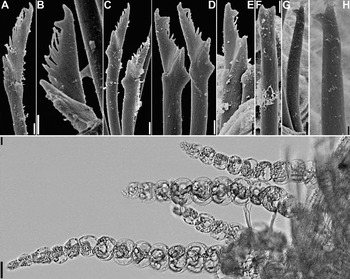
Syllis guidae sp. nov. (A) Upper falciger from an anterior parapodium; (B) lower falciger from an anterior parapodium; (C) intermediate and lower falcigers from an anterior parapodium; (D) pair of intermediate falcigers from a midbody parapodium; (E) lower falciger from a posterior parapodium; (F) dorsal simple chaeta; (G–H) ventral simple chaeta; (I) midbody dorsal cirri. Figure I from holotype, other photograhs from discarded specimen. Scale bars: A–B, E–F, 2 µm; C–D, G, 3 µm; H, 1 µm; I, 20 µm.

MATERIAL EXAMINED
Off Fortaleza, Ceará, Brazil: Station 3 (03°40′04.3″S 38°32′00.6″W): 9 specs, coll. 28 September, 2004; 12 specs, coll. 16 December, 2004; 5 specs, coll. 28 March, 2005, 11 specs, coll. 5 July, 2005. Station 6 (03°39′51″S 38°32′38.7″W): 2 specs, coll. 28 September, 2004; 8 specs, coll. 16 December, 2004; 2 specs, coll. 28 March, 2005; 4 specs, coll. 5 July, 2005. Station 8 (03°40′17.1″S 38°33′37.5″W): 3 specs, coll. 28 September, 2004. Station 9 (03°39′16.7″S 38°33′25.8″W): 3 specs, coll. 28 September, 2004; 1 spec., coll. 16 December, 2004; 2 specs, coll. 28 March, 2005; 4 specs, coll. 5 July, 2005. Station 10 (03°40′18.3″S 38°34′32.2″W): 4 specs, coll. 28 September, 2004. For details of sediment and depth see Table 1.
TYPE SERIES
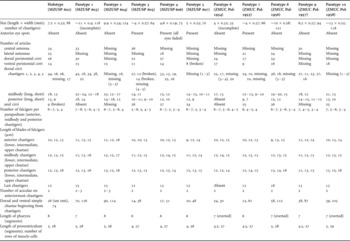
All specimens from type series permanently mounted on slides in glycerine jelly. Holotype (MZUSP 602): coll. Station 6, 16 December, 2004. Paratype 1 (MZUSP 603): coll. Station 3, 5 July, 2005. Paratype 2 (MZUSP 604): coll. Station 3, 5 July, 2005. Paratype 3 (MZUSP 605): coll. Station 3, 28 September, 2004. Paratype 4 (MZUSP 606): coll. Station 3, 28 September, 2004. Paratype 5 (MZUSP 607): coll. Station 3, 5 July, 2005. Paratype 6 (ZMUC Pol-1954): coll. Station 3, 5 July, 2005. Paratype 7 (ZMUC Pol-1955): coll. Station 6, 16 December, 2004. Paratype 8 (ZMUC Pol-1956): coll. Station 3, 28 September, 2004. Paratype 9 (ZMUC Pol-1957): coll. Station 9, 5 July, 2005. Paratype 10 (ZMUC Pol-1958): coll. Station 3, 28 September, 2004. Additional information on each specimen of type-series is provided in Table 2.
Morphological variation within the type series of Syllis guidae sp. nov.

DESCRIPTION
Holotype complete specimen, measuring ~7.2 mm in length by 0.32 mm in width, at proventricular level, with 88 chaetigers (Table 2).
Prostomium small, subpentagonal, with two pairs of eyes in open trapezoidal arrangement (Figure 1A). Palps longer than prostomium, totally free, touching each other basally, tapering to blunt tips at distal half (Figures 1A, 2A–C & 2E–F). Lateral antennae with 25 articles, inserted horizontally aligned with anterior pair of eyes, vertically aligned with posterior pair of eyes; central antenna longer, with 34 articles, inserted close to posterior border of prostomium, between posterior eyes (Figures 1A, 2A–C & 2E–F; Table 2). Prostomium, peristomium and segments 1–2 with transverse row of cilia, posterior to lateral antennae on prostomium, at midlength on peristomium and segments 1–2 (Figure 2A, E).
Peristomium much shorter than segments, dorsal peristomial cirri with 26 articles, ventral pair with 14 articles (Figures 1A, 2A–C & 2E–F; Table 2). Dorsal cirri on segment 1 much longer than following cirri, with 44 articles (Figure 1A, 2A–C & 2E–F; Table 2); on midbody, dorsal cirri alternating long, with 18 articles, and short cirri, with 13 articles (Figures 2G & 3I; Table 2); on posterior chaetigers, cirri alternating long, with 13 articles, and short, with 9 articles, except on last chaetigers, on which dorsal cirri are much smaller (Figure 2H). From proventricle, dorsal cirri with vacuolated articles, articles spherical at midlength of cirri, then tapering, with one pair of spiralled, L-shaped fribrilar inclusions on each article (Figure 3I). Ventral cirri short, digitiform, originating from distal half of parapodial lobes and terminating at same level as parapodial lobes, or slightly exceeding them, especially on posterior chaetigers (Figures 2B–D, F & H).
Anterior parapodia with 6–7 falcigers each, 5 falcigers per parapodium at midbody, 4 falcigers per parapodium on posterior chaetigers (Table 2), last chaetigers with 2–3 falcigers. Falcigers arranged in pairs within each fascicle, with 1 pair of upper chaetae, 1–2 pairs of intermediate chaetae, at different levels, and 1 pair or a single lower chaeta. Shafts of falcigers with marked subdistal triangular process, more conspicuous from proventricular level and on intermediate and lower chaetae on each fascicle (Figures 1B, 1E–F, 1J–K & 3A–D); shafts of lower chaetae thicker than those of other chaetae. Falcigers with short, bidentate blades throughout, both teeth about same size and divergent, distal tooth hooked, directed upwards, subdistal tooth straight, directed laterally (Figures 1B, 1E–F, 1J–K & 3A–E); after proventricle, subdistal tooth progressively stronger than distal one, especially on intermediate and lower falcigers within each fascicle (Figures 1F, 1J–K & 3B–E). Blades of falcigers conspicuously spinulated on cutting edge, basally with stronger, laterally directed spines, from midlength with thinner, upwardly directed spines, almost reaching tip of subdistal tooth, blades of lower falcigers on each fascicle with fewer spines and stouter than other chaetae (Figures 1B, 1F, 1J–K & 3A–E). Blades of falcigers slightly increasing in length posteriorly, with slight dorso-ventral gradation in length, blades measuring 10–13 µm on anterior chaetigers, 12–15 µm on midbody, 12–16 µm on posterior chaetigers (Table 2). Last chaetigers with 2–3 chaetae, with blades measuring 12 µm, with fewer and shorter spines, progressively diminishing in length towards tip (Figure 1E).
Dorsal simple chaetae present from chaetiger 26 (see below). Dorsal simple chaetae nearly straight, distally bifid, with strong, distally sharp teeth, subdistal spinulation absent (Figures 1G & 3F). Ventral simple chaetae present from chaetiger 74 (Table 2), chaetae sigmoid, slightly thinner than shafts of falcigers, strongly bidentate, sub-distal tooth directed laterally, distal tooth upwardly directed, with one thin spine below subdistal tooth (Figures 1H & 3G–H).
Anterior chaetigers with two aciculae per parapodium, both thin, subdistally inflated, with short, oblique tip (Figure 1C). From around half length of proventricle, single acicula per parapodium until end of body, with same morphology as those on anterior chaetigers, but thicker (Figure 1D).
Body terminating with one pair of anal cirri, broken in holotype, with 9 articles (Table 2), and long unsegmented papilla in-between (Figures 1I & 2H–I).
Pharynx extending for 8 chaetigers, with strong tooth at anterior border, proventricle extending for 5 chaetigers, with ~28 rows of muscle-cells (Figure 1A; Table 2).
VARIATION
The description above was based on holotype. Data on each specimen of type-series is given in Table 2. Our specimens showed great variation in size, 4–13 mm in length and 0.19–0.4 mm in width, and possibly the variation in other characters are due to this fact.
Eye spots are only present in shorter specimens and this probably is a juvenile character, as happens in several other species of Syllis (San Martín, personal communication), however all eyes are faded in several specimens and therefore we cannot be sure whether eye spots are really absent in larger specimens or just faded and inconspicuous.
The number of articles of antennae, dorsal and ventral peristomial cirri, dorsal cirri throughout and anal cirri also presented great variation (Table 2), but in general lateral antennae have around 2/3 of the number of articles of central antennae, dorsal peristomial cirri roughly have around the same number of articles as lateral antennae, with some variation, and ventral peristomial cirri have around half the number of articles of dorsal peristomial cirri (Table 2). Dorsal cirri on chaetiger 1 usually have more articles than central antenna and are much longer than those on chaetiger 2 (Table 2). All specimens have dorsal cirri from proventricular level with vacuolated articles, with one pair of spiralled L-shaped inclusions.
Smaller specimens have dorsal simple chaetae beginning from shortly after proventricle, larger specimens only have them on posterior chaetigers (Table 2). The holotype is intermediate between these conditions, as it has dorsal simple chaetae on chaetigers 26–28 only on the right side of the body, then dorsal simple chaetae are absent until chaetiger 56, from where they are irregularly present until the end of the body. Ventral simple chaetae are only present on last chaetigers in all specimens.
Paratypes 1 and 2 have 1–2 anterior parapodia with three aciculae, instead of two. Those parapodia are not on the anteriormost chaetigers and, in both specimens, parapodia of the other side of the body, within the same segment, have two aciculae only. We consider those parapodia as aberrant and therefore S. guidae sp. nov., typically has two aciculae per parapodium on anterior segments.
The number of falcigers per parapodium, the length of the blades of falcigers, of pharynx and proventricle, and the number of rows of muscle cells on proventricle showed little variation between specimens (Table 2).
The length of the unsegmented anal papilla between anal cirri is also characteristic for this species, measuring at least one-quarter of length of anal cirri, in specimens which have complete anal cirri.
REMARKS
Syllis guidae sp. nov., is characterized by having blades of falcigers with subdistal tooth about the same length as distal tooth, but stouter than it, with spinulation on cutting edge almost reaching the tip of subdistal tooth. In addition, S. guidae sp. nov., has a conspicuous triangular subdistal process on shafts of all falcigers throughout, more evident from midbody and on middle and lower falcigers on each fascicle. Finally, the unpaired anal papilla between anal cirri is long in comparison with the other species of this genus.
Among the species of Syllis with subdistal tooth stouter than distal tooth, with spinulation on cutting edge reaching the tip of subdistal tooth, S. cruzi Núñez & San Martín, Reference Núñez and San Martín1991, S. glarearia (Westheide, Reference Westheide1974), S. jorgei San Martín & López, Reference San Martín and López2000, S. lutea (Hartmann-Schröder, Reference Hartmann-Schröder1960) and S. magnipectinis Storch, Reference Storch1967 should be compared to S. guidae sp. nov. Of those species, only S. cruzi and S. glarearia have a triangular process on the shafts of falcigers, but far less conspicuous than that of S. guidae sp. nov., and, according to the line drawings provided by the descriptions available in the literature (Westheide, Reference Westheide1974; Núñez & San Martín, Reference Núñez and San Martín1991; Licher, Reference Licher1999; San Martín, Reference San Martín, Ramos Sánchez, Alba Tercedor, Belles i Ros, Gosálbez i Noguera, Guerra Sierra, Macpherson Mayol, Martín Piera, Serrano Marino and templado González2003), such triangular process is only present on intermediate and lower falcigers of posterior parapodia while in S. guidae sp. nov., it is present on all chaetae, but more conspicuous on intermediate and lower chaetae of fascicles from midbody chaetigers onwards.
Syllis cruzi was described from Tenerife, Canary Islands, and has also been found on the Mediterranean coast of Spain (San Martín, Reference San Martín, Ramos Sánchez, Alba Tercedor, Belles i Ros, Gosálbez i Noguera, Guerra Sierra, Macpherson Mayol, Martín Piera, Serrano Marino and templado González2003). In addition to the above, S. cruzi differs from S. guidae sp. nov., in having shorter antennae, peristomial cirri and dorsal cirri throughout; parapodia with small distal papilla, which is absent in S. guidae sp. nov.; more chaetae per parapodium, about 12 chaetae per parapodium on anterior chaetigers, 10 chaetae per parapodium on midbody chaetigers, and 7–8 chaetae per parapodium on posterior chaetigers, against 5–8, 4–6, and 3–5, respectively, in S. guidae sp. nov. (Table 2); falcigers with longer blades, measuring 19–34 µm on anterior chaetigers, 24–16 µm on midbody and posterior chaetigers, against 9–16 µm, 11–17 µm, 11–16 µm, respectively, in S. guidae sp. nov. (Table 2); blades of falcigers from midbody with subdistal tooth longer than distal tooth, while in S. guidae sp. nov. teeth are about the same size, but subdistal tooth is stronger; and dorsal simple chaetae indistinctly bidentate, while in S. guidae sp. nov. it is strongly bidentate. For more details, see Núñez & San Martín (Reference Núñez and San Martín1991) and San Martín (Reference San Martín, Ramos Sánchez, Alba Tercedor, Belles i Ros, Gosálbez i Noguera, Guerra Sierra, Macpherson Mayol, Martín Piera, Serrano Marino and templado González2003).
Syllis glarearia is only known from Santa Cruz, Galapagos Islands (Westheide, Reference Westheide1974; Licher, Reference Licher1999). It is morphologically very close to S. guidae sp. nov., with similar number of articles on antennae, peristomial cirri and dorsal cirri throughout, number of falcigers per parapodium and length of their blades, length of pharynx and proventricle, and number of rows of proventricular muscle cells. It differs from S. guidae sp. nov., however, in having: 2–3 aciculae per parapodium on anterior segments, two on midbody chaetigers and single acicula per parapodium on posterior segments, while S. guidae sp. nov., has two aciculae on each anterior parapodium and single acicula per parapodium from proventricular level (Table 2); blades of lower falcigers from midbody with subdistal tooth much longer than distal tooth; dorsal simple chaetae with distally blunt teeth, while in S. guidae sp. nov., teeth are distally sharp; and much shorter anal papilla between anal cirri (Westheide, Reference Westheide1974; Licher, Reference Licher1999).
Syllis jorgei is known from the Canary Islands and the western Mediterranean Sea (San Martín, Reference San Martín, Ramos Sánchez, Alba Tercedor, Belles i Ros, Gosálbez i Noguera, Guerra Sierra, Macpherson Mayol, Martín Piera, Serrano Marino and templado González2003). It also has number of articles on antennae, peristomial cirri and dorsal cirri throughout similar to that of S. guidae sp. nov., but it differs from our new species in having: more falcigers per parapodium, 10–12 on anterior segments and 6 from midbody, with much longer blades, measuring 20–50 µm on anterior chaetigers, 25–50 µm on midbody, and 17–25 µm on posterior segments; blades of falcigers with subdistal spines reaching far beyond the tip of subdistal tooth; sigmoid, hooked and bidentate dorsal simple chaetae with teeth laterally directed, instead of straight, with both teeth larger and upwardly directed, as in S. guidae sp. nov.; 3–4 aciculae per parapodium on anterior segments, progressively diminishing to a single acicula per parapodium from midbody; pharynx extending for 10–15 segments and proventricle extending for 8–10 segments, while in S. guidae sp. nov., pharynx extends for 6–8 segments, and proventricle, for 4–5 segments (Table 2); and much shorter anal papilla between anal cirri (San Martín & López, Reference San Martín and López2000; San Martín, Reference San Martín, Ramos Sánchez, Alba Tercedor, Belles i Ros, Gosálbez i Noguera, Guerra Sierra, Macpherson Mayol, Martín Piera, Serrano Marino and templado González2003).
Syllis lutea was described from the Red Sea and has a wide distribution, having been reported from the Gulf of Akaba, Japan and Brazil (Hartmann-Schröder, Reference Hartmann-Schröder1960; Licher, Reference Licher1999; Nogueira & San Martín, Reference Nogueira and San Martín2002). It is a more robust species, ~0.8 mm in width, against up to ~0.4 mm, as in S. guidae sp. nov. In addition, it differs from S. guidae sp. nov., because it has: fewer articles on antennae, peristomial dorsal cirri, dorsal cirri throughout and anal cirri; more falcigers per parapodium throughout, with longer blades and, from midbody, with subdistal tooth longer than distal tooth; more aciculae per parapodium on anterior and midbody chaetigers, 3–4 aciculae per parapodium on anterior segments, 2 aciculae per parapodium on midbody segments; dorsal simple chaetae with smaller, distally blunt teeth; longer proventricle, extending for ~12 segments; and much shorter anal papilla between anal cirri (Hartmann-Schröder, Reference Hartmann-Schröder1960; Licher, Reference Licher1999). In addition, S. lutea has already been identified in Brazilian waters, from material from the state of São Paulo (Nogueira & San Martín, Reference Nogueira and San Martín2002) and its differences to S. guidae sp. nov., are readily recognized.
Syllis magnipectinis was described from the Red Sea and was also reported from China and the Gulf of Mexico (Storch, Reference Storch1967; Licher, Reference Licher1999). It is a much longer and proportionally thinner species than S. guidae sp. nov., measuring up to more than 20 mm in length, by 0.3 mm in width, with developed nuchal organs. In addition, it differs from S. guidae sp. nov., in having: from midbody parapodia, falcigers of two types, ‘normal’ and modified, both types with subdistal tooth longer than distal tooth, but the latter type in lower position on fascicles, with remarkably longer blades, with subdistal tooth much longer and stouter than distal tooth; all blades longer than those of S. guidae sp. nov., measuring 16–22 µm on anterior chaetigers, on midbody, ‘normal’ chaetae with blades measuring 15–18 µm, blades of modified chaetae measuring 35–40 µm, and, on posterior chaetigers, ‘normal’ chaetae with blades measuring 10–18 µm, blades of modified chaetae measuring 32–35 µm; thin, sigmoid dorsal simple chaetae, distally hooked, bidentate, with teeth laterally directed, ventral simple chaetae about as thick as shafts of falcigers, with long subdistal spines reaching the level of subdistal tooth, while S. guidae sp. nov., has straight dorsal simple chaetae, stouter than those of S. magnipectinis, with teeth upwardly directed, and thinner ventral simple chaetae, with a single spine under subdistal tooth; and much shorter anal papilla, between anal cirri (Storch, Reference Storch1967; Licher, Reference Licher1999).
In addition to the species discussed above, S. gerundensis (Alós & Campoy, Reference Alós and Campoy1981), only known from the Mediterranean coast of Spain (Licher, Reference Licher1999; San Martín, Reference San Martín, Ramos Sánchez, Alba Tercedor, Belles i Ros, Gosálbez i Noguera, Guerra Sierra, Macpherson Mayol, Martín Piera, Serrano Marino and templado González2003), is also similar to S. guidae sp. nov., in having falcigers with subdistal tooth about the same length as and stouter than distal tooth and, on intermediate and lower falcigers from midbody, according to the drawings provided by Licher (Reference Licher1999), shafts with conspicuous subdistal triangular process. This species, however, lacks the long subdistal spines on cutting edge of falcigers reaching the tip of subdistal tooth as in S. guidae sp. nov., and all species discussed above have. Besides that, S. gerundensis has antennae, peristomial cirri and dorsal cirri throughout with far fewer articles than S. guidae sp. nov.; sigmoid, sub-bidentate dorsal simple chaetae; tips of aciculae clearly protruding from parapodial lobes, which does not occur in S. guidae sp. nov.; and much shorter anal papilla between anal cirri (Alós & Campoy, Reference Alós and Campoy1981; Licher, Reference Licher1999; San Martín, Reference San Martín, Ramos Sánchez, Alba Tercedor, Belles i Ros, Gosálbez i Noguera, Guerra Sierra, Macpherson Mayol, Martín Piera, Serrano Marino and templado González2003).
Finally, S. bifurcata Hartmann-Schröder, Reference Hartmann-Schröder1980, only known from the Caribbean Sea (Hartmann-Schröder, Reference Hartmann-Schröder1980; Licher, Reference Licher1999), has a conspicuous subdistal triangular process on the shafts of falcigers throughout, but in this species this triangular process is larger and more prominent than that of S. guidae sp. nov., according to the drawings provided by Licher (Reference Licher1999). Moreover, S. bifurcata differs from S. guidae sp. nov., in being a much smaller species, measuring around 3.3 mm in length, by 0.2 mm in width, and in having: falcigers with smaller blades, measuring 8–12 µm on anterior parapodia and 8–10 µm from midbody; posterior aciculae distally rounded; and much shorter pharynx and proventricle, both extending for 2–3 segments, the latter with 20 rows of muscle-cells (Hartmann-Schröder, Reference Hartmann-Schröder1980; Licher, Reference Licher1999).
ETYMOLOGY
This species is dedicated to Ana Margarida Miguel Ferreira Nogueira, nicknamed Guida, a recently deceased brilliant medical doctor scientist, investigator on gastric cancer and sister of the first author.
ACKNOWLEDGEMENTS
This study was funded by Companhia de Água e Esgoto do Ceará (CAGECE). In addition, J.M.M.N. receives a productivity fellowship from Conselho Nacional de Desenvolvimento Científico e Tecnológico (CNPq) and G.Y-G received a Master's fellowship from CNPq. G.Y-G is very grateful to Professor Dr Cristina A. Rocha-Barreira, from LABOMAR–UFC, for supervising his MSc dissertation, and to the LABOMAR–UFC, for the support to the collections. We are also grateful to Enio Mattos, from Departamento de Zoologia, IB–USP, for preparing the specimen for the study under SEM; to Lara Guimarães, from Laboratório de Microscopia Eletrônica, MZUSP, for the photographs under SEM; and to both anonymous referees who gave valuable comments and suggestions to improve this manuscript.