Introduction
The successful implementation of Russia’s geo-political and geo-economic strategies in the Arctic (Russian Federation, 2008, 2020a, b), as well as the realisation of the Northern Sea Route (NSR) – a potential international transport corridor – largely depends on socio-economic conditions across the Arctic Zone of the Russian Federation (AZRF) (Russian Federation, 2020b). Currently, the Arctic provides ∼11% of Russia’s national income, including > 90% of Russia’s nickel and cobalt, 60% of Russia’s copper, 96% of Russia’s platinoids, and 100% of Russia’s barite and apatite concentrate (Russian Federation, 2008). Nearly one quarter (22%) of Russian exports are produced here; moreover, ∼25% of the world’s total hydrocarbon resources are concentrated in the AZRF (Russian Federation, 2008).
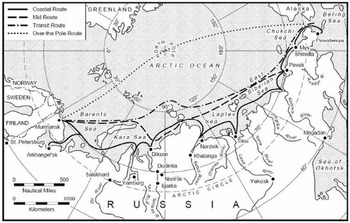
The NSR is part of the northern transport corridor that starts at Kara Gates and ends at Cape Dezhnev (Fig. 1). The NSR historically served as a transit corridor between the north-western and far-eastern reaches of Russia. It is the shortest sea route connecting European and East Asian markets and a potential alternative to the Suez Canal. In accordance with a presidential decree, the target for cargo traffic on the NSR is ≥ 80 million tons by 2024. According to Rosatom (2020) (Moscow, Russia), the national atomic energy corporation that is also responsible for the development of the NSR, the volume of cargo traffic on the NSR in 2020 amounted to 32.97 million tons (31.5 million tons in 2019; 29.5 million tons in 2018; 10.7 million tons in 2017; and 7.5 million tons in 2016; Seanews, 2021; Rosatom, 2020).
The Northern Sea Route (Arctic Economics, 2008).

The long-term sustainability of the expansion of this international maritime transport corridor will be influenced, not only by the global market environment but also by socio-economic conditions in the AZRF and the development of the NSR’s links to ports in the AZRF. Presently, the most important ports are Arkhangelsk and Murmansk, and their expansion, in conjunction with the construction of the Belkomur railway (White Sea–Komi–Ural) through the Perm and the Komi Republic regions of the AZRF, is expected to improve communication significantly between Siberia and Asian countries such as China, Japan, and South Korea. These railways along the northern latitude will also reduce transportation times between Western Siberia and ports in the Baltic, White, Barents, and Kara Seas.
The full-scale development of the AZRF and the NSR requires an integrated socio-economic development strategy for the northern regions of the Russian Federation, an improvement in their management efficiency, and the creation of a common strategy for the future of all regions. In October 2020, the Russian President approved a revised ‘Strategy for the development of the AZRF, and ensuring national security for the period until 2035’ (Russian Federation, 2020b), which emphasises the established geographical, historical, and economic linkages between the AZRF with the NSR.
In 2019, the state administration system of the Arctic Zone was reorganised, where the powers of the State Commission for Arctic Development were expanded, and the Ministry of the Russian Federation for the Development of the Far East and the Arctic was formed. According to experts, the consistent development of the NSR in the foreseeable future will benefit the economies of the Northern regions and create new job opportunities (Gutenev, Reference Gutenev2019). The Russian government plans to create 200,000 new jobs in the Russian Arctic by 2035, raise average life expectancy to the average for Russia, increase the Arctic regions’ contribution to the development of the country’s economy by 1.5 times, and the share of investment in environmental protection, research, and development fourfold. The volume of cargo transportation along the NSR is expected to increase to at least 130 million tons by 2035 (Arctic Russia, 2020).
Population migration is closely tied to local socio-economic processes within the region, an integral factor determining local demographics, and a determinant of the current and future labour potential. Accordingly, it is necessary to analyse these processes in the Russian Federation’s Arctic regions to predict the available human resources for the NSR more accurately.
The research presented herein considered the factors, patterns, and impacts of migration on the quantity and quality of human resources in the AZRF, with respect to its likely impact on the NSR development plan. The causes of migration were explored by an analysis of the quantitative data, supplemented by the results of sociological studies and expert assessments. An index methodology was used to compare the quality of life in the Arctic regions and the development of human capital using the national ratings on the quality of life in Russian regions that is based upon the United Nation’s human development index (HDI). The study then sought to address the adequacy of future labour resources and the growth potential of the NSR.
The rest of this paper is organised as follows: the ‘Research methodology’ section outlines the methodology, briefly tracing the history of the AZRF with specific reference to migration and territorial changes of the AZRF. The ‘Migration in the AZRF’ section presents the population changes of the AZRF in the 20th century, and the ‘Migration and human resources’ section analyses the current migration patterns and statistical data according to the Russian population census. The ‘Migration attitudes of the AZRF’ section evaluates the impacts and drivers of migration, with regional statistical data of immigration and emigration. The ‘Migration and development of the NSR’ section discusses the federal government plans for the development of the NSR, and the human resources required to meet this plan. The ‘Discussion’ section focuses on a comparative context of other Arctic countries, and the potential government policies that could address the human resource requirement for Russia’s Arctic strategy, and the development of the NSR.
Research methodology
The study of migration, as with any complex phenomenon of the modern world, is characterised by a pluralism of research approaches that address the nature and directions of development of social mobility processes. The authors believe there is an interdependence between the processes of horizontal and vertical mobility. People’s ambitions for high-quality education, increased income, a job within their field, and secure living conditions influence both individuals and groups to migrate towards regions with a higher standard of living.
Modern migration processes in the AZRF are largely determined by economic factors. Out migration has been driven by better job prospects in Moscow and Saint Petersburg, reduction of enhanced location pay (coefficients is the Russian equivalent), and deteriorating social infrastructure in the Arctic regions (Galimullin, Reference Galimullin2019; Larsen & Fondahl, Reference Larsen and Fondahl2014; Zaikov, Katorin & Tamitsky, Reference Zaikov, Katorin and Tamitsky2018).
This study analyses the political and spatial (geographical) determinants of changes that will affect the dynamics and composition of population migration in the regions of the Russian Arctic. Over the past three decades, the main actors developing the economy of the studied regions have become large corporations that rely on the localisation of their facilities and the ‘shift’ method of attracting labour resources (Pilyasov & Putilova, Reference Pilyasov and Putilova2020). The implementation of large infrastructure projects, related to the state policy for the development of the NSR, creates incentives within the spheres of education, economy, and the infrastructure of the Arctic regions of Russia, forming centres of attraction, and eliminates some of the adverse effects associated with the outflow of the population.
The present study used quantitative statistics, population censuses, qualitative methods of sociological research, the index of development of Russian regions, and the HDI. The use of qualitative methods made it possible to study the factors driving population migration and to analyse correlated patterns in the AZRF. First, these factors are often tied to certain socio-cultural values, when emigration begins to be perceived in the public consciousness as a way for an individual to increase their social status. Migration is becoming more popular among the youth, as they possess the greatest potential for upward social mobility (Galimullin, Reference Galimullin2019; Larsen & Fondahl, Reference Larsen and Fondahl2014; Zaikov et al., Reference Zaikov, Katorin and Tamitsky2018).
Second is the factor of non-homogeneous distribution of human capital. Migration of the most proactive and mobile people to developed regions and countries leads to an increase in the quality of human capital in the receiving areas, and a depletion in the areas of exodus. Accordingly, investments in the social sphere of peripheral regions, such as education, increase the number of potential migrants who are dissatisfied with their neighbourhood’s lower quality of life. Educated young people prefer to migrate to large cities, attracted by higher wages, job prospects, and a comfortable quality of life in large cities (Galimullin, Reference Galimullin2019; Larsen & Fondahl, Reference Larsen and Fondahl2014; Zaikov et al., Reference Zaikov, Katorin and Tamitsky2018).
Understanding the driving forces and consequences of the migration of populations from the northern regions of Russia requires elements of demography (Fauzer & Smirnov, Reference Fauzer and Smirnov2020; Fauzer, Lytkina, Fauzer & Smirnov, Reference Fauzer, Lytkina, Fauzer and Smirnov2018; Sinitsa, Reference Sinitsa2016a, b), economics (Korovkin, Dolgova, Edinak & Korolev, Reference Korovkin, Dolgova, Edinak and Korolev2015), sociology (Osipova & Maklashova, Reference Osipova and Maklashova2016), history (Sokolova, Reference Sokolova2016), political science, and other professional disciplines. The focus of attention of Russian researchers has been gradually shifting from study of the territories of the Far North to the Arctic regions.
Migration in Arctic cities is of considerable interest to researchers (Duhaime, Reference Duhaime, Einarsson, Larsen, Nilsson and Young2004; Orttung, Reference Orttung2016; Parente, Shiklomanov & Streletskiy, Reference Parente, Shiklomanov and Streletskiy2012). After the collapse of the USSR and economic reforms in Russia (Duhaime, Reference Duhaime, Einarsson, Larsen, Nilsson and Young2004), the problem of single-industry towns built around one main enterprise (for example, Norilsk Nickel) has worsened.
A study carried out for the Chukotka Autonomous Okrug indicated negative results and the need for a minimum population size to sustain urban settlements economically (Kumo & Litvinenko, Reference Kumo and Litvinenko2019). The need to improve education, skills training, and analyse the impact of social infrastructure was highlighted in another article related to migration in the AZRF (Khoreva, Konchakov, Leonard, Tamitsky, & Zaikov, Reference Khoreva, Konchakov, Leonard, Tamitskiy and Zaikov2018). Interregional migration in the AZRF is an integral part of demographic processes and includes aspects of marriage patterns, fertility, and mortality (Karabchuk, Kumo, & Selezneva, Reference Karabchuk, Kumo and Selezneva2017).
Migration and depopulation processes in Northern Russia have been studied in detail by Heleniak (Reference Heleniak1999, Reference Heleniak and Heinenin2014, Reference Heleniak, Leal and Rodríguez2016, Reference Heleniak2020; Heleniak & Bogoyavlensky, Reference Heleniak, Bogoyavlensky, Larsen and Fondahl2015). Heleniak studied the massive emigration from Russia’s northern regions during the post-Soviet era to determine the extent of the change in Northern population structures. The massive in-migration during the Soviet era was driven by Northern benefits (Heleniak, Reference Heleniak1999). Heleniak highlighted both the push factors (bust cycles caused by resource price volatility, withdrawal of Northern benefits remote location) in the post-Soviet era and the pull (economic) factors (Heleniak, Reference Heleniak1999). Preference for certain regions is based on the skills of individuals (Heleniak, Reference Heleniak2013); however, he also stressed the weakening of social infrastructure in the region (Heleniak & Bogoyavlensky, Reference Heleniak, Bogoyavlensky, Larsen and Fondahl2015). Heleniak stated earlier that the presence of family, social networks, and familiarity with the place might help to build attachment for migrants (Heleniak, Reference Heleniak2009). The authors agree with Heleniak’s (Reference Heleniak2019) conclusion that the ‘disintegration of the Soviet Union, the transformation to a market economy, and the liberalisation of society’ (p. 22) were the main determinants of the demographic and migration processes in the Russian Arctic that resulted in a fall in population of more than 20% (Jungsberg et al., Reference Jungsberg, Turunen, Heleniak, Wang, Ramage and Roto2019).
The Arctic Human Development Reports of 2004 (Csonka & Schweitzer, Reference Csonka, Schweitzer, Einarsson, Larsen, Nilsson and Young2004; Duhaime, Reference Duhaime, Einarsson, Larsen, Nilsson and Young2004; Einarsson, Larsen, Nilsson & Young, Reference Einarsson, Larsen, Nilsson and Young2004) and 2014 (Larsen & Fondahl, Reference Larsen and Fondahl2014), prepared by the Stefansson Arctic Institute (2004; 2014), analyse the socio-economic processes in the Arctic macro region, including population migration. The Russian Arctic is characterised by both general trends and specific manifestations (Einarsson, Larsen, Nilsson & Young, Reference Einarsson, Larsen, Nilsson and Young2004; Larsen & Fondahl, Reference Larsen and Fondahl2014). The authors highlight that flight of human capital is a common problem of peripheral regions (Larsen & Fondahl, Reference Larsen and Fondahl2014).
Most of these studies were conducted using Russian statistical data and are indicative of the interest and importance surrounding this region under study. However, a number of studies, including Heleniak (Reference Heleniak and Heinenin2014; Reference Heleniak, Leal and Rodríguez2016) and Heleniak and Bogoyavlensky (Reference Heleniak, Bogoyavlensky, Larsen and Fondahl2015), have focused on a larger region of interest. Analyses of migration processes were performed for the extremely heterogeneous regions of the Far North with unclear delineations depending on the goals of state regulation (there are 24 regions of the Russian Federation located completely or partly within the Far North – see Federal State Statistics Service, 2009 for more information).
Thus, the literature survey revealed that the research problem posed by the authors of this article has not been adequately researched – the impact of migration on the quality of human resources in the Russian Arctic regions, linkages with Russia’s state policy for the development of the Arctic regions, and in particular, the modernisation of the NSR, which could have a positive impact on the living conditions of the population and, as a result, on migration processes. In our opinion, the key factor influencing the direction, intensity, and dynamics of migration processes in the Russian Arctic region has been, and will remain, government policy. In the post-Soviet period, the economy of the Arctic regions became dominated by large corporations that relied on the use of labour migration and the introduction of modern technologies, which have led to job cuts. The privatisation and denationalisation of property, the reduction of the state’s social obligations in the 1990s, and the effective withdrawal of the state from the North contributed to the depopulation and the outflow of people from territories in the Far North. In this regard, the return of active government involvement in the Arctic, the development of large infrastructure projects after 2008, and now the NSR could have a positive impact on the demographic and migration processes in the Arctic regions of Russia.
Migration in the AZRF
The migration processes themselves are interrelated and interdependent on the policies and socio-economic status of the regions. In the present research, nine regions of the AZRF were considered. The AZRF is a conglomerate of local territorial societies, with different population densities and settlement systems. Taken together, the scale of the macro region, extensive heterogeneity, and economic interconnectedness mandates a special approach to research (Pavlenko et al., Reference Pavlenko, Dregalo, Ul’yanovskij, Kucenko, Malinina and Balickaya2017).
According to Russian law, the term ‘AZRF’ refers to the territories located beyond the Arctic Circle. The border territories of the AZRF were established by a presidential decree on 2 May 2014 (Russian Federation, 2014) and included the territories of four regions of the Russian Federation (Murmansk Region, Nenets, Chukotka, and Yamal-Nenets Autonomous Okrugs [YNAO]) and partial territories of three regions (Arkhangelsk Region, Krasnoyarsk Territory, and the Republic of Sakha [Yakutia]). In 2017, the list of land territories was supplemented by three municipalities of the Republic of Karelia by decree (Russian Federation, 2017).
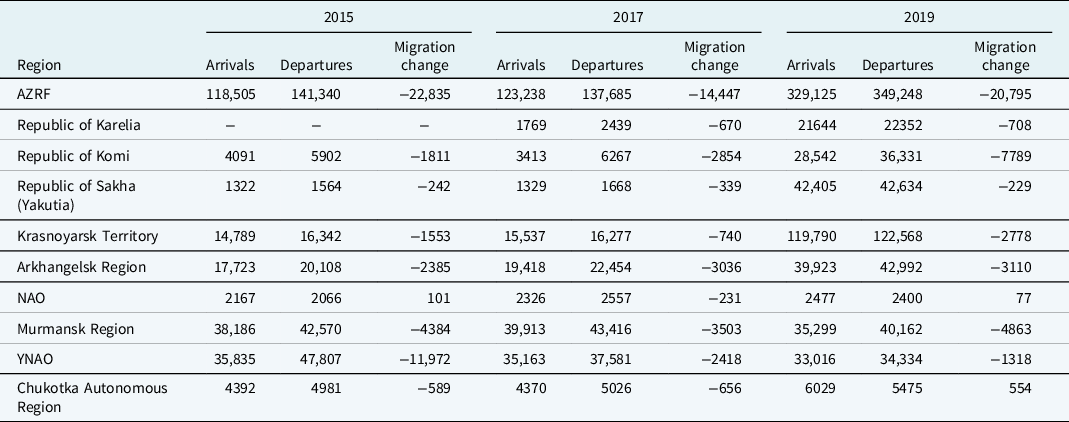
The Russian migration data used in the present research were obtained from online statistical indicators published by the Federal State Statistics Service (FSSS) of the Russian Federation (http://www.gks.ru/wps/wcm/connect/). According to their estimates, the permanent population of the land territories of the AZRF was 2.406 million people as of 1 January 2018 (urban population, 2.14 million; rural, 267,000; Federal State Statistics Service, 2017b). Due to the negative dynamics of natural growth and emigration, the total population of these territories decreased more than 27% between 1989 and 2017, with the greatest population loss occurring between 1989 and 2000, when 20% of the population died. Emigration is an important factor in population decline, and data from the FSSS on the AZRF, which began to be published annually in 2015, showed that more than 51,000 people emigrated out of the region between 2017 and 2020 (Table 1).
The number of arrivals, departures, and changes associated with migration of the population in the Arctic Zone of the Russian Federation (AZRF).

Source: Federal State Statistics Service (2020).
The total number of arrivals in 2019 was noticeably higher than other years. Rosstat experts attributed this sharp increase to the acquisition of more comprehensive information by the Ministry of Internal Affairs due to the introduction of new federal statistical observation forms (Vedomosti, 2019). Thus, the increase in data on arrivals in 2019 is a function of the new forms that were used. If, until 2019, only migrants who registered their place of permanent residence for a period of more than a year were taken into account, now migrants who register their place of residence for a period of nine months or more are also subject to registration. This adjustment made it possible to increase the quality of accounting for certain groups of the population, such as students. However, it also led to an increase in the scale of migration.
The specifics of population settlement for the macro region consist of opposing characteristics. Overall, the AZRF has a low population density; however, the level of urbanisation in the Arctic regions is one of the highest in the country (∼90%). The largest city in the Arctic region, Arkhangelsk, is Russian, with a population of 350,000 in 2018. The majority of the population is concentrated in six large cities (populations ≥ 100,000), and there are a further 30 cities with populations > 5000. The remainder of the population lives primarily in closed communities, with difficult and seasonal transport. As a whole, diverse and complicated geographical, climatic, and economic features inhibit the formation and implementation of a holistic state policy in the AZRF.
The Russian demographer, Fauzer, estimated that there are 20 cities in the world’s Arctic with more than 40,000 inhabitants – 12 in Russia, 7 in Northern Europe, and 1 in the USA (Fauzer & Smirnov, Reference Fauzer and Smirnov2018). Between 1989 and 2017, most of the foreign Arctic cities experienced population growth; however, only one quarter of the Arctic cities in Russia increased in population – Novy Urengoy, increased by 25%; Noyabrsk, 24.5%; and Salekhard, 50% (Fauzer & Smirnov, Reference Fauzer and Smirnov2018). During the same period, the largest losses in the population occurred in Vorkuta, 37%; Monchegorsk, 38%; Murmansk, 37%; and Apatity, 36% (Fauzer & Smirnov, Reference Fauzer and Smirnov2018).
In the first half of the 20th century, the migrant population intensively developed the natural resources of the north-western AZRF. To encourage migration to the northern regions, the Russian state used a wide range of organisational mechanisms, including party appeals, organised recruitment, and Komsomol construction sites. A compensation mechanism was implemented for residents of the north, where salary allowances, faster access to better quality housing, better social infrastructure, and early retirement became the primary appeal in drawing members from other regions of Russia (Bulatov, Reference Bulatov1989; Heleniak, Reference Heleniak and Heinenin2014).
Since the 1970s and 1980s, and moreover, the 21st century, the direction of migration shifted to the north-eastern territories, especially the Yamal-Nenets Autonomous Okrug and the Krasnoyarsk Territory (Panikar & Shaparov, Reference Panikar and Shaparov2016) to develop the state’s oil and gas industries, and gold, diamond, and non-ferrous metal deposits.
The Arctic regions of Russia experienced positive demographic shifts until the early 1990s. From 1959 to 1989, the total population of the Arctic regions increased by 60%, reaching 9.5 million (Sokolova, Reference Sokolova2015). Thus, by the end of the 1980s, these regions had a positive demographic potential, a high level of urbanisation, differentiated settlement systems for economic purposes, a developed socio-cultural infrastructure, and highly qualified personnel.
The dissolution of the USSR meant a change in the models of political and economic development, with important social ramifications. In the first half of the 1990s, owing to economic liberalisation and privatisation of the public sector, the public sector’s share of the economy decreased sharply. This economic crisis had a negative impact on the demographic situation in the Arctic regions of Russia (Heleniak, Reference Heleniak and Heinenin2014).
In the Russian Federation, the economic–technocratic approach of the Far North prevailed in strategic planning and practice of public administration in the 1990s. Its proponents advocated the need to reduce the costs of maintaining infrastructure in harsh climatic conditions, optimise expenses, and other economic-based reasons aimed at increasing the efficiency of funds spent by the government and companies (Minakir & Leonov, Reference Minakir and Leonov2014). The government concluded that it was unprofitable to develop the AZRF, as the costs were high and economic benefits were not obvious. This was justified by the fact that only 6 of the 24 regions of the Russian Federation legally classified as Arctic regions were contributing to the federal budget, and the rest were recipients with poorly developed industrial and social infrastructure, and a low standard of living (Ivanova & Zajcev, Reference Ivanova and Zajcev2016). Accordingly, there was a sharp reduction in federal spending on the northern territories, benefits for those arriving in the north were frozen, and other fiscal limitations abounded.
In 2002, a state programme aimed at supporting citizens who were leaving the Far North was adopted. The right to receive housing subsidies was granted to those citizens who arrived in the AZRF and equivalent areas before 1 January 1992 had a total length of service in these areas of ≥ 15 years, and those without other residences in the Russian Federation outside the region. First, state housing certificates were provided to disabled people of groups I and II, as well as people disabled from childhood born in the Far North. Second, these were provided to all pensioners, with unemployed citizens and all working citizens making up the third and fourth groups.
The policy adopted by the government in the 1990s had a negative impact on the demographics, reflected in both the natural decline of the population and the negative balance of migration in most regions. Emigration became the dominant trend in the AZRF (up to present), as life in the north is no longer economically attractive. Notably, the demand for highly qualified personnel and young people declined due to the shift in federal priorities. The average income also decreased, and the wages no longer compensated for the cost of living in the north.
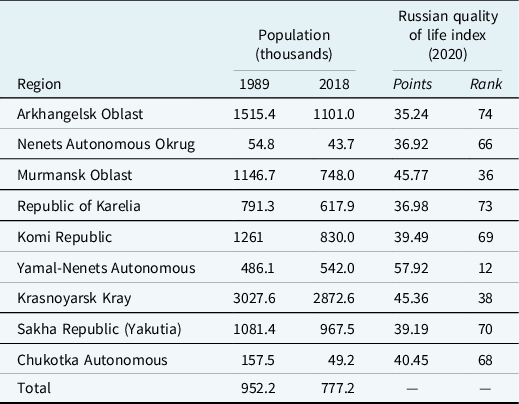
As a result of these factors, the population of the AZRF decreased by 18.4% from 9.5 million to 7.8 million between 1989 and 2018, whereas the population of the entire Russian Federation decreased by only 1.35% during the same period (Russian Federation, 2013). In the European North, the biggest losses in total population were experienced in the Arkhangelsk Region, the Murmansk Region, and the Republic of Komi. The only region in which population growth was observed was the Yamal-Nenets Autonomous District, where the population increased by approximately 10% from 489,000 to 540,000 over the same period (Table 2). Net migratory loss for the 10-year period between 2008 and 2017 alone amounted to 321,400 people, including more than 21,000 young people, and 199,600 people in the working-age group.

For the demographic structure, the share of the working-age population between 2004 and 2013 fell by nearly 5%, while the share of the population older than the working age increased by almost the same amount. The population ageing process was more intense in the regions of Soviet industrialisation during 1930–1950, where the migrant population had taken root, acquired social ties, and did not want to abandon their now native territories.
The Russian Arctic is characterised by not only migration outflow but also high migration activity due to the practice of working in shifts, which is a form of labour migration. Temporary labour migration includes several forms of migration movement – pendulum, seasonal, shift – which do not lead to a change of permanent residence. Shift workers can be categorised as intraregional watch (permanently residing in the AZRF) and interregional watch (workers permanently residing outside the AZRF) (Fauzer & Nazarev, Reference Fauzer and Nazarev2011).
The numbers and patterns of population flux by region are extremely varied due to regional economic development, the requirement of jobs specific to economic activity in the region, and quality of life. Table 2 presents the ratings of Russian regions based on the quality of life, which was assessed using 72 indicators divided into 11 groups to characterise living conditions: education, the availability of social infrastructure facilities, the level of economic development, the level of development of small business, the development of the region, the development of transport infrastructure, the population income, state of the employment, and labour market, the employment situation, the security of living, the demographic situation, environmental and climatic conditions, the health of the population, and housing conditions. The indicators are assessed based on the data of the Federal State Statistic Services (Rosstat), the Ministry of Health, the Ministry of Finance of Russia, and the Central Bank of the Russian Federation. RIA ratings are used as a tool to aid the formation of the government’s economic strategy and policy and are also used by the administration of the regional entities of the Russian Federation as guidelines for determining socio-economic plans.
The top spots in the rating for the quality of life were occupied by Moscow (82.16) and Saint Petersburg (80.63), which are the primary centres of attraction for migrants in the European part of the country. Among the regions of the AZRF, the top positions in the quality of life ratings were occupied by the Yamal-Nenets Autonomous Okrug (57.92) and the Krasnoyarsk Territory (45.36). Most of the Arctic regions occupied lower positions in the ratings and have undergone population loss. The regions with the lowest quality of life rating were the Republic of Karelia (36.98) and the Arkhangelsk Region (35.24), and both sets of data correlate with the records of regional migration in- and outflow. Therefore, we can infer that quality of life is a significant determinant in desirability of a given region for migration.
A single Arctic region, YNAO, occupied a top 10 position in the quality of life ratings amongst regions of the AZRF (see Table 2, where the local population was also growing due to a natural increase in fertility; Khoreva et al., Reference Khoreva, Konchakov, Leonard, Tamitskiy and Zaikov2018). This can be attributed to the inherent advantages of gas production and the development of the construction sector (Tynkkynen Tabata, Gritsenko, & Goto, Reference Tynkkynen, Tabata, Gritsenko and Goto2018), relatively lower out-migration in the 1990s and a low dependence on federal subsidies (Khoreva et al., Reference Khoreva, Konchakov, Leonard, Tamitskiy and Zaikov2018). The economy of the YNAO is driven by oil and gas production. The leading oil and gas producing companies in Russia are Gazprom, Rosneft, Novatek, Lukoil, and TNK-BP, and they also operate in the territory. Most of Russia’s Arctic regions are not associated with oil and gas production – only exception being the Nenets Autonomous Okrug – and are ranked lower in terms of quality of life and experience steady losses in population (see Table 3).

Therefore, in our opinion, the significant factor determining migration processes is employment, or rather, the presence or absence of jobs with stable and high wages; however, the analysis shows that the quality of life rating that includes the factor of employment is also a vital element in driving migration. We also want to note an essential factor that is well known to researchers of international migration (the network effect) – the chain nature of migration outflow – receives little attention from researchers of internal migration. Families and their relatives are involved in the migration process. The chain nature of migration outflow is typical for most regions of the Russian Arctic. At first, the migration process involves young people receiving higher education in large university centres. In the process of studying, young people find a job and, after graduation, they do not return to their former place of residence but remain to work and live in large cities, where they create their own families and raise their children. The older generation also subsequently migrates to be with their grandchildren. The university centres in the Arctic regions are Arkhangelsk, Murmansk, Petrozavodsk, Syktyvkar, and Yakutsk. However, even in these regions, young people prefer to move to Moscow and Saint Petersburg, cities that provide high-quality education, the best infrastructure, and attractive offers on the labour market. Therefore, it can be inferred that large- and medium-sized cities with universities and more developed infrastructure are engaged in assimilating human and social capital and become migration attractors.
Along with migration outflow, the AZRF is characterised by high population migration due to working in shifts. Interregional migration is typical in the Murmansk Region, the Nenets, Yamal-Nenets, and Chukotka Autonomous Okrugs, where the shift method of work is implemented (Federal State Statistics Service, 2015) because they use labour from other regions. In the Republic of Komi and the Arkhangelsk Region, intraregional migration of rural populations to cities and interregional migration to the central and southern regions of Russia were more pronounced. Intraregional migration (more than 50%) is more widely represented in the republics of Komi, Karelia, Sakha (Yakutia), the Arkhangelsk Oblast, and the Krasnoyarsk Territory. The reasons for this phenomenon were explored by Heleniak in his work, ‘The role of attachment to place in migration decisions of the population of the Russian Arctic’ (Heleniak, Reference Heleniak2009). In particular, the author subtly noted that the entrenched population, interwoven by extensive social ties and contacts built over years of staying in the region, is not inclined to migrate, despite the increase in unfavourable factors. Indeed, firstly, there is the significant layer of the indigenous population that, as a rule, is poorly involved in migration processes. Secondly, these territories were actively developed and settled by Russians in the 15th to the 17th centuries and at the dawn of Soviet industrialisation in the 1930s–1950s. Consequently, people who have adapted to the harsh northern climatic conditions, have relatives across several generations, and extensive social ties and contacts, and as a rule, are not inclined to change their living conditions and place of residence radically. In the hierarchy of values, their social needs, sense of having a comfortable living environment, and social interaction will prevail. Migration within the region is the most that they may decide to do under conditions of increasingly unfavourable factors in a particular area.
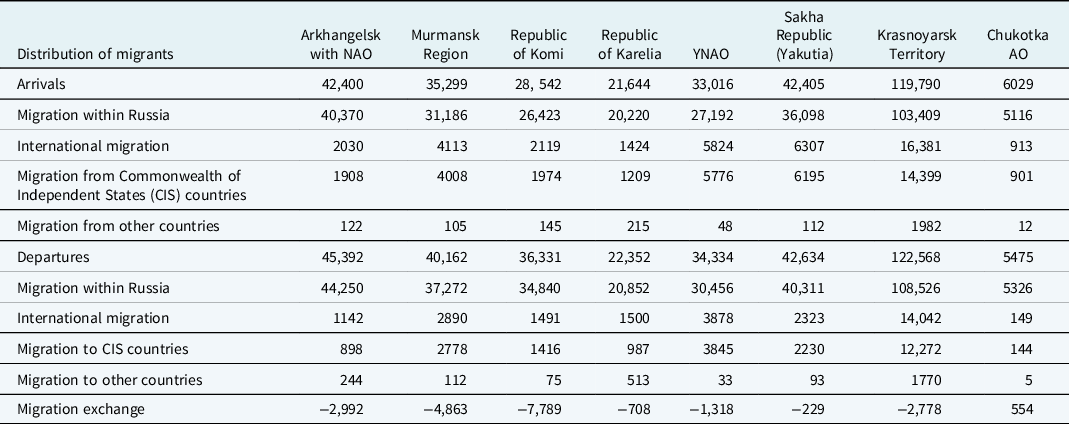
In all the Arctic regions, internal Russian migration is expected to overshadow international migration (Table 3); however, the AZRF may be attractive to immigrants from some post-Soviet countries (International Organisation for Migration, Reference McAuliffe and Khadria2019). In particular, against the backdrop of the political crisis of 2014, the flow of immigrants from Ukraine increased by 1.5–2 times. According to the territorial organisations of the FSSS, in 2016, citizens from the Ukraine (928), Azerbaijan (253), and Uzbekistan (92) comprised the majority of international migrants in the Komi Republic. In the Krasnoyarsk Territory, migrants were dominated by citizens of Tajikistan (2915), Ukraine (2873), and Kyrgyzstan (1743). In the Republic of Sakha (Yakutia), citizens of Ukraine (436), Kyrgyzstan (360), and Armenia (196) were the most dominant group of migrants; while in the YNAO, citizens of Ukraine (2224), Belarus (666), and Azerbaijan (343) were dominant.
In our opinion, there is no single answer to the problem of why people move to the Arctic or leave it. The importance of the well-paid work factor is especially high in climatically unfavourable areas, for example, Norilsk and Vorkuta that people tend to leave after reaching retirement age. Quality of life is a factor of great importance to attract people. For example, large cities – Arkhangelsk and Murmansk, where higher educational institutions, modernised medical centres, and transport infrastructure are located, have a positive indicator of intraregional migration growth but a negative balance of interregional migration. At the same time, medium-sized and large cities of the Russian Arctic have witnessed positive migration due to international inflows from the former republics of the USSR (Fauzer & Smirnov, Reference Fauzer and Smirnov2020). Thus, regions that can provide their residents with a high standard of living will act as attractors for intraregional and international migration, but donors in interregional migration. The state regional policy should facilitate such support zones by stimulating large investment projects, such as the NSR, infrastructure, educational institutions, and health care.
Migration and human resources
Migration inherently has a significant impact on the quantitative and qualitative characteristics of the human capital of countries and regions. The index methodology was used in the present study to compare the Arctic regions by their level of human capital development using the international Human Development Index (HDI). HDI is the most universal tool for comparing countries and regions by their quality of life and human capital development. It is calculated as a system of three indicators: longevity (based on life expectancy), education (based on the proportion of literate population and students), and income (based on gross national income, GNI, and per capita purchasing power parity). This is also true for Moscow and Saint Petersburg, which maintain the highest HDI in Russia, and have high education and GNI indices due to the influx of migrants. A significant limitation of the HDI is that it does not account for the loss of human capital in regions due to emigration.
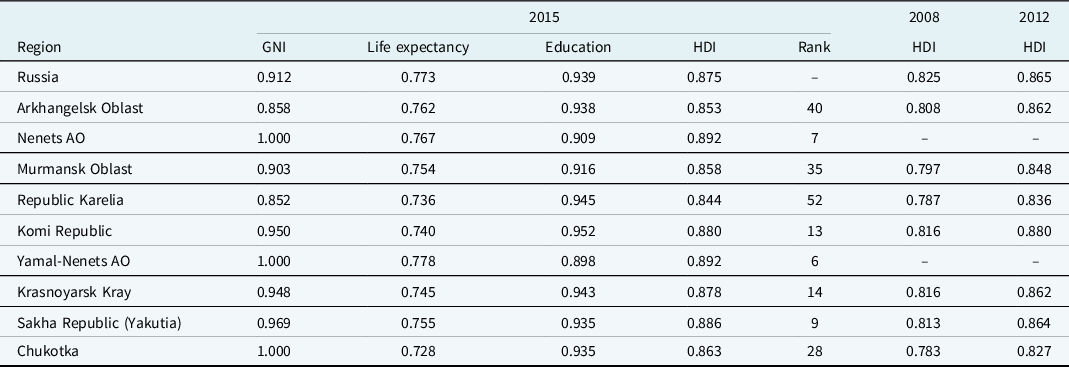
For Russia, the overall HDI in 2015 was 0.875, and all regions of the country can be categorised into four groups (Bobyleva & Grigoryeva, Reference Bobyleva and Grigoryeva2018): highly developed financial and economic centres (Moscow and Saint Petersburg), and raw materials-rich and/or export-oriented locations, including the Republic of Komi, Nenets Autonomous Okrug (NAO), YNAO, and the Republic of Sakha-Yakutia, formed the first group. The second group had developed manufacturing (Arkhangelsk Oblast, Krasnoyarsk Territory) or mining industries (Murmansk Region). The third group showed average levels of development in industry and agriculture (Republic of Karelia). The fourth group was considered less developed (Chukotka Autonomous Okrug, Table 4)
Position of the Arctic regions of Russia according to the human development index (HDI) (Federal State Statistics Service, 2008–2019).

Source: Compiled by the authors according to UNDP reports from 2008 to 2015 and obtained from the 2018 report (UNDP, 1990–2020). The human development index (HDI) is calculated as a system of three indicators: longevity (based on life expectancy), the ability to acquire knowledge (based on the proportion of literate population and students), and the ability to achieve a decent standard of living (based on gross national income (GNI) per capita), as per the 2015 report (UNDP, 1990–2020). The ranking of the Arctic regions of Russia is a relative ranking based on the HDI of all the regions in Russia (Bobyleva & Grigoryeva, Reference Bobyleva and Grigoryeva2018).
In 2008, all Arctic regions had an HDI below the national level (United Nations Development Programme [UNDP], 2010). In 2012, this trend continued with the exception of the Republics of Komi and Sakha-Yakutia which now exceeded the all-Russian index average); however, by 2015, most of the Arctic regions were close to the national average index for education (except for NAO and YNAO) and income (except for Arkhangelsk Oblast and the Republic of Karelia). NAO, YNAO, and Chukotka Autonomous Okrug (AO) have significantly higher incomes than the national average, but these do not reflect the real standard of living, as high salaries do not fully compensate for the costs endured by living in such harsh climatic conditions. Notably, the longevity index indicated that almost all regions were below the national average (with the exception of the YNAO). All Arctic regions in 2015 had improved their HDI performance compared to 2008, and most regions compared to 2012 as well (with the exception of the Arkhangelsk Oblast).
The comparison of the Arctic regions by quality of life and human development indices yielded several conclusions. Most of the Arctic regions have high rates of human development. NAO, YNAO, and the Republic of Sakha (Yakutia) were in the top 10 regions of Russia. With respect to education, which reflects the quality of human capital, a number of regions ranked better or near the national average (0.939): the Republic of Komi (0.952), the Republic of Karelia (0.945), the Krasnoyarsk Territory (0.943), and the Arkhangelsk Oblast (0.938). Alternatively, most regions lagged far behind the national average in longevity (with the exception of the YNAO). Ultimately, most Arctic regions occupied lower positions in the national ratings for quality of life (four of the nine regions had low rankings ≤ 70), with only YNAO in top 20 national regions (RIA Rating, 2018). Thus, the majority of Arctic regions hold high human capital; however, since they do not provide high-quality living conditions, they act as donors of migrants (that is, human capital) for other regions of Russia, primarily large centres.
The migration outflow of the population, especially the youth and those with higher and secondary special education, not only decreases the demographic capital in these northern regions but also reduces the chances of progressive, innovative development of the Arctic regions. The authors of the Arctic Human Development Report-II stated that ‘creative human capital is critical for economic development and socio-economic transformation in the Arctic, as it often becomes the engine of economic reinvention and revitalisation of a region’ (Larsen & Fondahl, Reference Larsen and Fondahl2014, p. 378).
The primary factor contributing to the outflow of young people is the low demand in the regional labour market. They are drawn towards population, education, and labour centres such as Moscow and Saint Petersburg (Larsen & Fondahl, Reference Larsen and Fondahl2014).
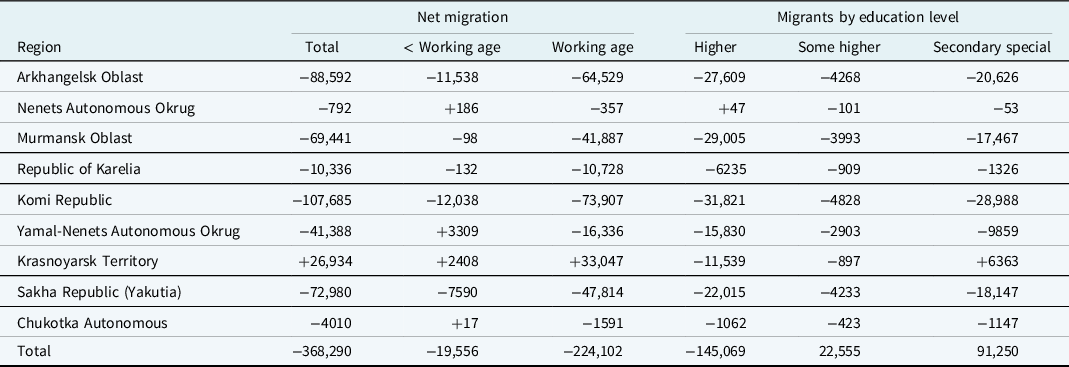
Statistical data also showed that the Arctic regions primarily lose specialists with higher and secondary special education. Indeed, 66.4% of those who left the Arctic regions between 2008 and 2017 were those with (incomplete) higher (140,700) and secondary specialised education (72,000). A rare exception was the Krasnoyarsk Territory, where there was an influx of people with secondary, specialised education because of construction projects (Tynkkynen et al., Reference Tynkkynen, Tabata, Gritsenko and Goto2018). Quantitatively, the largest losses of persons with higher and specialised education were in the Republic of Komi, Arkhangelsk, and Murmansk regions (Table 5).
Migration in the Russian Arctic regions by age and education, 2008–2019.

Source: Compiled by the authors based on Federal State Statistics Service (2008–2019).
Thus, in the Arctic regions, there is a significant imbalance between supply and demand of labour resources, particularly pertaining to general and qualified personnel. The lack of demand for high-level specialists is indicative of the low level of innovative development in the region. Non-utilisation of these specialists naturally drove emigration from the region. Presently, there are two possible scenarios for the future development of the AZRF: first, the gradual desolation and depopulation of the AZRF can continue, and localities of shift workers will remain. This ongoing trend is visible from the population reduction, where the Russian census highlights that over the period between 2002 and 2010 the share of people living in the region by birth decreased from 46.4% to 37.3% (Russian Population Census, 2010). The second scenario will involve a radical shift in state policy towards ensuring progressive and innovative development, and technological breakthroughs in the region, which will help preserve the existing human capital and potentially bring in more.
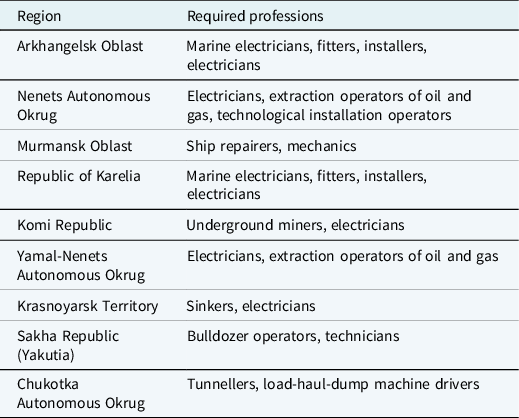
A 2018 survey conducted by the Ministry of Education and Science of the Russian Federation of 97 large companies in the production sector of the AZRF showed that demand for university graduates and technical specialists, such as geologists, surveyors, drilling engineers, programmers, foremen in mining, and operators of oil and gas production, can only be rejuvenated in the medium- and long-term. Currently, the main industries of the region are experiencing a shortage of skilled labour and those with secondary special education. The regional vacancies in skilled labour and specialised education are listed in Table 6 (PORA, 2018).
Region-wise requirement of professions in AZRF.

Migration attitudes of the AZRF
As statistical analyses do not address the underlying reasons for migration, the scope of the present study was expanded to include sociological research surrounding the migration attitudes of the regional AZRF populations (Katorin, Reference Katorin2015; Kondratev, Reference Kondratev2016; Markin & Silin, Reference Markin and Silin2017). A portion of sociological research is devoted to youth and their enhanced mobility amongst the population (Maksimov, Zaikov & Tamitsky, Reference Maksimov, Zaikov and Tamitsky2017; Osipova & Maklashova, Reference Osipova and Maklashova2016). For the influential mechanisms behind migration attitudes, sociologists highlight quality of life and the social well-being of the population, particularly satisfaction with the quality of education and health care.
The results of numerous sociological studies of the population of the Arctic regions indicate that: 1) the primary mechanisms behind population outflow are socio-economic, such as the reduction of social guarantees, low wages, and high costs of living in the north; 2) there is a high migration potential (emigration of Russians and immigration from Central Asia and other republics of the erstwhile USSR) in the regions of the AZRF; and 3) among potential migrants, there is an increase in attitudes directed towards departure from the regions, both among new settlers and the pre-existing migrants.
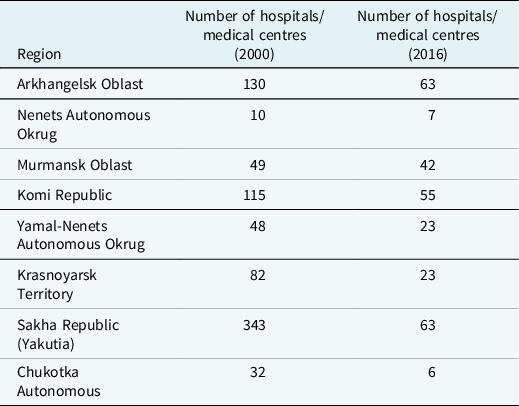
According to a sociological study conducted in Yakutia, the most important criteria for the youth in this region is education (Osipova & Maklashova, Reference Osipova and Maklashova2016). Elsewhere, comfort and safety factors had an important influence on the migration attitudes of residents. Markin & Silin (Reference Markin and Silin2017) noted that the indicators of the level of satisfaction of northerners with medical care were significantly lower than the remainder of the country. This dissatisfaction was accompanied by a reduction in public spending on the health care system and a decrease in the number of medical organisations. The present research calculated a decrease in the number of hospitals between 2000 and 2016 by > 80% in some regions (see Table 7). Notably, the number of outpatient organisations has remained approximately the same, with the exceptions of the Republic of Sakha (Yakutia; 375–115), NAO (17–6), and Chukotka AO (40–26; Federal State Statistics Service, 2017a). Sociologists have noted that satisfaction with the quality of medical services is an important factor affecting the migration attitudes of the middle-aged and elderly population, as well as young people.
Region-wise hospitals/medical centres in AZRF in 2000 and 2016.

Arriving migrants to the AZRF come expecting to satisfy their financial needs. The reported reasons for immigration to the Komi Republic were an increase in earnings (26.6%), job search (12.3%), education (12%), marriage and divorce (11.3%), improved housing (7.2%), and to return to their homeland (4.9%; Fauzer et al., Reference Fauzer, Lytkina, Fauzer and Smirnov2018). A comparative analysis of the factors of desirability and departure showed that among the reasons for arrival, the financial motive was the most cited (26.6% of respondents), although it was only cited by 8.1% of respondents (4th place) among reasons for departure. Job search was in the 2nd place for outgoing emigrants (12.3%) and 6th place for potential immigrants (5.5%), a 50% decrease.
The results of numerous sociological studies of the populations of Arctic regions indicate that:
-
The main factors that contribute to population outflow from the North are socio-economic: reduction of social guarantees, low wages, and high cost of living;
-
There is a high migration potential in the regions of the Russian Arctic; and
-
Among potential migrants, there is a propensity towards a departure from the AZRF, both among newcomers and the local population.
Migration and development of the NSR
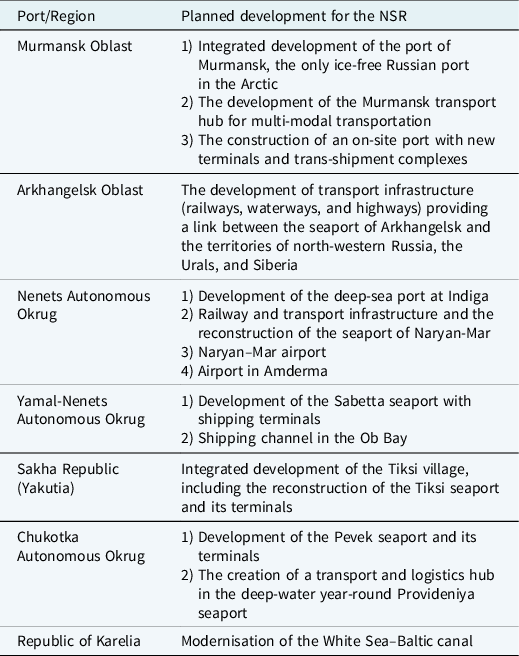
The Russian government has formulated ambitious plans for the development of the NSR. Prior to the release of Russia’s new foundations of Arctic state policy until 2035 (Russian Federation, 2020a), the strategic planning document for the NSR was released by the government in late 2019 (Russian Federation, 2019a). It covered various facets of improving infrastructure along the NSR, including a special regional section that defined the priority directions of socio-economic development for each territory within the AZRF towards the development of the NSR. These are listed in Table 8. When evaluating the migration status in the Arctic region, it should be emphasised that these plans could be derailed if adequate, skilled manpower is not available. The shift system may not fulfil the requirements of additional jobs for the development of the NSR, and reliance on migrants may be accompanied by inherent risks.
The planned development of ports/regions of the NSR.

Source: Compiled by the authors based on the Russian government’s plan for the development of the NSR (Russian Federation, 2019a).
There is no doubt that the implementation of large infrastructure projects, such as the NSR, will have a significant effect on the economies of the Arctic regions of Russia. The presented results of the implementation of the previous strategy for the development of the Arctic zone for the period up to 2020 demonstrated a positive effect on many indicators, including the volume of cargo transported via the NSR, which in 2014 amounted to 4 million tons and in 2019 rose to 31.5 million tons. The new strategic documents outline, in addition to the transport infrastructure of the NSR, a focus on energy, utilities, housing, and digital technology. These are all likely to have a positive effect on the creation of jobs and the modernisation of the education system. Due to the involvement of the federal government, the Northern Arctic Federal University in Arkhangelsk and the Murmansk Arctic State University have given a focused Arctic orientation to policy. It is important that the Russian government pays detailed attention to the Arctic regions. They are singled out as a special object of state policy. At the beginning of the article, we noted that the sharp curtailment in state programmes for the development of the territories of the Far North in the 1990s had a negative impact on demographic processes, particularly on out-migration. In this regard, we hope that the state’s interest in the economic development of the Russian Arctic at present will have a positive impact on slowing the outflow of people and attract qualified personnel and educated youth to the regions economically connected with the NSR.
Discussion
The regional consequences of population migration should also be taken into account when forming an ethno national policy in Russia. In particular, the replacement of inhabitants by migrants who plan long-term residence, but are maladapted to northern conditions (International Organisation for Migration, Reference McAuliffe and Khadria2019), entails the risk of rising ethnic tensions in a sensitive region of national geo-political importance. Unregulated migration, promoted by unscrupulous employers, is the dominant factor that negatively affects inter-ethnic relations (BBC, 2019).
At the federal level, the focus should be on developing a rational settlement system to optimally settle and develop these territories. There is no single, unambiguous solution to this issue; to date, there are two models for solving this problem: Scandinavian and American (Leonov, Reference Leonov2014). The Scandinavian approach to the development of the circumpolar territories is carried out with the support of local resources and indigenous people engaged in traditional activities like forestry, fishing, and reindeer husbandry. The North American approach to developing Northern territories is based on the shift method. It is most widely practiced in Canada, as the indigenous people of these territories mostly live a separate life away from civilisation (Heleniak, Reference Heleniak and Heinenin2014). If we proceed from natural-climatic and resource prerequisites, then the Canadian model may be more suitable for most of the Russian territory where the climate is harsh and unsuitable for permanent residence. The only exception is the European North of Russia, where the winter, although colder than Scandinavia, is mild compared to the Urals. However, it is not possible to directly apply the Canadian method to Russia, as a vast Russian infrastructure was created during the Soviet years, connecting the Northern territories with the ‘mainland’, and a network of cities designed for permanent residence was built (Csonka & Schweitzer, Reference Csonka, Schweitzer, Einarsson, Larsen, Nilsson and Young2004; Duhaime, Reference Duhaime, Einarsson, Larsen, Nilsson and Young2004). Moreover, the old settlements created in the pre-industrial Soviet era by the indigenous or original settlers of the AZRF are connected to natural transport routes and provide optimal access to renewable, biological resources (Csonka & Schweitzer, Reference Csonka, Schweitzer, Einarsson, Larsen, Nilsson and Young2004). However, this cannot be said about the settlements created near mines and oil fields, as they have a high risk of abandonment due to resource depletion or changes in market conditions, which has happened for several coal and ore-producing regions (Duhaime, Reference Duhaime, Einarsson, Larsen, Nilsson and Young2004; Zamiatina, Reference Zamiatina2020).
The document’s foundations of Arctic policy of the Russian Federation until 2035 released in March 2020, in contrast to the earlier policy of 2008, envisions the development of the NSR into an internationally competitive transport route (Russian Federation, 2020a). It must be emphasised that sub-paragraph 7(a) of the policy notes the fall in the population of the Arctic region, and 7(b) mentions the inadequate socio-economic and transport infrastructure in the region (Bhagwat, Reference Bhagwat2020). The declining population of the Arctic, exacerbated by out migration of skilled labour as discussed above, is likely to affect plans to develop the NSR unless focused efforts are made to suppress and reverse this trend. Laruelle analysed the new Arctic policy and stated that Russia’s vision involves human and financial investments which are unreliable under the current budgetary and social conditions (Laruelle, Reference Laruelle2020). The strategy for the AZRF promulgated in October 2020 attempts to address the shortcomings in the development mentioned in the foundations of state policy for the Arctic (Russian Federation, 2020b).
Researchers have highlighted that the coastal location and marine economic activity are the most important factors in the migration attractiveness of territories (Druzhinin, Mikhaylov & Lialina, Reference Druzhinin, Mikhaylov and Lialina2021; Lialina, Reference Lialina2020). The technical reconstruction of the northern seaports and the development of maritime infrastructure could become a powerful impetus for the development of river, rail, and road transport in the Arctic regions of Russia. This would ensure the delivery of goods to seaports from other regions of the country and contribute to their socio-economic development, expansion of international economic ties, and more comprehensive attraction of foreign investment. Overcoming the transport restrictions of remote northern territories could be an impetus for developing tourist routes, namely Arctic tourism, both extreme and ethnographic. In turn, transport accessibility and demand for new labour resources, combined with northern benefits and preferences for workers in unfavourable northern latitudes, would increase the migration attractiveness of the Arctic territories. In this regard, it seems significant to radically revise Russia’s state policy for developing its regions. Most of the Arctic regions that are not self-sustaining are unable to solve the problem of ensuring sustainable socio-economic development of territories without state support. State support mechanisms, along with direct investments in the development of the NSR, should include the creation of political and legal conditions to increase the investment attractiveness of adjacent territories.
The first steps on this path have been taken, and we hope that they will be consistently implemented. In particular, in the ‘Spatial Development Strategy of the Russian Federation for the period up to 2025’, the Arctic territories are classified as geostrategic, that is, ‘essential for ensuring sustainable socio-economic development, territorial integrity and security of the Russian Federation’ (Russian Federation, 2019b, p. 1). The Arctic territories of Russia have been accorded the status of a Special Economic Zone (Russian Federation, 2020c).
A new factor in attracting migrants may be to obtain land plots in the territories of the Arctic zone up to 1 hectare in size. According to the terms of the state programme ‘Arctic Hectare’, the plot of land is provided for free use for five years. It is possible to build an individual residential house on the plot and engage in household farming or conduct economic activity. If it is used for its intended purpose, then the land may be registered as property.
Conclusion
Creating conditions for the development of the NSR into an international transportation route will include the development of the supporting regions of the AZRF. The implementation of large-scale infrastructure projects implies the creation of jobs, investments in the educational and scientific-technical sphere for training personnel, and the development of existing settlements by creating additional logistical corridors, which could all have a positive impact on the living conditions of the AZRF.
Future demographic and socio-economic conditions of the AZRF, particularly in the European region, are likely to have reduced working-age populations, leading to increased labour shortages and an increasing dependency on the working population. The lack of an economically active population may be aggravated by the imbalance of labour supply not meeting the specific industrial, professional, or regional demands. Thus, in the future, the Arctic regions will again require external labour resources, as they did during their initial period of development.
In an effort to overcome the socio-economic risks identified in the ‘Strategy for the development of the AZRF and, ensuring national security for the period up to 2035’ (Russian Federation, 2020b), namely negative demographic processes, and the outflow of labour resources (especially highly qualified) to the southern regions of Russia and abroad, it will be possible to formulate the most important tasks of state policy. Based on the existing demographic and human potential, the state policy in the AZRF regions should effectively combine the use of the shift method with a stationary model of territorial development. The Arctic territories represent different types of settlements (large cities with universities, single-industry towns, and small settlements with collapsing infrastructure), different types of economic activity (e.g., oil production), and different economic actors (the state, large companies, medium- and small-sized businesses). Therefore, for well-developed territories with a developed infrastructure, the stationary model should be a priority of state policy; for oil and gas production, the shift method is considered suitable.
It will be necessary to modernise the current system of northern benefits (through guarantees and compensations), to account for present circumstances by providing them to people working in the commercial sector of the economy. Intranational migration plays a dominant role in the total volume of movement in the AZRF and is a potential advantage for goals of the government and businesses.
To reduce the outflow of population (that is, emigration), it is necessary to revise the concept of development of the northern circumpolar territories. The region should not remain just a source of raw materials for the country. An important task of state policy is the reindustrialisation of the economy of these regions to ensure the development of the NSR. The re-industrialisation of the economy could introduce innovative digital and green technologies and the production of new high-tech goods, which requires highly qualified employees. In the USSR, powerful support zones were created in cities in the territories of the Far North, where there were well-developed education systems, health care services, and infrastructure (Arkhangelsk, Severodvinsk, Murmansk, and Syktyvkar). The level of urbanisation of the Russian Arctic is the highest among the other Arctic countries. Globally, there are 20 cities in the Arctic, each with a population of more than 40,000 – 12 are located in Russia. Thus, the Russian Arctic regions have a high level of urbanisation, diversified economies, multi-level education and health systems, and the potential for sustainable development.
This, in turn, should become the basis for the development of social and cultural infrastructure, health care, education, and the labour market.
The state socio-economic policy in the AZRF should include the following priority areas:
-
Demographic policy measures to stabilise the population.
-
Promotion of youth employment, and training in specialised areas that are in demand in the labour markets of the Arctic regions.
-
Increasing the survival rate of new settlers in areas of intensive economic development (primarily, the NAO and the Yamal-Nenets Autonomous District).
-
Development of large educational clusters, including levels of secondary and higher education, capable of meeting the labour needs of each region.
The formation of a Russian national transport communication system, like the NSR, that is competitive on the world market, could have a positive impact on the socio-economic development and demographic processes in the regions of the AZRF, increasing their migration attractiveness and reducing the negative consequences of the ongoing migration outflow.
Acknowledgements
The authors gratefully acknowledge the comments from the two anonymous reviewers.
Funding
This research received no specific grant from any funding agency, commercial, or not-for-profit sectors.
Conflict of interest
The authors declare none.