HERITAGE DESIGNATION
The coveted designation of world heritage site bestowed by the United Nations Educational, Scientific, and Cultural Organization (UNESCO) is a mark of distinction whose value extends far beyond the sphere of culture. Such conferrals recognize the often long-term efforts of local architects, historians, ecologists, archaeologists, anthropologists, and artists to preserve sites that represent times, events, places, and people central to the hegemonic enterprise of nation building. This is particularly the case with tangible heritage, which recognizes the artistic and architectural genius of past generations or inspirational sites of natural beauty. Moreover, in urban settings heritage designation can be a successful economic strategy for recovering deteriorated infrastructure through symbolic revaluation that in turn spurs a revaluation of private property with the potential for tourist-oriented development.1
See articles in Serageldin, Shluger, and Martin-Brown, Historic Cities.
In a similar vein, UNESCO's efforts to recognize and promote “Masterpieces of the Oral and Intangible Heritage of Humanity” provide an opportunity to ensure that the global economy and political strife between ethnic groups and nations do not obliterate local cultural belief and practice. Such efforts may slow and, in some cases, arrest the forces unleashed by global economic development. The first round of beliefs and practices recognized by UNESCO in 2001 included the Garifuna language, dance, and music (Belize); Kunqu opera (China); and Georgian polyphonic singing (Georgia) and demonstrated international concern for cultural continuity, peoples' rights to the meanings afforded their daily life through cultural practice, and the importance of social and symbolic relations of living peoples.2
See http://www.unesco.org/opi/eng/unescopress/2001/media_adv_140501e.shtml for a full list of the beliefs and practices designated in the first proclamation. See also http://www.unesco.org/bpi/intangible_heritage/backgrounde.htm for a succinct description of the UNESCO program of intangible heritage recognition.
On a less positive note, all pretensions to heritage involve political processes that do not necessarily involve or benefit the whole of the society whose tangible or intangible culture is recognized. The political process that begins with building local support for heritage recognition and proceeds with petitions to national and/or international deliberative bodies for official confirmation takes place in what William Roseberry calls “social fields of power,” complex networks of economic interest and political power negotiated at local, national and international levels. The social field of heritage designation is constituted by the ways in which heritage is defined in legal terms, appropriated by different social groups, influences economic development, and is struggled over in the political sphere. The production and signification of heritage can be comprehended as an eminently political process in which social groups and classes contend for the right to establish the juridical and institutional content of patrimony, that is to say, the cultural beliefs and practices worthy of recognition. This process unfolds on uneven social fields of power characterized by economic, political, and social inequalities that render some social groups and classes more or less powerful than others and therefore more or less capable of effectively prosecuting their interests.3
See Roseberry, Cuestiones agrarias, for a lengthy treatment of this concept.
The differences among social groups and classes with respect to the ability to impose their will on others, what John Holloway refers to as “power-over,” is immediately apparent in cases in which heritage designation leads to the development of tourist destinations with the potential for attracting foreign investment and boosting flagging local economies.4
In Change the World, Holloway proposes conceiving of power in terms of power-over, which does not achieve real change because it merely replaces the powerful with the powerless, leaving the structural roots of inequality in place. Power-to, on the other hand, is a collective, creative exercise of a social group's ability to conceive of and engage in nonhierarchical, humanistic social relations. See chapters 3 and 4 in particular.
For details on the process by which the Paseo project was conceived and implemented, see Vélez Pliego, Cambio social en el centro histórico, Téllez Morales, Megaproyecto y Renovación Urbana en el Centro Histórico, and Milián Ávila, El Paseo del Río.
When the municipal government announced plans in 1993 to expropriate 40 acres in eight centrally located barrios, local residents and businesspeople mobilized against the project. Different social groups and classes protested for a variety of reasons, but the central argument of residents, predominantly renters, revolved around their right to remain in the barrios that they and their ancestors had called home for generations They evoked a distant indigenous past, when the city of Puebla was built by the Cholultecan, Tlaxcateclan, and Huejotzingan indigenous peoples forcibly settled east of the San Francisco River, near the church and convent of the Franciscan monks who would attend to their souls. Claiming common ancestry with the original inhabitants of the barrios, contemporary residents and their allies in the National Institute of Anthropology and History contended that their rights to their heritage, both tangible and intangible, was no less important than the recovery and restoration of the buildings said to constitute the tangible heritage of all Pueblans.6
The mobilization against the project is detailed in Churchill, “El Paseo del Río San Francisco”, and Churchill Conner, “Espacio e historia hegemónica.” The case for intangible heritage is made in Garza Marcué, Viramontes Anzures, and Flores Morales, “El patrimonio cultural.”
If barrio residents' claims to intangible culture were publicly recognized, the municipal and state governments would have had a harder time negotiating the Paseo project. To circumvent the problem, the municipal government commissioned a private, for-profit research company to investigate the existence of traditional culture in the barrios, now 400 years beyond their indigenous origins. A team of social scientists decided to measure the gelatinous concept of tradition by comparing the organization and implementation of religious and secular celebrations in the barrios of Zacapoaxtla, a small city in the northern, mountainous region of the state of Puebla, and in the barrios of the capital city of the same state. In Zacapoaxtla, traditional culture calls for: (1) barrio residents to know the territorial limits of their barrio; (2) festivals to be organized by a cargo system, in which responsibility for implementation rotates among families headed by recognized, responsible adult men; and (3) the entire community to participate in barrio festivals. The team found no existing traditional culture in Puebla's historic barrios, thereby relieving the government of the responsibility to protect their intangible patrimony and absolving government officials of blame for evicting cultural producers and practitioners.
My research on the effects of the Paseo project on popular culture in the surrounding area challenges the findings of the government's study. I have encountered a wealth of cultural beliefs and practices that range from artisan production to popular religious festivals and, not least of all, carnival, the enactment of which expresses and reinforces a deep sense of belonging in both space and time. The barrios are not simply a built environment occupied by the descendents of the original, indigenous inhabitants but should instead be considered dense webs of social and cultural relationships that constitute a we-in-this-place.
On the uneven field of power constituted by capitalist property rights, residents could not effectively challenge the state's right of eminent domain, but they could insist on their collective right to their intangible heritage. They took to the press, the radio, and the streets to convince other social groups and classes to join their struggle to save the social and cultural matrix that gave, and continues to give, meaning to their lives. But how can politically and socially disadvantaged groups successfully prosecute such campaigns, particularly when they consist of small ethnic or cultural enclaves within a larger, heterogeneous nation? If the beliefs and practices of barrio residents in Puebla are not shared by their fellow citizens, much less the rest of the nation, why are they so important and how might it be possible to have them recognized as such? Moreover, who documents or determines their authenticity, their true history? Finally, once authenticity is somehow determined and the cultural belief or practice recognized, who possesses the right to its discrete knowledge and correct practice?
The contested cultural terrain constituted by the campaign by Pueblan carnival producers for official recognition offers an opportunity to explore the ways in which intangible heritage is determined, appropriated, and contested; but more importantly, it illustrates some of the problems inherent in this process. In Puebla carnival is produced annually by and for the working class and poor residents who continue to populate the barrios undergoing restoration by private enterprise, under state supervision. The campaign for public acknowledgement on the part of working-class carnival producers has thus far failed to convince local economic and political elites, including some anthropologists, of the social and cultural significance of this community-based, annual event. More importantly, however, it has created dissention within the ranks of producers themselves; the ways people define and value cultural expressions is changing amid the ongoing debates over the value of tangible heritage.
In Puebla carnival is inconsequential in the annual urban cultural calendar, not least because its practitioners are largely working class. Indeed, efforts by local elites in the mid-1900s to fashion an annual carnival consisting of a parade of floats followed by a masked ball bore only periodic fruit, while the popular practice has continued unabated since at least the 1920s, if not earlier.7
See La Opinión, February 22, 1930, and La Opinión, February 13, 1956, for articles on the attempts to foment carnival among Puebla's elites.
In the following text, I explore the process of dignification in the context of the politics of heritage designation. I begin with a description of the form and content of Pueblan barrio carnival, followed by a discussion of the political conjuncture that constituted the social field of power on which carnival producers have been prosecuting their interests, with varying degrees of success and failure. Finally, I discuss the discord that has surfaced among carnival producers over the campaign for dignification and recognition, relations that are affecting the present practice of carnival, both within and outside the barrios in which it constitutes the most important cultural event the year. I conclude by taking up the questions previously posed concerning the authentication of cultural traditions and the rights of producers.
CONTEMPORARY CARNIVAL IN PUEBLA'S HISTORIC CITY CENTER
Although its origins have yet to be verified in the official historic record, living memory locates a carnival celebration in the barrio of El Alto as far back as the postrevolutionary period of the late 1920s. Both Serafin Capilla Orea and Sabino Mendoza Bonilla, now into their eighth decades of life, lived and danced there as young men.8
In this article I use the real names of some individual carnival dancers and their cuadrillas, such as Serafín Capilla Orea and Sabino Mendoza Bonilla, who wish to be recognized for their contributions to barrio carnival, its history, and preservation. I use pseudonyms to protect the identities of those involved in controversial aspects of carnival production and preservation.
This cuadrilla, now known as “The Original Cuadrilla of Huehues from the Barrio of El Alto,” or colloquially “El Alto Original,” developed a rivalry with its counterpart from neighboring Los Remedios, until a dispute between dancers from the two cuadrillas left a man dead in the street. The parish priest declared that anyone who continued to dance in carnival could not enter the church for seven years, and “the responsibility of being a huehue,” as Serafin Capilla Orea puts it, weighed heavily on the shoulders of those who continued to participate.9
Huehue means “old one” in the Náhuatl language, a reference to the indigenous practice of elders presiding over rites and cultural practices.
Eventually, El Alto's cuadrilla grew so large in numbers that it divided into two groups. A group of young men led by Domingo Salazar broke away to form a new cuadrilla in the barrio of Xonaca, naming it 26 Oriente after the street on which the Salazar family lived. From there, carnival expanded to other families in Xonaca—notably the Capillas and the Illescas—and later took hold in the contiguous working class colonias of Lomas Cinco de Mayo and Lomas Diez de Mayo.10
In Puebla, barrio is the term applied to the original, indigenous neighborhoods established at the city's founding in the 1530s. A colonia is a more recently established neighborhood in which inhabitants purchase lots and construct their homes. Both are delimited by local custom, according to specific streets and landmarks.
The original myth recounted by Serafin Capilla Orea and Sabino Mendoza Bonilla is contested by dancers from the 26 Oriente, who are the contemporary rivals of El Alto Original. If the handwritten date on the back of a photo of Xonacan men dressed in carnival garb can be accepted as accurate, at least one cuadrilla existed in Xonaca in 1937, earlier than either Serafin Capilla Orea or Sabino Mendoza Bonilla recall. And Serafin Capilla Orea does remember cuadrillas in the barrios of Santa Anita and San Antonio, across the San Francisco River from El Alto, as well as a cuadrilla composed entirely of men dressed as devils in the barrio Santiago. He also recalls carnival in the towns of San Felipe Hueyotlipan and San Aparicio, located outside the Puebla city limits in the early 1900s. He cannot, however, date his recollections.
Although we lack verification of the time and place of its inception, we can affirm with certainty that carnival in center city Puebla has always been an organized cultural event, with groups of men following the direction of an encabezado, or leader. They were not mojigangas, the local term for individuals or small bands dressed in rags and masks of animal skin that run through neighborhoods, whooping and creating havoc, stopping to beg for handouts from market vendors.11
See Villavicencio Rojas, Mojigangas y pachecos.

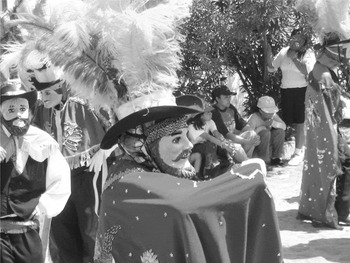
Dancers at the Puebla Carnival, 2005
The huehue is the principal figure of Pueblan barrio carnival, and all but a few dancers in each cuadrilla dress as this representation of nineteenth-century hacendados, or hacienda owners. As Raul Bravo Flores of San Felipe Hueyotlipan explains, the hacendados forbade their indigenous and mestizo laborers12
In the Mexican racial classification system, mestizos are persons of “mixed” Spanish and indigenous descent.
See Mauldin, “Ritual and Play,” for the case of the neighboring state of Tlaxcala.
Oral accounts of carnival's history confuse indigenous belief and practice with cultural forms of much later periods in Mexican history. Historian Javier Pérez Siller and Professor of Traditional Dance Celestino Rodríguez, both researchers at the Autonomous University of Puebla, concur that the form and content of the Pueblan barrio carnival locate its origins in the mid-nineteenth century.
Puebla's center city cuadrillas are organized first along territorial lines according to one's barrio or colonia of birth or residence, and second by relations of blood and fictive kin among the encabezado and his dancers. For example, the cuadrilla Lomas Cinco de Mayo, headed by Delfino Villalba Poblano, is comprised of family and friends, all of whom hail from the colonia Lomas Cinco de Mayo. The dancers in his group embroider the name of their colonia on their capes, making them instantly recognizable. In barrios or colonias with more than one cuadrilla, huehues adopt the surname of the encabezados, such as Illescas, or use another distinguishing moniker. In the colonia Lomas Cinco de Mayo alone, there are five cuadrillas: Lomas Cinco de Mayo, Nueva Era, Los Compadres, Baila Bonito, and Lomas Cinco de Mayo Pastén.
All the cuadrillas wear the same basic attire and dance the same steps to the same music, with slight variations. As noted above, the huehue is the predominant figure of this form of carnival and composes cuadrillas in their majority. He dresses in Western-style clothing, imitating the superior style of the hacendados but in modernized form: clean, pressed, dress pants and matching vest, long-sleeved white shirt, polished dress shoes, and a tie. To this basic uniform dancers add the carnivalesque: First, they cover their heads with bandanas and colored scarves, atop which they place a black felt Texan-style hat to which are affixed a number of tall, multicolored feathers.15
A second style of dress is the charro, which is more faithful to the hacendados' clothing, as Mauldin points out in “Ritual and Play.”
Each cuadrilla of huehues is guided through the tightly choreographed dances by a female figure known as the maringuilla, who is said to represent La Malinche, the indigenous woman who became Hernán Cortés' guide and lover during the conquest of Mexico. La Malinche is an ambivalent figure in Mexican history, both revered for her intelligence and political acumen and despised for betraying indigenous peoples to the Spanish. Over time, carnival dancers have invented numerous variations on the maringuilla, a controversial practice discussed in more detail in the following text. The version known as the traditional maringuilla is a man dressed as a woman, covered from head to toe in a long-sleeved, embroidered blouse; a floor-length skirt; white lace gloves to cover rough, male hands; the same scarves, hat, and feathers as the huehue; and a female mask.
Puebla's carnival is pegged to the Christian calendar and constitutes a final, community-wide celebration before the solemnity required during Lent. For the three days and nights prior to Ash Wednesday, the cuadrillas and their musicians walk the streets of their barrio or colonia, stopping to dance in front of homes and businesses that cooperate with a monetary donation dedicated to carnival expenses. Only two cuadrillas still follow the tradition of contracting a group of musicians to accompany them on their journey. The original El Alto cuadrilla pays a violinist, a guitarist, and a bassist, all of whom connect to a car's sound system, and Real de Hueyotlipan pays for a violinist, guitarist, and accordion player, who play without the benefit of speakers. For these cuadrillas, the cost of music alone can run as high as 6,000 pesos per day, which is why most have eschewed tradition and opted for a more economical arrangement, paying a single keyboardist mounted in a sound truck. Synthesizer music is louder, enabling the larger cuadrillas to keep in time with the music and remain in step, but more importantly, it costs only 1,200 pesos per day.
In El Alto in the 1930s, carnival began with a mass attended by all the dancers on the first day of festivities and ended on Tuesday night, when a symbolic burning of the devil was held to proclaim the triumph of good over evil. The men dressed as devils would have their tails burned as the band played “La Muerte del Diablo” (the death of the devil). On the morning of Ash Wednesday, carnival participants, often reeling with hangovers, attended mass to receive the priest's blessing and begin the solemn Lenten period.
Today, none of the cuadrillas in center city Puebla prepare for or end carnival with a mass. Moreover, like their counterparts in Tlaxcala, they have invaded the Lenten period by adding an additional day to their celebration. The first Sunday of Lent, denominated la octava (the eighth day), is now reserved for a morning of dancing, followed by a midday meal for dancers and their families at the home of the encabezado.16
Mauldin, in “Ritual and Play,” notes the same practice in the case of carnival in the neighboring state of Tlaxcala, reinforcing the theory that center city Pueblan carnival has close ties to the festival practiced in Tlaxcala. On this point, see also Sevilla, Rodríguez, and Camara, Danzas y bailes tradicionales.
The octava is only one of a number of practices that constitute what Hobsbawm and Ranger call “invented traditions.”17
Hobsbawm and Ranger, The Invention of Tradition.
Another innovation is the conclusion of carnival with a public dance in the street in front of the encabezado's house, to which everyone in the community is invited, free of charge. This dance takes place on the evening of the remate, following the communal meal, despite the fact that this is a full two weeks into the Lenten period. The prestige of the cuadrilla is enhanced when its leader pays for a renowned musical group to play at its dance, and more still if the band comes from Mexico City or Veracruz.
DIGNIFYING CARNIVAL IN PUEBLA'S WORLD HERITAGE SITE
No one who has experienced the full depth and breadth of Pueblan urban carnival can deny its capacity for transgression, as men risk losing their jobs for taking time off from work to dance in the streets with relatives and friends; as families interrupt their daily routines to assist and accompany dancers with food, drink and moral support from early morning until late into the night; as men dressed as women lead the cuadrillas in dancing, occasionally stopping to gulp down a beer or take a swig of tequila; and as cuadrillas crisscross through the barrios and colonias during the four or five days of festivities, music echoing off the walls late into the night. The routines of daily life are set aside as people take to the streets in a community-wide celebration of belonging.
In these respects, Pueblan popular carnival bears resemblance to the carnival celebrations of Europe, where since the Middle Ages everyday behavior is inverted in the pre-Lenten period.18
Davis, Society and Culture; Bakhtin, Rabelais; Burke, Popular Culture; and Mauldin, “Introduction.”
Burke, Popular Culture, 210.
Mauldin, “Ritual and Play,” 152.
In the city of Puebla, however, there is no evidence that carnival bands ever profaned religion or religious figures, nor did they threaten the social peace by straying into upper-class neighborhoods. Even the mojigangas that periodically invaded the city from the small towns surrounding it ran amok through the markets and plazas of the barrios, not the streets where their social betters lived. The licentious presentations found in the carnival celebrations in Rio de Janeiro are replaced in Puebla with modest huehues and maringuillas, all covered from head to toe. And the fierce competition among cuadrillas from different barrios and colonias that periodically resulted in the death of a carnival dancer in decades gone by has been transformed today into a serious but good-natured rivalry over which group has the best-dressed huehues and the most spirited dancers, as well as the most renowned band at the popular dance.21
My research has uncovered two deaths during carnival. The first is the result of a rivalry between El Alto and Los Remedios, recounted by Sabino Mendoza Bonilla. The second came up in an informal discussion with an elderly man who had danced in the cuadrilla of devils from the barrio Santiago, reporting it to have been the tragic result of an internal dispute among dancers from the same cuadrilla.
While most carnavaleros still punctuate the long days and nights of revelry with beer and shots of hard liquor, those who drink to excess are quietly taken aside and asked to sit out for a while, until they “recover their feet,” in local parlance. The traditional practice of stopping for a drink or two at every bar along the route, common in the days of Serafin Capilla Orea and Sabino Mendoza Bonilla, is no longer observed. Thus, the feasting and imbibing that Bakhtin considers essential characteristics of the popular festival are present in barrio carnival but in a muted form.22
Bakhtin, Rabelais.
In my first encounter with center city carnival in Puebla, I found the discouragement of excess puzzling, particularly since a few years earlier I had witnessed a different form of carnival in San Baltazar Campeche, just a few kilometers south of El Alto. There, dancers costume themselves, if they wish and as they wish, as presidential figures, priests, cartoon characters, and extraterrestrial beings, with or without masks. Some dance while others stand on the corners and shoot painted muskets into the air, a practice borrowed from the festivities in the town of Huejotzingo, 15 miles to the west. Not only do supporters follow the revelers carrying pulque to “animate the spirits” of dancers and shooters, but the midday carnival meal in San Baltazar is accompanied by limitless quantities of this potent drink.23
Villalobos Sampayo, El proceso de conurbación. It is important to note that carnival and pulque consumption have an historic relationship. Pulque is an alcoholic beverage made form the fermented juice of the maguey plant, and was made by indigenous peoples. In Puebla, pulque vendors were located in the barrios, and the carnival circuit included frequent rest periods in these establishments.
I believe that the less ludic appearance of barrio carnival has much to do with the context in which it is produced today, in the aftermath of the Paseo project. The centerpiece of the tourist district, a convention center surrounded by gardens, was completed and inaugurated in 1998, following five years of popular oppositional struggle. The eviction of hundreds of families from their homes in the barrios of La Luz, El Alto, and to a lesser extent Analco, was justified by the restored splendor of the colonial-era, built environment that comprises what M. Cristine Boyer would call a “historic tableau.”24
Boyer, “Cities for Sale,” 181.
Churchill Conner, “Espacio e historia hegemónica.”
Popular cultural practices like carnival sully hegemonic historic memory by foregrounding the indigenous and mestizo working classes who have always lived in El Alto and neighboring barrios. Over time, these neighborhoods became sites of transgression to which Spaniards escaped for nights of debauchery: pulque drinking, prostitution, and violence.26
Salazar Exaire, “Violencia y espacio urbano.”
The same year that the Paseo project was inaugurated, 14 carnival cuadrillas created a formal association with the stated goals of rescuing the tradition of urban carnival and dignifying its principal figures, the huehue and maringuilla. The unstated motive for their collective organization was, and remains, the need for economic support for carnival. Traditionally borne by the encabezados, the cost of producing this annual event has become an onerous burden caused by the decades-long economic crisis that continues to plague the Mexican economy. Many cuadrillas have now formed directive committees to spread expenses among several leaders instead of just one. Still, the cost of musicians and sound truck rental, feeding dancers each of the four or five days of celebration, and the public dance that signals the end of festivities add up to weighty sums.
The association initially aligned themselves with the Revolutionary Institutional Party (Partido Revolucionario Institucional, or PRI), the ruling party in Puebla since the Mexican Revolution some 70 years prior. A PRI stronghold since the party's founding, the state of Puebla has never had a non-PRI governor. In 1996, however, the capital city of Puebla elected its first non-PRI mayor, Gabriel Hinojosa, from the National Action Party (Partido Acción Nacional, or PAN). The combination of a visible and vocal mobilization against the Paseo project from its advent in 1993 and the election of the PAN mayor three years later shook the PRI's confidence in its popular base. They therefore began reorganizing to regain the loyalty of workers and the poor. One strategic means for bringing the dubious back into the fold was to sponsor popular cultural events like carnival. When the PRI retook the municipality in the 1999 election, the new mayor, Mario Marín Torres, convoked the first of what would become an annual Concurso de Huehues, a two-day long exhibition of carnival dances, held for the first three years on the grounds of the new convention center. Perhaps more importantly, he consolidated the political support of the carnavaleros by contributing funds to the association members during each of his three years in office. Though producers appreciated the mayor's public recognition of their carnival, the financial support was invaluable.
In the political culture of paternalism, clientelism, and personalism that has prevailed in Mexico since the formation of the PRI in the aftermath of the Mexican Revolution, the carnival association essentially became the party's client.27
Vélez Ibáñez, Rituals of Marginality.
This risk is pronounced in Mexican politics, which prohibits reelection. Mayors, for example, are elected for three-year terms, making political appointments and clients vulnerable if their party loses office in the following election. This disadvantage can be offset by establishing client relationships with state-level officials, since governors remain in office for six years.
This is exactly what happened when the PAN recaptured the municipality in 2002 and the carnival association was unable to establish significant relations with the new mayor, Luis Paredes Moctezuma. His administration did give permission to hold the annual Concurso de Huehues in the city's central plaza, or zócalo, which moved the agenda of recognition of popular carnival forward because of the greater exposure afforded by the more central location. However, the financial support that the association had received from the previous mayor was no longer forthcoming. Throughout the next year, the association redoubled its efforts to establish a working relationship with the mayor's office and was rewarded with gallery space for an exhibition of costumes and masks, as well as bleachers and a sound system for the zócalo performance. A small amount of money was bestowed upon a few cuadrillas, but the association was deposed as the principal mediator between government and carnival cuadrillas. Instead, the mayor's staff took it upon themselves to decide which groups deserved funding, doling out varying amounts to different cuadrillas, and causing resentment against those who received larger amounts. The third and final, lame-duck year of Paredes Moctezuma's administration was marked by a return to a policy of rejection of any form of support whatsoever.
In the absence of government funding for carnival production, the PRI political operatives instrumental in the creation of the association abandoned it in 2002, along with several cuadrillas. The remaining eight groups and their independent ally, the 26 Oriente, have redoubled their efforts to earn official recognition for carnival, which they refer to as “tradition.” This concept, always pronounced with emphasis and conviction by carnival producers, serves as a simple, one-word explanation for the importance of their practice. It is as if its end would set barrio dwellers adrift in modernity, breaking with history and the inchoate identity of a shared “Mexican-ness.” To a man, they insist on the responsibility they have voluntarily accepted to follow in the footsteps of their fathers, who were passed the same baton by their fathers. To renounce this social obligation would mean to cease being who they are: carnival producers, sons, fathers, Pueblans, Mexicans, and respected members of their communities. It would weaken the already-fragile identities that constitute the lived experience of subordination among the popular classes.29
This concept is developed in Crehan, Gramsci, Culture and Anthropology.
Association members have decided that dignification is the path that will lead to recognition from other social groups in Pueblan society. Intensive, ongoing internal analysis, punctuated by intervention from outside agents such as government officials and cultural elites, sometimes anthropologists, have led to the conclusion that the tradition of their fathers and grandfathers has been distorted. Leaders like Raul Bravo Flores admit that outsiders who disparage them as nothing more than a bunch of drunkards and transvestites looking for a few days off from work are not entirely wrong. The remedy for this situation is to recover the “true” tradition of carnival and dignify its principal figures, the huehue and the maringuilla.
There are several types of external critiques to which carnival producers feel obliged to respond. Most have emanated from bureaucrats and politicians who appear to find carnival either aesthetically displeasing or morally egregious. For example, when scheduling a citywide festival in 2005, a municipal cultural official was reluctant to schedule carnival cuadrillas for church atria because men dressed as devils and as women might, in his words, “offend the Lord.” On another occasion, a government official in charge of distributing funds to cultural producers declined the request of carnival cuadrillas because he felt they promote transvestism. In 2003 staff in the state secretary of culture's office replied in the negative to an association request for an exhibition of costumes and masks in a centrally located museum, citing the poor quality of their cultural practice for a venue dedicated to high culture. Even anthropologists have registered their opinions on the subject, counseling carnival leaders to improve the appearance of their cuadrillas by eliminating the more questionable elements, a vague reference that carnavaleros take to mean obvious transvestism.
As previously noted, the aspersions cast by these and other public figures have come to form part of the internal debate concerning the authentic tradition of carnival in center city Puebla, that is to say, what carnival was, has been, is, and should be. Clearly, some of these external judgments coincide with the sentiments of religious, family-oriented carnival practitioners who dislike being painted with the same broad brush as what they consider to be their morally egregious counterparts.30
I thank an anonymous reviewer who pointed this out in a review of my original article.
Although it is hard to say whether the discussions surrounding dignification owe more to the ongoing, internal process of self-evaluation among carnival producers or to critiques made by outsiders, they have resulted in a schism within the association, dividing it and other independent carnival producers into two distinct camps. The group that I call the dignifiers define their objective as the recuperation of carnival from the excesses of past generations. I dub the opposing group, the ludists for their insistence that the essence of carnival is merrymaking, color and delight. The more outrageous one's costume and behavior, they say, the more enjoyable carnival is to dancers and spectators alike. Both groups pretend to have knowledge of the authentic tradition and appeal to the past to support their views. They sometimes refer to the memories of old timers like Serafín Capilla Orea and Sabino Mendoza Bonilla, but more often they rely on their own experiences as young men. Recently, though, the dignifiers have begun citing the opinions of outsiders as evidence of their having strayed from the authentic form.
Discord has emerged in three discrete areas of presentation and behavior: costume, alcohol consumption and the representation of the female figures of carnival. The dignifiers now impose a regimen of dress on their dancers and exhort all cuadrilla leaders to do the same. First, they have regularized dancers' attire so that all huehues dress the same except for the designs on their capes, the sole sanctioned expression of individuality. Recall that huehues wear matching pants and vest; long-sleeved, white shirt; dress shoes; a black, Texan-style hat adorned with abundant feathers of good quality; and a wooden, rather than cardboard, mask.31
The two principal head coverings in center city carnival are Texan-style hats, which are stiff and small brimmed with a high crown, and the charro style, an extra wide-brimmed hat with a small crown.
On this point, historical accuracy takes a back seat to the desire to wrest Mexican culture from foreign influence. Interviews with Serafín Capilla Orea and Sabino Mendoza Bonilla reveal that the cape decorations in the 1930s were simple, consisting of a few bells, a bit of fringe, and at most a small sun or moon embroidered in sequins. Photos of dancers during subsequent decades verify their claim. Although the North American cartoon characters that are blamed for the distortion of an appropriately Mexican carnival began appearing on capes in the 1960s, there is no evidence that they replaced more Mexican themes. The elaborate representations of Aztec warriors, princesses, and calendars that have come to dominate the visual panorama of carnival during the past few years are an invented tradition par excellence. The debate among dignifiers and ludists on this point appeals to two different versions of tradition, the former recalling a mythic past and the latter insisting on the right of the individual to wear what he likes, as long as it is colorful and provokes a reaction among spectators.
The dignifiers have also entered the arena of behavior control by prohibiting public alcohol consumption among huehues to demonstrate to the rest of Pueblan society that carnival dancers are serious, sober, tradition minded, family men. This aspect of the regimentation of carnival has met with little success, particularly because carnival occurs at the end of the dry season, when afternoon temperatures can easily reach 30° Celsius (85° Fahrenheit). Their bodies covered by hats, masks, long-sleeved shirts, and capes, huehues begin to sweat profusely after an hour in the streets. Few will forego an occasional, cold beer just because their cuadrilla leader is concerned with keeping up appearances. The most they will accede to is drinking inside the small, neighborhood stores known as tiendas, rather than in the street, in front of families and children.
The irony, of course, is that alcohol consumption has historically been one of the defining features of carnival practice in these barrios. The personal testimony of Severo Camacho Gómez should be proof enough. Elderly informants from El Alto echo his story, recalling that when cuadrillas piled into the pulque bars, huehues would hang their masks on nails on the walls. Lost in the memory, they smile wistfully as they continue the story: Those who imbibed themselves into a stupor were left behind when the others rejoined the carnival route, often losing their masks to comrades who grabbed the wrong one.
The third and most contentious debate over carnival tradition concerns the figure of the maringuilla. The dignifiers wish to ban all female figures save the traditional maringuilla, who covers herself from head to toe: a long-sleeved, full-length dress to conceal her male body; hats and scarves to hide her head and neck; and a female mask to disguise her face. A second, more modern version of the maringuilla appeared in the 1960s. This “urban woman,” as she is called, is a man attired in a knee-length dress or skirt, mesh stockings, dressy shoes (sometimes patent leather), carrying a pocketbook, and wearing facial make-up instead of a mask. Those with hair long enough comb it into a slightly feminine style; only a few wear wigs or small, dressy hats. Still, there is no mistaking the male identity of the urban woman, her muscular arms protruding from sleeves bursting at their seams.
A more recent and extreme adaptation of the urban woman is the loca, or crazy woman, again a man but this time dressed in a combination of masculine and feminine clothing: a tube top, mini skirt, boots, and baseball cap topped off with a feather boa or a pastel chiffon evening gown, too tight to zip up all the way. One young man from Lomas Cinco de Mayo appears every year dressed as a female devil, with red blouse, skirt, stockings, and shoes, all covered by a crimson cape. Like all the female figures, including the traditional maringuilla, he stuffs socks into a bra to give the appearance of exaggerated breasts.
Five years ago dignifiers were openly criticizing urban women and locas for failing to respect the criteria of masks and long skirts, but today their criticisms are vituperative. Some have taken to using the contemptuous vernacular term for homosexuals, jota, to describe those who insist on the ludic value of the outrageous costume and behavior of the loca. They describe those who dress as anything other than the traditional maringuilla of being more interested in their egotistical desire to dress as women in public than in preserving the tradition of carnival. If, say the dignifiers, these jotas had proper respect for their barrios and their mothers, sisters, and wives, they would accept the responsibility of the huehue to faithfully represent his cultural heritage.
Although the attacks have grown more personal, ludists tend to shrug them off by reclaiming the central importance of merriment. Carnival, says Norberto Torres García, “is magic. It is color,” he continues, “it gives color to …” and here he trails off for a minute, then picks up the thread of his thoughts once more: “When the time approaches, one's legs begin to vibrate and to feel the music, to feel the music, … [and even] when you are working, you begin to move to the rhythm of the music, whistling or humming; that is to say, you begin to feel the sensation [of carnival]. When the rehearsals arrive, one begins to get a bit of energy and when the moment of carnival arrives, that energy doubles.” Torres García explains that he began his career in carnival as a huehue, only assuming the maringuilla role when his older brother retired. Reluctant at first, he acceded to the request by the encabezados because every cuadrilla must have an experienced dancer to serve in this key role. Self-conscious at first, Norberto has grown into his female role because, as he admits with a shrug and a smile, “I like it.”
Following the tradition of his older brother, Norberto Torres García has always dressed as an urban woman, in a knee-length skirt with matching vest, stockings, and boots and with a small, cardboard mask that covers only his eyes. This, he asserts, is the “tradition” in Los Mayordomos. His interpretation of that tradition is that other men who wish to dress as urban women or locas may do so, as long as it is understood that he is the maringuilla who will guide the cuadrilla's dances. A few years ago, convinced by the arguments of the dignifiers, Norberto commissioned an expensive, carved wooden mask for himself. He now feels that his appearance is complete. Still, he does not impose this criterion on others, allowing a place in his cuadrilla to anyone expressing a desire to dance.
Others agree with Torres García, citing the creativity of individual dancers whose innovations please the spectators. The cuadrilla Amigos 10 de Mayo has as its principal maringuilla a man dressed as the India María, a popular, comedic, Mexican movie character. The crowds applaud his portrayal despite the fact that he does not wear a mask, hat, feathers, or in any way conceal his identity. Every year this enormous cuadrilla admits a plethora of young men dressed as urban women and locas, as well as the occasional Zorro, clown, and women and girls simply attired in peasant-style blouses and wide, colorful skirts. Another cuadrilla from the same colonia is comprised of men, women, and children of both sexes, all dressed as close to the form of the huehue as they can, given the poor economic situation of many families in this neighborhood. Few can afford wooden masks, so the younger huehues improvise face coverings with painted cardboard. The principal maringuilla is the cuadrilla's leader, David Hernández, who dresses simply in a peasant-style blouse, full skirt, and sandals; he eschews scarves, hat, and mask, which he insists was the tradition that he learned while dancing as a young man in Xonaca. When the dignifiers criticize the chaotic presentation of his cuadrilla, Hernández argues that not only do the crowds love their spirited performance but that carnival is by definition inclusive. His principal preoccupation is to incorporate young men and women into carnival as a means of teaching them responsibility to their community and keeping them out of gangs and away from drugs and alcohol.
In sum, the ludists reject the pretensions of the dignification campaign because, in their view, it violates the tradition to which they adhere. They either feign ignorance of the sexual preferences of their dancers or are not bothered by the fact that some of their urban women and locas are homosexuals and transvestites. None of that, says David Hernandez, has anything to do with the festival of popular carnival. Whereas in 2005 the El Alto cuadrilla bowed under the pressure of dignification and expelled their long-time maringuilla, an openly gay transvestite who wore modern dresses and a wig,32
A particularly controversial feature of this maringuilla's performance was that, at twilight on the Tuesday of carnival, she would remove her skirt to reveal a fitted, beaded, sparkling bodysuit in which she would dance into the plaza for the grand finale.
To underwrite some of their expenses, the ludists reaffiliated with the PRI political operatives who had abandoned them during the PAN years of 2002–2005, and in so doing, have consigned themselves once again to a clientelist relationship with the party. The dignifiers decided to distance themselves from such relationships and concentrate instead on building relationships with institutions of government like the new municipal office of cultural affairs. The relative success they have encountered, however, is tempered by the fact that their efforts coincided with a new PRI mayor's first year in office. His staff is eager to establish relationships with community leaders, and has thus invited the carnival association to participate in a variety of city-wide, cultural celebrations. It is unclear what might be expected of the association in return for what can only be understood as favors on the part of the PRI officials, and some are understandably uneasy. Still, they are hopeful of furthering their goal of recognition as an intangible cultural heritage of the city of Puebla and are not sorry to have lost the ludists, who, in their opinion, were unwilling to work to restore the authentic tradition of center city carnival.
POLITICS AND HERITAGE IN PUEBLA'S BARRIOS
I have presented the social production of carnival in the popular barrios of Puebla in ethnographic detail to emphasize the complexity of local social relations that are easily passed over in processing claims to heritage. This complicated situation makes it difficult to answer some of the questions I posed above with regard to the rights of carnival producers to their tradition. As the tourist project expands, it is likely to extend further into the barrios of La Luz and El Alto, reconfiguring the space in and the conditions under which carnival is produced each year. Rather than being able to pull back from the politicization of the area and its social relations, carnival producers will be drawn more and more into the ambit of the Paseo project.
A disadvantaged position on the uneven ground of the social field of power conditions the possible courses of action for local social actors. Although the carnival producers in this case are not soliciting anything as formal as a UNESCO declaration to affirm the historic value of their cultural practice, they do seek recognition from local government, in large part because of their need for funding. To formalize this type of relationship with the municipal and/or state government, they have negotiated with politicians and professionals who operate within the political culture of clientelism, rather than being able to present their case on its own merits. Although these cultural producers are consummate organizers and more than capable of preserving their practice for posterity,33
Churchill Conner, “Autogestión del patrimonio.”
Since the formation of the carnival association eight years ago, Pueblan carnavaleros have attempted to exercise what John Holloway calls their “power-to”—to create, innovate, elaborate, even reinvent their tradition, and most importantly, claim ownership of the totality. When they have surrendered their power-to by internalizing the critiques of more powerful outsiders, they have received support, at times financial assistance toward the cost of carnival production and at other times space for exhibitions of costume and dance. Despite their appropriation and application of the concept of tradition, they still have no real power-over the political and cultural elites who could move their agenda forward.34
Holloway, Change the World.
The need for intermediaries is one of the problems with heritage designations. Even when criteria and procedures for authentication are clearly and succinctly spelled out, as is the case with the UNESCO process for recognizing traditional culture and folklore,35
Sherkin, “A Historical Study.”
UNESCO, “Proclamation of Masterpieces.”
Still, there can be no doubt that intangible heritage is everywhere in need of recognition and protection, not only because of political strife and wars, but also because of the ever-increasing reach of globalized systems of mass communications. If it is to be an effective tool in this regard, it behooves those with “power-over,” who make these decisions, to be fully aware of local politics and culture. In Mexico, for example, once the fanfare dies down following the declaration of a “masterpiece of the oral and intangible heritage of humanity,” the real negotiations will begin concerning its rescue, preservation and promotion.
Mexican political culture's specific form in the city of Puebla has already affected the unity of carnival producers in their struggle for official recognition. The PRI has always organized, paternalized, and clientelized less-educated social groups and classes, and it controls them through intermediaries like the party operatives who generated the association of carnival producers in 1998, or alternatively, through state or municipal elected officials. Thus, as noted earlier, a declaration of carnival as cultural heritage in 2005 may be meaningless in 2009, for if the state deputy responsible for enactment leaves office, any personal ties with the former deputy are useless and the process must be undertaken once again. This occurred when the PAN replaced the PRI in the mayorship of 2002–2004.
Since 1972 tangible heritage has been protected in Mexico by the Federal Law of Monuments and Archaeological, Artistic and Historic Zones. Enforcement of the law, however, ranges from nonexistent to effective, depending primarily on the remunerative value of tourist attractions, such as historic city centers and archaeological zones. In 2000, for example, the state of Veracruz announced plans to hold a millennium concert on the grounds of the archaeological zone of El Tajín, provoking protests by the employees of the National Institute of Anthropology and History (INAH) responsible for the restoration and conservation of monumental heritage. The workers in this and other similar instances foresee the eventual privatization of the country's archaeological sites and the prioritizing of tourist events over research.37
See Morales, “Trabajadores del INAH,” and Mellado May, “Trabajadores del INAH.”
The protection of intangible heritage is a more complex situation. According to Julio César Olivé Negrete, the INAH is responsible for “investigating, identifying, recovering and protecting the traditions, oral histories and customs … of all the peoples and social groups of the country.”38
Olivé Negrete, “Retrospectiva,” 318.
Becerril Miró, “La gestión jurídica.”
Suppose that we could find a publicly recognized and interested political or cultural figure who believes that this form of carnival should be officially recognized. The next question would have to be, which carnival tradition would this person promote? Would it be the dignified version, in which well-dressed huehues prance through the streets without benefit of the lift provided by alcohol; the maringuilla, a chaste and demure version of womanhood; and the cuadrilla's devils acting the clown rather than frightening the children watching from the sidewalk? Or would it be the ludic version, a chaotic, irreverent mass of adults and children, male and female, appropriating the streets dressed as huehues with Mickey Mouse embroidered on their capes, locas in tube tops cracking bullwhips, clowns, Spider-man and an occasional Indian princess? Would not the best approach be to compromise, declaring the general practice of carnival in the barrios a cultural heritage and leaving it up to practitioners to reproduce it each year as each sees fit, either in dignified fashion or in the wild chaos that reigns in the barrios on the last Sunday of carnival?
Recognizing the ongoing incorporation and discarding elements in Pueblan carnival would provide a wide enough umbrella for both dignified and ludic carnival to coexist. I believe that this was the intention when UNESCO recently declared the Day of the Dead in Mexico to be a “masterpiece of the oral and intangible heritage of humanity,” allowing for regional and local differences in practice.40
See Portal de la Cultura, “Cultural Heritage: Intangible,” http://www/lacult.org/lacult_en/inmaterial/indice.php.
Here is a carnival with a long, rich history, annually uniting the people of the barrios in community. It is not an exaggeration to claim that carnival defines El Alto, Xonaca, and the colonias populares of Lomas Cinco de Mayo and Lomas Diez de Mayo; nor is it too much to claim that it defends the people who live in these working class neighborhoods as good, family people, rather than the dangerous classes that many Pueblans believe them to be. In this sense, all carnival—dignified and ludic—is essential to the social well-being of the barrios. But the symbolic value of barrio carnival does not register on the social screen of the Pueblan upper classes, whose thoroughly modern lives are conducted from upscale, gated communities on the periphery of the city. For recreation they shop at the exclusive Ángelopolis mall, work out in sports facilities, and fly to Houston on the weekend for professional football games. Similarly, it is difficult to imagine local politicians and government bureaucrats having any interest in popular culture outside of its potential to pull in revenue as a tourist attraction. This is particularly the case as the restoration of the built environment in the heart of El Alto continues, incorporating the streets on which carnival is danced into the sixteenth- and seventeenth-century tourist tableau.
The carnival association's campaign for dignification dovetails nicely with municipal and state government strategies to promote tourism as a revenue-enhancing mechanism. The problem is that the dignified carnival that is acceptable as tourist spectacle denies the fluid nature of its tradition, as presented in the memories of men like Serafín Capilla Orea and Sabino Mendoza Bonilla. In particular, the ludic aspects of uncontrolled alcohol consumption and gender crossing are branded as distortion and their practitioners spurned as egotists. This, then, is the real tragedy of the story, the characteristic that makes it an interesting case study for the politics of heritage designation: The need for funding and the desire for recognition have divided Puebla's carnival producers, rather than pulling them together to struggle for their common good.
Perhaps tragedy is a bit of an exaggeration, for even if the dignified huehue becomes the official representative of Pueblan barrio carnival, the ludists will surely continue to conjure a festival each year that coincides with the recollections of their elders: a merry, drunken revelry that appropriates public space, mocks authority of all kinds, is inclusive, and thus produces a sense of identity and belonging. Yet, the campaign for recognition by the dignifiers locates them in crucial relationship with government officials, and if carnival were to be officially declared a municipal or state heritage, they would be in a position to set the criteria. They would likely push for an exclusionary policy that would limit public performances to cuadrillas that eliminate homosexuals, transvestites, urban women, locas, Zorro, the India Maria, female dancers, and alcohol consumption, as well as any other transgressions against the tradition that they have defined. In this potential scenario, the carnival now produced by and for the people of the barrio would become the property of a few residents of the barrio, who would produce it for consumption by outsiders.
Some of these exclusive practices are already present. Just after carnival in 2005, a committee organizing the celebration of the 475th anniversary of Puebla's founding asked the association to participate in a citywide festival. The five association cuadrillas all danced in a public performance on that day, and called out their members again in November of 2005 for government-sponsored Day of the Dead festivities. On neither occasion did they suggest the participation of their ludist counterparts. In this case the judgment of one group of cultural producers concerning the authenticity and quality of cultural practice is accepted by outside authorities because it coincides with the opinions of those outsiders. Other versions of carnival, in this case the ludist, are deemed illegitimate.
In consenting to the hegemonic conception of heritage as something that can be alienated from the creative, ongoing production of culture, dignifiers are fetishizing the cultural expression they have always created in what Holloway calls a “plural, choral, communal, and collective” form.41
Holloway, Change the World, 26.