Introduction
Currently, the main factors driving evolution of physical dormancy are heavily debated (Jayasuriya et al., Reference Jayasuriya, Athugala, Wijayasinghe, Baskin, Baskin and Mahadevan2015; Paulsen et al., Reference Paulsen, Colville, Daws, Eliassen, Högstedt, Kranner, Thompson and Vandvik2015). It has been suggested that a water-impermeable seed coat is a mechanism to hide from predators (Paulsen et al., Reference Paulsen, Colville, Kranner, Daws, Högstedt, Vandvik and Thompson2013), that it protects seeds during passage through the digestive tract (D'hondt et al., Reference D'hondt, Brys and Hoffmann2010) or that it could have evolved as a dormancy mechanism cueing germination timing (Jayasuriya et al., Reference Jayasuriya, Athugala, Wijayasinghe, Baskin, Baskin and Mahadevan2015). Depending on the environment, one or more of these factors may have contributed to physical dormancy evolution (Jayasuriya et al., Reference Jayasuriya, Athugala, Wijayasinghe, Baskin, Baskin and Mahadevan2015). One way to resolve this question is to try and resolve the conditions present at the moment physical dormancy evolved in the different clades and to look for common grounds.
Physical dormancy is a phylogenetically conserved plant trait, occurring in about 20 plant families (Baskin and Baskin, Reference Baskin and Baskin2014), one of which is the Geraniaceae. The Geraniaceae are a relatively large family consisting of seven genera and about 800 species which are distributed worldwide (Fiz et al., Reference Fiz, Vargas, Alarcón, Aedo, García and Aldasoro2008). Seeds with physical dormancy are generally observed in the largest genera Geranium, Pelargonium and Erodium (Meisert, Reference Meisert2002; Van Assche and Vandelook, Reference Van Assche and Vandelook2006). It is not known, however, whether physical dormancy occurs in seeds of Hypseocharis, which is a sister genus to the Geranioideae including all other Geraniaceae genera. Boesewinkel (Reference Boesewinkel1988) did observe some remarkable resemblances in seed morphology between Hypseocharis and other Geraniaceae genera. Both taxa have campylotropous seeds with a curved embryo, little or no endosperm and an exotegmen consisting of non-lignified palisade cells.
Hypseocharis species are acaulous herbs with thick taproots, endemic to the high Andes region. They grow in subalpine grasslands and open Polylepis woodlands of the Central Andes, from Peru in the north (6°S) to the border between Argentina and Chile in the south at altitudes between 2000 and 4000 m (Slanis and Grau, Reference Slanis and Grau2001). Hypseocharis was placed between the Oxalidaceae (Oltmann, Reference Oltmann1971) and Geraniaceae (Cronquist, Reference Cronquist1981) based on morphological observations, but molecular phylogenetic studies definitely confirm its basal position in Geraniaceae evolution (Price and Palmer, Reference Price and Palmer1993; Fiz et al., Reference Fiz, Vargas, Alarcón, Aedo, García and Aldasoro2008; Palazzesi et al., Reference Palazzesi, Gottschling, Barreda and Weigend2012).
In this study we examined whether seeds of Hypseocharis have physical dormancy or not. Answering this question will provide further insight into the age and early evolution of physical dormancy in the Geraniaceae.
Materials and methods
Seeds of two Hypseocharis populations were collected in April 2015 in alpine meadows in the Cochabamba region, Bolivia. As species delimitations in the genus are still unclear, we will refer to populations. The first population, TPA, was sampled between Miscamayu and Cuchiguasi (17°29′33”S, 65°27′15”W) at 3211 m altitude; the second population, TOT, was sampled between Epizana and Totora (17°42′16”S, 65°12′45”W) at 2900 m. Fruits were dried at room temperature, stored in paper bags and sent to the Botanic Garden Meise in Belgium for germination testing.
To test whether intact seeds have water-impermeable seed coats, and thus physical dormancy, imbibition curves were constructed. On 18 November 2015, six replicates of ten seeds for TPA and four replicates of nine seeds for TOT were placed on a filter paper in 9-cm diameter Petri dishes. Seeds in half of the replicates were chipped with a scalpel before moistening, while the other half were kept intact. All Petri dishes were moistened with distilled water and placed in a temperature-controlled incubator (LMS Cooled Incubator A280; LMS Ltd, Sevenoaks, UK) at 20°C with a 12 h/12 h photoperiod. Seeds were weighed together per Petri dish at the beginning of the experiment and every hour for the first 6 h. Seeds were weighed again after 24, 30, 48 and 54 h. Before weighing, seeds were dried with paper tissue. Differences in seed mass at the end of the imbibition period were analysed using analysis of variance, with treatment and population included as explanatory variables. Seed germination of both populations was recorded every day for 2 weeks. Germinated seeds were recorded and removed.
Results
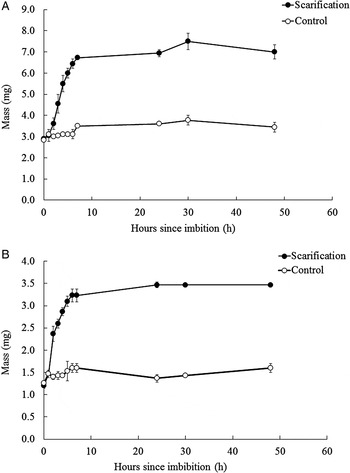
Seed mass at the end of the experiment differed significantly between populations and between treatments (F 2,7 = 56.62; P < 0.001). The initial mass of seeds from the TOT populations was 2.83 ± 0.06 mg (mean ± SE); this increased to 7.00 ± 0.33 mg in scarified seeds and 3.44 ± 0.22 mg in intact seeds after 48 h (Fig. 1). Only one of the non-scarified seeds was visibly swollen. Seeds of the TPA population initially weighed 1.27 ± 0.03 mg. After 48 h of imbibition, the seed mass had increased to 3.47 ± 0.03 and 1.60 ± 0.10 mg in scarified and non-scarified seeds, respectively. Some seeds had already started to germinate on day 2.
Change in mean seed mass during imbibition for scarified (closed symbols) and non-scarified (open symbols) seeds from two Hypseocharis populations (A) TOT and (B) TPA at 20°C. Error bars refer to standard error of the mean.

After 14 days, 93.3 ± 0.07 % of the scarified TPA and all scarified TOT seeds had germinated. None of the non-scarified seeds in either population had germinated after 14 days, but one swollen seed was observed in the TOT population.
Discussion
Seeds of both populations had water-impermeable seed coats, as shown by the imbibition curves. This is the first observation of physical dormancy in Hypseocharis, a genus basal in the Geraniaceae phylogeny. Together with the occurrence of physical dormancy in most of the Geranioideae and the fact that physical dormancy is a much conserved trait, this observation means that a water-impermeable seed coat almost certainly evolved in the Hypseocharis–Geranioideae ancestor. Little is known about the dormancy type in the other Geraniales families Vivianiaceae and Melianthaceae, although Baskin and Baskin (Reference Baskin and Baskin2014) listed Bersama abyssinica and Francoa sonchifolia (Melianthaceae) as being physiologically dormant.
Fiz et al. (Reference Fiz, Vargas, Alarcón, Aedo, García and Aldasoro2008) suggested that the split between Hypseocharis and the Geranioideae occurred about 55 million years ago (mya). According to the molecular dating of Palazzesi et al. (Reference Palazzesi, Gottschling, Barreda and Weigend2012), Hypseocharis and the other Geraniaceae started diverging more recently, about 36.9 (31.9–42.8) mya. Physical dormancy in the Geraniaceae thus may have evolved during the Eocene somewhere between 36 mya and 50 mya. It is suggested that during the Miocene, taxa such as Hypseocharis occurred in the warm and seasonally dry Patagonia in southern South America, and that increased cold and aridity associated with Antarctic ice-sheet development and the uplift of the Andes pushed them north where these events had less severe impacts (Palazzesi et al., Reference Palazzesi, Gottschling, Barreda and Weigend2012). DIVA analysis (data-interpolating variational analysis) indicated that the Geraniaceae ancestor occurred either in South America or South Africa (Fiz et al., Reference Fiz, Vargas, Alarcón, Aedo, García and Aldasoro2008). Further analyses are required to determine the area of origin of the Geraniaceae and Hypseocharis and to resolve the biogeographical events that resulted in the current distribution patterns and the circumstances during which physical dormancy in Geraniaceae evolved.
Seeds of Hypseocharis have other characteristics typical for physically dormant seeds, such as a large embryo, very little endosperm, a palisade of radially elongated seeds and relative high seed mass (Boesewinkel, Reference Boesewinkel1988). Based on these characteristics, Boesewinkel (Reference Boesewinkel1988) placed Hypseocharis close to the other Geraniaceae. Interestingly, Hypseocharis fruits are loculicidal capsules, thus differing from the beaked schizocarps typical for the Geraniodeae. Hypseocharis are probably not dispersed very far, as ripe fruits fall on the ground near the mother plant, while seeds are relatively large and exhibit no clear adaptations to wind or animal dispersal.
Further observations and experiments are required to determine timing of seedling emergence in the field, to resolve the factors breaking physical dormancy in nature and to assess seed longevity. As seeds are dispersed at the end of the wet season (March–April), a likely scenario would be that physical dormancy is broken during the dry season and that seeds germinate early in the wet season. However, experiments are required to confirm this scenario. In some temperate-climate Geraniaceae the seed coat becomes permeable to water during dry storage (Van Assche and Vandelook, Reference Van Assche and Vandelook2006; Vandelook and Van Assche, Reference Vandelook and Van Assche2010). This dry period requirement can prevent premature seed germination after incidental rains during the dry season. The fact that the Hypseocharis seeds in our experiment were still impermeable to water after 6 months of dry storage may indicate, however, that additional triggers are required to overcome physical dormancy. At first glance, seeds of Hypseocharis are not physiologically dormant as they germinated immediately after imbibition, but further tests with freshly collected seeds are required to confirm this observation.
Acknowledgements
We would like to thank Magaly Mercado and Dayne Agreda (both from Universidad Mayor de San Simon) for assistance with collecting the seeds.
Financial support
This work was supported by the Leopold III-Fonds voor Natuuronderzoek en Natuurbehoud, and Fonds Wetenschappelijk Onderzoek Flanders (grant number K200415N).
Conflicts of interest
None.