‘I had a home once and I ain’t forgot it – a home up over our little saloon down in Soledad’, the camp girl Minnie tells Jack Rance in David Belasco’s Girl of the Golden West, rebuffing him by recalling the love shared by her parents.Footnote 1 He demands; she evades by pointing away: an encounter that can be taken to be paradigmatic for the opera based on this play, Giacomo Puccini’s La fanciulla del West. There the principal librettist, Carlo Zangarini, re-arranged the text to open instead with the pointing gesture: ‘down there in Soledad, I was a little girl’ (‘Laggiù nel Soledad, ero piccina’). Puccini emphasises it even more. At ‘Laggiù’, her voice hovers, suspended, circling around e″; the orchestra, which had sounded a lush perpetuum-mobile chorale in support of Rance, suddenly drops away mid-phrase. Minnie touches down to an a′ at ‘Soledad’ and a new, sparser texture is heard, with only a staccato bass line, and quiet chords in the upper strings; flutes, clarinets, and horns play open fifths, pianissimo, where the libretto has commas. After this, ‘ero piccina’ continues as a mere afterthought.
‘Laggiù nel Soledad’ is Minnie’s single showpiece in an opera that is parsimonious with its lyricism, the only bit that sopranos are likely to record for their Puccini albums. And even there, amid the sultrier pleasures of ‘Sì, mi chiamano Mimì’, ‘Un bel dì’ and ‘Che il bel sogno di Doretta’, it runs the risk of being skipped – as it was almost inevitably when the present author, during her teenage years, was discovering the Puccini Heroines of Leontyne Price. Its peculiarities make ‘Laggiù nel Soledad’ a fitting representative of the opera as a whole. La fanciulla is an oddly fugitive work, almost but not quite doing what an opera by Puccini is expected to do. It is the not quite that interests me now: the way Puccini’s music here remains inscrutable and resistant to popular affection, even while accumulating critical favour; the way it seems to gesticulate wildly in an unreadable semaphore; the way that the melodies evade recollection.Footnote 2 The fact that the opera is still revived despite not flourishing during Puccini’s lifetime means that we can catch it repeatedly in its evasive act – its hollering, pointing and sidestepping cowboy dance.
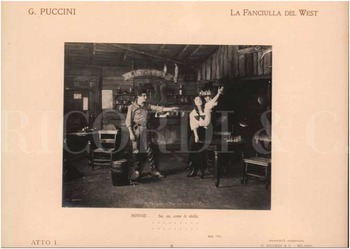
The pointing gesture at the opening of ‘Laggiù nel Soledad’ forces the music into a caesura, the accompaniment breaking off mid-phrase. In so doing it replicates musically the odd visual semiotics of Belasco’s play, whose characters were constantly pointing at things and at each other, arms straight at the elbows and index fingers outstretched. We know this because the firm of Byron in New York meticulously documented the first Girl of the Golden West, capturing stills from all of its important scenes, as well as recording its costumes, sets and props. Puccini, who had seen the play during a trip to the United States but could not have understood much of the language, studied these photographs while he was writing La fanciulla; he shared them with his principal librettist, Carlo Zangarini (whose English was also poor), and his publisher, Ricordi & Co. The traces of this encounter can be detected in the pictorialisms strewn throughout the opera, which point up and down as necessary, and also towards people, at objects and at things named, protruding from a musical unfolding that is otherwise continuous. For instance, the photograph of Bates in the saloon with a finger pointing straight upward corresponds to Minnie’s jarring melodic ascent at ‘up, up, up like the stars’ (Fig. 1: note how Johnson too points at what interests him). The caption within the image was helpfully supplied by Ricordi & Co., along with about forty other stills from the spoken play, to ensure that these gestures and all other important staging details were copied when La fanciulla circulated to other opera houses.Footnote 3 Puccini and his collaborators were insistent on this point: the opera must look precisely the same each time it was done.
(colour online) La fanciulla del West, ‘Su, su, come le stelle’ (Archivio storico Ricordi).

These pointing gestures reveal something important about La fanciulla, proclaiming the index to be the opera’s currency. The indexical sign, which points at its object, is a Peircean category allied with photography. It proclaims the uniqueness or ‘this-ness’ of the object, but also its contingency; the sign takes this shape because it exists in and reflects a world ruled by accident.Footnote 4 Nothing is hidden in the details of the indexical sign or image, and, as pure identification, it can be identified but not decoded. This opera’s preoccupation with chance is manifest in its many scenes of card playing, the motive of which makes an appearance in ‘Laggiù nel Soledad’ as Minnie recalls her parents’ gambling table. La fanciulla’s fascination with the singular and the contingent is also manifest in the sets, which fill the opera house to its rafters with details of historical ‘reality’, each pseudo-artefact jabbering its claims to having ‘been there’ through the carefully staged details of disarray. For instance, we know from the staging manual done for the premiere that Minnie sings most of ‘Laggiù nel Soledad’ sitting down at a large rectangular faro table fitted with the accoutrements of the game – decks of cards (which Rance has been shuffling nervously), faro board, balances – under a ceiling light with a ‘large shade’. Around the table are five wooden stools and four rustic chairs.Footnote 5 To her right is a large stuffed bear holding a sign painted with red letters, indicating the entrance to the ballroom.
Such a singularity also characterises many musical details of ‘Laggiù nel Soledad’, at least until its final bars. The aria claims this-ness for the objects at which Minnie points, through rarified orchestral textures: solo winds that articulate pianissimo chords just so; gentle finger-jabs from the pizzicato strings, solo harp and celeste. There are stretches of flatness – she chants much of the text near the bottom of her register – and, interspersed among them, sudden characteristic moments from the orchestra that respond directly to the text. For instance, when Minnie recalls the coming and going of guests, the strings, harp and percussion bustle briefly. As she remembers how her father dealt the cards for faro, and the gambling motive returns, this time it is sounded quietly by solo violin, for which Puccini has supplied an even more detailed set of articulations; when she describes her mother joining the game, her melody suddenly begins to leap around in staccato, like the bounded ricochets of a game chip. These motives and events are adjacent to one another without mutual entanglement. Throughout the aria (and in great stretches of the opera), Puccini uses inflections of Dorian, whole-tone and pentatonic scales, third relations, and parallel chords in root motion, to avoid not only long-range tonal momentum but also even the gentle ebb and flow of tension. The planar harmonic language creates a sense that the music is hosting this string of indices rather than generating it.
Apart from a return of the unaccompanied pointing gesture a few lines in, along with its punctuating winds, no music is repeated in ‘Laggiù nel Soledad’, not a single phrase, snippet of melody or motive. In formal terms this is extreme but not unheard of. After all, Puccini often opened such numbers with stretches of expository music, all the better to feed expectations of a soaring climax (as in ‘Sì, mi chiamano Mimì’). Something like that happens here, but again, not quite. The full orchestra resumes for the final three lines of text, surging from piano to fortissimo in four brief bars as Minnie recalls how her parents ‘loved each other so!’ Yet the ungainly way the vocal line hurdles its way to a high C from almost two octaves below, leaping upward again and again, as the orchestra thumps out a functionally inert progression between C major and A minor (again, mostly in root position), undermines what might otherwise be the return to a more familiar modus operandi for the composer. The problem is that opera’s musical language, adept at pointing at and with its characters, cannot quite shake out its stiff limbs in time to caress them.