Improving antibiotic use to slow the emergence of antibiotic resistance and decrease Clostridium difficile infections is a national priority. 1 The Infectious Diseases Society of America, Society for Hospital Epidemiology of America, and Centers for Disease Control and Prevention (CDC) provide recommendations for implementing antibiotic stewardship interventions in hospitals.Reference Barlam, Cosgrove and Abbo 2 , 3 Most of these interventions are geared toward improving antibiotic use during the hospitalization itself; however, a number of studies have demonstrated that for common infections, approximately two-thirds of the total treatment course is completed after the patient is discharged.Reference Jenkins, Knepper and Sabel 4 – Reference Yogo, Haas and Knepper 8 In addition, antibiotics dispensed at the time of hospital discharge are frequently suboptimal due to an overly broad spectrum of activity or excessive duration.Reference Yogo, Haas and Knepper 8 Thus, antibiotic stewardship interventions focused solely on inpatient antibiotic use may ignore a substantial component of antibiotic misuse. New interventions are necessary to address this important opportunity for antibiotic stewardship. We developed an intervention specifically focused on improving hospital discharge antibiotic prescribing. We hypothesized that such an intervention would decrease unnecessary antibiotic exposure by reducing the use of antibiotics with broad gram-negative activity and by shortening treatment durations.
METHODS
Study Setting and Population
Denver Health is an urban, academic, integrated healthcare system with a 477-bed teaching hospital. Most inpatients are admitted to medical or surgical teaching services; a minority are managed by a nonteaching hospitalist service. For patients admitted to teaching services, resident house staff are primarily responsible for management orders, including antibiotic prescriptions at hospital discharge.
Intervention
Based on data from our institution demonstrating substantial opportunity to improve discharge prescribing,Reference Yogo, Haas and Knepper 8 we implemented a multifaceted intervention with 2 main components: (1) the development and dissemination of an institutional guideline for oral step-down antibiotic selection and duration of therapy for common infections, and (2) prospective audit of discharge prescriptions with real-time recommendations to providers to promote adherence to the institutional guideline.
Guideline for discharge therapy
We developed a table with institution-specific recommendations for oral step-down therapy and treatment duration for the following conditions: community-acquired pneumonia (CAP); urinary tract infection (UTI) including uncomplicated cystitis, complicated cystitis, uncomplicated pyelonephritis, and catheter-associated infection; skin infections including cellulitis, cutaneous abscess, or wound infection; healthcare-associated and hospital-acquired pneumonia; chronic obstructive pulmonary disease (COPD) exacerbation; Clostridium difficile infection; and Helicobacter pylori infection (Online Supplementary Figure 1). The recommendations were obtained from a combination of preexisting institutional clinical practice guidelines and national guidelines.Reference Stevens, Bisno and Chambers 9 – 15 The final version of the guideline was approved by the Antimicrobial Subcommittee, the Pharmacy and Therapeutics Committee, the hospital’s Clinical Guidelines Committee, and the Chief Clinical Officer.
In September 2014, data supporting the rationale for the intervention and the discharge prescribing guidance were presented to house staff, attending physicians, and pharmacists. Laminated pocket-sized copies of the guideline were provided to all clinicians and pharmacists, and an electronic copy was posted on the hospital intranet. Throughout the intervention period, the chief medical resident and the infectious diseases pharmacist distributed the pocket cards to all incoming house staff and faculty during orientations. An institutional smartphone application containing all of Denver Health’s antibiotic treatment recommendations, including for the target conditions listed above, was made available to all providers in November 2014.
Prospective audit with real-time feedback to prescribers
Staff pharmacists were trained by the ID pharmacist to cross-reference prescriptions for oral antibiotics submitted to the discharge pharmacy with the institutional guideline. Beginning in September 2014, when the prescription did not appear to be consistent with the guideline, the ID pharmacist was contacted to perform a review of pertinent clinical and laboratory data. When appropriate, the prescribing physician was contacted to recommend modifications to the discharge prescription to promote adherence to the institutional guideline. The frequency and result of these audit and feedback episodes were recorded using a standardized reporting form. Prior to the start of the intervention, the audit and feedback process was pilot-tested for a 3-week period to determine feasibility and the impact on the discharge process.
Study Design
To determine the effects of the intervention, we performed a quasi-experimental, retrospective cohort study including adult inpatients prescribed an oral antibiotic at the time of hospital discharge before and after the intervention. The preintervention cohort was a previously published cohort discharged between July 1, 2012, and June 30, 2013.Reference Yogo, Haas and Knepper 8 The intervention cohort included patients discharged between October 1, 2014, and February 28, 2015.
Data Collection
Identical case-finding methods and data collection procedures were used for both time periods.Reference Yogo, Haas and Knepper 8 Patients aged 18 years or older who filled a prescription for oral antibiotic(s) at a Denver Health pharmacy within 7 days of hospital discharge were initially identified through the institution’s data warehouse. To determine eligibility, to derive the study cohorts, and to abstract data for included cases, electronic health records were manually reviewed by a single investigator (N.Y.). The following exclusion criteria were used: antibiotic prescriptions unrelated to the hospital stay, intravenous antibiotics at discharge, long-term prophylactic or suppressive antibiotics, absence of documentation of the indication for antibiotics, transfer to or from an outside institution, leaving against medical advice, failure to fill prescribed antibiotics within 48 hours of hospital discharge, infection with nonbacterial pathogens, and multiple hospitalizations for the same ongoing infection. For patients with multiple hospitalizations over the course of the study, only the initial hospitalization resulting in an oral antibiotic prescription was included. A standardized data abstraction form was used to record the following information: demographic and clinical characteristics, microbiologic data, inpatient antibiotic therapy, discharge antibiotics (indication, agent, dose, and treatment duration), and clinical encounters within the Denver Health system during the 30 days following hospital discharge.
The study was approved by the Colorado Multiple Institutional Review Board.
Appropriateness Review
To assess the appropriateness of discharge prescriptions, 2 infectious diseases physicians (T.J. and H.Y.) and 1 infectious diseases pharmacist (K.S.) reviewed the data abstraction form and discharge summary for a random sample of 100 cases from the preintervention and intervention periods (50 per period). To blind these investigators to the time period of each case, the lead investigator (N.Y.) redacted service dates and other potentially identifying information from the documents reviewed. After discussion of each case among the 3 investigators, a prescription was classified as appropriate when at least 2 judged the indication, antibiotic selection, dose, and prescribed duration to be consistent with institutional guidance. With respect to duration of therapy, prescribed durations ≥2 days longer or shorter than recommended in the institutional guidance were classified as inappropriate. For infections without institutional guidance, the assessment of appropriateness was based on national guideline recommendations, or if none existed, expert opinion.
Outcomes
All end points were specified prior to the study. The primary outcomes were changes in the total prescribed duration of therapy, defined as the number of calendar days of inpatient antibiotics plus the duration prescribed at discharge, and the proportion of patients prescribed antibiotics with a broad spectrum of gram-negative activity, defined as fluoroquinolones or amoxicillin/clavulanate. Secondary end points included change in the appropriateness of discharge prescriptions and rates of dermatologic, gastrointestinal, or nephrotoxic adverse drug events, rehospitalization, C. difficile infection, and treatment failure within 30 days of discharge. Treatment failure was defined as a change in antibiotic regimen or extension of planned treatment duration due to inadequate clinical response. Given their relative frequency, subgroup analyses for cases involving CAP, UTI, and skin infection were performed to evaluate for changes in antibiotic selection and duration of therapy.
Statistical Analysis
Based on preintervention period dataReference Yogo, Haas and Knepper 8 and the results of prior antibiotic stewardship interventions at our institution,Reference Jenkins, Knepper and Sabel 4 , Reference Haas, Dalton and Knepper 16 we hypothesized that the current intervention would reduce prescription of antibiotics with broad gram-negative activity from 51% of cases to 38% (25% relative reduction) and that the median treatment duration would decrease from 10 days to 8 days (20% reduction). We calculated that by including the 300 existing cases from the preintervention period, a minimum of 200 cases in the intervention period would be necessary to provide at least 80% power at an α of 0.05 to detect the differences we hypothesized. To determine the number of cases that would need to be reviewed to assess for a change in the appropriateness of discharge prescriptions, we hypothesized that the proportion of discharge prescriptions classified as appropriate would increase from 47% to 66% (40% relative increase), and we determined that 100 cases (50 in each group) were needed to provide 80% power at an α of 0.05 to demonstrate the hypothesized difference. The Pearson χ2, Fisher’s exact, and Wilcoxon rank-sum tests were used to perform comparisons between the periods, as appropriate. P values <.05 were considered statistically significant. All analyses were performed using SAS version 9.3 (SAS Institute, Cary, NC).
RESULTS
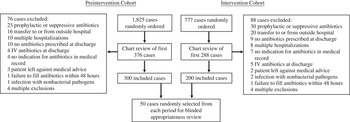
For the 12-month preintervention period, the initial electronic search yielded 1,825 cases with an oral antibiotic prescribed at discharge; among them, 376 were manually reviewed and 300 were included for analysis (Figure 1). For the 5-month intervention period, 777 cases were identified in the initial search; among these, 288 cases were manually reviewed and 200 were included for analysis. The frequency of reasons for exclusion were similar between the 2 periods (Figure 1). Nearly all antibiotics were filled within 24 hours after hospital discharge: 295 (98%) preintervention and 197 (99%) during the intervention.
Study diagram. In the preintervention study period, 1,825 adult cases were identified electronically. In total, 376 charts were manually reviewed until a total of 300 included cases was reached. In the intervention period, 777 adult cases were identified electronically. Overall, 288 charts were manually reviewed until a total of 200 included cases was reached. Furthermore, 50 included cases from each period were randomly selected for blinded appropriateness review.

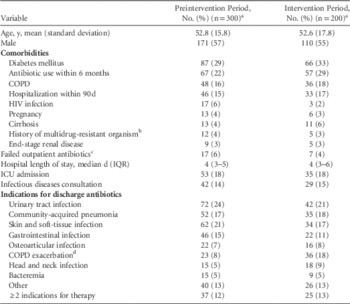
There were no significant differences between the 2 groups in baseline demographic and clinical characteristics (Table 1). The most common indications for the discharge antibiotic prescriptions were UTI, CAP, and skin infections (Table 1). The frequencies of indications were similar among the 2 groups; however, there were significantly more COPD exacerbations during the intervention period (8% preintervention vs 18% during the intervention; P=.001).
Demographic and Clinical Characteristics of Patients Discharged on Oral Antibiotics

NOTE. COPD, chronic obstructive pulmonary disease; HIV, human immunodeficiency virus; IQR, interquartile range; ICU, intensive care unit.
a No significant differences between preintervention and intervention cohort were observed (P>.05 for all subgroups) with the exception of COPD exacerbation.
b Defined as prior infection with methicillin-resistant Staphylococcus aureus, vancomycin-resistant Enterococci, or extended-spectrum β-lactamase producing Enterobacteriaceae.
c Defined as lack of clinical response to outpatient therapy requiring hospital admission.
d COPD exacerbations were significantly more frequent in the intervention cohort (P=.001).
Microbiology testing and results were similar between the 2 groups: 74% of patients in the preintervention period and 76% of patients in the intervention period had at least 1 specimen collected for culture, and 31% and 29% of patients, respectively, had a positive culture. The most common organisms identified were Escherichia coli (10% preintervention vs 11% during the intervention), Streptococcus spp. (8% vs 11%), and Staphylococcus aureus (7% vs 4%).
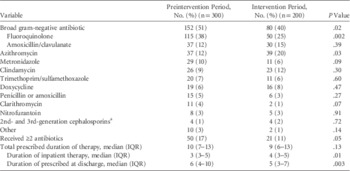
In total, the proportion of patients discharged with antibiotics with broad gram-negative activity significantly declined during the intervention (51% preintervention vs 40% during the intervention; P=.02). This result was primarily due to a reduction in prescription of fluoroquinolones (38% preintervention vs 25% during the intervention; P=.002) (Table 2). Prescription of azithromycin increased during the intervention period (12% preintervention vs 20% during the intervention; P=.03). The reduction in the total prescribed duration of therapy from a median of 10 days preintervention (interquartile range [IQR], 7–13 days) to 9 days during the intervention (IQR, 6–13 days) was not statistically significant. However, the duration prescribed at hospital discharge significantly declined from a median of 6 days preintervention (IQR, 4–10 days) to 5 days during the intervention (IQR, 3–7 days) (P=.003).
Antibiotic Selection and Prescribed Duration of Therapy

NOTE. IQR, interquartile range.
a Includes cefdinir, cefixime, cefpodoxime, and cefuroxime.
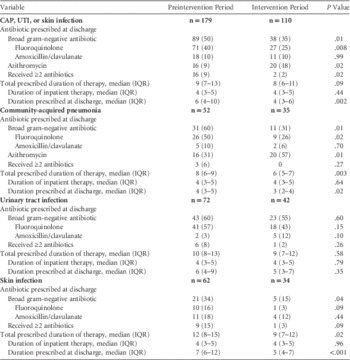
In subgroup analyses of 179 cases of CAP, UTI, or skin infection from the preintervention period and 110 cases from the intervention period, the findings were similar but more pronounced (Table 3). Discharge prescriptions for antibiotics with broad gram-negative activity declined from 50% preintervention to 35% during the intervention (P=.01), and discharge prescriptions for multiple antibiotics declined from 9% to 2% (P=.02). The reduction in the total prescribed duration of therapy from a median of 9 days (IQR, 7–13 days) to 8 days (IQR, 6–11 days) was not statistically significant (P=.09), but the duration prescribed at discharged decreased from a median of 6 days (IQR, 4–10) to 4 days (IQR, 3–6 days), which was statistically significant (P=.002). The changes in discharge prescribing were particularly pronounced in cases of CAP and skin infections; in cases of UTI, little change occurred (Table 3).
Subgroup Analyses of Cases of Community-Acquired Pneumonia, Urinary Tract Infection, or Skin Infection

NOTE. CAP, community-acquired pneumonia; UTI, urinary tract infection; IQR, interquartile range.
Appropriateness of Discharge Prescriptions
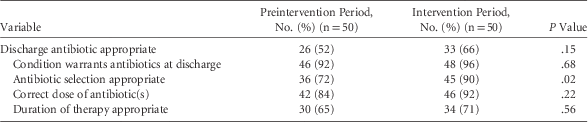
In the random sample of 100 cases for which the infectious diseases specialists performed a blinded assessment of the appropriateness of the discharge prescriptions, the overall appropriateness of the prescriptions during the intervention period increased from 52% to 66%, but was not statistically significant (P=.15) (Table 4). Antibiotic selection was more frequently appropriate during the intervention (72% vs 90%, P=.02).
Appropriateness of Discharge Prescriptions as Classified During Blinded Infectious Diseases Panel Review

Pharmacy Audit and Feedback of Discharge Prescriptions
During the 5-month intervention period, 918 patients were prescribed oral antibiotics at discharge. Among these patients, the prescriptions from 363 (40%) cases were reviewed by a pharmacist. In 99 of the 363 cases reviewed (27%), a provider was contacted by telephone to discuss the prescription. A recommendation to change the discharge prescription was made in 85 cases; 66 of these recommendations (67%) were accepted. The most common reasons prompting a recommendation to change the prescription were opportunities to optimize antibiotic choice (n=29; 44%), to optimize dose (n=28; 42%), and/or to reduce treatment duration (n=20; 30%).
Clinical Outcomes
A follow-up encounter within 30 days of hospital discharge was documented in 209 (70%) cases in the preintervention period and in 144 cases (72%) in the intervention period. There were no significant differences in the incidence of treatment failure (15% preintervention vs 15% intervention), readmission for the same condition (8% vs 8%), C. difficile infection (2% vs 0%), or adverse drug events (7% vs 3%).
DISCUSSION
To our knowledge, this is the first description of an antibiotic stewardship intervention designed specifically to optimize oral antibiotic prescriptions at the time of hospital discharge. Several previous studies have demonstrated that for infections commonly managed in the hospital, 60%–70% of the total antibiotic course is completed after discharge.Reference Jenkins, Knepper and Sabel 4 – Reference Yogo, Haas and Knepper 8 Thus, ensuring appropriate antibiotic selection at discharge represents an important opportunity to reduce use of antibiotics with overly broad-spectrum activity. Furthermore, because the total duration of therapy is determined by the duration of the discharge prescription, the discharge prescription is the critical point at which to intervene to shorten treatment durations.
Clinical care guidelines often include recommendations for inpatient therapy, the transition to oral therapy, and treatment durations. Our intervention was unique in that it did not attempt to alter inpatient prescribing but rather focused on the discharge prescription. The tools that we developed provided clinicians with point-of-care access to the most appropriate discharge antibiotic and the shortest effective duration of therapy for common infections. To our knowledge, this is the first description of a stewardship intervention incorporating prospective audit with provider feedback of discharge prescriptions. The audit and feedback process was intended to correct prescriptions that did not adhere to institutional guidance. Our data show that <50% of all prescriptions were reviewed by pharmacists, which may have been due in part to evening and weekend discharges when prescriptions were not reviewed. Notably, of the prescriptions reviewed, a recommendation to change therapy was required in <25% of cases. Ideally, as more providers become familiar with the institutional discharge prescribing guidance, even fewer interventions by pharmacy would be required over time; however, the longer-term sustainability and effectiveness of this intervention is not known and requires additional study.
Notably, the intervention had a more robust impact on prescribing for the subgroup of cases involving CAP, UTI, or skin infections. Interestingly, the greatest changes in prescribing were observed in CAP and skin infections, conditions for which successful syndrome-specific antibiotic stewardship interventions had been implemented in our hospital prior to the preintervention period of this study.Reference Jenkins, Knepper and Sabel 4 , Reference Haas, Dalton and Knepper 16 These prior interventions had led to substantial reductions in use of antibiotics with broad gram-negative activity and shorter treatment durations. Despite these prior improvements, the current intervention led to additional reductions in broad-spectrum antibiotic use and treatment durations. In contrast, the current intervention was not associated with significant changes in prescribing for UTIs, which had not previously been a focus of intervention in our hospital. Although the reasons for the variable success of this intervention on particular infections cannot be determined from this study, our findings suggest that the intervention may be most effective as a complementary approach to syndrome-specific stewardship interventions. A multilevel intervention that actively targets both inpatient and discharge prescribing may therefore have the greatest impact on antibiotic use.
Our study has several limitations. First, it was performed at a single academic safety-net hospital, which limits its generalizability. Second, by including all types of infections in the analysis, the effect of the intervention was likely diluted because the intervention was most likely to affect prescribing for a targeted group of infections. We designed the study in this manner to provide the most complete assessment of the overall impact of the intervention on discharge antibiotic use, to avoid the potential selection bias associated with limiting the analysis to certain infections, and because the intervention had the potential to impact prescribing for all types of infections. Third, there was a relatively long gap between the preintervention period and the start of the intervention because the intervention itself was designed and implemented after the collection of and in response to the preintervention period data.Reference Yogo, Haas and Knepper 8 We are not aware of any factors that would have impacted hospital discharge prescribing practices during this time. Fourth, although an interrupted time series analysis would have been the preferred statistical approach in this setting, such an analysis was not feasible given the lack of sufficient time points over the short intervention period. Fifth, seasonal variation in infections (and therefore prescribing patterns) was a potential confounding factor because the intervention spanned the winter months. This is likely why COPD exacerbations were more common during the intervention period, and this factor may have biased our results toward the null because COPD exacerbations are routinely treated with 5-day courses of azithromycin and were unlikely to have been impacted by the intervention. Sixth, the study was not designed to determine the effects of the individual components of the intervention but rather the effects of the bundled intervention. The impact of audit and feedback of discharge prescriptions, the component of the intervention requiring ongoing personnel time, is therefore not known. Finally, the study may have been underpowered to detect differences in total duration of therapy and appropriateness of discharge prescriptions.
In summary, a novel intervention combining institutional guidance for oral step-down antibiotic selection and duration of therapy with pharmacy-led audit of discharge prescriptions with feedback to providers led to a decrease in the use of antibiotics with broad gram-negative activity and to shorter postdischarge treatment courses. The intervention was particularly effective in cases of CAP and skin infection. Antibiotic prescribing at the time of hospital discharge may be an underappreciated opportunity to improve overall antibiotic use for common infections, and intervening at this point in time may be an important complement to currently recommended antibiotic stewardship interventions.
ACKNOWLEDGMENTS
We are grateful to Allison Nitsch, Elsbeth Jensen-Otsu, and the hospitalist group at Denver Health for their contributions to this project.
Financial support: This work was funded in part by the Department of Patient Safety and Quality, Denver Health. Dr. Jenkins was supported by the National Institute of Allergy and Infectious Diseases, National Institute of Health (T.C.J., grant no. K23 AI099082).
Potential conflicts of interest: All authors report no conflicts of interest relevant to this article.
SUPPLEMENTARY MATERIAL
To view supplementary material for this article, please visit https://doi.org/10.1017/ice.2017.10.