I. INTRODUCTION
At the end of March 1975, while Augusto Pinochet was in power, Milton Friedman visited Chile. For six days he participated in seminars, met with government officials, gave public talks, and gave several interviews to newspapers and magazines. At the time, the main economic challenge in Chile was inflation. Although it had fallen from its peak of almost 700% in 1973, by the end of 1974 it was still 369%. During a forty-five-minute meeting with Pinochet, Friedman suggested, among other measures, a sharp reduction in the rate of growth of the money supply and a drastic cut in government expenditure. Within a month he sent Pinochet a letter in which he summarized these recommendations. This visit generated much debate and scholarly attention.Footnote 1 More than twenty years later, Friedman felt the need to set the historical record straight. In his 1998 autobiography (with his wife, Rose), he devoted a complete chapter to this polemical trip (Friedman and Friedman Reference Friedman and Friedman1998, ch. 24, pp. 397–408), plus an appendix with documents on Chile (ibid., pp. 591–602).
On October 14, 1976, a year and a half after this visit, the Royal Swedish Academy of Sciences announced that Milton Friedman was the winner of that year’s Prize in Economic Sciences in Memory of Alfred Nobel. Ten days after the academy announced the award, the New York Times published two letters by previous Nobel laureates criticizing Friedman’s alleged role as an adviser to the Pinochet regime.Footnote 2 The controversy did not die after Friedman received the prize. Critics of market orientation and neoliberalism continued to argue that Friedman was an accomplice of Pinochet and his henchmen.
Friedman traveled to Chile a second time in November 1981, when Pinochet was still in power. In contrast to his 1975 trip, this second visit generated no international interest. In fact, even devoted followers of Friedman and his thinking are generally unaware of this voyage. This is surprising, as this visit took place a few months before the eruption of a major financial and currency crisis that resulted in a generalized collapse of Chile’s banking sector, and generated unemployment in excess of 25%.
An important question regarding Friedman and Chile is whether the success of the Chilean economy—it grew at almost 6% on average for fifteen years (1986 to 2000)—was due to the implementation of Friedman-inspired policies, or if, on the contrary, Chile did well in spite of the policies undertaken during the early years of the military dictatorship. This question is related to the deep and extremely costly currency and banking crisis of 1982, a crisis that resulted in a collapse in GDP (14% in 1983) and skyrocketing unemployment. The crisis also resulted in the ousting from the government of the old guard of the “Chicago Boys.”Footnote 3 According to Joseph Stiglitz, this crisis was the result of fixing the exchange rate at an artificially high level and deregulating the banking sector too fast and too broadly. In an extensive interview for the 2002 documentary The Commanding Heights, Stiglitz said: “[W]hen they [the military] followed Friedman’s prescription, Chile had a crisis; the free banking experiment that was done under the intellectual leadership of that free market hypothesis … [resulted in] the kind of bank boom and pause that we’ve seen around the world.”
From there Stiglitz went on to state that the good performance of the Chilean economy after 1985 was not “an example of the free market; it’s an example of a success of combining markets with appropriate regulation.”Footnote 4 Stiglitz was not the only prominent critic of Friedman’s involvement in Chile. In a 2010 article titled “Fantasies of the Chicago Boys,” Nobel prizewinner Paul Krugman argued that Chile’s rapid growth in the 1980s and 1990s was not the result of Chicago-oriented policies; according to him, it was the consequence of positive external conditions that triggered massive capital inflows and foreign direct investment.Footnote 5
The controversy on Friedman’s role in Chile’s economics and politics has had considerable staying power and lingers until today. Scholars and public intellectuals continue to discuss his legacy. For example, in a 2010 article published in the Guardian, Naomi Klein stated:
After the coup and the death of [President Salvador] Allende, Pinochet and his Chicago Boys did their best to dismantle Chile’s public sphere, auctioning off state enterprises and slashing financial and trade regulations. Enormous wealth was created in this period but at a terrible cost: by the early 80s, Pinochet’s [Milton] Friedman-prescribed policies had caused rapid de-industrialisation, a tenfold increase in unemployment and an explosion of distinctly unstable shantytowns. They also led to a crisis of corruption and debt so severe that, in 1982, Pinochet was forced to fire his key Chicago Boy advisers and nationalise several of the large deregulated financial institutions.
(Klein Reference Klein2010)Other recent participants in this debate include Timothy Clark (Reference Clark2017, Reference Clark2018), José Ahumada (Reference Ahumada2019), Johanna Bockman (Reference Bockman2019), and Claudia Kedar (Reference Kedar2019).Footnote 6 Milton Friedman’s views on monetary policy, exchange rates, and fiscal “shocks” have been recently discussed by authors such as Douglas Irwin (Reference Irwin2018), James Forder (Reference Forder2018a), and Edward Nelson (Reference Nelson2018).
In this paper we analyze in great detail Friedman’s two visits to Chile, and the relation between his thinking and the economic policies implemented by the Chicago Boys and supported by Pinochet. Our analysis differs from previous work in two important respects. First, we focus on the reaction to Friedman’s visits, not only internationally but also in Chile. This analysis is based on press archives, on the memoirs and recollections of some of the key Chicago Boys, and on interviews with some of the main actors, including those who were present during Friedman’s meeting with Pinochet. While there have been numerous discussions on the international reaction (in the United States and Europe, mostly) to Friedman’s first visit, very few authors have focused on how he was received in Chile. Second, we analyze the 1981 visit, when he attended a meeting of the Mont Pèlerin Society in Viña del Mar in November of that year. In this part of the paper we concentrate, in particular, on what Friedman said—or failed to say—with respect to Chile’s experiment with fixed exchange rates. Was he critical about the government’s experiment with pegged rates, implemented in 1979? Did he ring an alarm bell regarding the dangers of such a policy? Was he consistent with his view that flexible exchange rates were preferable for all types of countries, including the poor ones?Footnote 7 Answering these questions is important to evaluate the extent to which Friedman’s policies affected the performance of the Chilean economy. We also discuss what Friedman said on that occasion on the relation between economic and political freedom.
II. BRIEF HISTORICAL BACKGROUND: THE PINOCHET COUP AND THE CHICAGO BOYS
The Chicago Boys’ role in the military government was initially restricted to being advisers. During the early months, the military gravitated towards conventional views, including protectionism and control, and appointed traditional industrialists to senior government positions. As Juan Valdés (Reference Valdés1995) has pointed out, it was only slowly that the Chicago Boys’ views became dominant.Footnote 8 This gain in influence was the result of two factors: first, the original gradualist approach to solving the Unidad Popular economic imbalances—and especially to eliminating inflation—did not work out as anticipated; and, second, in the midst of the crisis, the Chicago Boys’ proposed policies appeared to be internally consistent.Footnote 9
Jorge Cauas, a respected Christian Democrat who had been vice-governor of the Central Bank during Frei Montalva’s government, was named minister of Finance in July 1974. He shifted gears and moved away from gradualism. The new approach was publicly announced on April 24, 1975, shortly after Friedman’s first visit. The “National Recovery Plan” was based on major and across-the-board cuts in government expenditures and on a very significant reduction in the rate of money creation by the Central Bank. During the next two years the economy was opened to international competition and a privatization program was put in place.Footnote 10 Most banks and more than 500 state-owned enterprises—many of which had been expropriated during the Allende years—were privatized and many regulations were eliminated.Footnote 11 In late 1977 the program appeared to be paying off. Inflation had declined to 84% that year and GDP was growing at almost 10% per annum. The implementation of the Chicago Boys’ economic program was neither easy nor straightforward. In particular, industrialists who had benefitted from decades-high import tariffs strongly opposed the opening up of the economy and the deregulation of business.
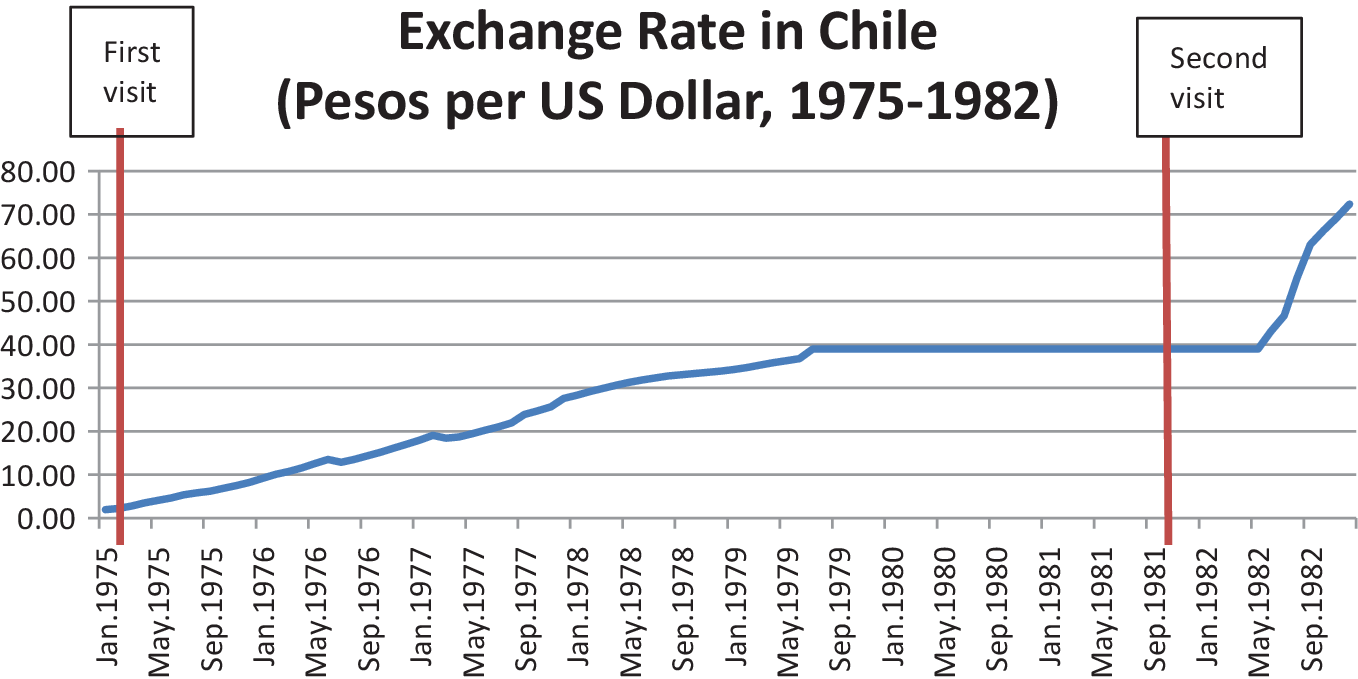
In June 1979 the government decided to use the exchange rate as an anchor to bring inflation down to 3% to 4% per year. The currency was fixed at a rate of thirty-nine pesos per dollar. Inflation, however, declined more slowly than anticipated, and the real exchange rate strengthened significantly. As in other stabilization attempts with exchange rate anchors, an increasingly large external deficit, which was mostly financed by short-term capital inflows, developed. By mid-1982, merely nine months after Friedman’s second visit, the situation became untenable and the government was forced to devalue the currency. A major financial crisis ensued. The economy contracted by 14% and unemployment exceeded the astonishing level of 25%.Footnote 12
The years that followed were painful and difficult. After wavering, Pinochet decided to maintain the market-oriented policies and to strengthen the institutional framework of the embryonic market system. By 1984 Chile had recovered from the currency collapse. Between the years 1984 and 1989, and as a result of the combination of a competitive currency and increased productivity stemming from the reforms, Chile experienced an average rate of growth of real GDP of almost 7% per annum. Investment in capital, machinery, equipment, and infrastructure grew at a rapid pace.
In 1990, after seventeen years of dictatorship, Chile returned to democratic rule. Many members of the country’s new political leadership had been imprisoned and persecuted by the military, and a number of them had been tortured and sent to exile. Nonetheless, the leaders of the democratic political parties that formed the Concertación coalition recognized the success of the economic policies. President Patricio Aylwin and his economic team led by Alejandro Foxley decided to deepen both the economic and institutional reforms initiated by the Chicago Boys.Footnote 13
From a historical perspective, the overall results of the reforms are impressive: for over two decades Chile’s exports grew at double-digit rates. Furthermore, during this period social conditions improved markedly. The number of people living below the World Bank’s poverty line fell from 24% of the population in 1989 to 5% in 2016. There was also some progress in reducing income inequality. Although the pace was slow, the Gini coefficient declined from 0.59 in 1989 to 0.49 in 2016. The safety net was widened, and transfers to the poor and the elderly increased substantially. In the second half of the 2000s, efforts were made to provide universal preschool education and to increase the number of university scholarships to low-income students. One way to illustrate the success of the economic reforms is to compare Chile’s performance with that of other Latin American countries over a relatively long period of time. During the period from 1981 to 1985, Chile’s income per capita was almost identical to that of Ecuador and Costa Rica. All three countries had an income per head of $3,670, measured in purchasing power parity terms. More than thirty years later, in 2017, Ecuador had an income per capita of $11,617. That same year, Costa Rica’s was $17,044. Chile’s income per capita reached $24,635.
III. PROFESSOR FRIEDMAN GOES TO CHILE
Milton Friedman arrived in Santiago, with his wife, Rose Friedman, University of Chicago Professor Arnold C. Harberger, and Brazilian economist Carlos Geraldo Langoni, on Thursday, March 20, 1975. They had been invited by Fundación de Estudios Económicos BHC, a private foundation associated with the Banco Hipotecario de Chile, the holding company of Chile’s largest financial and industrial conglomerate (Friedman and Friedman Reference Friedman and Friedman1998, pp. 398–399).Footnote 14
The day after their arrival, Friedman and Harberger met with Pinochet in “a meeting that extended from 17:30 until 18:15 approximately” (El Mercurio, Saturday, March 22, 1975; cf. Friedman and Friedman Reference Friedman and Friedman1998, p. 399).Footnote 15El Mercurio, Chile’s most important newspaper, also reports that on Friday and Saturday morning, the three economists were to meet with government officials and leaders of the private sector. On Saturday afternoon they would travel to Viña del Mar, visiting, on the way, some recently privatized agribusiness in the area. They spent the night at the coastal resort, and on Sunday, Friedman gave his first lecture at Universidad Técnica Federico Santa María. The group returned to Santiago that same night (El Mercurio, Saturday, March 22, Reference Friedman1975).
Friedman and the Chilean Press
During his visit, Friedman gave a number of interviews. The first one was published by El Mercurio on Saturday, March 22, 1975. Friedman talked about inflation in the US and pointed out that it was stubborn and about to re-emerge; he referred to the US economic situation as one of a “retarded or continuous recession.” Friedman also talked about the “energy crisis.” He argued that it was a temporary situation caused by the OPEC cartel, and predicted that in the long run the agreement to raise prices would fail. Friedman also talked about the international financial system, growth, and unemployment in the US. Towards the end of the interview, he addressed foreign aid policies, and pointed out that there were costs associated with redistribution from rich to poor countries. In this first interview, Friedman did not say anything about Chile.
On Sunday, March 23, El Mercurio published front-page interviews with the three economists. The piece pointed out that the visitors were somewhat “reluctant” to opine about Chile before the seminar organized by Fundación de Estudios Económicos BHC. In spite of this reluctance, they finally agreed to answer a few questions about the Chilean situation.
Arnold Harberger pointed out that monetary policy continued to be extremely loose; in his view that explained the persistence of high inflation (369% in 1974) and the delay in economic recovery. Friedman was asked if Chile was “a sick country with an economic disease.” He replied: “I can assure you that the patient is very strong. I think its disease is temporary and my diagnosis is that the patient suffers from a virus called ‘fiscal deficit’ with monetary complications.” Regarding the remedy for such illness, Friedman said that “social market economy is the only medicine. Absolutely. There is no other way. There is no other long term solution. No country in the world has been successful in improving its economy using any other method than the free market.” Then, when asked about the social costs of stabilization, in terms of unemployment, Friedman said:
Undoubtedly there are costs. But unfortunately there is no other alternative. Anyway, I believe that the current situation is better than 18 months ago [at the end of Allende’s government]. Possibly it could have improved more, but when the patient is ill, there is no easy solution. The oxygen, in this case, would worsen the patient’s condition, instead of curing him. The policy of a palliative instead of amputating the sick parts entails the danger of a final cost that is higher than the one we are trying to avoid. The alternative that Chile faces, in my view, is a high unemployment rate for a short period, or stagnation and high inflation in the longer run. When one is ill, you can only choose between a major or minor evil.
When the journalist asked whether the low price of copper was responsible for Chile’s economic stagnation, Friedman bluntly replied: “Chilean problems are made in Chile” (El Mercurio, Sunday, March 23, Reference Friedman1975).
The seminars sponsored by Fundación de Estudios Económicos BHC began on Monday, March 24, 1975. During the first talk Langoni analyzed the reforms in Brazil.Footnote 16 Harberger, who had been in Chile three times during the previous nine months, gave his diagnostic about the Chilean situation on Tuesday. On Wednesday, March 26, Friedman closed the seminar series with his assessment of the Chilean economy. According to El Mercurio he said: “The cause of inflation is always the quantity of money; this is the case in Chile.” He added that “the only way to end inflation in Chile is eliminating drastically the fiscal deficit, preferably reducing public spending.” And he famously argued that the country should choose a “shock treatment” like the one applied in Japan and Germany after the Second World War. This meant, he explained, “eliminating price and wage controls, strengthening the fiscal situation in order to eradicate the fiscal deficit, and keeping a strict limit on the quantity of money.” Friedman also called for “eliminating the 0’s from currency as a psychological measure, reducing public expenditure by 20 or 25 per cent, and suppressing all restrictive measures that hamper the emergence of a strong and dynamic private sector.”Footnote 17
Friedman also gave interviews to two magazines (Qué Pasa, no. 206, April 3, 1975; and Ercilla, no. 2070, April 4, Reference Friedman1975). Qué Pasa’s cover has a photo of Friedman playing tennis at the Sheraton Hotel in Santiago. The issue’s main title is “Raquetazos en la Política Económica, ” which may be loosely translated as “beating up economic policy with a tennis racquet.”Footnote 18 The interview is preceded by an article about the visitors’ activities in Chile. The piece, most probably written by Emilio Sanfuentes, one of the magazine’s founders and himself a Chicago Boy, opens by stating that the “experts” had met with members of the economic team, members of the military, and executives of state-owned companies.
The reporter indicated that in Chile, a “shock treatment” was already in the works. The policy, it is noted, had been “developed by government experts before the trio’s visit.” Moreover, the article affirmed that the “shock treatment” was going to be similar, but softer than the one proposed by Friedman, Harberger, and Langoni. Our analysis, based on interviews with a number of Chicago Boys who participated in the formulation of policy, indicates that the “shock treatment” policy was, indeed, already in the design stage before Friedman arrived.Footnote 19 This contradicts the view of critics, such as Naomi Klein (Reference Klein2007), who have argued that the Chilean government decided to implement the drastic fiscal adjustment at Friedman’s behest. When Friedman mentioned the need for a massive and rapid cut in public-sector expenditures in a letter to Pinochet, on April 21, 1975, Pinochet replied:
The valuable approaches and appraisals drawn from an analysis of the text of your letter coincide for the most part with the National Recovery Plan proposed by the Secretary of the Treasury, Mr. Jorge Cauas. The Plan is being fully applied at the present time—a plan for which we have high expectations of advancing the Chilean economy.
(letter dated May 16, 1975, in Friedman and Friedman Reference Friedman and Friedman1998, p. 594)Qué Pasa also included an interview with Friedman. The piece opens by describing Friedman as “the father of the Chicago School” and “a staunch supporter of free markets who travels around the world propagating his ideas. Chile is no exception. As a physician who studies a serious illness, Friedman is interested in the causes of Chilean inflation.” Friedman then declares that inflation “is a subject that has always concerned me, and I was especially curious for visiting a country where inflation goes through a really serious period.” A barrage of general questions follows. He is asked about the Soviet Union and his opinion on the economic situation in the US. He is then asked about his differences with John Kenneth Galbraith and Paul Samuelson, and whether “the powerful” can distort the functioning of markets. Only the last two questions refer specifically to Chile. Friedman defines the Chilean economy as a mixed economy that should transition towards a market economy, following the example of Hong Kong, Singapore, or Taiwan. The journalist asked Friedman if the Chilean military regime was applying his economic ideas. He said: “My impression is that the government has taken numerous measures based on the economic theory of free markets. The question is whether they are sufficient, or if they have covered what is necessary to correct the nature and gravity of the situation. I think that when one has a serious illness, deep measures are needed to heal” (Qué Pasa, no. 206, April 3, Reference Friedman1975).
The second magazine interview, in Ercilla, is titled “Los Consejos del Profesor” (The advice of the professor). Friedman asserts that the two challenges for Chile are inflation control and the establishment of a social market economy. The article summarizes the advice that Friedman allegedly gave to Pinochet during their meeting. According to the story, the advice could be summarized in three main components: (1) Just worry about the domestic situation and fix the economy, so international investors will find a good soil to sow. (2) Chile is like a patient with a heart disease. No matter what is the temperature of the house, the disease will remain. Copper price can go up or down, but heart disease will continue. And (3), with annual inflation of 400%, no capital will flow into the country. The problem must be solved rapidly. This is like cutting off a dog’s tail. You cut it at once or suffering is prolonged. If inflation is stopped drastically, suffering will last three months before the economy takes off.
He also talked about free competition in the labor market, free trade, the elimination of price controls, and privatizations.
Friedman’s Academic Lectures
Friedman gave an academic lecture on inflation and monetary policy at Escuela de Negocios de Valparaíso.Footnote 20 In addition, he gave a polemical talk on economic and political freedom at the two most important Chilean universities. In spite of the interest and controversy they generated at the time, they were barely mentioned in the press. El Mercurio very briefly reports that on Tuesday, March 25, Milton Friedman lectured on “The Fragility of Freedom” at Universidad de Chile (El Mercurio, Wednesday, March 26, Reference Friedman1975). The same lecture was given at Universidad Católica de Chile on Thursday, March 26. Only La Segunda reported that “in one of the central parts of his exposition he referred to the condition that economic freedom imposes upon political liberty, quoting historical examples.” It was also reported that Friedman answered questions from the public (La Segunda, March 26, Reference Friedman1975).
In Two Lucky People, Friedman recalls both of these talks:
I departed from the main theme of all the other talks which had to do with inflation and talked on the fragility of freedom, emphasizing the rareness of free societies … and the role in the destruction of a free society that was played by the emergence of the welfare state. The general line I was taking—which was that their present difficulties were due almost entirely to the forty-year trend toward collectivism, socialism and the welfare state, that this was a course which would hurt people not help them, and that it was a course that would lead to coercion rather than freedom—was, from their reaction, obviously almost completely new to them. There was an attitude of shock that pervaded both groups of students at hearing such a talk.
(Friedman and Friedman Reference Friedman and Friedman1998, p. 400)Footnote 21The scant attention these two lectures received from the press is not surprising, given the political context. Chile’s media was under severe censorship by the military. Critical opinions were labeled as being “communist ideas,” and those who criticized the government risked being sent to jail.
In the three available versions of the “The Fragility of Freedom” lecture, Footnote 22 Milton Friedman affirmed that freedom is usually under siege; it is a fragile condition. In the first written version of the lecture, published in Encounter, he used Chile as an example of this fragility:
There was first, the Allende regime with its threat of a left-wing dictatorship; and then a counterrevolution with the military taking over and a military junta established, which also is very far indeed from a free society. It, too, is an authoritarian society which denies the liberties and freedoms of the people in the sense in which Anglo-Saxon democrats conceive them.
(Friedman Reference Friedman and Lindbeck1976, p. 9)This was an old theme in Friedman’s writings. Already in “Capitalism and Freedom” (Reference Friedman1962) he argued that “[e]conomic freedom is also an indispensable means toward the achievement of political freedom.… The kind of economic organization that provides economic freedom directly, namely, competitive capitalism, also promotes political freedom because it separates economic power from political power and in this way enables the one to offset the other” (Friedman Reference Friedman1962, pp. 8–9).
International Reactions after His Visit
In the months that followed, little was said in Chile about Friedman’s visit. This contrasted sharply with the situation in the US and rest of the world, where it continued to attract the attention of reporters, analysts, and defenders of human rights. Most of these articles made two points: first, the Chilean junta was following a script written by Friedman; and, second, these policies were imposing on the people generalized suffering and hunger. In September 1975, on the second anniversary of the coup, the New York Times published an editorial that mentioned Chile was following Friedman’s policies. In its medullar part it said:
But after many months of applying Prof. Milton Friedman’s monetary theories and harsh austerity programs, unemployment hovers around 20 per cent, industrial production fell off sharply for the first half of the year, foreign investment remains at a trickle and a fantastic inflation rate has only recently shown signs of slackening. There is unquestionably a worldwide Marxist campaign to blacken the junta and exalt the chaotic Allende regime, much of it carried on by governments even more oppressive than the one headed by Pinochet.
(“Two Years of Pinochet,” September 22, Reference Friedman1975)Within a broader political context, the editorial makes two key points. First, up to that moment, the Chicago Boys’ policies had not generated the expected economic results. Inflation and unemployment continued to be extremely high, and output had shrunk considerably. Second, and perhaps more important, it suggests that there was an international campaign aimed at discrediting Friedman and his ideas by linking him to the repressive Pinochet regime.Footnote 23 These attacks responded, to a large extent, to the fact that Friedman had been traveling around the world presenting his ideas about economic policy and economic freedom.
Ten days later, Anthony Lewis wrote in the New York Times a column about torture and repression in Chile. Once again Friedman and his economic ideas are mentioned and linked to human rights abuses:
[B]ut the repression may also be related to an economic policy that could not be imposed on a free society.… The Chilean junta’s economic policy is based on the ideas of Milton Friedman, the conservative American economist, and his Chicago School. Friedman himself has visited Santiago and is believed to have suggested the junta’s draconian program to end inflation.
(“For Which We Stand: II,” October 2, Reference Friedman1975)On October 3, 1975, the student newspaper at the University of Chicago (the Chicago Maroon), published a reply from Friedman addressed to an “unnamed professor,” who, in a letter dated June 6, 1975, and copied to seventeen prominent academics, had used strong words to criticize his visit to Chile.Footnote 24 It turned out that the professor was Gerhard Tintner, a German-American econometrician, who ended his letter to Friedman as follows: “No doubt, you have hanging over your desk a hand signed photo of General Pinochet.… May I suggest you replace the copy with the original. I shall be very happy to send you, free of charge, a picture of this misunderstood libertarian defender of capitalism, Adolf Hitler.”Footnote 25
In his reply, Friedman accused Tintner of having a “curious double standard.” He pointed out that his visits to the Soviet Union and Yugoslavia did not elicit any reaction. Friedman writes: “I approve of none of these authoritarian regimes—neither the Communist regimes of Russia and Yugoslavia nor the military juntas of Chile and Brazil” (Friedman and Friedman, Reference Friedman and Friedman1998, pp. 595–596). Then he analyzes the situation with Allende, and asserts:
My impression is that the Allende regime offered Chile only bad choices: either communist totalitarianism or a military junta. Neither is desirable and had I been a Chilean citizen, I would if possible have opposed both.… As between the two evils, there is at least one thing to be said of the military junta—there is more chance of a return to a democratic society. There is no example so far as I know of a communist totalitarianism developing into a liberal democratic society.… The reason for the difference is not superior merit or demerit of the generals versus the commissars. It is rather the difference between a totalitarian philosophy and society and a dictatorial one. Despicable though the latter is, it at least leaves more room for individual initiative and for a private sphere of life … to restore democracy hinges critically on the success of the regime in improving the economic situation and eliminating inflation.
(ibid., p. 595)Friedman continues the letter by referring to his two talks on “The Fragility of Freedom.” He writes:
I explicitly characterized the existing regime as unfree, talked about the difficulty of maintaining a free society, the role of free markets and free enterprise in doing so, and the urgency of establishing those preconditions for freedom. There was no advance or ex post censorship, the audiences were large and enthusiastic, and I received no subsequent criticism. Could I have done that in the Soviet Union? Or, more to the point, in the communist regime Allende was seeking, or Castro’s Cuba? (ibid., pp. 595–596)
He finishes his letter as follows:
Let me stress again. I do not approve or condone the regimes in Chile, Brazil, Yugoslavia, or Russia. I had nothing to do with their establishment. I would fervently wish their replacement by free democratic societies. I do not regard visiting any of them as an endorsement. I do not regard learning from their experience as immoral. I do not regard giving advice on economic policy as immoral if the conditions seem to me to be such that economic improvement would contribute both to the well-being of the ordinary people and to the chance of movement toward a political free society.
(ibid., pp. 596)On October 27, 1975, the day Friedman’s letter to Gerhard Tintner was reprinted in the Wall Street Journal, a group of students at Chicago created a “Commission of Inquiry on the Friedman/Harberger Issue” (Friedman and Friedman Reference Friedman and Friedman1998, p. 402). Soon after, student protests began at the University of Chicago. Though the protests included such things as picketing the apartment house where he and Rose lived, they were small and, according to the Friedmans, “they were not very serious. However, they were the first of many during the next five years or so” (ibid., p. 402).
A front-page New York Times article on November 4, 1975, pointed out that in Chile there was generalized “suffering” as a result of the “shock” policies put in place to eliminate inflation. According to the reporter, 45,000 government employees had been fired. The policies, the reporter stated, had been designed by a group of economists who followed “the theories of Prof. Milton Friedman.” The article underlined that “even Gen. Augusto Pinochet, president of the military government concedes that the ‘social cost’ of his shock treatment is greater than he expected.” In spite of being harsh, the story pointed out, the policies were making some progress: “The monthly inflation rate has been sliced in half—from 20% in June to 9.2% in September.…” The Washington Post published an article along the same lines on November 28, 1975. According to this story, although the Friedman-inspired program had reduced inflation significantly, conditions were “still grim for the poor.”
At the end of November 1975, the New York Times foreign correspondent Cyrus L. Sulzberger published a long story on Chile and the military regime. The article was entitled “The Worst of Both Worlds” and included fragments of an interview with Pinochet; it also recognized that the economic policies of the socialist government had been a major failure. Sulzberger opened with a historical account of the Unidad Popular government: “Economically Chile was left a shambles by Mr. Allende.” The military regime was described as “plain old-fashioned dictatorship helped along by five secret police forces.” Regarding the junta’s economic policy and its attempt to stop inflation through a shock treatment, the correspondent wrote: “It is often said that the monetarist theories of Prof. Milton Friedman and his acolytes are the mode.” Regime critics, he added, claimed that these policies were responsible for a 23% rate of unemployment and for the fact that hunger was common. Sulzberger said that, when interviewed, Pinochet rejected the idea that his economic policies were based on Friedman’s dictates, declaring: “The Friedman philosophy cannot be applied effectively here although many of his suggestions to us were interesting.”
André Gunder Frank, a Marxist economist who graduated with a PhD from Chicago in 1957, played an important role in the campaign against Friedman and Harberger. Frank, one of the most important scholars in the dependency theory school, taught at Universidad de Chile’s Centro de Estudios Socio Económicos (CESO) during the Allende years. His thesis about the “underdevelopment of development” was very influential in the left during the late 1960s and early 1970s. Even before Friedman’s visit, in August 1974, Frank had already written his first long open letter criticizing Harberger’s involvement with Chile. In April 1976, Frank wrote his second open letter, this time mainly directed against Friedman. He claimed that “the new policies were implemented by Pinochet as equilibrium on the point of a bayonet” and that “Pinochet gave the Chicago Boys free reign over economic policy” (both letters are republished in Frank Reference Frank1976).
As protests and demonstrations against Friedman somehow dwindled, on September 21, 1976, Orlando Letelier was brutally assassinated in Washington, DC. Letelier had been Allende’s ambassador to the US and held three different cabinet positions during the last four months of Allende’s government. A bomb planted in his car killed him and Ronni Moffitt, his colleague at the Institute for Policy Studies. Moffitt’s husband, Michael, was seriously injured. This crime attracted worldwide attention and censure, especially as the involvement of DINA, Pinochet’s secret police, was suspected and then confirmed.
Only three weeks before the assassination, on August 28, 1976, Letelier had published an essay in The Nation, entitled “The ‘Chicago Boys’ in Chile: Economics ‘Freedom’s’ Awful Toll” (Letelier Reference Letelier1976). This essay was widely reproduced and talked about after the brutal crime. It contained a severe criticism of Friedman and the Chicago Boys’ economic policies, labeling Friedman as “the intellectual architect and unofficial adviser for the team of economists now running the Chilean economy” (ibid., p. 137). In the article Friedman is portrayed as the promoter of the “shock treatment” (ibid., p. 138).Footnote 26
Then, three weeks after Letelier’s assassination, on October 14, 1976, it was announced that Friedman had been awarded the Nobel Prize. The prize generated an instantaneous reaction and criticism by many prominent members of the international scholarly community. When Friedman arrived in December 1976 in Sweden, there were multiple organized demonstrations.Footnote 27 During the ceremony a protester dressed in black tie stood up and shouted “Down with capitalism, freedom for Chile” while Friedman was receiving the award. Vocal protests at his speaking appearances would recur over the next few years.
Friedman’s award generated a heated discussion on the possible political angles of the prize.Footnote 28 For example, on May 31, 1977, the New York Times published an article by Leonard Silk entitled “Nobel Award in Economics: Should Prize Be Abolished?” It begins by summarizing the whole situation:
The award of the Nobel Memorial Prize in Economic Science to Prof. Milton Friedman of the University of Chicago last October provoked a storm of criticism over Professor Friedman’s right-wing politics, focused particularly on his willingness to give advice to the central bank and the post-Allende Government in Chile. This storm has been followed by a blast from an earlier Nobel Laureate, Prof. Gunnar Myrdal.
To sum up, the initial uproar against Friedman’s visit to Chile was exacerbated by the assassination of Allende’s minister and US ambassador, Orlando Letelier, by an agent of the military dictatorship. These events intensified the many demonstrations and reactions against Friedman. The 1975 visit to Chile became an intense and cumbersome unintended episode in his public life, and the Nobel Prize was overshadowed by criticism.Footnote 29
IV. FRIEDMAN’S 1981 VISIT
At the end of 1976, Finance Minister Jorge Cauas resigned and Sergio de Castro, the most prominent and emblematic Chicago Boy, assumed this powerful position. With his appointment, the influence and control of the Chicago Boys became consolidated. Almost immediately de Castro withdrew Chile from the Andean Pact—a trade agreement with Colombia, Peru, Bolivia, Venezuela, and Ecuador—and drastically slashed import tariffs to a uniform 10%.Footnote 30 Opening up the economy to international competition was another fundamental principle of the Chicago School. These policies had been promoted through the years not only by Friedman but also by other members of the faculty, including Jacob Viner in the 1930s and Harry Johnson in the 1960s and 1970s.Footnote 31
In early 1978, with inflation still at 80% per annum, the exchange rate became the most important anti-inflation tool. A policy of pre-announcing a declining rate of the devaluation of the peso for up to a year was introduced as a form of guiding inflationary expectations and introducing discipline on tradable goods prices. The initial rate of devaluation was deliberately set below the ongoing rate of inflation. During the first three months of this new policy, the annualized rate of devaluation of the peso with respect to the dollar was 20%, while inflation ran at a 43% annualized rate. The economic authorities believed that this mechanism would generate a rapid convergence of domestic inflation to international inflation. This exchange rate scheme, known as “the tablita,” was supported by tight monetary and fiscal policies (Edwards and Cox Reference Edwards and Cox[1987] 1991, ch. 3).
In June 1979, with annual inflation standing at 35%, the government put an end to the pre-announced rate of the devaluation, and pegged the exchange rate at thirty-nine pesos per dollar. At first it was announced that this fixed rate would last until February 1980. A few weeks before that date, however, it was decided to maintain the fixed exchange rate “forever.” As Friedman would point out later, fixing the peso to the dollar generated a serious problem, since at around that time the US dollar strengthened significantly in the international currency markets. This meant that the peso, which was pegged to the dollar, strengthened relative to other currencies in the global marketplace. Between the third quarter of 1979 and the second quarter of 1982, the multilateral, trade-weighted, nominal exchange rate with respect to a basket of currencies appreciated by more than 30% (Edwards and Cox [1987] 1991, p. 39).
Larry Sjaastad, a University of Chicago professor and a frequent visitor to Chile, was a strong supporter and promoter of the fixed exchange rate scheme. Based on the then-popular “monetary approach to the balance of payments,” he believed that purchasing power parity held in the short run, and that fixed exchange rates would provide almost instantaneous discipline and allow for rapid and low price stabilization. He explained the exchange rate-based program as follows:
The rationale … was that once economic agents understood, or inferred, that the equilibrium between the prices of tradables and nontraded (home) goods is neither random nor arbitrary, a change in the price of tradable goods will cause a revision of expectations concerning the equilibrium price of home goods. Under such circumstances, excess supply would not be required to drive down inflation; the change can occur spontaneously, as it were.
(Sjaastad Reference Sjaastad1983, p. 12)Every month between June 1979 and June 1982, domestic inflation exceeded international inflation. This contributed further to real (as opposed to nominal) exchange rate appreciation. As a result, an increasingly large current account deficit developed: it was almost 6% of GDP in 1980, it climbed to 8% in 1981, and reached the staggering figure of 16% of GDP in 1982. These deficits were largely financed with short-term, dollar-denominated, bank loans and other forms of speculative capital. At the time very few people made the point that having a fixed exchange rate ran counter to what Milton Friedman had espoused since at least the late 1940s. Friedman had historically been a supporter of floating, market-determined, exchange rates. Indeed, for a long time he was a lonely voice regarding this issue.
In late 1981, at the time of Friedman’s second visit, a number of Chilean economists had become increasingly concerned about the large (and growing) external imbalances. Some of them believed that the peso had to be devalued in order for the country to regain competitiveness. And a small group advocated transitioning to a market-determined exchange rate regime.
The Mont Pèlerin Society Meeting
On October 27, 1981, El Mercurio announced that Milton Friedman would attend the 1981 regional meeting of the Mont Pèlerin Society to be held November 15–19, in Viña del Mar.Footnote 32 Friedman, accompanied by his wife, Rose, arrived in Chile on Sunday, November 15, for another six days’ visit. After landing in Santiago, Friedman made a few statements related to the global economy. Asked about a global slump, he declared that “there is no recession in the world.” He said that there were different conditions in different countries; the idea of a worldwide recession was meaningless. His statement—“there is no recession in the world”—was expediently published in the front page of El Mercurio (Monday, November 16, 1981). On Tuesday, when asked about the Chilean economy, Friedman apologized for not answering. He said that he “did not know enough about the Chilean economic situation” (La Tercera, Wednesday, November 18, 1981). One day later, at a press conference, he appeared guarded, and gave the impression that he was still affected by the bad publicity stemming from his first trip. He said:
I would like you to understand why I am in Chile. I am here to attend the Regional Meeting of the Mont Pèlerin Society, of which I have been a founding member for 34 years. I am not here to give advice, neither to analyze Chile’s policies. I believe this country has been notably successful during the last years without my advice and I believe it will continue to be successful.
(Ercilla, November 25, 1981, p. 21)Even if he initially tried to avoid talking about Chile, he ended up doing so. When asked the inevitable question of the benefits of the fixed exchange rate in Chile, Friedman replied that by fixing the exchange rate, the government was imposing a constraint on money creation. That is, he answered the question in an indirect way: instead of tackling it openly, he pointed out that a truly fixed rate—by which he meant an irrevocably fixed one—acted as a limitation on monetary policy, in a way similar to the gold standard.
He was then asked about the benefits of the government bailing out weak financial institutions—something that had recently happened.Footnote 33 Friedman answered that it made sense to do it, as long as the goal was to protect small depositors but not shareholders. When asked about salaries—Chile had just implemented a policy of full backward-looking indexation for public sector wages —Friedman said that he endorsed a free market for salaries. When asked about protection and subsidies for agriculture, he replied that the agricultural sector should be treated as any other activity, without special treatment (Ercilla, November 25, 1981, p. 21; see also La Segunda, Wednesday, November 18, 1981; and El Mercurio, Thursday, November 19, 1981).
The Mont Pèlerin Society meeting opened with a reception and dinner on Sunday, November 15. On Thursday, November 19, the conference began with a participant celebrating the fact that the military government in Chile had promoted the implementation of a free market economy. La Segunda reported that Friedman spoke up and argued that the same reforms could be implemented under a constitutional or parliamentary democracy (see also La Tercera, Friday, November 20, 1981). It was reported that he received an ovation from the participants (La Segunda, Thursday, November 19, 1981; and see also Hoy, November 25, 1981, p. 27).Footnote 34
The Fixed Exchange Rate Issue
Before tackling the “exchange rate” discussion during Friedman’s 1981 visit, it is useful to step back and return to his 1975 trip, as this will provide the right perspective and the adequate context for the analysis.
During Friedman’s first visit, the exchange rate was not an important policy topic. It was taken as a given that with a three-digits rate of inflation, Chile could not have a completely fixed exchange rate. At the same time, most analysts—including officials at the International Monetary Fund—thought that Chile or any other developing country did not have the institutional capacity to adopt a truly market-determined exchange rate regime. The crawling peg was considered, by most experts, to be the natural answer to the exchange rate question. The challenge, of course, was to determine the rate of the crawl in a way that, at almost every moment, the actual exchange rate was close to its “equilibrium” value.
In Friedman’s main lecture in 1975, the term “exchange rate” did not come up even once. He talked about monetary policy, the fiscal deficit, the inflation tax, the merits of a “social market” economy, shock adjustment, and the experiences of Germany and Japan after World War II. But during his speech he did not say one word about currencies or exchange rates.Footnote 35 The exchange rate issue was brought up briefly during the questions-and-answers period. In his reply to a question on the connection between the degree of openness of the economy and monopoly power, Friedman intimated that, in his view, the authorities took into account market forces when determining the (sliding) value of foreign currency. He said: “If the exchange rate corresponds to a market rate—as is the current policy of the government—, what would be the results [of a policy that opened trade fully]?”Footnote 36 He answered his own question by stating that under those circumstances, an increase in the demand for foreign currency would lead to a depreciation of the peso.
The exchange rate was again raised in a question regarding the generalized indexation system that existed in Chile at the time. A participant asked whether periodic and frequent adjustments of prices, wages, and the exchange rate could contribute to inflation by creating a “vicious circle.” In his answer Friedman dismissed the circularity argument and insisted that the source of Chile’s very rapid inflation was the printing of money to finance a fiscal deficit that amounted to 10% of GDP. He then defended indexation as a form of facilitating the signing of contracts in an environment of rapidly rising prices.Footnote 37
A third (and last) exchange rate-related question focused on the effects of the “mini devaluations” on costs and companies’ profits. Friedman answered as follows:
[M]ini devaluations … don’t result in higher real costs. They are simply a response to price increases.… If prices in Chile increase by 10% each month, then it is necessary to devalue in 10% in order to maintain a stable real value of foreign currency.… And you already know the story: if you try to maintain a low price for foreign exchange, there would simply be a need to ration it. What happens then? Everyone would want to buy it [foreign exchange]. How would you decide who is allowed to buy [dollars]?Footnote 38
To summarize, during his 1975 visit Friedman defended the sliding parity (crawling peg) regime, and explained that if inflation was high, fixing the rate would necessarily result in disequilibrium and rationing. He also praised, implicitly, the fact that the government was trying to maintain the official exchange rate close to its equilibrium value.
When Friedman arrived in Chile for his second visit, in November 1981, the fixed exchange rate experiment was entering its third year (as noted, the strictly fixed rate at thirty-nine pesos per US dollar began in June 1979). At the time there were clear strains and difficulties; the real exchange rate had appreciated significantly, as anticipated by a number of analysts. However, there had been no need to ration foreign exchange. The very large and growing current account deficit was financed with ample monies coming from abroad in the form of syndicated bank loans.
Before he ever visited Chile, Friedman had given lectures and written articles and memoranda on exchange rates in developing countries. In a number of these lectures—including the 1972 Horowitz Lectures in Israel—he indicated that the “fixed but adjustable rates system” instituted at the Bretton Woods Conference was a deficient and unstable regime that invited speculation and tended to result in massive devaluation crises (Friedman Reference Friedman1973). In his opinion, there were only two good options for the developing countries: the first was a flexible, market-based regime with a flexible exchange rate (in India he recommended using foreign exchange auctions); the second was a system of “unified” monies, where the small country irrevocably tied its currency to that of a large and stable trading partner. In most of his presentations and writings, he explained that a unified currencies regime would be credible only if the small developing country abolished its Central Bank. Only then would economic agents believe that the domestic currency was truly tied and unified with that of an advanced nation (as in Panama and Hong Kong).
In November 1981, when Friedman arrived in Santiago, Chile did not have either of his two preferred exchange rate regimes. For all practical purposes, it had a “fixed but adjustable” regime fully consistent with the Bretton Woods principles. This was the type of regime that Friedman had criticized time and again. Chile had a Central Bank—the governor at the time was Sergio de la Cuadra, a prominent Chicago Boy—and the military had never considered abolishing it, or granting it political independence. Moreover, and as already mentioned, in November 1981 the real exchange rate was clearly overvalued, a situation that Friedman had predicted in 1975, when he argued that with a high rate of ongoing inflation, it was unwise to fix the exchange rate. Furthermore, in 1979 the military had approved a new Labor Law that automatically indexed public sector wages to past inflation. This introduced significant rigidities in the economy and eliminated the possibility of adjusting the real exchange rate through domestic disinflation. In fact, with declining inflation, this backward-looking indexation regime automatically raised real wages, independently of productivity gains.
On Friday, November 20, 1981, the newspaper La Segunda partially reproduced Friedman’s Mont Pèlerin presentation.Footnote 39 According to the article, Friedman refrained from openly questioning Chile’s pegged exchange rate policy. He did not endorse it but did not criticize it either. He explained the difference between temporary currency pegs à la Bretton Woods and irrevocable pegs with unified currencies. Friedman stated that he endorsed the latter, and mentioned the dangers of the former, but failed to spell out clearly that Chile had opted for what he had long considered to be a dangerously unstable regime. Neither did he mention that in his opinion a requirement for adopting a credible “unified” currency regime was to abolish the Central Bank, and in that way eliminate the possibility of discretionary monetary policy. What he did say was that Chile, by pegging its currency to the US dollar, had opted for an “intermediate solution.” Chile, he added, had “lived three or four years of extraordinary economic success, but could lose credibility” (La Segunda, November 20, 1981).
Friedman also noted that it mattered with respect to which nation the local currency was fixed. The reason was that under a durable, irrevocable, and credible peg, the monetary policy of the reference country would be imported. He recalled that when Australia decided to adopt a fixed exchange rate regime, he recommended a peg with respect to the Japanese yen.Footnote 40 This was for two reasons: first, because Japan was Australia’s most important trade partner; and, second, because Japan’s monetary policy had been, during the previous eight years, more stable and prudent than that of the United States. Given that the US was Chile’s main trading partner, pegging the peso to the dollar would, in principle, make some sense. However, Chile would have to accept what it implied in terms of monetary policy.Footnote 41
To summarize, during his 1981 visit, Friedman was not openly critical about the fixed exchange rate policy in Chile. He didn’t endorse it, but he didn’t disapprove of it either. He covered himself by making a distinction between hard and soft pegs, and by saying that since Chile had opted for fixity, it had to make sure that its system resulted in a credible hard peg.
In many ways this ambiguity and evasiveness are surprising and are not consistent with Friedman’s usual bluntness and directness. At this point, one can only speculate about his motives. A possible explanation is that after meeting privately with the Chicago Boys’ authorities—possibly with Central Bank President Sergio de la Cuadra—he realized that the government would not or could not alter its exchange rate policy; introducing flexibility was out of the question. Thus, under those circumstances it would make little sense for him to criticize the exchange rate anchor openly. In fact, planting doubts about the sustainability and desirability of the fixed rate could have triggered major speculative moves, and even a major currency crisis. Milton Friedman opted for circumspection and silence.
Seven months after Friedman’s second visit, and in spite of his reluctance to criticize the policy openly, Chile could not defend herself from a massive speculative attack. On June 15, 1982, the peso was devalued. The crisis that followed was one of the deepest ever faced by a Latin American nation.Footnote 42
Friedman on Economic and Political Freedom in 1981
Before traveling to Chile, Friedman had been in Peru, where journalist José Rodríguez Elizondo interviewed him for Peru’s most important weekly magazine (Caretas, no. 673, November 16, 1981).Footnote 43 Once Friedman returned to Chicago, he and Rodríguez Elizondo—a member of Chile’s communist party, who had been exiled in East Germany between 1973 and 1976—maintained an interesting correspondence. When Rodríguez Elizondo sent him a copy of the magazine issue with the interview, Friedman sent him a thank-you note stating:
I write, however, not merely to say thanks, but also to pass on some views about the situation as I found it in Chile. On the basis of what I found there I felt impelled to say while I was in Chile, in a press conference with the news media, that Chile would not retain its present economic freedom unless it ended the military form of government and did establish a more democratic government. That, as you will realize, did not take a great deal of courage in the present situation in Chile since the military government has announced its intention to terminate its hold and to return the country to a more democratic form of government, and hence I was able to precede my remarks by saying that I applaud the government for announcing that intention and I trust very much that that will in fact be carried out because otherwise the economic freedom could not be retained. I also on the way back on the plane wrote a Newsweek column [“Free Markets and the Generals,” Newsweek, January 25, 1982] along that theme that I plan to complete and publish sometime in the not too distant future … the kind of economic freedom that Chile enjoys goes fundamentally against the basic instincts of a military government. The military is organized from the top down in a hierarchical fashion; a free economy is organized from the bottom up with no lasting hierarchy. I know of no other military government which has supported over any long period a free economy. I suspect this one will not either if it stays in power, and sooner or later it will revert to type.Footnote 44
This letter is interesting for at least two reasons. First, when using the term “courage,” he seems to have his first visit in mind, implying that in 1975 it took courage to address those issues but not in 1981. And, second, he insists on the relationship between economic and political freedom in the Chilean case. In fact, Friedman published the column about Chile in Newsweek (“Free Markets and the Generals,” Newsweek, January 25, Reference Friedman1982, p. 59) with the same arguments he had shared with Rodríguez Elizondo. The column closes as follows:
Chile is currently having serious difficulties.… This temporary setback will likely be surmounted. But I predict that the free-market policy will not last unless the military government is replaced by a civilian government dedicated to political liberty—as the junta has announced is its intention. Otherwise, sooner or later—and probably sooner rather than later—economic freedom will succumb to the authoritarian character of the military.… I have long argued that economic freedom is a necessary but not sufficient condition for political freedom. I have become persuaded that this generalization, while true, is misleading unless accompanied by the proposition that political freedom in turn is a necessary condition for the long-term maintenance of economic freedom. (ibid.)
In this column Friedman evinces he is aware of the difficult economic situation and the political challenges faced by the possible transition to democracy.Footnote 45 Friedman had consistently emphasized economic freedom as an indispensable means toward the achievement of political freedom; now he was stressing the importance of political freedom towards maintaining economic freedom. Perhaps the Chilean experience, and what was politically happening with the promise of elections, influenced him to stress this point.
On Sunday, November 22, El Mercurio published interviews with four prominent members of the Mont Pèlerin Society: William Hutt, Richard Hartwell, Anthony Fisher, and Pascal Salin.Footnote 46 When Hutt declares that “we all have a great concern for human rights, freedom of expression, of thinking and writing,” the journalist immediately and succinctly adds: “[t]his was corroborated, besides, by the declarations made by Friedman and Buchanan” (El Mercurio, Sunday, November 22, 1981).Footnote 47 In his interview with Ercilla, Friedman said: “I believe that a free economy is a necessary condition for a politically free society; unfortunately, it is not a sufficient condition. However, I think that a free economy will be difficult to maintain in the long term, unless it is accompanied by a politically free society” (Ercilla, November 25, 1981, p. 21).
In Capitalism and Freedom (Reference Friedman1962) Friedman had already expressed a similar idea (Friedman Reference Friedman1962, p. 10). But this time he publicly stressed the importance of political freedom.
Friedman also stressed the importance of freedom in private correspondence, both to private citizens and political authorities in Chile. On August 7, 1976, he wrote to General Pinochet on behalf of Fernando Flores, a former member of President Allende’s cabinet who had been imprisoned by the junta. Friedman closed his two-page letter by lecturing Pinochet about freedom and politics. He wrote: “Freedom is indivisible. Greater economic freedom promotes and facilitates greater political freedom. But equally, greater political freedom promotes economic freedom and it contributes to economic progress and development.”Footnote 48 There is no evidence that Pinochet ever replied, but what is known is that around the time Friedman wrote his letter, Fernando Flores was released by the military. Flores was the last major political figure to be freed; he spent almost three years in several prisoners’ camps.Footnote 49
Chile after Friedman’s Visit
Sergio de Castro resigned as minister of Finance on April 19, 1982.Footnote 50 The controversial fixed exchange rate, staunchly defended by the majority of the Chicago Boys, was abandoned two months later, on June 15, 1982 (see Figure 1, where the vertical lines show the time of Friedman’s two visits). The devaluation of the peso had a devastating effect on companies that had borrowed heavily in foreign currency. All of the sudden their debts skyrocketed in peso terms; hordes of them went bankrupt. Banks that had granted dollar-denominated loans could not recoup their monies and became insolvent.
Exchange Rate in Chile.

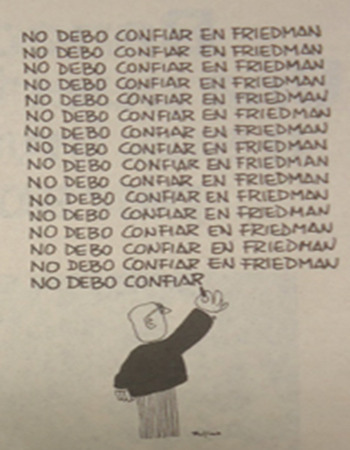
The crisis was so severe that in 1982, unemployment reached over 25% and real GDP contracted by 14.1%. Suddenly it seemed that the economic liberalization policies of the Chicago Boys had failed. A period of acute economic depression, political uncertainty, and intense social and civil unrest followed. After Sergio de Castro’s resignation, Chile had five Finance ministers in a three-year period. In this scenario of uncertainty, the military junta was ambivalent with respect to the future of the economy. The market-oriented reforms were at risk; so was the promised transition to democracy. And, as reflected in the cartoon, published in one of Chile’s leading weekly magazines (see Figure 2), the economic policies of the Chicago Boys and their mentor, Milton Friedman, were publicly blamed for the crisis. This was also the case internationally: analysts argued that the costly crisis was the result of Friedman-inspired policies.
“I shall not trust Friedman”.

Hernán Büchi, who had previously worked in the military government, assumed the position of Finance minister in February 1985. Conveniently, Büchi was not a Chicago graduate; he had obtained a MBA from Columbia in 1975. However, he surrounded himself by a new generation of Chicago Boys and embarked on a new round of reforms and privatization, while maintaining a flexible exchange rate (a crawling peg, once again) and avoiding overvaluation. In that regard, the policies followed since 1985 were more in line with Friedman’s views on exchange rates and external adjustment than those followed by the old guard of the Chicago Boys until 1982. Indeed, one of the most important goals of Büchi’s team was to make sure that the peso stayed somewhat undervalued, as a way of providing an incentive for exports. Under Büchi’s market-oriented and pragmatic macroeconomic management, the Chilean economy would take off again. By 1988 economic growth was at 7.3% and unemployment had declined to 9.9%.
On October 5 of that year, Chileans voted on a plebiscite with only one question: Should Pinochet stay on as president another eight years? Voting for “NO” meant that free presidential and Congress elections would be called within a year’s time, while voting “YES” meant maintaining the military regime for eight more years. Approximately 55% of the Chileans voted “NO.” In December 1989, Patricio Aylwin, a Christian Democrat who led a political coalition of center and center-left parties called Concertación, was elected president with 56% of the votes. Interestingly, his adversary was none other than former Minister of Finance Hernán Büchi, considered by many to be the father of the “Chilean miracle.” During 1989, the last complete year of Pinochet in power, real GDP growth reached 10.5% and unemployment hit a low of 7.9%.
In a ceremony at the new congressional building in Valparaíso, Pinochet handed over power to democratically elected President Patricio Aylwin, on March 11, 1990. Since then, Chile has experienced sustained economic growth, democracy, and political stability. During the so-called golden period of the Chilean economy (1985 to 1997), GDP grew at an average annual rate of 7.1% and GDP per capita doubled (De Gregorio Reference De Gregorio2005, p. 23). Nowadays Chile has the highest GDP per capita in South America. Since 1973, the last year of Allende, Chile’s GDP per capita has increased from less than 20% of US GDP per capita to almost 50% in 2017 (measured in purchasing power parity terms).
V. CONCLUDING REMARKS
In this paper we have addressed three issues related to Milton Friedman and Chile. First, we analyzed his two visits, in 1975 and 1981, during the Pinochet dictatorship. To do this we combed archives in Chile and the United States, and we interviewed, among others, two of the people who accompanied him to the by-now-famous meeting with Pinochet—Arnold Harberger and Rolf Lüders. We went over Friedman’s meetings, lectures, and interviews; we studied the questions he was asked and the answers he gave. We talked to a number of people who attended his lectures, and we read everything he wrote on Chile—papers, letters, notes, memoranda. As noted, the first 1975 visit has been documented before; indeed, his meeting with Pinochet has been analyzed and deconstructed many times, by both friends and foes. However, very little has been written about his second trip.
Second, we address a question raised by a number of authors, including Joseph Stiglitz and Paul Krugman: What did Friedman think and say (if anything) about Chile’s experiment with pegged exchange rates during 1979 to 1982, an experiment that ended up badly, with a major and costly crisis? More specifically, did he point out, either publicly or privately, that by fixing the exchange rate to the dollar and deregulating the financial sector, the Chicago Boys were following a dangerous path, a policy that he had criticized innumerable times? We conclude that during his first visit the exchange rate was barely touched on. What he said was simple: he agreed with the crawling peg system of mini devaluations followed by the government at that time. In addition, he pointed out that with Chile’s very high inflation, it would be highly dangerous to peg the exchange rate. By the time of his second visit, things had changed significantly in Chile. The country was then entering the third year of a pegged exchange rate policy, and according to almost every indicator the peso had become severely overvalued.
During his second visit Friedman was asked repeatedly about the fixed exchange rate issue. His answers were evasive and ambiguous. Although he did not endorse the pegged rate, he refrained from criticizing it. This contrasts sharply with what he had done in the past in other developing countries, including in India and Israel, where he did not hesitate to criticize their fixed exchange rate policies. In Chile Friedman did not say what he really thought about pegging the exchange rate at an artificial level. Of course, it is difficult to know what would have happened if in November 1981 he had criticized the fixed exchange rate and suggested moving to greater flexibility. A possible problem with that strategy was that by then it was already too late. The external imbalance was so large that nothing short of a major devaluation would have helped solve the situation.
Third, we investigated what he said regarding political freedom during those visits. Our interest is not in what he said many years later, when Pinochet was out of power and democratic rule had been restored. We inquire whether during the dictatorship, and while in Chile, he stated that the military had to grant political freedom to Chilean citizens and had to reinstitute the democratic system. Our conclusion is that although he declared that the political and economic conditions were very negative under President Salvador Allende, he did not provide open support for the coup or the dictatorship. On the contrary, he was explicit about liberty, and during both visits he publicly stated that political and economic freedom had to go hand in hand. During the 1981 visit, Friedman publicly stressed the importance of political freedom to maintain economic freedom in the context of the Chilean promised road to democracy.
In sum, if in his 1975 visit to Chile Milton Friedman was fully consistent with his economic ideas on inflation, he was silent about politics and human rights abuses. And if in his 1981 visit he spoke about politics and the transition to democracy, Friedman was silent regarding his economic ideas on exchange rates.