1. Introduction.
Over the last few years, an increasing interest in the syntax of Middle Low German (MLG) can be observed; yet to date many syntactic aspects and phenomena of MLG have been barely investigated and are only marginally described. There is some research that addresses the MLG verbal syntax. For example, Rösler (Reference Rösler1997) and Mähl (Reference Mähl2014) examine the position of the finite verb within the sentence; Rösler (1992, Reference Rösler1997), Bieberstedt (Reference Bieberstedt2005, Reference Bieberstedt2006), and Barteld et al. (Reference Barteld, Dreessen, Ihden, Schröder, Szczepaniak, Hartmann and Dücker2019) investigate sentence-like infinitive and participle constructions; and Macha (Reference Macha2003) focuses on afinite constructions.Footnote 1 However, research on the verbal complex construction wērden ‘become’/wēsen ‘be’ + present participle, as in 1, has not been the center of interest and therefore is still a strong desideratum within the field.Footnote 2
-
(1)


With regard to the meaning of wērden/wēsen + present participle constructions, the old MLG grammar books suggest that they can express different aspectual meanings, such as durative or inchoative; but the statements on which kind of meaning is assigned to which formal type, namely, the one with wērden or the one with wēsen as the finite verb, vary.Footnote 4 Besides the aspectual meaning, wērden in present tense + present participle can also convey a temporal meaning, namely, it can refer to a future action. However, more detailed information on the precise grammatical forms of wērden and wēsen with a present participle or the connection between these forms and different meanings is lacking in MLG grammar books. In order to shed some light on this area of the MLG syntax, the verbal complex construction wērden/wēsen + present participle is examined in this paper with a focus both on its structure and its meaning, and on a potential correlation between these two. In order to analyze the phenomenon in a rather inductive way and to gain insight into the use of the constructions in MLG texts from different times, language areas, and genres, a corpus-based approach is used.
The structure of this article is as follows: First of all, there is a short overview of the state of knowledge concerning the examined construction in MLG and closely related (historical periods of) languages based on grammar books and research studies (section 2).Footnote 5 Subsequently, the database for the analysis is described (section 3.1). The analysis answers the following main questions: What are the different meanings (especially temporal and aspectual ones) conveyed by the MLG constructions with wērden/wēsen + present participle, and what meaning is assigned to which form, taking into account not only the type of the finite verb but also its tense and mood (sections 3.2 and 3.3)? Besides these main issues, the paper also addresses the relationship between the semantics of the main verb and the aspectual meaning of the whole construction (section 3.4). Moreover, in order to evaluate the use of wērden/wēsen + present participle in MLG correctly, its occurrence in different texts is investigated (section 3.5), and the use of some alternative verbal complex constructions with the same meaning is analyzed (section 3.6). The last section contains a summary of the most important results (section 4).
2. Previous Research on Wērden/Wēsen + Present Participle.
In this section, I provide an overview of existing research on the wērden/wēsen + present participle construction in MLG and related languages. Since there are no detailed recent studies on wērden/wēsen + present participle in MLG, the most crucial sources of information are the old grammar books of Lübben (Reference Lübben1882), Lasch (Reference Lasch1914/1974), and Sarauw (Reference Sarauw1924). Unfortunately, as indicated in section 1, they contain only meager information on these constructions. Moreover, this information is at times contradictory. For example, according to Lasch (Reference Lasch1914/1974:222, paragraph 412, note 3), wēsen + present participle can express an inchoative action, as in 2a, or a durative action, as in 2b. In contrast, Sarauw (Reference Sarauw1924:226–227) and Lübben (Reference Lübben1882:92–93) distinguish between the two auxiliaries: While wēsen + present participle marks durative actions, wērden + present participle is used for inchoative actions. In addition, Lübben (Reference Lübben1882: 92–93) describes the special meaning of a past tense form of wērden + present participle, namely, its ability to express the beginning as well as the duration of an action at the same time, as in 2c. Finally, according to Sarauw (Reference Sarauw1924:226–227), a present tense form of wērden + present participle can be used to express a future meaning, as in 2d (emphasis and translation are mine).
-
(2)

These examples show that wērden/wēsen + present participle has a wide range of aspectual as well as temporal meanings in MLG. However, there is no precise and clear description of the connection between each meaning and the use of wērden versus wēsen or the grammatical form of each auxiliary.
In order to gain a more comprehensive insight into the examined phenomenon, this section provides a summary of information on the use of the construction, its development, and its different meanings in other varieties closely related to MLG. In general, the construction be + present participle can be found in all Indo-European languages; in the Germanic languages, it occurs in the older varieties—Old English (OE), Old Saxon (OS), Old High German (OHG), Middle High German (MHG)—and later disappears (Aronstein Reference Aronstein1918:5).Footnote 6
In OE, weorđan + present participle appears only rarely (Denison Reference Denison1993:385). The construction with be + present participle is used rather infrequently from OE until the early period of Middle English.Footnote 7 However, Denison (Reference Denison1993:380) does observe a higher frequency of wesan/beon + present participle in some OE texts; Mustanoja (Reference Mustanoja1960:584) states that the construction occurs more frequently in OE prose than in poetry. From the 14th century onward, be + present participle is used more often (Mustanoja Reference Mustanoja1960:585–586, Denison Reference Denison1993:380–382). According to Mustanoja (Reference Mustanoja1960:584), in general, the periphrastic construction expresses a durative meaning. Mustanoja (Reference Mustanoja1960:584–585) also shows that sometimes the wesan/beon + present participle construction is “preferred to the simple verb form because it has a greater descriptive force, i.e., it makes the narrative more graphic” (Mustanoja Reference Mustanoja1960:585). Aronstein (Reference Aronstein1918:10–11) points out that the variation between the wesan/beon + present participle construction and simple verbs is observed especially frequently with verba dicendi.
In OS, both wesan and werđan are used with a present participle; however, the information on the potential aspectual meaning is rather vague. Holthausen (Reference Holthausen1921:182, paragraph 504) points out that both wesan and werđan + present participle express an ongoing state or action. Clark (Reference Clark1914:12) states that in OS both constructions are used similarly to their counterparts in OHG (see below).
In OHG, werdan + present participle appears infrequently; its occurrence increases in MHG (Behaghel Reference Behaghel1924:261, paragraph 690). In earlier stages of development, it marked an inchoative action (Rick Reference Rick1905:28, Winkler Reference Winkler1913:71–78, Paul Reference Paul1920:126–127, Saltveit Reference Saltveit1962:179–180, Betten Reference Betten1987:111), and later on acquired the future meaning with werden in present tense (Behaghel Reference Behaghel1924:261, paragraph 690, Harm Reference Harm2001:289). Kotin (Reference Kotin2003:102) shows that the construction used to mark a change from one state to another, which would last for a period of time. He argues that the meaning of the construction resulted from the meaning of its two parts: werden conveyed the inchoative aspect and the present participle expressed durativity. However, Clark (Reference Clark1914:23, 25) states that in OHG, in some cases there are no clear semantic or aspectual differences between werdan + present participle and the simple verb.
One of the alternative constructions to werden in present tense + present participle with a future meaning is werden + infinitive (see section 3.6). The origins of this latter construction are widely discussed in research literature (see, among others, Behaghel Reference Behaghel1924:262–263, paragraph 690, Saltveit Reference Saltveit1957, Reference Saltveit1962, Schmid Reference Schmid2000, Kotin Reference Kotin2003:155–163).Footnote 8 Most theories agree that it either derives from the present participle by the phonological change from -ende to -en(n)e to -en (as in MLG hebbende > hebbene > hebben ‘have’) or develops by analogy with other periphrastic constructions, namely, modal verb + infinitive (Ebert Reference Ebert1978:60–61).Footnote 9 While werden in past tense + present participle indicating an inchoative action (Clark Reference Clark1914:30) becomes unusual through time (Paul Reference Paul1920:148, paragraph 368), werden + infinitive is grammaticalized as a future periphrasis in the middle of the 16th century (Oubouzar Reference Oubouzar1974:85).Footnote 10
With respect to the aspectual meaning, Betten (Reference Betten1987:112) distinguishes between the inchoative—that is, punctual—werden + present participle and the durative sein + present participle. The durative meaning of sein + present participle is mentioned, for example, by Rick (Reference Rick1905:21), Winkler (Reference Winkler1913:41–54), Paul (Reference Paul1920:72, paragraph 320), and Kotin (Reference Kotin2003:163). Winkler (Reference Winkler1913:78–80) also provides evidence for a durative meaning of MHG wërden + present participle. Additionally, Winkler (Reference Winkler1913:54) observes a few occurrences of MHG sîn + present participle with an iterative meaning.
Before moving on to the description of the study in section 3, a few words are in order about certain factors that may have affected the use of relevant constructions in various Germanic languages. These factors are taken into account in the analysis of wērden/wēsen + present participle in MLG. First, several studies point out the influence of the Latin language on the use of werden/sein + present participle in translated texts, where Latin grammatical structures could have been transferred to MLG (see, among others, Rick Reference Rick1905:6, Meyer Reference Meyer1906:7–12, Paul Reference Paul1920:72, paragraph 320 concerning OHG; Glück Reference Glück, Thielemann and Welke2001:82 regarding OHG and MHG; Holmberg Reference Holmberg1916:40–52 with respect to MHG; Fleischer Reference Fleischer2007:334–337 concerning OHG and OS; Mustanoja Reference Mustanoja1960:584, Denison Reference Denison1993:382 regarding OE). As regards werden + infinitive as the successor of werden + present participle, Diewald & Habermann (Reference Diewald and Habermann2005:241–247) prove that the influence of the Latin language was crucial for the expansion of the construction in Early New High German.Footnote 11 With respect to the MLG Evangelistary of Buxtehude, Schröder (Reference Schröder1992b:11–13) shows two dominant options for translating the Latin predicative participle with a nominative to MLG, namely, the simple present and the wēsen + present participle construction. The role of the original also needs to be considered when analyzing MLG texts influenced by High German varieties, as Clark (Reference Clark1914:16) shows for the use of wēsen + present participle in Reinke de Vos.
Second, Betten (Reference Betten1987:113) suggests that in the 15th century, the use of werden + present participle depended on the different writing competences of the authors and on their style of writing. There is also evidence for various language-internal factors, such as the kind of verb used in the present participle. For example, according to Betten (Reference Betten1987:111), in the Prose Tristan the use of the inchoative werden + present participle is restricted to verbs of emotion, such as wainen ‘cry’ and klagen ‘lament’. At the same time, according to Winkler (Reference Winkler1913:58), the durative sein + present participle was particularly common with verbs of psychological state, such as wünschen ‘wish’ or klagen ‘lament’. As the two verb categories show an overlap, the same verbs appear with werden in Betten Reference Betten1987 and with sein in Winkler Reference Winkler1913 and, accordingly, are assigned either an inchoative or a durative meaning, which creates a contradiction. Furthermore, Behaghel (Reference Behaghel1924:265, paragraph 694) points out that werden + present participle with a future meaning is not used in clauses whose function it is to refer to future events, such as conditionals or temporal clauses with the subordinating conjunction ehe ‘before’.
3. Corpus Study of Wērden/Wēsen + Present Participle.
3.1. Database for the Analysis.
An inductive approach to the MLG grammar as aspired to in this study is possible due to digital corpora such as the Reference Corpus Middle Low German/Low Rhenish (ReN). The ReN is structured using the parameters language area, time, and genre (Barteld et al. Reference Barteld, Dreessen, Ihden, Schröder, Becker and Hausmann2017, Peters Reference Peters2017); it is also rather large compared to other historical corpora, containing about 2.3 million tokens, about 1.4 million of which are grammatically annotated with respect to part of speech, inflectional morphology, and lemma.Footnote 12 In ANNIS (Krause & Zeldes Reference Krause and Zeldes2016), the ReN is divided into two subcorpora—ren-anno that contains all grammatically annotated texts and ren-trans that contains all the texts that are transcribed but not annotated. For this study, I used the annotated data from ren-anno to identify all occurrences of wērden/wēsen + present participle in that subcorpus.Footnote 13 In order to gather the maximum number of occurrences, I used the main query pos=“VVPS” and eliminated all false positives from the hit list where the present participle was not combined with wērden or wēsen.
Due to the formal and functional overlap between the infinitive and the present participle in MLG, the present participle may have also been annotated with the tag VVINF or similar tags for a verb. Therefore, I also searched for tokens ending in -ende or the assimilated form -enne not annotated as VVPS using the query tok_anno=/.+(ende|enne|ene)/_=_ pos!=“VVPS”. I checked all hits annotated as a verb and added the true positives to my data list. During the search, cases in the ReN were detected randomly, with the main verb having the tag ADJS for pos and the tag VVPS for posLemma.Footnote 14 Therefore I performed another search for these occurrences using the query pos=/ADJ(S|D)/_=_ posLemma=“VVPS”, so that the true positives could be added to the list.Footnote 15
As the next step, I went over the data eliminating false positives and adding further annotation concerning the finite verb (wērden or wēsen), its tense and mood, the verb class of the main verb according to Vendler’s (1967) classification—that is, an activity, a state, an accomplishment or an achievement—and the aspectual meaning (inchoative, durative, etc.).Footnote 16 I also added supplementary notes, for example, on the grammatical context. The resulting database contained 410 occurrences of wērden + present participle and 238 occurrences of wēsen + present participle. These were then examined with respect to their grammatical structure and the range of available meanings. The following sections present the results on this analysis.
3.2. Wērden + Present Participle.
The auxiliary wērden + present participle is used in 41 texts covering all language areas (North Low Saxon, the language of Lübeck, East Elbian, Baltic Low German, Westphalian, Eastphalian, Elbe Eastphalian, and South Markish), a time period from the second half of the 13th century till the second half of the 16th century, and nearly all genres (except for inscriptions, which is only very marginally presented in the ReN): administration, law, deeds, transfer of knowledge (for example, chronicles, medical handbooks, etc.), clerical writing/religion, literature, and private writing and correspondence (the names of the genres are given as they appear in the ReN). Table 4 in Appendix shows the number of occurrences for different grammatical forms of the finite verbs wērden and wēsen, for all texts.
With regard to the grammatical structure of wērden + present participle, most of the 410 instances contain the auxiliary verb wērden in the present indicative (346), as in 3a, with only one occurrence in the imperative, as in 3d. Moreover, the corpus data contain 32 occurrences of the past indicative, as in 3b, and 16 occurrences of the subjunctive, as in 3c. In addition to these two-part verbal complexes, there are also 11 instances of a three-part construction with the finite verb schȫlen ‘shall’ or künnen ‘can’, as in 3e, and 4 instances with the finite verb wēsen, as in 3f.
-
(3)

In the following, the different temporal and aspectual interpretations of wērden + present participle in the corpus data are examined in detail. Table 1 shows the range of meanings for different grammatical forms of the auxiliary.Footnote 17 Since the Bible translations in the corpus are influenced by the text of the Latin Vulgate, cases where a Latin future form or a participle is translated are listed in separate lines.Footnote 18
Meanings of wērden + present participle.

Regarding wērden in the present indicative, as in 3a, in the majority of these cases the construction has a future meaning. It derives from the original lexical meaning of wērden ‘become’, which conveys the change from one state or action to another. As already indicated above, when analyzing language data from an MLG biblical text, one has to be aware of the important role the original plays and therefore always compare the MLG translation with the original text. In case of 3a, this comparison shows that in the Latin Vulgate, of which the Bible of Lübeck is a translation, future forms are used as well: spinas et tribulos germinabit tibi et comedes herbas terrae ‘thorns and thistles will sprout for you, and you will eat the herbs of the field’ (germinabit ‘will sprout’, comedes ‘you will eat’).Footnote 19 However, Latin Vulgate future forms do not necessarily need to be translated using wērden + present participle, since MLG has other options for expressing future actions. I concentrate on this issue in section 3.6.
In general, the analyzed data confirm the observation in the research literature that the combination of wērden in the present indicative and a present participle marks a future action. There are only a few exceptions where the construction has no future meaning or is ambiguous with regard to tense and aspect. For example, the sentence in 4, where werdet kyuende is used after the verb komet ‘come’ in the present indicative, describes two hypothetical actions taking place one after the other. In this sentence, the participle construction seems to indicate the beginning of an action that is supposed to go on for a longer time (werdet kyuende ‘begin to fight’). However, it could also be used in order to temporally distinguish the second action (kyven ‘fight’) from the first one (komet ‘come’), as they take place not at the same time, but one after the other. In the data, there are several occurrences of wērden + present participle in sentences that convey a specific temporal relation between two distinct actions, such as conditional constructions.
-
(4)

A future meaning is also conveyed by sentences with wērden in the imperative, as in 3d, and by three-part verbal complexes with the finite verb schȫlen (or künnen) in the present indicative, as in 3e. These examples again show the influence of the Latin original on the translated biblical text, since the Vulgate uses future forms (aedificabis ‘you will build’, facietis ‘you will make’). The construction scholen makende werden ‘shall make’ in 3e seems like a fusion of two options for expressing future in MLG (wērden + present participle and schȫlen + infinitive), and thus represents a third alternative.
In the majority of sentences with wērden in the past indicative, the beginning of a new action is expressed, as in worden se ropende vnd schryende ‘they started to shout and scream’ in 3b. Thus, the inchoative aspectual meaning observed in other historical varieties (see section 2) can be confirmed in MLG as well. Strikingly, in the Vulgate original of 3b the two verbs are used in the perfective tense (levavit ‘has raised [its voice]’; flevit ‘it has cried’). Apart from this example, there are a few more instances where wērden in the past indicative + present participle follows a temporal clause, as in 5a, or is part of such a clause itself, as in 5b.Footnote 20 In contexts like these, the participle may be used to indicate a strong temporal connection between two actions, namely, that one takes place immediately after the other (for example, wake up > look up).
-
(5)

The examples in 5 reveal another important point concerning wērden in the past indicative + present participle. If it was only used for expressing the beginning of an action, its use would be limited to durative events; this construction would not be used with achievements as they are incompatible with an inchoative reading. Yet the data contain examples of achievement verbs such as entslâpen ‘fall asleep’ in 5a and entwāken ‘wake up’ in 5b. However, in these examples, the construction does not convey an inchoative meaning but rather a simple past meaning; therefore, these occurrences are listed under “past” in table 1. This interpretation is supported by the fact that in the MLG dictionary by Lasch et al. (1956ff., vol. 1, column 569), the combination entslâpen(de) wērden is listed and translated without any aspectual meaning. It is possible that by that point, wērden + entslâpen had already become lexicalized, and so now wērden could be used with other achievements, such as entwāken.
Similar to wērden in the past indicative + present participle, the three-part verbal complex with the finite verb wēsen could also express inchoative aspect, as in sende were worden ‘started to see’ in 3f. However, strikingly, all such cases in the corpus come from the Evangelistary of Buxtehude and contain the participle form of the same main verb sên ‘see’. This verb always appears in the same context, where it seems to function as a predicative adjective and is therefore assigned to the category ambiguous in table 1.Footnote 21 The use of sên in the verbal complex wēsen + wērden + present participle might be exclusive to this particular biblical text.
Unlike wērden in the past indicative, wērden in the past subjunctive such as in 3c conveys subjunctive mood rather than inchoative aspect. Therefore, this construction is compatible with achievements such as tôsetten ‘hire’ in 3c: This example does not convey an ongoing action but one that takes place at a specific moment. In the corpus data, amongst the 16 occurrences with wērden in the past subjunctive there are 9 instances with an achievement. In none of the 16 instances of wērden in the past subjunctive + present participle can a distinct aspectual meaning be identified. This might suggest that the construction with this grammatical form expresses mood rather than aspect. Further studies based on more texts are necessary in order to verify this hypothesis.
3.3. Wēsen + Present Participle.
The auxiliary wēsen + present participle is used in 61 texts covering all language areas, nearly all genres except for inscriptions, and a time period from the second half of the 13th century till the second half of the 17th century. Table 5 in Appendix shows the number of occurrences for different grammatical forms of the finite verb, for all texts.
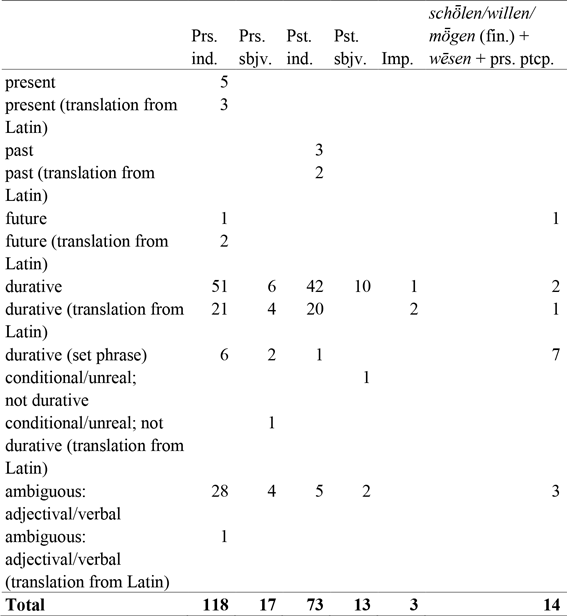
There are 238 occurrences of wēsen + present participle in my database. In the majority of cases, wēsen is used in the present indicative (118), as in 6a, and in the past indicative (73), as in 6c. The present subjunctive (17), as in 6b, the past subjunctive (13), as in 6d, and the imperative (3), as in 6e, appear less frequently. The auxiliary wēsen is also used in a three-part verbal complex with the finite verbs schȫlen ‘shall’, willen ‘want to’ or mȫgen ‘be able to’ (14), as in 6f.
-
(6)

As shown in table 2, wēsen + present participle has a wide range of meanings. In most sentences where wēsen is in the present/past indicative or subjunctive, as in 6a–d, the main verb is a state, an activity or an accomplishment. The same is true for three-part verbal complexes, as in 6f. Since these verbs denote actions or events that can last for a period of time, it is possible that wēsen + present participle emphasizes the durative nature of the event, as noted in the research literature. Note, however, that the use of wēsen + present participle is not obligatory in this context: The same meaning can also be expressed by the simple present, as shown by the co-occurrence of bogerende syn ‘desire’ with the present indicative form esschen ‘request’ in 7a below. Hence, wēsen + present participle is an optional device, which seems to be applied due to stylistic or pragmatic reasons. Moreover, the corpus data prove the influence of Latin in translated texts: Two of the three cases with wēsen as an imperative, as in 6e, contain the same sentence from the Bible found in different texts. Here the reason for using wēsen + present participle lies in a close translation of the Vulgate participle construction (esto consentiens ‘be-sg.imp agreeing’).
Texts such as deeds or legislative and administrative documents that make heavy use of linguistic routines and set phrases (for example, the guild’s order in 7a or the municipal law of Bremen in 6f), may have contributed to the stabilization of participle constructions with specific verbs and their subsequent expansion. This might also be a reason for wēsen + present participle appearing in certain contexts. I analyzed three-part verbal complexes with wēsen + present participle in the corpus and found that they follow a particular pattern of use. This pattern is particularly consistent in complexes with the verbs wachten ‘guard’ and wāren ‘last’. Occurrences with these patterns are assigned to the category set phrase in table 2. As one can see, three-part verbal complexes with wēsen + present participle are mostly used as set phrases.
Meanings of wēsen + present participle.

In addition to sentences with durative verbs, the data also contain sentences with achievements that do not have a durative meaning, as in 7b,c. In 7b, a future action is referred to. As in other translations of the Vulgate, in the Evangelistary of Buxtehude the Latin participle construction (venturus est ‘will be coming’) is transferred into MLG (Schröder Reference Schröder1992b:11–13). Additionally, 7c shows a different case containing the ambiguous token tokomende ‘come’, which could also be interpreted as a predicative adjective.Footnote 22
-
(7)

As the analysis of wēsen + present participle shows, this construction expresses a wide range of meanings and is used in a variety of contexts. Apart from emphasizing a durative action, wēsen + present participle renders participle constructions in translations of Latin Vulgate texts and appears in linguistic routines and set phrases, especially in deeds and legislative and administrative documents.
3.4. Aspectual Meaning and the Semantics of the Main Verb.
Having investigated the range of meanings of wērden/wēsen + present participle as determined by the different grammatical forms of the auxiliary verb, this section focuses on aspectual meaning, namely, the inchoative meaning of wērden in past tense + present participle and the durative meaning of wēsen + present participle. As discussed in section 3.3, the semantics of the main verb (that is, the present participle) has an influence on the meaning of the whole construction. Therefore, the relationship between the main verb and the aspectual meaning of the participle construction needs to be investigated further.
In section 3.2, 21 occurrences of wērden in past tense + present participle conveying an inchoative meaning were identified, as well as 3 cases that were translations of a participle in the Latin Vulgate (see table 1). Table 3 lists all the main verbs in this construction (the occurrences in Bible translations are given separately), according to their semantic class.Footnote 23
As the table shows, 12 occurrences (plus one in a Bible translation) contain verbs expressing emotions, such as lachen ‘laugh’.Footnote 24 Two examples contain the verba dicendi seggen ‘say’ and sprēken ‘speak’.Footnote 25 Note, however, that other types of verbs can also appear in this construction. This contrasts with Betten’s (1987:111) observation with respect to the Prose Tristan, where the inchoative werden + present participle is restricted to emotion verbs (see section 2). To account for the use of inchoative werden + present participle in MLG, all main verbs in the construction were also analyzed using Vendler’s (1967) classification. This analysis gives rise to the following generalization: Although emotion verbs and verba dicendi denote actions that in general could go on without an end point, in the actual context they always have an end point, and thus belong to the group of accomplishments. So, all in all, in the majority of the occurrences in table 3 the main verb is an accomplishment. This reveals the special function of the present participle with wērden in the past tense in MLG, that is, to mark the beginning of an action going on for a specific period of time and ending at some point.
Main verbs in the wērden in past indicative + present participle construction with an inchoative meaning (n=24).

Regarding wēsen + present participle, the analysis in section 3.3 has shown that in most of the sentences, the main verb is a state, an activity or an accomplishment. Thus, it could be suggested that in MLG, the participle construction was used to emphasize the durativity of the event. Figure 1 shows the number of wēsen + present participle constructions occurring with verbs from each aspectual class (the occurrences in Bible translations and set phrases are excluded).
Wēsen + present participle construction with a durative meaning (n=112).

In more than half of the sentences (59/112), the main verb is a state; in 36 sentences, the main verb is an activity, whereas accomplishments appear rather infrequently (17). Thus, the semantics of the main verb and the durative meaning of the whole construction interact: Since accomplishments necessarily involve an end point, they would be less felicitous in the wēsen + present participle construction, which emphasizes duration.
The data show that the two constructions discussed in this section are in complementary distribution with regard to the verb class of the main verb: The inchoative wērden in past tense + present participle is mainly used with telic verbs (that is, verbs that denote events with an end point), while the durative wēsen + present participle is mainly used with atelic verbs (that is, verbs that denote events without a specified end point). This proves that there is an interaction between the semantics of the main verb and the meaning of the whole construction.
3.5. Wērden/Wēsen + Present Participle in Different MLG Texts.
The analysis of different grammatical forms and meanings of wērden/ wēsen + present participle suggests that the use of this construction could be characteristic of specific texts. In this section, the use of wērden/wēsen + present participle in different MLG texts is investigated further. Tables 4 and 5 in Appendix do not provide relative frequencies but absolute frequencies. Due to the wide range of meanings expressed by wērden/wēsen + present participle and the number of alternative constructions with those meanings, a relative frequency may not be determined using the total number of tokens in any given text or even the total number of finite wērden/wēsen in that text. One would need the total number of all construction tokens in the entire corpus, for each particular meaning (for example, future, durative, etc.). Unfortunately, an analysis of all the texts in the corpus would be too time consuming, and so an extensive quantitative investigation of a possible correlation between external factors (time, language area, and genre) and the use of wērden/wēsen + present participle is not feasible. Nevertheless, the absolute frequencies in tables 4 and 5 in Appendix can provide at least some useful hints at the patterns of occurrence of the construction in MLG.
As already mentioned in sections 3.2 and 3.3, both wērden and wēsen + present participle occurred throughout nearly the whole MLG period, all language areas, and nearly all genres (that is, they were not restricted to particular texts). This suggests that the construction was not a marginal phenomenon but a stable (albeit infrequent) part of the MLG grammar. In general, wērden/wēsen + present participle could be used independently of the nature of the text or the context in which it was produced. However, there were certain conditions that did influence how often wērden/wēsen + present participle actually occurred in any given text. For example, as tables 4 and 5 in Appendix demonstrate, the Bible texts contain a relatively high number of occurrences. This frequent use is explained both by the content and by the grammatical structure of the translated Latin text. A participle in the Vulgate can be translated by wēsen + present participle, and a future form by wērden in the present indicative + present participle. Thus, the Bible texts tend to use wērden/wēsen + present participle more often.
However, there is no one-to-one relationship between the Latin and MLG texts; the grammatical structure of the Vulgate language does not force the use of the present participle construction, since several alternative constructions expressing the same meaning exist in MLG (see section 3.6). Hence, the use of wērden/wēsen + present participle is a choice of the scribe or printer, and therefore its frequency can vary in different MLG Bible texts, as tables 4 and 5 in Appendix indicate. Since the ReN does not provide whole Bible texts and the contained passages can differ from one another, no corpus-based word-to-word comparison between all Bible texts and the Latin Vulgate is possible. Therefore, further examination of participles and future forms translated from the Vulgate language into MLG would be necessary to gain insight into translation preferences of different scribes or printers.
Besides the Bible texts, there are two other religious texts that stand out in tables 4 and 5 in Appendix: Sunte Birgitten openbaringe (Lüb. Birg. Openb. 1496) with a relatively high number of wērden + present participle and the Liudger-Vita of Johannes Cincinnius (Cincinnius Liudger 1512) with a relatively high number of wēsen + present participle. Since both are religious texts, one could hypothesize that the use of participle constructions in the Bible texts might have been extended to other texts of similar genres. As pointed out before, this hypothesis can only be tested in a detailed study that would establish relative frequencies of wērden/wēsen + present participle in such texts.
Another category of texts with several occurrences of wērden/wēsen + present participle are deeds and legislative and administrative documents. As mentioned above, the use of the construction in these texts could be due to their highly formulaic language. The corpus reveals the following difference between the two auxiliaries: Wērden + present participle occurs in different linguistic contexts, whereas wēsen + present participle often appears in certain set phrases, especially with the verbs wachten ‘guard’ and wāren ‘last’ and the ambiguous word tôkōmende ‘come’ that could be interpreted as a predicative adjective meaning ‘prospective’.Footnote 26
A text from a different genre contains a strikingly high number of wērden + present participle constructions: Der schapherders Kalender (Schapherders Kalender), a calendar that contains, among other things, astrological forecasts (Schröder Reference Schröder2019:152). Such frequent use of wērden + present participle could be partially explained by the nature of the text: As extended portions of the text deal with astrology—that is, predicting the future based on people’s astrological signs—reference to future events is frequently made. Therefore, certain phrases are often repeated, especially with the verbs hebben ‘have’ and krîgen ‘get’, for example, he wert hebbende eyne grote nese ‘he will get a big nose’. However, as mentioned above, one has to keep in mind that the future meaning can be expressed by alternative grammatical constructions and that the use of wērden + present participle is not determined by content alone.
As these observations show, in order to evaluate the choice of wērden/wēsen + present participle in a text correctly, one has to gain a deeper insight into the use of alternative constructions. The next section discusses the use of alternatives to the present participle construction with wērden.
3.6. Wērden + Present Participle and Alternative Constructions.
A comprehensive study of wērden/wēsen + present participle and all the possible alternatives in the whole corpus would be too time consuming and is therefore beyond the scope of the present research. However, an analysis on a smaller scale—examining alternative ways to express future—is quite feasible. Such an analysis could provide an initial insight into this issue and become the basis for future investigations.
For the purposes of this analysis, Der schapherders Kalender was chosen, as it contains the most occurrences of wērden in the present + present participle with the future meaning. According to the MLG grammar books, apart from wērden + present participle MLG could use two other constructions to express a future meaning: wērden in the present + infinitive and a modal verb (schȫlen/willen/mö̂ten) in the present tense + infinitive. In addition, the simple present can also convey a future meaning (Lübben Reference Lübben1882:91, Lasch Reference Lasch1914/1974:222–223, paragraph 412, note 6, Sarauw Reference Sarauw1924:225).
In this section, I focus on the verbal complex constructions that occur in variation with wērden + present participle. All occurrences of wērden + infinitive and schȫlen/willen/mö̂ten + infinitive were identified in Der schapherders Kalender, after which the results were checked to eliminate false positives.Footnote 27 Figure 2 shows the number of occurrences for each of the five variants; only unambiguous cases were included in the analysis.
Different verbal complex constructions expressing future in Der schapherders Kalender (only unambiguous cases; n=292).

As figure 2 shows, wērden + present participle occurs 123 times in Der schapherders Kalender and is the dominant variant for expressing future. An alternative construction, wērden + infinitive, is used only 53 times to convey the same meaning. In the modal verb + infinitive construction, schȫlen occurs most frequently (94), willen is used rather infrequently (18), and mö̂ten appears only marginally (4).
A closer look at the data reveals that there is no clear preference for any one variant; different variants often occur side by side, for example, wērden + present participle/infinitive, as in 8a (where the present participle and the infinitive even share the same auxiliary), or wērden + infinitive and schȫlen + infinitive, as in 8b. This use of different constructional variants to express the same meaning might be a conscious stylistic choice of the printer in order to avoid too many structural repetitions and thus make the text, which contains formulaic language and rather frequent repetitions of phrases, less monotonous.
-
(8)

The analysis above focuses on Der schapherders Kalender and thus sheds light on the variation between different constructions expressing the future within the same text. However, different texts reflect different preferences as far as expression of the future is concerned. In the passage 2nd Mose 20,9 found in the Bible of Köln, the Bible of Lübeck, and the Bible of Halberstadt, a Latin Vulgate future construction is translated by different complex verbal constructions: The Bible of Köln and the Bible of Halberstadt have schȫlen + infinitive, as in 9a,b, whereas in the Bible of Lübeck, wērden + present participle is used, as in 9c.
-
(9)

The relatively high number of occurrences in the ReN extract of the Bible of Lübeck of wērden in present tense + present participle expressing future (see table 1 above and table 4 in Appendix) could indicate that this particular translator had a special preference for this construction. However, to verify this hypothesis, more research is needed. To gain a better understanding of the translator’s preferences, one would need to analyze translations of all expressions with a future meaning across the three Bible texts in their entirety.
4. Conclusion.
As the overview on wērden/wēsen + present participle in MLG and related languages has shown, there is a range of different temporal and aspectual meanings the construction can have depending on the type and the grammatical form of the auxiliary. However, previous studies and grammaticographical descriptions differ somewhat in what meaning they attribute to which version of the wērden/wēsen + present participle construction.
With regard to the grammatical form of the construction, the analysis based on corpus data from the ReN 1.0 revealed that the auxiliaries wērden and wēsen occur in different tenses and moods, and even as infinitives in three-part verbal complexes. Wērden + present participle is observed not only with aspectual but also with temporal meanings. In the present indicative and as part of a three-part verbal complex with the modal verbs schȫlen or künnen, it is mainly used to express future events, whereas wērden in the past indicative + present participle predominantly conveys inchoative aspect. These findings are in line with the observations made in the literature on MLG and related historical varieties. However, as far as wērden in the past indicative + present participle is concerned, there are some exceptions, that is, this construction does not always have an inchoative meaning. In several cases, the sentence with the participle follows a subordinate temporal clause or is a temporal clause itself. Here the participle might be used to mark the temporal connection between the two events, with one taking place immediately after the other. Furthermore, the data contain constructions with the present participles of the achievements entslâpen ‘fall asleep’ and entwāken ‘wake up’. It is possible that these particular instances of the construction had become lexicalized.
It has been noted in literature that wēsen + present participle mainly occurs with states, activities, and accomplishments, with the participle emphasizing the durative nature of the event. However, the participle construction is only one option, which can be used for stylistic or pragmatic reasons. It may, for example, occur in set phrases used in formulaic language, especially in deeds and legislative and admini-strative texts. The analysis also revealed some exceptions: The data contain cases of wēsen + present participle with no durative meaning used to render Latin Vulgate participles. Some ambiguous cases were identified as well that could be classified either as participle constructions or as copula constructions with a predicative adjective. The same ambiguity is also observed in case of wērden + present participle.
With respect to the relationship between the semantics of the main verb and the aspectual meaning of the construction, it has been shown that wērden in the past indicative + present participle with an inchoative meaning and wēsen + present participle with a possible durative meaning are in complementary distribution: The former occurs mainly with telic verbs—that is, verbs that denote events with an end point—with the construction marking the beginning of the event. The latter is mostly used with atelic verbs—that is, verbs that denote events without an end point. As ongoing events without an end point are, by definition, durative, the meaning of the main verb and the durative meaning of the construction fit together perfectly.
A more thorough quantitative analysis of the use of wērden/wēsen + present participle in different MLG texts is problematic due to limited data available. In particular, one would need a database containing all possible alternative constructions from the entire corpus. Nevertheless, the present study has identified a number of tendencies, which could be further explored in future research. It has been shown that the wērden/wēsen + present participle construction was not restricted to particular MLG texts, as it appears throughout nearly the whole MLG period, across all language areas and nearly all genres. The frequency of the construction can, however, be influenced by the nature of the text and the circumstances in which it was created. For example, translations of the Latin Vulgate tend to have a higher occurrence of wērden/wēsen + present participle, presumably due to the grammatical properties of the original language. Yet an examination of selected translations of Latin Vulgate future forms into MLG in different Bible texts suggests that wērden + present participle was one of several constructions that conveyed the same meaning, and that its use could be a choice of a particular scribe or printer.
Besides the Bible translations and other religious texts, Der schapherders Kalender also contains a relatively high number of wērden + present participle, which is partly due to the content of the astrology section. Moreover, the analysis of this text has revealed a clear preference for wērden + present participle, although constructions with wērden + infinitive and with modal verb + infinitive are also used to convey future meaning.
The study of MLG corpus data presented in this paper confirms the descriptions of wērden/wēsen + present participle found in the literature, and it complements those earlier descriptions with new insights regarding the structure, meaning, and use of the construction. The present analysis could serve as a basis for further studies, which could, for example, compare wērden/wēsen + present participle with corresponding constructions in the older varieties of High German or English. Such comparison would allow one to create a more comprehensive picture of the phenomenon in the Germanic languages.
APPENDIX
The appendix is accessible via the following DOI: http://doi.org/10.25592/uhhfdm.11455, accessed on February 08, 2023.
MIDDLE LOW GERMAN DATA SOURCES
The following information is taken from the metadata of the ReN:
Brem. StR 1303,04 Originalhandschrift = Bremer Stadtrecht, Originalhandschrift. 1303–1304. Staatsarchiv Bremen, 2-P.5.b.2.a.1.
Buxteh. Ev. = Qvatuor Evangeliorum versio Saxonica. Buxtehude around 1480. Königliche Bibliothek Kopenhagen, Thott 8, 8°.
Cincinnius Liudger 1512 = Johannes Cincinnius: Liudger-Vita. 1512. Münster, Landesarchiv Nordrhein-Westfalen, Abteilung Westfalen (LA NRW, Abt. WF), Altertumsverein Münster Msc. 136.
Halberst. Bibel 1522 = Halberstädter Bibel. Halberstadt 1522: Ludwig Trutebul, 1. Mose 1,1 – Romans 7,12. München, Bayerische Staatsbibliothek, B3Kat-ID: BV035304241.
Lüb. Bibel 1494 = Biblia. Lübeck 1494: Steffen Arndes. München, Bayerische Staatsbibliothek, Ink B-495.
Lüb. Birg. Openb. 1496 = Sunte Birgitten openbaringe. Lübeck 1496: Mohnkopf. Göttingen, Niedersächsische Staats- und Universitätsbibliothek. I. E. Sanct 39a (Inc.).
Lüb. HistB. L = Historienbibel, Hs. L. 21 February 1470. Lübeck, Stadtbibliothek, Ms. Theol. Germ. 8.
Lüb. Jüt. LB = Jutisch Lowbok. Lübeck 1485: Matthaeus Brandis. Oldenburg, Landesbibliothek; Kopenhagen, Kgl. Bib., CIM. II, 248 b.; Arbeitsnegativ L. N. Mikro Nr. 132.
Reval Schragen 1451–1500 = 5 guild’s orders from Reval. Tallinn (Reval) 1451–1500. National Archives of Estonia/Tallinn City Archives, REV3: TLA.190.2.70; REV8: TLA.190.2.549; REV9: TLA.190.2.149; REV4: TLA.190.2.642; REV12: TLA.190.2.24.
Rig. Uk. 1351–1400 = 10 digitized deeds from Riga from the ASoR, 1351–1400.
Schapherders Kalender = Der schapherders Kalender. Rostock 1523, Ludwig Dietz. Herzog August Bibliothek Wolfenbüttel, A: 36 Astron.
Val. u. Nam. Stockh. Hs. = Valentin vnde Namelos, Stockholmer Handschrift (Hs. Cod. Holm. Vu 73). Around 1420. Stockholm, Königliche Bibliothek, Cod. Holm. Vu 73.