INTRODUCTION
Diffusion of new crop varieties in dry areas has been much slower than in more favourable ones. One reason for this is the inherent difficulty in breeding for dry areas due to the extreme ecological and socio-economic variability. The failure of the formal seed systems to serve these environments is another reason. Generally, formal seed systems work well when they can produce large quantities of seeds for a few crop types grown on large areas, but are less effective when different ecological and socio-economic environments require different crop varieties (Bishaw and Kugbei, Reference Bishaw and Kugbei1997). Smallholder farmers in the dry areas may keep different varieties for different environmental niches and socio-economic needs, or to minimize production risks and the incidence of disease (Cromwell, Reference Cromwell1990; Sperling et al., Reference Sperling, Scheidegger and Buruchara1995). This implies that no single variety will cover a substantially large area.
The lower seed replacement rate in less favourable areas than in more favourable areas is evidence of the failure of formal seed systems to serve these environments (FAO, 1999). Two other factors hinder the diffusion of improved crop varieties in less favourable areas. First, the environments (research stations) where varieties are developed only partially represent the wide variability of these less favourable areas. Second, farmers' knowledge and perceptions of the new varieties are not taken into consideration in developing these varieties. The result has been a very low adoption rate of modern varieties by smallholder farmers in the less favourable areas who, as a consequence, are benefiting less from public agricultural research. Because there is no ideal variety which can be recommended to farmers in all environments, new varieties have to be developed with full consideration of the wide environmental diversity in the dry areas.
Diffusion theory stresses the importance of decentralized communication channels, through which knowledge and information are disseminated via informal networks, as essential elements for behaviour change (Rogers, Reference Rogers1983). Farmer-to-farmer seed diffusion mechanisms form part of those decentralized communication channels. Studies elsewhere (Cromwell, Reference Cromwell1990; Ndjeunga et al., Reference Ndjeunga, Kumar and Ntare2000) have found that farmer-to-farmer seed exchange is an effective means of diffusing new varieties to smallholder farmers that formal seed systems were unable to cover. These studies concluded that informal seed systems are the main source of seed for smallholders even in situations where formal seed systems have a large number of seed outlets, and that the diffusion of new crop varieties is achieved primarily through these informal seed systems. However, there are few cases to date that have empirically established the relationship between informal seed systems and variety diffusion. There is also a need to understand better the mechanisms of informal seed diffusion in the dry areas in order to identify ways of bridging the gap between the formal and the informal seed systems. In addition, a better understanding of farmers' variety performance criteria is needed, in order to help breeding programmes develop new varieties with better chances of acceptance by smallholder farmers.
The purpose of this study was to determine the extent of diffusion of new barley varieties through farmer-to-farmer seed exchange, farmers' performance criteria for the new varieties, and factors affecting their adoption or rejection. Specific objectives were to i) describe the patterns of seed diffusion in the dry areas through informal farmer-to-farmer networks, ii) determine how farmers obtain new varieties, and iii) analyse how farmers evaluate new varieties and the criteria they use in accepting or rejecting new barley varieties under different environments. This study does not compare farmers' preferences between different varieties as that has been done within a separate participatory research programme (for details see Ceccarelli and Grando, 2007).
METHODOLOGY
This study uses data collected from farmers who received seeds of new barley varieties from the ICARDA barley breeding programme as compensation for their collaboration in barley breeding research. The programme distributed new barley varieties to 52 farmers in the cropping season 1994/95. These farmers were located in five provinces and different agro-ecological zones (Zones 1 through 3) in Syria. Zone 1 is a relatively high rainfall region with over 350 mm annually and accounts for about 15% of the country. Zone 2 receives an average annual rainfall of 250–350 mm (not less than 250 mm during two-thirds of the years monitored) and accounts for 13% of Syria. Zone 3 has an average annual rainfall of about 250 mm and accounts for 7% of the country's area.
The majority of farmers who received seeds of promising varieties for the first time have either hosted on-farm trials, or visited and evaluated varieties during field days. Five barley varieties (Arta, Rihane-03, Zanbaka, Tadmor and WI2291) were distributed to farmers in the first year. Some farmers selected more than one variety while others chose only the one that they considered most suitable for their own environment. Arta is a white-seeded cultivar with an average yield advantage over the local landrace Arabi Abiad of 21%. It performs well in both Zones 2 and 3, although it tends to become very short under drought. Rihane-03 is a six-rowed variety, which out-yielded Arabi Abiad by 11%. It has been released in Iraq, Iran, Lebanon, Algeria, Tunisia, Morocco and Spain. Zanbaka is a black-seeded cultivar with an average yield advantage over Arabi Aswad of 6.7%, a black-seeded local cultivar grown in the drier part of the country (Zone 3). Its most attractive trait is its height being about 10 cm taller than the local cultivar in dry years and in dry environments. Farmers consider this characteristic very important because it allows the use of combine harvesters even in dry years. Tadmor is a black-seeded cultivar with a yield advantage of 4% over Arabi Aswad. Both Zanbaka and Tadmor are pure line selections derived from a single head collected in farmers' fields. WI2291 is white-seeded cultivar showing an average yield advantage of 5% over Arabi Aswad and 6.5% over Arabi Abiad (Mazid et al., Reference Mazid, Aw-Hassan and Salahieh2007). Arta and Rihane-03 were distributed in Zone 2 only, with the exception of one farmer in Zone 1 who received Rihane-03. Zanbaka and Tadmor were distributed in Zones 2 and 3. WI2291 was distributed in Zone 3.
Each farmer received 100–200 kg of seed. Some of the farmers had knowledge about some of these varieties as a result of their participation in ICARDA's on-farm trials programme. Farmers planted the new varieties using the same agronomic practices as for their local barley without any supervision either from ICARDA or extension agents.
In the same year that the seeds were distributed, a seed tracer study was launched. This was an annual survey, which documented farmers' reactions to the new varieties, their decisions to continue or not continue planting in successive years and their transfer of seeds to other farmers. The study covered a five-year period from 1994/95 to the end of the 1998/99 season. In each year, the original growers and the farmers who received seeds through farmer-to-farmer contacts were traced and interviewed. The process was repeated every year, covering the original growers and those others who became part of the seed network through farmer-to-farmer seed distribution. In the first season (1994/95), the 52 farmers who initially received seeds from ICARDA were interviewed. In the 1995/96 season, the number interviewed increased to 97 farmers: the original group plus those who received seeds from them. This number increased to 149 farmers in the third year, 186 in the fourth season and 206 in 1998/99. A questionnaire, specifically designed for the purpose, was used to collect the data.
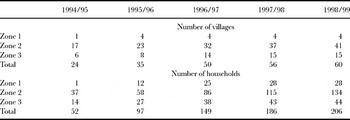
Because the new barley variety spread to neighbouring villages as well, the number of villages included in the survey also increased every year (Table 1). The farmers in the sample were visited in their villages at the end of the planting season. The monitoring included all farmers who had been exposed to at least one promising variety for one year, and had continued for the five-year period, even if they had temporarily stopped growing barley due, for example, to crop rotation or unavailability of seed.
Number of villages and households monitored during the study period.

The structure and concentration of the informal seed system were mapped. Farmers' acceptance and rejection of new varieties were computed using the five-year tracer data, and the relative importance of different criteria for acceptance or rejection were computed.
The study was carried out in a barley–livestock farming system. This is sited in areas adjacent to the dry steppe with an annual rainfall of between 200 and 350 mm. The average farm size of the sample farmers was 22 ha, but 50% of the farmers occupied farms of less than 5 ha and only 4% had 100 ha or more. Crop production represented more than half the household income with off-farm work in second place. Barley is the most common crop, although wheat is important in some areas. In the case of barley, both the grain and the straw are used as livestock feed. Where farms are large or animal holdings are small, barley may be grown as a cash crop, with the stubble being rented out for grazing by migrating flocks (ICARDA, 1989).
RESULTS
Seed networks
Farmers in the study area tend to sell all their barley production at harvest time in one large lot to cover expenses and to pay debts. Even if farmers are convinced of the superiority of new varieties, they indicated that they do not keep seeds for future planting if they do not plan to grow barley the following year due to lack of land or the requirements of crop rotation. The reason for not keeping seed is that farmers cannot guarantee its safe storage in their village against the depredations of rats and insects. This means many farmers rely on outside sources for seeds on an annual basis. Because of this continuous reliance on external seed sources, mainly neighbours and other farmers, it is important to understand how new seeds spread through informal farmer-to-farmer seed systems, in order to identify ways to strengthen these systems.
The 52 farmers who initially received seeds of the new barley varieties transferred these to another 156 farmers during the five-year period that the farmers were monitored. There was no involvement of formal institutions with the exception of the initial injection of the seeds and a smaller annual provision by ICARDA to the original farmers. Other farmers, who became aware of these new varieties, either by direct observation or through other farmers, purchased seeds. This informal seed transfer was thus based on market conditions. The prices of seeds of the new varieties were higher than those of common grain used as livestock feed. In total, 156 seed transactions were reported during the four years of the study.
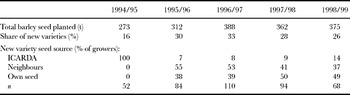
Table 2 shows the amount of barley planted, the share occupied by the new varieties and the sources of these seeds. In the fifth year of the seed tracer study, new varieties accounted for 26% of the seed cultivated by the sample farmers. This is much higher than the share of seed provided through the formal seed system – estimated at 5% of the annual barley seed requirement (FAO, 1999). About half the farmers (49%) used their own seeds saved from the previous season and 37% of them purchased seed from neighbours. Most of the new growers reported purchased seeds of the new variety from farmers who had grown it in the previous year. Neighbours were the most important source of seeds.
Share of new barley varieties and source of seeds.

Figure 1 is a map of the networks through which the new barley seeds were distributed among farmers during the five years of the study. Some farmers did not sell seeds at all during the period. Other farmers sold new variety seeds only in the second year of planting while some farmers continued selling new barley seeds to other farmers for more than one year. All seed transactions were purchases and none were gifts or seed exchanges. About a quarter (24%) of the barley growers sold part of their barley production to other farmers as seeds. The fact that these seed transactions were made through purchases indicates that farmer-to-farmer seed distribution can be sustained on a commercial basis and can facilitate the diffusion of new varieties.
The networks through which new barley seeds were distributed among farmers.
Note: The letter and number combinations are used only as farmer identifiers.

It is clear from Figure 1 that some farmers formed more important nodes of the seed distribution networks than others. About 85% of the transactions took place within 10 networks. Six farmers (F11, F14, F28, F36, F38, F44), who were among the original 52 farmers who received seeds from ICARDA, have become the main nodes of these seed distribution networks. These six farmers directly accounted for 38% of the total number of seed transactions. If another two ‘second generation’ seed suppliers are added, these eight farmers directly account for about 44% of transactions. All in all these six networks accounted for 58% of the seed transfer.
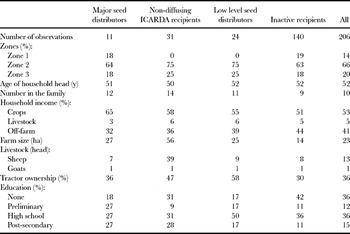
Although a few of these local seed suppliers had significantly larger farms, they were more likely to own a tractor, and had higher incomes from crops. When all the 11 major seed suppliers were compared with other farmers no significant differences were found. Table 3 shows the characteristics of four groups of farmers within the seed networks. These are (i) major seed suppliers who supplied seeds to four or more farmers, (ii) ICARDA recipients who did not sell seeds, (iii) recipients who distributed seeds at a low level and (iv) non-distributing recipients. No major differences are noted.
Socio-economics and farm resource characteristics of participating farmers in the informal barley seed network.

Diffusion of new barley varieties
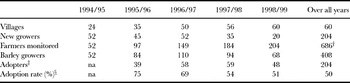
The initial 52 farmers were located in 24 villages. The number of villages that acquired new barley varieties during the study period in the three agro-ecological zones increased from 24 to 60 (Table 4). This means the new varieties spread, on average, to an additional nine new villages every year. This rate of spread is lower than that reported by Witcombe et al. (Reference Witcombe, Petre, Jones and Joshi1999) who found a spread from 3 to 41 villages in four years in Western India. Diffusion was much faster in Zone 2 where six new villages were added every year. This is mainly due to the stability of barley production in this zone. However, the diffusion of new barley varieties through farmer-to-farmer seed distribution is essentially clustered around the initial villages which received the seeds in the first year. Wider initial seed injection should be an important consideration for the extension service to address this localized diffusion given that new varieties outperform local cultivars.
Numbers of villages and monitored farmers growing new barley varieties.

†The total of cases monitored is higher than the number of farmers as farmers were re-interviewed every year.
‡Farmers who planted a new variety a second time after having evaluated it one season.
§Adopters divided by the number of growers of the previous year.
na = not applicable.
The number of farmers who received new barley varieties increased from 52 to 206 in the fifth year. However, the adoption rate did not follow the same trend. Here, we defined adopters as farmers who, after planting and evaluating a new variety, cultivated it again for at least another season. We used this definition to avoid treating first-time growers, who may be just testing the new material, as adopters. Farmers often subject new varieties to rigorous on-farm experimentation and observation before deciding to adopt it or not (Cromwell, Reference Cromwell1990). The survey data indicated that some farmers who planted new varieties actually decided not to grow them again. About 30% of growers in the first year were growing more than one promising barley variety; some of them planted up to four varieties. But this percentage declined over time and ended with only 4% in the fifth year. This indicates that farmers take deliberate decisions on testing new varieties, and then select the best varieties for their environments. This may also indicate that farmers tend to grow multiple varieties or mixtures in the same field to reduce losses in drier years.
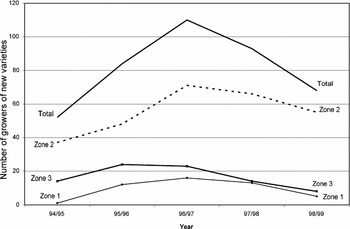
In estimating the adoption rates, we also excluded farmers who did not grow barley due to crop rotation or land use changes, for example shifting to olive production. Overall 278 farmers (41%) of the 686 farmers interviewed did not plant barley from one season to the next for these reasons, whereas 294 farmers did plant new varieties for at least a second time. The adoption rate in the fifth year was 51% of the farmers who had previously planted the new varieties. However, there is a clear decline in the number of growers of the new varieties over time as shown in Figure 2, and that was most severe in Zone 3, the driest region. The reasons behind these trends will be clarified later from the review of farmers' perceptions of the performances of the varieties.
Number of growers of new barley varieties by zone.

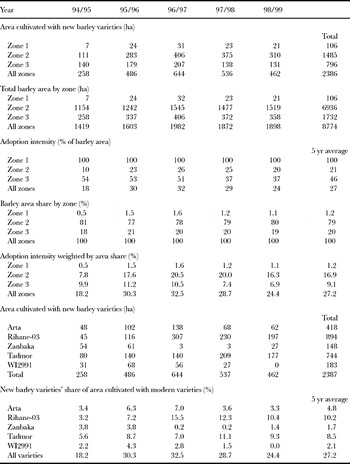
The intensity of adoption, as defined by the proportion of the area cultivated with new varieties, by zone and by variety, is given in Table 5. Overall, this increased from 18% of the barley area in the second year to 24% in the fifth year. However, Zone 1 sustained 100% diffusion (‘adoption intensity’) in all years and Zone 3 had rates of about 50%. The high adoption in Zone 1 can be explained by the fact that all barley growers preferred the lodging-resistant Rihane-03 variety which is highly adapted to this higher rainfall zone. However, barley is relatively unimportant in Zone 1, which accounts for only 1.2% of the total national barley area. The high adoption rates in Zone 3 result from the presence of one large land holder who preferred to plant new varieties and reflects neither the trends in the number of growers (Figure 2) nor the overall farmers' perceptions. About one-third of the area planted with new varieties was found in the less favourable Zone 3, where the variety Tadmor was the farmers' favourite. The diffusion of the new varieties was, however, most pronounced in Zone 2 where 62% of the area planted with new varieties was located. The diffusion of new barley varieties by zones, weighted by the proportion of area under barley, which gives a more balanced picture, is given in Table 5.
Barley areas and diffusion of new varieties by zone and by variety.

Note: Some totals in this table do not add up exactly because of rounding-off.
Over the five-year period, farmers cultivated new barley varieties on a total of 2387 ha, which represents 27% of the total barley area. Farmers' acceptance of new varieties (Table 4) showed marked differences for the different varieties. The variety Rihane-03 accounted for 37% of that area, Tadmor 31% and Arta 17%. Varieties Zanbaka and WI2991 accounted for just 6% and 8% of the area cultivated with new varieties.
Farmers' assessments of new varieties
The diffusion of new varieties through farmer-to-farmer seed distribution was influenced by farmers' assessments of the new varieties. The tracer study generated multi-year farmer evaluations of new varieties in each agro-ecological zone. This type of data, which is rarely available, provided insights into farmers' adoption decision behaviour. Understanding the criteria that farmers use to evaluate new crop varieties allows breeders to set effective priorities and target different breeding strategies to different communities in the dry areas. Targeting becomes more critical for the more marginal areas due to the wide spatial and temporal variability of agro-ecological conditions and different socioeconomic needs. For this purpose, farmers were asked to rank the five new varieties introduced at that time against their local cultivar. These farmer assessments were not facilitated by any agricultural professional; they are independent, individual, farmers' views based on their own judgments of the performances of the varieties and their preferences. In the analysis we use the cumulative frequencies of all farmers monitored and traced over the five-year period by zone and by variety.
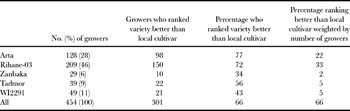
The ranking of new varieties compared to the local cultivar was done by farmers who planted the varieties and observed their yield performances and other attributes. The varieties that farmers ranked better than the local cultivars in the different zones were significantly different at the 0.1% level of significance. Farmers' rankings of the new barley varieties over the 5-year period and their overall approval ratings for the varieties are given in Table 6. The approval rating is the percent of farmers who stated that the new variety was superior to the local cultivar. It is clear from the data that Rihane-03 was the most frequently cultivated variety (grown by 46% of all growers) and it received an overall approval rating of 72% from farmers who cultivated it over the five-year period. The second most popular variety was Arta, cultivated by 28% of the sample over the five-year period. This received an overall approval rating of 77%. Fewer farmers (6–11%) tried the other three varieties, and these received much lower approval ratings. Among these three varieties only Tadmor received an approval rating of over 50%. The approval ratings of less than 50% for Zanbaka and WI2291 may indicate that these varieties have limited adoption potential in the areas where they were evaluated.
Farmers' ranking of new varieties compared to local cultivars.

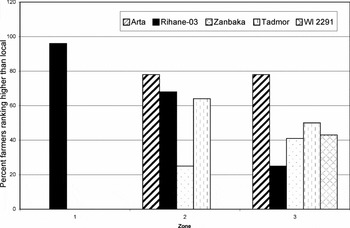
The data, disaggregated by agro-ecological zone, are presented in Figure 3. Rihane-03, the most frequently cultivated variety, was grown mainly in Zone 2 (75%) and Zone 1 (23%) with the remaining 2% in Zone 3. Its approval rating declines as the environment becomes drier; almost 100% in Zone 1, 68% in Zone 2 and 25% in Zone 3. The variety Arta was grown predominantly in Zone 2 (93%) with a few hectares in Zone 3. This variety received an approval rating of 78% in both zones. The small number of growers does not allow the drawing of firm conclusions on its approval rating in Zone 3. The third most frequently cultivated variety was WI12991, grown by 11% of the farmers in Zone 3 over the five-year period. Less than half (43%) of these farmers have rated it as better than the local variety. The numbers of farmers who cultivated the other two varieties, Zanbaka and Tadmor, were too small to provide definite conclusions. However, Tadmor was slightly more favoured in Zone 2, with an approval rating of 64%, than in Zone 3 (50%). Zanbaka was more favoured in Zone 3, with a 41% approval rating against 25% in Zone 2. This implies that this variety has greater potential for the drier Zone 3 than any of the other varieties evaluated. In contrast, Zanbaka will have limited diffusion potential in Zone 2, where other more popular varieties, such as Rihane-03 and Arta, are preferred. The data also show that none of these varieties has been widely accepted in the driest region, Zone 3. Developing new, superior varieties for the drier regions remains a challenge.
Farmers' ranking of new varieties by agro-ecological zone.

However, the major trend that emerged is that farmers' approvals of new varieties tend to decline as the environment gets drier. This may imply that in the drier areas farmers' evaluations of new varieties are more complex, as a result of giving more consideration to risk, or it may also imply that these varieties did not exhibit performances that are widely acceptable in the drier areas. Prevailing weather conditions, such as rainfall and frost, affected the performances of the new varieties and, as a result, farmers' opinions and acceptance of the new varieties. Weather conditions during the previous season were a critical factor influencing farmers' assessment of varieties and also their decision about planting a new variety the following season.
Farmers' criteria for variety evaluation
Farmers who directly or indirectly received seeds of the new varieties from ICARDA were surveyed each year, to understand why they continued to use the seeds, whether they planted the new variety for a second season or the reasons for not continuing to use them. The importance of the different criteria that farmers used to evaluate the new varieties was measured in terms of the frequency that each criterion was mentioned by farmers as a reason either to keep the variety or to discontinue its use.
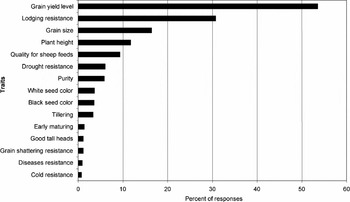
The frequency of the farmers' performance evaluation criteria for the whole sample across zones and varieties is shown in Figure 4. Overall, farmers used 15 different criteria to decide whether to adopt new varieties. There were seven main traits that were mentioned by at least 6% of the farmers. As shown in Figure 4 grain yield was the most dominant criterion in evaluation of a variety (53%). This was followed by lodging resistance (31%), grain size (16%), plant height (12%), feed quality (9%), drought tolerance (6%) and seed purity (6%).
Farmers' performance evaluation criteria for whole sample.

The use of seed purity as a decision criterion to replant a new variety shows that farmers value seed quality in addition to the inherent productivity. The reference to seed quality is a reflection of the trust within the network through which these new varieties are propagated.
A different picture, however, emerges when farmers' evaluation criteria are disaggregated by agro-ecological zone and by variety. Although grain yield still remains the most important criterion in all zones, the number of important traits considered, and their relative importance, varied between zones. In the higher rainfall area (Zone 1), only grain yield and lodging resistance were important in farmers' decisions. This means that in these zones, there is a high chance of farmers' adopting new, high yielding varieties that are more tolerant to lodging. The importance of lodging resistance in this zone is natural because of the higher chances of lodging under higher rainfall conditions. Other criteria were less relevant to the farmers. In Zone 2, grain yield was an important criterion, followed by lodging resistance and grain size, whereas in Zone 3, grain yield was the most important, followed by plant height and drought tolerance.
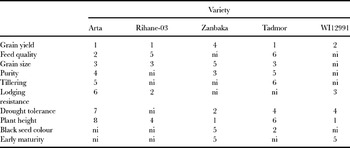
Farmers' criteria in deciding to adopt new varieties were also examined for each variety. The criteria were ranked (highest rank = 1, lowest = 8) using the frequency with which farmers cited each criterion as a reason for keeping a new variety. The results are summarized in Table 7. The relative importance of the different criteria was different for different varieties. However, the overall picture that emerges is that five main criteria influenced farmers' decisions in adopting new barley varieties. These are, in order of importance, grain yield, plant height, grain size, drought tolerance and lodging resistance. This list is somewhat different from the top five criteria presented in Figure 5 when the data were pooled. The main difference is that when data are disaggregated by variety, drought tolerance is included in the top five criteria, due to the data from Zone 2, where drought tolerance did not appear in the top five criteria. This masked the importance of drought tolerance for the drier region, Zone 3, where the farmer sample was smaller. Since this was a tracer study, the structure of the sample was determined by the spread of varieties and was not designed to represent the different zones equally. The structure of the data itself shows farmers' acceptance of different varieties.
Ranking of farmers' reasons for keeping new varieties (1 = highest, 8 = lowest).

ni = not important.
Farmers' reasons for not adopting the new varieties
The top five reasons for not adopting the new varieties were a yield lower than the local cultivar, sensitivity to frost, low feed quality, sensitivity to diseases and lack of seeds. Other farmers did not cultivate barley due to crop rotations. The most important reason for non-adoption was low yield (lower than the local cultivar). This is particularly true in the drier Zone 3 and for the varieties Tadmor, Zanbaka and WI2991. The disaggregation of these data by zone indicates that low grain yield was the main reason given by farmers who did not continue planting the new varieties in Zone 3 (23%). Thirty-eight percent of farmers gave this reason for not adopting Tadmor, 21% for Zanbaka and 16% for WI2991.
Sensitivity to frost was the second most important reason for non-adoption. This was again more related to the varieties Rihane-03 (17%) and Tadmor (10%). Severe frost occurred in the 1996/97 season during the tillering stage. Rihane-03 was the most sensitive of all the new varieties to frost damage, which forced some farmers either to graze it out, or plough their fields and grow spring chickpeas. This affected the area planted with Rihane-03 in the following year due to shortage of seeds. Lower feed quality was the third most important factor for non-adoption, particularly in Rihane-03 (15%) and Tadmor (14%). Sensitivity to diseases was the fourth most important reason. This was predominantly attributed to the variety WI2991 (49%).
This analysis showed that farmers in Zone 3 had a much higher negative assessment of the new varieties with a cumulative value of 85%, a much higher proportion than for the relatively wetter Zone 2 (52%) and Zone 1 (33%). This again shows that farmers' evaluation criteria in drier environments are more complex than in wetter areas, and they may be giving higher weight to reduced risk rather than increased yields. Farmers are concerned with the risks associated with multiple factors including frost, drought, and diseases.
DISCUSSION
This paper analyses three inter-related issues: informal seed systems, adoption of new varieties and farmers' perceptions of new varieties. These are critical elements for securing the continuous and timely transfer of new crop varieties to small farmers in the dry areas and in complex farming systems.
Informal seed system
The availability of seeds of new crop varieties is critical if commodity improvement research is to have an impact. Seed availability is, however, problematic for marginal crops that are cultivated in drier areas and mountainous environments where agro-ecological variability limits any single variety to a relatively small area. The formal seed distribution system (private and public seed companies) may consider the provision of seeds in such fragmented environments as uneconomic as compared to more favourable areas where the large areas covered allow for economies of scale in seed production. This attitude is clearly demonstrated by the seed gap between different crops. The seed replacement rate for wheat in Syria is estimated at 87%, but it is only 5% for barley (FAO, 1999). Sustainable seed supply in the dry areas on a commercial basis remains a critical bottleneck for the diffusion of new varieties.
Earlier studies have pointed out that formal seed services, mainly government parastatal and private companies are not necessarily meeting small farmers' needs (Cromwell, Reference Cromwell1990). This is mainly because business with small farmers in diverse agro-ecologies, who grow a wide range of crops and varieties targeted to specific seasons, is not attractive for the formal seed system (Jones et al., Reference Jones, Audi and Tripp2001). Small farmers grow a mixture of different varieties in order to target specific agro-ecological niches, farming system patterns and user preference, and to minimize risk. In these complex production systems, small farmers may not need the formal seed sector to supply large quantities of improved seeds for replacement on a regular basis, but rather prefer seeds of new varieties, primarily to experiment with and multiply themselves (Cromwell, Reference Cromwell1990).
The informal seed system, therefore, remains the main seed source for almost all small-holder farmers in developing countries (Ndjeunga, et al., Reference Ndjeunga, Kumar and Ntare2000). The system provides farmers with seeds at a relatively low cost and seed quality has not become a major concern. It is critical, therefore, to understand the mechanism of the informal seed system in order to determine how it can be utilized to reach small farmers as a complement to the organized seed system. Informal seed systems consist of a communication and market system in which information exchange and seed transactions take place through social networks, such as family ties, neighbours and other social connections. Seed transactions can take place in the form of cash, exchange, gifts, payment for labour or sharecropping. Farmer-to-farmer diffusion of new barley varieties, which were monitored in the tracer study, revealed the importance of the informal system in dry areas.
This study demonstrates the existence of an active local seed system functioning through informal networks and built on trust and reputation for access to knowledge and new seeds. Informal seed systems, such as the one described in this paper, are underutilized. The fact that all seed transactions were made through purchases indicates that farmer-to-farmer seed distribution can be sustained on a commercial basis and can facilitate the diffusion of new varieties. However, we found a strong propensity for seed trade concentration at the local level as farmers identify specific suppliers of seeds. These results confirm the findings of Cromwell (Reference Cromwell1990) and Almekinders et al. (Reference Almekinders, Louwaars and de Bruijn1994), who found that key individuals were important factors in the success of informal seed diffusion, but contradict those of Jones et al. (Reference Jones, Audi and Tripp2001), who found little evidence that farmers source seeds from specific farmers.
Five of the 10 main seed suppliers (F11, F14, F16, F19 and F37 in Figure 1), who are among the original recipients, obtained new seed injections from the ICARDA barley breeding programme in successive years, while the other five did not. This shows that continuous contact with ICARDA has played a positive role in building a reputation as a reliable source of new variety seeds and helped the development of local seed enterprises. The implications of this is that ICARDA needs to work closely with national research systems and national seed authorities to devise policies and mechanisms for encouraging and supporting farmer-based seed supply systems that remain important source of seeds for farmers in the dry areas, particularly for crops with which the formal seed sector has been less successful. This realization has been already taking place at ICARDA and dialogue between breeders and seed authorities is increasing.
Although the original intention of ICARDA's collaboration with these farmers was not to strengthen the informal seed system, this positive spillover is a clear indication that an informal seed system can actually be strengthened with proper institutional support and can accelerate the adoption of new varieties.
Farmers' criteria for variety adoption
Adoption of new varieties is highly influenced by farmers' evaluations and their perceptions of the varieties. Farmers' perceptions of technology characteristics are important factors in adoption behaviour (Adesina and Zinnah, Reference Adesina and Zinnah1993; Mazid, Reference Mazid1994). These perceptions can change if farmers test the technology themselves. Researchers can also identify criteria that farmers use to evaluate new varieties from studies similar to the one presented here or from participatory research activities. Earlier studies show that farmers test new varieties rigorously using a wide range of criteria and make very sensitive trade-offs between the relative strengths and weaknesses of new varieties in comparison with existing varieties (Cromwell, Reference Cromwell1990). We have demonstrated in this study that these criteria depend on agro-ecological conditions. The criteria can also change with the production system and with the end-users' tastes and preferences. It is important to understand these criteria so that crop improvement research can target the attributes most desired by farmers.
The results of our tracer study highlight two main points regarding the criteria that influence adoption of new varieties. The first point is that in the drier zones, relatively less weight is given to grain yield than in wetter areas, and that the increased importance of other criteria, such as plant height and drought tolerance, is a clear indication of farmers' concerns about averting risk as much as getting higher yields. The second point is that the number of criteria that farmers use in adoption decisions, increases as the environment becomes drier. In this study, farmers in the wetter zone (Zone 1) had only two criteria, yield and lodging resistance. Farmers in drier areas had more criteria to consider. Four main criteria were used in Zone 2 (mentioned by over 10% of the farmers) and six criteria were used in Zone 3. These results underline the complexity of farmers' adoption criteria in the drier environments. It helps to explain why adoption of new varieties is often faster in the wetter areas. It also highlights the challenges in breeding for dry environments. The main criteria that farmers use in deciding whether to keep a new variety in a given zone can be used as indicators of potential success in adoption and should be given high consideration in crop improvement research.
Diffusion of barley varieties
Other studies found for some crops a much higher diffusion rate for new varieties through the public service than through informal farmer-to-farmer seed dissemination after an initial injection of new seeds (Sperling and Loevinsohn, Reference Sperling and Loevinsohn1993; Witcombe et al., Reference Witcombe, Petre, Jones and Joshi1999). In this study we demonstrated the effectiveness of the informal seed system in the dissemination of new technology. About 50% of the farmers who have cultivated the new varieties at least once have adopted them and 27% of the barley area of the farmers sampled in the study was cultivated with new varieties in the fifth year. This diffusion has taken place entirely through the informal seed system with no public support in extension, promotion or quality assurance, and hence no public cost, which shows that the informal seed system is quite an efficient mechanism for seed distribution as well as a good vehicle for the diffusion of new varieties.
Traditionally, the informal seed system has been associated with non-market distribution mechanisms, such as gifts and seed-for-seed exchange through kinship and social relationships, which were considered to play dominant roles in farmer-to-farmer seed diffusion as compared to direct sales (Cromwell, Reference Cromwell1990; Jones et al., 2000). In this study, however, we found that farmer-to-farmer seed exchange was mainly done through seed sales. This market-based dimension of the informal system is gaining greater recognition (Sperling et al., Reference Sperling, Remington, Haugen and Nagoda2004). The important role of a market-based local seed system implies that farmers specializing in seed sales can invest in local seed enterprises and provide sustainable services at affordable prices. The commercial potential of such local seed enterprises has implications for how this sector can be supported.
The role of informal systems does not mean a diminishing role for formal seed systems. The two systems are complementary and, if co-ordinated properly, can increase their reach to small farmers in complex farming systems and in less favourable areas that are currently underserved. This will reduce the seed gap between less favourable and more favourable areas. However, public research, extension institutions, and non-governmental organizations should look at the informal seed system through a different lens, given the argument presented in this paper. The role of the public sector is first and foremost to increase the number and geographical distribution of seed outlets so that access will be improved. Second, public research and extension systems need to provide support to the informal system in the form of capacity building, a continuous flow of new variety seeds, participation in experiments and demonstrations of new varieties. With such support higher adoption rates than reported here can be achieved. This research has shown that an initial injection of new varieties into rural communities sparks off a significant diffusion process. By expanding the geographical coverage of these initial injections the diffusion of new varieties can be increased if they have superior attributes. Farmers and traders specializing in seed sales can benefit from training in seed quality and enterprise development. Periodic monitoring of the performance of the system can provide information for further action. Understanding and utilizing these existing seed networks will be effective in seed dissemination if the networks are adequately supported.
Finally, it is important to note that extension services for promotion of new barley varieties is nonexistent in the study area and recorded adoption data are unsupported. Public support through extension, new seed injections and capacity building of local seed entrepreneurs are essential for sustainable new variety diffusion in the dry areas.
CONCLUSION
In this study we demonstrate the existence of informal seed systems through which new barley varieties are disseminated with a high degree of local concentration, in spite of the lack of extension services. We also demonstrate that complexity of farmers' evaluation criteria would explain the low adoption of new varieties in dry areas. The results of this study suggest that a sustainable seed supply can be achieved by supporting local seed networks with extension, injection of new seed varieties and capacity building. The results have important policy implications as many national systems do not recognize informal seed systems and encourage (or even legislate) a monopoly for public seed companies.