Introduction
In digenetic trematodes, very few studies on parasite–snail first intermediate host compatibility are centred on one parasite strain with one sympatric snail species and its comparison using allopatric strains of the same snail species (‘local’ or ‘at home’ vs. ‘foreign’ or ‘away’ results, according to the terminology proposed by Greischar & Koskella, Reference Greischar and Koskella2007). Most of these studies deal with parasite strains of different origins and one snail species (sympatric or allopatric), or with one parasite strain and snails of different species (sympatric or allopatric) (Tchuem Tchuenté et al., Reference Tchuem Tchuenté, Southgate, Théron, Jourdane, Ly and Gryseels1999; Gasnier et al., Reference Gasnier, Rondelaud, Abrous, Carreras, Boulard, Diez-Baños and Cabaret2000; Southgate et al., Reference Southgate, Tchuem Tchuenté, Théron, Jourdane, Ly, Moncrieff and Gryseels2000; Goumghar et al., Reference Goumghar, Dreyfuss, Rondelaud, Benlemlih and Cabaret2001).
Echinostomes are useful models for the analysis of larval parasite–host relationships (Toledo et al., Reference Toledo, Muñoz-Antoli and Fried2007). These trematodes follow a three-host life cycle: small mammals and aquatic birds harbour intestinal adults; several species of planorbids, lymnaeids and bulinids have been recorded as first intermediate hosts; numerous snail species, clams, tadpoles, frogs, fish and natural products such as snail mucus may serve as second intermediate hosts (Huffman & Fried, Reference Huffman and Fried1990). Each echinostome species may have a broad spectrum of sympatric snail species as first intermediate hosts (Muñoz-Antoli et al., Reference Muñoz-Antoli, Trelis, Toledo and Esteban2006; Esteban & Muñoz-Antoli, Reference Esteban, Muñoz-Antoli, Fried and Toledo2008). However, the available information on experimental echinostomatid infections in allopatry is scant. To date, the only information available is the study by Maldonado et al. (Reference Maldonado, Vieira, Garcia, Rey and Landfredi2001), in which only sympatric associations were effective in parasite transmission.
Euparyphium albuferensis (Trematoda: Echinostomatidae) is a digenean solely found in Albufera Natural Park (Valencia, Spain), infecting the snail Gyraulus chinensis (Gastropoda: Planorbidae) as the natural and experimental first intermediate host (Esteban et al., Reference Esteban, Toledo, Sanchez and Muñoz-Antoli1997). Muñoz-Antoli et al. (Reference Muñoz-Antoli, Trelis, Gozalbo, Toledo, Haberl and Esteban2003) showed the high specificity of E. albuferensis miracidia for G. chinensis as first intermediate host snail under laboratory conditions. This planorbid, originating from south and east Asia, was introduced to several European countries through human activities linked to rice fields and swamps and presents a wide distribution all over Spain (Meier-Brook, Reference Meier-Brook, Falkner, Groh and Speight2002).
During the course of our biological studies on echinostome larval infections of freshwater snails from Spain, stable populations of G. chinensis snails from three different geographic areas were cultivated under laboratory conditions. These three natural parks, mainly occupied by rice fields and irrigation canals, constitute way stations for many species of migratory birds. The disposal of different G. chinensis strains raises the question of whether the different geographic sources of these snails could affect the level of host–parasite compatibility.
The aim of the present paper is to examine parasite local/away adaptation, using the experimental model of E. albuferensis infection of three different sources of G. chinensis snails from the rice fields of Albufera (sympatric), and Delta and Doñana (allopatric) natural parks.
Materials and methods
Experimental infections
The life cycle of E. albuferensis (originally obtained from Albufera Natural Park, Valencia, Spain) was maintained under laboratory conditions for 15 years using G. chinensis as first intermediate host. This freshwater snail species, as well as others from the same natural area, were used as experimental second intermediate hosts. Golden hamsters (Mesocricetus auratus), kept for 4 months under standard laboratory conditions, were used as experimental definitive hosts. Techniques for maintaining the life cycle were the same as in previous studies (Esteban et al., Reference Esteban, Toledo, Sanchez and Muñoz-Antoli1997). Briefly, hamsters were infected with metacercariae, recovered from second intermediate host snails; intestinal adult worms were obtained, and eggs were removed from the worm uteri; eggs were kept in the dark at 25 ± 1°C for 15 days, and the miracidia obtained were used for first intermediate host snail infections.
All snail strains considered in the present study originated from different rice fields in Spain. The first group of G. chinensis came from Albufera Natural Park, province of Valencia (snails sympatric with E. albuferensis), whereas the two others were from Ebro Delta Natural Park, province of Tarragona, and from Coto de Doñana Natural Park, province of Huelva (both snail populations allopatric with the parasite). The three natural parks considered are far away from each other: Delta and Doñana are located more or less 191 km and 737 km away from Albufera, respectively.
All snail groups, collected in the three different ecosystems, were transported to the laboratory and placed in breeding containers until they shed eggs that gave rise to juvenile snails (2–3 mm in diameter). Experimental snails used in this study originated from more than one family.
Experimental infections were performed using 50 laboratory-reared snails from each strain. Each snail was individually exposed to one recently hatched miracidium in 3 ml of spring water at room temperature for 24 h. After exposure, snails were kept under a 12 h light–dark cycle at 20 ± 1°C and were fed with washed lettuce ad libitum. Control snails of each strain were not exposed to any miracidium.
Data analysis
The snails were tested daily for cercarial shedding from day 30 post-infection. Once the patent period was reached (first shedding), cercarial counts were performed once a week, every 2 h, from 12.00 h up to 20.00 h, and every week until death of the snails (end of the shedding period). The rhythm of cercarial emergence was studied according to the methods described by Southgate et al. (Reference Southgate, Tchuem Tchuenté, Théron, Jourdane, Ly, Moncrieff and Gryseels2000). Moreover, we calculated the index of Total Cercarial Production (TCP), proposed by Frandsen (Reference Frandsen1979) and modified by Théron (Reference Théron1981), following the formula: total number of cercariae shed/total number of days for the patent period/number of cercarial shedding (CS) snails.
Parameters studied were: (1) infection rate; (2) time between exposure and first cercarial shedding (prepatent period) as well as the duration of the shedding period (patent period); (3) life span of infected snails (compared with control snails); (4) shell diameter of cercarial shedding snails (CS snails) at the first shedding and at the death of snails; (5) daily and total cercarial production over the total shedding period; and (6) the chronobiology of cercarial emergence over a 24-h period. The mean values obtained were compared by the χ2 test and Student's t-test (P < 0.05). The data of cercariae produced were log(x+1) transformed.
Results
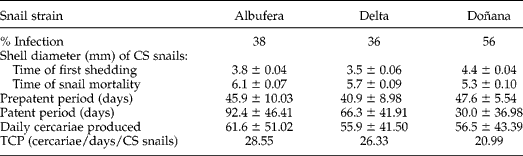
Table 1 shows the general characteristics of E. albuferensis infection. The highest infection rate (56%) was obtained in Doñana snails, with no significant differences among the three snail groups. The shell diameter of CS snails at the first cercarial shedding was statistically larger in Doñana planorbids compared with Albufera (t = 7.85; df = 98; P < 0.05) and Delta (t = 9.23; df = 98; P < 0.05) snails. However, at the death of the snails the shell diameter was statistically larger in Albufera planorbids compared with Delta (t = 2.36; df = 98; P < 0.05) and Doñana (t = 4.39; df = 98; P < 0.05) snails. Although the time between exposure and first cercarial shedding (prepatent time period) was similar in the three planorbid populations, the mean duration of the shedding period (patent period) was statistically longer in Albufera snails compared with Delta and Doñana snails (t = 2.91 and 6.48; df = 98; P < 0.05), respectively. The shedding period ended with the death of the snails in all three snail groups considered. The highest average of cercariae produced daily (61.6) was obtained in Albufera snails, with statistical differences in relation to cercariae produced by Delta and Doñana snails (t = 3.18 and 2.66; df = 1118 and 940; P < 0.05), respectively. Over the total shedding period, the TCP index calculated for the three snail groups considered showed a significant host–source effect.
Characteristics of Euparyphium albuferensis experimental infections in the three Gyraulus chinensis strains from Albufera, Delta and Doñana.
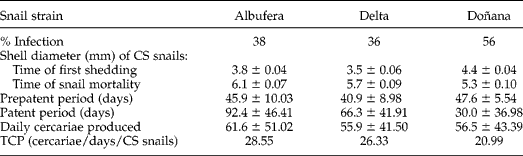
Total snails infected/strain, 50; mean values ± standard error; CS, cercarial shedding; TCP, total cercarial production.
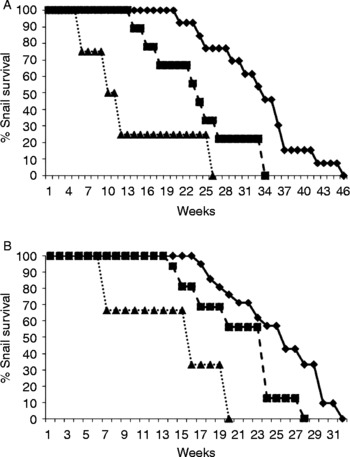
Figure 1 shows the life span of infected snails (A) compared to that of control snails (B). The mean life span was statistically longer in Albufera than in Delta and Doñana snails (t = 2.39 and 2.70; df = 98; P < 0.05), respectively. Moreover, the maximum life span reached by Albufera snails (46 weeks post-infection) was longer than that in Delta (34 weeks) and Doñana snails (26 weeks), respectively.
Life span of the three Gyraulus chinensis snail strains from Albufera (♦), Delta (■) and Doñana (▲). (A) Infected with Euparyphium albuferensis; (B) control snails.

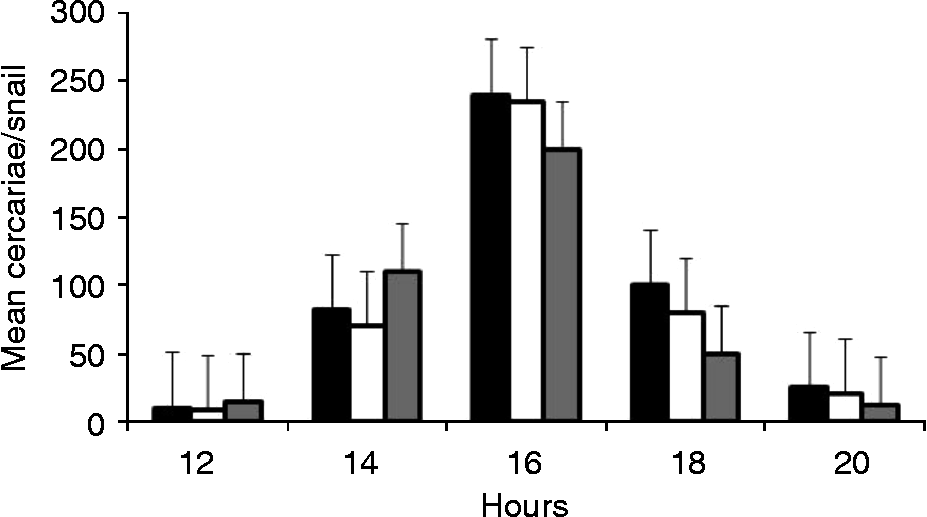
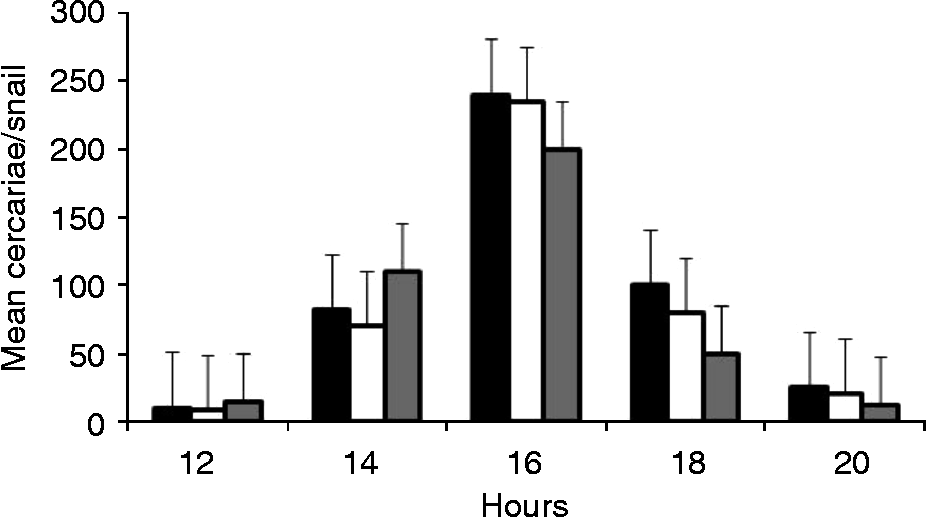
Figure 2 shows the cercarial emergence pattern. Euparyphium albuferensis cercariae were shed daily between 12.00 h and 20.00 h, with a daily peak at 16.00 h, in both sympatric and allopatric snail groups studied. Albufera snails shed a maximum number of 959 cercariae weekly during the emergence peak, whereas 1120 and 539 cercariae were shed by Delta and Doñana snail groups, respectively.
Mean number (+SE) of cercariae produced by the three Gyraulus chinensis snail strains from Albufera (black bars), Delta (white bars) and Doñana (grey bars), for different hours of the day.
Discussion
The short duration of the prepatent period, the long duration of the patent period and high cercarial production are among the criteria considered to indicate the compatibility between snail hosts and parasites (Pino et al., Reference Pino, Matinella and Morales1999).
Very few studies have analysed the compatibility of one parasite species with one sympatric snail species, and compared ‘local’ or ‘at home’ results with ‘away’ or ‘different strains’ of the same snail species, allopatric with the parasite. All studies with associations of Schistosoma–hosts from the same geographic area (sympatric combinations) showed them to be more compatible than allopatric ones (Pino et al., Reference Pino, Matinella and Morales1999; Tchuem Tchuenté et al., Reference Tchuem Tchuenté, Southgate, Théron, Jourdane, Ly and Gryseels1999; Yacoubi et al., Reference Yacoubi, Zekhnini, Moukrim and Rondelaud1999; Southgate et al., Reference Southgate, Tchuem Tchuenté, Théron, Jourdane, Ly, Moncrieff and Gryseels2000). However, the results obtained in studies carried out with other associations, e.g. Fasciola hepatica–Lymnaea truncatula, from different geographic origins, are variable (Dreyfuss et al., Reference Dreyfuss, Vignoles and Rondelaud2000; Gasnier et al., Reference Gasnier, Rondelaud, Abrous, Carreras, Boulard, Diez-Baños and Cabaret2000; Vignoles et al., Reference Vignoles, Dreyfuss and Rondelaud2002, Reference Vignoles, Favennec, Rondelaud and Dreyfuss2003; Belfaiza et al., Reference Belfaiza, Rondelaud, Moncef and Dreyfuss2004, Reference Belfaiza, Moncef and Rondelaud2005) as cercarial production is similar in sympatric and allopatric associations in some cases, while cercarial production is higher in allopatric snail populations in other cases.
The present study tests the compatibility between E. albuferensis–G. chinensis snails from Albufera and compares these sympatric results with those obtained with the same snail species but allopatric with the parasite. General characteristics of E. albuferensis infection show significant differences between ‘local’ and ‘away’ snail populations. The main differences observed are those related to the slower final growth of allopatric snails, their shorter shedding period, shorter life span and lower amount of cercariae produced. Continuous contact between E. albuferensis and the local G. chinensis snails seems to produce a kind of chronic infection. It is likely that the parasite is less lethal in Albufera snails, while the parasite produces more damage in Delta and Doñana snails. A reduced growth rate could increase the mortality of the infected snails, resulting in a shortened shedding period and, therefore, in a reduction of the total cercarial production.
The study by Maldonado et al. (Reference Maldonado, Vieira, Garcia, Rey and Landfredi2001), focused on E. paraensei and sympatric and allopatric snails, demonstrated that none of the snail species allopatric to the echinostome species released cercariae, in such a way that only sympatric associations were effective in cercarial transmission. However, in the present study, experimental infection with E. albuferensis is achieved with sympatric as well as allopatric snails, although the ‘away’ snails show a lower compatibility with the parasite.
The profile of cercarial emergence is similar in sympatric and allopatric combinations, presenting a daily peak at 16.00 h, when conditions seem most favourable for parasite–host contact (higher temperatures). Consequently, the chronobiology of the shedding patterns seems to be correlated with the climatic and vegetal features of the transmission areas (Toledo et al., Reference Toledo, Muñoz-Antoli and Esteban1999).
Although we used G. chinensis from three different sources, their origin and evolution in the three rice field areas must have been somewhat similar (Meier-Brook, Reference Meier-Brook1983). Moreover, Gow et al. (Reference Gow, Noble, Rollinson, Mimpfoundi and Jones2004) explained that snails subjected to pronounced annual cycles of drainage and flooding, a typical feature of rice fields, were expected to show reduced genetic variability. Regardless of the spatial distance, the abiotic factors that could have influenced snail population stability may have been very similar in the three natural areas considered (similar environmental, ecological conditions, etc.). Leaving abiotic differences aside, there should be no differences in compatibility in the host–parasite association analysed. However, the experimental compatibility data show a different efficiency of E. albuferensis infection in their ‘at home’ G. chinensis snails and in the two ‘away’ snail groups considered.
Prolonged parasite–snail contact, between E. albuferensis and local G. chinensis from Albufera Natural Park, has converted this sympatric parasite–host association into the most compatible one. The evolution of the two experimental allopatric host–parasite relationships would still have to be in progress, as in the case of some studies on allopatric F. hepatica infections. In this sense, and so far, E. albuferensis has only been found in Albufera Natural Park.
Acknowledgements
The present study was supported by Project CGL2005-02321/BOS of Ministerio de Educación y Ciencia (Spain) and FEDER (Europea Union) and by Project PROMETEO 2009/081 of Conselleria d'Educació of Generalitat Valenciana (Valencia, Spain). The experiments comply with current Spanish legislation.