1. Introduction
Coherent systems are among the basic and fundamental concepts in reliability engineering. A system is said to be coherent if its structure is non-decreasing in each component and there is no irrelevant component; see [Reference Barlow and Proschan1]. A well-known example of n-component coherent structures which plays a fundamental role in reliability engineering is the k-out-of-n system (sometimes referred to in the literature as k-out-of-n:G structure). Such a system functions as long as at least k components function. Assume that  $X_1,X_2,\ldots,X_n$
denote the independent and identically distributed (i.i.d.) lifetimes of components of a coherent system where the
 $X_i$
follow a common cumulative distribution function (CDF) F. Usually the states of the system (or its components) are classified as ‘functioning’ or ‘failed’, and the system state is fully specified by the states of the components. Recent developments on reliability and ageing specifications of coherent systems are mainly based on the notion of signature. Assume that
 $X_{1:n}\leq X_{2:n}\leq\cdots\leq X_{n:n}$
are the ordered component lifetimes of the system with lifetime T. The system signature is defined as a vector
 $\boldsymbol{s}=(s_1,s_2,\ldots,s_n)$
, where
 $s_i=\mathbb{P}\{T=X_{i:n}\}$
,
 $i=1,2,\ldots,n$
. A comprehensive discussion of different properties of the signature is presented in [Reference Samaniego18]. Since the signature
 $\boldsymbol{s}$
is not influenced by F, the system reliability can be computed as
 \begin{equation*}\mathbb{P}\{T >t\} =\sum_{i=1}^{n}s_i \mathbb{P}\{X_{i:n} > t\},\quad t\geq 0.\end{equation*}
Navarro, Ruiz, and Sandoval [Reference Navarro, Ruiz and Sandoval17] demonstrated that the same result remains valid for every coherent structure with components having exchangeable and absolutely continuous distribution.
As a generalization of coherent systems, one can consider the class of mixed systems whose lifetimes are, in fact, stochastic mixtures of those of coherent structures of a certain size (see [Reference Boland and Samaniego3]). The mixed system may be physically actualized by choosing at random from coherent systems. As a consequence of this generalization, every vector  $\boldsymbol{p}=(p_1,p_2,\ldots,p_n)$
of probabilities such that
 $p_1+p_2+\cdots+p_n=1$
may be considered as the signature of a mixed system. Then, if the component lifetimes are exchangeable, the reliability of any mixed system can be expressed as a mixture of the reliabilities of
 $X_{1:n},X_{2:n}, \ldots,X_{n:n}$
.
Failure rate (FR) and reversed failure rate (RFR) are two useful concepts both in theory and in applications of reliability and statistics. Assume that X is a lifetime random variable with an absolutely continuous CDF F(x). The corresponding reliability function and probability density function are denoted by  $\bar{F}(x)=1-F(x)$
and f(x), respectively. Define
 $a=\inf\{x\colon F(x)>0\}$
and
 $b=\sup\{x\colon F(x)<1\}$
. Further, suppose that F is strictly increasing on [a, b]. The interval [a, b],
 $0\leq a<b\leq\infty$
, is called the interval of support of F. The FR h(t) and the RFR r(t) of X are defined as
 \begin{equation*}h(t)=\dfrac{f(t)}{\bar{F}(t)},\quad \bar{F}(t)>0,\end{equation*}
and
 \begin{equation*}r(t)=\dfrac{f(t)}{F(t)},\quad F(t)>0.\end{equation*}
Notice that the existence of h(t) (or r(t)) requires the CDF F to be absolutely continuous.
In reliability engineering, the quality of products has been impressed with the shapes of h(t) and r(t). The behavior of these and other ageing concepts leads us to some classes of lifetime distributions such as decreasing and increasing FR. These classifications have been found to be very useful in various fields of applied probability such as survival analysis and reliability theory. For studying the shape of the FR and RFR, we refer the reader to [Reference Barlow and Proschan1], [Reference Lai and Xie9], [Reference Mi11], and [Reference Navarro, Guillamón and Ruiz16].
We now begin by introducing the most important classes of lifetime distributions based on ageing concepts. A CDF F is said to be an increasing FR (IFR) if  $\bar{F}$
is log concave. Similarly, F is said to be a decreasing FR (DFR) if
 $\bar{F}$
is log convex. It is worth mentioning here that these definitions do not need the CDF to be absolutely continuous. For an absolutely continuous CDF F, the IFR (DFR) is equivalent to h(t) being increasing (decreasing) in
 $t\geq 0$
. Defining other classes based on the monotone behavior of the RFR is similar, the difference being that there does not exist any lifetime distribution having increasing RFR function on the entire interval of support; see [Reference Block, Savits and Singh2]. Thus we only define the class of lifetime distributions whose RFR is non-increasing. The CDF F is said to be a decreasing RFR (DRFR) if F is log concave. In the literature, several other classes based on ageing concepts are introduced and implicative relationships between them are investigated; we refer, among others, to [Reference Barlow and Proschan1], [Reference Chandra and Roy4], and [Reference Lai and Xie9].
In the literature, the initial and final behaviors of the FR have also been investigated. We refer, among others, to Finkelstein and Cha [Reference Finkelstein and Cha5], who considered an FR that is initially decreasing or eventually increasing, and Mi [Reference Mi12], who discussed the optimal burn-in time under the condition that the FR function is eventually increasing.
Throughout the article we shall use the following concepts.
Definition 1.1. (Karlin [Reference Karlin6].) A bivariate function  $k(x, y)$
is sign-regular of order 2
 $(\mathrm{SR}_{2})$
if
 $\varepsilon_{1}k(x, y)\geq 0$
and
 $\varepsilon_{2}[k(x_{1},y_{1})k(x_{2},y_{2})-k(x_{1},y_{2})k(x_{2},y_{1})]\geq 0$
whenever
 $x_{1}<x_{2}$
and
 $y_{1}<y_{2}$
, for
 $\varepsilon_{1}$
and
 $\varepsilon_{2}$
equal to
 $+1$
or
 $-1$
;
 $k(x, y)$
is said to be totally positive of order 2
 $(\mathrm{TP}_{2})$
if the above relations hold with
 $\varepsilon_{1}=\varepsilon_{2}=+1$
;
 $k(x, y)$
is said to be reverse regular of order 2
 $(\mathrm{RR}_{2})$
if they hold with
 $\varepsilon_{1}=+1$
and
 $\varepsilon_{2}=-1$
.
When studying the reliability properties of distributions, the next lemma due to Karlin [Reference Karlin6] constitutes a key result.
Lemma 1.1. Let A, B and C be subsets of the real line, and let L(x, z) be  $\mathrm{SR}_{2}$
for
 $x\in A$
,
 $z\in B$
, and M(z,y) be
 $\mathrm{SR}_{2}$
for
 $z\in B$
,
 $y\in C$
. Then, for any
 $\sigma$
-finite measure
 $\mu$
,
 $K(x,y)=\int_B L(x,z)M(z,y)\,{\mathrm{d}} \mu(z)$
is also
 $\mathrm{SR}_{2}$
for
 $x\in A$
and
 $y\in C$
, and
 $\varepsilon_i(K)=\varepsilon_i(L)\varepsilon_i(M)$
for
 $i=1,2$
, where
 $\varepsilon_i(K)=\varepsilon_i$
denotes the constant sign of the ith-order determinants.
A basic question in which we are interested in this paper is how the behavior of the FR and RFR of the coherent system relates to those of components. The question will be answered in Section 2. We also relate in this section the initial or final behavior of the component probability density function to the FR and the RFR of the system. Finally, in Section 3, some stochastic comparisons of coherent systems based on doubly truncated random variables are provided.
In the article, the terms decreasing and increasing stand for non-increasing and non-decreasing, respectively.
2. The FR and RFR for coherent systems
In the present section, some results on the behavior of the FR and the RFR functions of coherent systems are provided. In a k-out-of-n system, it is known that if the component lifetimes are i.i.d. according to an IFR distribution, then the system’s lifetime is also IFR (see [Reference Barlow and Proschan1]). Samaniego [Reference Samaniego18] proved the result for a mixed system under a condition on the structure of the system. Navarro et al. [Reference Navarro, Sordo and Suárez-Llorens15] studied conditions for the preservation of the IFR (and other reliability classes) under the formation of coherent systems based on the domination function. We now begin by establishing a theorem in this regard. The result gives a simpler sufficient condition for a coherent (or mixed) system with IFR (DFR) component lifetimes to be IFR (DFR). An analogous result determining the behavior of the RFR function of a coherent structure can also be obtained; see Theorem 2.2 below.
Theorem 2.1. Let  $\boldsymbol{s}=(s_{1},s_{2},\ldots,s_{n})$
be the signature vector of a coherent (or mixed) system. If the common CDF F of components is IFR (DFR) and
 $a_i\,:\!=(n-i)s_{i+1}/\sum_{j=i+1}^{n}s_{j}$
(when defined) is non-decreasing (non-increasing) in i, then the system’s lifetime is also IFR (DFR).
Proof. The FR of a mixed system can be rephrased as [Reference Samaniego18]
 \begin{equation*}h_{T}(t)=\dfrac{\sum_{i=0}^{n-1}(n-i)s_{i+1}\binom{n}{i}u_{t}^{i}}{\sum_{i=0}^{n-1} (\!\sum_{j=i+1}^{n}s_{j})\binom{n}{i}u_{t}^{i}}h(t),\end{equation*}
where  $u_{t}=F(t)/\bar{F}(t)$
represents the odds of failure versus survival. To prove the result, we need to show that the function
 $\xi$
, given by
 \begin{equation*}\xi(x,k)=\sum_{i=0}^{n-1}c_{i,k}\binom{n}{i}x^{i} {,}\end{equation*}
is  $\mathrm{TP}_{2}$
 $(\mathrm{RR}_{2})$
in
 $(x,k)\in[0,\infty)\times\{0,1\}$
, where
 \begin{equation*}c_{i,k}=\begin{cases} \sum_{j=i+1}^{n}s_{j}& k=0, \\ (n-i)s_{i+1}& k=1.\end{cases}\end{equation*}
It can be easily observed that  $x^{i}$
is
 $\mathrm{TP}_{2}$
in
 $(x,i)\in[0,\infty)\times\{0,1,\ldots,n-1\}$
. Under the assumption of the theorem,
 $c_{i,k}$
is
 $\mathrm{TP}_{2}$
 $(\mathrm{RR}_{2})$
in
 $(i,k)\in\{0,1,\ldots,n-1\}\times\{0,1\}$
. The required result then follows from Lemma 1.1.
Remark 2.1. It follows from the proof of Theorem 2.1 that if F is initially IFR and  $(n-i)s_{i+1}/\sum_{j=i+1}^{n}s_{j}$
is non-decreasing in i, then the system’s lifetime is also initially IFR. Also, it can be easily deduced that in the case where F is DFR and
 $\boldsymbol{s}$
is a DFR discrete probability vector (i.e.
 $s_{i+1}/\sum_{j=i+1}^{n}s_{j}$
is non-increasing in i), then the system’s lifetime is DFR.
An analog of Theorem 2.1 about the preservation of DRFR class under the formation of coherent systems is as follows.
Theorem 2.2. If the common CDF F of components is DRFR and  $b_i\,:\!=i s_{i}/\sum_{j=1}^{i}s_{j}$
(whenever defined) is non-increasing in i, then the system’s lifetime is DRFR.
Proof. One can show that the RFR of the system can be expressed as
 \begin{equation*}r_{T}(t)=\dfrac{\sum_{i=1}^{n}i s_{i}\binom{n}{i}u_{t}^{i}}{\sum_{i=1}^{n} \big(\!\sum_{j=1}^{i}s_{j}\big)\binom{n}{i}u_{t}^{i}} r(t),\end{equation*}
where  $u_t=F(t)/\bar{F}(t)$
and r(t) denotes the common RFR of component lifetimes. Define the function
 $\tilde{\xi}(x,k)=\sum_{i=1}^{n}\tilde{c}_{i,k}\binom{n}{i}x^{i}$
, where
 \begin{equation*}\tilde{c}_{i,k}=\begin{cases} \sum_{j=1}^{i}s_{j} & k=0, \\ is_{i}& k=1.\end{cases}\end{equation*}
The result then follows from Lemma 1.1 on noting that under the assumption of the theorem,  $x^{i}$
is
 $\mathrm{TP}_{2}$
in
 $(x,i)\in[0,\infty)\times\{1,2,\ldots,n\}$
and
 $\tilde{c}_{i,k}$
is
 $\mathrm{RR}_{2}$
in
 $(i,k)\in\{1,2,\ldots,n\}\times\{0,1\}$
.
Some important facts regarding Theorems 2.1 and 2.2 are demonstrated in the following examples. In the first example, it is seen that the conditions of the cited theorems on the system signature are not necessary for the results to hold.
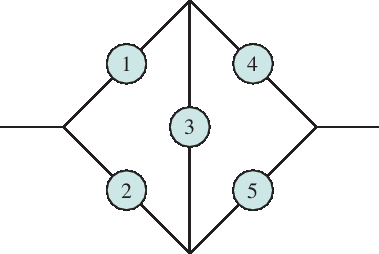
Example 2.1. Consider the bridge system pictured in Figure 1. Suppose the component lifetimes follow a Weibull distribution  $W(\alpha,\beta)$
with reliability function
 $\bar{F}(t)=\exp\{-(t/\beta)^\alpha\}$
,
 $t\geq 0$
, where
 $\alpha,\beta>0$
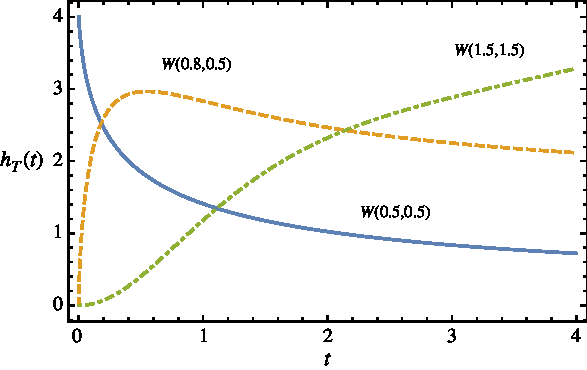
. Figure 2 depicts the system FR for different values of
 $\alpha$
and
 $\beta$
. It can be shown that the system signature
 $\boldsymbol{s}=(0,0.2,0.6,0.2,0)$
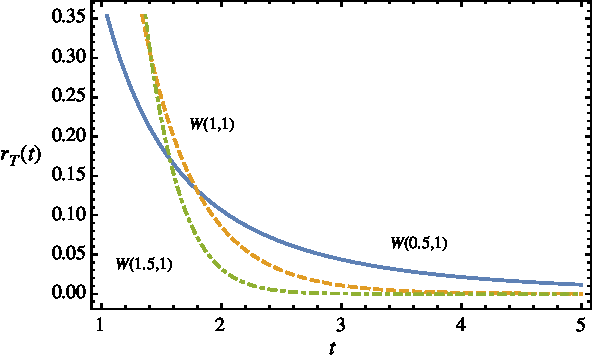
satisfies neither the condition of Theorem 2.1 nor that of Theorem 2.2. However, as seen in Figure 2, the FR of the system with IFR (DFR) Weibull components may be increasing (decreasing). Moreover, one can observe in Figure 3 that the RFR of the system with such components is decreasing. Note that for the case where the component lifetimes are distributed as
 $W(0.8,0.9)$
, the system has an upside-down bathtub-shaped FR.
The bridge system.

The FR of the bridge system with different Weibull component lifetimes.

The RFR of the bridge system with different Weibull component lifetimes.

Example 2.2. It can be shown that the signature of a k-out-of-n structure is the n-dimensional unit vector  $(0, \ldots, 0, 1, 0, \ldots, 0)$
with 1 as the vector’s
 $(n-k+1)$
th element, and that it fulfills the conditions of Theorems 2.1 and 2.2. This implies that k-out-of-n systems are IFR (DRFR) when the corresponding component lifetimes are independent according to an IFR (DRFR) distribution. The fact that the formation of k-out-of-n systems preserves the IFR property had been already proved in Theorem 5.8 of [Reference Barlow and Proschan1].
Remark 2.2. As mentioned above, the preservation of IFR/DFR classes under the formation of coherent systems was studied by Navarro et al. [Reference Navarro, Sordo and Suárez-Llorens15]. They considered coherent systems with identically distributed components or with arbitrarily distributed components, including the case of possibly dependent components. However, while their study is based on the representation of the system reliability function in terms of its domination function, we follow a different approach (see Theorems 2.1 and 2.2) based on the system signature, which is sometimes simpler.
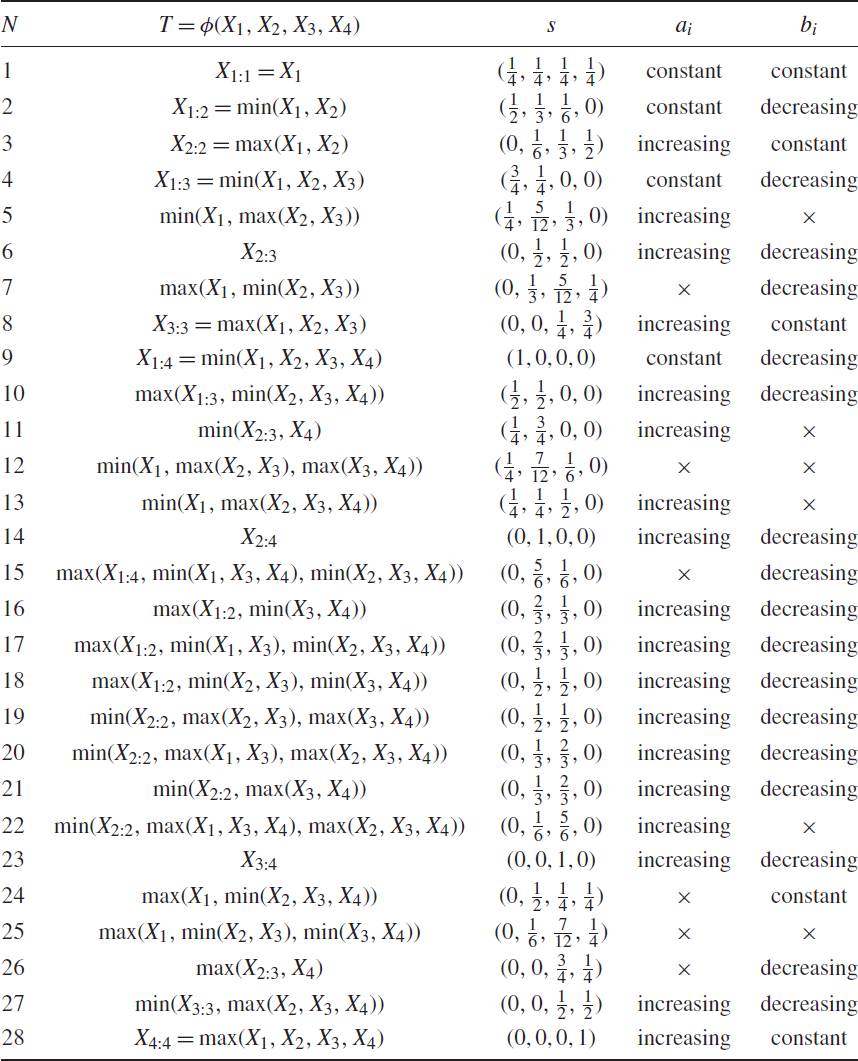
For all coherent structures with 1–4 components, the signature vectors of order 4 are provided by Navarro and Rubio [Reference Navarro and Rubio13]. They are given in Table 1, in which we have determined whether each system satisfies the assumptions of Theorems 2.1 and 2.2. It can be seen that of 28 coherent systems listed in Table 1, only six systems do not fulfill the stated assumption in Theorem 2.1. The same is also true for the assumption of Theorem 2.2.
Signature vectors of order 4 for all coherent systems with 1–4 components

It is well known that there does not exist any lifetime distribution whose RFR function is strictly increasing on its interval of support (see [Reference Block, Savits and Singh2]). In the following theorem, we have proved a stronger result implying that the RFR of any continuous lifetime distribution must be first decreasing at the beginning of the interval of support. In other words, such a distribution is initially DRFR.
Theorem 2.3. Let [a, b] be the interval of support of an absolutely continuous random variable X with CDF F(x), where  $0\leq a<b\leq\infty$
. Furthermore, let
 $\delta\in(0,b-a]$
be an arbitrary value. Then the RFR function of X is not increasing on
 $(a,a+\delta)$
.
Proof. For  $\delta=b-a$
, the theorem is essentially a result of Block, Savits, and Singh [Reference Block, Savits and Singh2]. Thus, assume that
 $\delta<b-a$
, which implies that
 $\delta<\infty$
.
Let r(t) denote the RFR of X and assume that it is increasing on  $(a,a+\delta)$
. It follows that
 \begin{equation*}\int_{t}^{a+\delta}r(x)\,{\mathrm{d}} x \leq \int_{t}^{a+\delta}r(a+\delta)\,{\mathrm{d}} x=(a+\delta-t)r(a+\delta)\end{equation*}
for all  $t\in(a,a+\delta)$
. This, in turn, implies that
 \begin{equation*}F(a+\delta)\leq F(t)\,{\mathrm{e}}^{(a+\delta-t)r(a+\delta)}.\end{equation*}
Taking the limit as  $t\rightarrow a^{+}$
and using the continuity of F, we have
 $F(a+\delta)\leq 0$
. Therefore
 $F(a+\delta)=0$
, which is a contradiction to the assumption
 $a=\inf\{x\colon F(x)>0\}$
.
It follows from Theorem 2.3 that there is no distribution (with a non-negative left extremity of the support) with an upside-down bathtub-shaped RFR.
If  $\bar{F}(t)$
is strictly concave at any point
 $t_0$
, then the FR h(t) is strictly increasing at
 $t_0$
. Similarly, the RFR r(t) is strictly decreasing at
 $t_0$
when F(t) is strictly concave at
 $t_0$
. The following lemma reveals that, under some conditions, the mixture of distributions is IFR and DRFR. We shall use this lemma to determine the local behavior of the FR and RFR of a coherent system.
Lemma 2.1. Consider the mixture distribution
 \begin{equation*}F(t)=\int_AF_\theta(t) \,{\mathrm{d}} G(\theta),\end{equation*}
where  $\{F_\theta,\ \theta\in A\}$
is a family of sufficiently smooth (continuous, second time-derivatives) distributions. Let
 $\bar{F}$
and
 $\bar{F}_\theta$
denote the reliability functions corresponding to F and
 ${F}_\theta$
, respectively.
(a) If each
 $\bar{F}_\theta$
is concave in a neighborhood of any point
$t_0$
, and if at least one of the
$\bar{F}_\theta$
is strictly concave in this neighborhood, then
$\bar{F}$
is strictly concave in this neighborhood and the corresponding failure rate is strictly increasing at
$t_0$
.
(b) If each
$F_\theta$
is concave in a neighborhood of
$t_0$
, and if at least one of the
$F_\theta$
is strictly concave in this neighborhood, then F is strictly concave in this neighborhood and the corresponding reversed failure rate is strictly decreasing at
$t_0$
.


Proof. Part (a) is due to Klutke, Kiessler, and Wortman [Reference Klutke, Kiessler and Wortman7], but for the sake of completeness, we sketch the proof here. Let  $h_\theta$
and
 $r_\theta$
denote the failure rate and the reversed failure rate functions corresponding to
 $F_\theta$
, respectively. First, for each
 $\theta\in A$
, observe that
 \begin{equation*}h^{\prime}_\theta(t_0)=h^2_\theta(t_0)-\dfrac{\bar{F}^{\prime\prime}_\theta(t_0)}{\bar{F}_\theta(t_0)}.\end{equation*}
If  $\bar{F}_\theta$
is strictly concave at
 $t_0$
, then
 $\bar{F}^{\prime\prime}_\theta(t_0)<0$
and hence
 $h^{\prime}_\theta(t_0)>0$
. Therefore, under the assumptions of the lemma,
 $\bar{F}$
is strictly concave at
 $t_0$
. Similarly,
 \begin{equation*}r^{\prime}_\theta(t_0)=\dfrac{{F}^{\prime\prime}_\theta(t_0)}{{F}_\theta(t_0)}-r^2_\theta(t_0),\end{equation*}
and if  ${F}_\theta$
is strictly concave at
 $t_0$
, then
 ${F}^{\prime\prime}_\theta(t_0)<0$
and
 $r^{\prime}_\theta(t_0)<0$
. Therefore, under the stated assumptions in part (b), F is strictly concave at
 $t_0$
.
The bathtub-shaped FR appears in many reliability practices such as environmental-stress-screening to manufactured products or burn-in. In this case the curve has the property that in the so-called ‘early failure’ period, the FR decreases over time. To be more precise, a bathtub-shaped FR h(t) is strictly decreasing on  $(0,t_1)$
, constant on
 $(t_1,t_2)$
, and strictly increasing on
 $(t_2,\infty)$
, where it is assumed that
 $0\leq t_1\leq t_2\leq\infty$
. This means that the FR is strictly decreasing as the unit becomes stronger in early life, but finally increasing as the unit begins to deteriorate. In such a situation, h(t) is called a bathtub-shaped FR with two change points
 $t_1$
and
 $t_2$
. Klutke et al. [Reference Klutke, Kiessler and Wortman7] noticed some limitations of the bathtub-shaped FR in mixture models, and showed that a sufficient condition for the mixture of distributions with concave reliability functions in a neighborhood of 0 to have an IFR at 0 is that at least one of the distributions has a strictly concave reliability function in a neighborhood of 0; see Lemma 2.1. This means that the mixture of such distributions is initially IFR and thus cannot follow the classical bathtub shape. The following theorem reveals an application of this result to coherent systems.
Theorem 2.4. Consider a coherent (or mixed) system consisting of n i.i.d. components with a sufficiently smooth CDF F and signature  $(s_1,s_2,\ldots,s_n)$
. Let
 $k=\min\{i\colon s_i>0\}$
. If
 $\bar{F}_{k:n}(t)$
is strictly concave in a neighborhood of any point
 $t_0$
, then the system FR is strictly increasing in this neighborhood.
Proof. Under the assumption of the theorem, the system reliability function has the form
 \begin{equation*}\bar{F}_T(t)=\sum_{i=k}^{n}s_i\bar{F}_{i:n}(t).\end{equation*}
Observe that if  $\bar{F}_{k:n}(t)$
is strictly concave in a neighborhood of
 $t_0$
, then
 $f^{\prime}_{k:n}(t)$
(the derivative of the corresponding density with respect to t) is strictly increasing in that interval. We conclude that
 \begin{equation*}f^{\prime}_{k+1:n}(t)=\dfrac{n-k}{k}\{[1+\phi(t)]h(t)f_{k:n}(t)+\phi(t)f^{\prime}_{k:n}(t)\},\end{equation*}
where  $\phi(t)=F(t)/\bar{F}(t)$
, is positive and hence
 $\bar{F}_{i:n}(t)$
,
 $i=k,k+1,\ldots,n$
, is strictly concave in the neighborhood of
 $t_0$
. The proof is completed by using Lemma 2.1(a).
It can be concluded from the proof of Theorem 2.4 that a sufficient condition for  $\bar{F}_{k:n}(t)$
to be strictly concave on an interval is that
 $\bar{F}^n(t)$
be strictly concave on that interval.
Theorem 2.5. Consider a coherent (or mixed) system consisting of n i.i.d. components with a sufficiently smooth CDF F and signature  $(s_1,s_2,\ldots,s_n)$
. Assume that
 $\ell=\max\{i\colon s_i>0\}$
and
 $F_{\ell:n}(t)$
is strictly concave at any point
 $t_0$
. Then the system RFR is strictly decreasing at
 $t_0$
.
Proof. By a similar argument to that used in the proof of Theorem 2.4, we conclude that if  $F_{\ell:n}(t)$
is strictly concave at
 $t_0$
, then so are
 $F_{i:n}$
,
 $i=1,2,\ldots,\ell$
. The result then follows from the mixture representation
 \begin{equation*}F_T(t)=\sum_{i=1}^{\ell}s_i\bar{F}_{i:n}(t),\end{equation*}
and part (b) of Lemma 2.1.
As a consequence of Theorem 2.4, the next corollary shows that the initial behavior of the density function of components determines whether the system is initially improving or getting worse.
Corollary 2.1. Consider an arbitrary coherent structure consisting of n i.i.d. components with a sufficiently smooth CDF F. Let f(t) be the probability density function of the component lifetimes. If  $f(0)=0$
and
 $f'(0)>0$
, then the system’s lifetime is initially IFR.
Proof. By Theorem 2.8, it is sufficient to show, under the assumption of the corollary, that  $\bar{F}_{1:n}(t)=\bar{F}^n(t)$
is strictly concave in a neighborhood of 0. Let u(t) denote the second derivative of
 $\bar{F}_{1:n}(t)$
. It is readily observed that the function
 \begin{equation*}u(t)=n\bar{F}^{n-2}(t)[(n-1)f(t)-f'(t)\bar{F}(t)]\end{equation*}
is continuous and  $\lim_{t\rightarrow 0}u(t)<0$
. This implies that
 $u(t)<0$
for all t in a sufficiently small neighborhood of 0 and hence
 $\bar{F}_{1:n}(t)$
is strictly concave in that neighborhood.
Remark 2.3. Many important lifetime distributions such as the gamma distribution and the Weibull distribution, both with shape parameters greater than 1, satisfy the assumptions of Corollary 2.1. We conclude that if the component lifetimes of a coherent structure have such distributions, then the system’s lifetime is initially IFR.
Example 2.3. Consider a beta distribution with strictly concave reliability function
 \begin{equation*}\bar{F}(t)=1-t^2,\quad 0\leq t\leq 1.\end{equation*}
It is easy to verify that  $\bar{F}^n(t)$
is strictly concave in the interval
 $[0,{{1}/{\sqrt{2n-1}}}]$
and therefore, using Theorem 2.4, any n-component system with
 $\bar{F}(t)$
as the component reliability function is initially IFR.
3. Doubly truncated lifetimes
Let  $D=\{(x,y)\colon F(x)<F(y)\}$
. Kotlarski [Reference Kotlarski8] and Shanbhag and Rao [Reference Shanbhag and Rao21] studied the doubly censored (truncated) mean function
 $m(x,y)=\mathbb{E}\{X\mid x<X\leq y\}$
defined for all
 $(x,y)\in D$
, which represents the expected lifetime for an item that was operating at time x and failed at or before time y. The mean residual life of that unit is defined as
 $\mathbb{E}\{X-x\mid x<X\leq y\}$
, which may be referred to as doubly censored mean residual life. In this section we study the stochastic properties of doubly truncated lifetimes for coherent structures. The following theorem gives a comparisons of two systems with different structures in the sense of likelihood ratio order.
Theorem 3.1. Let  $T_{1}$
and
 $T_{2}$
be the lifetimes of two coherent (or mixed) systems with component lifetimes
 $X_{1},X_{2},\ldots,X_{k}$
,
 $k\leq n$
, and
 $X_{1},X_{2},\ldots,X_{m}$
,
 $m\leq n$
. If
 ${\boldsymbol{s}}^{(1)}$
and
 ${\boldsymbol{s}}^{(2)}$
are the respective signatures of order n such that
 $\boldsymbol{s}^{(1)}\leq_{\rm lr}\boldsymbol{s}^{(2)}$
, then for any
 $(t,y)\in D$
,
 \begin{equation*}(T_{1}-t\mid t<T_{1}\leq y)\leq_{\rm lr}(T_{2}-t\mid t<T_{2}\leq y).\end{equation*}
Proof. For  $m=1,2$
, the reliability function of
 $(T_{m}-t\mid t<T_{m}\leq y)$
can be rephrased as
 \begin{equation*}\mathbb{P}\{T_{m}-t>x\mid t<T_{m}\leq y\}=\sum_{i=1}^{n}s_{i}^{(m)}(t,y)\mathbb{P}\{X_{i:n}-t>x\mid t<X_{i:n}\leq y\},\end{equation*}
where
 \begin{equation}s_{i}^{(m)}(t,y)= \mathbb{P}\{T_{m}=X_{i:n}\mid t<T_{m}\leq y\}= \dfrac{s_{i}^{(m)}\mathbb{P}\{t<X_{i:n}\leq y\}}{\sum_{j=1}^{n}s_{j}^{(m)}\mathbb{P}\{t<X_{j:n}\leq y\}}.\end{equation}
It is obvious that  ${\textbf{\textit{s}}}^{(1)}(t,y)\leq_{\rm lr}{\textbf{\textit{s}}}^{(2)}(t,y)$
, where
 ${\textbf{\textit{s}}}^{(m)}(t,y)=(s_1^{(m)}(t,y),\ldots,s_n^{(m)}(t,y))$
,
 $m=1,2$
. On the other hand, note that
 \begin{equation*}\dfrac{\tfrac{{\mathrm{d}}}{{\mathrm{d}} x}\mathbb{P}\{X_{i+1:n}-t>x\mid t<X_{i+1:n}\leq y\}}{\tfrac{{\mathrm{d}}}{{\mathrm{d}} x}\mathbb{P}\{X_{i:n}-t>x\mid t<X_{i:n}\leq y\}}=\dfrac{n-i}{i}\dfrac{\mathbb{P}\{t<X_{i:n}\leq y\}}{\mathbb{P}\{t<X_{i+1:n}\leq y\}}\dfrac{F(t+x)}{\bar{F}(t+x)},\end{equation*}
which is an increasing function of x in  $[0,\infty)$
for all
 $t\geq 0$
, and hence
 \begin{equation*}(X_{i:n}-t\mid t<X_{i:n}\leq y)\leq_{\rm lr}(X_{i+1:n}-t\mid t<X_{i+1:n}\leq y).\end{equation*}
The rest of the proof can be established from Theorem 1.C.7 in [Reference Shaked and Shanthikumar20, page 49].
Let T be the lifetime of a coherent system consisting of n i.i.d. components with ordered lifetimes  $X_{i:n}$
. Assume that
 ${\textbf{\textit{s}}}(t,y)$
is the vector whose ith element is
 \begin{equation}s_i(t,y)=\mathbb{P}\{T=X_{i:n}\mid t<T\leq y\},\quad i=1,2,\ldots,n\end{equation}
(see equation (1)). This probability vector is, in fact, the signature vector of a coherent structure when we have taken into account some partial information about the system’s lifetime. In the literature, such kinds of signature vectors are often called the dynamic signature of the system. Navarro, Balakrishnan, and Samaniego [Reference Navarro, Balakrishnan and Samaniego14], Samaniego, Balakrishnan, and Navarro [Reference Samaniego, Balakrishnan and Navarro19], Zhang [Reference Zhang23], Mahmoudi and Asadi [Reference Mahmoudi and Asadi10], and Tavangar [Reference Tavangar22] are among the references in which different types of dynamic signature are defined. In the following theorem, sufficient conditions are presented for the likelihood ratio ordering of the dynamic signature (2) of two structures with different component lifetimes.
Theorem 3.2. Assume that  $T_1$
and
 $T_2$
are lifetimes of two coherent systems with i.i.d. component lifetimes
 $X_1,X_2,\ldots,X_n$
and
 $Y_1,Y_2,\ldots,Y_n$
, and signatures
 ${\textbf{\textit{s}}}^{(1)}$
and
 ${\textbf{\textit{s}}}^{(2)}$
, respectively. Let
 ${\textbf{\textit{s}}}^{(1)}(t,y)$
and
 ${\textbf{\textit{s}}}^{(2)}(t,y)$
be the corresponding dynamic signatures of two systems with elements defined in (2). If
 $Y_{1}\leq_{\rm st}X_{1}$
and
 ${\textbf{\textit{s}}}^{(1)}\leq_{\rm lr}{\textbf{\textit{s}}}^{(2)}$
, then for any
 $(t,y)\in D$
,
 ${\textbf{\textit{s}}}^{(1)}(t,y)\leq_{\rm lr}{\textbf{\textit{s}}}^{(2)}(t,y)$
.
Proof. Let  $F_{1}$
and
 $F_{2}$
denote the distributions of
 $X_{1}$
and
 $Y_{1}$
, respectively. Note that
 \begin{equation*}\mathbb{P}\{t<X_{i:n}\leq y\}=i\binom{n}{i}\int_{0}^{1}I_{[F_{1}(t),F_{1}(y)]}(u)u^{i-1}(1-u)^{n-i}\,{\mathrm{d}} u \end{equation*}
and
 \begin{equation*}\mathbb{P}\{t<Y_{i:n}\leq y\}=i\binom{n}{i}\int_{0}^{1}I_{[F_{2}(t),F_{2}(y)]}(u)u^{i-1}(1-u)^{n-i}\,{\mathrm{d}} u,\end{equation*}
where I denotes the indicator function. We prove that
 \begin{equation*}P_m(t,y)=i\binom{n}{i}\int_{0}^{1}I_{[F_{m}(t),F_{m}(y)]}(u)u^{i-1}(1-u)^{n-i}\,{\mathrm{d}} u\end{equation*}
is  $\mathrm{TP}_{2}$
in (i, m) in
 $\{1,2,\ldots,n\}\times \{1,2\}$
.
One can easily prove that  $u^{i-1}(1-u)^{n-i}$
is
 $\mathrm{TP}_{2}$
in
 $(i,u)\in\{1,2,\ldots,n\}\times[0,1]$
. Now we show that
 $I_{[F_{m}(t),F_{m}(y)]}(u)$
is
 $\mathrm{TP}_{2}$
in (u, m) in
 $[0,1]\times\{1,2\}$
. It follows from
 $Y_{1}\leq_{\rm st}X_{1}$
that
 $F_1(x)\leq F_2(x)$
, for all x, and hence only two cases may arise.
(i)
$F_{1}(t)\leq F_{2}(t)\leq F_{1}(y)\leq F_{2}(y)$
. In this case it can be shown that
is increasing in
\begin{equation*} I_{[F_{2}(t),F_{2}(y)]}(u)/I_{[F_{1}(t),F_{1}(y)]}(u) \end{equation*}
$u\in[0,1]$
for all
$(t,y)\in D$
.(ii)
$F_{1}(t)\leq F_{1}(y)\leq F_{2}(t)\leq F_{2}(y)$
. In this case it can be easily checked that
\begin{equation*}I_{[F_{1}(t),F_{1}(y)]}(u_2)I_{[F_{2}(t),F_{2}(y)]}(u_1)\leq I_{[F_{1}(t),F_{1}(y)]}(u_1)I_{[F_{2}(t),F_{2}(y)]}(u_2).\end{equation*}


Therefore  $I_{[F_{m}(t),F_{m}(y)]}(u)$
is
 $\mathrm{TP}_{2}$
in (u, m) in
 $[0,1]\times \{1,2\}$
. Then it follows from Lemma 1.1 that
 $P_m(t,y)$
is
 $\mathrm{TP}_2$
in
 $(i,m)\in\{1,2,\ldots,n\}\times\{1,2\}$
.
Now, since the product of two  $\mathrm{TP}_2$
functions is a
 $\mathrm{TP}_2$
function, we conclude that
 $s_i^{(m)}(t,y)$
is
 $\mathrm{TP}_2$
in
 $(i,m)\in\{1,2,\ldots,n\}\times\{1,2\}$
.
4. Conclusions
The classes of distributions based on ageing concepts such as increasing and decreasing FR have been found very useful in applied probability, reliability theory, and survival analysis. In this article we considered the behavior of the FR and the RFR functions. We presented a sufficient condition for a coherent system with IFR (DFR) component lifetimes to be IFR (DFR) – a condition which is simpler than those given earlier in the literature. We also investigated the initial behavior of the FR of a coherent structure. Finally, we studied the ageing and stochastic properties of doubly truncated random variables.
Acknowledgements
The author would like to thank Editor-in-Chief Professor Peter Taylor, the Editor, and two anonymous referees for their constructive comments and suggestions which improved the presentation of the paper. The author’s research work was performed in IPM Isfahan branch and was in part supported by a grant from IPM (no. 94600076).