1. INTRODUCTION
The notion of uncertainty has earned a great deal of attention from researchers belonging to various academic disciplines. Uncertainty is often understood (semantics) by classifying it into different categories, for example, aleatory uncertainty, epistemic uncertainty, irreducible uncertainty, reducible uncertainty, and inference uncertainty (Booker & Ross, Reference Booker and Ross2011; Ross et al., Reference Ross, Booker and Montoya2013). In general, aleatory uncertainty refers to uncertainty due to random variability or stochastic processes. Epistemic uncertainty refers to uncertainty due to lack of knowledge or imprecision associated with the data and information. Irreducible uncertainty refers to uncertainty due to natural variability that can be quantified but cannot be reduced. Reducible uncertainty refers to uncertainty that can be reduced by acquiring more information. Inference uncertainty refers to predicting the future from the past, inferring the population behavior from a sample, and inferring the system behavior from its subsystems. To compute uncertainty in a formal manner (syntax), numerous theories have been developed, for example (to name a few), probability theory (Dempster, Reference Dempster1968, Reference Dempster, Yager and Liu2008), imprecise probability theory (Walley, Reference Walley1991, Reference Walley2000), evidence theory (Shafer, Reference Shafer1976; Klir, Reference Klir1990), possibility theory (Zadeh, Reference Zadeh1978; Dubois & Prade, Reference Dubois and Prade1988), and random interval theory (Joslyn & Booker, Reference Joslyn, Booker, Nikolaidis, Ghiocel and Singhal2004). In certain cases, the theories are based on different categories of uncertainty. For example, the probability theory deals mainly with the aleatory uncertainty, whereas the possibility theory deals mainly with the epistemic uncertainty. Certain theories can deal with multiple categories of uncertainty; for example, imprecise probability theory can deal with aleatory uncertainty and the epistemic uncertainty associated with the probabilities of events. Nevertheless, the uncertainty of a category can be interpreted in terms of the uncertainty of a different category (Klir, Reference Klir1999; Dubois et al., Reference Dubois, Foulloy, Mauris and Prade2004; Sharif Ullah & Shamsuzzaman, Reference Sharif Ullah and Shamsuzzaman2013). This means that the aleatory uncertainty, epistemic uncertainty, and any other uncertainty are different from each other in the sense of semantics, but all these uncertainties are somewhat same in the computational sense, and thereby, they can be integrated while developing systems for making decisions under uncertainty regardless of its category.
Similar to numerous academic communities, the engineering design community has also recognized the above-mentioned theorization (syntax) and categorization (semantics) of uncertainty, and developed numerous models and tools for making design decisions under uncertainty (Antonsson & Otto, Reference Antonsson and Otto1995; Huang & Jiang, Reference Huang and Jiang2002; Nikolaidis et al., Reference Nikolaidis, Chen, Cudney, Haftka and Rosca2003, Reference Nikolaidis, Ghiocel and Singhal2004; Youn & Choi, Reference Youn and Choi2004; Gurnani & Lewis, Reference Gurnani and Lewis2005; Ullah, Reference Ullah2005a , Reference Ullah2005b ; Ullah & Harib, Reference Ullah and Harib2008; Achiche & Ahmed-Kristensen, Reference Achiche and Ahmed-Kristensen2011; Sharif Ullah & Tamaki, Reference Sharif Ullah and Tamaki2011; Sharif Ullah et al., Reference Sharif Ullah, Rashid and Tamaki2012; Matsumura & Haftka, Reference Matsumura and Haftka2013; Sharif Ullah & Shamsuzzaman Reference Sharif Ullah and Shamsuzzaman2013; Jiang et al., Reference Jiang, Li, Apley and Chen2015; Rezaee et al., Reference Rezaee, Brown, Augenbroe and Kim2015). The methods and tools for dealing with uncertainty bring benefits for both approaches of engineering design, namely, solution-based design and problem-based design. In particular, the aleatory uncertainty-based measures (e.g., probability distributions and Bayesian inferences) are useful for the solution-based design, where the robustness or reliability of a given design solution is enhanced, without making any drastic changes in the geometric and material specifications of the given design solution. In the case of problem-based design, the geometric and material specifications are not clearly defined or known; rather, numerous problems are introduced and solved (determining customer needs, concept selection, and materials selection) by using the epistemic uncertainty-based measures (e.g., possibility measures and fuzzy numbers). The goal here is to transform a problem-based design to a solution-based design. Some authors have integrated both aleatory uncertainty and epistemic uncertainty based measures to make the design decision-making process an even more robust and user-friendly process (e.g., see the works of Nikolaidis et al., Reference Nikolaidis, Chen, Cudney, Haftka and Rosca2003; Sharif Ullah & Tamaki, Reference Sharif Ullah and Tamaki2011; Sharif Ullah & Shamsuzzaman, Reference Sharif Ullah and Shamsuzzaman2013).
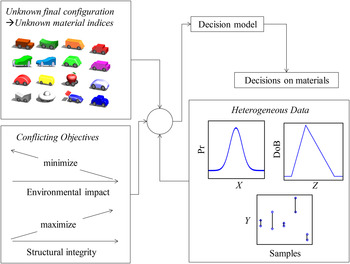
However, materials have been considered a key factor for managing the complexity while designing engineering products (McDowell et al., Reference McDowell, Panchal, Choi, Seepersad, Allen and Mistree2010). In addition, to achieve a sustainable future, the reduction and diversification of material usages (i.e., materials efficiency) are considered more effective than other measures (e.g., energy efficiency; Allwood et al., Reference Allwood, Ashby, Gutowski and Worrell2011; Ullah et al., Reference Ullah, Hashimoto, Kubo and Tamaki2013; Sharif Ullah et al., Reference Sharif Ullah, Fuji, Kubo and Tamaki2014). This is even more relevant for the products called vehicles. Mayyas et al. (Mayyas, Mayyas, et al., Reference Mayyas, Mayyas, Qattawi and Omar2012; Mayyas, Qattawi, et al., Reference Mayyas, Qattawi, Omar and Shan2012) and Poulikidou et al. (Reference Poulikidou, Schneider, Björklund, Kazemahvazi, Wennhage and Zenkert2015) have shown that the environmental impact of a vehicle depends heavily on the materials used in different parts of a vehicle. Therefore, if a designer has a clear idea about the appropriateness of a set of materials for making the parts of a vehicle at the early stage of the design process, then it would be easy for the designer to control the complexity of the subsequent design activities (McDowell et al., Reference McDowell, Panchal, Choi, Seepersad, Allen and Mistree2010; Omar, Reference Omar2011). While assessing the appropriateness of a set of materials for making the parts of a vehicle, it is likely to be the case that the designer encounters a certain degree of epistemic uncertainty, as schematically illustrated in Figure 1.
A scenario of epistemic uncertainty.

As seen from Figure 1, if a designer prefers to select the optimal materials for making the body of a vehicle at a very early stage of the design process, he or she makes this decision without knowing the exact physical configuration of the body. As such, the material indices (Ashby, Reference Ashby2005, pp. 509–512) to be used for comparing the materials are unknown. It is worth mentioning that the outline of a vehicle body depends on customer requirements (Sharif Ullah et al., Reference Sharif Ullah, Sato, Watanabe and Rashid2016), and the outline is refined to get the final configuration using numerous engineering analyses where the materials must be known beforehand (Omar, Reference Omar2011). In addition, we need to handle conflicting objectives while selecting materials. For example, if a designer prefers to maximize the structural integrity, then it may create a conflict with the environmental impact, as schematically illustrated in Figure 1. As such, how to define and manage these conflicting objectives is an important issue that must be tackled under the above-mentioned epistemic uncertainty (i.e., under the situation where the material indices are unknown). Moreover, the designer may encounter heterogeneous and imprecise decision-relevant information. For example, the information regarding some material attributes (or properties) can be given by some numerical ranges, information regarding some other materials properties can be given by probability distributions, and information regarding some other material properties can be given by fuzzy numbers, as schematically illustrated in Figure 1. It highly unlikely that all the materials-relevant information are available as crisp numerical values, as it is considered in other studies (Mayyas, Mayyas, et al., Reference Mayyas, Mayyas, Qattawi and Omar2012; Mayyas, Qattawi, et al., Reference Mayyas, Qattawi, Omar and Shan2012; Poulikidou et al., Reference Poulikidou, Schneider, Björklund, Kazemahvazi, Wennhage and Zenkert2015).
Therefore, the goal of this study is to develop a novel decision model to select the best alternatives. The proposed model is designed to handle epistemic uncertainty and conflicting objectives simultaneously. In order to show the effectiveness of our model, we present a material selection case study, where we do not have complete information about alternative materials and design specifications. We have organized the remainder of this article as follows: Section 2 describes the mathematical entities that are needed for performing the required mathematical operations. Section 3 describes how to determine the numerical scales for defining the objective functions using some fuzzy numbers. Section 4 describes a procedure to induce a triangular fuzzy number from numerical data as it is useful in making decision when the probability distribution underlying a set of data is unknown or given. Section 5 describes the proposed decision model that consists of four major steps, namely, decision formulation, information gathering, compliance calculation, and aggregation. Section 6 presents the results and discusses their implications. In particular, Section 6 presents the results of a material selection problem using the proposed decision model where a large number of alloys of aluminum, magnesium, and titanium are evaluated. Finally, Section 7 provides the concluding remarks of this study and avenues for future research.
2. MATHEMATICAL SETTINGS
As mentioned in the previous section, one of the objectives of this study is to develop a novel decision model that helps make a decision under epistemic uncertainty. To achieve this, the decision model must be able to handle heterogeneous forms of information (Fig. 1). Now, as far as the uncertainty is concerned, there are two broad categories of information, namely, crisp information and granular information (Zadeh, Reference Zadeh2005; Khozaimy et al., Reference Khozaimy, Al-Dhaheri and Ullah2011). A piece of crisp information refers to a sharp numerical value (e.g., density is 10 kg/m3). The other category of information, granular information, refers to a set of numerical values and has numerous forms. The simplest form of granular information is called crisp granular information that refers to a numerical range (e.g., density is [10, 15] kg/m3). Probability granular information refers to a piece of information given by a probability distribution (e.g., density is normally distributed with mean 12 kg/m3 and standard deviation 1 kg/m3). Fuzzy granular information refers to linguistically defined pieces of information that are often modeled by the fuzzy sets or numbers (e.g., density is “low” where low is defined by a triangular fuzzy number with core 12 kg/m3 and support [8, 20] kg/m3). The terms called triangular fuzzy number, core, and support will be discussed in a moment. There are other complex forms of granular information, for example, fuzzy-probability granular information (density is most likely normally distributed with mean 10 kg/m3 and standard deviation 1 kg/m3). If the probability distribution is unknown, one can model a piece of information using a fuzzy number or possibility distribution (Dubois et al., Reference Dubois, Foulloy, Mauris and Prade2004; Sharif Ullah & Shamsuzzaman, Reference Sharif Ullah and Shamsuzzaman2013). This means that a fuzzy number is a general form of granular information that subsumes other forms of information.
Therefore, the proposed decision model must be able to model both crisp information and various forms of granular information. To formally compute the crisp information and various forms of granular information in an integrated manner, certain mathematical entities are needed. The remainder of this section describes the needed mathematical entities, namely, fuzzy numbers, triangular fuzzy numbers, maximization/minimization fuzzy numbers, and the degree of compliance.
2.1. Fuzzy number
A fuzzy number F is a function F: ℜ → [0, 1], and it must be normal, compactly supported, convex, and upper semicontinuous (Zadeh, Reference Zadeh1975; Dubois & Prade, Reference Dubois and Prade1978; Dijkman et al., Reference Dijkman, van Haeringen and de Lange1983). It is normal means that there is, at least, one real number f 0 for which F(f 0) = 1. It is compactly supported means that the set {f ∈ ℜ | F(f) > 0} is bounded. It is convex means that if f 1 ≤ f 2 ≤ f 3, then min(F(f 1), F(f 3)) ≤ F(f 2) for all f 1, f 2, f 3 ∈ ℜ. It is upper semicontinuous means that the set {f | F(f) ≥ α} is closed for each α ∈ [0, 1]. The points corresponding to F(.) = 1 constitute an interval called core. The closed interval S = [a, b] ∈ ℜ beyond which the fuzzy number F(.) = 0 is called support. As such, F(a) = 0 ∧ F(a + ε) > 0 and F(b − ε) > 0 ∧ F(b) = 0, where ε is a very small positive number.
2.2. Triangular fuzzy number
A triangular fuzzy number T is a fuzzy number that has a triangularly shaped membership function represented as follows:
 $$T\lpar x \rpar = \max \left\{ {0 \comma \,\min\Bigg( {\Bigg( {\displaystyle{{x - a} \over {c - a}}} \Bigg)\comma \,\Bigg( {\displaystyle{{b - x} \over {b - c}}} \Bigg)} \Bigg)} \right\}.$$
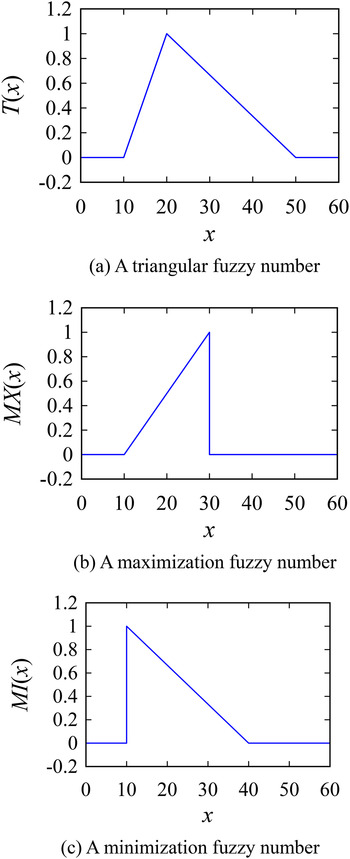
In Eq. (1), x ∈ ℜ, a < c < b ∈ ℜ. As such, the support of the triangular fuzzy number T is [a, b]. The core of T is c because T(x = c) = 1. The function (x−a)/(c−a) is called the left function and the function (b−x)/(b−c) is called the right function. The alpha-cuts of a triangular fuzzy number are the intervals [a + (c−a)α, b − (b−c)α], ∀α ∈ (0, 1). The concept of alpha-cut is useful when one needs an interval or a set of intervals from a given triangular fuzzy number. In this sense, all alpha-cuts belong to the support [a, b]; that is, the support is the largest alpha-cut. Figure 2a shows, for example, a triangular fuzzy number T where a =10, b = 50, and c = 20.
Examples of triangular, maximization, and minimization fuzzy numbers.

2.3. Maximization fuzzy number
A maximization fuzzy number denoted as MX is also a fuzzy number. It defines a possibilistic objective function for maximizing a quantity. The expression of MX is as follows:
 $$MX\lpar x \rpar = \left\{ {\matrix{ {\max \left\{ {0\comma \,\,\displaystyle{{x - a} \over {b - a}}} \right\}} \quad \hskip -1pt {x \le b} \cr 0 \hfill &\hskip -2.76pc{\hbox{otherwise}} \cr}} \right..$$
As such, the core of MX is equal to b and the support is equal to [a, b]. MX linearly increases with the increase in x in the interval of its support. Figure 2b shows, for example, an MX where a = 10 and b = 30. As MX is for maximizing a quantity, setting its support [a, b] is a critical issue. This issue is described in Section 3.
2.4. Minimization fuzzy number
A minimization fuzzy number denoted as MI is also a fuzzy number. It defines a possibilistic objective function for minimizing a quantity. The expression of MI is as follows:
 $$MX\lpar x \rpar = \left\{ {\matrix{ {\max \left\{ {0\comma\,\,\displaystyle{{b - x} \over {b - a}}} \right\}} \quad \hskip -1pt {x \ge a} \cr 0\hfill & \hskip -2.76pc{ \hbox {otherwise}} \cr}} \right..$$
As such, the core of MI is equal to a and the support is equal to [a, b]. MI linearly decreases with the increase in x in the interval of its support. Figure 2c shows, for example, an MI where a = 10 and b = 40. As MI is for minimizing a quantity, setting its support [a, b] is a critical issue, similar to MX. This issue is also described in Section 3.
2.5. Degree of compliance of a crisp value
Let d be a point in the support of MX or MI; that is, d ∈ [a, b]. Its degree of compliance with MX or MI, denoted as CC MX or CC MI , respectively, is its membership value or degree of belief (DOB). Thus, Eqs. (4) and (5) can be used to express them:
 $$CC_{MX} = MX\lpar d \rpar = \displaystyle{{d - a} \over {b - a}}\comma \,$$
 $$CC_{MI} = MI\lpar d \rpar = \displaystyle{{b - d} \over {b - a}}.$$
For example, consider that [a, b] = [10, 30] for both MX and MI. As such, if d = 15, then CC MX = 0.25 and CC MI = 0.75. Needless to say, the nature of CC MX or CC MI resembles the nature of MX or MI, respectively. The higher the value of CC MX or CC MI , the better the d from the viewpoint of maximization or minimization, respectively.
2.6. Degree of compliance of a crisp granular information
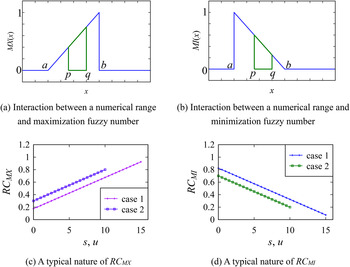
Let P = [p, q] be an interval in the support [a, b] of MX or MI; that is, p ≥ a ∧ q ≤ b, as schematically illustrated in Figure 3a–b. The compliance of P with respect to MX or MI denoted as RC MX or RC MI , respectively, is the average membership value of P with respect to MX or MI (Ullah, Reference Ullah2008; Rashid et al., Reference Rashid, Sharif Ullah, Tamaki and Kubo2011; Shamasuzzaman et al., Reference Shamasuzzaman, Sharif Ullah and Dweiri2013). Therefore, Eqs. (6) and (7) can be used to express them:
 $$RC_{MX} = \displaystyle{{\int_p {MX\lpar x \rpar dx}} \over {\vert {q - p} \vert }} = \displaystyle{{MX\lpar p \rpar + MX\lpar q \rpar } \over 2} = \displaystyle{{\lpar {\,p + q} \rpar - 2a} \over {2\lpar {b - a} \rpar }}\comma \,$$
 $$RC_{MI} = \displaystyle{{\int_p {MI\lpar x \rpar dx}} \over {\vert {q - p} \vert }} = \displaystyle{{MI\lpar p \rpar + MI\lpar q \rpar } \over 2} = \displaystyle{{2b - \lpar {p + q} \rpar } \over {2\lpar {b - a} \rpar }}.$$
Compliances of a range with respect to maximization and minimization fuzzy numbers.

As such, RC MX and RC MI take a value in the interval [0, 1]. The plot shown in Figure 3c for two arbitrary cases shows the typical nature of RC MX . Case 1 corresponds to p = 12 + s, q = 15 + s, s = 0, 0.5, … , 15. The other case corresponds to p = 12 + u, q = 20 + u, u = 0, 0.5, … , 10. The range corresponding to the first case is relatively slim, whereas the other is relatively fat. In both cases, RC MX linearly increases when it approaches the upper limit of maximization (i.e., b = 30). RC MX becomes unit if it is a point equal to the core of MX (i.e., p = q = b). RC MX becomes zero if it is a point equal to a, (i.e., p = q = a). Otherwise, RC MX < 1 (see Fig. 3c). The higher the value of RC MX , the better the P from the viewpoint of maximization.
In contrast, the plot shown in Figure 3d for two arbitrary cases shows the typical nature of RC MI . Case 1 corresponds to p = 12 + s, q = 15 + s, s = 0, 0.5, … , 15. The other case corresponds to p = 12 + u, q = 20 + u, u = 0, 0.5, … , 10. The range that corresponds to the first case is relatively slim, whereas the other is relatively fat, similar to that in RC MX . In both cases, RC MI linearly decreases when it approaches the lower limit of minimization (i.e., a = 10). RC MI is unit if it is a point equal to the core of MI (i.e., p = q = a). RC MI is zero if it is a point equal to b, (i.e., p = q = b). Otherwise, RC MI < 1 (see Fig. 3d). The higher the value of RC MI , the better the P from the viewpoint of minimization.
2.7. Degree of compliance of a triangular fuzzy number
This subsection employs the notion of triangular fuzzy number as defined in Eq. (1) but expresses it using a different set of notations so that one can differentiate it from other triangular fuzzy numbers.
Let t 1, t 2, and t 3 be three points in the ascending order on the real-line; that is, t 1 ≤ t 2 ≤ t 3 ∈ ℜ. Let the interval [t 1, t 3] and the point t 2 be the support and core, respectively, of a triangular fuzzy number denoted as D. As such, the following expression holds:
 $$D\lpar x \rpar = \max \left\{ {0 \comma \min \left( {\left( {\displaystyle{{x - t_1} \over {t_2 - t_1}}} \right)\comma \,\left( {\displaystyle{{t_3 - x} \over {t_3 - t_2}}} \right)} \right)} \right\}.$$
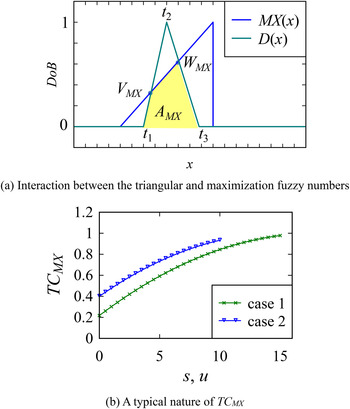
Recall the maximization fuzzy number MX defined in Equation (2) and its support [a, b]. Assume that the support of D belongs to the support of MX; that is, a ≤ t 1 and b ≥ t 3. This assumption is illustrated in Figure 4a, where the points of intersections of D and MX are V MX (V MXx ,V MXy ) and W MX (W MXx ,W MXy ), and are given as
 $$\eqalign{& V_{MXx} = \displaystyle{{bt_1 - at_2} \over {\lpar {b - a} \rpar - \lpar {t_2 - t_1} \rpar }}\comma \cr & V_{MXy} = \displaystyle{{t_1 - a} \over {\lpar {b - a} \rpar - \lpar {t_2 - t_1} \rpar }}\comma }$$
 $$\eqalign{& W_{MXx} = \displaystyle{{bt_3 - at_2} \over {\lpar {b - a} \rpar + \lpar {t_3 - t_2} \rpar }}\comma \cr & W_{MXy} = \displaystyle{{t_3 - a} \over {\lpar {b - a} \rpar + \lpar {t_3 - t_2} \rpar }}.}$$
Compliance of a triangular fuzzy number with respect to a maximization fuzzy number.

Let the area under the function min(D(x), MX(x)) be A MX . As a result, the following expression holds:
 $$\eqalign{A_{MX} &= \int\limits_{t_1} ^{t_3} {\min (D(x)\comma \,MX(x))dx} \cr & = \displaystyle{{V_{MXy} (W_{MXx} - t_1 ) + W_{MXy} (t_3 - V_{MXx} )} \over 2}.}$$
The maximum possible A
MX
is
 $\textstyle{1 \over 2}\lpar {t_3 - t_1} \rpar $
, which occurs if t
1 = a and t
2 = t
3 = b, that is, if D takes the shape of MX. Therefore, if A
MX
is normalized by the abovementioned maximum possible area, then the resulting quantity denoted as TC
MX
measures the degree of compliance of D with respect to MX in the interval [0, 1]. Equation (12) is used to express this relationship:
 $$TC_{MX} = \displaystyle{{A_{MX}} \over {\displaystyle{1 \over 2}(t_3 - t_1 )}} = \displaystyle{{V_{MXy} (W_{MXx} - t_1 ) + W_{MXy} (t_3 - V_{MXx} )} \over {(t_3 - t_1 )}}.$$
A typical nature of TC MX is shown in Figure 4b for two arbitrary cases. Case 1 corresponds to t 1 = 10 + s, t 2 = 12 + s, t 3 = 15 + s, s = 0, 0.5, … , 15. The other case corresponds to t 1 = 10 + u, t 2 = 15 + u, t 3 = 20 + u, u = 0, 0.5, … , 10. The triangular fuzzy number corresponding to the first case is relatively slim, whereas the other one is relatively fat. In both cases, an exponential increase in the value of TC MX is observed, if the triangular fuzzy numbers approach the upper limit of maximization (i.e., b = 30). TC MX becomes unit if D takes the shape of MX (i.e., t 1 = a, t 2 = t 3 = b). Otherwise, TC MX < 1 (see Fig. 4b). The more the D resembles MX, the higher is the value of TC MX . In other words, the higher the value of TC MX is, the better is the D from the viewpoint of maximization.
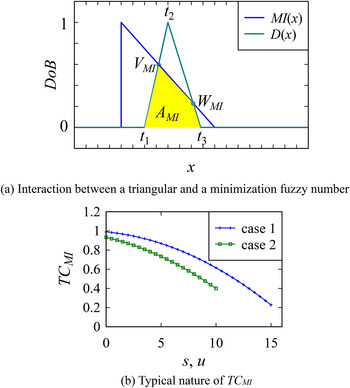
Recall the minimization fuzzy number MI defined by Eq. (3) and its support [a, b]. We assume that the support of D belongs to the support of MI; that is, a ≤ t 1 and b ≥ t 3. This assumption is illustrated in Figure 5a, where the points of intersections between D and MI are V MI (V MIx , V MIy ) and W MI (W MIx ,W MIy ), and are given, as follows:
 $$\eqalign {& V_{MIx} = \displaystyle{{bt_2 - at_1} \over {(b - a) + (t_2 - t_1 )}}\comma \cr & V_{MIy} = \displaystyle{{b - t_1} \over {(b - a) + (t_2 - t_1 )}}\comma }$$
 $$\eqalign{& W_{MIx} = \displaystyle{{bt_2 - at_3} \over {(b - a) - (t_3 - t_2 )}}\,\comma \cr & W_{MIy} = \displaystyle{{b - t_3} \over {(b - a) - (t_3 - t_2 )}}.}$$
Compliance of a triangular fuzzy number with respect to a minimization fuzzy number.

Let the area under the function min(D(x), MI(x)) be A MI . As a result, the following expression holds:
 $$ \eqalign { \hskip 3.3pc A_{MI} &= \int\limits_{t_1} ^{t_3} {\min (D(x)\comma \,MI(x))dx} \cr & = \displaystyle{{{V_{MIy} (W_{MIx} - t_1 ) + W_{MIy} (t_3 - V_{MIx} )} \over 2}.}}$$
The maximum possible A
MI
is
 $\textstyle{1 \over 2}\lpar {t_3 - t_1} \rpar $
, which occurs when t
1 = t
2
= a and t
3 = b, that is, when D takes the shape of MI. Therefore, if A
MI
is normalized by the abovementioned maximum possible area, then the resulting quantity denoted as TC
MI
measures the degree of compliance of D with respect to MI in the interval [0, 1]. The expression of TC
MI
can be expressed as follows:
 $$TC_{MI} = \displaystyle{{A_{MI}} \over {\displaystyle{1 \over 2}(t_3 - t_1 )}} = \displaystyle{{V_{MIy} (W_{MIx} - t_1 ) + W_{MIy} (t_3 - V_{MIx} )} \over {(t_3 - t_1 )}}.$$
The typical nature of TC MI is shown in Figure 5b for two different cases. Case 1 corresponds to t 1 = 10 + s, t 2 = 12 + s, t 3 = 15 + s, s = 0, 0.5, … , 15. The other case corresponds to t 1 = 10 + u, t 2 = 15 + u, t 3 = 20 + u, u = 0, 0.5, … , 10. The triangular fuzzy number corresponding to the first case is relatively slim compared to that of the other case. In both cases, TC MI linearly increases if the triangular fuzzy number approaches the upper limit of maximization (i.e., b = 30). It is worth mentioning that TC MI becomes unit if D takes the shape of MI (i.e., t 1 = a, t 2 = t 3 = b). Otherwise, TC MI < 1 (see Fig. 5b). The higher the value of TC MI , the better the D from the viewpoint of minimization.
3. DETERMINING THE SUPPORTS
To define the maximization or minimization fuzzy number denoted as MX or MI, as described in the previous section, the support [a, b] must be known beforehand. Despite the remarkable progress of fuzzy-number-based knowledge-based systems, it remains true that no unique, best-of-the-world solution exists for setting a support of a fuzzy number unless it is induced using a set of numerical data (see Section 4). Keeping this in mind, this section describes four types of supports, namely, deterministic, local, semiglobal, and global supports, for defining MX or MI. These supports are described below using numerical examples.
Consider the support called deterministic support. Deterministic support means a support that is known to all without any controversy. For example, consider the parameter called recycle fraction. It is customary to express the recycle fraction using a number taken from the interval [0, 1]. This means that if one defines MX or MI for maximizing or minimizing the recycle fraction, respectively, then the support [a, b] is equal to [0, 1]; that is, [a, b] = [0, 1]. The same argument holds for numerous physical quantities. It is worth mentioning that the compliances described in the previous section also underlie a deterministic support that is equal to [0, 1]. If one is interested in seeing whether the compliances of an alternative for a set of criteria are being maximized, he or she obviously chooses an MX for compliance maximization. In this case, the MX underlies a support equal to [0, 1] because the values of the compliances always lie in the interval [0, 1] no matter the type of compliance (crisp, range, and fuzzy), as described in the previous section.
However, the local, semiglobal, and global supports are somewhat subjective and, thereby, depend on the user's judgment or the available numerical data. For example, consider the following scenario. Engineering materials are divided into seven classes, namely, wood and wooden products, foams, rubbers, polymers, composites, ceramics, and metals and alloys. Assume that one is interested in maximizing or minimizing the density of material. According to (Ashby, Reference Ashby2005, pp. 520–521) the density (Mg/m3) of wood and wooden products, foams, rubbers, polymers, composites, ceramics, and metals and alloys lies in the interval [0.6, 1.05], [0.016, 0.47], [0.92, 0.955], [0.89, 1.58], [1.5, 2.9], [1.9, 15.9], and [1.74, 8.94], respectively.
Now, if one considers a class of materials, for example, metals and alloys, as the alternatives, and wants to evaluate the materials in the class using density as one of the criteria, then an interval [1.74, 8.94], or even a larger one (e.g., [1, 10]), becomes the support of MX or MI because the suggested support subsumes the intervals representing the density of all materials belonging to the considered class according to the supplied data. This kind of support is called the local support in the sense the support focuses alternatives that belong to a single class.
In contrast, if one considers two classes of materials, for example, polymers and ceramics, as the alternatives, and wants to evaluate the materials of both classes using density as one of the criteria, then an interval [0.89, 15.9], or even a larger one (e.g., [0.5, 20]), becomes the support of MX or MI because the suggested support subsumes [0.89, 1.58] and [1.9, 15.9], that is, the intervals underlying the two classes of materials considered in terms of the criterion called density according to the supplied information. This kind of support is called the semilocal support.
Moreover, if one considers all materials as alternatives, and wants to evaluate them using density as one of the criteria, then an interval [0.016, 15.9], or even a larger one (e.g., [0.01, 20]) becomes the support of MX or MI. The reason is that the suggested support includes all intervals for all the materials considered in terms of the criterion called density according to the supplied information. This kind of support is called the global support.
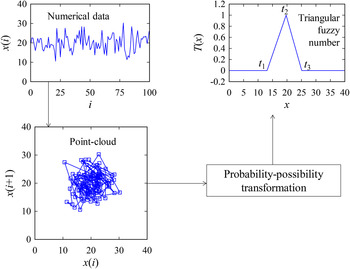
4. INDUCTION OF A TRIANGULAR FUZZY NUMBER FROM NUMERICAL DATA
In certain cases, the uncertainty associated with a set of numerical data can be represented by a possibility distribution of triangular form, that is, a triangular fuzzy number. To do this, it is important to develop a transformation mechanism based on the probability–possibility consistency principle, which states that lessening of the possibility of an event tends to lessen its probability, but not vice versa (Zadeh, Reference Zadeh1978). Figure 6 illustrates a triangular fuzzy number induction process using an arbitrary set of numerical data X = {(i, x(i)) ∈ ℜ | i = 0, … , 100}. As we have seen in Figure 6, the variability associated with a variable X is first represented by a point-cloud that is the plot in ordered pairs {(x(i), x(i+1)) | i = 0, 1, … , 99}. Using a probability–possibility transformation, the point-cloud can be transformed into a triangular fuzzy number. See Sharif Ullah and Shamsuzzaman (Reference Sharif Ullah and Shamsuzzaman2013) for a detailed procedure that transforms a point-cloud to a triangular fuzzy number. The induced triangular fuzzy number can be used to calculate the degree of compliance of the supplied set of data on X with respect to MX or MI, as described in Section 2.6.
Representing the uncertainty of numerical data using a triangular fuzzy number.

It is worth mentioning that the set of numerical data must lie in the support of MX or MI; that is, x(i) ∈ [a, b], i = 0, 1, … , n. Otherwise, the calculation of the degree of compliance cannot be performed. In addition, if a variable X takes values from a unimodal probability distribution (e.g., from uniform, normal, or triangular distribution), then its equivalent possibility distribution (a triangular fuzzy number) can be used while calculating the degree of compliance in accordance with the procedure described in Section 2.6. Sharif Ullah and Shamsuzzaman (Reference Sharif Ullah and Shamsuzzaman2013) shows the equivalent triangular fuzzy numbers for the uniform and normal distributions.
5. PROPOSED DECISION MODEL
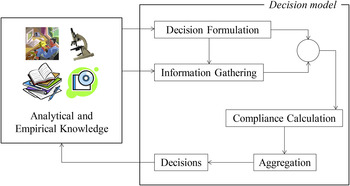
This section describes the proposed decision model. The proposed decision model employs the formulations described in Section 2 to Section 4, and helps users to make a decision under epistemic uncertainty, as described in Section 1. Figure 7 schematically illustrates the proposed decision model and its relationship with the decision-relevant (analytic and/or empirical) knowledge. As seen from Figure 7, the decision model consists of four modules, namely, formulation, information gathering, compliance calculation, and aggregation. The formulation and information gathering modules work in coordination with the decision-relevant knowledge. This means that the available knowledge regarding a given decision problem plays a vital role while performing the activities of formulation and information gathering modules. The output of the formulation module serves as an input for the information gathering module. The combined output of the formulation and information gathering modules serves as the input for the compliance calculation module. The output of the compliance calculation module is the degrees of compliances for all alternatives for each criterion. Once the compliance calculation module completes its function, the aggregation module makes a trade-off among the compliances of some of the selected criteria based on the user-defined importance in order to rank the alternatives. The ranks of the alternatives thus help make an informed decision. The decision made can be fed into the existing body of knowledge to enrich it, as schematically illustrated in Figure 7.
Proposed decision model.

However, the above description of the proposed decision model is rather informal. A relatively formal description of the decision model is given, as follows: consider the formulation module. To be more specific, let A = {A 1, … , A N } be the set of N different alternatives, C = {C 1, … , C M } be the set of M different criteria, and O = {O 1, … , O M } be the set of the states of the members in C so that ∀O j ∈ {maximization, minimization}, j = 1, … , M. The purpose of the formulation module is to define A, C, and O. In doing so, the formulation module relies on the analytical and empirical knowledge underlying the decision problem, as schematically illustrated in Figure 7. Finally, the formulation module decides the natures of the objective functions for the criteria in C as follows. Let OB = {OB 1, … , OB M } be the set of the objective functions of the criteria defined in C. As such, if O j = maximization, then OB j = MX j ; otherwise, OB j = MI j .
Once the formulation module completes its functions, the second module, called information gathering, gathers all sorts of data/information needed for determining the degree of compliances. It gathers the information to define the supports of the objective functions. Needless to say, there are four types of supports, namely, deterministic, local, semiglobal, and global supports, as described in Section 3. However, to be more specific, let S j = [a j , b j ] be the support of OB j , ∀j ∈ {1, … , M}. Thus, S j = [a j , b j ], ∀j ∈ {1, … , M} can be a deterministic, local, semiglobal, or global support. The other function of the information gathering module is to gather the decision-relevant information on each alternative defined in A for all criteria defined in C. Here, a piece of decision-relevant information denoted as DRI i,j can be a set of numerical values {dk i,j | k = 1, 2 , …}, a set of real intervals {Pl i,j | l = 1, 2, …}, a set of triangular fuzzy numbers {Dr i,j | r = 1, 2, …}, and any combination of these. This implies that DRI i,j ⊆ {DRIk i,j , DRIl i,j , DRIr i,j }, where DRIk i,j = { dk i,j | k = 1, 2 , …}, DRIl i,j = { Pl i,j | l = 1, 2 , …}, and DRIr i,j = { Dr i,j | r = 1, 2, …}.
Using the outcomes of the formulation and information gathering modules, the subsequent module, that is, the compliance calculation module, calculates the degree of compliance for each combination of alternative and criterion. A degree of compliance denoted as COM i,j ∈ [0, 1] is calculated by inputting each member of DRI i,j in to CC MX , CC MI , RC MX , RC MI , TC MX , or TC MI , as defined in Section 2. If DRIz i,j is a member of DRI i,j , then the corresponding degree of compliance can be represented as COM z i,j .
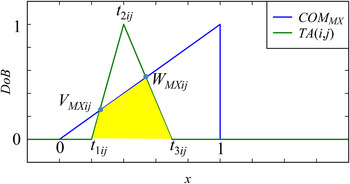
Finally, the aggregation module aggregates the compliances of an alternative for some selected criteria in order to rank the alternatives so that one can make an informed decision. To be more specific let Y i,j = {COM z i,j | z = 1, 2, …} be the set of compliances of the ith alternative with respect to jth criterion. Using Y i,j ∈ [0, 1] a triangular fuzzy number denoted as TA i,j can be induced. The induction process is described in Section 4. Let the support and core of the induced triangular fuzzy number TA i,j be [t 1ij , t 3ij ] and t 2ij , respectively. As the values of the compliance lie in the interval [0, 1] and the compliance must be maximized, a special maximization fuzzy number denoted as COM MX can be considered where the support and core are [a, b] = [0, 1] and b = 1, respectively. As a result, the compliance of TA i,j with respect to COM MX is the ranking score of the ith alternative with respect to the jth criterion denoted as RS i,j . Recall the procedure of determining the compliance of a triangular fuzzy number with respect to a maximization fuzzy number described in Section 2 [see Fig. 4 and Eqs. (8)–(12)]. This procedure is valid for TA i,j and COM MX , too. The interaction between TA i,j and COM MX is schematically illustrated in Figure 8, which is a similar case illustrated in Figure 4. In Figure 8, the points of intersections of TA i,j and COM MX are V MXij (V MXxij ,V MXyij ) and W MXij (W MXxij ,W MXyij ). This yields the following expression defining RS i,j :
 $$RS_{ij} = \displaystyle{{V_{MXyij} (W_{MXxij} - t_{1ij} ) + W_{MXyij} (t_{3ij} - V_{MXxij} )} \over {(t_{3ij} - t_{1ij} )}}.$$
Determining the ranking of an alternative based on a criterion.

We found the following relationships by substituting 0, 1, t 1ij , t 2ij , t 3ij , V MXxij , V MXyij , W MXxij , and W MXyij for a, b, t 1, t 2, t 3, V MXx , V MXy , W MXx , and W MXy , respectively, in Eqs. (9) and (10):
 $$V_{MXxij} = V_{MXyij} = \displaystyle{{t_{1ij}} \over {1 - (t_{2ij} - t_{1ij} )}}\comma \,$$
 $$W_{MXxij} = W_{MXyij} = \displaystyle{{t_{3ij}} \over {1 + (t_{3ij} - t_{2ij} )}}.$$
Therefore, the ranking score RS i,j defined in Eq. (17) is calculated after calculating V MXxij , V MXyij , W MXxij , and W MXyij using Eqs. (18) and (19), respectively. The ranking scores of an alternative A i for all criteria can be added using the weighted importance. This yields a decision score denoted as DC(A i ), as follows:
 $$\eqalign{DC(A_j ) &= \sum\limits_{\,j = 1}^M {w_j RS_{ij}}\comma \quad \hbox{so}\,\hbox{that}\quad \cr w_j &= \displaystyle{{{IMP}_j} \over {\sum\nolimits_{\,j = 1}^M {{IMP}_j}}}.}$$
In Eq. (20), IMP j is the importance of jth criterion that is an integer in the scale 0 to 10; that is, IMP j ∈ {0, 1, … , 10}, ∀j ∈ {1, … , M}. The more the importance of the criterion, the greater the value of IMP j . Thus, w j represents the normalized weight of the jth criterion, ∀w j ∈ [0, 1]. Note that each IMP j is assigned subjectively by the decision maker(s).
6. RESULTS AND DISCUSSIONS
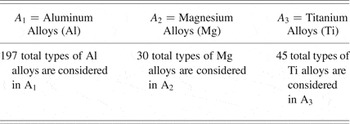
We will use the same material selection problem illustrated in Figure 1 to show how our proposed model works. Consider the formulation module. Here, three alternatives are considered as listed in Table 1 based on the general knowledge regarding materials used for making vehicle parts (McDowell et al., Reference McDowell, Panchal, Choi, Seepersad, Allen and Mistree2010; Omar, Reference Omar2011; Mayyas, Mayyas, et al., Reference Mayyas, Mayyas, Qattawi and Omar2012; Mayyas, Qattawi, et al., Reference Mayyas, Qattawi, Omar and Shan2012; Poulikidou et al., Reference Poulikidou, Schneider, Björklund, Kazemahvazi, Wennhage and Zenkert2015). The first alternative is a set of aluminum alloys (Al) that consists of 197 types of aluminum-based alloys. The second alternative is set of magnesium alloys (Mg) that consists of 30 types of magnesium-based alloys. The last alternative is set of titanium alloys (Ti) that consists of 45 types of titanium-based alloys. The number of alloys 197, 30, and 45 of Al, Mg, and Ti are considered based on the information available in a material database (CES Selector, Granta Design Limited, UK).
Alternatives (A)

To select materials for engineering components, there are material indices (Ashby, Reference Ashby2005, pp. 509–512). The indices depend on the nature of a component (e.g., tie, shaft, beam, column, plate, and panel) and the objective (e.g., stiffness-limited design at minimum mass and strength-limited design at minimum mass). In these indices, such material properties as density, tensile strength, and Young's modulus are involved. Therefore, when the nature of the component is unknown or not given, as it is the case here (Fig. 1), at least, three material properties, namely, density, tensile strength, and Young's modulus, must be considered to ensure the structural integrity of the component. In addition, according to the material indices (Ashby, Reference Ashby2005, pp. 509–512), to achieve a given objective (e.g., stiffness-limited design at minimum mass and strength-limited design at minimum mass), the density must be minimized whereas the tensile strength and Young's modulus must be maximized. For example, the environmental impact of a vehicle can be minimized by reducing its weight. Therefore, minimization of density helps reduce the environmental impact, too. Moreover, to reduce the usages of material, that is, to increase the material efficiency (Allwood et al., Reference Allwood, Ashby, Gutowski and Worrell2011; Ullah et al., Reference Ullah, Hashimoto, Kubo and Tamaki2013; Sharif Ullah et al., Reference Sharif Ullah, Fuji, Kubo and Tamaki2014), the recycle fraction of materials must be maximized. At the same time, the primary production of materials must not produce a large quantity of greenhouse gasses (i.e., consume energy) and consume resources (e.g., water and land; Rashid et al., Reference Rashid, Sharif Ullah, Tamaki and Kubo2011; Ullah et al., Reference Ullah, Hashimoto, Kubo and Tamaki2013; Sharif Ullah et al., Reference Sharif Ullah, Fuji, Kubo and Tamaki2014). Thus, besides density, water usage, CO2 footprint of primary production of materials, and the recycle fraction must be considered in order to accommodate the issue of sustainability while selecting material for making the body of a vehicle.
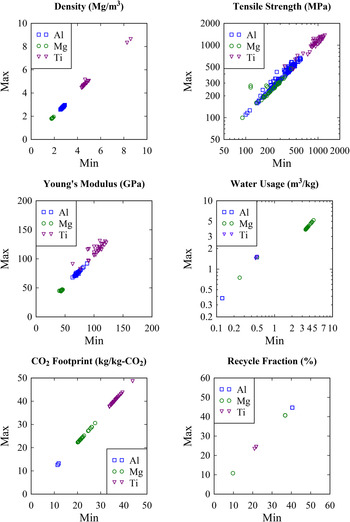
Based on the above contemplation, a set of six criteria, namely, density, tensile strength, Young's modulus, water usage, CO2 footprint, recycle fraction, are considered to evaluate the alternatives called Al, Mg, and Ti. The decision-relevant information of these six criteria are shown by the minimum–maximum plots in Figure 9. As the material properties of an alloy are given by some numerical ranges or as a crisp granular information (see CES Selector database), the minimum and maximum values of each range can be plotted on the horizontal and vertical axis, respectively. For example, let the density of an alloy be [2.63, 2.78] Mg/m3 (here “Mg” is mega-gram not magnesium). This piece of decision-relevant information is thus a point (2.63, 2.78) on the minimum–maximum plot.
Decision-relevant information for three different categories of metal alloys.

However, based on the decision-relevant information shown in Figure 9, the supports of the respective criterion are determined, as summarized in Table 2. As such, all supports here are local supports except the support of recycle fraction, which is a global support. The optimization states of the criteria are also listed in Table 2. As we see from Table 2, the tensile strength, Young's modulus, and recycle fraction must be maximized, whereas the density, water usage, and CO2 footprint must be minimized, as described above.
States of criteria and their supports

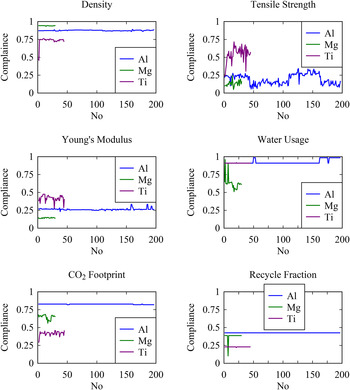
The compliances of each alloy are determined using the procedure described in the previous section and shown by the plots in Figure 10. As we see from the plots in Figure 10, the order of preference in terms density is Mg > Al > Ti, tensile strength is Ti > Al > Mg, Young's modulus is Ti > Al > Mg, water usage is Al > Ti > Mg, CO2 footprint is Al > Mg > Ti, and recycle fraction is Al > Mg > Ti.
Compliances of the alternatives for respective criterion.

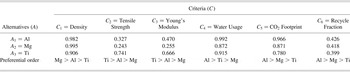
The ranking scores of the three alternatives for each criterion are also determined using the procedure described in the previous section and shown in Table 3. This ranking score also preserves the abovementioned order of preferences, as indicated in the last row in Table 3. This means that the ranking score is an effective means to aggregating the uncertainty associated with an alternative for a given criterion.
Ranking scores of the alternatives

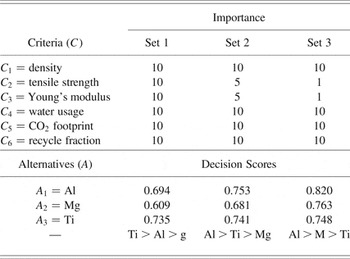
Once the ranking scores are known, one can determine the decision score as described in the previous section. In doing so, the importance of the criteria must be set. For this particular case, the criteria called density, water usage, CO2 footprint, and recycle fraction are useful in assessing the sustainability of material and, thereby, the sustainability of vehicles, as described in the above. The other two criteria, namely, Young's modulus and tensile strength, are useful for ensuring the structural integrity of the body of a vehicle. Therefore, density, water usage, CO2 footprint, and recycle fraction are called sustainability criteria, and the other two are called integrity criteria. One can determine the decision-scores of the alternatives for different sets of importance as shown in Table 4. In particular, three sets of importances are chosen here for determining the decision scores. In the first set, both sustainability and integrity criteria are considered equally important. This makes Ti's decision score the maximum followed by those of Al and Mg, respectively. Thus, when both sustainability and integrity criteria have the same degree of importance, the list of preferences is Ti > Al > Mg. In the second set, sustainability criteria are considered relatively more important than the integrity criteria. This makes Al's decision score the maximum followed by those of Ti and Mg, respectively. Thus, when the sustainability criteria are more important than the integrity criteria, the list of preferences is Al > Ti > Mg. This means that Ti and Al alternate their positions once the integrity criteria lose their importance compared to those of sustainability. In the last set, the sustainability criteria are considered very important compared to those of integrity. This makes Al's decision score the maximum followed by those of Mg and Ti, respectively. Thus, when the integrity criteria are somewhat insignificant compared to those of sustainability, the list of preferences is Al > Mg > Ti. This means that Al and Mg are the preferred materials when the sustainability is a key concern.
Decision scores of the alternatives

7. CONCLUDING REMARKS
Selecting appropriate materials at an early stage of a design process helps manage the complexity in the subsequent steps of product realization (detailed design, manufacturing, assembly, and operations management). Therefore, material selection entails a great deal of significance in engineering design.
The early stage of a design process means that the design specifications and requirements are not known. Therefore, conventional material selection procedures are not applicable for selecting materials at an early stage of a design process. This study sheds some lights on this issue by developing a novel decision model that helps make a decision even though the design specifications and requirements are still evolving.
In the presented decision model, the mathematical entities called triangular fuzzy number, compliance, and decision-score play a vital role. They are helpful for assessing and managing the heterogeneous decision-relevant information and conflicting objectives. The participation of a decision maker is also assured by introducing the user-defined importance in the calculation process of the decision score.
Although a set of six criteria (density, tensile strength, Young's modulus, water usage, CO2 footprint, and recycle fraction) is used in selecting materials for the body of a vehicle under epistemic uncertainty, one can add other criteria (e.g., cost, reserve, thermal property) if needed. Adding criteria will enlarge the set of the degrees of compliances without adding any additional information processing steps in the decision-making process. Therefore, the presented decision model possesses a great deal of scalabilities.
The advanced outlook on design process states that a design process is not only a knowledge-using process but also a knowledge-creation process; the creation of knowledge takes place if one can handle the epistemic uncertainty in a systematic manner. As demonstrated in this study, the presented decision model can handle epistemic uncertainty in a systematic manner. It is also shown to be useful in creating new knowledge (e.g., it can create a list of material preferences even though the required design knowledge is not available). Thus, the presented decision model can be integrated with a design process when knowledge creation is preferred over knowledge use. This particularly true when a problem-based design is transformed into a solution-based design. Nonetheless, how to integrate the presented decision model with the multiexpert decision-making scenarios (Noor-E-Alam et al., Reference Noor-E-Alam, Lipi, Hasin and Sharif Ullah2011) is a future direction of research.
Sweety Shahinur is a Senior Scientific Officer at the Bangladesh Jute Research Institute. She received an MPhil in materials science from Bangladesh University of Engineering and Technology (BUET) and is now pursuing a PhD in manufacturing systems at Kitami Institute of Technology (KIT). She has published more than 20 journal and conference articles. Her research is in both natural and metallic materials from the viewpoint of sustainability.
A.M.M. Sharif Ullah is an Associate Professor in the Faculty of Engineering at KIT. Prior to joining KIT, he was employed by United Arab Emirates University and Asian Institute of Technology. He received his PhD from Kansai University and BS from BUET, both in mechanical engineering. Dr. Ullah’s research is in product realization engineering with emphasis on creativity, design, manufacturing, materials, sustainability, systems, and decision making.
Muhammad Noor-E-Alam is an Assistant Professor in the Department of Mechanical and Industrial Engineering at Northeastern University. Prior to his current role, he was a Postdoctoral Research Fellow at the Massachusetts Institute of Technology. His research interest lies in the intersection of operations research and big data analytics. Dr. Noor-E-Alam’s research team is currently targeting design and developing data-driven decision making techniques for a wide variety of applications such as the supply chain, healthcare, energy, and manufacturing systems.
Hiroyuki Haniu is a Professor in the School of Earth and Environmental Engineering at KIT and the Director of the Mechanical Engineering Master’s program at KIT. He obtained his PhD in mechanical engineering from the University of Iowa. He has supervised several doctoral students from different countries. Dr. Haniu’s research is in fluid mechanics, renewable energy resources, and engineering design. He has published more than 90 papers in reputed national and international journals.
Akihiko Kubo is an Assistant Professor in the Department of Mechanical Engineering at KIT. He received his Bachelors degree in mechanical engineering from Kushiro National College of Technology. He teaches courses related to precision machining and computer-aided design/computer-aided manufacturing. His research field is precision machining and sustainable manufacturing.