Deepening partisan polarization has become one of the major concerns of scholars working in the subfield of American political development.Footnote 1 A growing body of research has examined and debated the degree of extreme partisanship across the two increasingly ideologically sorted parties, tracing its effects within governing institutions, mass publics, interest groups and social movements, and media outlets.Footnote 2 Many view the development as problematic for governance. Some scholars even raise serious concerns about the effect of gridlock, policy stalemate, and increasing inequality on the stability of American democracy itself.Footnote 3
Polarization is a product of what I call the advocacy party—a form of party organization in which extraparty interest groups, advocacy organizations, think tanks, and social movements have come to substitute for the diminished institutional capacity and popular legitimacy of the formal party apparatus and its leaders. The electoral dependence of party officeholders and officials on advocacy organizations of various groups and interests—labor, feminist, civil rights, pro-immigration, environmentalists, and LGBT for Democrats; evangelical, Catholic, pro-life, free market, and gun rights for Republicans—has provided these advocacy groups with greater leverage over party leaders to shape the parties’ public image and governing agenda.Footnote 4 While still having to contend with one another, as well as party elites’ own ambitions and agendas, well-organized advocates have pushed the parties off-center, if asymmetrically, to give us the modern polarized party system.Footnote 5
Many scholars have rightly pointed to the presidential nomination reforms made by the Democratic Party's post-1968 Commission on Party Structure and Delegate Selection (known as the McGovern-Fraser Commission) as a key contributor to polarization by increasing the influence of ideological activists through the use of binding primary elections in the presidential nomination process.Footnote 6 In the wake of the 1968 insurgent primary campaigns of Senators Eugene McCarthy and Robert Kennedy and the violence of the National Democratic Convention in Chicago, “New Politics” reformers—hailing from segments of the civil rights, student, antiwar, and feminist movements, as well as liberal union leaders—dismantled procedural arrangements that empowered party officials, officeholders, and other “bosses” to monopolize candidate selection in the fabled smoke-filled backrooms of the convention hall. In their place, the primary process has encouraged the development of a more “plebiscitary presidency,” which sacrifices presidential party leadership for a “direct relationship between presidential candidates and the people,” thus eroding an important source of Americans’ “civic attachments.”Footnote 7 (Because many of these reforms required state legislation, they affected the Republican Party, too.)
Consequently, parties now lack any “organizational features designed to integrate or even encompass the multiple rather than singular concerns of citizens.”Footnote 8 They have become, in Schlozman and Rosenfeld's apt phrase, “hollow parties,” in which highly motivated grassroots activists and groups of “intense policy demanders” compete for influence but do not share any common agenda, party loyalty, or even a “sense of party.”Footnote 9 For the Democrats, hollowness is evident along several dimensions: organizationally, in the party's incapacity to mobilize irregular or nonvoters; programmatically, in its laundry list of group-specific priorities; and in terms of the legitimacy of its leaders, as recent controversies over the actions and preferences of party elites have demonstrated. To be sure, more factors are at work than just party reform in bringing this development about, such as the role of the Bipartisan Campaign Reform Act in depriving state party organizations of soft money, the Supreme Court's decisions regarding independent campaign expenditures, and the role of political consultants and new campaign technologies in changing approaches to voter mobilization. However, the point remains that few accounts of the development of modern polarization fail to include party reform as a critical inflection point in the hollowing out of the parties. Thus, notwithstanding the relative sophistication of the national committees’ fundraising abilities, which has grown in recent decades,Footnote 10 America's polarized parties are, paradoxically, organizationally weak even while partisanship is strong.Footnote 11
Yet, the contribution of McGovern-Fraser reformers to the hollowness of today's polarized parties is not as direct as many have thought. As more scholars are coming to realize, the reformers of 1968 did in fact attempt to build the very same integrative partisan organizations that many find modern-day parties to be sorely lacking.Footnote 12 After having engineered major alterations to the rules governing convention delegate selection and the process of presidential nomination during 1968–1972, further attempts were made from 1972 to 1974 to reconstruct the party organization, including introducing a dues-paying, rank-and-file membership; creating a more representative Democratic National Committee (DNC); building new institutions, such as regional party organizations, to interface between state and national committees; and holding midterm Democratic National Conferences to strengthen the national party's policymaking capacities and act as accountability mechanisms between officeholders and the party base. These far-reaching proposals were more than just pipedreams: The DNC was successfully reformed in 1972; new reform commissions were mandated; three midterm policy conferences were held between 1974 and 1982; and the party wrote and ratified its first-ever constitution.
It is especially ironic to consider that had the full range of the reformers’ agenda taken hold, it is plausible that today's parties, while still polarized, would be far less hollow. To be sure, the McGovern-Fraser reformers were polarizers who saw the blurred bipartisanship of the mid-twentieth century as a barrier to achieving their partisan and policy goals.Footnote 13 But their positive vision for a responsible party system that gave voters clear alternatives combined an interest in conjoining participatory forms of democratic politics with a keen recognition of the role nuts-and-bolts organization can play in tempering some of the ill effects of mass participation. Their new Democratic Party aimed to engage new constituencies through more open procedures and balance their influence with enhanced leadership roles for mid- and top-level party elites, thus integrating the grassroots with the grass tops. A dues-paying mass membership sought to make partisanship more meaningful beyond mere ritualized voting behavior, cultivating not only a better sense of party in citizens’ everyday lives but also positive loyalty to the organization, its candidates, and its positions. No doubt, reformers’ attempt to marry participatory politics with responsible partisanship was ambitious, perhaps even naïve, considering the antiparty sentiment in American political culture, especially during the 1970s. However, given the problems associated with the advocacy party model, where the smoke-filled rooms are gone and participatory democracy has become unchecked, their innovative political experiment deserves revisiting when it comes to understanding the historical and institutional roots of polarization.
So what happened? Why did we get hollow advocacy parties instead of something else after the 1970s? Focusing for the purposes of this article on the Democrats, I argue that the advocacy party is not the direct result of the actions of McGovern-Fraser reformers, but rather the outcome of their pitched battle with intraparty opponents of reform, who, while failing to prevent changes to presidential nominations, were ultimately successful in defeating the party-building dimension of the reformers’ project of party reconstruction. The product of the factions’ intraparty struggle was a hybrid institutional amalgam that layered new participatory arrangements over a hollow party structure devoid of any aggregative organizations or procedures capable of channeling the influx of grassroots energy into responsible mass partisanship. In short, the resolution of the struggle between reformers and counter-reformers in the 1970s set the Democratic Party on a path toward the advocacy party and its polarizing politics. (The advocacy party model and the GOP will be treated in this article's conclusion.)
In this article, I trace the course of intraparty reform politics in the Democratic Party between 1968 and 1974 to emphasize the centrality of entrepreneurial political conflict in shaping the process—a dimension curiously absent in many influential accounts.Footnote 14 I will show that reforming the Democratic Party was from the outset a project that intertwined the goals of opening the party to greater grassroots influence as well as building the party's institutional capacities for internal deliberation, policy cohesion, and officeholder accountability. Critically, that project was phased in two temporal sequences: before and after the 1972 presidential election and the disastrous defeat of Senator George McGovern. While the electoral loss took the wind out of the sails of the New Politics movement powering the reform agenda, it was insufficient in itself to bring the reform process to an end. New Politics reformers had dominated the 1972 National Convention and passed resolutions creating additional reform commissions with new mandates to carry forward a more thoroughgoing party reconstruction. Despite McGovern's loss in November, the momentum remained largely in the reformers’ favor in the immediate postelection period.
However, McGovern's landslide defeat provided antireform opponents of the New Politics with the ammunition they needed to launch an offensive against the reform project. Under the banner of the Coalition for a Democratic Majority (CDM), party officeholders and officials, labor leaders, foreign policy hawks, and cold warriors fought a rearguard battle across multiple fronts to scuttle the structural phase of party reform and weaken some of the new nomination reforms. Ironically, CDM members utilized the new party bodies and institutional authority of the National Committee created by the reformers to coordinate their antireform campaign, ultimately codifying the loosely organized, federated party structure they preferred in the party's new constitution, the Democratic Party Charter, bringing the New Politics reform movement to an end.
While reformers and their opponents fought over complex delegate selection mechanisms and the details of party structure, more was at stake than just seemingly arcane procedural matters. As both sides realized, the very meaning of American liberalism was up for grabs during the long 1970s. Political institutions are never neutral in how they distribute power and authority, including political voice. Reformers and counter-reformers alike understood that party organization is not neutral either. Who speaks for the party? Who defines what principles the party stands for? Who shapes the party's public image? Who determines the party's agenda in government? Both sides saw that different ways of organizing the party empowered different sets of voices. New Politics insurgents sought to bring the newly mobilized constituencies of the 1960s and 1970s social movements into mainstream politics, displacing the mostly white, male, middle-aged, and middle-class power brokers from their privileged positions in the party's smoke-filled rooms. They envisioned a politics that could extend the rights revolution beyond its New Deal boundaries imposed by its coalition with Southern conservatives, its anticommunist foreign policy, and its presumption of the breadwinning male as the model citizen. Thus, the struggle over party structure was inextricably intertwined with the struggle to redefine Democratic Party ideology and policy at a juncture when New Deal liberalism was entering its terminal crisis.
While one point of this article is to revise our understanding of the reform movement, the story I tell here is not about heroes and villains. Neither faction was successful at installing its vision of a new Democratic Party for the 1970s. As the 1972 election confirmed, the majoritarian coalition many New Politics reformers considered to be on the verge of emergence in the late postwar period failed to materialize, at least not for another generation.Footnote 15 They misread as permanent features of the political landscape phenomena that were ultimately fleeting symptoms of the breakdown of the New Deal order and the widespread mobilization of new social movements.Footnote 16 Counter-reformers, on the other hand, looked backward to restoring a New Deal coalition whose contradictions ran deep, failing to appreciate the depth of its disjunctive crisis in the late 1960s and early 1970s. Their emphasis on a pragmatic, elite-brokered, vital center liberalism increasingly rang hollow, not only among New Politics liberals but also among Southern and religious conservatives inbound for the GOP. The Democratic Party that developed in the post–New Deal regime was not the product of anyone's master plan. But its hollowed-out, advocacy party structure—and its polarizing politics—is explicable as the product of past entrepreneurial struggle.
PERSPECTIVES ON PARTY REFORM
The party reforms of the McGovern-Fraser Commission have been extensively researched and analyzed.Footnote 17 However, most accounts focus largely on the reforms made to delegate selection procedures, neglecting similar efforts directed at reconstructing the party organization.Footnote 18 While it could be argued that because the structural reforms were less successful than those made to the nominating process, devoting exclusive analytical attention to the latter is justified. But such a teleological argument reads the outcome of the reform struggle back into the past, resulting in a one-sided and ultimately misleading account of the reform process in the Democratic Party.Footnote 19
First, many analyses that focus primarily on delegate selection have wrongly interpreted the reformers, whether in intent or due to unintended consequences, as antiparty.Footnote 20 These scholars rightly observe that opening up delegate selection procedures diminished the role of what they call the “regular party organization” in selecting its presidential nominee. Before the reforms, each stage of the nominating process, from the local precinct meetings all the way up to the National Convention, had been conducted under the supervision and control of party leaders. After the reforms, the authority of the party chieftains was drastically reduced in favor of grassroots activists and primary voters. Consequently, the National Convention, which used to have a deliberative function for party leaders negotiating over a viable nominee, was transformed into “a body dominated by candidate enthusiasts and interest group delegates.”Footnote 21 Because under the new rules nearly all delegates were pledged to support a particular candidate before arriving at the convention, what was once a “pure partisan institution”Footnote 22 survived “primarily as spectacle.”Footnote 23
On the one hand, it is misleading to characterize delegate selection reform as antiparty when it was itself an unprecedented assertion of national party power, not only over its state and local affiliates but also over state laws under which the subnational parties operated.Footnote 24 Neither the formal authority nor the institutional capacity of the national party to formulate and impose a universal code of standards for local and state party governance existed prior to the McGovern-Fraser reforms, and therefore had to be built in the process of their implementation and enforcement. Critics who see this as antiparty narrowly constrict the definition of party to refer only to the ability of state and local party leaders to control the selection of their party's presidential nominee. But if the party also includes the National Convention, the National Committee, and their sovereignty over the entire party apparatus, then by expanding the national party's institutional capacities, the reformers were acting more as party builders than demolishers.Footnote 25
On the other hand, the party-building orientation of the New Politics movement is undeniable when the post-1972 structural phase of reform is brought back into the narrative. It is striking that this history makes no appearance in the critical literature.Footnote 26 The very name of the official reform body—the Commission on Party Structure and Delegate Selection—suggests that party reformers were not only concerned with altering delegate selection procedures but were also concerned with restructuring the party organization itself. As we will see, this included developing institutional innovations such as codifying a party constitution, the Democratic Party Charter. In place of a national party that only came to life once every four years, the charter proposed creating a continuous, active national organization in American politics, which would feature a restructured DNC; a new set of regional organizations; biennial national conferences to determine party program and policy; a mass dues-paying membership; and a semi-autonomous educational and training arm to organize the party rank and file, cultivate new voters, and recruit party candidates. Reformers intended to “build the party as an institution [to be] bigger than any of its officeholders, bigger than any of its candidates.”Footnote 27
With this in mind, the antiparty characterization of McGovern-Fraser is too simple. Rather than the goal or the unintended consequence of the reformers’ actions, the hollowed-out party organizations produced by the era of reform were an outcome of a dynamic intraparty struggle over the institutional shape of the Democratic Party.
Second, accounts concerned only with delegate selection reform consequently diminish the role of counter-reformers in shaping the modern polarized party system. For all the exhaustive detail found in Byron Shafer's Quiet Revolution: The Struggle for the Democratic Party and the Shaping of Post-Reform Politics, the narrative stops short of McGovern's 1972 nomination, precluding analysis of the second, structural phase of reform, its organized opposition, and its consequential resolution. Ironically, despite featuring “struggle” in its subtitle, Shafer's tome contains very little of it. This is not an oversight of omission; it is an accurate rendering the truncated timeline under his examination. As Rosenfeld has put it, during the first phase of reform, from 1968 to 1972, centered on changing the presidential nomination process, reformers experienced so little in the way of organized intraparty resistance that they were essentially “pushing through an open door.”Footnote 28 As David Plotke has explained, the absence of any formidable antireform campaign before McGovern's nomination reflected most party stakeholders’ disbelief that the McGovern-Fraser Commission would actually be effective in making substantive changes. More importantly, reform skeptics simply had no persuasive alternative to offer in response to the party's legitimacy crisis in the aftermath of the violent and chaotic 1968 Chicago convention and the subsequent electoral defeat in November.Footnote 29 President Lyndon Johnson reflected as much in his outgoing statement as party leader when he acknowledged that, though the politics of the late 1960s had proven difficult to manage, the Democrats ought to “continue acting like a majority party.”Footnote 30
To better understand how and why party reform unfolded the way it did, it is necessary to reconnect the first phase of delegate selection reform with the second phase of organizational reconstruction. That the latter was largely unsuccessful does not render it irrelevant. On the contrary, the struggle between the New Politics reformers and the CDM counter-reformers, and their mutual combination of victory and defeat, had developmental consequences that continue to shape U.S. politics today. This is more than just a road-not-taken exercise in speculation about what could have been. Revising our understanding of the dynamics of reform politics not only provides a more complete account of the transformation of the Democratic Party at the end of the New Deal order, but it also sheds light on how American politics traveled the path that led to its current polarized form.
Reconceiving modern American parties as advocacy parties also offers to enrich scholarly perspectives that theorize parties as long coalitions of “intense policy demanders.”Footnote 31 While this group-centered approach is especially valuable in illuminating the dynamic forces driving the parties away from the median voter in the current era, the advocacy party perspective offers to explain historically how the parties came to be hollowed out into little more than “arenas of conflict and cooperation” in which well-organized policy-demanding groups swarm party leaders and officeholders, who have their own opinions, preferences, and priorities.Footnote 32
Parties are enduring, multilayered institutions that bring together multiple contending groups and ambitious officeholders at different levels of government.Footnote 33 Thus, institutions matter in shaping the group-centered, free-for-all struggle for party power.Footnote 34 While there may always be policy-demanding groups seeking access and influence, party structures mediate the entryways, privileging some groups over others, facilitating more entrants or fewer, bridging divides or suppressing conflicts. By transforming the process by which presidential nominees are selected, the struggle for the Democratic Party during the long 1970s left both parties more open to groups and movements pressing for access and demanding “ideological patronage” and policy results in return for their electorally relevant resources.Footnote 35 The fragmentation of the left in the post–New Deal period has produced a pluralism of advocacy groups in the Democrats’ extended party network, resulting in their laundry list of policy issues and group-targeted political appeals. The relative ideological coherence of conservatism and the awesome financial and organizational power of the Koch network have produced a robust shadow party encircling the GOP, driving it to the right.Footnote 36 Formal party institutions must be distinguished from their extended networks of affiliated groups if we want to understand the dynamics of party development, especially the rise of the advocacy party and the development of modern polarization. Focusing our attention on policy-demanding groups is important, but without an appreciation for how party institutions mediate their influence, we risk downplaying the degree to which the institutional basis of partisan politics has been transformed since the 1970s.
ELECTIONS AND POLITICAL ENTREPRENEURS
Electoral outcomes create winners and losers, not only between parties but within them as well. For presidential campaigns—which involve complicated, often controversial, claims about the appropriate mix of messaging and mobilization—a victory or a loss in the general election can vindicate or undermine the legitimacy of the party candidate, their platform, and their strategy. Losses in particular tend to dredge up acrimonious debates that relitigate what went wrong, who is to blame, and what can be done about it four years down the road. Fueling these debates in part is the fundamental ambiguity surrounding voter choice. Electoral outcomes do not speak for themselves; their results require interpretation and explanation, and often lend themselves to multiple interpretations. Political scientists have explained why voters vote the way they do as a result of near-term macroeconomic performance, foreign wars, and the extent of partisan identification in the electorate. Winning candidates often interpret their victory as a mandate for specific policy action. Political entrepreneurs, on the other hand, often supply different explanations based on their motivation to use electoral outcomes to transform how politics works.Footnote 37
Political entrepreneurship was central to the initial success of New Politics reformers after 1968 as well as in the subsequent success of the CDM in subverting the remainder of the reform project after McGovern's landslide loss in 1972. In the first instance, entrepreneurs in the nascent New Politics movement capitalized on the atmosphere of disarray following Hubert Humphrey's defeat in the 1968 general election. Referring to the major Democratic losses in the 1966 midterms (ten Senate seats, fifty-two House seats, thirteen governorships, and a 20 percent decline in public identification), the public humiliation of the Chicago convention, and then a bitterly narrow loss to Richard Nixon, who polled a 0.7 percent margin in the popular vote, reformers promulgated a narrative diagnosing the party crisis as a product of barriers to participation, inadequate representation, and the absence of democratic accountability. Armed with convention resolutions calling for an official reform commission, reformers conducted a lobbying operation targeting the DNC, coordinating their efforts across advocacy organizations and trade unions, and disseminating their demands for change within the pages of liberal media organs like The Nation and The New Republic. This narrative was effectively seconded and reinforced by the party leadership. In his postelection statement in the party's newsletter, Humphrey argued that the path forward required “opening the party to the fullest public participation,” while DNC chair Lawrence O'Brien accepted that the path back to unity and victory led through reform: “If a significant number of young people, women, and minorities, and others alienated by traditional political institutions are actively involved in the nominating process, a revitalized and recharged Democratic Party almost surely will emerge in the [1972] general election campaign.”Footnote 38 Through the entrepreneurial agency of New Politics activists, the party crisis of 1968 was understood as a watershed event from which there was no going back. The question was no longer whether or not to reform the party, but on whose terms reform would proceed.
In the second instance, the entrepreneurship of the counter-reformers was just as essential in mobilizing party stakeholders to thwart the reformers’ plans to reconstruct the national party organization in 1972. While McGovern's landslide defeat was less ambiguous and open to interpretation than Humphrey's narrow loss four years earlier, the evidence suggests that the opponents of the New Politics were not content to let the results speak for themselves. On the contrary, the extent of their efforts planning, coordination, and sustaining their counter-reform project over the subsequent years makes it clear that the CDM and its allies left nothing to chance. Just as party reform required the right mixture of opportunity and agency, so too did counter-reform. Election year 1968 provided reformers with an opening; 1972 did so for their opponents. But the opportunities electoral outcomes produce are not enough; entrepreneurial action is required to transform those opportunities into durable political change. Critically, in the aftermath of McGovern's defeat, counter-reform entrepreneurs directed public attention toward structural issues, dismissing anyone who would pin the blame on McGovern personally as “superficial and self-serving.”Footnote 39 In their widely circulated postelection manifesto, CDMers greeted the “historic opportunity” to shift the “climate of opinion” regarding the new entrants in the Democratic Party and the reforms they had installed.Footnote 40 Flipping the script used by the post-1968 insurgents, the CDM attacked the New Politics reformers as elitist, undemocratic, and unrepresentative, promoting the interests and ideology of a “new class” of professional middle-class activists over those of the “ordinary citizen” through use of demographic quotas and participatory primaries.Footnote 41 This was a powerful and decisive discursive shift; counter-reformers effectively seized the rhetorical traction of democratic reform promulgated by New Politics activists and deployed it against them, leaving the latter at a major disadvantage. Indeed, as the CDM put it in one of their newsletters, “Why shouldn't those of us who want to replace the de facto quota system enacted in 1971 with a truly democratic and open process of electing delegates now be entitled to be considered the ‘reformers’?”Footnote 42
Reframing the reforms in such a way leveraged popular notions of democratic process and equal representation in American public life, as many color- and gender-blind opponents of affirmative action were utilizing with increasing frequency during the 1970s. But while the CDM's rhetorical shift was quite effective in swaying many party stakeholders against the McGovern-Fraser reforms on principle, others, including many erstwhile supporters of the New Politics, were swayed on pragmatic grounds. Simply put, no one was in favor of losing more elections. Trade union leaders were especially dependent on personal access to the president. Leonard Woodcock, president of the reform-oriented United Auto Workers, eventually came to express his reservations about the primary system and its accessibility for populist candidates such as George Wallace, who won the Michigan primary in 1972.Footnote 43 Added to this was the sheer extent by which McGovern had lost, carrying only the state of Massachusetts and the District of Columbia. O'Brien, once so enthusiastic about shepherding alienated constituencies into the party, quickly revised his assessment in a party-wide missive after the landslide: “we must immediately give full attention to re-enlisting the confidence of traditional Democrats and others who did not support our national ticket in this election.”Footnote 44
McGovern's loss, then, did not spell the end of the reform in itself. Indeed, the struggle over party structure stretched on for years. It did, however, provide the opportunity for counter-reformers to build a coalition against the reformers, on whom they pinned electoral defeat and charges of elitist political manipulation. Moreover, the counter-reformers’ assumption of the mantel of reform robbed the New Politics movement of the rhetorical edge it had crafted in the wake of the 1968 crisis. The 1968 reformers shifted into a defensive, rearguard mode in the face of the counter-reform movement and did their best to press ahead with their reform agenda. But they never regained the advantage. As I will show in the next section, the resolution of this dynamic entrepreneurial struggle, punctuated by elections, put the Democratic Party on a path to institutional hollowness and the polarizing politics of the advocacy party.
MCGOVERN-FRASER AND THE NEW POLITICS: ENVISIONING A PARTY OF A DIFFERENT TYPE
As is generally well known, in the two years following the turbulent and traumatic 1968 Democratic National Convention, the combination of strong insurgent pressure, pragmatic acquiesce among party elites, and temporary disinterest on the part of most state party leaders resulted in the issuance of an unprecedented set of binding delegate selection reforms. The McGovern-Fraser Commission, named after its two successive chairmen (South Dakota senator George McGovern and Minnesota representative Donald Fraser), issued its report, Mandate for Reform, in April 1970, concluding that “meaningful participation of Democratic voters in the choice of their presidential nominee was often difficult or costly, sometimes completely illusory, and, in not a few instances, impossible.”Footnote 45 The use of “secret caucuses, closed slate making, widespread proxy voting—and a host of other procedural irregularities—were all too common,” it reported.Footnote 46
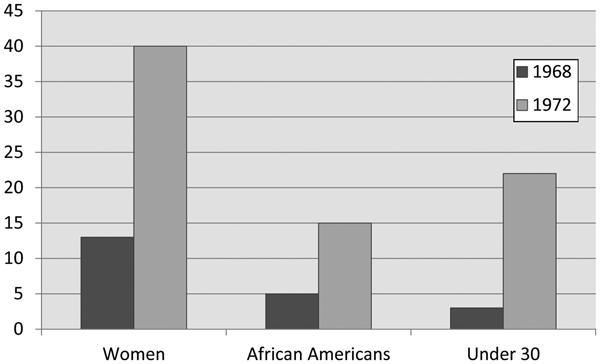
The binding guidelines that followed did not dictate what form delegate selection had to take in the states, but did outline a set of “reasonable standards” meant to guarantee all rank-and-file Democratic activists and voters a “full, meaningful, and timely opportunity to participate”—effectively ruling out many widely used practices.Footnote 47 These included some relatively uncontroversial modernizing reforms such as selecting all delegates in the same calendar year as the convention and requiring state parties to provide written rules for party procedures and to provide adequate public notice of party meetings with uniform dates and times. More controversially, the guidelines banned proxy voting, stripped Democratic Party officials and officeholders of automatic delegate status, curtailed the authority of state party committees to fill delegate seats through committee appointment, and implemented affirmative action provisions meant to “overcome the effects of past discrimination” by encouraging state parties to take “affirmative steps” to represent “minority groups, young people, and women in reasonable relationship to their presence in the population of the State.”Footnote 48 As Figure 1 demonstrates, the guidelines had a significant effect on the demographic composition of the 1972 Democratic National Convention.Footnote 49
Proportion of Women, African Americans, and Youth Delegates at Democratic National Conventions, 1968 and 1972.

While scholars have rightly characterized the McGovern-Fraser guidelines as having “opened the party,” that assessment should not obscure the more ambitious project at work in the commission and the New Politics movement behind it, which sought to fundamentally reconstruct the role of parties as mediating agents between state and society. It was a perspective more born of practice than theory. Even as the commission labored away at delegate selection rules, many leading reformers inside and outside the commission recognized the need to balance procedural openness with new integrative organizations, which could harness insurgent movement energy and channel it in responsible and responsive ways. Indeed, in its final report, the commission argued that “If [the Democrats] are not an open party; if we do not represent the demands for change, then the danger is not that people will go to the Republican Party; it is that there will no longer be a way for people committed to orderly change to fulfill their needs and desires within our traditional political system. It is that they will turn to third or fourth party politics or the anti-politics of the street.”Footnote 50 As a solution, according to chairman Fraser, “political parties need to be reasonable, disciplined operations even though there needs to be free entry into the party, and an opportunity for insurgency.”Footnote 51
The imperative to not only open the party but also reconstruct the party as an organization became especially clear during the summer of 1969 as the commission held a series of seventeen regional hearings to “elicit grass roots sentiment” from more than 500 party officeholders, interest group representatives, and members of the public, who provided testimony on the issue of party reform.Footnote 52 As the transcripts of those hearings show, movement activists and reform enthusiasts understood that simply removing the barriers to participation that kept the insurgents out in 1968 would be insufficient to address the party's legitimacy crisis or the “anti-politics of the street” then-plaguing American society. As one internal commission report reads:
These hearings [have] revealed that reform goes much further than simply reforming internal structures. Making the party “open” is only a first step … for even if the doors of the party are opened wider to the grass roots, it is not at all certain that the grass roots will rush in to seize the opportunity.… It is not enough to “democratize” party procedures if large numbers of people are not interested in participation.Footnote 53
By publicly posing the question of what barriers, “legal or otherwise,” were preventing “meaningful participation” in the Democratic Party, the McGovern-Fraser Commission churned up penetrating critiques of the nature of American party politics in general, the parties’ relationship to its constituents, and the role parties play in formulating public policy.Footnote 54 As the hearings proceeded, Florida Democrat and commission member Leroy Collins noted, “It seems obvious to me that we must consider all legitimate questions concerning the structure of our party. No area should be sacrosanct.… It may well be that a new kind of structure is required to meet the needs of our time and the years beyond.”Footnote 55
In the hearings, the commission was told that participation in the Democratic Party could no longer mean “just ratifying someone else's choice of a candidate”—that the very idea of a political party had to be rethought.Footnote 56 This was reflected in the testimony of William Haber, chairman of the state reform commission in Michigan, who reported that he and his fellow reformers “are not thinking of our role as … purely procedural in character.”Footnote 57 Indeed, Joseph Duffey, an important New Politics leader among the Connecticut Democrats, told the commission, “We don't feel that the prime purpose of political parties in today's system can be to have the ability under all circumstances to win elections.… [T]he political party best functions as lobbyist for the people who are its members.”Footnote 58
Testimony transcripts indicate that reform activists conceived of this new role for parties as requiring more robust forms of organization. This was most clearly expressed by the amateur members of the New Democratic Coalition (NDC)—formed by McCarthy and Kennedy campaigners—which sent representatives to nearly every commission hearing. “The party must serve the people between elections years,” one member asserted.
The party, as opposed to the candidate or the officeholder, should be involved in issues which are vital to the people of the state. The party itself, through the state central committee, must lead the way to bring political solutions to pressing problems. The party must be concerned, in a democratic way, with issues and must act to support the principles its claims.Footnote 59
NDC members emphasized that what was needed was “a new kind of political service organization,” one that took an “activist” approach to organizing its constituents.Footnote 60 “If we are to develop a broad base, representing the best interests of Americans and thus winning elections, we may have to pull people inside.”Footnote 61 Eugene O'Grady, chair of the Ohio Democratic Party, proposed that the project will “take more than what we may do by reforming the party structure.… We've got to find something in the way of an educational system … of getting people specifically involved in politics.”Footnote 62 Many agreed that one way of pulling people into politics was through principled, issue-based appeals. As chairman McGovern wrote to promote the commission's work in Harper's:
Political parties must serve as more than just conduits by which people secure public office. They must address themselves seriously to the social problems and major issues of public policy which face our nation.… This is what reform of the Democratic Party is all about.Footnote 63
In sum, contrary to the impression found in most of the scholarship, McGovern-Fraser concerned itself with more than just opening the party through delegate selection reforms. As the evidence demonstrates, from its earliest days many within the commission conceived of their mandate in broad terms and saw their task as requiring more than just new modalities for grassroots participation but rather new forms of organization, which could provide the foundation for a different kind of party and refashion the role parties in state-society relations.
To be sure, many ideas to increase popular participation in party politics were not wholly new. Often elements of responsible party doctrine, dating back to the mid-twentieth-century American Political Science Association report (and before), could be found in the more nuanced arguments for developing programmatic, issue-based parties.Footnote 64 And even some enterprising National Committee chairs of both parties had made considerable efforts in the past to enhance the parties’ policymaking capacities, including proposing midterm conferences.Footnote 65 However, the fallout of the 1968 party crisis had created a window of opportunity past reformers had lacked. Whereas previous efforts to promote responsible partisanship in American politics had largely fallen on deaf ears, after 1968 many more were listening.
BUILDING A NEW TYPE OF PARTY: THE DEMOCRATIC PARTY CHARTER
Even as reform activists and commissioners were making integral connections between open, participatory structures and the need for mechanisms of intraparty consensus and officeholder accountability, the pressure of events and limited funding placed delegate selection reform as McGovern-Fraser's top priority through 1969–70. But by early 1971, with delegate selection reform well underway, the commission used its remaining time before the body's scheduled expiration at the 1972 Convention to direct its work toward revamping Democratic Party organization. If this compressed timeframe imposed limits on developing the requisite support for such a bold proposal, the success of delegate selection reform was expected to increase the likelihood that the forthcoming National Convention (composed of many new party entrants) would be amenable to their proposal for a new party structure.Footnote 66 After a letter to DNC chair Lawrence O'Brien in March, in which Fraser communicated, “we are prepared to move ahead with consideration of structural changes which we might recommend to the 1972 convention,” the DNC chair readily agreed: “we have an opportunity unique in the history of this party to bring about significant changes.”Footnote 67
A detailed proposal for a reorganized national Democratic Party emerged from a joint meeting of the McGovern-Fraser Commission and its companion convention rules reform commission (called the O'Hara Commission after its chair, Representative James O'Hara of Michigan) in Washington, DC, in November 1971.Footnote 68 DNC Chair O'Brien addressed the members of the joint session, giving them his blessing to “define the next reform goals,” which, he said, might lead to the “historic and fundamental reshaping of the Democratic Party.”Footnote 69 The subsequent commission discussions addressed tough questions about the nature of political parties in American society, their internal structures, their role in policymaking, and the accountability of officeholders to party members. The product, a proposed “Charter for the Democratic Party of the United States,” was to be the party's first constitution in its more than 150 years’ existence. It sought to answer the question of “how a national party—or a national ‘in-between-conventions-organization’—should be structured and what its responsibilities ought to be.”Footnote 70 The seventeen-page draft charter was circulated throughout the party at the end of March 1972 to solicit commentary and suggestions before its scheduled consideration at the 1972 National Convention in Miami Beach.
The charter's stated aim was to reorganize the national party in ways “to permit more direct participation by members in national party policy-making” by “adding a new dimension of grassroots interest to complement that of state organizations and elected officials,” thereby “bringing new vitality to the party as a whole.”Footnote 71 Rather than just opening the floodgates to the hordes of movement activists, the reconstructed Democratic Party would temper insurgent passion by combining it with the cool-headedness of experienced party leaders. This was to be accomplished by introducing a number of significant institutional innovations meant to carve out greater autonomy for the party as an organization and a collective actor in American politics and policymaking.
First, at the apex of the party, as depicted in Figure 2, the sovereign authority of the quadrennial National Convention would be complemented with a midterm national policy conference, where popularly elected delegates, state parties officials, and national party officeholders could formulate official party policy on national issues without the added pressure of selecting a presidential nominee. This “mini-convention,” it was imagined by one of its leading proponents, James MacGregor Burns, would function as “a transmission belt between movement politics and party politics.… [providing] a way that movement people … could register themselves in the Democratic Party in an organized, relatively coherent and legitimate way.”Footnote 72 This would keep the national party “active, vital, and visible” between presidential elections, thus advancing the “continuing interests of the party” besides those of competing for office.Footnote 73
Charter Proposal for National Party Structure.

Second, a National Committee, expanded to reflect states proportionately rather than equally, would exercise sovereign authority during the interim between national meetings, while delegating day-to-day operations to a smaller Executive Committee, which would meet about every six weeks. Its chief officer, the DNC chair, would be elected by the national policy conference to serve a four-year, full-time, paid term of office rather than being a de facto appointee and agent of the party's presidential nominee. The Executive Committee would also include the ranking party leaders from the House and Senate, as well as the Regional Committee chairs (see below), to facilitate better coordination between the party organization and the party in government. Additionally, members of the Executive Committee would appoint a board of directors to oversee a national Education and Training Unit to recruit and groom candidates for office at all levels of the party. It would also undertake independent research and development for improving candidate service provisioning and campaign technology.
Third, the added expenses associated with such an active national party organization would be partially offset by a national dues-based membership program, housed in a new body, the Membership and Finance Council, which would alleviate fundraising reliance on those Fraser referred to as “fat cat contributors.”Footnote 74 Moreover, veteran party reformer Neil Staebler argued that “meaningful membership” would “give individuals a chance to relate to the national party” at a historical juncture where “a large and growing percentage of people disclaim any party connection” whatsoever.Footnote 75 For an annual enrollment fee of $3, rank-and-file party members would be eligible to vote for delegates to the regional and national policy conferences or run as delegates themselves. Half of all dues would go to the Education and Training Unit.
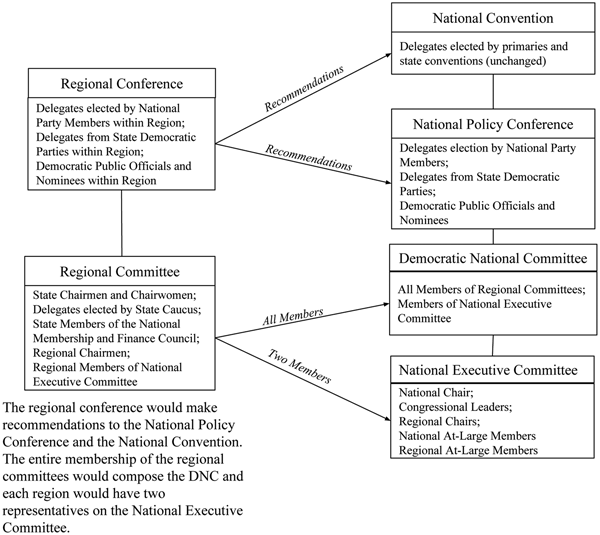
Finally, as shown in Figure 3, the charter also proposed a new set of seven Regional Committees, which would be constructed to help interface between the state and national layers of the party. Each Regional Committee would be composed of state party leaders, local members of the Membership and Finance Council, and their representatives on the DNC. The Regional Committees would in turn sponsor their own regional conferences to be held in odd-numbered years. Their “primary obligation” would be to “promote party organization, education and training” within their respective geographic areas, while also developing policy recommendations to be forwarded for consideration at the next national meeting.Footnote 76
Proposed Relationship between Regional and National Organizations.

In sum, the authors of the charter proposal held that it would “discard the frustrating weaknesses of the present system,” such as those voiced in the McGovern-Fraser hearings, “and usher in a new and vastly strengthened structure, based on broad grassroots support.”Footnote 77 Clearly seeing the limits of purely participatory democracy, reformers advanced an ambitious plan in the waning months of the McGovern-Fraser Commission that sought to remake party politics altogether. The new Democratic Party, they asserted, would be “an institution open to all people, greatly influenced by its incumbent officeholders and leaders but bigger than they, and not just their creation.”Footnote 78 Instead, it would function as “an active and creative force in American politics … which can respond intelligently to the problems and needs of modern America.”Footnote 79 Thus, reformers attempted to marry and balance the twin concerns of providing greater opportunity for grassroots participation as well as producing the incentive to do so through the draw of national, programmatic, issue-based party politics. The charter sought to combine the old and the new politics into a fresh admixture, one that could both temper insurgents and revitalize the party establishment.
BRINGING THE COUNTER-REFORMERS BACK IN: THE COALITION FOR A DEMOCRATIC MAJORITY
The charter's aim to transform the decentralized power structure of the Democratic Party helped galvanize a formidable antireform backlash. While delegate selection reform had asserted national party authority over state organizations as never before, it had left the state organizations in place as the constituent units of the national party. In proposing a new regional substructure between state and national organizations, the charter threatened the power of state party leaders in a way delegate selection reform had not. And after the debacle of the 1972 presidential election, both aspects of reform came under intense attack.
McGovern's chaotic and mismanaged general election campaignFootnote 80 culminated in a landslide defeat to President Richard Nixon—losing every state except Massachusetts and the District of Columbia—and marked a turning point in the dynamics of Democratic Party reform. While such a decisive rebuke at the polls did not spell the end of reform politics as such, the dispiriting effect it had on reform advocates was palpable, as was its encouraging effect on their opponents. Most importantly for the latter, it provided antireformers with a persuasive counter-argument where no rationale had been available before. This intellectual void had been displayed in Richard Scammon and Ben Wattenberg's best-selling book, The Real Majority, which offered a lackluster defense of the pre-reformed nomination process just as the McGovern-Fraser Commission was formulating its guidelines:
What can be said about the delegate selection system is this: Somehow it works. All the delegates are elected or, if not, are selected by people who were elected popularly or, in some cases, selected by people who were selected by people who were elected popularly at one time or another. There is, then, a democratic process, if far removed, behind each delegate.Footnote 81
Defenses of such highly attenuated systems of delegation galvanized little in the way of organized support or public endorsement when issued in 1970. The party crisis of 1968 had temporarily discredited such systems and their rationales. McGovern's devastating loss at the polls, however, quickly altered the circumstances.
No agent was more important in halting the momentum of the reform movement than the Coalition for a Democratic Majority (CDM). Founded by former LBJ speechwriter Ben Wattenberg and AFL-CIO associate Penn Kemble, the early CDM's active members and supporters included several prominent Democratic officeholders, such as Senator Henry Jackson (WA), Representative Thomas Foley (WA), and erstwhile reformer Representative James O'Hara (MI); a handful of academic and public intellectuals, such as Jeane Kirkpatrick, Austin Ranney, Nelson Polsby, Nathan Glazer, Norman Podhoretz, and Midge Decter; several key labor leaders and officials, such as Al Barkan, Bayard Rustin, and Albert Shanker (the CDM's primary source of funding came from AFL-CIO affiliated unions); and an array of Democratic Party officials and strategists, including Hubert Humphrey aide Max Kampleman, Joshua Muravchik, Daniel Patrick Moynihan, and Richard Perle.Footnote 82 The members’ views and motives were diverse, ranging from a pragmatic interest in recapturing the presidency to restoring the union leadership’s privileged role in nominations to disillusionment with the reform project itself. Others, many of whom would later become prominent neoconservatives and Reagan administration officials, expressed ideological hostility toward the dovish foreign policy and domestic countercultural mores that they saw as part of a single phenomenon they labeled “McGovernism.”
The coalition backing the CDM had its formative roots in the failed eleventh-hour “Anybody But McGovern” campaign to block the senator's nomination at the 1972 Convention. In the run-up to the conclave, Muravchik had raised the alarm among his associates, warning that the proposed charter, if adopted in Miami Beach, would result in a “sweeping restructuring of the party.” Encouraging his future CDM colleagues to “do something about it,” Muravchik emphasized the high stakes that the charter proposal represented in the context of intraparty institutional politics: “The decisions that the convention will make in this area will determine the framework within [which] the post-November battles for control over the party will be fought.”Footnote 83
Accordingly, the nascent coalition hastily put together a partially successful lobbying effort directed at the convention's Rules Committee. In a circular, the group asserted that the charter's party membership provision would amount to a de facto “second voter registration” system likely to depress participation; its delegate selection provisions would “institutionalize” the McGovern-Fraser reforms before their effects could be reviewed; and the charter would “virtually eliminate the role that public officeholders and state party officials play in party affairs.”Footnote 84 While these assertions rested on questionable assumptions, they had their intended effect. With the support of other intraparty groups, such as the Association of State Democratic Chairs, the Democratic Governors Conference, and top officials in the AFL-CIO's Committee on Political Education (COPE), as well as the acquiesce of the McGovern campaign, consideration of the charter was postponed until the party's first midterm policy conference, scheduled for 1974, to be orchestrated by a new Charter Commission.
The CDM made its official debut in the aftermath of McGovern's much anticipated electoral defeat. The minutes of their first postelection meeting state that the outcome “verified our point of view” and immediate steps were needed to capitalize on the “vacuum in the Democratic Party.”Footnote 85 Publishing their manifesto, “Come Home, Democrats,” as a full-page ad in the New York Times and the Washington Post a month after the election, the CDM declared its mission to root out the “unrepresentative” social groups that had come to exert “undue influence” within the party.Footnote 86 The group's logic was clear: The reforms had created an unrepresentative convention; the convention had nominated an unrepresentative candidate. To uproot the unrepresentative groups, the reforms had to be reformed. As the labor-oriented civil rights organizer and CDM member Bayard Rustin put it, “the problem lay not with McGovern, but with his supporters and the changes they made in the Democratic Party.”Footnote 87
However, for some members of the CDM, more was at stake than just the procedures of the Democratic Party. They frequently framed their project in grander, ideological terms as an effort to “redefine liberalism for the 1970s.”Footnote 88 This task in turn required them “to cleanse mainstream liberalism” of its McGovernite elements.Footnote 89 As they put it in their newsletter, CDM Notes:
We now face a need to draw some distinctions between the two major strands of what used to be called liberalism. One strand, with which CDM is aligned, holds that the Democratic Party must rebuild a broad coalition to win back the blue-collar, Southern moderate, Catholic, and “middle-American” voters who deserted the Democratic ticket in 1972.… The second strand seeks to strengthen the forces which came to dominate the party between 1968 and 1972—an alliance of women, blacks, and youth, led by dissident elements of the affluent, educated middle class.Footnote 90
The CDM was “not looking for unity” between these strands, but rather intended “to draw bright, clear lines” between them to better transform liberalism's internal splits “into a chasm.” “Compromise,” Wattenberg asserted, “would come later.”Footnote 91
During 1972–1974, the CDM elaborated its case against the reforms by focusing its criticisms on what it called the undemocratic quota system mandated by McGovern-Fraser's affirmative action guidelines. These provisions, alongside the ban on automatic delegate status, had become a vehicle for “New Class” elites to take control of the party.Footnote 92 Practically, however, as the struggle between the party reformers and their antagonists played out in the aftermath of 1972, the anti–New Politics front, with a few important exceptions, did not seek to return the party to the status quo ante. Rather than trying to restore the old regime, counter-reformers embedded their attack within the remit of reform itself, using the remaining momentum from the 1972 Convention to institutionalize their own vision of Democratic Party structure. By concentrating its efforts on recapturing the party leadership and influencing the work of the new Delegate Selection Commission (known as the Mikulski Commission) and the Charter Commission (the Sanford Commission), the relatively small-sized CDM was able to use the window of opportunity presented by McGovern's defeat to prevent the reformers from realizing the participatory, programmatic, national organization they had envisioned in their proposed party constitution.
Retaking the Party Chair
CDM members were keenly aware that the “cooperation of party professionals,” especially DNC chair Lawrence O'Brien, had been a “decisive” factor in the reformers’ success between 1968 and 1972.Footnote 93 Accordingly, the first front in their battle to retake the party from the New Politics reformers developed around the pivotal institution of the party chair. By installing Utah DNC member Jean Westwood as chair, Democratic nominee McGovern had not only appointed one of his own supporters from the ranks of the newly created National Women's Political Caucus (NWPC), but had also appointed the party's first woman to the top of the leadership.Footnote 94
As McGovern's appointee and a symbol of the New Politics movement, Westwood presented an ideal target for the counter-reform movement to signal their commitment to restoring party professionals to power. While moderate state party chairs put their names forward for consideration to run the Democratic National Committee ahead of the party's first postelection meeting in December 1972, the CDM decided to make a show of strength by consolidating their influence behind Texas lawyer and DNC treasurer Robert Strauss. As a protégé of former House Speaker Sam Rayburn and a close friend of former Governor John Connally (TX), who had spearheaded the anti-McGovern “Democrats for Nixon” campaign the previous fall, Strauss appeared to many as the prototypical party official of the old politics. Although he promised committee members to move on from the electoral debacle in the spirit of pragmatism, seeking middle-of-the-road compromises to mend fences, privately Strauss harbored personal hostility for the reform wing of the party.Footnote 95
In the weeks between the November election and the DNC meeting, CDM forces worked out of Senator Jackson's Washington, DC, office, lining up the votes to support Westwood's replacement with Strauss. After an intensive lobbying campaign at the Democratic Governors Conference meeting in early December, Strauss and AFL-CIO forces extracted eighteen out of thirty-one governors’ endorsements to unseat Westwood.Footnote 96
The atmosphere of electoral defeat had robbed Westwood and her supporters of any significant sources of intraparty support, including from McGovern himself. As he later reflected, “since we lost so overwhelmingly … I didn't want any Democrat to think we were going to cling to my appointment with Jean Westwood. It wasn't that I was unhappy with her—I just didn't think we ought to get into a battle to keep her on after my defeat.”Footnote 97 When the DNC met in early December, two days after the CDM's “Come Home, Democrats” ad had signaled their anti–New Politics commitment, Westwood was deposed and replaced with Strauss by four and a half votes.Footnote 98
Weakening Affirmative Action
Wattenberg described the CDM's victory in the battle for the DNC leadership as “just the first skirmish” in their intraparty war of position against the New Politics.Footnote 99 The second skirmish took place in the Mikulski Commission (named after commission chairwoman, Baltimore city councilor Barbara Mikulski). Unlike the appointment of the McGovern-Fraser Commission in the aftermath of the 1968 party crisis, the creation of the new Commission on Delegate Selection and Party Structure drew the keen attention of all party actors who saw the balance of power inside the commission as a matter of great importance in determining the future of the party. Following Westwood's ouster, and under pressure from COPE director Al Barkan, Strauss appointed an additional twenty-five members to the already fifty-member commission, including eight recommended by Barkan himself, diluting the strength of the New Politics bloc.
The CDM also influenced the Mikulski Commission through the lobbying efforts of its Task Force on Democratic Rules and Structure. In late April 1973, just after the Mikulski Commission's deliberations got underway, the CDM Task Force released a comprehensive report evaluating and critiquing the McGovern-Fraser guidelines: Towards Fairness and Unity for ’76 argued the McGovern-Fraser reforms were themselves a violation of basic principles of democratic process and equitable representation. The root of the problem lay in the reformers’ “bias toward ‘participatory’ over ‘representative’ democracy,” which resulted in the “over-representation” of activists of the “so-called grassroots.”Footnote 100 Further, the affirmative action guidelines, with their “reasonable relationship” language, only benefited the “new class” of white-collar elites. “Quota representation and other forms of administered ‘democracy’ ultimately lead to greater influence for quota-makers, and not for the groups in whose interests they purport to speak.” Democracy inside the party, they asserted, can only mean “open and fair” processes, not a “guaranteed outcome” according to “rather arbitrary biological categories” of race, gender, and age. “Democracy by demography” is itself not only “absurdly unworkable,” they concluded, but it would also “gravely undermine the democratic process itself.”Footnote 101
The “reasonable relationship” quota guidelines, the report recommended, should be abolished, along with the ban on automatic delegate status for Democratic officeholders and the prohibition of closed slate making. To better bring the party professionals back in, the report recommended raising the limit on party committee appointment from 10 to 30 percent of state delegations. The goal, they wrote, must be to “reconstitute” the “broad coalition” of “all Americans with an interest in progressive social change,” including the “newly awakened blacks and browns, the women, the young, and the intellectuals,” but also the blue-collar workers, the Southern moderates, the white ethnics, the business community, farmers, and many others. Such a “complex alliance” required “skilled and experienced leaders” who “know what it takes to bring the various groups together” and possess the “web of relationships which enables them to do so.” In the end, they concluded, “our proposals would restore the democratically chosen leaders to their proper place” in the Democratic Party.Footnote 102
The CDM distributed copies of Towards Fairness and Unity to all members of the Mikulski Commission and orchestrated supportive testimony from more than forty CDM-affiliated experts at eight of the commission's regional hearings.Footnote 103 O'Hara also circulated the report among members of the Democratic House Caucus, many of whom responded with enthusiasm.
At the end of 1973, after nearly a year of meetings, testimony, and deliberation, the Mikulski Commission issued its final report, Democrats All, which outlined new delegate selection guidelines binding on all state parties for the 1976 National Convention. On balance, its findings affirmed the general thrust of the McGovern-Fraser reforms.Footnote 104 The overall framework and assumptions McGovern-Fraser had installed as a system for regulating the National Convention and delegate selection was not open for debate; “the questions debated were on the content of the rules, not their existence.”Footnote 105 But the CDM's strategy in this arena and the reason for its effectiveness was precisely in not challenging the existence of the rules but in modifying their content.
Thus, while the commission retained affirmative action guidelines in name, it acquiesced to the CDM's objections by specifying that representational goals “shall not be accomplished either directly or indirectly by the Party's imposition of mandatory quotas.”Footnote 106 In contrast, NWPC chair Frances Farenthold urged commission leaders to “not overreact to the [1972] defeat” and “retreat and abandon the substantial gains” made since McGovern-Fraser; “Fairness dictates that we be represented in proportion to our numbers in the population,” she said.Footnote 107 However, at the same time, to make a good-faith effort to heal the rifts between reformers and establishment figures, commissioners reinstated automatic delegate status (but yet not voting rights) for Democratic officeholders. New Politics reformers, such as Eli Segal, pointed to what he considered to be the hypocrisy of the CDM and its supporters in calling for the “abolition of so-called quotas for some Democratic groups” only to replace them with “quotas for other Democratic groups,” namely party officials and officeholders.Footnote 108 Lanny Davis agreed, writing to a fellow commissioner, “we've been given a bum rap on the quota issue. We've let the CDM and Mr. Strauss shift the debate from the legitimate issue—the responsibility of state party organizations to open up … to the issue of a numerical quota.”Footnote 109 Fraser said the CDM's “use of the word ‘quota’ is a deliberate attempt to mislead.”Footnote 110 Though Democrats would later implement “equal division” of gender for convention delegates in 1980, CDM founder Penn Kemble felt that “we have clearly won the philosophical battle against quotas.”Footnote 111
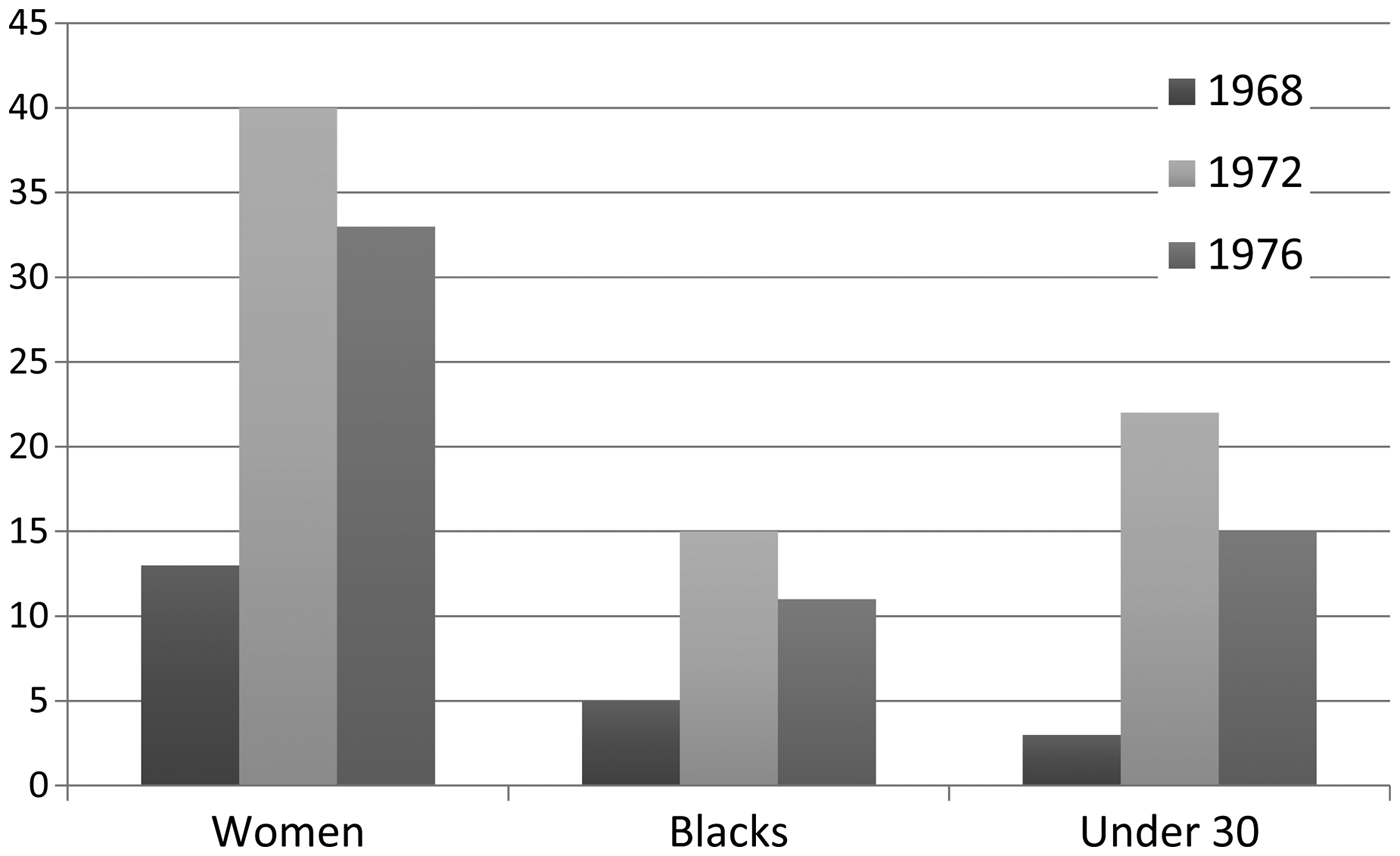
Furthermore, Democrats All shifted the burden of proof from defendants to plaintiffs in antidiscrimination delegate credentials challenges, of which there had been a record number at the 1972 Convention. Thus, “if a State Party had adopted and implemented an approved Affirmative Action Program, the Party shall not be subject to challenge based solely on delegate composition or primary results.”Footnote 112 This had the desired effect of bringing the number of credentials challenges down for 1976. However, as Figure 4 shows, it also corresponded with a drop in black, women, and youth delegates.
Demographic Composition of Democratic National Conventions, 1968–1976 (%).

Altogether, these amounted to subtle yet substantial shifts in the details of delegate selection, which weakened the reformers’ legitimacy in defining the standards for fair representation in the party's governing bodies. By influencing the proceedings of the Mikulski Commission, the CDM employed the newfound authority of the national party to codify new rules that rolled back some of the most far-reaching changes made by the McGovern-Fraser Commission.
Constitutionalizing Party Federalism
Operating concurrently with the Mikulski Commission was the Charter Commission, chaired by former North Carolina governor Terry Sanford. As mandated by the 1972 Convention, it was tasked with working out in detail a constitution for the Democratic Party that codified its governing structures, relations of authority, and operating procedures, as well as planning a 1974 midterm national policy conference at which the revised charter would be presented for approval.
Unsurprisingly, as the most ambitious element within the New Politics reform project, the proposal for a wholly reconstructed party organization aroused a significant amount of hostility from stakeholders with vested interests in the loose structure of party federalism. As a part of the compromise within the 1972 Convention's Rules Committee, the charter had already been stripped of its proposals for a national dues-paying membership and the regional substructure to better integrate national and state party governance. Still, the draft with which the Charter Commission began its deliberations in the spring of 1973 had in it a number of proposals deemed quite controversial, including holding regular midterm policy conferences between presidential nominating conventions; extending affirmative action programs to “all party affairs,” including in state and local party organizations; establishing a nine-member intraparty judicial council to monitor state-level compliance with party law; and instating four-year terms of service for the DNC chair, to be elected by the party membership at midterm conferences rather than appointed by the presidential nominee.
Upon inheriting the Charter Commission from the deposed Westwood, Strauss appointed an additional fifty-five members to the already large 105-member body, as he had done with the Mikulski Commission, to better balance its composition and dilute the strength of the reformers. Much to the chagrin of the counter-reformers who backed his nomination for chair, Strauss's priority within the Charter Commission was to avoid any messy confrontation that could harm the party's public image going into the 1974 midterm elections. In an attempt to placate the rivaling party factions, Strauss created the Democratic Advisory Council of Elected Officials (DACEO), tasking it with developing some issue positions on foreign and domestic policy for public consumption. Strauss closed the body to “outside” influence, however, naming eleven senators; twenty-one House members; ten governors; nine mayors; and twenty state, county or local party officials to the body.Footnote 113 By insisting that “only the Democratic Advisory Council is authorized to make official policy declarations,” Strauss sought to reassure those who feared that it might become a vehicle for New Politics liberals and an electoral liability.Footnote 114
However, while reformers continued to distrust Strauss, counter-reformers also grew disenchanted with his triangulation strategy. Feeling frustrated with the chair's reticence to fully marginalize New Politics reformers, COPE's Barkan considered backing Strauss for DNC chair to be “the worst political mistake” he had ever made.Footnote 115
Going it alone without Strauss's leadership, the CDM spearheaded the charge to outflank the New Politics in shaping the charter's terms and provisions. Under the direction of Muravchik, the CDM developed a second special task force, the Charter Conference Clearing House, to mobilize support for a modified party constitution that could “redirect and realign our party” away from the New Politics forces.Footnote 116 From the perspective of those on the Task Force, the convention-mandated midterm conference presented a potentially “constructive” opportunity, depending on whether the “responsible forces” in the Democratic Party could properly “influence the charter debate.”Footnote 117
Prior to the content of the charter becoming the central matter of dispute, reformers were dealt a major setback in defining the Charter Conference's agenda and its very purpose. At the second Charter Commission meeting in Fort Collins in July 1973, CDM member Representative Thomas Foley led a bloc of Southern Democrats, AFL-CIO operatives, and traditional party leaders in narrowly passing a resolution limiting the midterm policy conference to considering “only the recommendations for restructuring the Democratic Party,” prohibiting discussion of party program or policy.Footnote 118 New Politics reformers protested in vain. New York State Democratic chair Joseph Crangle told the Fort Collins meeting that they were “putting blinders on” the party by preventing it from speaking with a unified voice about national issues at a time of major public concern (e.g., the Watergate scandal).Footnote 119 Patricia Derian, DNC representative of Mississippi, emphasized the detrimental effects programmatic incoherence was having on partisan identification: “we're losing 10 percent of our members to independents each year,” she said.Footnote 120
Our party is balkanized; each elected official stands on his own plank, works in his own area of interest. Our bill of complaints falls on the populace like handfuls of confetti.… What does it mean to anyone anymore to be a Democrat? If it only signifies that one is not a Republican, that is not enough.… A clear statement of intentions is needed.Footnote 121
Curtailment of the agenda notwithstanding, reformers scored narrow upset victories at the subsequent charter meeting as the commission finalized its first revised draft for circulation in March 1974. The new draft included mandatory midterm conferences, an independent intraparty judicial council, and affirmative action programs “in all party affairs.”Footnote 122 The anti–New Politics opposition at the March meeting, led by Barkan, his COPE operatives, and other members of the CDM, focused their efforts on the provision for mandatory midterm conferences. As Barkan later communicated to AFL-CIO president George Meany, “this is a mare's nest that can only provide a forum for the issues and persons who divide the party.”Footnote 123 However, their alternative proposal, making midterm policy conferences optional at the discretion of the DNC, failed to carry a majority. As one reformer responded, “those for mandatory conferences believe they must be [mandatory] because if it is left up to the discretion of the DNC they will never happen.”Footnote 124 Reformers were jubilant. The tide of the party meeting, reported one reformer, had turned “against Strauss and [back] toward reform.”Footnote 125
Although reformers were encouraged, the March meeting was not a decisive victory. The commission met again in August to review the charter proposal before a final vote at the December Democratic National Conference. In the interim, fearing that the balance of power was slipping back toward the reformers, the Charter Conference Clearing House, under the direction of Muravchik, sought to “orchestrate a scare” among complacent Democrats and labor leaders.Footnote 126 CDM members reached out to state Democratic officeholders to alert them to the threat they believed the Charter Conference to be. As Barkan wrote to Governor Milton Shapp (PA), “the essential thrust of this draft charter is to diminish the independence and political authority of the state and local Democratic Party structures, and to centralize authority in a National Party structure which … would be more responsive to the ideological measures of militants and activists.”Footnote 127 Subsequently, the March draft of the charter received a stark rebuke from the Democratic Governors Conference meeting in June. By unanimous decision, the governors voiced their opposition to establishing national party supremacy and demanded that, due to “changing needs” as well as “the inability to mandate four years in advance,” mandatory midterm conferences be dropped. The governors’ resolution also bristled at the proposal for an independent judicial council to resolve intraparty disputes, instead preferring such power to be “vested in the DNC.”Footnote 128 A similar item-by-item attack on the March version of the charter was also issued by more than 150 members of the House Democratic Caucus in July.Footnote 129
In July, the CDM's Charter Conference Clearing House circulated its official critique of the proposed party constitution, entitled Unity Out of Diversity.Footnote 130 The report attacked the reformers’ efforts to “centralize, ideologize, and ‘Europeanize’ the party in ways that run against the grain of American political tradition and the unique coalitional character of the Democratic Party.”Footnote 131 Midterm conferences, it alleged, would “probably be unrepresentative and divisive, and could harm the party's electoral appeal.”Footnote 132 Further, codifying affirmative action guidelines “in all party affairs” would “cast the current set of delegate selection rules into the iron of the charter,” making the rules rigid and inflexible, and “conscript local officials into an all-consuming national affirmative action crusade, eclipsing the role they should play in electing their candidates, raising money, and building party structure.”Footnote 133 Last, the CDM attacked the New Politics overarching goal of building a more liberal programmatic party:
It is unrealistic to talk of the desirability—even the possibility—of a united, liberal “national” party driving out the impure and arousing new converts by trumpeting a sweeping national program.… We should continue to build along the lines of a federative, pluralistic party, in keeping with the character of American politics.… [The charter] should not be seen as a blueprint for the creation of a wholly new party.”Footnote 134
The Charter Commission's August meeting exploded in acrimony. During a two-day session in Kansas City, the CDM's well-orchestrated whip operation resulted in decisive defeats for reformers: mandatory midterm conferences were revised as optional; delegate selection was removed from the purview of the judicial council, rendering the body largely irrelevant; and the power to select the DNC chair was retained by the party's presidential nominee. Further attempts to limit the reach of affirmative action guidelines resulted in a walkout of the reform bloc. Mississippi's Hodding Carter III criticized CDM forces for “making what's left of this charter a sham.”Footnote 135
On the eve of the charter's ratification, the CDM members felt “gratified to report that our view has prevailed,” resting assured that the conference would produce a constitution institutionalizing “the peculiarly limited roles and duties of an American-style national political party.”Footnote 136 By their own detailed estimates, the balance of power among conference delegates favored the charter as they had refashioned it.Footnote 137 They had been assisted by Strauss's efforts to boost attendance of party officeholders, who were invited as automatic delegates but could not send proxies.Footnote 138 Over the protestations of reformers such as Fraser, Strauss had also imposed strict limits on floor amendments and required the entire charter to be approved, item-by-item, in a single session, with no allowance for motions to adjourn.Footnote 139 Feeling assured of a relatively benign party conclave, Strauss allowed DACEO to sponsor a number of issue seminars at the event to “assist in identifying issues of concern to the Democratic Party.”Footnote 140 But it was made clear to conference delegates that “no action shall be taken at these panels.”Footnote 141
In the aftermath of the conference, reformers did their best to salvage what they could from the hollow victory many of them felt it to be. Letters of thanks and congratulations among some of the most prominent reformers acknowledged that the charter was not “all that we wanted” but held out hope it would provide “a more durable base” on which to build.Footnote 142 Others were more blunt in their assessments: “The result in Kansas City is a piece of paper that, in effect, codifies the existing system—a loose coalition of state parties and interest groups … that unite when it suits their interests and divide when it doesn't.”Footnote 143 When compared to the original charter proposal introduced to the 1972 Convention, the final version of the party constitution stood as “testimony to the anti-party power in national politics—to the primacy of candidates over structure, to the centrifugal strength of state and local chairmen.”Footnote 144 The CDM, on the other hand, felt its “founding purpose has been achieved.”Footnote 145
The unexpected success of former Georgia governor Jimmy Carter in the 1976 presidential nomination process and the general election raised the hopes of many on both sides of the intraparty divide that the Democratic majority of the postwar era had been restored. Both factions were soon disappointed, however, due to the general disarray of the Carter administration and its success in mostly suppressing activists’ dissent at the 1978 midterm policy conference held in Memphis. Four years later, most of the CDM had crossed the aisle during the Reagan revolution, while the Democrats held one final midterm policy conference in Philadelphia, where it was decided that due to costs no further midterm conferences would be called.
CONCLUSIONS AND IMPLICATIONS
When the full sweep of the party reform struggle from 1968 to 1974 is correctly taken into account, we can see that the New Politics coalition was about more than simply opening the Democratic Party. From the beginning, many of the most influential reformers saw the need to couple procedural openness with party-building measures, which together, they thought, would revitalize the party as an organization and resolve the legitimacy crisis affecting the Democrats in the wake of 1968. Seizing the opportunity presented by the crisis, these political entrepreneurs sought to build and deploy the authority of a robust, nationally integrated party to bring state and local organizations into compliance with the new rules it saw as necessary for achieving a standard of fairness and representation and for extending the rights revolution beyond the limits of the New Deal coalition.
Their more ambitious project of party reconstruction was inevitably disruptive of existing patterns of party governance, even if many of those forms—reliant on custom, tradition, and transactional politics—were already in an advanced state of decay.Footnote 146 The opposition that party reconstruction aroused was successful in limiting that phase of reform. The result of the struggle between reformers and counter-reformers in the 1970s was a system more permeable to outside groups, insurgent candidates, and political entrepreneurs generally, in which parties lacked internal organizations or procedures capable of integrating and aggregating new entrants into responsible forms of mass partisanship. With the institutional basis of machine politics in decline and the New Politics alternative dashed, the Democratic Party was transformed into a shell of its former self: nationalized in terms of party authority, but hollow in its organizational linkage with citizens. The hollow party became more dependent on extraparty organizations, consultants, think tanks, interest groups, and movement activists for its operations. The diminished institutional capacity to control its own nomination process as well as the loss of legitimacy to do so laid the foundation for the rise of the advocacy party and the organizational basis of polarization.
From the perspective of the twenty-first century, it seems naïve that McGovern-Fraser reformers believed that party reform would lead to party revitalization. In hindsight, the 1970s was perhaps the most inhospitable decade to try and spur popular interest in mass-based forms of partisan politics. The rise of pure independents, split-ticket voting patterns, and ad hoc legislative coalitions, while all temporary phenomena, suggested to many contemporaries that, far from verging on revival, the party system's days were numbered.Footnote 147 Even if reformers had reformed the party along the lines laid out in the charter proposal, it is unlikely that greater opportunities for participating would have revitalized the Democrats in the short or medium term. Thus McGovern-Fraser reformers encountered the intractable dilemma that confronts all political entrepreneurs. While they boldly proposed to make a “sharp break with the past,” they also recognized that “the party structure cannot be reformed in a vacuum.”Footnote 148 Reformers never get to wipe the slate clean and start fresh. They are always saddled with the burden of the past: inherited institutions with vested interests in maintaining them. Reform politics therefore knows no clean breaks. Change and continuity mix together to different degrees with different effects, and reformers must necessarily cope with vestiges of the old order that augment and limit the new.
What is more interesting to entertain is the counterfactual of how modern polarization would have developed in the absence of the advocacy party born from the reform struggle. Ideological sorting across the two-party system has many causes, including the democratization of the South—a process well underway prior to McGovern-Fraser. Thus, it is likely that a conservative Republican Party and a liberal Democratic Party would have emerged regardless of the transformative effects of party reform. If McGovern-Fraser reformers had succeeded, however, their alternative party may have been able to cultivate entrance, voice, and loyalty for partisan organizations currently subject to a cacophony of advocates’ demands. Of course, ideologically sorted parties with coherent policy agendas and cohesive voting patterns will still cause problems of gridlock and stalemate in a system segmented by checks and balances. More organizationally robust parties would offer no easy solutions for these issues, to be sure. But it is plausible to think that by encouraging bottom-up participation, cross-constituency interaction, and transparent negotiation with party officials and leaders, parties of a different type could foster the much-needed trust and legitimacy that American political institutions, particularly parties, have been so sorely lacking since the 1970s.
Thus, it is important to get the account of Democratic Party reform right because it helps us understand how the advocacy party developed as well its impact in laying the organizational foundation for modern polarization. Moreover, examining party development through the lens of the advocacy party raises interesting questions and implications for several branches of ongoing inquiry.
First, the advocacy party model has proved contagious, spreading into surprising venues such as the “party establishment” itself. Recently, the advocacy party has shown itself to be periodically strained by conflicts between activists and the establishment, especially during high-stakes presidential nominations. In past years the Democratic Party has experienced several controversies over the role of its unpledged superdelegates in the 2008 and 2016 nomination contests. These special seats, reserved for elite party officials and present and former top officeholders, were introduced in the mid-1980s as a means of courting party elites back to the national conventions after their participation rates plummeted in the wake of McGovern-Fraser's revoking their automatic delegate status. Since then, superdelegates have figured between roughly 15 and 20 percent of convention votes. While an initiative of latter-day counter-reformers and a recurrent object of distrust from liberal insurgents, the advent of superdelegates represents less of a restoration of the smoke-filled rooms than it does party officials’ adaptation to the advocacy party model. As Shafer observes, “a conscious effort to reintroduce the official party to ‘its’ convention only underline[s] the extent to which party officials themselves ha[ve] become just one more organized interest” in the Democrats’ extended party network.Footnote 149 Party elites’ attempts to respond to the dynamics of the advocacy party by asserting their own group interests, however, only further undermines party officials’ legitimacy in claiming any enhanced degree of authority or expertise in presidential nominations. Although they have not yet figured decisively in any nomination contest, the party elite's group basis as superdelegates lacks a credibility in the advocacy party, and their role is likely to be curtailed for future conventions.Footnote 150
Second, despite having traveled a very different developmental path, the Republican Party appears as institutionally hollow and in the grip of the advocacy model as the Democrats. Trump's ability to cut through what has always been a relatively more robust Republican organization has raised interesting questions about partisan asymmetry and activist–elite antagonism in the GOP. By changing state laws regulating the use of presidential primaries, McGovern-Fraser reformers did indeed open the Republican Party to a significant, though less rancorous extent, suggesting that it too has developed advocacy party–type dependence on extraparty groups. Its relative organizational edge notwithstanding, it may be the case that up until recently the Republicans’ extended party network has simply been more ideologically homogeneous than the Democrats’, subjecting its fragile institutions to fewer insurgent challenges and grassroots revolts. The post–Tea Party era, however, demands revisiting Republican Party development through the lens of the advocacy party, not only to trace its own unique path but also to examine new points of partisan similarity.
Finally, contrary to what some might predict about hollow parties that are dependent on extraparty groups for their operations, the advocacy party model contributes to the presidential domination of the parties. For instance, while Barack Obama has been criticized for doing little to rebuild Democratic organization over the course of his presidency, what innovative party building did occur was undertaken through the president's personal campaign organization, Obama for America (OFA), and its postelection nonprofit spin-off, Organizing for America (OFA 2.0). The initial OFA combined netroots outreach with face-to-face canvassing, centrally coordinated from its data-rich headquarters in Chicago.Footnote 151 The mission of OFA 2.0 was to establish a permanent field organization that folded Obama's vast support network of 3 million donors, 13 million email addresses, millions of volunteers, and tens of thousands of neighborhood coordinators into the DNC and remain active between elections. As the “grassroots arm of the DNC,” OFA 2.0 promoted, organized, and mobilized support for the president's policy agenda through community-level events, petition drives, letters to the editor, and lobbying activity directed at state legislators and members of Congress.Footnote 152 Following the 2012 elections, OFA was removed from the DNC and rebranded as Organizing for Action (OFA 3.0), a 501(c)(4) social welfare organization unconstrained by campaign finance regulations, and continues to promote “the agenda Americans voted for in 2012.”Footnote 153
However, OFA's ostensibly neutral role as a partisan organization was belied by its inability to prevent the staggering Democratic losses suffered during the Obama presidency. Obama's postelection OFA entities remained his organizations, prioritizing his policy agenda, promoting his goals, and ultimately reinforcing his authority over the Democratic Party. This was less a personal failing than it was a result of what could be called the “advocacy imperative” imposed on the leader of an advocacy party. By undertaking innovative steps to sustain his campaign organization as a personal political vehicle, Obama embraced the role of “advocate in chief” and sought to master the politics of the advocacy party rather than counter them. The relatively fluid ensemble of organizations, movement groups, and advocacy networks that compose the Democratic coalition finds precious few sources of centralized coordination outside the office of the presidency. Time will tell if similar dynamics take shape across the aisle during the Trump presidency, but preliminary evidence suggests that, despite coordinated efforts of resistance on the part of the Koch brothers, the president is having considerable success at transforming the Republican Party into the party of Trump.Footnote 154
The advocacy party has had complex and paradoxical effects on our politics. On the one hand, by removing procedural barriers to participation, the advocacy party has facilitated a welcome diversification of American politics, contributing to significant improvements in the civic status and material well-being of numbers of historically marginalized groups in the American polity. On the other hand, the advocacy party has its own unique shortcomings. Not only has it contributed to the increasing power of the wealthy and well-organized to colonize the GOP and shift politics and public policymaking to the right, it can also produce gaps in representation for those unable to make their voices heard through the mode of advocacy politics. Organizations dedicated to social and economic justice have a difficult time representing their most intersectionally marginalized constituents, contributing to compounding inequality within groups.Footnote 155 Moreover, the resources required sustain advocacy politics can act as a sieve that filters out individuals and groups that do not fit the professionalized model of advocacy politics—a pattern Theda Skocpol has described as fostering “advocates without members.”Footnote 156 Openness, it seems, has its own systematic exclusions.
This is an opportune moment to revisit and recover the whole story of Democratic Party reform. Contrary to the inhospitality of the 1970s, the polarization of the current historical moment may offer new opportunities for reorganizing mass partisanship. While the future of this prospect cannot be known, one thing is certain: Would-be party reformers of the early twenty-first century will not face the same antiparty barriers that characterized the 1970s. Instead, they face a different challenge: strong partisanship and hollow parties—the paradoxical product of past conflict between reformers and counter-reformers, and the key characteristic of our polarizing advocacy parties.