By the close of the eighteenth century international trade had expanded in volume, in variety, and in geographic scope.Footnote 1 In the face of these growing business opportunities in distant and unconnected areas, merchants could no longer solely rely on the limited reach of their personal networks. This raises an important question: How was long-distance trade among strangers financed outside the leading financial centers at a time when correspondent banks were not widespread and international enforcement was weak? Contemporaries unfailingly noted the central role played by Bills of Exchange (BofEx).Footnote 2 Considering them to be the foundational and distinctive feature of modern capitalism, historians, in the first one-half of the twentieth century, elaborately reconstructed the modus operandi of BofEx.Footnote 3 These traditional accounts, however, are incomplete in that they overlook the legal underpinnings, implicitly assuming that BofEx per se were suited to facilitate the expansion of trade in the early modern period. In contrast, this article argues that it was the changing legal framework that allowed BofEx to circulate across ever greater social and geographic distances, triumphing in an environment dominated by private information, spatial separation, and limited communication.
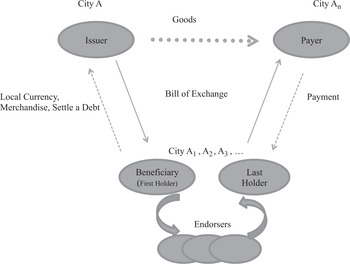
A BofEx was a document from a merchant (the issuer) to his agent abroad (the payer), commanding him to make payment in a different location on his behalf to a third party (the beneficiary) at a set date in the future.Footnote 4 A beneficiary could transfer the bill, at a discount, to another party by endorsement in exchange for currency, merchandise, or to extinguish a debt, as could anyone receiving the bill by endorsement. In contrast to the BofEx issued by banks and traded in stock markets during the nascent era of financial capitalism (Neal Reference Neal1993), these bills originating in long-distance trade in the mercantile economy were subject to both information problems and uncertainty that potentially could limit their usefulness in an expanding world of trade.
First, given the spatial separation between issuers and payers, how could issuers be sure that agents responsible for payment (their payers) would honor their bills? Payers could behave opportunistically by receiving assets from issuers but refusing payment to beneficiaries—a moral hazard problem. Without proper incentives to elicit honesty from payers, issuers would be reluctant to issue bills. While reliance on commercial contacts who were either kin or coreligionists continued through the eighteenth century, such reliance on personal networks limited the scope of trade. Second, asymmetric information between endorsers regarding the issuer's solvency and payer's reliability, would attenuate resale of any BofEx. Adverse selection would impair the circulation of bills, or restrict their circulation to local or closely bonded networks. Finally, in the absence of courts with international jurisdiction, how could holders rely on foreign courts to enforce the terms of a bill? If courts cannot enforce bills issued outside their jurisdiction, bills will only circulate within a given jurisdiction. Thus, moral hazard could prevent bills from being issued, adverse selection could hinder their circulation, and imperfect international enforcement could preclude bills from being enforced. In this article, I propose that the joint liability rule (JLR) whereby all parties to a bill were legally responsible for its contents, mitigated all three of these inherent limitations such that the costs of using BofEx were low enough to enable them to coexist with banks.
To explain how BofEx worked, I assembled a new dataset from the records of an ordinary French merchant house, Maison Roux in Marseille, spanning the decade, 1780 and 1790. The dataset includes more than 1,700 original BofEx, 350 notices of protested bills, in addition to evidence from court records, and 80,000 business letters. This rich trove of documents allows me to study to what extent patterns of actual endorsement attenuated the threat posed by moral hazard and adverse selection. I show that the JLR enabled this merchant house, located outside a major financial center, to mobilize large amounts of capital, for short- and long-term financing, across long-distances in semi-anonymous settings. I find evidence consistent with endorsement chains decreasing the payers' temptation to default, and that bills worked to broaden trade in the sense that agents used them across business networks.
This article illustrates the development of a successful financial arrangement that supplied a means of payment and credit without relying on specialized financial intermediaries or the centralization of financial services. The geographically dispersed trading supported by this legal construct—the JLR—stands in contrast to the more “modern” models premised on a centralized market for the clearing of bills either through a central bank (Amsterdam's Wisselbank) or through dominant private banks (London's acceptance market).Footnote 5 In doing so, I highlight how the JLR served the economic reality faced by the vast majority of businesses located outside the few sophisticated credit and money markets in the great hubs of Northern Europe.
In the standard tale of modernization, less developed societies rely on private-order, personal-based modes of interaction (Greif Reference Greif1989), but with time economies expand, establish impartial courts, and construct formal institutions mediating credit such as banks and stock markets (North Reference North and Weingast1989; Dixit, Reference Dixit2003). This shift was obviously not instantaneous; rather, the transition path accounts for the bulk of history and merits extended consideration. By examining the virtues and limitations of the JLR, this article casts new focus on the role of law in shaping the development of financial markets and highlights an important step in the transition from reputation, personal-based exchanges to formal, law-based institutions.
WHAT WAS THE JOINT LIABILITY RULE?
The JLR was a legal rule enacted in both common and civil law jurisdictions that specified that all endorsers, in addition to the issuer and payer, could be held liable for the full amount of the bill if the bill was not paid. Operationally, should a payer refuse to pay on the due date, a notary verified the refusal in a legal act called a “protest,” which was then distributed to previous endorsers and the issuer (Savary Reference Savary1726, p. 143). Note that the protest simply signals that the payer refused to pay the bill on the due date; a protested bill could be subsequently fully or partially paid. With the protest in hand, the holder could demand either immediate payment of the bill by drawing a re-exchange bill on any party to the bill, or she could sue in a commercial court (the jurisdiction consulaire in France, or the common law courts in England for instance) any combination of endorsers and the issuer. The endorser faced with a re-exchange bill or a lawsuit could pursue previous endorsers in his own right. An important consequence of a payer's refusal to pay was that the aggrieved holder was under a legal obligation to distribute copies of the protest to all previous endorsers and the issuer.Footnote 6
Although the origins of the JLR are uncertain, it was first formally adopted at the instigation of the merchant class in the Antwerp Estate Ordinances of 1541, and later added to the Antwerp Costuymen of 1608 (Van der Wee Reference Van der Wee1977, p. 326; de Long Reference de Long1870, p. 380, art. 14).Footnote 7 Merchants advocated for this legal change because they preferred to sacrifice finality of payment for the legal treatment of transfers as assignment. Importantly, under the JLR transfers are not final and liability attaches to endorsers. In France, the JLR dates back to the Ordonnance de Commerce of 1673, and these rules were reproduced almost without change in the Code de Commerce of 1807. In England, William v. Field (1694) established in a common law court that the last endorsee could sue any of the previous endorsers, as well as the issuer.Footnote 8 Starting on the 1660's, German cities initially hostile to endorsement and its legal consequences, gradually enacted legislation adopting the JLR: Frankfurt 1666, Breslau in 1672, Leipzig in 1682, Braunschweig [Brunswick] in 1686, Danzig in 1701, and Augsburg in 1707/1716 (De Ruysscher Reference de Ruysscher2011; Denzel Reference Denzel2010).
By the eighteenth century, the JLR was a fully developed and enforced legal construct across most of continental Europe. This means that under the period of my study, the territorial range of JLR application had expanded and affected merchants throughout Europe and beyond.Footnote 9
While historians have acknowledged the crucial role played by endorsements in facilitating the circulations of bills, and have looked at the legal underpinnings of this practice, they have tended to focus upon the transferability and negotiability of bills far more than their ability to tie merchants together in joint liability (de Roover Reference de Roover1953).Footnote 10 R.D. Richards highlights the emergence of “complete assignability” of BofEx in the English common law in the seventeenth century as making possible the practice of repeated endorsements (Richards Reference Richards1929, p. 46). King, meanwhile, claims that the legal attributes of BofEx, such as its negotiability, “explain its great commercial and financial value” (King Reference King1936, p. xvi).Footnote 11 In addition to discounting the importance of joint liability, most analyses of BofEx privileged the examination of “on the equilibrium path” behavior, meaning on “the normal course of affairs” when merchants paid their bills.Footnote 12 In contrast, an examination of court cases, legal and merchant's manuals in the seventeenth and eighteenth centuries reveals that negotiability was of little practical importance, and was hardly mentioned (Rogers Reference Rogers1995). Contemporary court records suggest that it was the credible threat of the JLR triggered by the protest that gave merchants' promises to pay credibility.
THE MAISON ROUX DATASET
In order to test the role played by JLR in mitigating problems of asymmetric information, I created a new dataset from the business records of Maison Roux, a French merchant house in Marseille. Marseille was one of the largest commercial centers in eighteenth-century France and dominated French trade in the Mediterranean, accounting for more than 35 percent of all French imports in the 1780s (Daudin Reference Daudin2005). Founded in 1728 as the successor of the Maison Bruny, Maison Roux initially specialized in the shipping and commission business of a vast array of commodities such as coffee, sugar, ivory, textiles, olive oil, soap, cod, and wine, amassing a commercial network that reached into more than 216 cities in France and 11 countries and colonies across Europe, the Levant, North Africa, French Caribbean, and South America (Carrière Reference Carrière1973, Reference Carrière1976). In 1780 alone, Maison Roux received BofEx amounting to at least 5 percent of total imports into Marseille. While a comprehensive typology of Maison Roux's operations would require careful analysis of the more than 80,000 business letters Maison Roux exchanged with an estimated 2,500 business partners, snapshots of these letters assures us that its record keeping, accounting, and business practices were comparable to the modus operandi of similar merchant houses exhaustively studied in the literature.Footnote 13 The dataset used here spans the decade 1780–1790 and includes more than 1,700 original BofEx and 350 notices of protested bills. Supporting evidence is drawn from court records, and Maison Roux's voluminous business letters collection.Footnote 14 The survival of various types of records from this merchant house—unique among such eighteenth-century collections—affords us the opportunity to reconstruct the inner workings of trade across jurisdictions and personal networks.
Merchants, such as Maison Roux, typically conducted their affairs abroad by employing an agent. A merchant abroad would send merchandise to his agent who would sell the merchandise locally. In order to recover the proceeds of the sale, and to cover the costs of export, a merchant had several options: the merchant could, often upon dispatch of the merchandise, either draw a BofEx on his own agent, on some agent's debtor, or on the agent's bank; or the merchant could get reimbursed by having the agent buy a BofEx and endorse it to the merchant. Although recognizing such a range of possibilities, several accounts in the secondary literature highlight the critical role of prominent banking houses in the Northern financial centers as payers, and suggest that a common mean of trade financing in the eighteenth century was to draw on the banker's agents (Samuelsson Reference Samuelsson1955). In exchange for a commission, these bankers provided credit by offering to small issuers the facility to draw bills on those bankers, who certified the issuers by pre-accepting his bills. In contrast, Maison Roux's letters reveal that even when Maison Roux expressed a preference for this mode of remittance (for merchants it was valuable to have credit on a prominent banking house in Amsterdam, for instance) even agents with access to such bankers often refuse to employ them due to the prohibitive commissions charged. For example, in 1731, the firm La Lande-Magon ordered 700 q. of soap from Maison Roux, which contemplated to get paid by drawing a BofEx on La Lande-Magon's bank in Paris. To avoid paying commission, La Lande-Magon asked Maison Roux to draw a BofEx on La Lande-Magon himself (Carrière Reference Carrière1973, p. 853).
Indeed, when acting as a commission agent selling merchandise for the account of an exporter, Maison Roux appears rarely to have employed a foreign banker as a payer. Instead, to recover their funds exporters either drew on Maison Roux, or had Maison Roux send them endorsed bills (Carrière Reference Carrière1973, p. 851). In 1803 Veuve Mallet from Cadix commissioned Maison Roux as her agent to sell 88 tins of salmon and, in order to recover the proceeds, Veuve Mallet drew on Maison Roux several BofEx because she had found good buyers for these bills (ACCIMP LIX-836). Having sold in 1737 a cargo of cod from the ships “le Raphael et l'Astree” for the account of its principal—Le Chevallier Baillon, de Saint-Malo—Maison Roux bought and endorsed 11 BofEx totaling 25,937 livres to return the proceeds of the sale (ACCIMP LIX 580).
Given the diversity of its operations, Maison Roux could occupy potentially one of four positions in a BofEx as depicted in Figure 1: issuer, endorser, final holder, and payer. Bills issued or endorsed by Maison Roux traveled beyond the house to points unknown. In my dataset, I observe the complete cycle only when Maison Roux was the final holder or the payer.
THE BILL OF EXCHANGE AND THE FLOW OF CREDIT, SPECIE, AND MERCHANDISE

For the period 1780–1788, my dataset contains all existing bills. I randomly sampled 30 percent of the paid bills in 1789 and 1790, since, in these two years of the French Revolution, the quantity of paid bills was four times larger than the average between 1780–1788. Although there are no surviving accounting books to establish whether the fluctuations in the number of bills track real business activity, the partnership agreement (compte de bilan) drafted in 1791 describing the balance sheet bills and the trimestral bills portfolio, suggests that, if this snapshot is representative of the preceding two years, attrition in the bills' sample for 1789 and 1790 is probably negligible.Footnote 15 Further, historical evidence bears that Maison Roux's business activity during these two years did not deviate significantly from the preceding years.Footnote 16 Maison Roux' business letters also suggest continuity over this ten years span and hint at no evidence of reorientation in business activity or events that could introduce any break in bills volume pre-1789. The reduced number of bills during 1780–1788 compared to 1789–1790 is therefore probably rather a result of an under-preservation of pre-1788 bills. To examine survivorship bias, I test whether there are any differences in bills' characteristics pre- and post-1789. The t-tests for means do not reject the hypothesis that the characteristics of 1789 and 1790 bills including value, term, and number of endorsements do not differ from the characteristics of bills in most of the years between 1780–1788.Footnote 17
For each bill, I assembled name and location of issuer, payer and endorsers, dates of endorsements, face value, term (days between the date of issue and date of redemption), and motive (the stated purpose of the transaction such as exchange of merchandise, value in cash, or credit in account). Unfortunately the bills rarely contained transaction prices despite a legal obligation to indicate the amount received every time the bill changed hands (Ordonnance de Commerce Reference Diamond1673, Titre V).
The data on protests for non-payment on the due date are extracted from the Fonds des Notaires, kept at the Archives Départementales des Bouches-du-Rhône (ADBdR). In case of a refusal to pay on the due date, the final holder would file a note (termed “protest”) with a notary, verifying the payer's refusal.Footnote 18 As Maison Roux correspondence frequently illustrates, once the protest was drafted, the final holder could sue or collect from any previous endorsers (ACCIMP, LIX 60).Footnote 19 The protest contained the entire content of the protested bill along with the reason given by the payer for delinquency. As the protest had to be drafted in the payer's location, and the protest was generally identified only by the surname of the last holder, I could collect information on protests only for the subset of bills payable in Marseille whose final holder was Maison Roux. In the subsequent empirical analysis I use the full sample and a restricted sample for which information on protest was available.
The catalogue of the ADBdR reports the existence of 27 études notariales (notary offices) in Marseille. As Maison Roux switched notaries over the years, and sometimes dealt with more than one notary during the same year, I examine the 25 études notariales available for protest records filed by Maison Roux.Footnote 20 Attrition in the protested bills sample is unlikely to be a concern because notaries were legally obliged to keep copies of these documents.Footnote 21 The aggrieved holder was legally required to file a protest and notify the issuer and previous endorsers of the protest, as failure to do so could discharge previous endorsers of their responsibilities as warrantors (Ordonnance de Commerce Reference Diamond1673, Titre V, art. 15). Furthermore, protest fees were minor both in absolute and relative terms: equivalent to one-half a day of wages for an unskilled worker in France or 0.01 percent of the average value of a bill in my Maison Roux sample.Footnote 22
TRADING WITH BOFEX UNDER THE JLR— THE EVIDENCE FROM MAISON ROUX
Two monumental investigations by de Roover (Reference de Roover1999) and Melis (Reference Melis1962) dissecting the inner workings of BofEx and their technicalities focus on the late Middle Ages when the JLR was not yet a regular feature of bills. Relying on the careful examination of merchant correspondences, pass books and wills, that contain only fragmentary information about bills but not the bills themselves, studies have focused on the dynamics of trading BofEx and acceptance bankers in the great financial hubs of Northern Europe (Samuelsson Reference Samuelsson1955; Denzel Reference Denzel2010).Footnote 23 In focusing primarily on London and Amsterdam as clearinghouses for BofEx, this earlier literature fails to appreciate the importance of the JLR for the scores of other commercial centers (Chapman, Reference Chapman2006; Neal, Reference Neal1993).
The views about BofEx commonly circulated in the literature suggest that bills had small denomination,Footnote 24 short maturity,Footnote 25 many endorsements,Footnote 26 and served mostly as counterpart in a sales contract.Footnote 27 In the rare instances any attention is given to the behavioral effects of the JLR, scholars speculate that, owing to this legal innovation, potential buyers had an incentive to scrutinize the creditworthiness of all previous endorsers, and that the probability of payment correlated positively with the number of endorsements.Footnote 28
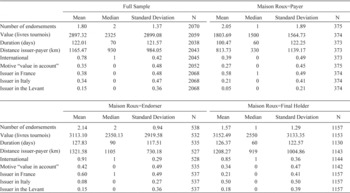
Table 1 displays the key features of the BofEx used by Maison Roux. BofEx were not issued for small amounts. The average value of a BofEx (2,897.32 livres) falls between the average yearly income of nobles and members of the clergy and that of a typical member of the bourgeois class. It would take an unskilled worker nearly 10 years to earn this much.Footnote 29 These values are large even compared to data on notarial loans which were long-term loans probably reflecting life-cycle motives. The BofEx average value represented almost one-fifth of the average Parisian notary loan in 1780 (15,941 livres), or three-quarters of the average notarial loan in other big cities in France (3,819 livres) (Hoffman, Postel-Vinay, and Rosenthal 1992). Although not recorded systematically on the protest, the reported payers', issuers', and endorsers' professions suggest that these bills served mostly the merchant class. In my sample, the nobility accounted for less than 1 percent of Maison Roux's bills, in contrast to about 64 percent of all borrowers and 40 percent of lenders found in notarial loans (Hoffman, Postel-Vinay, and Rosenthal 1992, p. 299).
BILLS OF EXCHANGE CHARACTERISTICS

Sources:
Archives de la Chambre de Commerce et Industrie Marseille Provence. Archives Départementales des Bouches-du-Rhône.
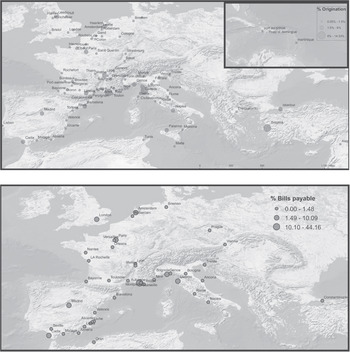
The geographic distribution of issuers and payers demonstrates that the BofEx supported long-distance transactions. As described in Table 1 and depicted in Figure 2, the bills in the Maison Roux dataset originated in 128 different cities, passed through 136 different cities in Europe, and were settled in 56 different destination cities. Importantly, they were not settled predominantly in the two major financial centers at the time, London and Amsterdam. The issuer and the payer were, on average, more than a thousand kilometers apart and sometimes further in the case of bills originated in the Caribbean and redeemed in Europe.
PROPORTION OF BILLS ORIGINATED AND SETTLED IN VARIOUS PLACES (1780–1790)

Bills had an average maturity of four months, but more than 20 percent had a maturity of a year or more, showing that bills could also support long-term finance. A substantial fraction of bills reached Marseille with a few days remaining before the due date, so maturity did not bind circulation. Given that duration could be fairly long, it might seem surprising that bills on average bore only two endorsements. However, the number of endorsements is not only a function of duration but also of cost, as at every endorsement a discount is charged, and merchants would avoid selling a bill unless their position required them to do so.
Bills of exchange did face uncertainty of payment. An estimated 20 percent and 44 percent of the bills held by Maison Roux and payable in Marseille were protested in 1789 and 1790, respectively.Footnote 30 The total yearly value of protested bills averaged about 50,000 livres between 1780–1785, 90,000 livres between 1786–1788, and reached a peak in 1789 with 181,596 livres. In absolute terms, the total value of protested bills could represent a sizable fraction of Maison Roux' capital, estimated at 250,000 livres.Footnote 31 Although I have no direct individual evidence of what fraction of those protested bills were eventually paid or renegotiated, extant copies of court cases preserved in the Fonds Roux and the minutes of the local merchant court, Jurisdiction Consulaire, reveal that Maison Roux rarely resorted to the merchant courts to solve disputes over bills.
ASYMMETRIC INFORMATION AND THE JOINT LIABILITY RULE
Adverse Selection
A single bill that can be transferred and perform multiple transactions across different people has important advantages over non-transferable claims. Apart from decreasing the need to ship hard currency, transferability generates efficiency gains through elimination of weak links in the credit chain and the provision of information about previous trades in the economy (Kahn and Roberds, Reference Kahn and Roberds2007). The circulation of debt may have ramifications for the patterns of trade as well. When trade is bilateral, as long as the balance of trade is equilibrated between two countries, debts and credits can simply be canceled out. Multilateral trade implies that credit and debts may not be in the same place, and that credit in one place may not be available to pay the debt in some other place. Therefore, if bills do not circulate, merchants paying others abroad would need to have trade balances in that same location abroad. Alternatively, merchants could coordinate to settle balances in a clearing center, such as Amsterdam or London. However, small merchants may not have the financial resources to keep agents in Amsterdam or London.
Though beneficial, transferable bills face the threat of adverse selection. Analogous to a market for lemons story, when quality is not verifiable, sellers have ceteris paribus an incentive to pass on the notes of riskier debtors since “good” and “bad” bills with similar observable characteristics (to buyers) command equal market prices. A seller who observed that the issuer's situation deteriorated may selectively choose to sell this bill instead of one about which he has received no bad information. The long-distance setting potentially exacerbated the adverse selection problem. As numerous business letters of Maison Roux suggest, buyers “placed” their orders with sellers at a distance based on a few dimensions: value, duration, and place of payment (ACCIMP, LIX 579). Unlike bills traded in existing public exchanges and stock markets, endorsement in the long-distance trade context was rarely a face-to-face transaction and characteristics potentially correlated with “quality,” such as the number of endorsements, the identities of the signatories and dates of endorsement may have been observed by buyers only post-trade.
Two predictions follow from the presence of adverse selection. First, if adverse selection is severe the market for bills may unravel and bills will only circulate locally or in closely bounded networks where information is common knowledge. Second, if adverse selection exists but is not so severe that a market from bills ceases to exist, low-quality claims are expected to be traded more often, a result analogous to Gresham's law. Guarantees and brand names can arise, however, to counteract the destructive effects of adverse selection. Circulation of private debt can then expand outside closely-knit networks if those issuing and paying bills are perfectly monitored and can credibly commit to payment through the building of reputation (Kiyotaki and Moore Reference Kiyotaki and Moore2003; Gorton Reference Gorton1996). Eighteenth-century England enjoyed a centralized market for BofEx in London and early banking houses specializing in the acceptance of BofEx; once a reputable firm had pre-accepted a bill, it could freely circulate.
In the absence of such a centralized market, buyers' and sellers' incentives could be aligned under the JLR. Due to the JLR, those selling bills had “skin in the game” and were committed legally to reimburse the face value of a defaulted bill, in addition to paying legal and transaction costs incurred in recovering payment. As a consequence, sellers were discouraged from trading on private information. Besides, the JLR provides the seller a commitment mechanism to credibly communicate to potential buyers he is selling a good bill. Yet, even under JLR adverse selection may persist in equilibrium if enforcement of the JLR is not perfect.
Based on the geographic spread of origination and settlement locations for BofEx, mapped in Figure 2, it is clear that adverse selection was not so severe that a market for bills did not exist. Maison Roux's records suggest that the market for bills was not only of global dimensions but it was also quasi-anonymous. The archival collection of the Maison Roux's papers contains roughly 80,000 business letters exchanged by the Maison with its commercial contacts from 1728–1840. Based on Maison Roux's incoming letters, I identify the names of over 2,500 merchants who were in a business relationship with Maison Roux and construct Maison Roux's business network. By comparing the names in this “address book” with the signatures of issuers, payers, and endorsers on the bills, I am able to check whether Maison Roux was taking or passing bills to parties in previous contact with the house. I assume that the existence of a letter between Maison Roux and an individual indicates that they were in a business relationship. With few exceptions, no issuers, endorsers, or payers in my sample were listed on contemporary directories of most prominent local bankers and merchant houses in Europe (Gournay 1788).
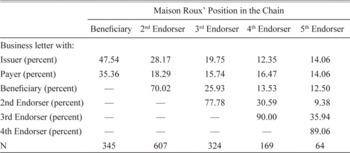
Table 2 describes where Maison Roux lay in the endorsement chain in comparison to its business contacts. While Maison Roux rarely knew all the payers, issuers, or endorsers along in the chain, it was almost always in contact with the previous endorser (the one who sold the BofEx) and the ones to whom it passed bills. For instance, when Maison Roux was the fourth buyer or endorser, in 77 percent of the bills I find no business letter between Maison Roux and the issuer or the payer. Maison Roux was in contact with the beneficiary in 13.5 percent of the bills, with the second endorser in 30.6 percent of the bills, and with the third endorser in 90 percent of the bills. In fact in more than 60 percent of the bills bought by Maison Roux, neither the issuer nor the payer had been in direct contact with the merchant house.Footnote 32 This pattern confirms that under the JLR the expected risk of buying a bill likely depended on the buyer's knowledge of the solvency of the previous person on the endorsement chain and not necessarily on knowledge about the probability of default of the issuer or the payer, who could be unknown and far away. The JLR allowed Maison Roux to hold a diversified portfolio since payers and issuers were drawn from a large pool outside of Maison Roux's network.
MAISON ROUX'S RELATIONSHIP WITH ENDORSERS, PAYERS, AND ISSUERS

Notes:
Except for bills in which Maison Roux acted as the payer, full sample used for analysis. The columns depict the position occupied by Maison Roux. N refers to the total number of bills falling into each category. The rows list the signatories of the bill. For each position occupied by Maison Roux the table displays the percentage of cases for every signatory in which a business letter between the signatory and Maison Roux was found. For instance, Maison Roux was in the 5th position in 64 bills; of those Maison Roux exchanged business letters with almost 90 percent of the 4th signatories, but only in 36 percent of the bills a business letter between Maison Roux and the third signatory existed.
Source:
See Table 1.
I know of no other collection of BofEx in France similar to that of Maison Roux surviving from the period before the JLR. There is, however, a small collection of 150 BofEx traded by a more modest merchant house in Grenoble, Maison Perrin et Chabert, from the period just before the JLR was introduced in France (1669–1674). These reveal a marked difference in the bills' characteristics and their use (Archives Départementales de l'Isère, II E 626–628). These bills were mostly to be paid at sight and in small amounts, they circulated within a limited geographical area, and they bore no endorsements.Footnote 33 Maison Roux's BofEx, by contrast, circulated widely, for large amounts and were endorsed several times. While I am unable definitively to attribute this result to the advent of the JLR, BofEx may not have been as well suited, before the JLR, to support the expansion of trade as previous scholars have thought.
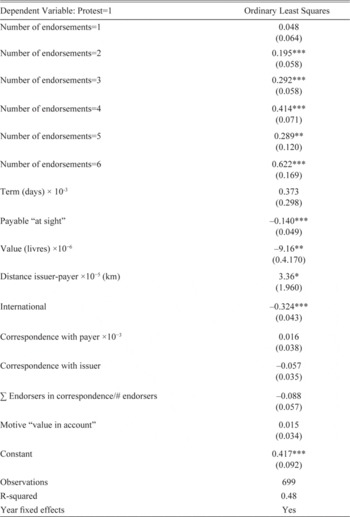
Adverse selection may not have prevented a large and semi-anonymous market from taking shape, but we can ask whether the JLR entirely eliminated the threat of adverse selection. Conditional on observable characteristics, the standard tests for the presence of adverse selection compare either the quality between traded with the quality of continuously held goods or they compare the price of the adversely selected goods with the non-adversely selected goods, assuming that some categories of sellers are more likely to adversely select on to the market. Following Bond (Reference Bond1982), I test in my sample of paid and protested bills payable in Marseille whether low quality claims were traded more often using the following model:

where N i,s is a dummy variable equal to 1 if number of endorsements of bill i is equal to s and zero otherwise; x i,j are k controls for the bill's characteristics.
The adverse selection argument predicts that β s > 0 and is increasing in s. The dependent variable Default i is binary, and I use protest (Default i = 1) as a proxy for default. Note that a protest does not perfectly correspond to a default as discussed below. I allow for non-linear effects of endorsement by including dummy variables for the number of endorsements. The omitted category is zero endorsements; those bills were not endorsed and therefore the JLR did not apply. The controls x i,j include the following: Term indicates the length in days between issuance and the due date; Payable at sight indicates that the holder could decide to present the bill for payment at any time up to a year; Value Footnote 34 ; Distance is the distance in kilometers between the issuer and the payer; International is a dummy which takes a value of 1 if the issuer and the payer were located in different countries; Correspondence with Payer is a dummy for existence of a business letter between Maison Roux and the payer; Correspondence with Issuer is a dummy for existence of a business letter between Maison Roux and the issuer; ∑ Endorsers in Correspondence/# Endorsers is the sum of previous endorsers in correspondence with Maison Roux, normalized by the total number of endorsements; Motive “value in account” indicates whether the bill was issued to settle a debt as opposed to serve as a means of payment for merchandise or local currency. Year and place of origination fixed effects were included to account for common year shocks and shocks in the issuers' location. The results in Table 3 suggest a typical adverse selection story: low-quality claims circulated more on average. As expected, the payer's likelihood of delinquency increases with the distance between issuer and payer, and the existence of a business letter between Maison Roux and the payer or the issuer before the bill was issued is negatively correlated with the probability of default but the coefficients are not significant. Paradoxically, bills of greater value, as well as, if issuers and payers were in different countries are associated with lower payer's willingness to default. While suggestive, these results cannot be interpreted as causal because bills' characteristics are endogenous.
ADVERSE SELECTION AND BILLS OF EXCHANGE

Standard errors in (). ∗∗∗ p<0.01, ∗∗ p<0.05, ∗ p<0.1.
Notes:
Paid bills in Marseille and protests samples used for analysis.
Source:
See Table 1.
Moral Hazard in Agency
The commission agent model arose as a response to the high transaction costs of engaging in arm length dealings, given the slow communication and transportation technology in the early modern period. Agency, however, is not free. Issuers had to deal with clearing risks, that is, payers refusing to pay their bills. Payers, in turn, had to deal with the risk of “over-issuance,” meaning that issuers may misrepresent to potential lenders the amount payers owe them. I now focus on the commitment problem of payers.Footnote 35 To illustrate, assume that an Issuer ships some goods to the Payer (as shown in Figure 1) and chooses between issuing a BofEx of high value (VH) or low value (VL) over to the Payer. The Issuer then discounts the bill and receives the face value minus a discount rate, d. The Payer sells the Issuer's goods for X, and chooses whether to default on the bill and embezzle the proceeds, or to pay the bill and keep the difference between the value issued by the Issuer and the value collected from the merchandise sale. If the Payer decides to default, the Issuer is obliged to reimburse the face value in addition to transaction costs. In a one-shot interaction, the Issuer and the Payer will not be able to cooperate. In the Nash equilibrium in this one-time interaction setup, the Issuer will always choose to over-issue and the payer will always choose to default.
Credible commitment can be achieved through repeated interactions, however, given the large amounts at stake on these bills, the surplus from the relationship (continuation value) between issuers and payers has to be sufficiently large, and payers must be extremely patient to ensure cooperation. Even if these conditions were met, issuers and payers would have to “communicate” this commitment to future buyers of bills. If payers and issuers were not linked in any obvious way, such as through a legal partnership, family or religious ties, how could the external world infer that the issuer was in fact entitled to draw on the payer? In medieval times, well-known banking houses mitigated the principal agent problem by cementing their relationships with payers in their branches abroad through family and religious ties. Alternatively, as in eighteenth century London and Amsterdam, reputable bankers with almost perfectly observable trading histories functioned as payers. Additionally, the moral hazard was circumscribed by the relatively close proximities of the different parties to a bill. Even between London and Amsterdam it took only a few days for information to pass from one city to the other, and the frequency of communications ensured up-to-date knowledge. In the absence of those conditions, the JLR put in place a commitment mechanism for payers and issuers which relied on two related channels: monitoring and reputation.
First, the JLR induced endorsers to participate in the enforcement of agency relationships, as the possibility of being held liable encouraged endorsers to monitor the payer (agent). Monitoring in this context meant that endorsers had an incentive to collect and spread information about payer's behavior, and could even take remedial action against a payer whose risky behavior threatened non-payment on the due date. If monitoring reduced the private benefit that the agent enjoyed from misbehaving (Holmstrom and Tirole Reference Holmstrom and Tirole1997), then payers' incentives to cheat, by refusing to accept a bill for no valid reason, were mitigated if the probability of being caught cheating increased due to monitoring. The intuition behind monitoring is that, for any given issuer, payers who are less monitored by endorsers may be more tempted to embezzle their principals' money. Therefore, an increase in the number of endorsers should increase monitoring and thereby reduce the chance of a default. Court decisions, business letters, and scholarly legal doctrine expressed through commentaries on legal codes recommended endorsers should monitor payers, though they did not require it.Footnote 36 Several letters between Maison Roux and its business partners show the merchant house's fears that certain payers were on the verge of defaulting and therefore the issuer should be advised to provide the payment by himself or through a third party.Footnote 37
Monitoring may not be observable but if physical distances map into ability or cost of monitoring, then we should expect endorsers to be closer to their monitored payers in the bills which were paid compared to the protested ones. Although some of the distances individually are statistically different in the two groups, the distances between these two groups are jointly statistically different only at a p-value of 0.146 using the Bonferroni correction. If monitoring is the channel through which endorsers influenced payer behavior, then the physical distances are only weakly capturing it.
The JLR created additional reputation concerns for the payer. An important feature of the JLR was that copies of the protest were distributed to endorsers and to the issuer. Through the spread of negative information in the protest, a payer who refused to pay a bill on the due date could lose his reputation vis-à-vis the endorsers, and potentially harm the likelihood of future exchange with other issuers in locations where the endorsers of protested bills were located.Footnote 38 In other words, the JLR introduced an additional term in the payers' equation—continuation value with endorsers—that made the incentive compatibility constraint easier to be met. As endorsers cared and had the information necessary, through the protest, to punish a dishonest payer in subsequent interactions or refuse to deal with him, the greater the number of endorsers and the variety of locations they were in, the greater the potential damage to the payer's reputation.
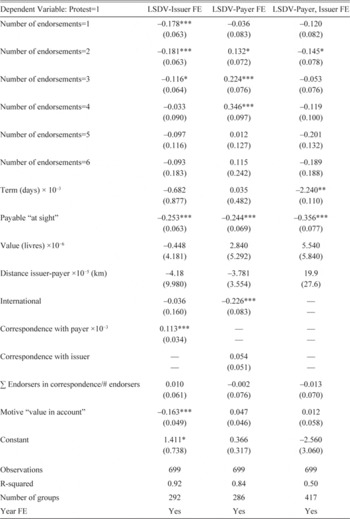
The results in the previous section suggest that there is a positive relationship between the number of endorsements and the probability of default. In contrast, the moral hazard hypothesis implies that, given a certain issuer, more endorsers should decrease the probability of non-payment on the due date. The basic challenge is that the number of endorsements is endogenous, and possibly related to an omitted variable: the bill's initial quality given by the issuer. In order to isolate the effect of the initial quality of the bill on the payer's decision to default, I re-estimate the adverse selection model to include issuer fixed effects. The basic assumption is that once the initial quality is controlled for, the number of endorsements is exogenous, and therefore we can isolate the effect of the number of endorsements in the payer's decision to honor or protest the bill. It is possible that issuers' quality changed over years. Due to small sample size, I cannot include year*issuer fixed effects, but whenever the partnership changed I considered different issuers, for instance, Rolland ainé fils and Rolland fréres were considered different issuers.
The results in Table 4 show that with the inclusion of issuers' individual fixed effects the sign of the endorsement dummies switches: after controlling for the bills' characteristics, given two bills issued by the same issuer, an additional endorsement decreases the probability the payer will refuse to pay on the due date.Footnote 39 Although the coefficients are positive and are statistically significant, they do not increase monotonically as theory would predict. A plausible explanation for the small magnitude of the coefficients associated with higher number of endorsements could be attributed to a countervailing effect. As monitoring delivers a public good, it may induce free-riding. If the cost of monitoring is assumed to be convex, this implies diseconomies of scale in monitoring. While the multiple monitoring benefited from diseconomies of scale in monitoring, it suffered from duplication of effort and sharing of monitoring benefits. As chains of endorsements lengthened, each endorser's marginal contribution to monitoring could decline.
MORAL HAZARD AMONG ISSUERS AND PAYERS

Standard errors in (). ∗∗∗ p<0.01, ∗∗ p<0.05, ∗ p<0.1
Notes:
Paid bills in Marseille and protests samples used for analysis. Number of groups refers to the number of unique issuers.
Source:
See Table 1.
Alternatively, the effectiveness of monitoring might depend on payers' reputations. I have so far assumed that reputation (“long-lived information about an agent's type”) does not vary over payers but that might not be the case. If there is heterogeneity on payers' reputations such that those with weak reputation lose little by defaulting or by being caught cheating when monitored, then neither monitoring nor reputation provide incentives for honest behavior. Monitoring may, in turn, be unnecessary for those payers who can lose a lot in future opportunities if information about them defaulting is revealed (Diamond Reference Diamond1991).
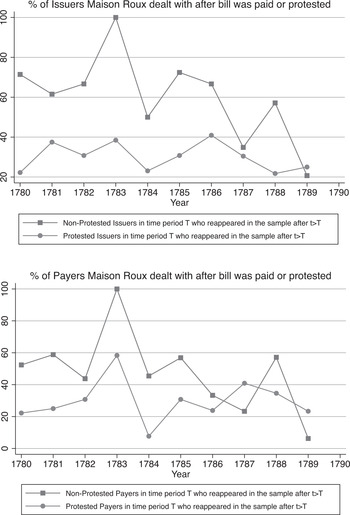
I now examine whether a protest had any consequences for the pattern of Maison Roux' subsequent interactions with the parties involved in the protest. If the protest was just trade friction, we should not observe any change in the trade pattern pre and post protest. Did protested parties reappear in the sample after a protest event? Were all the involved parties in the bill punished for the non-payment or only the “responsible” parties as claimed in the protest? A simple strategy to tackle these questions would be to implement a difference-in-differences technique comparing the difference in the frequency of appearance in the sample before and after a default (protest) in year T, with the difference in the frequency of appearance in the sample before and after for those who had not defaulted (were not protested) in year T. Unfortunately, because the sample size drops drastically when I consider year-by-year changes this empirical strategy is not viable. Figure 3 suggests, however, that Maison Roux's probability of dealing with a certain issuer or payer after a “paid” event is different than after a “protest” event. Maison Roux' probabilities of dealing in the future with an issuer and a payer of a protested bill fell by 54 percent and 32 percent respectively after a “protest” event.Footnote 40 As I cannot account for exits or death, these results should be interpreted as an upper bound.Footnote 41 If the protest was due to insolvency and the issuer or payer was forced out of the market, Maison Roux's probability of dealing with them would be zero regardless of punishment.
PUNISHMENT AND REPEATED INTERACTIONS: PROTEST AND PROBABILITY OF FUTURE DEALINGS WITH MAISON ROUX

The most common reasons given for the lack of payment on the due date are associated with issuers' lack of funds or “avis,” payers' absence, lack of liquidity, or bankruptcy.Footnote 42 Surprisingly, payers did not always blame issuers for the protest. On the contrary, in almost 60 percent of the bills the justifications for non-payment are associated with payers' admission of fault. Nonetheless, issuers who were blamed by their payers had a lower probability of dealing in the future with Maison Roux than issuers whose protested payers blamed themselves. Payers who blamed issuers (38 percent) appeared in the sample with the same probability as payers who paid (39 percent).Footnote 43 Thus a protest, per se, was not taken as unequivocal evidence of moral hazard. The results overall suggest, however, that the protest provided a reliable signal of issuers' and the payers' fault for non-payment on the due date, as merchants, such as Maison Roux, decided to deal with issuers and payers in the future depending on the occurrence of a protest.
CONCLUDING REMARKS
Based on new archival evidence, this article investigates the role played by the law in setting a foundation for the remarkable expansion of trade during the early modern period. This article considers the legal change that transformed the bill of exchange into a fully-fledge financial instrument. The JLR put in place a formal mechanism that linked otherwise distinct personal networks so that trade could expand beyond the limits any single network could support. Drawing on modern agency theory I explain how this institution ameliorated problems of information asymmetry. Using a unique dataset, I explore whether trading patterns with BofEx are consistent with what standard moral hazard and adverse selection theories would predict. My findings uncover transactions supported by BofEx that were of large denominations, long duration, quasi-impersonal, and carried out across great distances making them capable of supporting long-term credit for international trade finance.
Since I focus on the mechanics of this institution and its economic rationale, of necessity I slight the larger historical context. A more thorough study, one far too big for this article, would attempt to trace the evolution of the JLR, from its origins through the political economy behind its enactment and how international commerce brought about the spread of this rule, to its final demise with the rise of international banking. Future research may also illuminate the JLR's implications for the geography of trade and the organization of commercial networks in the early modern period.