Article II of the Constitution empowers the president to nominate federal judges. Extensive scholarship demonstrates that when utilizing the nomination power, presidents attempt to select nominees whose legal policy preferences mirror their own (Rowland and Carp Reference Rowland and Carp1996; Songer, Sheehan, and Haire Reference Songer, Sheehan and Haire2000; Nemacheck Reference Nemacheck2007). However, Article II conditions this power by requiring the Senate to provide “advice and consent” on all judicial nominations. Presidents are therefore constrained in their selections by the need to have their judicial nominees confirmed by the Senate (for the history of conflict in the judicial appointment process, see Binder and Maltzman [Reference Binder and Maltzman2009, 15–58]).
Presidents regularly promote judges from the lower federal judiciary to fill appellate court vacancies. Of the 60 Supreme Court justices confirmed since the creation of the US courts of appeals in 1891, 25 (41.7%) previously served as a court of appeals judge, including 10 of the last 11.Footnote 1 A similar pattern emerges in the courts of appeals; Savchak et al. (Reference Savchak, Hansford, Songer, Manning and Carp2006, 479) estimate that 43.5% of court of appeals judges serving between 1946 and 1995 had been promoted from a federal district court. The frequency with which vacancies are filled through promotion likely reflects the usefulness of a promotion strategy for selecting judges who will both advance the legal policy goals of the president and be successfully confirmed by the Senate (479–80). In terms of policy goals, promoting judges may increase the likelihood of presidents successfully identifying nominees who share their legal policy preferences by reducing the uncertainty inherent in all nominations. The established judicial records of active judges provide information to presidents that is unavailable for candidates without judicial experience. In terms of confirmation, promoted judges may also be more likely to be confirmed (Savchak et al. Reference Savchak, Hansford, Songer, Manning and Carp2006; Binder and Maltzman Reference Binder and Maltzman2009). Judges who have previously navigated the confirmation process successfully may be more likely to successfully complete the process again.
The extensive use of promotion in the judicial selection process raises the question of what effect, if any, promotion has on judicial behavior in the federal judiciary. The availability of promotion as a selection strategy stems from the hierarchical nature of the federal judicial system. Scholars have devoted substantial attention to the effects of this hierarchy on judicial behavior (Songer, Segal, and Cameron Reference Songer, Segal and Cameron1994; Cameron, Segal, and Songer Reference Cameron, Segal and Songer2000; Scott Reference Scott2006; Zorn and Bowie Reference Zorn and Barnes Bowie2010; Kastellec Reference Kastellec2011a; Lax Reference Lax2012). I expand on this literature by examining how the federal judicial hierarchy fosters the development of social identities in federal judges on the basis of their court membership. Social psychologists have demonstrated that individuals’ decisions are shaped by self-concepts and that these self-concepts are defined largely in relation to others. The potential effects of group identity on individual behavior have been articulated most clearly through the lens of social identity theory (for early developments, see Tajfel [Reference Tajfel1978]). Scholars of judicial politics have recently recognized the value of psychological principles associated with social identity theory for understanding judicial behavior (Baum Reference Baum2006; Braman Reference Braman2012; Black et al. Reference Black, Owens, Wedeking and Wohlfarth2016).
Promotion is likely to affect judicial behavior because the experience of being promoted may activate psychological pressures associated with social identity. All federal judges are likely to develop identities shaped in part by their membership on the court to which they were appointed. Unlike most judges, promoted judges come to a new appointment with a previously established professional identity. Promoted judges are thus forced to consider competing identities upon confirmation to a new position. This has the potential to shape the decisions of promoted judges, suggesting that promotion will affect the development of legal policy in the lower federal judiciary.
The article proceeds as follows. I begin by discussing social identity theory and defining several mechanisms through which social identity influences individual behavior. I then discuss the application of social identity theory to the judicial politics literature by identifying two mechanisms that are likely to be particularly salient with respect to promotion: in-group bias and esteem seeking. Both of these mechanisms suggest that promoted judges will be less likely to vote to reverse district court judges. To test this effect, I compare the decisions of promoted and nonpromoted judges to vote to reverse district court judges from 1946 to 1996. The results suggest that promotion substantially affects decision making in the lower federal judiciary. Promoted judges are more likely to affirm district court judges, but this effect fades as judges redefine their social identities. The results also demonstrate that promoted judges treat appeals from their former colleagues more favorably. I argue that social identity best explains these patterns and not alternative accounts of judicial behavior. In conclusion, I discuss the importance of considering the effects of promotion on decision making in the courts of appeals and of recognizing the influence of social identity on judicial behavior.
The Utility of Social Identity for Understanding Judicial Behavior
Over 40% of court of appeals judges experience promotion from the federal district courts. I theorize that this experience independently affects the decision-making behavior of promoted judges by activating psychological processes consistent with social identity theory. Below, I outline the fundamental principles of social identity theory and explain how group identity affects individual behavior. I then turn to a discussion of the application of social identity theory to the study of judicial behavior.
Social Identity and Individual Behavior
Social psychologists have devoted substantial attention to the notion of the self and how self-concepts affect behavior (Baumeister Reference Baumeister, Gilbert, Fiske and Lindzey1998). This approach is useful because of the well-demonstrated desire of all individuals to build and maintain a positive evaluation of their self-concept (Becker Reference Becker1968, 328), frequently described in terms of self-esteem. Individuals can build positive self-esteem by relying on a variety of sources, but group identities are thought to be particularly important (Hoyle et al. Reference Hoyle, Kernis, Leary and Baldwin1999, 31). Scholars investigating the effect of group identity on the self-concept have done so primarily through social identity theory (Tajfel Reference Tajfel1978). Social identity theorists suggest that individuals can enhance their self-esteem through group identification and membership. Because self-concepts are partly a function of group membership, when individuals form positive evaluations of their groups, they simultaneously heighten their own sense of personal self-esteem. From this perspective, groups play an important role in determining how individuals view their own self-concepts.
The desire for positive self-esteem not only is an inherent goal that, all else being equal, individuals would prefer to see realized but acts as an operable goal that motivates their behavior. While social identity theorists have identified a variety of behavioral manifestations of this influence (for an overview of the social identity literature, see Brown [Reference Brown2000]), two warrant heightened attention.
The most prominent behavioral manifestation of social identity theory is in-group bias. When individuals operate in an environment in which they can be identified as belonging to a group, they become prone to believe that their own group (“in-group”) is superior to others (“out-groups”). This act of distinctiveness most commonly results in positively biased in-group evaluations rather than negatively biased out-group evaluations. As Brewer (Reference Brewer1999, 441–42) argues, “many discriminatory perceptions and behaviors are motivated primarily by the desire to promote and maintain positive relationships within the ingroup rather than by any direct antagonism toward outgroups.” However, this bias still causes individuals to discriminate against out-group members, even when rationales for doing so are minimal or nonexistent (Tajfel et al. Reference Tajfel, Billig, Bundy and Flament1971). Therefore, social identity theorists generally expect individuals to treat other in-group members more favorably than non–group members, even when the ties that bind the group together are nominal.
Individuals can also maintain a positive sense of self by capturing the esteem of salient individuals or groups. The esteem of others may be important for several reasons (for discussion, see Baumeister [Reference Baumeister1982]). First, individuals may seek the esteem of specific groups in an effort to receive concrete benefits. In this case, the esteem of a specific individual serves as a means to a preexisting end. While this motivation could develop as a result of group membership, esteem as an instrumental goal does not independently affect how individuals view themselves. The desire to earn the esteem of others for its intrinsic value is more clearly associated with such evaluations. A wealth of social psychology research demonstrates the connection between the value others place on individuals and how individuals value themselves (see, e.g., Leary et al. Reference Leary, Haupt, Strausser and Chokel1998). This connection is strengthened as the relationship between the individual and the appraiser grows closer; the opinions of salient individuals or groups affect individual self-evaluation more heavily. Regardless of whether an individual seeks the esteem of others for instrumental or intrinsic reasons, social identity theory suggests that individuals will take actions designed to earn that esteem. The nature and scope of those actions depend on both the relevant group from whom individuals are seeking esteem and the environment in which those individuals are operating.
Social Identity and Judicial Behavior
Psychology has played a central role in the development of the field of judicial politics (for an overview, see Collins [Reference Collins2012]). Subsequent to the development of the attitudinal model (Segal and Spaeth Reference Segal and Spaeth1993, Reference Segal and Spaeth2002), scholarly interest in psychology as a tool for understanding judicial behavior waned, particularly as interest in strategic approaches grounded in the rationale choice paradigm grew (Collins Reference Collins2012, 8). While the value of these contributions to the judicial politics literature is beyond debate, many questions concerning judicial behavior do not lend themselves to strategic approaches. The emergence of these questions has led to revitalization of scholarly interest in the psychology of judicial behavior (Wrightsman Reference Wrightsman1999; Klein and Mitchell Reference Klein and Mitchell2010). Some researchers have returned to and updated themes addressed by early judicial politics scholarship (e.g., see a discussion of small-group behavior in Collins and Martinek [Reference Collins and Martinek2011]). Others have focused on questions largely unexplored by earlier scholarship, including the role of cognition (Tetlock, Bernzweigh, and Gallant Reference Tetlock, Bernzweigh and Gallant1985; Baum Reference Baum2006) and emotion (Black et al. Reference Black, Treul, Johnson and Goldman2011) in the judicial decision-making process. Despite this renewed interest, many recent advancements in the field of psychology have received only passing attention in the study of judicial behavior. Social identity theory serves as one such example of this phenomenon. Despite its centrality to the study of social psychology, judicial politics scholars have only recently begun to recognize its value for understanding the behavior of judges.
Baum (Reference Baum2006) is the first to systematically assess the role of social identity in the study of judicial behavior by examining judges’ choices as forms of self-presentation. Further theoretical treatments and empirical tests of social identity on judicial behavior are nascent in their development. For example, Black et al. (Reference Black, Owens, Wedeking and Wohlfarth2016) have only recently elaborated on its importance at the Supreme Court by assessing the extent to which judges craft opinions by anticipating the responses of salient audiences. While these contributions have substantially advanced the literature on this subject of social identity, important questions remain unaddressed. First, the primary (although not exclusive) focus of these analyses is on the US Supreme Court. This choice is sensible given the disproportionate impact of the Supreme Court on the legal and political system, but it leads to questions of whether these motivations or behaviors generalize to judges serving in other contexts. By virtue of its position atop the federal judicial hierarchy, the Supreme Court considers audiences and receives attention unlikely to be representative of the experiences of other judges. Further examination is necessary to determine the effects of social identity in other contexts. Second, the primary focus of these analyses is on one form of behavior. While self-presentation is consistent with social identity theory, the principles captured by this approach can manifest in other forms of behavior, particularly those that result from in-group bias. The role of in-group bias has been largely unexplored by judicial political scholarship.
I address both of these questions by examining the behavior of promoted judges in the US courts of appeals. As discussed in greater detail below, investigating the behavior of promoted judges allows for an evaluation of the effects of esteem seeking and in-group bias on judicial decision making. The results will thus provide greater theoretical clarity concerning the importance of social identity for understanding judicial behavior.
Promotion and Social Identity in the Courts of Appeals
For social identity to affect decision making in the courts of appeals, judges must form identities shaped by group membership. I suggest that all judges are likely to develop identities based on their court membership within the federal judiciary. At first glance, membership on a court does not mirror the level of group intimacy featured in many examples of groups around which social identities are formed. However, many of the conditions that facilitate the development of social identities (Tajfel and Turner Reference Tajfel, Turner, Austin and Worchel1986) are present with respect to court membership in the federal judiciary. First, a clear identification of an individual with his or her in-group helps facilitate social identification. All federal judges are clearly identified as members of their respective courts. Second, a sufficiently comparable out-group helps to raise the question of group distinctiveness. The different levels of the federal judiciary are sufficiently comparable to highlight group distinctiveness. Third, an opportunity exists for an evaluation between in- and out-groups. This characteristic most strongly suggests that group identification is likely to form on the basis of court membership. The hierarchical nature of the federal judiciary forces members of the in-group (appellate court) to make regularly evaluative comparisons to the out-group (lower court). Therefore, while a court is not the prototypical group around which social identities are likely to form, these characteristics of the federal judicial hierarchy suggest that federal judges will in fact develop identities strong enough to affect their behavior.
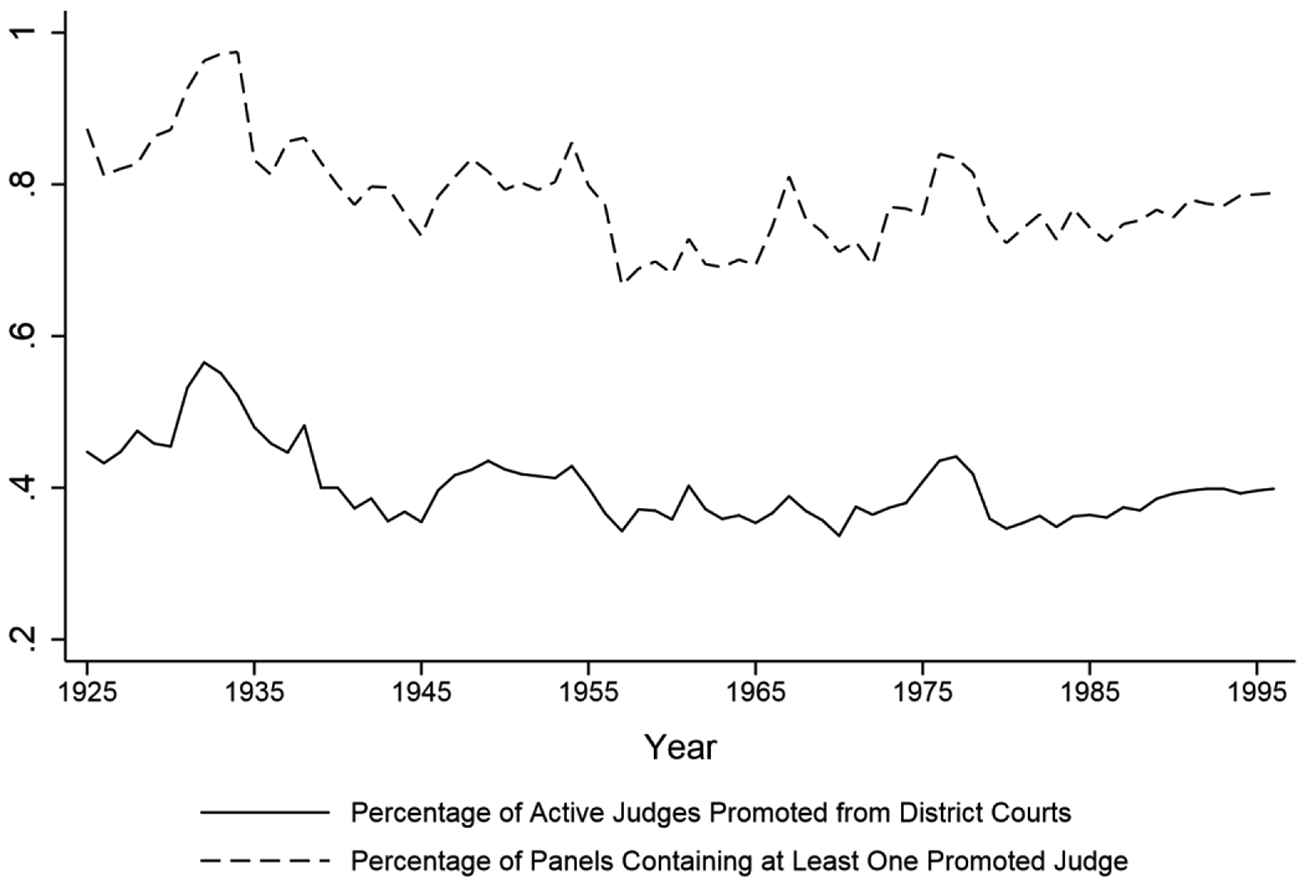
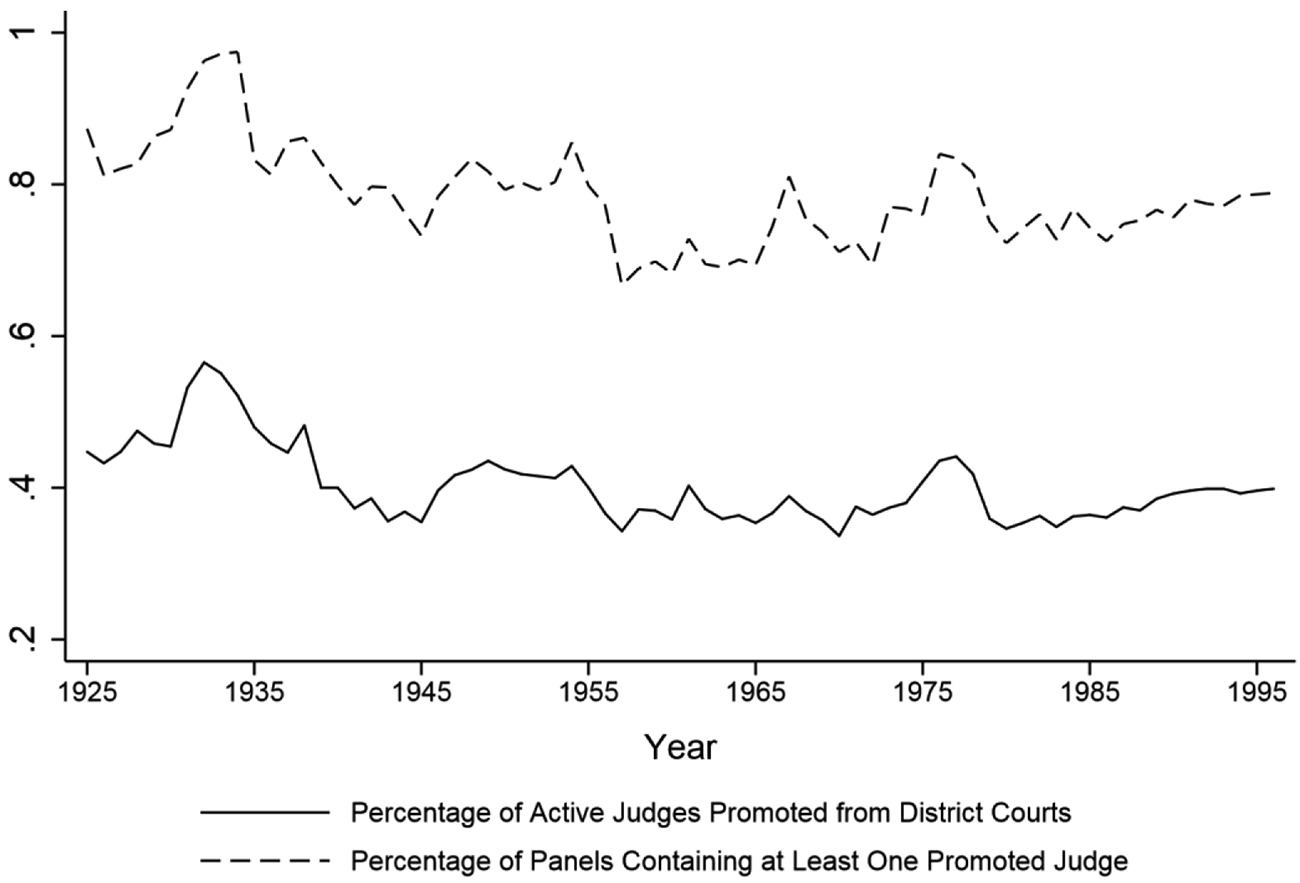
Even if these identities develop, the circumstances under which social identity is salient could be sufficiently limited to render its impact insignificant. However, the frequency with which judicial vacancies are filled through promotion makes it likely that social identity affects judicial behavior.Footnote 2 As discussed above, promotion serves as the dominant selection strategy for staffing the appellate federal judiciary. This is demonstrated in figure 1, which displays the percentage of active court of appeals judges promoted from the district courts from 1925 to 1995. Typically 40% of active court of appeals judges were promoted from the courts of appeals, and approximately three out of four panels (78%) were expected to include at least one promoted judge.
Promoted judges in the US courts of appeals, 1925–96
Promotion is likely to activate social identity because it raises the salience of both in-group bias and esteem seeking. In terms of in-group bias, promotion brings role conceptions into conflict. While social identity theorists have demonstrated that identities are typically stable and enduring, there are not permanent components of individuals’ self-concepts. For example, individuals may redefine their social identity when they are no longer satisfied with their in-group. As Brown (Reference Brown2000, 747) notes, “in the event of an ‘unsatisfactory’ identity, people may seek to leave their group.” Scholars have also demonstrated that social identification is strengthened by frequent and intimate contact between group members. When such contact decreases or disappears, social identity wanes (Brewer and Miller Reference Brewer, Miller, Brewer and Miller1984). Most promoted judges are not leaving their previous court because of dissatisfaction with their group. This may lead a district court judge promoted to the court of appeals to continue to positively identify with the district court. This positive identification is likely to fade over time as the newly promoted judge reduces levels of contact with the district court. In addition, the promoted judge has also joined a new group—the court of appeals—and is thus likely beginning to form an identity as a member of that court.
In terms of esteem seeking, for a promoted court of appeals judge, members of the district court from which the judge was promoted may be an audience whose esteem the judge values.Footnote 3 This is true for several reasons. While social identity theory recognizes that the types of groups individuals care about vary substantially, two types regularly emerge as being of greater salience: social and professional groups. Social groups are constituted by those with whom individuals maintain personal relationships. In the case of judges (like all people), this includes friends and family. Professional groups, on the other hand, are constituted by those relevant to individuals through their profession. In the case of judges, this includes colleagues, lawyers, and other members of the legal profession. All individuals seek the esteem of social groups. Unlike most individuals, judges may disproportionately value the esteem of professional groups. The jargonistic nature of legal decision making renders many individuals unable to evaluate judicial work. As a result, judges may be more likely to value the esteem of groups or individuals that have the knowledge necessary to develop a meaningful evaluation of their work. Unlike family members or other members of the legal profession, members of the court from which a judge has been promoted are likely members of both groups. These individuals may be part of the personal circles of promoted judges and possess the requisite knowledge to evaluate their judicial output.
In addition, promoted judges may further value the esteem of members of the district court from which they were promoted because of the challenges of creating legal policy in a hierarchical system. Published decisions of the court of appeals create binding circuit precedent that district court judges in that circuit are expected to apply. While this affords court of appeals judges substantial power, implementation of circuit precedent is not automatic (Baum Reference Baum1980; Boyd Reference Boyd2015). Further, district court judges can play an important role in the crafting of legal policy by supplying information about the implications of those policies to appellate judges in the form of (non)compliance (Randazzo Reference Randazzo2008; Clark and Carrubba Reference Clark and Carrubba2012; Hansford, Spriggs, and Stenger Reference Hansford, Spriggs and Stenger2013). The interdependent nature of the legal policy-making process in the lower federal judiciary should therefore induce appellate court judges to seek the esteem of their district court brethren. This desire is undoubtedly motivated in part by the instrumental value of enhancing the likelihood of faithful implementation of the appellate court’s preferred policies by district court judges. However, given the time and effort dedicated by judges to the creation of legal policy, it is not unreasonable to believe that they would value the esteem of those with whom they work closely as an end in itself. Most individuals desire to be liked and respected by their peers. The value of this esteem is likely enhanced for promoted judges, who have experienced the legal policy-making process from both perspectives.
Hypotheses
Promoted judges are expected to treat district court judges more favorably. To capture this behavior I focus on the decision to vote to reverse a district court judge.Footnote 4 Voting to reverse represents a direct evaluation by one group of members of another.Footnote 5 If promoted judges psychologically benefit by treating district court judges more favorably, this should be apparent in the decision to reverse.
Promoted judge. Promoted judges are less likely to vote to reverse a district court judge than nonpromoted judges.
Promoted judges affirming district court judges at a higher rate is consistent with both mechanisms tied to social identity: in-group bias and esteem seeking. To isolate these mechanisms, I begin by examining behaviors most consistent with the presence of in-group bias. The effects of in-group bias can be determined by examining how the aversion of promoted judges to reverse district court judges changes over time. Social identities, even though typically enduring, are not impregnable, particularly when individuals are no longer members of the group around which their identity was formed. For promoted judges, the greater the length of time since they left the district courts, the less likely they are to continue to identify with district court judges. This decreases the likelihood of continuing to affirm that group at higher levels. Perhaps just as importantly, promoted judges are developing identities as court of appeals judges. As this identity shifts, positive evaluations are also likely to shift away from the district courts and to the court of appeals. Promotion therefore brings judges’ social identities into conflict: promoted judges’ identities as district court judges fade as their identities as appellate court judges emerge. To capture these dynamics, I make the following hypothesis.
Promoted judge × court of appeals experience. For promoted judges, as the length of court of appeals experience increases, the likelihood of voting to reverse a district court judge also increases.
Court of appeals experience, which assesses whether the length of court of appeals experience has an effect on nonpromoted judges, is also included. This variable serves two purposes. First, its inclusion is necessary to estimate the interactive effect. Substantively, this variable tests whether the length of court of appeals experience affects the decision to reverse for judges who lack district court experience. Because these judges are not facing the type of conflict discussed above, there is no reason to suspect their propensity to reverse to vary over time.Footnote 6
The effect of in-group bias may be greater for promoted judges with more district court experience. Lengthy service on the district courts allows promoted judges greater opportunities to cement their identities as district court judges. The in-group biases of promoted judges with this breadth of experience may therefore be even more substantial than those of promoted judges with relatively limited district court experience. Note that because only promoted judges have district court experience (the measure takes a value greater than zero for all promoted judges and the value of zero for all nonpromoted judges), the variable functions as the conditional effect of district court experience on promoted judges.
District court experience. As a promoted judge’s length of district court experience increases, the likelihood of voting to reverse a district court judge decreases.
Finally, designated district court judges (“designated judges”) provide an additional opportunity to examine the potential influence of group identification. If regular and intimate contact reinforces group identification, then designated judges, who are serving only temporarily in the courts of appeals, may be particularly disinclined to vote to reverse. Circuit practices appear to recognize this potential influence. Most circuits (with the Second Circuit serving as the primary exception) avoid assigning designated judges to panels hearing appeals from the designated judge’s home district (Brudeny and Ditslear Reference Brudeny and Ditslear2001, 572n10). This is undoubtedly driven by the belief that, given the temporary nature of the appointment, designated district court judges will continue to identify as district court members, even when serving in the court of appeals. This provides an opportunity to examine how group identification influences a judge’s role conception when the ability to seek esteem from former/current colleagues (as discussed below) is not directly applicable.
Designated judge. For designated judges, the likelihood of voting to reverse a district court judge is reduced.
The hypotheses outlined above represent the primary tests of in-group bias. Group distinction was operationalized by experience: both the experience of being promoted (even temporarily) and the quantity of experience in the district and appellate courts. However, these hypotheses cannot determine whether the behavior of promoted judges is driven by experience in the district courts rather than the psychology motives raised by promotion. As Posner (Reference Posner2008, 74) suggests, “appellate judges promoted from the trial court may be more likely than other appellate judges to vote to affirm a trial judge. They are more sensitive to the advantages that the trial judge has over the appellate court in gaining a deeper understanding of a case—especially a case that is actually tried, for then the trial judge will have spent much more time on it than the appellate judges who review his ruling.” This perspective is consistent with scholarship examining how other career experiences influence judicial decision making (see, e.g., Sisk, Heise, and Morriss Reference Sisk, Heise and Morriss1998). However, scholars have demonstrated the value of distinguishing the effect of experience from similar, but distinct, influences. For example, Miller and Curry (Reference Miller and Curry2009, Reference Miller and Curry2013) contrast the potential influence of general experience with that of subject matter expertise. They find that expertise, not experience, plays a more prominent role in the decision-making process.
I follow a similar strategy here to distinguish the potential influence of experience from the effect of in-group bias. To do so, I examine the behavior of judges who previously served on a state trial court but not in federal district court. Federal district court is not the only place an individual could experience life as a trial court judge. Each state has its own judicial system and each includes some level of trial courts. This creates the possibility that a judge could have experience in state trial courts but not in federal district court. While state and federal trial courts undoubtedly differ, many of the experiences and insights gained during service as a district court judge should also be available to judges during their service in state trial courts. However, if aversion to reversal is motivated primarily by social identity, there is no reason for a judge lacking in district court experience to be unduly favorable to federal district court judges.
Service on a state trial court. Judges with experience on a state trial court but not on a federal district court will not be less likely to vote to reverse a district court judge than court of appeals judges without district court experience.
In addition to in-group bias, social identity also has the potential to shape judicial behavior through a desire to earn the esteem of salient groups. The hierarchical structure of the federal judiciary affords a test of this expectation. Promoted judges may value the esteem of members of the court from which they were promoted. Because district court judges are overwhelmingly promoted to the court of appeals of the circuit including their original “home” district court, these judges have the potential to review appeals originating in their home district. If promoted judges desire the esteem of those district court judges, they should be less likely to vote to reverse them. While this expectation taps into group identification to some degree, it also has the potential to be shaped by esteem seeking. Some evidence of this effect exists at the US Supreme Court. Epstein et al. (Reference Epstein, Martin, Quinn and Segal2009) find no evidence that justices with court of appeals experience are generally more favorable to cases appealed from those courts. However, they do find evidence of what they term a “home court advantage” (868). They note that “with only a few exceptions, Justices who served on the circuits behave in a significantly different manner toward their former court relative to all others” (873). I test a similar hypothesis here.
Same district. If a case is appealed from a district to which a judge was once appointed, that judge will be less likely to vote to reverse.
Same district assumes that promoted judges desire the esteem of all members of their former court equally. However, just as group identification is strengthened by regular and intimate contact (Brewer and Miller Reference Brewer, Miller, Brewer and Miller1984), individuals tend to value the esteem of those with whom they have built stronger ties through frequent interaction. Therefore, promoted judges are likely to value the esteem of former court members with whom they have built close, personal connections. To investigate this possibility, I examine cases in which promoted judges review the decisions of district court judges with whom they served concurrently on the district court. Former colleagues, unlike all members of their former court, are likely members of promoted judges’ social and professional groups. If promoted judges value more highly the esteem of individuals with whom they shared regular contact, they should treat appeals from former colleagues more favorably.
Former colleague. If the district court judge whose decision is being appealed is a former colleague, a promoted judge will be less likely to vote to reverse.
Data and Measurement
The dependent variable—voting to reverse—and several variables relating to the history of the case are constructed from the Original U.S. Appeals Courts Database (Songer Reference Songer2008). Most of the variables concerning judicial careers are constructed from the Attributes of U.S. Federal Judges Database (Zuk, Barrow, and Gryski Reference Zuk, Barrow and Gryski2004). Any variables unavailable from this database were constructed from the biographical directory of federal judges available online from the Federal Judicial Center.Footnote 7
The operationalization of most of the variables of theoretical interest is straightforward. Promoted judge is coded as one if a court of appeals judge previously served in the federal district courts. Court of appeals experience takes the difference between the year the case was decided and the year the judge was officially commissioned to the court of appeals. Similarly, district court experience takes the difference between the years a judge was officially commissioned to the court of appeals and to the district court. Designated judge is coded as one if the judge is either a current federal district court or a senior federal district court judge. Service on a state trial court takes the value of one if a judge had previously served on a state trial court but not the federal district court. Finally, former colleague takes the value of one if the court of appeals judge served concurrently on the same district court as the district court judge being reviewed.
In addition to promotion, the decision to reverse may be driven by a variety of additional factors (Haire, Songer, and Lindquist Reference Haire, Songer and Lindquist2003; Hettinger, Lindquist, and Martinek Reference Hettinger2006; Epstein, Landes, and Posner Reference Epstein, Landes and Posner2013). Primary among these are judges’ policy preferences. Judges are more likely to vote to reverse when the district court decision is ideologically distant (Haire et al. Reference Haire, Songer and Lindquist2003; Hettinger et al. Reference Hettinger2006; Epstein et al. Reference Epstein, Landes and Posner2013). To control for this potential influence I utilize the judicial ideology scores created by Giles, Hettinger, and Peppers (Reference Giles, Hettinger and Peppers2001) for the courts of appeals and extended to district court judges by Boyd (Reference Boyd2010). These measures create ideological distance, which takes the absolute value of the difference between the ideological scores of the court of appeals judge and the district court judge from whom the case was appealed.
Scholars have also demonstrated the potential influence of “panel effects” (Revesz Reference Revesz1997; Cross and Tiller Reference Cross and Tiller1998; Sunstein et al. Reference Sunstein, Schkade, Ellman and Sawicki2006; Kastellec Reference Kastellec2011b , Reference Kastellec2013; Epstein et al. Reference Epstein, Landes and Posner2013). Panel effects occur when judges’ vote choices are affected not only by their own policy preferences but by the preferences of the other members of the panel. The primary consequence of panel effects is greater observed unanimity in the courts of appeals than would be predicted by examining only the partisan makeup of the panel. This pressure toward conformity has the potential to independently shape judges’ vote choices. To control for this influence, I include reversal votes, which takes the value of the number of votes cast by the panel to reverse excluding the judge being examined. This can range from two (meaning both other panelists voted to reverse) to zero (meaning neither of the other panelists voted to reverse).Footnote 8
Distinct from ideological considerations but potentially related to reversal is caseload. Judges operating in environments in which caseload pressures are substantial may opt to affirm a district court rather than reverse because of the costs associated with reversal (Hettinger et al. Reference Hettinger2006, 101). Because affirming requires less additional justification, judges facing disproportionately heavy caseloads may not have the time necessary to develop their own justifications for a reversal. Caseload takes the value of the total number of published opinions in a judge’s court of appeals in a given year divided by the total number of judges serving in the court of appeals.
A variety of characteristics associated with the case have also been shown to affect the likelihood of reversal. Studies have demonstrated that judicial behavior is conditioned by case salience (Collins Reference Collins2008). The expectation that appellate judges defer to the findings of the trial court limits their discretion and may compel them to vote for outcomes inconsistent with their preferences. While this expectation may be sufficiently strong to dictate behavior in nonsalient cases, it may not be strong enough to overcome judges’ preferences in cases that are salient. To capture case salience, amicus is included, which takes the value of one if at least one amicus brief was filed in the case.
A second set of case characteristics stems from the reviewing function of the courts of appeals. Some case factors make it more difficult for district court judges to accurately apply circuit law. If a district court judge makes an error, it is the responsibility of the court of appeals to correct that mistake. The likelihood of legal error is assessed by two factors. The first is case complexity. As Hettinger et al. (Reference Hettinger2006, 94) note, “the more complex a case, the more easily a district court judge can arrive at an erroneous ruling.” Legal issues, which takes the value of the number of issues raised by the case, is included. The second consideration is the presence of frivolous appeals. Because most litigants have a statutory right to an appeal, many appeals are without legal merit. This motivation is clearest for appeals of criminal convictions. Those convicted of crimes are likely to appeal even if the appeal is legally baseless. Criminal cases are therefore likely to be affirmed at a disproportionately higher rate. Criminal takes the value of one if the case is a criminal appeal.
Finally, different circuits have different norms regarding reversal. While some circuits are hesitant to reverse the district court, others are more willing. To account for the differing baseline probabilities for reversal and other potential circuit effects, reversal rate is included, which is an estimated percentage of cases with published opinions reversed by the circuit the year before the observed case.Footnote 9
The result is an analysis of 10,326 court of appeals votes in published opinions from 1946 to 1996. Of the observed votes, 28% were cast in favor of reversal.Footnote 10 Because the dependent variable is dichotomous, logistic regression is employed. Sampling weights are included to account for the sampling procedure used to construct the database. Robust standard errors, clustered by judge, are employed.Footnote 11
Results
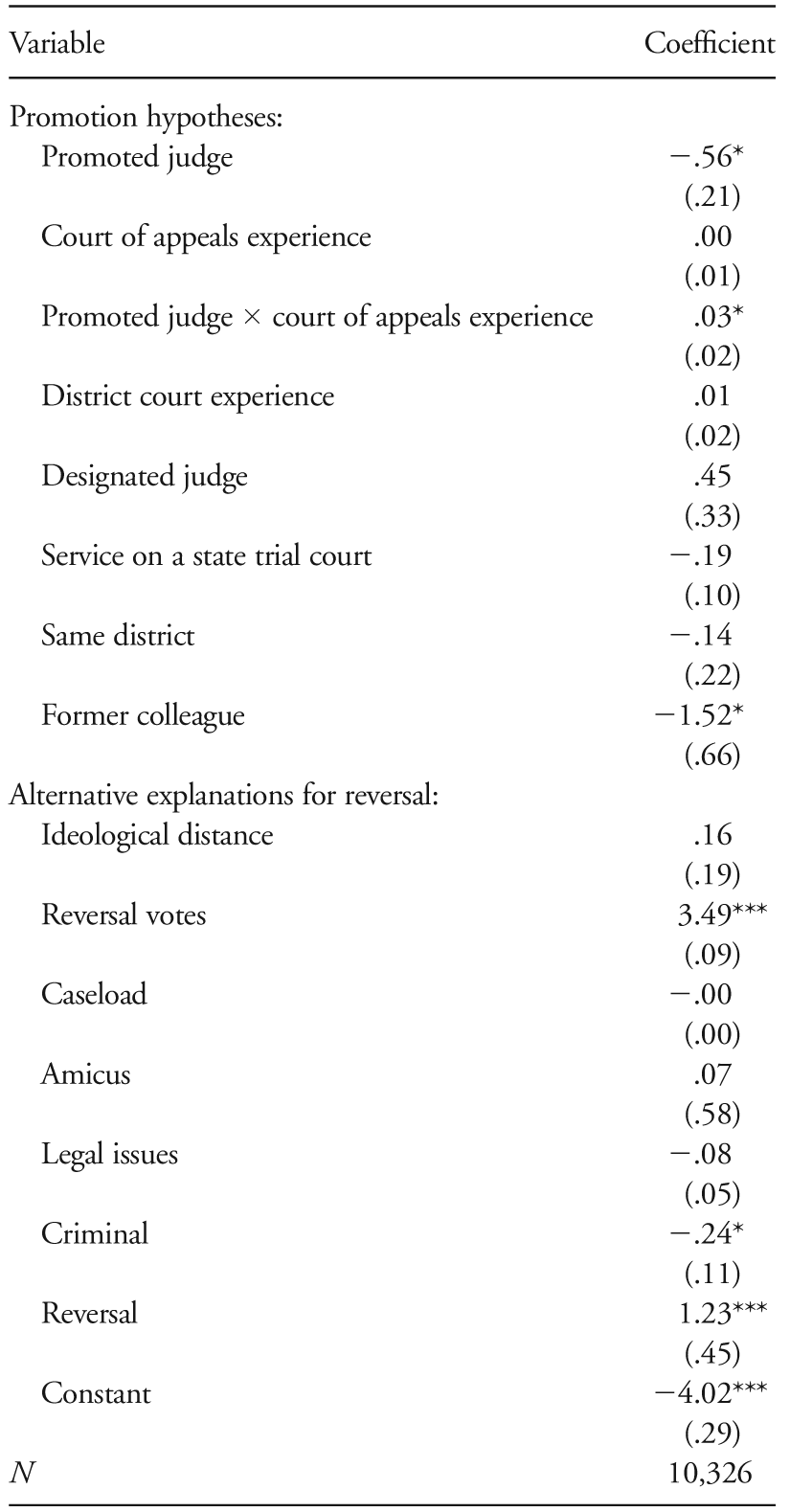
The results are presented in table 1. Nearly 47% of the observed votes were cast by promoted judges. The variable capturing status as a promoted judge is negatively signed and statistically significant. However, this result alone is limited in two respects. Statistically, because promoted judge is interacted with court of appeals experience, the reported effect applies only to judges with no court of appeals experience—a practical impossibility. Substantively, the effects of social identity activated by promotion are not hypothesized to influence promoted judges in a uniform manner. All promoted judges are likely to initially share a common identity as members of the district court. Shortly after promotion, these judges likely experience conflict in their identities as they transition from service in the district courts to the courts of appeals. After a period of service on the courts of appeals, the lack of regular contact and interaction with their former district court brethren causes their identification with the district court judges to fade as their identities as court of appeals judges grow to dominate. Therefore, while the presence of in-group bias suggests that promoted judges will avoid voting to reverse district court judges, this effect is expected to fade as judges’ court of appeals experience grows.
The Effect of Promotion on Decision Making in the US Courts of Appeals
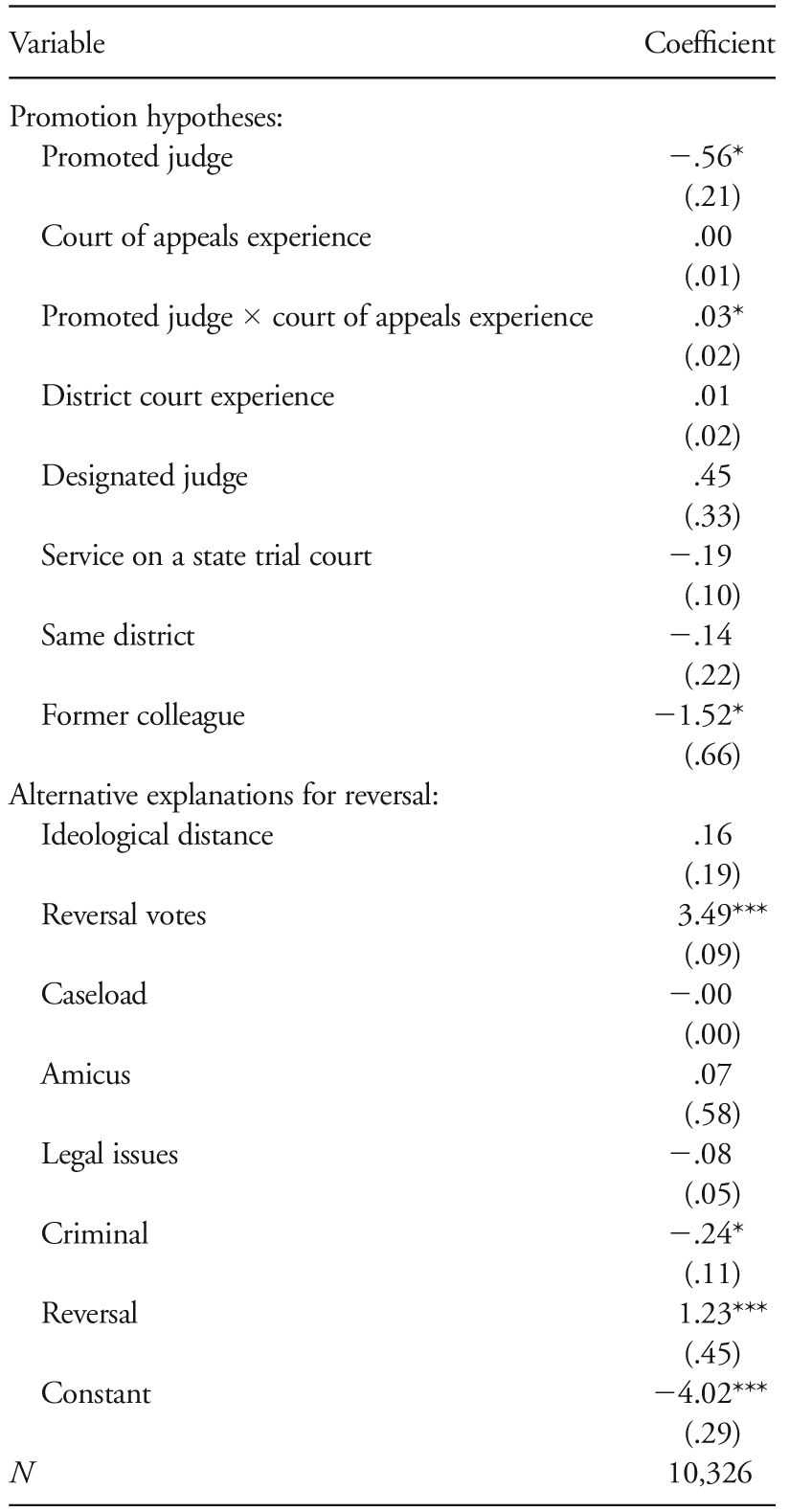
Note.—Dependent variable: Did judge vote to reverse (1 = yes)? Logistic regression coefficients are reported with standard errors, clustered by judge, in parentheses.
*. p < .05.
**. p < .01.
***. p < .001.
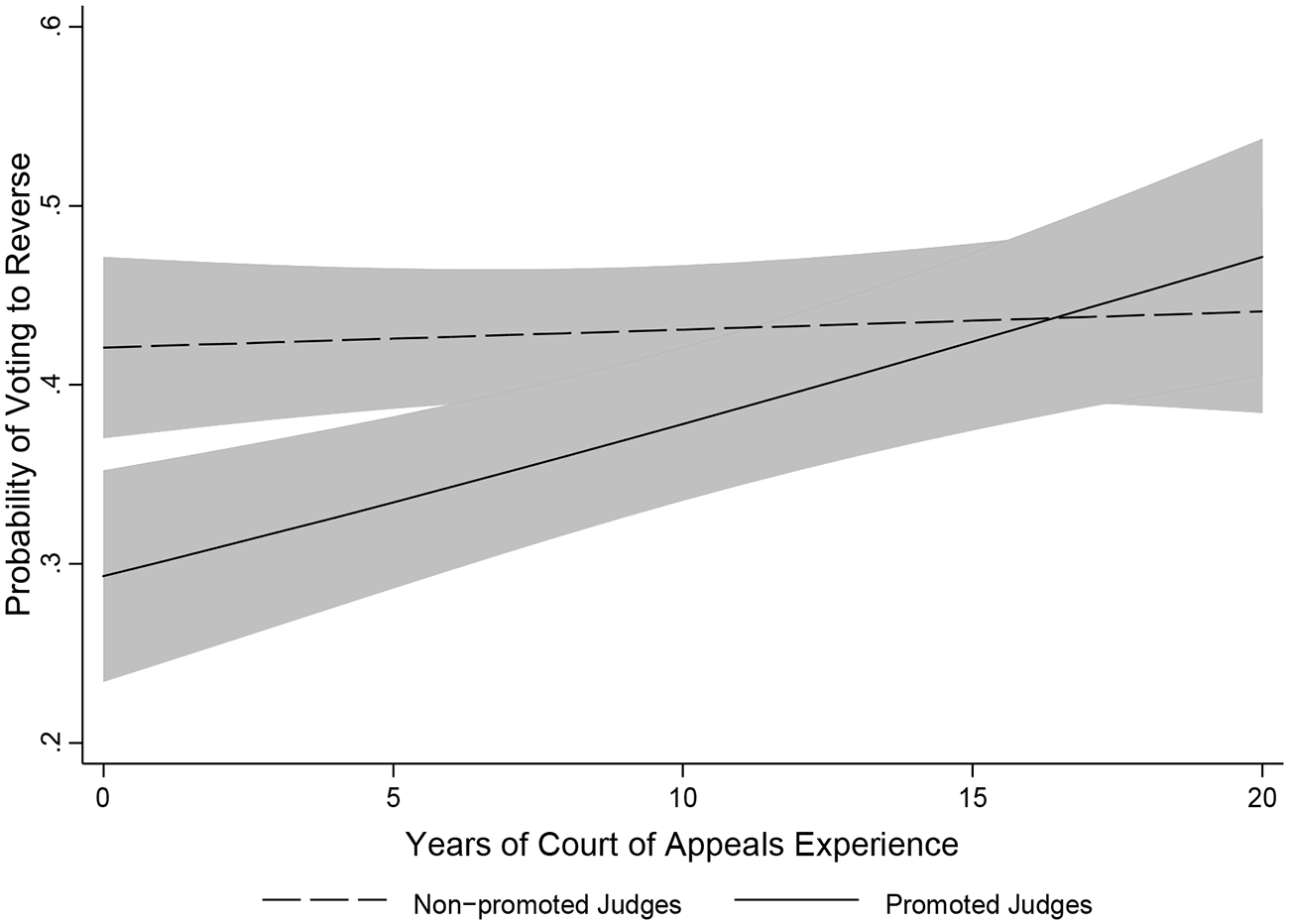
The interaction of promoted judge with court of appeals experience directly tests this effect. While the effect of court of appeals experience is likely to vary over time for promoted judges, in the case of nonpromoted judges, there is no reason to expect a disinclination to vote to reserve. The results of the analysis confirm this expectation. While court of appeals experience does not influence the behavior of nonpromoted judges, it does affect the behavior of those promoted from the district courts. The effect can be observed in figure 2, which displays the predicted probability of voting to reverse for promoted and nonpromoted judges over their first 20 years of service on the court of appeals.Footnote 12
The changing effect of promotion on voting to reverse
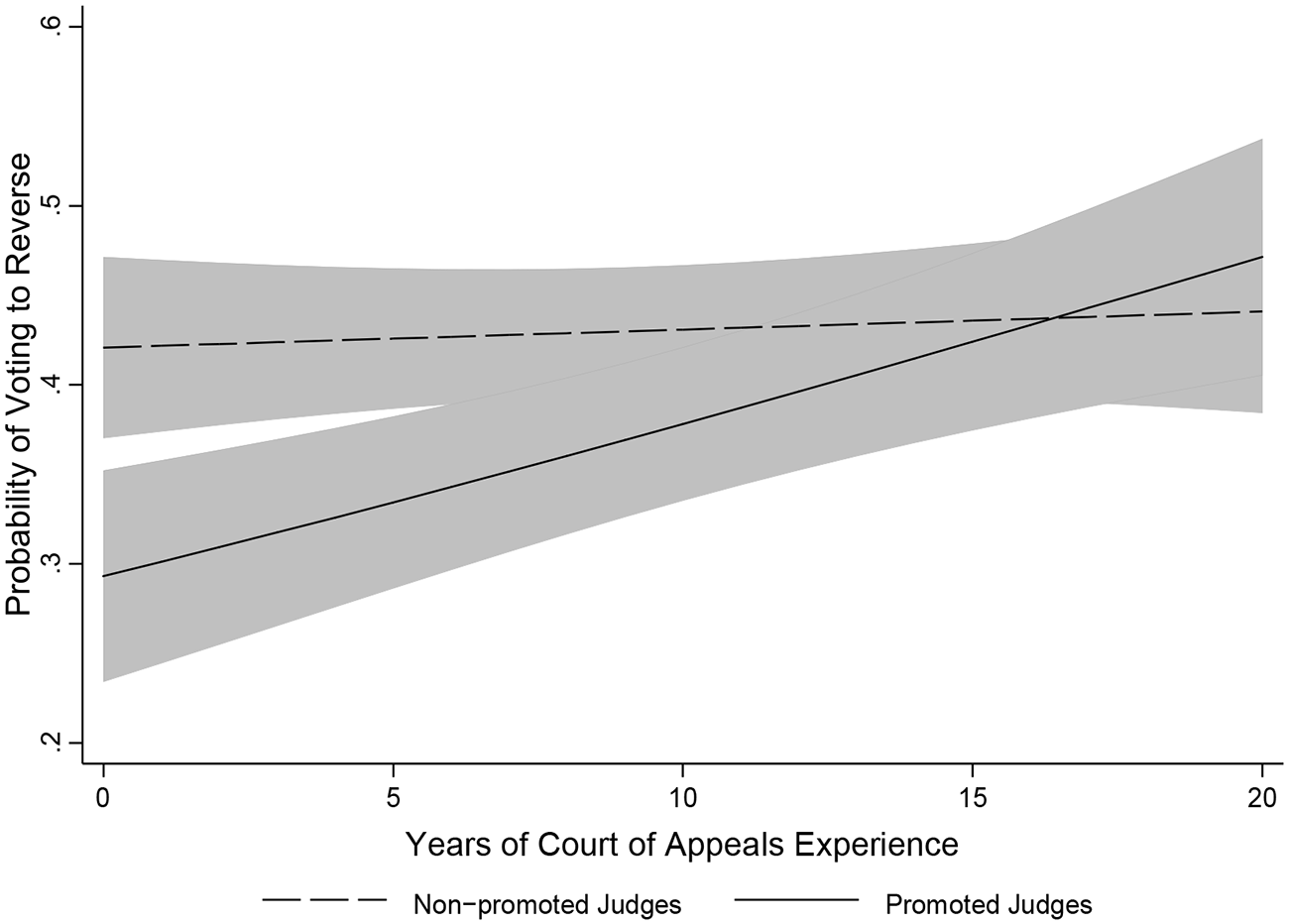
Nonpromoted judges with little court of appeals experience have a 42% probability of voting to reverse. This prediction does not substantively vary over time. Promoted judges with little court of appeals experience have only a 29% probability of voting to reverse. However, as their length of court of appeals experience increases, so does their likelihood of voting to reverse. By the tenth year of service on the court of appeals, promoted and nonpromoted judges are statistically indistinguishable.Footnote 13 Around their seventeenth year of court of appeals experience, their predicted likelihoods of voting to reverse are identical.
In-group bias is not the only plausible interpretation of this result; experience qua experience could be driving this finding. Promoted court of appeals judges may simply recall their experiences as district court judges, leading them to behave in a more deferential manner. As time passes, these experiences become less salient, and thus the differential behavioral pattern begins to fade. To distinguish between these possibilities, service on a state trial court is included, which identifies court of appeals judges who previously served on state trial courts but lack experience in federal district courts. The results demonstrate that these judges are no less likely to vote to reverse than judges without any trial court experience (at either the state or federal level).Footnote 14 The lack of effect for service on a state trial court casts serious doubt as to whether the differential behavior of promoted and nonpromoted judges can be explained by experience. While there are likely some differences between service on state and federal trial courts, the central experiences of being a trial court judge should be common across both levels. If promoted judges were truly disinclined to vote to reverse because of their experiences as federal trial court judges, a similar pattern should emerge for judges who served in state trial courts. This is not evident here.
Length of district court service is also hypothesized to affect the likelihood of voting to reverse due to in-group bias. However, this is not what is observed. The effect of promotion is not conditional on years of district court experience. Promoted judges with lengthier district court careers are no less likely to vote to reverse than those with relatively brief careers. While this finding may be inconsistent with initial expectations, those expectations may be inconsistent with the principles of social identity. Scholars investigating social identities have found that individuals can develop group identities almost immediately after being assigned to a group, even if group assignment is based on truly trivial criteria (e.g., preferences for the painters Klee or Kandinsky in Tajfel et al. [Reference Tajfel, Billig, Bundy and Flament1971]). If this is the case, because membership on a court is far from a trivial criterion, district court judges (who presumably lack the competing identity of promoted judges) may form group identities very quickly. This represents an important avenue for potential future research.
Finally, designated judges are not less likely to reverse than court of appeals members. While this result is inconsistent with theoretical expectations, alternative demands could motivate designated judges to behave more like their temporary court of appeals colleagues than they might otherwise prefer. Commentators have questioned whether designated judges are able to contribute equally to the appellate court decision-making process. While they proffer a variety of rationales for this concern (for discussion, see Cohen [Reference Cohen2002, 191–201]), one consistent theme is the increased workload created for a district court judge when visiting. As one Ninth Circuit judge noted, “if we bring district judges in, they come as volunteers … but their work goes on in their absence. They are on a wheel, and they get the same number of cases, and no one takes them off the wheel for one or two rounds in order to come visit with us” (197). Evidence suggests that this concern affects the behavior of designated judges. Brudeny and Ditslear (Reference Brudeny and Ditslear2001) demonstrate that designated judges contribute proportionately fewer opinions than would be expected when visiting. The simplest strategy to avoid the extra work of opinion authorship on a three-judge panel is to vote with the other two panel members. If a designated judge voted for a different outcome, she would bear the burden of authoring a dissenting opinion. It is possible then that workload demands overwhelm any potential effect of social identity for designated judges.
The second set of hypotheses are designed to capture the effect of promotion through the desire to seek esteem from salient groups. Promoted judges could seek the esteem of all members of their former court, regardless of their relationship to those individuals. However, even if true in the abstract, it does not appear to affect their behavior. Same district is correctly signed but fails to achieve conventional levels of statistical significance. This does not foreclose the possibility that promoted judges could seek the esteem of specific members of their former court. Because social identity is strengthened through regular and intimate contact, promoted judges may seek the esteem of members of their former court with whom they developed personal and professional relationships. Former colleague tests, and supports, this expectation. Promoted judges are less likely to vote to reverse in appeals coming from a district court judge with whom they served.Footnote 15 The magnitude of this effect is notable. For a case appealed from a typical promoted judge’s former district, the probability of voting to reverse is 35%. However, if the same case being reviewed from the promoted judge’s former district was decided by a former colleague, the probability of voting to reverse shrinks to a mere 9%.
One could alternatively characterize the significance of former colleague as demonstrating the effect of friendship or personal loyalty rather than social identity. While the line of demarcation between them is subtle, the two can conceivably be distinguished in terms of motivation. From the social identity perspective outlined here, esteem from salient groups is valuable because it enhances one’s own sense of self-esteem. The motivation for earning the esteem of an individual or group is thus inwardly directed. Individuals desiring the esteem of their peers because of friendship or loyalty do so presumably to enhance the self-esteem of those individuals. In other words, friendship and loyalty are understood as being outwardly directed. The challenge presented by these similar, but potentially distinct, motivations is the behavioral equivalence they produce: both expect promoted judges to vote to affirm, rather than reverse, former colleagues at higher rates. Given the evidence presented here supporting the effect of social identity in the form of in-group bias and the general assumption of the political science literature that actors are (at least in substantial part) self-interested, it is not unreasonable to conclude that esteem seeking offers the most likely explanation for this result. Even if these competing explanations cannot be sufficiently distinguished, the substantively consequential relationship between promoted judges and their former colleagues offers strong support for the effect of promotion on decision making in the courts of appeals.
Finally, a brief discussion of the alternative factors affecting reversal is warranted. Aside from the effect of social identity raised by promotion, the likelihood of voting to reverse is affected by characteristics stemming from the panel, the case, and the circuit. Contrary to expectations, neither ideological distance nor caseload reaches conventional levels of statistical significance. The effect of reversal votes, however, is substantively large and statistically significant. This is consistent with previous scholarship demonstrating the importance of panel effects on decision making in the courts of appeals. In terms of case characteristics, the variables designed to capture case salience or complexity are statistically insignificant. Only the variable designed to capture frivolousness (criminal) appears to affect the vote to reverse. In addition, it is clear that different circuits have different norms regarding the propensity to reverse. Most of these findings are consistent with previous scholarship regarding reversal.
Conclusion
The empirical results presented here offer evidence that the decision to fill judicial vacancies through promotion affects individual-level decision making in the US courts of appeals. Two consistent behavioral patterns are identified that exist exclusively as a result of promotion. First, promoted judges are less likely to vote to reverse district court judges than nonpromoted judges, but this effect fades the longer a promoted judge has served on the court of appeals. Second, promoted judges are substantially less likely to vote to reverse a district court judge with whom they once served. Neither of these patterns would exist unless presidents utilized promotion to staff the appellate federal judiciary.
The results not only identify the effect of promotion but provide substantial insight into why promotion affects judicial behavior. The observed behavioral patterns associated with promotion likely develop in response to psychological motivations consistent with social identity theory that are activated in response to the experience of being promoted. The aversion of promoted judges to vote to reverse district court judges is best explained by the presence of in-group bias. In-group bias suggests that individuals will make positively biased evaluations of members of their in-group, but the magnitude of that bias will fade as regular and intimate contact between group members decreases. This is exactly what is observed here; as the identities of promoted judges shift, so do their decision-making patterns. This behavior does not appear to be a function of the most likely alternative explanation—shared experiences—as court of appeals judges with state trial court experience but not federal district court experience are not any less likely to vote to reverse. The aversion of promoted judges to vote to reverse their former colleagues can be explained by the desire to earn the esteem of these individuals. While it may not be possible to definitively determine that esteem seeking and not friendship or loyalty motivates this behavior, taken together, the results offer strong evidence that the effect of promotion is motivated by social identity.
This analysis makes several important contributions, beginning with its normative implications for the judicial nomination process. Presidents rely heavily on a promotion strategy when staffing federal appellate courts. Doing so could alter the behavior of appellate court judges. For presidents who desire an appellate judiciary hesitant to upset legal policy made in lower courts, a promotion-based selection strategy may be wise. However, for presidents who envision an appellate judiciary that will feel free to make substantial changes to legal policy, promoting judges from lower courts may undermine this vision. Presidential administrations and judicial politics scholars should recognize that promotion forces judges to reconsider their social identity, and the process of updating this identity will likely affect their behavior.
It is also the first analysis to conceptually distinguish between prior judicial experience and promotion. Previous scholarship has demonstrated the value of distinguishing between experience and expertise (Miller and Curry Reference Miller and Curry2009, Reference Miller and Curry2013). These characteristics have the potential to shape judicial behavior in different ways. A similar pattern is observed here; the experiences of individuals occurring prior to their appointments to the bench shape the choices they make when serving. However, a judicial career is more than the aggregation of an individual’s previous experiences. The procedural components inherent in a career in the federal judiciary also have the potential to affect future choices. The consequences of this distinction have yet to be sufficiently clarified in the literature. This analysis helps correct this limitation.
In addition to identifying the effects of promotion on decision making, the analysis also advances the study of judicial behavior by contributing to a burgeoning literature of scholarship that examines how judicial politics might be better understood by investigating the psychological pressures underlying the judicial decision-making process (Wrightsman Reference Wrightsman1999; Klein and Mitchell Reference Klein and Mitchell2010). Theories from psychology have the potential to offer a variety of contributions to judicial politics research. This analysis highlights the value of one—social identity theory. While social identity theory has been considered by judicial politics scholars elsewhere, this analysis builds off previous discussions in several important respects. The current literature focuses primarily on one potential mechanism for the influence of social identity: seeking esteem from salient groups. This analysis broadens the application of social identity frameworks by incorporating group identification. The results suggest that social identity influences judicial behavior through both the desire of the esteem of salient groups and in-group bias. This analysis not only demonstrates the effect of social identity but is the first to assess multiple potential mechanisms underlying its influence in the context of judicial behavior.
This analysis also represents the first analysis of the potential effect of social identity in the US courts of appeals. Previous scholarship has focused primarily on the US Supreme Court. While the Court warrants disproportionate scholarly attention, its unique institutional position creates questions as to whether behavioral patterns demonstrated by Supreme Court justices generalize to judges outside of the institution. In terms of behaviors resulting from social identity, the answer appears to be yes: judges in the lower federal judiciary are affected by group identification. This demonstrates that the influence of psychology generally (and social identity specifically) on judges outside of the Supreme Court represents a fruitful avenue for future research.
Finally, the effect of social identity demonstrated here may provide some clarity to scholarship considering the possibility of acclimation effects. Scholars of both the Supreme Court (Hagle Reference Hagle1993; Wood et al. Reference Wood, Camp Keith, Noble Lanier and Ogundele1998; Hurwitz and Stefko Reference Hurwitz and Stefko2004; Lanier Reference Lanier2011) and the courts of appeals (Brenner and Hagle Reference Brenner and Hagle1996; Hettinger, Lindquist, and Martinek Reference Hettinger, Lindquist and Martinek2003) have long been interested in whether judges or justices behave differently in their new or freshman period on a court than the later periods of their court service. This scholarship has produced largely mixed results as to whether acclimation effects exist and why these effects might be present. Social identity theory has the potential to help shed light on this question. If acclimation effects are driven in part by changing identities, then perhaps the impact of the acclimation period should vary on the basis of whether judges’ social identities are being brought into conflict rather than simply being formed originally.
Further development of this and related questions creates potential opportunities for future research.