D zud is a Mongolian term for a severe winter disaster in which heavy snow, extreme cold, or other conditions render forage unavailable or inaccessible, leading to high livestock mortality. During 1999-2002, Mongolia experienced consecutive dzuds that resulted in a loss of nearly 6 million livestock. As a result, severe psychological stress and increased school dropout rates were reported. In addition, increased migration of rural herders into urban centers has placed a burden on water, sanitation, medical, and social services. This disaster threatened the health and food security of approximately 40% of the country’s population. 1 In the winter of 2009-2010, Mongolia experienced the most severe dzud since the consecutive dzud winters of 1999-2002.Reference Morris 2 However, it is obviously difficult to accurately evaluate the risk of the effects of dzud on human lives and public health, and there are few reports about such creeping cold disasters in the dryland. Therefore, medical support systems by the government and other nongovernmental organizations are rarely constructed during dzud.
In general, during extreme cold weather, some population groups such little children, elderly people, and outdoor workers are more vulnerable than others.Reference Goggins, Yang and Hokama 3 In particular, infants have a lower resistance to severe environments, and this group is one of the highest risk groups in natural disasters. Infant mortality is defined as the death of a child less than 1 year of age. The infant mortality rate is an estimate of the number of infant deaths for every 1000 live births. This rate is often used as an indicator to measure the health and well-being of a nation because factors affecting the health of entire populations can also impact the mortality rate of infants. The global rate in 2012 was 35 deaths per 1000 births. The lowest rates were in Sweden, Singapore, Norway, Luxembourg, Japan, Iceland, and Finland, which had 2 deaths per 1000 live births, whereas the highest was in Sierra Leone, which had 117. For Mongolia, the rate was 23 deaths per 1000 births. 4 The present study aimed to evaluate Mongolian public health risks typified by infant mortality in terms of livestock loss with dzud.
Methods
Association Between Infant Mortality and the Declining Rate in the Numbers of Livestock or Meteorological Data in the Latest Dzud
We analyzed data from all 21 aimags (provinces of Mongolia) and Ulaanbaatar in Mongolia. We defined the change in infant mortality as the difference in the infant mortality rate from 2009 to 2010. The declining rate in the numbers of livestock in 2010 was determined on the basis of a decrease in the year-on-year percentage of livestock, including horses, cattle, camels, sheep, goats, and sheep units (horses × 7, cattle × 6, camels × 5, sheep × 1, and goats × 0.9). We compared the change in infant mortality with the declining rate in the numbers of livestock. These parameters were based on data from the National Statistical Office of Mongolia. 5 - 7 We also compared the change in infant mortality with average temperature and total precipitation in each aimag center (province capital) from October 2009 to February 2010. These meteorological data were based on data from the National Agency for Meteorology, Hydrology and Environment Monitoring.
Time-Course Analysis
We evaluated the association among the following trends from 2001 to 2012 throughout Mongolia: (1) the infant mortality rate, (2) the number of livestock conversion to sheep units, and (3) foodstuff consumption. The contents of foodstuff consumption were milk products and meat products and were indicated by adult equivalents (kg per month). These data were also from the National Statistical Office of Mongolia. 4 - 6
Statistical Analysis
All data analyses were performed by using SPSS 21.0 for Windows (IBM, Armonk, NY). The relationships between the declining rate in the numbers of livestock and the change in infant mortality or the infant mortality rate were assessed by using the Spearman rank-correlation with a significance level of 5%.
Results
Association Between Infant Mortality and the Declining Rate in the Numbers of Livestock or Meteorological Data in the Latest Dzud
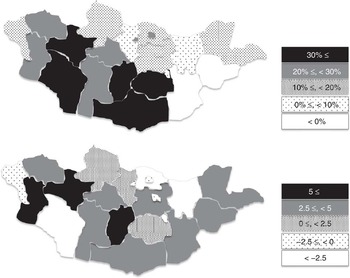
The changes in infant mortality and the declining rate in the numbers of livestock (in sheep units) are shown Figure 1. The infant mortality rate across Mongolia in 2010 (20.2 deaths per 1000) was increased by 0.2 points compared with that in 2009 (20.0 deaths per 1000). The declining rate in the numbers of each livestock (horses, cattle, camels, sheep, goats, and sheep units) across Mongolia in 2010 was 13.5%, 16.3%, 2.7%, 24.9%, 29.4%, and 21.2%, respectively. The correlation coefficients between the changes in infant mortality and the declining rate in the numbers of each livestock were positive: horses, 0.348, P=0.112; cattle, 0.392, P=0.071; camels, 0.44, P=0.038; sheep, 0.277, P=0.277; goats, 0.200, P=0.371; and sheep units, 0.362, P=0.098. The correlation coefficients between the changes in infant mortality and meteorological data were −0.001 (P=0.997) for average temperature and −0.123 (P=0.627) for total precipitation.
Mongolian Maps Showing the Declining Rate of Livestock by Sheep Unit (Top) and the Change in Infant Mortality (Bottom) in Each Aimag, 2009 to 2010.

Time-Course Analysis
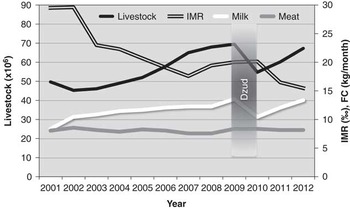
Trends in the infant mortality rate, the number of livestock, consumption of milk products, and consumption of meat products throughout Mongolia from 2001 to 2012 are shown in Figure 2. The infant mortality rate was significantly negatively correlated with the number of livestock and the consumption of milk products (r=−0.797, P=0.002; r=−0.784, P=0.003, respectively). There was no correlation between the infant mortality rate and the consumption of meat products (r=0.304, P=0.336). The number of livestock was significantly correlated with the consumption of milk products (r=0.872, P<0.001); by contrast, consumption of meat products had no significant association with the number of livestock (r=−0.230, P=0.472).
Trends in the Infant Mortality Rate, Number of Livestock, and Foodstuff Consumption Throughout Mongolia, 2001 to 2012. Abbreviations: IMR, infant mortality rate; FC, foodstuff consumption; milk, milk product consumption; meat, meat product consumption.

Discussion
The results of the present study showed that loss of livestock was associated with infant mortality in Mongolia. Globally (including Mongolia), the infant mortality rate has been decreasing yearly, except after dzud in Mongolia. Mass debilitation and death of livestock in Mongolia adversely affect many herders who depend on their animals for food, fuel, income, and transportation. 1 In the current study, we assessed all of Mongolia, including Ulaanbaatar, which is the capital city with few agricultural workers and livestock. Nonetheless, the changes in the overall trends in infant mortality were closely associated with livestock loss. This livestock damage affects public health throughout Mongolia. On the other hand, the cold environment was not influential on infant mortality, although it is said that low ambient temperature is related to many kinds of mortality.Reference Goggins, Yang and Hokama 3 This may be because the period of this cold disaster was of a relatively short duration (5 months) compared to the time before last, and we performed the analysis without the sample into rural and urban areas.
The 1999-2002 dzud threatened the health and food security of approximately 40% of the country’s population. 8 In a 2001 survey, there were indications of a high prevalence of growth stunting, which is indicative of chronic malnutrition, in children aged 6-59 months in districts severely affected by dzud. 1 In our study, consumption of milk products in 2010 decreased compared to the previous year, similar to the number of livestock. It is widely known that milk and milk products are important nutrients in childhood. Therefore, poor intake of milk products leading to malnutrition may be one of the factors in the increase in infant mortality.
Furthermore, there is a potential nutritional problem of a lack of vitamin D in Mongolia. Vitamin D deficiency is a highly prevalent disorder in children and pregnant women in Mongolia because of insufficient dietary intake.Reference Uush 9 This deficiency remains a public health problem. Vitamin D, a nutrient derived from diet and sunlight, helps the body absorb calcium and has been recognized as pivotal to good health. Mongolians, especially nomads, lack access to vitamin D-fortified foods or foods that are naturally rich in vitamin D, including fish and champignon. In addition, almost no vitamin D is produced in the skin in the winter in Mongolia because the amount of ultraviolet (UV)-B reaching the earth’s surface is insufficient at this latitude (Ulaanbaatar is at 48˚N).Reference Ganmaa, Holick and Rich-Edwards 10 Moreover, there are fewer hours of sunlight during a dzud than in a normal winter and decreased intake of calcium from dairy products because of loss of livestock. These factors are thought to be causally related to increasing infant mortality in dzud. Previous studiesReference Madden, Feldman and Smith 11 , Reference McNally, Menon and Chakraborty 12 have shown that vitamin D deficiency is strongly associated with critical illness in children.
Our study had some limitations. First, we did not investigate the cause of the infant deaths (infections, external injuries, maternal problems, and so on) or review any laboratory data, including measurement of vitamin D levels. Second, we could not assess the impact of dzud on the elderly, who are another risk group. However, the crude death rate in each aimag hardly increased and the percentage of elderly people was low in Mongolia (life expectancy at birth in 2010 was 68.05 years old). 7 Therefore, the impact on very elderly people looks limited. Another limitation of the current study is the problem of census region. We chose the aimag unit as our census region, which was too rough to use for making a hazard map. It is necessary to conduct more detailed surveys on disorders associated with dzud. Various risk assessment strategies for severe climatic disaster in Mongolia have been reported.Reference Shinoda, Nachinshonhor and Nemoto 13 For comprehensive dzud risk assessment, it is necessary to monitor snowfall in the winter, the vegetation condition in the previous summer, and the density and health conditions of the livestock.Reference Tachiiri, Shinoda and Klinkenberg 14 Moreover, it is hoped that a comprehensive and integrated approach would include epidemiologic surveys to predict and prevent or minimize damage caused by dzud.
Recently, nonseasonal weather adding to the damage was observed. An intense snow and dust storm occurred on May 26-27, 2008, in a broad area of Mongolia, killing 52 people and 280,000 livestock. Our surveys showed that such a severe dust storm not only directly impaired nomads’ health but also impacted long-term health, including decreased quality of life.Reference Mu, Battsetseg and Ito 15 , Reference Mu, Otani and Shinoda 16 In particular, there was a significant correlation between livestock loss and quality of life of physical and spiritual health because of the economic losses after such a large loss of livestock.Reference Mu, Battsetseg and Ito 15 Therefore, decreased quality of life might result from not only acute disaster but also “creeping disaster,” such as dzud, which causes great financial loss all over Mongolia. Long-term medical health supports, including psychological consultations, are necessary after dzud.
Conclusions
An increase in the infant mortality rate in dzud is associated with loss of livestock and decreased consumption of milk products, which may cause deterioration of nutritional status. Public health problems with dzud typified by the infant mortality rate may be affected by livestock loss and shortage of milk products.
Funding
This work was supported by JSPS KAKENHI (grant number 25220201) and the Assessment and Control of Dust Emission in Degraded Drylands of East Asia (Project Asian Dust), Tottori University.