The proportion of offenders who come from different ethnic backgrounds and the ways ethnic groups are treated by the criminal justice system are two major preoccupations of contemporary criminologists. Their research has concentrated mainly on patterns of offending and victimization among different ethnic groups, on racist violence, on the discriminatory policing of ethnic minorities, and on the impact of the ethnicity of the accused on the penalties they receive.Footnote 1 However, historians studying eighteenth- and early nineteenth-century crime and justice have tended to ignore ethnicity, focusing instead on issues such as social status, gender, and age.Footnote 2 The small amount of research that has been done on ethnicity, crime, and justice in this period has been mainly incorporated within broader studies of the black and Jewish communities, and although the large role played by Irish offenders during the Victorian period has been discussed, Irish experiences of the criminal justice system in the long eighteenth century have remained almost completely unstudied.Footnote 3 This is surprising because the Irish were by far the largest migrant group in England in the later eighteenth century and created distinct enclaves in Georgian London, such as the famous “Little Ireland” Rookery in St Giles.Footnote 4 This article provides the first systematic analysis of the Irish experience of, and impact on, the criminal justice system in the long eighteenth century. It focuses primarily on London not only because the capital contained more Irish migrants than any other English city well into the nineteenth century but also because the metropolis has the only systematic records on the ethnic/national background of offenders available for this period.Footnote 5 The Criminal Registers, a relatively neglected source listing those awaiting trial at the Old Bailey, which for a brief period between 1791 and 1805 recorded the place of birth of nearly twelve thousand offenders, has made it possible to compare prosecution rates against the Irish (and the verdicts and sentences they received) with similar indices for non-Irish offenders.Footnote 6 When combined with the detailed trial reports available through the Old Bailey Sessions Papers (OBSP) and the wide range of reports on crime and the courts carried by the London press, this source offers a unique opportunity to analyze attitudes toward the Irish as witnesses, victims, and accused and to reconstruct the policies pursued by the courts in dealing with them.
This is an important exercise because it allows us both to explore a revealing and neglected aspect of criminal justice history and to analyze how attitudes toward a major ethnic group played out in practice. It is relatively easy to reconstruct contemporary discourses about the Irish, although they were often paradoxical or contradictory. In the years leading up to and following the Act of Union in 1800, numerous pamphlets, books, and newspaper articles discussed Ireland and the Irish.Footnote 7 But it is only by studying what happened on the ground, when English people made actual decisions about individual Irish men and women, that we can test the purchase and impact of the attitudes found in contemporary writings.
With this in mind, the main issue focused on here is the extent to which the Irish experienced discrimination in the London courts during the period from 1750 to 1825. Did the key decision makers in the criminal justice process treat the Irish in the same way as other groups in evaluating evidence against them, hearing cases they brought to the courts as victims, deciding guilt, and determining what punishment they should suffer? What can the courts' reactions and the ways they were reported and discussed tell us about attitudes toward the Irish in this period? By not relying on printed discourses alone but also studying what happened when attitudes turned into actions, this analysis aims both to deepen our understanding of perceptions of the Irish and to explore an important and overlooked aspect of the nature of justice in the long eighteenth century.
■ ■ ■
Although Victorian attitudes toward the Irish have been studied in some detail, eighteenth-century attitudes have yet to be seriously researched. An investigation of major eighteenth-century works on crime and criminal justice and a broader, if less complete, search for opinions about the Irish in English newspapers, gazetteers, and books reveals two important themes. First, apart from some brief comments by Saunders Welch in the 1750s, the vast majority of eighteenth-century pamphlets on crime and criminal justice did not mention the Irish, let alone pick them out as particularly criminal. Even Patrick Colquhoun's studies of crime in London, ever longer editions of which were published between 1797 and 1800, made no reference to Irish offenders except in relation to vagrancy and in the brief section on coining, within which he labeled them as “great utterers of base money.”Footnote 8 This was to change in the nineteenth century, as we will discuss later, but in the eighteenth century Irish offenders were rarely, if ever, identified as a particular problem.
Second, if we study more general attitudes toward the Irish, it soon becomes clear that the English were deeply ambivalent about the Irish migrants in their midst between the mid-eighteenth and early nineteenth centuries. John Seally's 1787 Gazetteer, for example, described them as “strong and nimble, courteous to strangers, impatient of abuse or injury, implacable in enmity and vehement in all affection. . . . The religion of these native Irish is the Romish, only heightened by superstition and ignorance.” Richard Brookes's 1812 Gazetteer described “the common Irish . . . as [an] ignorant, uncivilised, and blundering sort of people, implacable and violent in all their affections, but quick of apprehension, courteous to strangers and patient of hardships.”Footnote 9 Although they were not yet shaped by the overtly racist ideas that many historians have argued influenced postfamine attitudes, the views found in the later eighteenth- and early nineteenth-century discourse were clearly influenced by predominantly negative images of the Irish as peasant, papist, poverty stricken, and politically rebellious.Footnote 10 The 1736 anti-Irish riots in London and the anti-Catholic Gordon riots, which shook the capital in 1780, not to mention the reaction of the English press to the 1798 Irish Rebellion (which led some to associate the Irish with Jacobinism), all expressed or reinforced these negative views of the Irish.Footnote 11 So did the frequent references in print to “the sordid and indolent poverty” and the “rude and barbarous customs” of Ireland's native inhabitants, and to the “ignorant, uncivilised and violent . . . character of the Irish . . . immersed in indolence and misery.”Footnote 12
There were some alternative voices. Six years after the union, Cobbett's Weekly Political Register argued that the Irish were unfairly associated with “laziness, drunkenness and dishonesty.” Their willingness to work in the toughest laboring jobs and to travel long distances each year to provide labor for the hay harvest clearly indicated they were not lazy. “The intellectual and physical powers of the lower orders of the Irish must become better understood and more justly appreciated,” it argued. “The garrets and cellars of St Giles must not be raked for specimens of the lower Irish,” which “gives to the poor Irishman a character not habitual to him, which in fairness ought to be attributed to his situation.”Footnote 13
On the whole, however, the Irish were usually given a much less positive press than this and attitudes may well have begun to harden further during the 1810s, as Irish migrants began flooding into the British mainland in ever increasing numbers.Footnote 14 Witnesses giving evidence to a parliamentary committee in 1815, for example, described the Irish poor as idle, drunken, and deceitful, as “habitually living in a state of want, dirt and ignorance,” and as “a growing evil,” while contrasting them with Scottish migrants who were seen as much more industrious.Footnote 15 Until the second quarter of the nineteenth century at least, however, attitudes were by no means entirely negative. Most Englishmen seem to have remained deeply ambivalent about, and confused by, the Irish, but as the main historian of the Victorian Irish in England, Roger Swift, has pointed out, while the Irish were seen as “feckless, stupid, violent, unreliable and drunken, they were also perceived as chaste, hospitable, witty, kindly and generous.”Footnote 16
To what extent were these attitudes reflected in the ways that Irish people were treated by the courts? Using a variety of sources about both victims and accused, this article will address this question by looking at four main issues: the treatment of Irish witnesses and victims in court, the success rates of Irish prosecutors, patterns of prosecution against the Irish, and judicial decision making in relation to the Irish accused by the jurors who decided guilt or innocence and then by the judges who made equally vital judgements about sentencing and pardoning.
■ ■ ■
The OBSP and the trial reports that often appeared in the London press offer many insights into the courts' attitudes toward the evidence brought by Irish witnesses. Most of these witnesses were victims or bystanders, but a considerable number were watchmen.Footnote 17 In several early nineteenth-century London parishes, the majority of watchmen were Irish, and some contemporaries were quite positive about them.Footnote 18 One magistrate believed that “an Irish Labourer makes a first-rate watchman,” and others specifically stated that the Irish “were decidedly the best men that offered their services.”Footnote 19 Elsewhere the Irish were much less well regarded. Until the 1820s, when the parish decided to change its policy and “avoid Irishmen except of very good character,” the watch of St. George's Hanover Square was said to have “consisted entirely of Irishmen, persons who worked through the day and . . . were perfectly useless in their calling.” The parish constable of St. Paul's Covent Garden was equally critical. “I am far from entertaining any national antipathies,” he told a parliamentary committee, “but I consider it improper for the majority of the watch to be all Irish, because I have known instances where there have been squabbles, and the principals have been Irish, who have been permitted to go about their business, and no cognizance taken of it.”Footnote 20
Whether they came in a policing role or not, witnesses who were recognized by the court as Irish were rarely directly challenged about the veracity of their evidence on oath, but the court did occasionally note that some Irish Catholics attached greater importance to swearing on a cross than on a Bible. In 1799, for example, one Irish prosecutor was asked, “Do you know that you are bound to tell the truth just as much as if you were to swear upon a cross?”Footnote 21 Although, in purely technical terms, the testimony of Irish witnesses was almost always regarded as admissible by the courts, this did not stop the accused and his counsel from using contemporary stereotypes about the ignorance or unreliability of the Irish to undermine the value of their evidence. “I believe you are a thick headed Irishman,” a watchman appearing as an Old Bailey witness was told by counsel in 1797. “I am an Irish man,” was his only recorded reply.Footnote 22 Two years later, a witness attempted to undermine another Irishman's testimony by pointing out that “[t]he Irish are very fond of taking one another's part,” echoing a theme that also featured in contemporary newspaper reports. In reporting the case of a poor Irish woman indicted for stealing bacon, for example, the Times noted that a fellow Irishman who tried to provide her with an obviously fictitious alibi was laughed out of the court and threatened with prosecution for perjury.Footnote 23
When both accused and accusers were Irish, the courts sometimes became completely exasperated by the contradictory stories given by the two sides. During an 1814 murder trial arising from an Irish faction fight in St. Giles, the judge “interrupted the course of the evidence and observed that the gross and palpable contradictions which it exhibited throughout rendered it impossible . . . for the jury to convict. It was not like a case at Nisi Prius where conflicting testimonies might be nicely weighed. . . . [T]he evidence must be direct and positive, and not, as in the present instance, flatly controverted by different witnesses from beginning to end.”Footnote 24 It was not uncommon for the court to face contradictory evidence whatever the ethnicity of the witnesses, but misgivings about the reliability of Irish testimony seem to have been particularly widespread. This may have affected how Irish victims were treated when they came to court to prosecute those who had stolen their property or acted violently toward them.
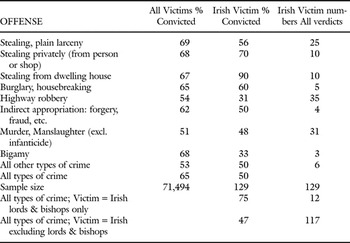
This is not an easy issue to investigate, however. The recognizances binding victims to appear and prosecute did not record the victim's ethnic background, and other sources that might enable us to measure the success of Irish prosecutors are rarely available.Footnote 25 The Old Bailey Criminal Registers, for example, only record the birthplace of the accused. However, although the OBSP also include no systematic record of the victim's birthplace, the testimony given at the trial—much of which was recorded in the OBSP—did sometimes include references made by witnesses, victims, or offenders either to their own place of birth or to that of others. After extensive keyword searches, 129 Irish victims have been identified between 1750 and 1825. This is not a typical sample of those who actually brought prosecutions. The more detailed the trial report, the more likely that the ethnic background of either the accused or the victim would be mentioned. Since murder trials were usually longer, a much higher proportion of them offer ethnic identification information. Only just over 1 percent of all trials were murders, but homicides account for 24 percent of the trials in which the OBSP definitely identified the victim as Irish, and a considerable distortion also occurred in highway robbery cases, the equivalent figures here being 6 and 27 percent.Footnote 26 Other cases in which victims could be identified as Irish were fairly evenly distributed among the most popular types of indictment and, since the ethnic background of the prosecutor/victim was not recorded more frequently in cases where they had been unsuccessful, the comparison of conviction rates in all cases with those known to involve Irish victims (table 1) offers interesting insights.Footnote 27
Comparison of OBSP Conviction Rates, Irish Victims, and All Victims 1750–1825

Between 1750 and 1825, Irish victims were considerably less likely to obtain a conviction. Two-thirds of all prosecutions reported in the OBSP ended in a guilty verdict, compared to only half of those brought by Irish victims. Moreover, this figure falls to 47 percent if the twelve members of the Irish aristocracy who were victims of crime are excluded (see table 1 final line), because they achieved a 75 percent conviction rate. In two of the three specific categories of crime for which the sample size of Irish victims is reasonably large—plain stealing and highway robbery—a similar and substantial difference is also in evidence. Less than a third of Irish robbery victims obtained a conviction, compared to 54 percent of all robbery prosecutors. Irish victims of simple theft were a fifth less likely to get a conviction (table 1). They were also slightly less successful in murder cases, and even when they got a conviction, they very rarely obtained more than a partial verdict of manslaughter—a verdict that often resulted in only minor punishment such as the one shilling fines handed out to two Englishmen for killing an Irishman with a knife after being attacked by a group of Irish coal heavers.Footnote 28 This failure to get full convictions meant that killing a non-Irish person was three times more likely to take the offender to the gallows than if the person killed was Irish. Since they were also less successful than average when they prosecuted cases of indirect appropriation such as fraud, Irish prosecutors at the Old Bailey clearly labored under considerable disadvantages.Footnote 29
The causes of these differentials are difficult to unravel. The Irish may have been more inclined to bring prosecutions in which the evidence was less conclusive or convincing. Several highway robbery acquittals can be linked to the fact that, after a fight between Irishmen, one would accuse the other of robbing him. In 1766, after a street fight with an Irish drinking companion, Brian Swinney found himself indicted for the robbery of his opponent's hat and wig, but the trial soon uncovered the context and Swinney was acquitted because “the jury had a very bad opinion of the prosecutor.” In 1789 two Irish haymakers were prosecuted by another Irishman for robbing him of his pitchfork and some money, but it was seen as “nothing but an Irish quarrel” and he was acquitted. In 1799 alone, at least four extremely tenuous accusations of highway robbery were brought by Irishmen, three of which arose out of fights and three of which were brought against their fellow countrymen. All four resulted in acquittals.Footnote 30
While this undoubtedly helps to explain why Irish prosecutors bringing robbery accusations were roughly half as successful as non-Irish ones, many other factors such as the relative poverty of most Irish prosecutors (and their consequent inability to hire counsel) almost certainly contributed to their relatively low success rate. Some Irish victims also suffered other problems such as a lack of English language skills, a lack of literacy, and a lack of understanding of legal practices and customs. A significant number of Irish victims clearly had only a limited command of the English language, just as many Irish-speaking defendants also had insufficient knowledge of English to understand the case against them. In 1785, for example, Timothy Bryan was permitted to cross-examine a witness against him in Irish after his counsel had pleaded that “he is newly come from Ireland, and does not understand English well enough to know what the witnesses say.” Twenty years later, an Irishwoman stood mute because “she had lately come from Ireland and she could not speak or understand English.” The court was often reasonably indulgent in these situations. When it became clear in 1816 that three Irish counterfeiters were “unable to articulate the English language . . . an interpreter was accordingly sworn to . . . communicate their defence to the court,” and on other occasions Irish witnesses who could speak some English may well have been difficult for the court to understand because of the thickness of their accents.Footnote 31 Sometimes an Irish defendant's ignorance of legal proceedings led the courts to make further allowances. In 1819 The Times reported that “a poor illiterate Irishman” accused of bank note forgery had stupidly refused to plead guilty to the lesser crime of uttering and had therefore not availed himself of an informal plea bargaining tradition that would have enabled him to avoid the gallows. His counsel then asked the court to allow him to retract his plea pointing out that “he was a poor ignorant Irishman and . . . did not know what he was about.” “An Irishman,” he then pointed out, “is always by courtesy allowed to speak twice.” The Irish defendant was then permitted to plead guilty to the lesser offense and was acquitted of the capital charge.Footnote 32
Irish victims' poverty, illiteracy, and ignorance of the law were not, however, the only factors that hampered them in obtaining convictions. Many of the middling Londoners from whom the Old Bailey juries were drawn may have embraced such negative stereotypes about the Irish that they instinctively gave less credence to their testimony. The OBSP certainly records many insults directed at the Irish by witnesses: “You lie you Irish bugger,” “Damn the Irish rebels they should all be put to death,” “he said he would cut my bloody Irish blood out,” “he would hang any Irish man or any Irish woman for a shilling,” “go along you Irish faggot,” “You Irish bitch,” “Murder the Irish dog,” and “Don't ask the Irish bastard's pardon I will break out his daylights” provide a reasonable flavor. Other comments, though less direct, were equally derogatory: “She being an Irish girl who I knew were not particular” and “I saw a great many people of inferior character such as Irish labourers” being two typical examples.Footnote 33 Although similar insults were directed at other groups or simply at neighbors in the heat of the moment, there is a considerably greater density of anti-Irish comments in the OBSP. While the impact of such prejudices on jurors' willingness to both believe Irish victims and find offenders fully guilty of crimes committed against them remains very difficult to unravel, Irish victims' relatively low success rates as prosecutors were almost certainly partly related to the prejudices many Londoners harbored against them.
■ ■ ■
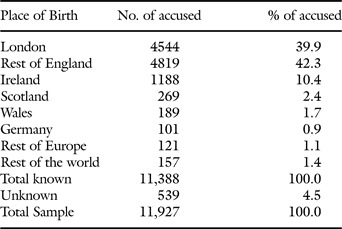
Turning now to the courts' reactions to Irish men and women when they came as the accused rather than as witnesses or prosecutors, the Criminal Registers listing those awaiting trial at the Old Bailey can be used to examine the impact of ethnicity on prosecution levels, types of crime, verdicts, and punishments. These sources, like the OBSP, are not of course a guide to all the crimes that actually took place, because they exclude both those that were never prosecuted and the minor crimes that were tried summarily or at the metropolis's quarter sessions level courts. They do, however, contain records of all the defendants who appeared before the Old Bailey, including those who were acquitted and those whose indictments were “not found” by the grand jury and were not therefore sent for public trial.Footnote 34 More important for our purposes here, from 1791 until 1805 the Criminal Registers contain much greater detail than they had previously done or would subsequently do. In 1802, for example, Stephen Byrne was described as “Aged 36, 5ft 10in, fair complexion, born in the county of Wicklow, a silk weaver.” Birthplace information such as this allows us to calculate the proportion of different ethnic and migrant groups found among the accused.Footnote 35 As table 2 indicates, over a sixth of the Old Bailey accused came from outside England, but lacking precise pre-1841 information on the proportion of London's population that came from different ethnic/national groups, only an approximate calculation can be made about how under- or overrepresented each of these groups was among the accused.
Old Bailey Accused, 1791–1805, Place of Birth

The London-born were inevitably underrepresented because most migrants did not arrive in the capital until their late teens or twenties, which meant that the one-third of London's inhabitants who were largely immune from prosecution because they were under age fifteen had mainly been born in the metropolis.Footnote 36 Despite this background, not all migrant groups formed a larger proportion of the accused than of the London population in general. The sizable German community was not significantly overrepresented nor, it seems, were black offenders, although the size of London's black population is difficult to calculate. Migrants from other parts of Britain were somewhat overrepresented. The Scots, who constituted around 1.4 percent of the London population in 1841, accounted for 2.4 percent of the 1791–1805 accused, and the equivalent figures for the Welsh were 0.8 and 1.7 percent. However, the Irish clearly stood out as the only ethnic group making a highly disproportionate impact. Although they constituted only between 2 and 3 percent of London's inhabitants in 1791–1805, 10.4 percent of the accused were Irish-born, making them between 3.5 and 5.2 times better represented among the accused than they were in the general population. They were also heavily overrepresented among London's prostitutes and among all the lesser offenders imprisoned after summary trial. In 1828, 14.3 percent of the prisoners in London's goals were Irish.Footnote 37 Given that Jewish offenders, like their black contemporaries, seem to have been under- rather than overrepresented, the Irish were clearly the main ethnic group that made a disproportionate contribution to the London accused.Footnote 38
This heavy Irish overrepresentation may have been partly linked to the negative attitudes of many of London's population toward them, but concrete evidence about the ways such attitudes might have increased London victims' propensity to prosecute when the offender was Irish is difficult to uncover. The Home Office pardoning archive, which contains the petitions of prisoners and related judges reports, does occasionally offer insights from outside London. In 1791 a Dublin craftsman working for a Birmingham silversmith, who had been sentenced to transportation for stealing his master's silver, claimed that his prosecution was the result of a plot “laid . . . to drive him out of the country.” On arrival, his shopmates told him “the waste silver and the clippings” were allowed by the master as a perquisite of the trade and that he should sell them to supply his shopmates with ale. When he did so, they had him arrestedFootnote 39
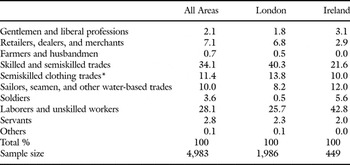
However, the overrepresentation of the Irish among the London accused in 1791–1805 does not seem to have been a product of specific moral panics about Irish offenders since, before 1810 at least, contemporary commentators rarely pinpointed the Irish as being especially prone to commit property crimes. The poverty of the Irish was almost certainly a more central reason for their overrepresentation among property offenders. Surveys made in the 1770s and the 1810s indicate that many of London's vagrants and beggars were Irish, and the census data available after 1841 shows that the Irish tended to gravitate to the less skilled, lowest paid, and least secure forms of employment.Footnote 40 The occupational data extracted from the Criminal Registers for 1791–1805 (table 3), which confirms that Irish offenders were more likely to follow unskilled occupations and much less likely to be skilled artisans, also suggests similar links between poverty and Irish crime. However, since the age profiles of London's Scottish, Welsh, and Irish offenders were very similar, age was almost certainly not a key factor in explaining Irish overrepresentation.Footnote 41 Nor was gender. The proportion of the Irish accused who were female (31 percent) was only slightly larger than the overall average (27 percent). Moreover, since men were much more likely than women to end up being prosecuted, those ethnic groups that were male dominated (such as the black community and the sailor-dominated non-European born) might have been expected to be better represented among the accused than communities such as the Irish, which contained relatively large numbers of females. On the whole, however, they were not.Footnote 42
Occupations of Male Old Bailey Accused by Place of Birth, 1791–1805

*Tailors, shoemakers, and weavers.
■ ■ ■
What types of crime were the Irish indicted for? Since nearly 90 percent of the crimes tried at the Old Bailey between 1791 and 1805 involved the appropriation of property, the great majority of offenders from every ethnic group, including the Irish, were accused of theft. Just over 9 percent of Old Bailey property offenders were Irish, making them at least three times overrepresented compared to their proportions in the general population, but the percentage varied considerably between different categories of property crime. The Irish were rather more prominent (11 percent) among those accused of highway robbery and much less prominent amongst horse thieves, cattle thieves, and housebreakers, while it was only among those accused of coining and uttering that they made a major impact (28 percent), thus confirming Colquhoun's observations about their widespread involvement in these crimes.Footnote 43
The Irish stood out particularly prominently among those accused of violent offenses. Since the vast majority of nonlethal violent crimes were tried in the lower quarter sessions or petty sessions courts (where the offender's ethnicity was not recorded), the sample sizes for violent crimes are relatively small. However, the Irish were massively overrepresented among Old Bailey indictments for violent crimes just as they later were in the lower courts of many mid-Victorian cities.Footnote 44 Just under 20 percent of all those accused of riot, affray, assault, murder, and rape were Irish, making them at least six times overrepresented. Within this broader category, nearly half of those tried for riot or affray were Irish born—a considerable achievement given that they accounted for only 2 to 3 percent of London's population. Twenty-four percent of rape cases also involved Irish accused, making them at least eight times overrepresented among this admittedly small subgroup of the accused. In addition, the Irish contributed 12 percent of those indicted for assault and 14 percent of those accused of murder. Moreover, the Irish actually constituted a considerably higher proportion of murderers because in 1799—one of the three years excluded from these 1791–1805 calculations because the Criminal Registers do not survive for that year—a further ten Irish men and women were tried for one murder, making the overall figure nearly 20 percent during this decade and a half.Footnote 45
Contemporaries were not slow to link the Irish with violent crime. In 1815 a London-based magistrate complained that “[t]he Irish poor are worse than the English. . . . We hardly ever hear of a riot, or a murder . . . in which some of these poor creatures are not implicated.” Four years earlier, a foreign visitor who came across “a colony of Irish labourers who fill every cellar and garret,” described them as “very poor, very uncleanly and very turbulent. They give each other pitch battles every Saturday night.”Footnote 46 However, apart from suggesting general links with their heavy drinking habits and with the immensely overcrowded and poverty-stricken conditions that most Irish families lived in, contemporary commentators rarely provide explanations for this Irish overrepresentation among violent offenders.Footnote 47 Religious differences and riots against the Orange Association did not play a regular role in London in this period, although they led to an increasing number of arrests in Liverpool and Manchester.Footnote 48 Police attitudes, however, may well have played a part. In 1798, for example, a massive Boxing Day police raid on a peaceful Irish pub ended in a large-scale confrontation between “the Irish people in St Giles” and the police, which resulted in the indictment of ten Irish men and women for murdering a Bow Street Officer. Although the warrant that the raid was based on was illegal and the defense proved that, because the accused were resisting unlawful arrest, the charge should only be manslaughter, three of them were still capitally convicted, hanged, and dissected.Footnote 49 Several early nineteenth-century newspapers reported other incidents in which policemen were killed or badly injured after being called in to quell fights, riots, or violent rescues involving the Irish. In 1814 a watchman was badly wounded while breaking up a fight, and although his fellow watchmen arrested the Irishman responsible, they were then attacked by over sixty Irish rescuers and one of them was killed.Footnote 50 The reputation of the Irish as good fighters sometimes led to their being hired in election contests and to their involvement in violent altercations that resulted in murder trials as “Proctors Irish gang” were during the 1769 Middlesex election and as “a great body of Irish chairmen” armed with bludgeons who attacked those who “wouldn't call out Fox forever” were in 1784.Footnote 51 Irishmen also responded violently to prejudicial statements about their country. In 1815, for example, two Irishmen returning home from a whiskey-drinking evening in Wapping started a fight that ended in a murder after overhearing what they believed was insulting talk about the Irish nation.Footnote 52
Many Irish migrants may also have brought with them what John Carter Wood has described as a “customary” attitude toward violence—that is, one in which direct physical confrontation is seen as a legitimate response, an accepted form of retribution, a means of reinforcing communal norms, an expression of masculinity, and even sometimes a recreational resource. This would explain why Irish migrants had a greater propensity to resort to violence to resolve disputes, exact revenge, defend their honor, or simply create entertainment.Footnote 53 Irish historians continue to debate whether interpersonal violence in Ireland was primarily about upholding male honor or whether it mainly reflected a desire for recreation, but whatever their motives, many Irish migrants almost certainly brought with them a different and more tolerant spectrum of attitudes toward violence.Footnote 54 The Irish faction fight, for example, a ritualized brawl involving large numbers and any weapon that came to hand, was a feature of London's Irish communities just as it was of their counterparts in rural Ireland.Footnote 55 In 1816–17 London magistrates noted that “dreadful affrays where they half murder each other” were a feature of the Irish community and described pitched battles every Saturday night and regular Sunday morning fights in St. Giles involving hundreds of drunken Irishmen with “shelelas.”Footnote 56 Some Old Bailey prosecutions clearly arose from such contexts. In 1814 a faction fight in St. Giles between “the Limericks” and the “Cork people,” in which swords, bludgeons, and scaffolding poles were the main weapons of choice, ended in two Irishmen being indicted for murder.Footnote 57 Thus, although prejudice, policing methods, and poverty clearly contributed to the general overrepresentation of the Irish among the Old Bailey accused, their even greater role among violent offenders may also have been linked to the traditions of riot and to the customary attitudes legitimating violence that many migrants brought with them.
■ ■ ■
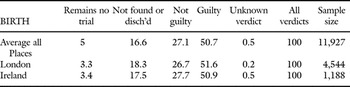
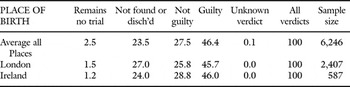
The 1791–1805 data on nearly twelve thousand accused also makes it possible to compare the verdicts and the sentences received by Irish and non-Irish offenders. A surprisingly high proportion of all Old Bailey trials did not end in a guilty verdict (table 4). Five percent of all offenders listed in the Criminal Registers were either remanded back to prison, died before trial, were transferred to another court, or avoided going before the grand jury for other reasons. Nearly 17 percent were then “discharged by proclamation” either because their prosecutors failed to turn up or because the private grand jury hearing returned a “not found” verdict. A further 27 percent were publicly tried before an Old Bailey petty jury but then found not guilty.
Verdict by Place of Birth, All Old Bailey Accused 1791–1805, Percentages

Note:—partial verdict and insane added to guilty.
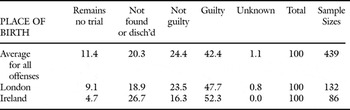
As table 4 makes clear, the Irish accused were dealt with in a very similar way to the rest of those indicted at the Old Bailey. They were very slightly less likely to be remanded without reaching the grand jury and slightly more likely to attract a favorable verdict from the grand jury. Their acquittal rate following a public trial was almost exactly the same as that for all offenders, and overall, therefore, the Irish had only a slightly higher conviction rate than the rest of the accused and a slightly lower one than the London born. The Irish also had a marginally lower conviction rate than average in cases of simple larceny (table 5) and a 2 percent lower rate in cases involving shoplifting, pickpocketing, and stealing in the dwelling house. Conversely, their conviction rate for indirect appropriation was around 3 percent higher, and the overall rate for robbery and housebreaking was just under 4 percent greater.Footnote 58 However, for crimes involving violence, the Irish stood a significantly greater chance of being convicted. On average 42 percent of offenders accused of murder, rape, riot, and affray were convicted. The equivalent figure for the Irish born was 52 percent (table 6). The difference was particularly noticeable among the relatively small number of rape trials. It was extremely difficult to obtain a conviction for rape at the Old Bailey, and only one of the thirty-one non-Irish accused prosecuted for rape suffered this outcome. However, 44 percent of the nine Irishmen accused of rape in the period from 1791 to 1805 were found guilty. Thus of the five offenders fully convicted of rape and sentenced to death, four were Irish.Footnote 59
Plain Stealing Only, Verdict by Place of Birth, Old Bailey, 1791–1805

Violent Offenses, Verdict by Place of Birth, Old Bailey, 1791–1805

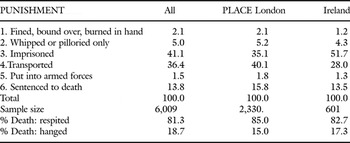
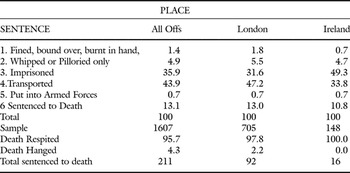
The Criminal Registers also provide evidence about sentencing patterns in relation to the Irish. Between 1791 and 1805 the Irish did not generally receive heavier than average sentences (table 7). They were slightly less likely to receive the three lightest punishments—fining, branding, and whipping—but they were no more likely than average to be sentenced to death. Once sentenced to death, they had about the same chances of getting a reprieve as all capital convicts. Moreover, the court's decisions about its two most widely utilized sentencing options tended to favor the Irish. They were considerably less likely to be transported (28.0 compared to 36.4) and much more likely to be imprisoned (51.7 compared to 41.1). However, within this broad pattern (table 7) there were major differences in sentencing policies according to the type of crime involved and the degree of violence it entailed.
Sentence by Place of Birth, All types of Crime, Old Bailey, 1791–1805

Note:—Excluding sentence unknown and those not convicted—percentages.
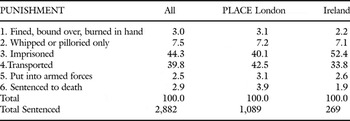
For every category of property crime the sentences given to the Irish born tended to be less harsh. Among the large numbers convicted of simple larceny, for example, about 10 percent of both Irish and non-Irish convicts were fined, whipped, or sent into the armed forces. However, the Irish were a fifth more likely to receive a sentence of imprisonment and a sixth less likely to be transported (table 8). This pattern of transporting a smaller proportion of Irish convicts and imprisoning a higher one, while using other punishments fairly equally, was even starker in cases involving shoplifting, pickpocketing, and stealing from the dwelling house (table 9). Here the Irish were over a third more likely to be imprisoned, while the non-Irish were nearly a third more likely to be transported, a pattern that can also be seen among those convicted of indirect appropriation.Footnote 60 In housebreaking and robbery cases, most offenders were sentenced to death and around two-thirds of both Irish and non-Irish experienced this sanction. However, although the numbers are small, it appears that the Irish found it slightly easier to obtain a pardon, and among those who avoided the capital sanction by obtaining a partial verdict, the Irish were much more likely to be imprisoned rather than transported.
Plain Stealing Only, Sentence by Place of Birth, Old Bailey, 1791–1805, Percentages

Note:—Transportation includes sentences to the “Hulks” or the “Thames”.
Shoplifting, Pickpocketing and Stealing from the Dwelling House, Sentence by Place of Birth Old Bailey 1791–1805

excl not Convicted and Sentence Unknown.
By contrast, among the relatively small number of offenders found guilty of violent offences, the Irish seem to have received slightly tougher sentences. Within the rather mixed overall category of violent offenders, which included both major capital crimes, like murder and rape, and minor misdemeanors, such as assault, the Irish were never given the mildest sentence, a fine, and were rather more likely to be sentenced to death. Within the most important subcategory of violent crime, murder, the Irish were more than twice as likely to be sentenced to death as the non-Irish.
The complex and interconnected nature of the criminal justice process makes it difficult to unravel why verdict and sentencing policies differed between ethnic groups. Acquittal rates in property crime cases involving Irish defendants may, for example, have been as high as those for the non-Irish, not because juries treated the Irish equally, but because victims and magistrates were more willing to bring poorly evidenced cases against the Irish (thus explaining in part their massive overrepresentation among the accused). If this was true (as the cases already discussed in which robbery prosecutions were brought against Irishmen after minor fights suggests it may be), then the indictments against Irish defendants that eventually reached the jury courts would have included a higher proportion of cases in which the evidence was weak. Even if juries were naturally slightly biased against Irish defendants, their tendency toward mercy where the evidence was less full would then have kept acquittal rates in Irish cases at average levels. Equally, when the Irish brought cases against each other, which they fairly frequently did, the jurors' reluctance to convict when the prosecutor was Irish would have increased acquittal levels among those Irish offenders fortunate enough to be indicted by a countryman.
Despite these problems, however, two important and contrasting patterns of judicial decision making stand out. First, no consistent evidence of anti-Irish attitudes can be found in the 90 percent of Old Bailey cases that involved property crime. The court's preference for imprisoning rather than transporting Irish thieves may well have been linked to the perception that the Irish would have seen transportation as less of a punishment, which in turn may have been connected to the fact that the widespread use of transportation by the Irish courts meant that a third of the Australian population was Irish born. Contemporaries certainly worried that for young unattached offenders transportation held few fears, and they may have felt the same about many of the impoverished and recently arrived Irish convicts, for whom transportation would not have involved separation from deeply held ties of family or neighborhood.Footnote 61 Alternatively, this policy may reflect sympathy for some Irish offenders, many of whom were extremely poor and vulnerable, strangers in a strange land whose language they hardly knew. Whatever the reasons, Irish offenders were, on average, between 20 and 50 percent more likely to avoid transportation than their non-Irish counterparts. This was no minor difference. Although many of those sentenced to transportation actually spent much, if not all, of their sentence imprisoned on the hulks (especially if they had been sentenced to only seven years transportation rather than fourteen years or life), the average length of their imprisonment would still have been massively longer. The average Old Bailey prison sentence lasted between six months and a year, whereas those transported or held in the hulks following a transportation sentence faced a minimum of six to seven years, which meant that their average time in confinement increased about tenfold. Because Irish convicts attracted more imprisonment sentences, the average Irish offender was detained in posttrial custody for a considerably shorter time.
The contrast between this pattern and the second one—the tendency for the Irish to gain fewer acquittals when accused of violent crimes and to be subjected to harsher sentences once convicted for them—is stark. It is surely no coincidence that the only type of crime for which there is substantial evidence that the judicial system had a significant bias against Irish offenders was precisely the category of crime for which they were most notorious and within which they made up a much more substantial proportion of offenders.
■ ■ ■
Around the second decade of the nineteenth century, attitudes toward Irish offenders, and toward the Irish more generally, began to change. Between the mid-eighteenth century and the end of the Napoleonic Wars, the period mainly focussed on here, Irish offenders remained relatively unremarked on both by those who wrote about criminal justice and by the newspapers in their everyday crime reporting.Footnote 62 However, as Patty Seleski has shown, this changed after 1815. As the Irish economy fell into difficult times and waves of Irish migrants flooded into Britain from rural Ireland, and as many Irishmen left the armed forces following the massive demobilization at the end of the Napoleonic Wars, the London authorities increasingly saw the Irish as a huge poor law burden and a threat. “The limited ability of the English poor law to cope with Irish poverty,” Seleski argues, “combined with the magnitude of Irish immigrant poverty . . . to demonize both the Irish poor and Irishness itself.”Footnote 63 As the Irish became simultaneously a more visible and a less acceptable presence, she argues, so their involvement in crime began to be reinterpreted. To illustrate this, she uses a notorious murder involving both Irish victims and an Irish accused. When the case was first reported in 1813, the newspapers made very little of the offenders' Irish background; “Irishness as a signifying identity played no role.”Footnote 64 However, when the case was reprinted in a collection of notorious trials in 1828, it was respun as a threatening narrative of Irish predation and used as part of a call to end Irish immigration into Britain.Footnote 65
Seleski offered no further analysis of changing attitudes toward Irish offenders after 1815, but both the London newspapers and those printed in major areas of Irish in-migration such as Manchester and Liverpool were increasingly highlighting Irish crime and the problems it posed.Footnote 66 This theme of Irish crime can also be found in the many contemporary parliamentary reports about criminality and its policing. As early as 1815, the Irish poor in London were being described as “a growing evil” not only because they would “increase the parochial rates” but also because their growing numbers “must affect the policing of the town,” and the long-established Irish “rookery” in St. Giles was thought to shelter “the greatest thieves in London.”Footnote 67 Later parliamentary reports occasionally referred to a tendency for the Irish to commit “petty depredations,” and one report assumed that among Irish children “the boys mostly become thieves and the girls prostitutes.”Footnote 68 However, the broad nationwide reports of the 1826–1828 Select Committees on Criminal Commitments, which focused primarily on property offenses, rarely mentioned Irish thieves. When the high constable of Birmingham was asked whether the Irish were “oftener than any other individuals connected with crime,” he replied, “No, I do not think that they are; their crimes are generally those of being unruly or fighting, but they are not more criminal than others.” When it came to property crime, he regarded the Irish as “rather poor than wicked,” but it is interesting that, like many other early nineteenth-century commentators, he made a clear link between the Irish and violence.Footnote 69
Irish faction fights and Sunday morning brawls in areas such as St. Giles were widely commented on in the parliamentary reports, and after 1815 the press began to highlight stories about “Irish rows” and large-scale fighting.Footnote 70 Reporting a “violent outrage” in Fleet-market in 1815, for example, the Morning Chronicle noted that “the case arose from one of those unfortunate scenes called ‘an Irish row,’” and two years later, after reporting that a Southwark pub had been nearly demolished by “an assemblage of the lower class of Irish,” who had also attacked the local watchmen, the Observer described the Irishmen's conduct as “very outrageous.”Footnote 71 As Irish migration to other cities rapidly increased, similar “Irish rows” were reported in Manchester, Liverpool, and elsewhere. In 1819, for example, the papers reported that a large group of Irish dockers had broken into Liverpool Bridewell, rescuing one of their compatriots and badly wounding several constables.Footnote 72
By the 1820s, press reports increasingly included stereotypes about Irish violence and lawlessness, using phrases such as “speak of an Irishman and you speak of a man disposed to riot and disorder.”Footnote 73 In reporting on another “Irish Row” in Manchester in 1825, for example, the Guardian noted that prosecution counsel “ridiculed the idea that an Irishman would stay in the house when there was a riot in the street merely for the purpose of eating his dinner (as the defence claimed). Fighting was much more acceptable to the natives of the sister kingdom, than meat and drink.”Footnote 74 The press rarely referred to gangs of Irish thieves, but they did begin to highlight the fact that the Irish always “according to custom, made most energetic resistance” when arrested, and this developing discourse may well have influenced the courts' sentencing policies.Footnote 75 Following an Irish riot in Clerkenwell in 1824, in which a number of policemen and watchmen were “dangerously wounded” in a clash with “those fiery spirits,” the court was reported to have handed out heavier sentences than usual “to correct this lawless propensity so peculiar to the un-reclaimed Emeralders.”Footnote 76 The gradual emergence of the Irish as the main ethnic criminal “other” of the mid-Victorian period—that is, as the group whom propertied Englishmen were most concerned about and whom (partly in consequence of their fears) they saw as having a particular predisposition toward violence and disorder—mainly occurred after the period studied here.Footnote 77 However, there were signs by the mid-1820s that the Irish would soon be attracting much greater attention from those writing about crime, and many of the themes such as “Irish rows” that began attracting regular headlines in the Victorian period were clearly emerging before 1825.Footnote 78
■ ■ ■
The London sources, and especially the Criminal Registers, have enabled us to build up for the first time a well-evidenced picture of justice and prejudice in relation to the Irish in the later eighteenth and early nineteenth centuries. It is not a full picture of course. Although the Old Bailey heard a higher proportion of felony and petty larceny cases than most eighteenth-century provincial assize courts, many minor thefts and assault cases went to the Middlesex, Westminster, or London sessions or were heard in the petty session courts.Footnote 79 In the absence of systematic ethnic information on offenders in other areas of Irish in-migration such as Liverpool and Manchester, we cannot be certain that the London pattern was typical. Nonetheless, by the 1820s, the newspapers published in these cities often carried similar stories about Irish offenders and their treatment, and later nineteenth-century evidence suggests many similarities between London and the rest of England and Wales, or at least with the urban part of it. The nationwide statistics available for the 1870s indicate that the Irish born constituted around 14 percent of the prison population and about 2.5 percent of the national population—very similar to the equivalent 1828 London figures.Footnote 80
Although the end of the period 1750–1825 witnessed the beginnings of a major change in attitudes toward Irish offenders, during the pre-1815 period, that transformation had hardly begun. At this point, attitudes toward Irish offenders, and the various policies pursued by the courts toward them, were far from unidirectional, and the fundamental ambivalence of the English toward the Irish was clearly reflected in the ways the Irish were treated by the English criminal justice system. Although several commentators regarded the Irish as “unreliable and drunken,” this did not stop many London parishes from employing large numbers of Irishmen as watchmen, and when the Metropolitan Police was formed in 1829, more than a sixth of its constables (some five hundred in all) were Irish.Footnote 81 Irishmen were therefore even more overrepresented among the capital's police than they were among its recorded offenders. The Irish may or may not have been more prone to give false evidence, but contemporary attitudes stressing their deceitfulness were mirrored in the ways their evidence was often treated, and their much lower success rate as prosecutors was partly a reflection of these negative attitudes.
The Irish were also frequently portrayed as “implacable and violent,” and once again these discursive frameworks found parallels in the court records and seem to have had an impact on their treatment.Footnote 82 Whether they were actually more violent or simply more likely to be arrested if they committed a violent act cannot be finally determined, but their massive overrepresentation among those accused of violence was almost certainly in part a reflection of these discursive frameworks, although it may also have been influenced by the broader acceptance of violence that many Irish migrants brought with them. The fact that nearly half of all those indicted at the Old Bailey for riot were Irish suggests, for example, that cases involving the Irish may well have been sent to that court rather than to the lower sessions courts precisely because the authorities regarded the Irish as a particular threat. Equally important as a guide to contemporary attitudes and their impact is the fact that the Irish were more harshly dealt with by the courts in cases involving violence. They were more than three times as likely to be convicted of rape and twice as likely to be fully convicted of murder. Perceived as more violent, and appearing by the frequency with which they were prosecuted to actually be so, they paid the price by suffering harsher verdicts and sentences in the courts.
These negative attitudes were not, however, in evidence in the vast majority of Old Bailey cases—those involving property offenders. Although the Irish were also overrepresented among these offenders, the court's decisions seem to have been unaffected by the large numbers of Irish property offenders coming before them. The fact that their success rate in obtaining pardons was much the same as that achieved by the non-Irish also suggests that they were rarely the victims of prejudice, particularly since a search of the Home Office pardoning archive before 1810 has revealed hardly any cases in which judges openly expressed hostility toward Irish petitioners.Footnote 83
The massive overrepresentation of the Irish among the accused does however suggest a less positive side to the picture. The fact that the Welsh and the Scots were also overrepresented may partly reflect the fact that all long-distance migrants had fewer networks (or less money) through which they could persuade victims not to prosecute, but this does not explain why the Irish were much more heavily overrepresented than any other migrant group. They may simply have been both poorer and more prone to petty crime, but they may also have been victims of the negative attitudes of London citizens toward the Irish poor, which probably resulted in a higher propensity to use formal prosecution as a means of sweeping Irish offenders off the streets. The Irish were therefore on the receiving end of both justice and prejudice. In the vast majority of Old Bailey cases, their conviction rates were no higher than average and they received slightly lighter sentences overall. However, although the great majority of Irish accused were not discriminated against, their reputation for being both inherently deceitful and prone to excessive violence meant that they were picked out for more negative treatment than other groups when they brought prosecutions and when they were accused of violent offences. The treatment of Irish men and women accused of violence is particularly significant. In relation to this subgroup of offenders at least, the attitudes and prejudices of contemporaries seem to have had real consequences because they were reflected in the harsher verdicts and sentences the courts inflicted on the Irish accused.
The criminal justice system of this period therefore provides an important historical prism through which attitudes to ethnicity can be studied and the subtle interactions between discursive frameworks and actual decision-making practices can be analyzed. The complex ways in which those who used and manned the courts dealt with the Irish clearly reflected the deep ambivalence the English felt toward them throughout the period 1750–1825.Footnote 84 However, if the evidence provided by the criminal justice records is any guide, historians should be careful not to assume that there was a deeply held and unidirectional prejudice against the Irish in the later eighteenth century and at the beginning of the nineteenth. Attitudes were changing by the second quarter of the nineteenth century, but the court records provide only limited evidence of prejudice obstructing justice in the period studied here. The criminal courts should not be idealized. They were never, as some elite contemporary commentators tried to suggest, a fair or entirely equitable forum without bias or prejudice. Yet the relatively equal and occasionally favorable treatment meted out to Irish property offenders suggests that the courts were not simply vehicles of propertied prejudice. The low reputation of the Irish poor was not usually translated into harsher verdicts or sentences, and by establishing this, the work presented here adds another plank to the arguments of those who have suggested that the courts were not just tools of the powerful, but instead embodied rules and traditions that offered at least limited forms of justice to even the least well regarded of the laboring poor.Footnote 85