


1 Introduction
The Epitome of Aristotle on Animals of Aristophanes of Byzantium is, I believe, a largely untapped source of evidence for two lost works of Aristotle, and it is my aim in this Element to show in some detail that this is the case.
Aristophanes of Byzantium (ca. 257–185/180 BC) was (inter alia) a grammarian and Homeric scholar, a student of Zenodotus and Callimachus, and the successor to Eratosthenes as head of the Library of Alexandria.Footnote 1 He composed an epitome of Aristotle’s works on animals in four books.Footnote 2 This work is lost, but the first two books (complete or nearly so) have been preserved in a tenth-century Byzantine zoological anthology compiled for Emperor Constantine VII Porphyrogenitus. Following a growing consensus, I refer to this latter work, which consists of two books, as Sylloge de historia animalium (Συλλογὴ τῆς περὶ ζῴων ἱστορίας, Collection of the Research-Results Concerning Animals),Footnote 3 or Sylloge for short.Footnote 4 It is made clear at the outset of the Sylloge that Aristophanes was the compiler’s main source, supplemented by material from Aelian (ca. 170–235), Timotheus of Gaza (fifth to sixth century), and a few others.Footnote 5
It is important to note at the outset that, as both the title and the content of the Sylloge make clear, Aristophanes’ Epitome of the Works of Aristotle on Animals (Ἀριστοφάνους τῶν Ἀριστοτέλους περὶ ζῴων ἐπιτομή) – Epitome for short – was not an epitome solely of Aristotle’s Historia animalium (HA), even if the περὶ ζῴων in the title was itself a title (i.e., On Animals), and even though the Historia animalium was undoubtedly Aristophanes’ main source. This is because in the Aristophanes material that survives in the Sylloge (more on this shortly), it is clear that in addition to the Historia animalium Aristophanes made use of the Generation of Animals (GA) and Parts of Animals (PA), as well as the Mirabilia and Problemata physicaFootnote 6 attributed to Aristotle – and two lost works, namely the DissectionsFootnote 7 and the Zoïka (Animal Matters),Footnote 8 or so I shall argue.Footnote 9 My primary focus is on the Zoïka. All the evidence for the Dissections is found in Sylloge 2, which I turn to in Section 3.Footnote 10
It is useful to pause at this point to say something, however brief, about my conception of what kind of works the Zoïka and the Dissections might have been. Allan Gotthelf (Reference Gotthelf2012, 383) describes Aristotelian biological inquiry as consisting of three stages:Footnote 11
the collection of data, the organization of data, and the explanation of data … There is no surviving treatise at [the collection] stage. This is the notebook stage, where Aristotle records observations and reports, evaluates them, deciding which to accept and which to reject; looks for shared features across different kinds; etc.
The Historia animalium, Gotthelf indicates, is from the organization of data stage, and the Parts of Animals and the Generation of Animals from the explanation of data stage. He goes on to describe, as a work from the collection stage of inquiry, the lost Dissections (383–384), and he speculates (following a suggestion of David Balme) that the Marvelous Things Heard (Mirabilia for short) attributed to Aristotle might “derive from a notebook that was authentic.” I have argued (Mayhew, Reference Mayhew, Mesquita, Noriega-Olmos and Shields2020) that the lost Zoika was just such a collection of data, which would have included both data obtained from direct observations by Aristotle and others in the Lyceum, as well as endoxa (and paradoxa and thaumata) collected by Aristotle or under his direction.Footnote 12 The little evidence we have about the structure of the Zoïka suggests that it was organized according to broad classifications of animals – for example, on fish (as Athenaeus Deipnosophistae 7 makes clear; see Mayhew [Reference Mayhew, Mesquita, Noriega-Olmos and Shields2020]) and on birds (as Athenaeus 9 suggests; see Mayhew [Reference Mayhew, Epstein and Verhasselt2026]).Footnote 13 I am not as certain that the Dissections was merely a work at the collection of data stage of biological inquiry, as for all we know it may well have contained a more theoretical discussion of the proper procedures of dissection.
It makes sense that Aristophanes would draw on all of Aristotle’s works on animals – despite the different roles they play in Aristotle’s biological inquiry – as I think Hellmann (Reference Hellmann, Horster and Reitz2010, 570) is right that Aristophanes’ aims in composing his Epitome were likely to have been much different from Aristotle’s in his biological works. He mentions two possibilities (which are not mutually exclusive): It was a library reference work for an audience that included poets (I would specify scholars of Homer and other poets) as well as scientists; and/or it was intended for an audience more interested in entertainment than biology. Given Aristophanes’ interest in Homeric scholarship and his work at the Library of Alexandria, I expect the former was its likely primary aim.Footnote 14
In the remainder of this Introduction, I discuss the nature of the Sylloge and the Epitome and say a bit more about the difference between the aims of the Epitome and of Aristotle’s extant biological works. I then answer objections that have been leveled against regarding the Epitome as a source of fragments for the lost Zoïka. Finally, I discuss the sometimes tricky issue of how to distinguish material in the Sylloge that comes from Aristophanes’ Epitome from material that comes from other sources. Following the Introduction, I turn to the search for fragments itself: In Section 2, I examine possible fragments from Sylloge 1 (which, as I explain, is virtually identical to Epitome 1). I regard a passage as worthy of consideration if there are no clear parallels in Aristotle’s extant works. I discuss thirteen such passages. In Section 3, I consider twenty-two passages from Sylloge 2 (which come from Epitome 2). Evidence for both the Zoïka and the Dissections is evaluated, and objections against regarding the Epitome as a source for the Dissections are addressed. Section 4 is a brief conclusion in which I summarize my results. The Appendix indicates to what extent past compilers of the fragments of Aristotle have made use of Aristophanes’ Epitome. If I am right about Aristophanes’ Epitome as evidence for the lost Zoïka and Dissections, then – as I hope I demonstrate in what follows – the amount of information we have about these works has increased considerably.
A word is in order about the structure of the original Epitome, which can be gleaned from what survives of it in the Sylloge.Footnote 15 All or most of Book 1 is extant in the Sylloge, with some opening remarks from the compiler and possibly some other material inserted by the compiler. So Book 1 of the Epitome is virtually the equivalent of Book 1 of the Sylloge, which has the following structure:Footnote 16
Part 1: A terminological introduction focused on the broad classifications of animals, with some comments on the nature of the work (1.1–26).Footnote 17
Part 2: A summary account of the generation of animals and related topics, drawing on Aristotle’s Generation of Animals as well as his Historia animalium (1.27–96).Footnote 18
Part 3: A survey of an array of facts about animals (1.97–154), first about humans (98–113) then about other animals (114–154). This section is strange, and it is difficult to know its purpose.Footnote 19
The Sylloge’s first book, and so for the most part Aristophanes’ first book as well, ends with the following transitional remarks (in 1.155):
Nearly all that it is possible to say, gathering together [the facts] in summary fashion by more general points, has been stated.Footnote 20 But in the following, as I said before, for each particular animal, kind by kind, I will set forth for you – having deemed it worthy to make a written account – the activities, the modes of life, the character traits, and how many years each can live.
ὅσα μὲν οὖν δυνατὸν ἀναλεξάμενον ὡς ἐπιδρομῆς μέρει καθολικώτερον εἰπεῖν σχεδὸν εἴρηται. ἐν δὲ τῷ ἐχομένῳ, ὡς προεῖπον, κατ’ εἶδος ἑκάστου ζῴου τὰς τε πράξεις καὶ τοὺς βίους, ἔτι δὲ τὰ ἤθη καὶ πόσα δύναται ἕκαστον ζῆν ἔτη ἀναγραφῆς ἀξιώσας ἀναθήσομαί σοι.
The phrase “I will set forth for you [singular]” (ἀναθήσομαί σοι) raises questions about this passage, which cannot be answered with confidence. Either it comes entirely from Aristophanes, who addressed his Epitome to a single person, whose identity is unknown (in which case “the following” refers to books 2–4); or it was written by the compiler of the Sylloge based on what Aristophanes wrote, in which case “you” refers to Emperor Constantine (and “the following” to book 2); or it is largely the transitional passage composed by Aristophanes, which the compiler revised somewhat to make it addressed to Emperor Constantine. Whatever the case, setting down for each animal kind the activities, the modes of life, the character traits, and longevity accurately describes by and large how Aristophanes structured most of the individual entries in his epitome.
There is another, important issue raised by this passage that one must keep in mind in what follows. Is it possible that in compiling an entry on a particular animal – its activities, longevity, et cetera – Aristophanes took some general claim that Aristotle made (e.g., about mammals) and imported it into his entry on a specific mammal, even if Aristotle did not mention that feature in his own discussion of that animal? This has implications for how reliably we can use Aristophanes’ Epitome as a source for lost Aristotle, and I discuss the issue further in Section 3.1.
The opening of the second book of the Sylloge, which must be the opening of the second book of the Epitome as well, says the same thing and more (2.1):Footnote 21
In this composition, being the second in number [i.e., book 2], after indicating beforehand the name of the animal with which I am dealing, I will attempt to place under this [name] how many parts the animal in question possesses, then [speak] about its mode of copulation and how many months it is able to be pregnant, and concerning its birth, what kind of young and how many it is able to bear. And in all cases what is the mode of life of the animal indicated and what its character is and how many years it is able to live. I attempted to do this, so that you do not have to go through the work by Aristotle on animals, which is divided into many [books], but can have gathered together in one place the entire inquiry about each animal, one by one.
ἐν τῇδε τῇ συντάξει, τὸν ἀριθμὸν οὔσῃ δευτέρᾳ, πειράσομαι, προγράφων περὶ οὗ ἐστιν ὁ λόγος ζῴου ὄνομα, προσυποτάσσειν τούτῳ ὅσα τὸ προταχθὲν ζῷον μόρια κέκτηται, εἶτα περὶ τῆς ὀχείας αὐτοῦ καὶ πόσους κύειν δύναται μῆνας, περί τε τῆς ἐκτέξεως ποῖα καὶ πόσα ὑπομένει τίκτειν βρέφη· ἐπὶ πᾶσι δὲ τίς ὁ βίος τοῦ προγραφέντος ζῴου καὶ ποῖον τὸ ἦθος καὶ πόσα δύναται ζῆν ἔτη. τοῦτο δὲ ἐπειράσθην ποιῆσαι, ἵνα μὴ διῃρημένην ἐν πολλοῖς τὴν ὑπὸ Ἀριστοτέλους περὶ ζῴων πραγματείαν ἐπιπορεύῃ, συνηγμένην δὲ ὁμοῦ πᾶσαν τὴν ἐφ’ ἑνὶ ἑκάστῳ ζῴῳ ἱστορίαν ἔχῃς.
Three comments on this last sentence: (1) ἐπιπορεύῃ is second-person singular and so raises the same issue as ἀναθήσομαί σοι in 1.155, just discussed. (2) τὴν ὑπὸ Ἀριστοτέλους περὶ ζῴων πραγματείαν (“the work by Aristotle on animals”) could be a reference to Aristotle’s Historia animalium, which as I said was by far Aristophanes’ main source, or it could be a reference to a compilation of all of Aristotle’s works on animals, labeled On Animals (e.g., in the Library of Alexandria). (3) This sentence seems to imply that the work of Aristotle used by Aristophanes was not organized by animal kind, which arguably would rule out the Zoïka being one of Aristophanes’ sources. I deal with this shortly, in my response to the second objection against using Aristophanes as evidence for the Zoïka.
Following this passage, Aristophanes reports that in the remaining three books of his Epitome, he covers viviparous quadrupeds (i.e., mammals, including humans even though they are bipeds), oviparous quadrupeds (i.e., reptiles and amphibians), fish, and birds – but not insects and the like, as they are unworthy of consideration.Footnote 22 Of these other three books, only the second is extant (or a great deal of it in any case), on mammals.
As has long been noted, and which I need not explore beyond these few brief remarks, Aristophanes’ procedure here contradicts the aims of Aristotle’s biological inquiry in two important ways: (1) The purpose of none of the extant biological works, including the Historia animalia, was to present a sophisticated classification of animals according to kind, providing, for instance, all the information on elephants in one place. The Historia animalium provides an organization of data not primarily according to animal, but in such a way as to facilitate causal explanations, of the sorts found in the Parts of Animals and the Generation of Animals. If I am right that the Zoïka was a collection of preliminary data organized according to animal kind, then this is something quite different from a work that attempts as its purpose the scientific classification of animals according to kind. (2) According to Aristotle, no animal is unworthy of scientific consideration – which is clear, not only from his explicit statement in Parts of Animals 1.5, but also from the space he devotes to the study of insects.Footnote 23
Before proceeding to the search for evidence of lost Aristotle in Aristophanes’ Epitome, I need to mention three objections that one could raise from the outset, which would (or might) stop the present inquiry in its tracks: The first is that this inquiry is pointless because the Zoïka and Aristophanes’ Epitome are the same work. This view had at one time a lot of support,Footnote 24 but it has to my mind been thoroughly refuted, especially by Arnaud Zucker in a recent essay.Footnote 25 But even if this were the case, given the incomplete nature of our evidence for the Epitome and especially the Zoïka, it would be impossible to establish. For most of the surviving evidence for the Zoïka concerns fish and birds, whereas what remains of the Epitome deals more than anything else with mammals.
A second objection is more challenging: Why would Aristophanes have gone through Aristotle’s works and placed the information about an individual animal together under the heading of that animal’s name, if he had access to the Zoïka, a work that was (so far as one can tell) also organized according to animal kind? First, if the Zoïka was a massive collection of all the data that Aristotle and his colleagues had compiled, organized according to animal but in no other way, it would have been a clumsy book – hardly the convenient encyclopedic work that Aristophanes aimed to create, organized as described in Sylloge 1.155 and 2.1. Second, this collection would not have been limited to direct observations in the field but would have included all kinds of endoxa, paradoxa, and thaumata, the veracity of which had not in every case been confirmed or rejected, making it on its own unreliable as a reference work.Footnote 26 Whatever the case may be, there are passages that Aristophanes presents that have no parallel in the Historia animalium and that seem to be exactly what we would expect from the Zoïka, as I have described that work.
A third objection is that, given the references to Aristophanes’ work on animals in other ancient or Byzantine texts, there is in fact no reason to think that it was an epitome of the works of Aristotle.Footnote 27 First, on this view one could deny that Aristophanes himself ever called his work an epitome, rather the compiler of the Sylloge did (recall the second heading in the manuscript: Ἀριστοφάνους τῶν Ἀριστοτέλους περὶ ζῴων ἐπιτομή). But in the absence of any other evidence, this heading, for what it is worth, would tend to count in favor of considering this an epitome of the works of Aristotle, not against it. There is, however, other evidence: Four texts refer to this work, and two of them indicate that it is an epitome of works of Aristotle.Footnote 28 Of these four, only Photius (ninth century) mentions neither Aristotle’s name nor that Aristophanes’ work is an epitome.Footnote 29 But this on its own neither supports nor undercuts the view that Aristophanes’ work was an epitome of Aristotle. Hierocles (fourth century?), however, like the Sylloge, mentions Aristotle’s name and implies that Aristophanes’ work is an epitome:Footnote 30
Aristophanes of Byzantium, epitomizing the [treatises] on the nature of animals from the [works] of the philosopher Aristotle, claims that a horse can live for fifty years and more.
Ἀριστοφάνης οὖν ὁ Βυζάντιος τὰ περὶ φύσεως ζῴων ἐπιτεμόμενος ἐκ τῶν Ἀριστοτέλους τοῦ φιλοσόφου φησὶν ἔτη ζῆν δύνασθαι ἵππον πεντήκοντα καὶ πρός.Footnote 31
John of Lydia (sixth century), On the Offices of the Roman Constitution 3.63, calls Aristophanes’ work an epitome; and although he does not say it is an epitome of the works of Aristotle, he does mention Aristotle’s name in the same sentence:
In fact, Aristotle and all the natural philosophers call it [i.e., the sturgeon] elops, and Aristophanes of Byzantium does too in his Epitome of the Physical Properties in Fish, but the Romans call it aquipenser.
καὶ ἔλοπα μὲν αὐτὸν Ἀριστοτέλης καὶ πάντες οἱ φυσικοὶ καλοῦσιν καὶ Ἀριστοφάνης δὲ ὁ Βυζάντιος ἐν τῇ Ἐπιτομῇ τῶν ἐν ἰχθύσι φυσικῶν, οἱ δὲ Ῥωμαῖοι ἀκυιπήνσερα.Footnote 32
This passage is intriguing because the title John refers to echoes the alternative title for the Zoïka in Athenaeus, Deipnosophistae 7, namely On Fish.Footnote 33 Finally, here is the earliest (second century AD) of these references, in Artemidorus’ Oneirocritica (On Dream Interpretation) 2.14:
But this [sc. the red mullet] is good [i.e., auspicious] for childless women, for it conceives three times [a year] – for which reason both Aristotle in the [books] On Animals and Aristophanes in the Hypomnemata on Aristotle claim that the name is given to it appropriately.
αὕτη (sc. τρίγλη) δὲ γυναιξὶν ἀτέκνοις ἐστὶν ἀγαθή· τρὶς γὰρ κυεῖ. ὅθεν αὐτῇ καὶ τοὔνομα εἰκότως φασὶ κεῖσθαι καὶ Ἀριστοτέλης ἐν τοῖς Περὶ ζῴων καὶ Ἀριστοφάνης ἐν τοῖς εἰς Ἀριστοτέλην Ὑπομνήμασι.
Given the fluidity of titles in antiquity, if these are in fact titles, I do not consider it problematic that Artemidorus refers to Aristophanes’ epitome as ὑπομνήματα (notes or memoranda).Footnote 34
Next, I need to say something about how to distinguish the material in the Sylloge that comes from Aristophanes – the only source that interests me – and the material that comes from Aelian et al. This does not apply to Sylloge 1, for as mentioned before, there is good reason to believe that Sylloge 1 consists almost entirely of the first book of the Epitome. But turning to Sylloge 2, for reasons that are not clear only at 2.283 does the compiler begin to name his sources explicitly (e.g., Ἀριστοφάνους; cf. 2.190 Αἰλιανοῦ, 2.291 Ἐκ τοῦ Τιμοθέου). Scholars have done a good job, however, in identifying extant sources prior to 2.283.Footnote 35 This is made possible largely by the fact that the compiler’s standard order of presentation (with rare exceptions) is: Aristophanes, then Aelian, then Timotheus, then any others. As the passages from Aelian’s extant On the Nature of Animals are nearly always clear-cut extracts, identifying Aristophanes’ contributions as what comes before those extracts is generally straightforward.
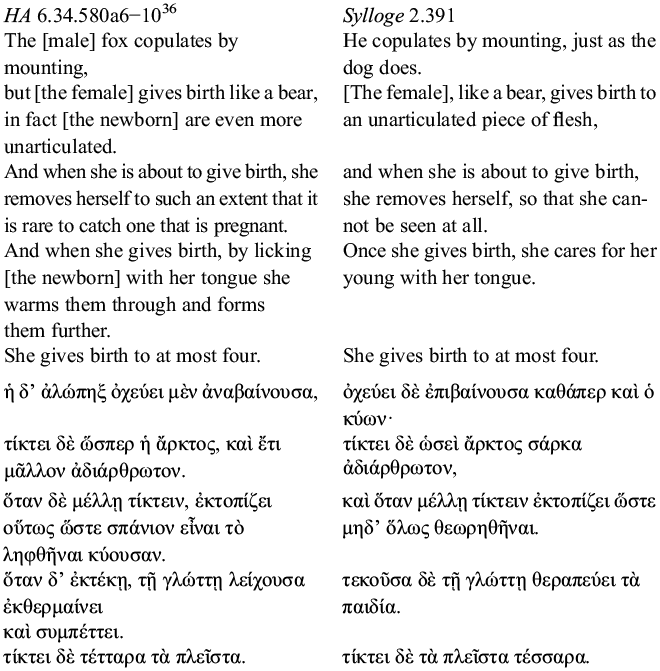
In what follows, I discuss the relevant entries from Sylloge 1 and 2 in the order in which I encounter them. But for reasons I give shortly, I here go out of order and compare (line by line) Aristotle, HA 6.34 and Aristophanes in Sylloge 2.391, on the fox:
|
|
There is some difference in the language used, of the sort you would expect from paraphrase (e.g., compare what follows “she removes herself” in each case); and there are additional bits of information or embellishments in Sylloge 2.391 (“just as the dog does”Footnote 37 and “flesh”). Otherwise, 391 would seem to be simply an abridged version of HA 6.34.580a6–10, of the sort one would expect to find much more often in Aristophanes’ Epitome, if it were an abridgement solely of the Historia animalium. Now there are many such passages from the Epitome in the Sylloge, but they are not the ones that interest me. It is instructive to note the difference between the similarities in these two passages on the fox and in most of the pairs of parallel passages that I compare in what follows, as they are usually not nearly as close.
In what follows, I do not discuss any text from Aristophanes’ Epitome for which I believe there are clear parallels with extant Aristotle (of the sort just presented on the fox).Footnote 38 But I do discuss some texts that are borderline cases, even if in the end I conclude either that they likely do not come from lost Aristotle or (as is often the case) that that cannot be determined with any probability. In editing a collection of fragments from the Zoïka, it is probably best to mark such texts of this latter sort with an asterisk or to include them in a section labeled dubia.Footnote 39
If a text in Aristophanes’ Epitome has no clear parallel in extant Aristotle, then I assume that it comes from a lost work of Aristotle unless there is evidence pointing to another source. This is because I take seriously the idea that Aristophanes’ work is an epitome of the works of Aristotle on animals. I do not assume, or give equal standing to the possibility, that such texts were added from elsewhere by Aristophanes or the compiler of the Sylloge, even though that cannot be ruled out completely. If, however, there is a close parallel, but with some difference in wording or some brief additional material, I am of course more open to that possibility.
Finally, I do not exclude from consideration as a fragment any text on the grounds that it is so strange that Aristotle would never have included it in one of his works or because it contradicts what Aristotle says in his extant works. I have argued that the Zoïka is a collection of observations and other endoxa (and paradoxa and thaumata) gathered by Aristotle or under his direction, and so we should expect it to contain any number of strange or false claims that did not make it into the extant works on animals (or if they did, it was in order to reject them).
2 Possible Fragments from Epitome 1
Recall the structure of Sylloge/Epitome 1. As mentioned, I do not think there is anything in the introduction (1.1–26) that can be established to have come from lost works of Aristotle. In what follows I consider five texts from the summary account of the generation of animals and related topics (1.27–96), followed by eight texts from the quick survey of facts about animals (1.97–154).
2.1 Peahen Egg-Laying (1.33)Footnote 40
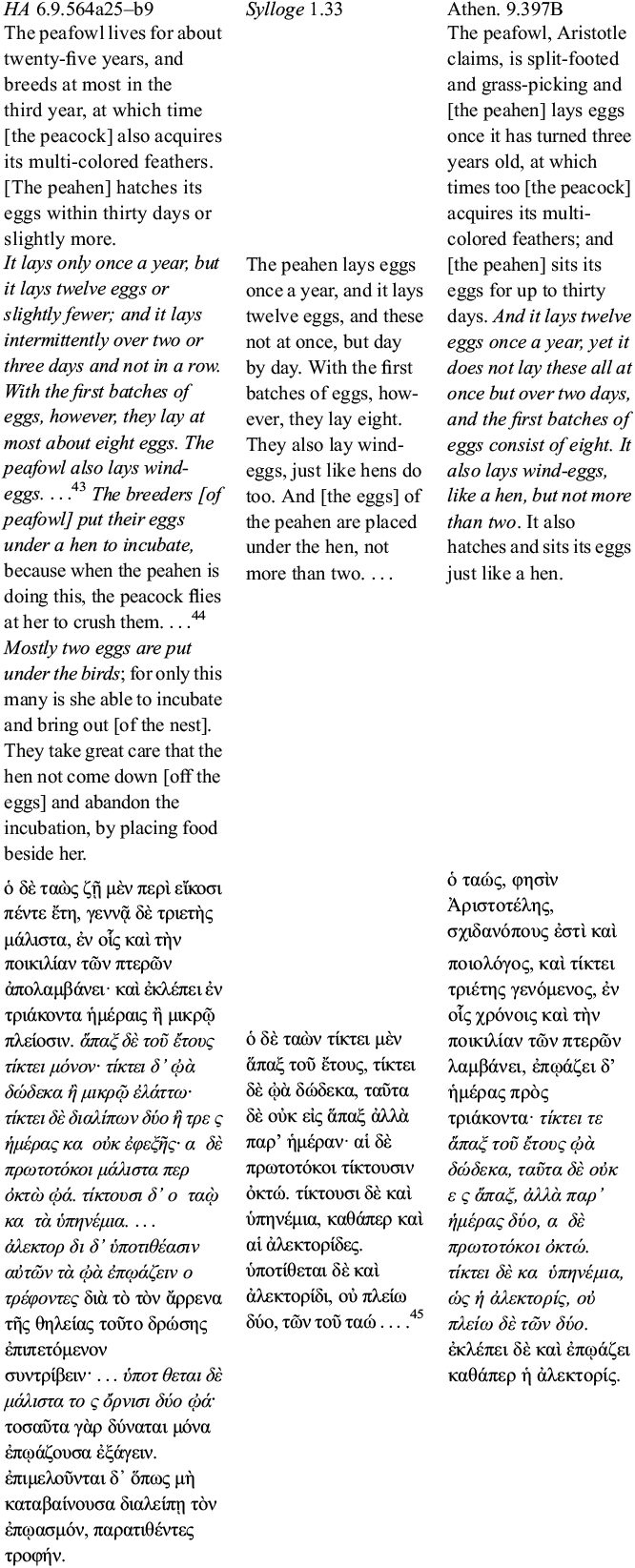
Sylloge 1.33 is worth considering, given its similarity to Athenaeus 9.397B, which I have argued elsewhere (Mayhew Reference Mayhew, Epstein and Verhasselt2026, 302–304) is a fragment from the Zoïka, owing to the reference to the peafowl being grass-picking and split-footed.Footnote 41 Moreover, Rose (Reference Rose1870b, 10) elsewhere argued that 1.33 – when compared to both Athenaeus 9.397B and a passage on the same topic in HA 6.9 – establishes with certainty that the Zoïka and Aristophanes’ Epitome were the same work.Footnote 42
Here are the three texts, with the relevant lines in HA 6.9 and Athenaeus 9.397B italicized:
|
|
|
Sylloge 1.33 might read like a straightforward abridgement of the material in HA 6.9, but when both are presented alongside Athenaeus 9.397B, this becomes less clear. For 1.33 and Athenaeus 9.397B are closer to each other than to HA 6.9 in that they contain references to chickens whereas HA 6.9 does not: “wind-eggs, just like hens do too” (ὑπηνέμια καθάπερ καὶ αἱ ἀλεκτορίδες) in 1.33 and “wind-eggs, like a hen” (ὑπηνέμια ὡς ἡ ἀλεκτορίς) in Athenaeus. But there is also a significant difference between 1.33 and Athenaeus, as the latter claims that the peahen lays no more than two wind-eggs, whereas HA 6.9 and Athenaeus refer to two eggs. So the Aristophanes passage is dependent on neither Athenaeus nor HA 6.9, and therefore they must both be dependent on a common source, namely the Zoïka.
2.2 Spontaneous Generation of an Insect out of Wax (1.36)
One line from 1.36, a lengthy list of insects and other invertebrates generated spontaneously out of various materials, is especially worth considering.Footnote 46
the ones called wax-dwellers [are generated spontaneously] out of wax.
ἐκ δὲ τοῦ κηροῦ οἱ κηροδύται λεγόμενοι.
The word κηροδύτης (“wax-dweller” or “wax-diver”)Footnote 47 never appears in Aristotle’s extant works, which must be Rose’s reason for considering this line a fragment (F 356 Rose3). But apart from the Sylloge, this word appears only in Michael Psellus (eleventh century), twice, in both cases as an example of an animal generated spontaneously.Footnote 48 Aristotle arguably says something similar in HA 5.32.557b6–8, also in a discussion of spontaneously generated insects:
And an animal comes to be in aging wax, as in wood, which is thought to be the smallest of all animals and is called akari;Footnote 49 it is white and small.
καὶ ἐν κηρῷ δὲ γίνεται παλαιουμένῳ ὥσπερ ἐν ξύλῳ ζῷον ὃ δὴ δοκεῖ ἐλάχιστον εἶναι τῶν ζῴων πάντων καὶ καλεῖται ἀκαρί, λευκὸν καὶ μικρόν.
The akari is most likely a mite that feeds on wax, though the larva of the greater wax moth (Galleria mellonella) is another possibility.Footnote 50 In any case, I think κηροδύται was probably an alternative name for ἀκαρί, and that Aristophanes or the compiler of the Sylloge switched the two words.Footnote 51 Such a single terminological difference is not sufficient to consider this line from 1.36 a fragment from the Zoïka.
2.3 Fire-Born Animals and the Bees’ Hostility to Perfume (1.37)
I present all of Sylloge 1.37, italicizing the material considered a fragment by Rose3 (F 358).
Even in fire and snow, Aristotle claims, small and sluggish animals come to be, the ones called fire-born. All the animals just enumerated happen to be lacking in blood and to die if oil is dripped on them, just as with all the insects as well. For this reason, bees sting and drive away people who are using perfume, out of a hostility to what is fat.Footnote 52 Indeed, this is why those who endeavor to approach them are without fat;Footnote 53 and in Egypt [the beekeepers] have even shaved their heads, so that no fatty moisture is left.
γίνεται δέ, φησὶν ὁ Ἀριστοτέλης, καὶ ἐν πυρὶ καὶ ἐν χιόνι ζῷα μικρὰ καὶ δυσκίνητα τὰ λεγόμενα πυριγενῆ. πάντα δὲ τὰ κατηριθμημένα ζῷα ἄναιμα συμβέβηκεν εἶναι καὶ τελευτᾶν ἐλαίου αὐτοῖς ἐπισταζομένου, καθάπερ καὶ τὰ ἔντομα πάντα. ὅθεν αἱ μέλισσαι τοὺς τῷ μύρῳ χρωμένους καὶ εἰσιόντας τύπτουσαι ἀποδιωθοῦνται ὡς πολεμίου τοῦ λίπους ὄντος· διὸ δὴ ἀλιπεῖς πειρῶνται προσάγειν αὐταῖς, ἐν Αἰγύπτῳ δὲ καὶ ἐξυρημένοι τὰς κεφαλάς, ἵνα μηδεμία ἰκμασία λίπους λείπηται.
In HA 5.19, Aristotle describes animals that come to be in snow and in fire (552b6–17): in Media, there are some born in snow that are large and white, and all of them are sluggish; in Cyprus, in places where copper is smelted, there are animals born in fire. Aristotle nowhere uses the term “fire-born” (πυριγενής), though in HA 5.19 he does refer to “creatures born in fire” (γίνεται θηρία ἐν τῷ πυρί, 552b11–12).Footnote 54 Further, he repeatedly says that insects are bloodless (e.g., HA 1.5.490a9, GA 2.1.733a25), and in HA 7(8).27, he says that all insects die if smeared with oil (605b19–20). In light of this, I think Rose was right not to consider the Zoïka the source of this first part of 1.37.
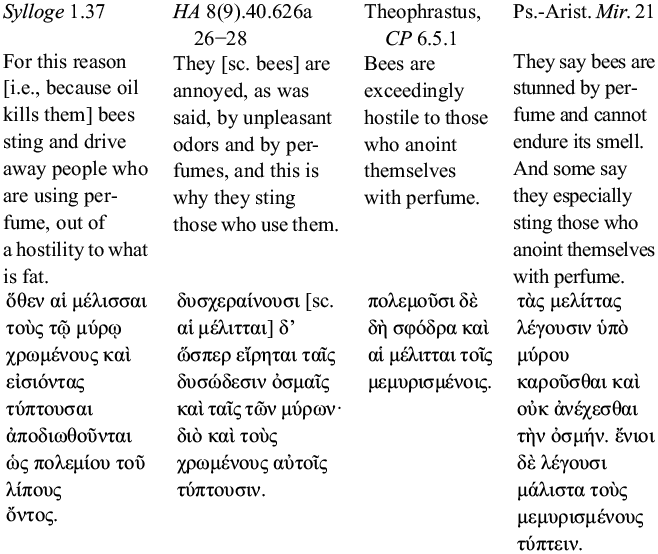
Turning now to the part he did consider a fragment, I present the first sentence again, alongside three parallel Peripatetic texts.
|
|
|
|
The Zoïka might well have been the source behind all of these, but I see little reason to favor the Zoïka over HA 8(9).40 or Mir. 21 as the source of 1.37.Footnote 55 Moving now to the end of the passage, however, the reference to Egyptian beekeeping has no parallel in extant Aristotle (or anywhere else, as far as I can tell). Given that the Peripatetic interest in endoxa and thaumata – in this case in the form of reports from animal experts (e.g., beekeepers) – including reports from different locations,Footnote 56 there is a good case for considering 1.37 a fragment. But one cannot rule out the possibility that the reference to Egyptian beekeepers is a later interpolation from another source – perhaps from someone in Alexandria.
2.4 Spontaneous Generation of Hardshell Animals, Including the Pelôris (1.45)
The ones called lagoon-oysters come to be in the mud, the pelôrides in the sand, the razor-shell and similar ones on stones; around the crevices of rocks sea squirts and barnacles and periwinkles [come to be], and sponges around the cavities of rocks. The sponge has with it a pina-guard, similar to a spider, which signals to it to capture the little fish when they enter into its cavities.
τὰ δὲ λεγόμενα λιμνόστρεα ἐν τῷ βορβόρῳ γίνεται, αἱ δὲ πελωρίδες ἐν τῇ ἄμμῳ, σωλὴν δὲ καὶ τὰ ὅμοια ἐν τοῖς λίθοις· περὶ δὲ τὰς σήραγγας τῶν πετρῶν τὰ τήθεα καὶ αἱ βάλανοι καὶ αἱ νήρεις, οἱ δὲ σπόγγοι περὶ τὰς τῶν πετρῶν κοιλότητας. ἔχει δὲ ὁ σπόγγος πινοφύλακα μεθ’ ἑαυτοῦ ὅμοιον ἀράχνῃ, ὃς αὐτῷ σημαίνει τὰ ἰχθύδια θηρεύειν τὰ εἰσιόντα εἰς τὰς κοιλότητας.
The reference to the pelôris (πελωρίς)Footnote 57 has no parallel in the extant works of Aristotle, who never mentions the animal, though a claim about it is also attributed to Aristotle by Athenaeus (3.92 F–93A):
The pelôrides are named from pelôrion (“mighty,” “massive”), for it is larger than and differs from a clam.Footnote 58 Aristotle claims that even these (sc. pelôrides) come to be in sand.
αἱ πελωρίδες ὠνομάσθησαν παρὰ τὸ πελώριον· μεῖζον γάρ ἐστι χήμης καὶ παρηλλαγμένον. Ἀριστοτέλης δέ φησι καὶ ἐν ἄμμῳ αὐτὰς γίνεσθαι.
These two texts should be considered in light of HA 5.15.547b11–23:
As for the so-called lagoon-oysters, wherever there is mud, their starting-point is first formed there. Konchai and clamsFootnote 59 and razor-clams and scallops form in sandy [places]. The pinai [mussels] grow upright from the byssus in sandy and muddy [places]. They have in them a pina-guard – some a little shrimp, some a little crab – deprived of which they die quickly. In general, all the hardshell animals come to be spontaneously in fact in sediment, various ones according to the difference in the sediment: oysters in muddy [sediment], cockles and the ones mentioned in sandy [sediment], around the crevices of small rocks sea squirts and barnacles and the ones on the surface, for instance limpets and periwinkles.
τὰ δὲ λιμόστρεαFootnote 60 καλούμενα, ὅπου ἂν βόρβορος ᾖ, ἐνταῦθα συνίσταται πρῶτον αὐτῶν ἡ ἀρχή. αἱ δὲ κόγχαι καὶ χῆμαι καὶ σωλῆνες καὶ κτένες ἐν τοῖς ἀμμώδεσι λαμβάνουσι τὴν σύστασιν. αἱ δὲ πίναι ὀρθαὶ φύονται ἐκ τῆς βύσσουFootnote 61 ἐν τοῖς ἀμμώδεσι καὶ βορβορώδεσιν. ἔχουσι δ’ ἐν αὐταῖς πινοφύλακα, αἱ μὲν καρίδιον αἱ δὲ καρκίνιον· οὗ στερισκόμεναι διαφθείρονται θᾶττον. ὅλως δὲ πάντα τὰ ὀστρακώδη γίνεται καὶ αὐτόματα ἐν τῇ ἰλύϊ, κατὰ τὴν διαφορὰν τῆς ἰλύος ἕτερα, ἐν μὲν τῇ βορβορώδει τὰ ὄστρεα, ἐν δὲ τῇ ἀμμώδει κόγχαι καὶ τὰ εἰρημένα, περὶ δὲ τὰς σήραγγας τῶν πετριδίων τήθυα καὶ βάλανοι καὶ τὰ ἐπιπολάζοντα, οἷον αἱ λεπάδες καὶ οἱ νηρεῖται.
If it were not for Athenaeus, one might conclude that Aristophanes’ source here was HA 5, to which Aristophanes or the compiler of the Sylloge added the reference to the pelôris. But as Athenaeus is very likely independent evidence for Aristotle having mentioned the pelôris,Footnote 62 the reference to the pelôris probably came from another source, which contained a list of hardshell animals thought to come to be via spontaneous generation, namely the Zoïka.
2.5 Diogenes of Apollonia on the Nourishment of Embryos (1.78)
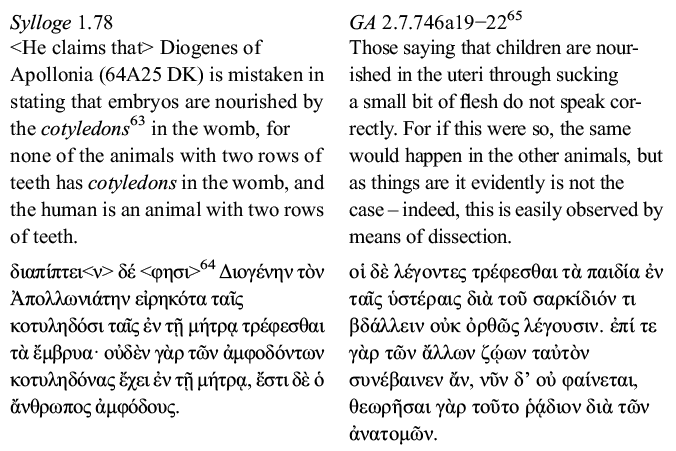
Sylloge 1.78 and GA 2.7.746a19–22 clearly describe the same mistaken view of the nourishment of embryos, but in quite different language and supported by different (though not incompatible) reasons:
|
|
Where Aristophanes refers to Diogenes, being mistaken (διαπίπτειν), embryos (τὰ ἔμβρυα), cotyledons, and the womb (τῇ μήτρᾳ), Aristotle refers to what people say (οἱ λέγοντες), not speaking correctly (οὐκ ὀρθῶς λέγουσιν), children (τὰ παιδία), sucking a small bit of flesh (διὰ τοῦ σαρκίδιόν τι βδάλλειν), and uteri (ταῖς ὑστέραις). I think it likely that the language Aristotle uses (especially “children” and “bit of flesh”) were meant to convey his contempt for this view. And it is important to note that earlier in GA 2.7, Aristotle used the word cotyledons in the same context. In fact, as recently as GA 2.7.746a8–10 Aristotle wrote: “Most of the docked [i.e. hornless] animals and those with two rows of teeth do not have cotyledons in the uteri” (τὰ δὲ πολλὰ τῶν κολοβῶν ζῴων καὶ ἀμφωδόντων οὐκ ἔχει κοτυληδόνας ἐν ταῖς ὑστέραις), the latter being the very reason Aristophanes gives for why Diogenes is mistaken.
I think the following are the two most plausible explanations for the differences between these two otherwise related texts: (1) GA 2.7 was Aristophanes’ source (recall that the Generation of Animals was his main source in 1.27–96), though he altered Aristotle’s language to make it more neutral and added a reference to someone known to have held this mistaken view; (2) the Zoïka included a set of endoxa concerning the nourishment of embryos, and this was the source for both Aristotle in GA 2.7 and Aristophanes.Footnote 66 I think the second is more likely, but cannot rule out the first.
2.6 Human Birth without Copulation, and What Is Called Osiris (1.98)
Sylloge 1.98–105 are focused on woman, with 1.98–102 each beginning with μόνη ἡ γυνή (μόνη τῶν διπόδων γυνή in the case of 98), and 103 and 105 each referring to γυνή. All but 98 and 104 have parallels in extant works by or attributed to Aristotle. Here is 1.98 (which is clearly corrupt), with one editorial intrusion:
Woman alone of the bipeds is viviparous, the other bipeds being oviparous. The woman alone of the viviparous gives birth to wind “eggs,”Footnote 67 <such as> what is called Osiris in Egypt.Footnote 68 Theophrastus bears witness to Aristotle saying that what is called Osiris was born without copulation, in the fifth [book] of the On Animals.
μόνη τῶν διπόδων γυνὴ ζῳοτοκεῖ τὰ δὲ ἄλλα δίποδα ᾠοτοκεῖ. μόνη ἡ γυνὴ τῶν ζῳοτόκων ὑπηνέμια τίκτει, ⟨οἷον⟩ τὸν λεγόμενον Ὄσιριν ἐν Αἰγύπτῳ. μαρτυρεῖ δὲ Θεόφραστος λέγοντι Ἀριστοτέλει ἄνευ ὀχείας γίνεσθαι τὸν λεγόμενον Ὄσιριν ἐν τῷ πέμπτῳ τῷ Περὶ ζῴων.
The major questions here are: What is being claimed? Who or what is the one called Osiris? Whose On Animals does this refer to, Theophrastus’ or Aristotle’s (the Greek allows for either)?Footnote 69 Where might Aristotle have said this, assuming he did? For there is nothing like this in any of his extant works.Footnote 70
See Sharples (Reference Sharples1995, 115–119) for commentary (with more extensive bibliographical references). It is worth quoting at the outset a substantial section of his commentary (116–117):
the assertion that human mothers produce young by parthenogenesis is blatantly un-Aristotelian: Aristotle insists that “wherever there is male and female in a species, the female cannot generate by herself.”Footnote 71 However, HA 10.7 638a22 ff. likens the mola uteri in women to the wind-eggs (hupenemia) of birds, and in GA 4.7 776a9 it is asserted that mola has only been observed to occur in women and not in other living creatures, the reason given being that the menstrual flow is greater in women (cf. GA 4.6 775b5).Footnote 72 Possibly then an original statement that women alone “produce hupenemia,” in the sense of uterine mole, has at some stage been misunderstood as a reference to parthenogenesis and had the reference to Osiris added to it as a gloss, by someone [other than] Aristophanes himself. …
This however does not explain the reference to Osiris, or its attribution to Theophrastus. A “so-called Osiris” was indeed said to be born without intercourse, but not from a human mother; for Plutarch, On Isis and Osiris 43 368 c, describes the sacred Apis-calf as an image of Osiris, and says that it was believed to be produced without the involvement of a bull, when the light of the moon fell on a cow in heat. Possibly Theophrastus mentioned this belief, and [the glossator] not only misinterpreted the text of Aristophanes but also misunderstood Theophrastus, taking him to refer to a human rather than a bovine mother.Footnote 73
It may help to refer to a passage in Diodorus Siculus 1.27.5, according to which Osiris is both the son of Cronus and born out of an eggFootnote 74 – a contradiction, according to Gresswell (Reference Gresswell1852, 174), resulting from the mixture of Greek (son of Cronus) and Egyptian (born from an egg) mythical cosmologies. Further, an entry in Hesychius (ο 1408 Latte) states: “Osiris: The women in Egypt bear wind-eggs, what is called Osiris” (Ὄσιρις· αἱ ἐν Αἰγύπτῳ ὑπηνέμια τίκτουσι, τὸν λεγόμενον Ὄσιριν, γυναῖκες). If Hesychius’ source was not our text, then this is independent evidence that in Egypt “wind-eggs” (= uterine moles?) produced by women were called Osiris. Gresswell (Reference Gresswell1852, 176), however, who was not aware of the Sylloge, thought γυναῖκες was clearly a mistake for ὄρνιθες, and concluded that in Egypt, owing to the egg-myth of this god’s origins, people called the wind-eggs produced by hens Osiris. But surely if that were a common (or even uncommon) practice, there would be independent evidence of it. It might just as well have been the case that in Egypt, uterine moles were called “Osiris.” But this is all speculation.
Now where might Theophrastus have reported that Aristotle said this? Again, one must speculate, but I can think of two works from the list of Diogenes Laertius: On Spontaneously Generated Animals 1 book (Περὶ τῶν αὐτομάτων ζῴων α´) (5.46 [203 Dorandi]) or Epitomes of Aristotle’s On Animals 6 books (Ἐπιτομῶν Ἀριστοτέλους περὶ ζῴων ς´) (5.49 [256]). The former would fit this context only if it were book 5 of Περὶ ζῴων ζ´ (5.44 [125]), but that title is generally thought to consist of the seven monobiblia on animals that precede it in Diogenes’ list, and Περὶ τῶν αὐτομάτων ζῴων is not one of them. So I think the latter is more likely. And as I said before, this work may have been Theophrastus’ “epitome” of Aristotle’s Zoïka. But if that was Aristophanes’ source, why does he mention Theophrastus here, but not in the case of any other potential references to the Zoïka?Footnote 75
On the hypothesis that what Theophrastus reports here comes from the Zoïka, perhaps this endoxon or thauma was included among reports from Egypt of unusual animals there. But so much is uncertain.
2.7 Married Women versus Immoderate Women (1.104)
Here is the other text on women without parallel in extant Aristotle:
Married womenFootnote 76 are completely sated with regard to sexual matters, while immoderate women are less so.
αἱ ὕπανδροι κατακορεῖς πρὸς τὰ ἀφροδίσια, αἱ δὲ τρυφεραὶ ἥττονες.
The earliest appearance of the adjective ὕπανδρος is in Polybius (second century BC), once. The word appears four times in the Septuagint (an ancient Greek translation of the Hebrew Bible) and once in the New Testament (Romans 7:2), and (judging by extant literature) it takes off as a standard term for a married woman around the time of Clement and Origen (both of Alexandria, second and third centuries AD) and continues into the Byzantine period. Further, according to LSJ (s.v. κατακορής) κατακορεῖς as a possible feminine accusative plural (which it must be here) occurs only in Byzantine Greek. This would tend to suggest that 1.104 is more likely a later addition from Aristophanes or the compiler of the Sylloge than that its source was the Zoika.
2.8 Lice on the Head of Humans (1.112)
I first present this text without emendation and translated fairly literally:
When the human alone is about to die,Footnote 77 head lice (i.e., “lice on the head”) are born.
μόνου τοῦ ἀνθρώπου μέλλοντος μεταλλάσσειν οἱ ἐν τῇ κεφαλῇ φθεῖρες γίνονται.
The verb γίνονται has bothered some scholars, no doubt because they do not interpret it as referring to birth (which would possibly make this about spontaneous generation);Footnote 78 rather they expect something to go with γίνονται (the lice become x). Rose (Reference Rose1870b, 37) expresses his doubts by printing in the apparatus “γίνονται (?),” but in a later work (Reference Rose1886, 225; F 282.2), he proposes “correcting” γίνονται to φθίνουσιν (the lice perish), a suggestion I return to shortly. Lambros (Reference Lambros1885, 31) suggests as a possibility οὐ σίνονται for γίνονται (the lice do no harm?), but that is not an improvement.
A less intrusive emendation is to bracket οἱ, which would change the second clause to “lice are born (or ‘appear’) on the head” rather than “head lice are born.” Finally, Rose’s proposed φθίνουσιν for γίνονται produces, if one brackets οἱ, “lice perish on the head.” The problem with this suggestion is that it simultaneously points to and contradicts a well-attested Zoïka fragment, which I turn to now.
Here is Apollonius Paradoxographus, Historiae mirabiles 27 (= F 288.1 Rose3 / 277.1 Gigon):Footnote 79
Aristotle in the Zoïka (Animal Matters) – for there are two treatises by him, one On Animals, one On Animal Matters – says that lice do not perish on the headFootnote 80 during chronic diseases, when the patients are about to die, rather they are found on the pillows having abandoned the head.
Ἀριστοτέλης ἐν τοῖς Ζωϊκοῖς – δύο γάρ εἰσιν αὐτῷ πραγματεῖαι, ἡ μὲν Περὶ ζῴων, ἡ δὲ Περὶ τῶν ζωϊκῶν – οἱ φθεῖρες, φησίν, ἐν τῇ κεφαλῇ ἐν ταῖς μακραῖς οὐ φθίνουσιν νόσοις, μελλόντων τελευτᾶν τῶν πασχόντων, ἀλλ’ ἐπὶ τὰ προσκεφάλαια εὑρίσκονται προλελοιπότες τὴν κεφαλήν.
Aristotle has a lengthy discussion of lice in HA 5.31, but he does not there or elsewhere mention the phenomenon referred to by Apollonius. So Historiae mirabiles 27 is a secure fragment from the Zoïka. As it comes down to us in the Sylloge, Aristophanes is not reporting the same thing as Apollonius, but that may be the result of textual corruption and/or Aristophanes’ extreme abridgement of the original, or 1.112 could be an alternative account of what is thought to happen to lice on the head of dying humans. Little is known about Apollonius and his Historiae mirabiles. He might have been contemporary with Aristophanes,Footnote 81 but even so, there is no (other) evidence of that work having been one of Aristophanes’ sources. In any case, whatever doubts there are about the state of the text, 1.112 most likely has some relationship to the content of Historiae mirabiles 27, and so I think the Zoïka is its likely source.
2.9 The Bedbug with Blood (1.115)
The [animals] that have more than four legs are bloodless and without viscera, except for the house bedbug. This is the only many-legged one that has blood.
τὰ δὲ πλείονας ἔχοντα πόδας τῶν τεσσάρων ἄναιμά ἐστι καὶ ἄσπλαγχνα πλὴν τοῦ κατοικιδίου κόρεως· οὗτος γὰρ μόνος πολύπους ὑπάρχων αἷμα ἔχει.
Aristotle begins HA 5.31: “Of the insects, those that are not flesh-eating, but live off juices of living flesh, for instance lice and fleas and bedbugs,” etcetera (τῶν δ’ ἐντόμων ὅσα σαρκοφάγα μὲν μή ἐστι, ζῇ δὲ χυμοῖς σαρκὸς ζώσης, οἷον οἵ τε φθεῖρες καὶ ψύλλαι καὶ κόρεις, κτλ., 556b21–23). A bit later, he writes: “The bedbugs [come to be] out of the fluid from the animals as it congeals outside [of them]” (αἱ δὲ κόρεις ἐκ τῆς ἰκμάδος τῆς ἀπὸ τῶν ζῴων συνισταμένης ἐκτός, 556b26–27). At the end of the chapter, he states: “all these insectsFootnote 82 are many-legged and bloodless” (πάντα δέ πολύποδά ἐστι ταῦτα καὶ ἄναιμα τά ἔντομα, 557a26–27).
HA 5.31 is the only place in his extant works where Aristotle mentions the bedbug (κόρις). Further, as indicated in Section 2.3, he repeatedly says that insects are bloodless. So not only does 1.115 not have a parallel in the extant works of Aristotle, it contradicts what Aristotle says in those works.Footnote 83 Perhaps the fact that this insect was referred to as a “house bedbug” (κατοικίδιος κόρις) might be relevant. Beavis (Reference Beavis1988, 104) reports that κόρις refers “almost exclusively in classical literature to a single species of insect pest, the bed-bug,” but adds that there are “a few examples of extended usage to cover insects of similar appearance.” The latter might explain the addition of the adjective κατοικίδιος in our text. Whoever is responsible for it might be making clear that this is the kind of bug that afflicts humans in their homes – that is, the bedbug – whereas Aristotle did not think such a clarification was necessary. This does not settle the issue, however, as the Zoïka might have been the source of 1.115 (= F 357 Rose3), with Aristophanes or the compiler of the Sylloge adding κατοικίδιος for such clarification.
2.10 Fish That Make a Sound (1.127)
No fish has a voice, only the one called skaros and the river choiros (= piglet).Footnote 84
οὐδεὶς ἰχθὺς λαλεῖ, μόνος δὲ ὁ λεγόμενος σκάρος καὶ ὁ ποτάμιος χοῖρος.
This is a very close match to the second half of the following passage, from Athenaeus 8.331D:
Mnaseas of Patras in his Sailing Around claims that fish in the Cleitor River make sounds, despite Aristotle having said that the skaros and the river choiros alone make sounds.Footnote 85
Μνασέας δὲ ὁ Πατρεὺς ἐν τῷ Περίπλῳ τοὺς ἐν τῷ Κλείτορι ποταμῷ φησιν ἰχθῦς φθέγγεσθαι, καίτοι μόνους εἰρηκότος Ἀριστοτέλους φθέγγεσθαι τὸν σκάρον καὶ τὸν ποτάμιον χοῖρον.
These two texts are clearly related. Further, there is nothing like this in Aristotle’s extant works. In HA 4.9.535b14–26, he claims that fish are mute (ἄφωνοι), as they lack the requisite organs (lungs, windpipe, pharynx) for producing what could correctly (ὀρθῶς) be called a sound or voice (φωνή), though some of them produce noises or grindings (ψόφους, τριγμούς) in other ways. He provides half a dozen examples, among them the kapros in the river Achelous (ὁ κάπρος ὁ ἐν τῷ Ἀχελῴῳ).Footnote 86 He does not, however, mention the skaros or the river choiros. In fact, he does not mention the fish choiros anywhere in his extant works, though it is noteworthy that χοῖρος and κάπρος have primary meanings of “piglet” and “boar,” respectively. Aristotle twice (HA 2.17.508b11–12 and 7(8).2.591b21–22) says that the fish called skaros seems or is thought (δοκεῖ) to be the only fish that ruminates (μηρυκάζειν),Footnote 87 which may have been misunderstood by Athenaeus or his source, or reported as a sound by someone gathering endoxa for Aristotle. Given how close 1.127 and Athenaeus 8.331D are, especially compared to these passages from the Historia animalium, I think they are related to each other and that their source was the Zoïka. And of the three possibilities – (1) this text from the Zoïka reached them independently, (2) Athenaeus’ source was Aristophanes, (3) the compiler of the Sylloge inserted material from Athenaeus into Aristophanes’ Epitome – I find the first the most likely.Footnote 88
2.11 The Sea Urchin (1.137)
Sea urchins, when they come to be, straightaway have five eggs. It is said that when they are divided according to parts and put back into the sea, they are able to live and feed.
ἐχῖνοι <οἱ> θαλάττιοι εὐθέως γεννώμενοι πέντε ᾠὰ ἔχουσι· λέγεται δὲ ὡς διαιρούμενος κατὰ μέρος καὶ ἀφιόμενος εἰς τὴν θάλασσαν δύναται ζῆν καὶ νέμεσθαι.
There is a lengthy discussion of the sea urchin (lit. sea hedgehog) in HA 4.5. Aristotle mentions their so-called eggs (τὰ καλούμενα ᾠὰ), and that they are the same in number in every kind of sea urchin, namely five (530b29–30). This I assume is the ultimate source of the first claim in 1.137. Aristotle also says that the sea urchin has numerous black parts that are all connected to the mouth but not to each other, and so “it is as it were divided” (ὥσπερ διειλημμένος ἐστίν). I think this is the most likely source of the second claim in 1.137, though it was embellished. But one cannot rule out the Zoïka entirely.
2.12 Two Deaf Birds (1.141)
Among birds, the aithyiai and the charadrios are deaf; for they neither make a sound nor hear.
τῶν πτηνῶν αἱ αἴθυιαι καὶ ὁ χαραδριὸς κωφά ἐστιν· οὔτε γὰρ φθέγγεται οὔτε ἀκούει.
In HA 7(8).3, Aristotle mentions the aithyia and charadrios,Footnote 89 one after the other, as examples of seabirds (593b14–15). In HA 5.9, he describes the aithyia but says nothing about the sound it makes nor its being deaf (542b17–21). In HA 8(9).11, he gives the charadrios as the example of a bird that dwells around streams or gullies (περὶ τὰς χαράδρας) and hollows, and he adds: “The charadrios is poor both in coloring and in voice” (ἔστι δ’ ὁ χαραδριὸς καὶ τὴν χρόαν καὶ τὴν φωνὴν φαῦλος, 614b35–615a2). Lambros (Reference Lambros1885, 34) comments that the source of 1.141 is unknown, unless it is this line from HA 8(9).11.
As is so often the case, one is confronted with two possibilities, with no way of determining which is more likely: Based on the differences between 1.141 and these HA passages, one could follow Rose3 (F 352) and consider 1.141 a fragment from the Zoïka, or conclude that in the process of abridgement or paraphrase, being poor in voice became not making a sound at all, which was then associated with deafness and applied to aithyia as well as charadrios. On balance, I find the former slightly more likely.
2.13 The Leopard’s Tail (1.143 and 2.251)
The leopardFootnote 90 alone moves the tip of its tail while not moving the whole tail.
μόνη ἡ πάρδαλις τὸ ἄκρον τῆς οὐρᾶς κινεῖ τῆς ὅλης οὐρᾶς ἀκινητιζούσης.
The leopard has the peculiar characteristic of moving the tip of its tail while not moving [the tail] itself.
ἰδιον δ’ ἔχει ἡ πάρδαλις τὸ κινεῖν τὸ ἄκρον τῆς οὐρᾶς αὐτῆς ἀκινητούσης.
There is no known parallel text, in Aristotle or anyone else, so I consider its source the Zoïka.Footnote 91
3 Possible Fragments from Epitome 2
The second book of the Sylloge is devoted to viviparous quadrupeds – that is, mammals – as was the second book of the Epitome. It begins with remarks (1–3) that come straight from Aristophanes, setting out his program for the rest of the Epitome.Footnote 92 Unlike book 1, eventually the compiler of the Sylloge included sources other than Aristophanes. These additional passages are at first usually marked by ὅτι (“that,” meaning something like “it is said that …” or “note that …” or “read that …”). This happens for the first time at 2.40: 40–42 come from Aelian, and 43–60 from Photius’ summary of Agatharchides,Footnote 93 with a further insertion (54) from an unknown source (which postdates Aristotle). And as I mentioned, at 2.283, the compiler begins to name his source explicitly (and thereafter uses ὅτι less frequently).
Here is a list of the mammals described: human (4–67),Footnote 94 elephant (68–132), lion (133–166), dog (167–206), wolf (207–244), leopard (245–269), giraffe (270–278), cheetah (279–282), thôsFootnote 95 (283–294), cat (295–307), hyena (308–325), bear (326–344), mouse (345–372), shrew (373–375), weasel (376–386), marten (387–389), fox (390–408), hare (409–418), mole (419–423), hedgehog (424–435), bat (436–442), cow (444–445), camel (446–475), deer (476–517), probata (i.e., sheep and goat) (518–560), pig (561–572), and horse (573–625).
Before proceeding, and with an eye on texts relating to dissection, it is instructive at this point to go out of order again and compare two parallel passages, in this case on the lion, one from Aristotle, one from Aristophanes.Footnote 96
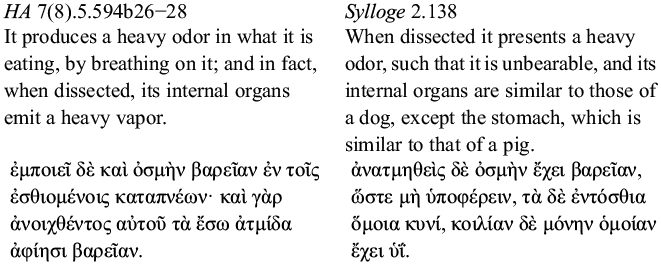
|
|
There are three things to note here. First, one could try to make a case that the latter is sufficiently different to conclude that it comes from another work of Aristotle (or from some non-Aristotelian text). However, given that Aristotle is being presented via an epitome of Aristophanes, who is likely abridging and paraphrasing him, it is important to be conservative in dealing with the Sylloge as a possible source of lost Aristotle. Second, this is the only case in which internal organs and dissection are mentioned by both Aristotle and Aristophanes (though it should be noted that Aristotle refers to dissection to support a claim about the lion’s eating habits, whereas Aristophanes is describing the lion’s internal organs). In many of the most interesting passages considered in what follows, Aristophanes mentions dissection where Aristotle does not. This is significant, though how it is significant is a matter of dispute. I think it likely indicates that the source is a lost work of Aristotle, others that the source is someone other than Aristotle.Footnote 97 Third, there are important terminological differences, despite the fact that Aristotle and Aristophanes are describing the same thing: Aristotle uses τὰ ἔσω to refer to internal organs here, whereas Aristophanes uses τὰ ἐντόσθια, a word that does not appear in Aristotle’s extant biological works, and which Aristophanes seems to use interchangeably with τὰ σπλάγχνα (“viscera”). Further, the word Aristotle uses for dissection here is ἀνοιχθέντος (ἀνοίγω), whereas Aristophanes uses ἀνατμηθείς (ἀνατέμνω). This is significant, as it means that Aristophanes using different terminology related to dissection does not automatically imply that his source comes from someone other than Aristotle.
In what follows, in the few cases where I skip an animal entirely, it is because the sections from Aristophanes all have clear parallels in Aristotle’s extant works or because Aristophanes is not one of the compiler’s sources.Footnote 98
3.1 The Elephant’s Gait (2.68)
Sylloge 2.68–132 is devoted to the elephant, with 68–82 coming from Aristophanes. With two exceptions (68 and 73), likely parallel passages in Aristotle’s extant works can be found, though a lot of reorganizing and paraphrasing of this material has taken place, and some passages are muddled.Footnote 99 Here is 2.68:
The elephant has two rows of teeth and is fissiped,Footnote 100 and it has two upper tusks; and it walks kata diametron [perhaps “diagonally”], in a crossed manner, but not kata skelos.
ὁ ἐλέφας ἐστὶ μὲν ἀμφόδους καὶ πολυσχιδής, ἔχει δὲ χαυλιόδοντας ἄνω δύο, πορεύεται δὲ κατὰ διάμετρον χιάζων, ἀλλ’ οὐ κατὰ σκέλος.
This text raises an issue that has implications for the present Element, far beyond Aristophanes’ report on the elephant, an issue first raised in Section 1, in commenting on Sylloge 1.155.
In HA 1.5.490b3–4, Aristotle writes: “All animals, quadrupeds and many-footed ones, move in the same way, for they move kata diametron” (πάντα δὲ κινεῖται ὁμοίως, τὰ τετράποδα καὶ πολύποδα· κατὰ διάμετρον γὰρ κινεῖται). He revises this statement somewhat in HA 2.1: All quadruped and many-footed animals move kata diametron, except for the lion and both kinds of camel, for these animals walk kata skelos (498b5–9).Footnote 101 In the first chapter of Aristotle’s work devoted to how animals walk or progress, De incessu animalium (On the Progression of Animals), he states that one of his aims is to discover “for what reason quadrupeds move kata diametron” (διὰ τίν’ αἰτίαν τὰ τετράποδα κινεῖται κατὰ διάμετρον) (704b7). He devotes IA 14 to explaining why this is so. It is not important to go into his explanation, except to mention what he means by kata diametron, which he makes clear in IA 14: In this kind of movement, first the right front leg is raised and moves, then the left hind leg, then the left front leg, then the right hind leg. His example is the horse.Footnote 102 In the De incessu animalium, Aristotle does not mention walking kata skelos (“according to leg” or “leg by leg”),Footnote 103 but from his comments in the Historia animalium, I think Peck (Reference Peck1965, 81) is likely right that it refers to both legs on one side moving at the same time.
This is important in the present context, because in his Epitome, Aristophanes states that the following animals walk kata diametron: elephant (which he adds does not walk kata skelos) (2.68), dog (2.167), wolf (2.207), leopard (2.246), thôs (2.283), cat (2.295), hyena (2.308), bear (2.327), and horse (2.573). He also says that the following two animals do not walk kata diametron but kata skelos: lion (2.133 and 2.144)Footnote 104 and camel (2.446). Setting aside, then, the passages on the horse, lion, and camel – animals that Aristotle mentions in this connection – how are we to interpret Aristophanes’ statements about the gait of the elephant, dog, wolf, leopard, thôs, cat, hyena, and bear? I think there are two possibilities:Footnote 105 Either Aristophanes began with Aristotle’s general statement in HA 2.1 that all quadrupeds move kata diametron (except for lions and camels) and then added this to his accounts of these other particular animals; or, Aristophanes’ source here included accounts of these animals and (inter alia) how they walked. If there were no other evidence that Aristophanes made use of works of Aristotle that are now lost, I would be more inclined to accept the former – but note that this is the opposite of abridgement or epitomizing. But as I think there is independent evidence that he made use of such works, I accept the latter interpretation here, in the case of the elephant and throughout (though one cannot rule out the former interpretation entirely). And note that this fits perfectly my hypothesis about the Zoïka and its relationship to the Historia animalium: that it was a notebook collection of data, organized according to kind of animal, which Aristotle made use of in composing the Historia animalium. In this case, he would have used the data in the Zoïka about specific animals to formulate or support his generalization that all quadrupeds move kata diametron, except for the lion and camel. Therefore, I think 2.68 should be included in a collection of fragments of the Zoïka.
3.2 Female Elephant Dissection (2.73)
The female has a nature similar to a donkey, but when dissected it presents the other viscera similar to a pig, differing in size, but she does not have a gallbladder near the liver, but rather near the intestine.
ἡ δὲ θήλεια τὴν φύσιν ἔχει ὁμοίαν ὄνῳ, ἀναπτυχθεῖσα δὲ τὰ μὲν ἄλλα σπλάγχνα ἔχει ὅμοια ὑΐ,Footnote 106 μεγέθει διαφέροντα, χολὴν δὲ οὐκ ἔχει πρὸς τῷ ἥπατι, ἀλλὰ πρὸς τῷ ἐντέρῳ.
There is some overlap between this text and a passage in HA 2.17, where Aristotle describes the internal organs of the elephant. Having described its intestines and stomach, he says (507b37–508a2):
And [sc. the elephant] has viscera similar to pigs, except that its liver is four times the size of an ox’s, as are the others, whereas its spleen is smaller or [it is smaller] proportionally.
καὶ τὰ σπλάγχνα (sc. ὁ ἐλέφας) ἔχει παραπλήσια τοῖς ὑείοις, πλὴν τὸ μὲν ἧπαρ τετραπλάσιον τοῦ βοείου καὶ τἆλλα, τὸν δὲ σπλῆνα ἐλάττω ἢ κατὰ λόγον.
The differences, however, are far greater than the similarities. Differences in details aside, in HA 2.17 there is no mention of a donkey and no reference to dissection (though of course it is implied).
I have noted before, and we shall see again, Aristophanes’ practice of describing features of a less common animal through comparison with a more common one, like a horse or pig or dog. That may explain the reference to the donkey.Footnote 107 But the reference to dissection is significant. The verb Aristophanes uses for dissection (ἀναπτυχθεῖσα) is not his standard term. Further, Aristotle never uses it for dissection in his extant works.Footnote 108 When Aristotle uses a verb to refer to dissection, it is ἀνατέμνω (four times)Footnote 109 or the aorist past participle of ἀνοίγω (five times)Footnote 110 or ἀνασχίζω (once, HA 6.16.570a5: ἀνασχισθεῖσαι). When Aristotle refers to dissection, however, he almost always uses the plural of the noun ἀνατομή (twenty-eight times), and in many of these cases he is (certainly or arguably) referring to the title of a (lost) work. Putting aside the fact that Aristotle himself uses varied terminology to report dissections, given the rewording that one expects from paraphrase I do not find such variations in terminology between Aristophanes and Aristotle all that problematic. They certainly do not rule out Aristotle’s Dissections having been Aristophanes’ source.Footnote 111
The use of ἀναπτύσσω for dissection in the Sylloge (and presumably in the Epitome) is significant, as this term is put to the same use in two passages in Athenaeus, Deipnosophistae 7, which I have elsewhere argued are very likely from the Zoïka.Footnote 112 The first is from 316 C–D, on the octopus (πολύπους). Here is the relevant line: “When dissected, it presents a two-part brain” (ἀναπτυχθεὶς δ’ ἐγκέφαλον ἔχει διμερῆ). The second is from 326 C–D, on the τεῦθος, a kind of squid: “When dissected it presents a stomach similar to that of pigs” (ἀναπτυχθεὶς δὲ κοιλίαν ἔχει ὁμοίαν ταῖς ὑείαις). The comparison to pigs is striking.
I believe the use of ἀναπτύσσω both in these Zoïka passages and in 2.73 supports the conclusion that the latter may well be a fragment from the Zoïka. But it also points to a difficult-to-solve puzzle concerning the relationship between the Zoïka and the Dissections – one I cannot attempt to solve here. I think we can rule out concluding that the Zoïka and the Dissections are in fact the same work, a view that some scholars in the past held.Footnote 113 On the face of it, too many passages that can be confidently assigned to the Zoïka have nothing to do with dissection. If the Dissections was more than just a collection of data acquired through dissection, for instance including discussions of methodology and sophisticated drawings, etcetera,Footnote 114 then perhaps the raw data acquired from dissections were (also) recorded in the relevant sections of the Zoïka – in On Fish, for instance, in the two passages just quoted. Anyone working on the Dissections ought not to neglect these overlap passages.
3.3 Leonine Health and Longevity (2.147 and 150)
Sylloge 2.133–166 is devoted to the lion, with 133–150 coming from Aristophanes. With two (seemingly) minor exceptions (147 and 150), likely parallel passages in Aristotle’s extant works can be found, though a lot of reorganizing and paraphrasing of this material has taken place.
a. The lion as disease-free (2.147)
The lion is in fact one of the disease-free animals.
ἔστι δὲ καὶ τῶν ἀνόσων ζῴων ὁ λέων.
Aristotle nowhere says anything like this, nor does any other author. So again, this might have come from the Zoïka, or it could have been added by Aristophanes or the compiler of the Sylloge. But given the policy I have adopted in this Element, I am inclined to accept the former.
b. Leonine longevity (2.150)
It lives as many years as a dog does too, which is alive eighteen years.
βιοῖ δὲ ὅσα καὶ ὁ κύων ζῶν ἔτη δεκαοκτώ.
This is the line with which Aristophanes’ account of the lion comes to an end. The closest Aristotle comes to saying anything like this is his claim that the lion lives many years (ἔτη δὲ ζῶσι πολλά, HA 8(9).44.629b30). Nevertheless, I think 2.150 is likely an extrapolation based on what Aristotle says elsewhere about the dog – a common practice in the Sylloge, as we have seen – and so its source should not be considered a lost work of Aristotle (certainly not with any confidence).
3.4 Canine Internal Organs and the -λοβος Suffix (2.168)
The sources of the entry on the dog (2.167–206) are not that straightforward: Aristophanes (167–181), Aelian (182–192), unknown (193–197),Footnote 115 Aelian (198–205), and St. Basil (206). There are two passages from Aristophanes that do not have parallels with anything in Aristotle’s extant works. The first is 2.168:
When dissected, it presents a narrow, small, and intestine-like stomach, somewhat similar to that of a human; an eight-lobe lung; the lobes are the same size, five lobes on the right and three on the left; a six-lobe white liver; a round heart; the other viscera are not different with respect to size.
διοιχθεὶς δὲ ἔχει τὴν κοιλίαν στενὴν καὶ μικράν, ἐντεροειδῆ, παρεμφερῆ τῇ τοῦ ἀνθρώπου· πνεύμονα ὀκτάλοβον· ἴσοι τὰ μεγέθη πέντε ἐκ δεξιῶν λοβοὶ καὶ τρεῖς ἐξ ἀριστερῶν· ἧπαρ ἑξάλοβον, λευκόν· καρδίαν στρογγύλην· τὰ δ’ ἄλλα σπλάγχνα οὐ παρὰ μέγεθος διαφέροντα.
Lambros claims that the part about the stomach (κοιλία) comes from HA 2.17.507b19, though for πνεύμονα ὀκτάλοβον κτλ. he writes: quis auctor? But in fact, his first claim is wrong and there are no extant parallel passages for any of 2.168. For HA 2.17.507b15–27 is about the stomachs of those animals with teeth in both jaws (τὰ δ’ ἀμφώδοντα μίαν ἔχει κοιλίαν κτλ.) – human, pig, dog, bear, lion, wolf, thôs – and the differences among them, but the dog is not singled out.
2.168 reads very much like a recording of data during a dissection. Some key terminology is not found in extant Aristotle, however: the use of λοβός in connection with eternal organs, and especially the related suffix -λοβος (which he never employs).Footnote 116 These rare terms appear thirteen times in the Sylloge, always in sections drawn from Aristophanes, and with one exception nowhere else in extant literature:Footnote 117 2.26 (μακρόλοβον, ποσάλοβον), 2.168 (ὀκτάλοβον, ἑξάλοβον), 2.210 (ὀκτάλοβον, ἑξάλοβον), 2.248 (ἑπτάλοβον), 2.328 (ἑπτάλοβον), 2.345 (ἑπτάλοβον), 2.378 (ἑξάλοβον, ἑπτάλοβον), 2.410 (ἑξάλοβον).Footnote 118 That they are used only in the Aristophanes sectionsFootnote 119 makes it fairly clear that they were not inserted by the compiler of the Sylloge but were part of Aristophanes’ Epitome. But where did he get this terminology?
There is a Zoïka fragment that tends to support a Peripatetic origin, namely Athenaeus 7.319E–F, on the skaros, a fish discussed in Section 2.10:
Skaros. Aristotle claims that this is saw-toothed and solitary and flesh-eating, and that it has a small mouth and a tongue not very firmly attached to it, a triangular heart, a white three-lobed liver, and that it has a gall bladder and a black spleen, and of its gills, one is double, the other single. It is also the only one of the fish that ruminates.
σκάρος. τοῦτον Ἀριστοτέλης φησὶ καρχαρόδοντα εἶναι καὶ μονήρη καὶ σαρκοφάγον ἔχειν τε στόμα μικρὸν καὶ γλῶτταν οὐ λίαν προσπεφυκυῖαν, καρδίαν τρίγωνον, ἧπαρ λευκὸν τρίλοβον, ἔχειν τε χολὴν καὶ σπλῆνα μέλανα, τῶν δὲ βραγχίων τὸ μὲν διπλοῦν, τὸ δὲ ἁπλοῦν. μόνος δὲ καὶ τῶν ἄλλων ἰχθύων μηρυκάζει.Footnote 120
It is also worth mentioning Athenaeus 9.392B–D (on the quail, ὁ ὄρτυξ), which consists of a likely fragment from the ZoïkaFootnote 121 and a fragment from Alexander of Myndus’ On Birds (F 1.15 Wellmann), followed by a report on the dissection of the quail, not clearly attributed to either author, which begins: “When dissected, it is seen not to have a large crop, but it does have a large heart, and this is three-lobed” (ἀνατμηθεὶς δὲ πρόλοβον οὐχ ὁρᾶται μέγαν ἔχων, καρδίαν δ᾿ ἔχει μεγάλην, καὶ ταύτην τρίλοβον). I think a stronger case can be made for this coming from lost Aristotle than from Alexander or from some third, unknown source.
So what should one conclude about passages like 2.168 that contain words with the -λοβος suffix? I think there are three viable hypotheses: (1) Aristophanes’ source was a lost work(s) of Aristotle (the Zoïka and/or the Dissections), in which Aristotle made use of this -λοβος terminology, though he later dropped it in composing his extant biological works. This would seem to get some support from the evidence from Athenaeus (unless Aristophanes’ Epitome was Athenaeus’ source); but it counts against this possibility that there is no obvious explanation as to why Aristotle abandoned this terminology. (2) Aristophanes’ source was lost Aristotle, but he revised what Aristotle composed with more up-to-date -λοβος terminologyFootnote 122 (taking Aristophanes’ Epitome as Athenaeus’ source here). (3) In these cases, Aristophanes did not use Aristotle at all but instead drew from a later work(s) on dissection that employed this terminology.Footnote 123 On the whole, I think (2) is the most plausible, though settling the issue will likely require a deeper study of both Aristotle on dissection and post-Aristotelian writings on dissection.Footnote 124
3.5 Mange in Dogs (2.179)
HA 7(8).22 is a brief sketch of the three canine diseases, which begins: “Dogs suffer from three diseases; these are named rabies, dog-throttle, foot-sickness” (οἱ δὲ κύνες κάμνουσι νοσήμασι τρισίν· ὀνομάζεται δὲ ταῦτα λύττα, κυνάγχη, ποδάγρα, 604a4–5). The focus is on rabies (λύττα, λύσσα). In 2.177, Aristophanes presents a close paraphrase of 604a4–7, and in 178, he actually cites HA 7 (“he says in the seventh [book] of the Historia,” λέγει δὲ ἐν τῷ ἑβδόμῳ τῆς Ἱστορίας)Footnote 125 and then paraphrases 604a8–10, using somewhat different terminology. For my purposes, however, what is important is that 2.179 seems to revise or supplement HA 7(8).22 by adding another canine disease: mange (ψωρίασις = ψώρα):
But mange too occurs in dogs, and dog-trainers can treat it at the beginning, but it is hard to deal with when it becomes chronic. And it is said that when a dog has worms, it eats wheat and expels the worms.
γίνεται δὲ καὶ ψωρίασις περὶ τοὺς κύνας, καὶ τὴν μὲν ἀρχὴν οἱ κυνοτρόφοι θεραπεύουσιν, ἐγχρονίσασα δὲ καὶ αὐτὴ δυσέφικτον. λέγεται δὲ ὡς ἑλμινθιάσασα, σῖτον φαγοῦσα ἐκτινάσσει τὰς ἕλμινθας.
The source of the second sentence (meant to point out a fifth canine illness?) seems to be HA 8(9).6.612a31–32, part of a long list of examples of animal intelligence (specifically in the form of animals curing themselves). But the part on mange does not have a parallel in extant Aristotle or anyone else. One possibility is that Aristophanes or the compiler of the Sylloge is correcting or revising HA 7(8).22 by adding non-Aristotelian material; another is that, as in the case of having worms, Aristotle did not consider mange a canine disease (νόσημα), whereas unlike having worms, he did not consider this endoxon about mange – included in the Zoïka – relevant enough to discuss in the Historia animalium.
3.6 The Wolf (2.210, 213, and 216)
Sylloge 2.207–244 is devoted to the wolf, with 207–216 coming from Aristophanes. As it happens, two scholars – Oliver Hellmann and Arnaud Zucker – have examined 207–216 closely, but disagree to some extent about which sections have parallels in Aristotle’s extant works, as well as about what possible sources might explain those sections that do not. They agree that there are no parallels for 210 and 216. And where they disagree, I believe Hellmann is right that a part of 213 has no parallel in Aristotle’s extant works.Footnote 126 So 2.210, 213, and 216 are the three sections I consider here.
a. Lupine internal organs (2.210)
When dissected, it presents a large and thick tongue, an eight-lobe lung, a six-lobe liver, a stomach similar to that of a dog; and the others [sc. internal organs] are similar to those of a dog.
ἀνατμηθεὶς δὲ ἔχει γλῶτταν μεγάλην καὶ παχεῖαν, πνεύμονα ὀκτάλοβον, ἧπαρ ἑξάλοβον, κοιλίαν κυνὸς ὁμοίαν, τὰ δ’ ἄλλα ὅμοια κυνί.
b. Lupine blood-drinking (2.213)
It is more inclined to attack a donkey, then cattle, and it drinks their blood by destroying a vein.
ἐπιτίθεται δὲ μᾶλλον μὲν ὄνῳ, εἶτα βοΐ, καὶ κατὰ φλέβα λύων αἱμοποτεῖ.
Part of this line arguably has a parallel in ΗΑ 8(9).1, but without a mention of drinking blood (609b1–3):
The wolf is at war with the donkey and bull and fox; for being carnivorous, it attacks cattle and donkeys †and the fox†.
λύκος δ’ ὄνῳ καὶ ταύρῳ καὶ ἀλώπεκι πολέμιος· ὠμοφάγος γὰρ ὢν ἐπιτίθεται τοῖς βουσὶ καὶ τοῖς ὄνοις †καὶ τῇ ἀλώπεκι†.Footnote 127
c. Lupine longevity (2.216)
The wolf lives just as many years as even the dog does.
ζῇ δὲ ὁ λύκος ὅσα περ καὶ ὁ κύων ἔτη.
In the case of 210, on lupine internal organs, I can merely repeat what I said in connection with 2.168 and all such cases: Either Aristophanes’ source was a lost work of Aristotle (the Zoïka and/or the Dissections), which employed this -λοβος terminology; or it was a lost work of Aristotle revised by Aristophanes to make use of the more current -λοβος terminology; or Aristophanes did not use Aristotle at all, but instead made use of a later work(s) on dissection. Provisionally I think the second is the most likely scenario.Footnote 128 (For similar passages in the remainder of this Element, take this statement to be implied.) In the case of 2.213, on lupine blood-drinking, I am inclined to consider its source the Zoïka. As we shall see, αἱμοποτεῖ with κατὰ φλέβα appears two more times in Aristophanes passages in the Sylloge (2.297 and 377), though no form of αἱμοποτέω appears in Aristotle nor in anyone earlier than Aristophanes. In the case of 216, however, on lupine longevity, I think this is likely an extrapolation (see Section 3.3b).
It is worth noting again a radically different approach to or conclusion about the Aristophanes material without parallels in Aristotle’s extant works (one I indicated before in connection with canine internal organs): Where I take these texts to be obvious candidates for consideration as “fragments” from the Zoïka and/or the Dissections, Zucker takes them to be evidence that what Aristophanes presents is no mere abridgement of Aristotle’s biological writings, but in fact includes substantial additions and elaborations (over half of the passage on the wolf, as he sees it) that do not come from Aristotle – a conclusion he believes is supported by terminology not found in extant Aristotle.Footnote 129 I cannot prove that this is false; and that Aristophanes occasionally adds non-Aristotelian material may well be the case sometimes, as I just claimed was likely in the case of 216 on lupine longevity. But I see no reason to think that this is a more likely scenario than that Aristophanes made use of all of Aristotle’s biological works, even those no longer extant. If Zucker is right, then whatever else we can say about Aristophanes’ Epitome, it is not in any real sense an epitome of Aristotle’s works on animals.Footnote 130
3.7 Pardine Internal Organs (2.248)
The leopard (ἡ πάρδαλις) is the subject of Sylloge 2.245–269,Footnote 131 with 245–251 coming from Aristophanes. Parallels in Aristotle’s extant biological works can be found, with two exceptions: 248 and 251. The latter, on the leopard’s tail, has been discussed already (see Section 2.13). Here is 248:
When dissected, it presents the other parts similar to those of a dog, except that it has a tongue rough and rasp-like, six-lobe lungs and a porcine stomach; pregnancy and parturition are entirely the same as for the dog.
ἀνατμηθεῖσα δὲ τὰ μὲν ἄλλα ἔχει ὅμοια κυνί, γλῶσσαν δὲ ἔχει τραχεῖαν καὶ ῥινώδη, πνεύμονα ἑπτάλοβον καὶ κοιλίαν ὑείαν, κύησιν καὶ ἔκτεξιν πάντα ὅμοια κυνί.
Nothing in this text has a parallel to extant Aristotle, and the reference to dissection further makes the case for considering its source a lost work of Aristotle.Footnote 132
3.8 The Internal Organs of the ThôsFootnote 133 (2.284)
Sylloge 2.283–294 is devoted to the thôs, and for the first time the compiler names his sources: Aristophanes (283–289), Aelian (290), and Timotheus (291–294).
There are parallels to be found in extant Aristotle for everything Aristophanes presents, except for the first half of 284:
When dissected, it presents internal organs similar to those of the wolf.
διοιχθεὶς δὲ τὰ ἐντόσθια ὅμοια τῷ λύκῳ ἔχει.
There is a parallel passage in HA 2.17 (507b17): “The thôs too has all the internal organs similar to the wolf” (ἔχει δὲ καὶ ὁ θὼς πάντα τὰ ἐντὸςFootnote 134 ὅμοια λύκῳ). If this were the only such passage, I would consider the mention of dissection a possible addition of Aristophanes – making explicit what is left to implication – but in light of all the other passages on dissection, which usually have no clear matches with extant Aristotle, I think it quite possible that 2.284 comes from somewhere else, perhaps from lost Aristotle.
3.9 The Cat (295–297)
Sylloge 2.295–307 is devoted to the cat (ὁ αἴλουρός), with 295–299 coming from Aristophanes.
Aristotle mentions the cat three times in his extant works, all in the Historia animalium: Two are parallel with 298 and 299 (namely 5.2.540a10–11 and 6.35.580a23–24 respectively), so I exclude them. (The third is a brief mention of cats being bird-eaters: HA 7(8).6.612b14–15.) The other three sections, however, are worth considering:
(295) Aristophanes’. The cat is fissiped and saw-toothed, and it moves kata diametron. (296) It has internal organs similar to a dog, except that its spleen has two lobes fewer, as do its lung and its liver, which also have two fewer. (297) This animal also drinks blood from the vein.
(295) Ἀριστοφάνους. ὁ αἴλουρός ἐστι μὲν πολυσχιδὴς καὶ καρχαρόδους, καὶ πορεύεται κατὰ διάμετρον. (296) ἔχει δὲ τὰ ἐντόσθια ὅμοια κυνί, σπλῆνα δὲ δυσὶ λοβοῖς ἐλάττονα, τὸν δὲ πνεύμονα καὶ τὸ ἧπαρ τοῖς αὐτοῖς δυσίν. (297) αἱμοποτεῖ δὲ καὶ οὗτος κατὰ φλέβα.
I consider 295 a fragment from the Zoïka, for the same reason given in Section 3.1, on the elephant’s gait (mutatis mutandis): that moving kata diametron is not explicitly attributed to the cat in the Historia animalium. I consider 296 a likely fragment from the Zoïka and/or the Dissections, for although there is no mention of dissection, neither is there a parallel in the Historia animalium, and we see again the reference to lobes. Finally, I am inclined to include 297 as a fragment from the Zoïka, for the same reasons given earlier in the case of the wolf (Section 3.6): the reference to αἱμοποτεῖ … κατὰ φλέβα (2.213).
3.10 The Hyena (308–313)
There are four sources for the hyena: Aristophanes (308–313), Aelian (314), Timotheus (315–324), and (unnamed) pseudo-Aristotle, Mirabilia 145 (325).Footnote 135 I present the entire entry from Aristophanes:
(308) Aristophanes’. [Note] that a hyena is both saw-toothed and fissiped, and it moves kata diametron. (309) When dissected it presents internal organs similar to those of the wolf, except for its liver, which is porcine. (310) Both male and female have their genitals below the tail and a certain more extraordinary concave area which, they claim, is not a passage. (311) A hyena has a stomach the size of a dog’s. (312) It also has a mane similar to that of a horse; and it attacks humans. It hunts dogs by vomiting, imitating the human. It is also said that this animal digs up graves. (313) In matters concerning conception and childbirth, it has everything that a dog has.
(308) Ἀριστοφάνους. Ὅτι ὕαινά ἐστι μὲν καὶ αὐτὴ καρχαρόδους καὶ πολυσχιδής, πορεύεται δὲ κατὰ διάμετρον. (309) ἀνατμηθεῖσα δὲ τὰ ἐντὸς ἔχει ὅμοια λύκῳ πλὴν τοῦ ἥπατος, τοῦτο δὲ ὑικόν. (310) ἔχει δὲ καὶ ὑπὸ τὴν κέρκον τὰ αἰδοῖα καὶ ὁ ἄρρην καὶ ἡ θήλεια καὶ περισσότερόν τινα τόπον ἔγκοιλον, πόρον μὴ ἔχοντά φασι. (311) κοιλίαν δὲ ἔχει τὸ μέγεθος ὕαινα κυνός. (312) ἔχει δὲ καὶ χαίτην ὁμοίαν ἵππῳ· ἐπιτίθεται δὲ ἀνθρώπῳ. τοὺς δὲ κύνας ἐμοῦσα θηρεύει μιμουμένη τὸν ἄνθρωπον. λέγεται δὲ καὶ τυμβωρυχεῖν τὸ ζῷον τοῦτο. (313) τὰ δὲ περὶ τὴν κύησιν καὶ ἔκτεξιν κυνὸς πάντα ἔχει.
Aristotle discusses the hyena twice: HA 6.32 and 7(8).5.594a25–b5. HA 6.32 contains a parallel to 310, though Aristophanes’ presentation is quite muddled; for what Aristotle is discussing (and debunking) is the false idea that hyenas all possess both male and female genitalia.Footnote 136 But perhaps this is explained by 310 not being a paraphrase of HA 6.32, but a continuation of the report of the dissection, as is 311. 312 appears to be an abridged paraphrase of HA 7(8).5.592b2–5, with a reference to the mane not in Aristotle, and with some differences: for example, “imitating the human” (μιμουμένη τὸν ἄνθρωπον) instead of “just like humans” (ὥσπερ οἱ ἄνθρωποι).Footnote 137
Rather than separating the parts with parallels from those without, I would be inclined to include the entire passage in an edition of Zoïka fragments.
3.11 The Bear (326–336)
Sylloge 2.326–344 is devoted to the bear, with 326–336 coming from Aristophanes.Footnote 138 The entry begins: “Aristophanes’ ‘On bears’” (Ἀριστοφάνους περὶ ἄρκτων). Perhaps the compiler inadvertently forgot to remove the heading of Aristophanes’ entry on the bear, or perhaps this is a rare instance of his simply including the entire entry, unabridged and with no further revision.Footnote 139 In any case, for reasons that should become clear, I present the whole of Aristophanes’ entry:
(326) Aristophanes’ “On bears”: The bear has five fingers, teeth that are sharp and separated [from each other] above, just like the saw-toothed animals, but continuous below, a thick and broad tongue, four breasts, two near the stomach and two by the thighs. (327) It walks kata diametron. (328) When dissected it presents a six-part lung, a seven-lobe liver and a gallbladder above it, and a spleen composed of many parts, just like the kidney of a cow. The male has a penis as long as even that of the elephant, and its testicles are internal, near the loins, just like roosters. (329) The female bear is in heat at various times, and for her there is no set right time for conception. (330) Males copulate by lying on the hind parts of females. (331) [The female] is pregnant for all thirty days.Footnote 140 She gives birth to one [cub], which is smaller than a weasel but larger than a mouse, with unformed joints and blind. She then cares for her little cub just like the dog does as well. (332) The female is braver than the male. (333) It is said that this animal hibernates for thirty days at the height of winter, and that for seven of them it does not move at all, and for the [remaining] twenty-three it only turns around. When it exits its cave it chews on pieces of wood, sticks and such, as if it were teething. (334) This animal is omnivorous and attacks all [animals]. It eats meat letting it rot first. (335) When they are fleeing and taking to the trees, they put their head down and the hind parts up, and in this way they ascend. (336) The bear lives for thirty years, give or take a little.
(326) Ἀριστοφάνους περὶ ἄρκτων. ἡ ἄρκτος ἔχει μὲν δακτύλους πέντε, ὀδόντας τοὺς μὲν ἄνω ὀξεῖς καὶ διεστῶτας καθάπερ τὰ καρχαρόδοντα, τοὺς δὲ κάτω συνεχεῖς, γλῶτταν παχεῖαν καὶ πλατεῖαν, μαστοὺς τέσσαρας, δύο πρὸς τῇ κοιλίᾳ καὶ δύο ἐν τοῖς μηροῖς. (327) βαδίζει δὲ κατὰ διάμετρον. (328) διοιχθεῖσα δὲ πνεύμονα μὲν ἔχει ἑξαμερῆ, ἧπαρ ἑπτάλοβον καὶ χολὴν ἐπ’ αὐτοῦ, σπλῆνα δὲ ἐκ πολλῶν μερῶν συγκείμενον καθάπερ ὁ βόειος νεφρός· αἰδοῖον ὁ ἄρρην μακρὸν ὡς καὶ ὁ ἐλέφας, τοὺς δὲ ὄρχεις ἔσω πρὸς τῇ ὀσφύι καθάπερ οἱ ἀλεκτρυόνες. (329) ὀργᾷ δὲ ἡ ἄρκτος ἄλλοτε ἄλλως· καιρὸς δὲ τῆς κυήσεως αὐτῇ οὐκ ἔστιν ἑστώς. (330) ὀχεύουσι δὲ παρακεκλιμένοι οἱ ἄρρενες πρὸς τὰ ὀπίσθια τῶν θηλειῶν. (331) κύει δὲ πάσας τὰς ἡμέρας τριάκοντα· τίκτει δὲ ἓν ὅ ἔστι τῷ μεγέθει ἔλαττον μὲν γαλῆς, μεῖζον δὲ μυός, ἄναρθρον καὶ τυφλόν. θεραπεύει δὲ τὸ σκυμνίον καθάπερ καὶ ἡ κύων. (332) ἔστι δὲ καὶ ἡ θήλεια ἀνδρειοτέρα τοῦ ἄρρενος. (333) λέγεται δὲ φωλεύειν τὸ ζῷον τοῦτο ἡμέρας τὰς χειμεριωτάτας τριάκοντα, ὡς ἑπτὰ μὲν οὐδ’ ὅλως κινεῖσθαι, τὰς δὲ ἄλλας εἰκοσιτρεῖς μόνον στρέφεσθαι. ἐξελθοῦσα δὲ ἐκ τοῦ φωλεοῦ μασᾶται ξύλα καὶ ἄλλα κάρφη ὥσπερ ὀδοντοφυοῦσα. (334) ἔστι δὲ τὸ ζῷον τοῦτο παμφάγον καὶ ἐπιτιθέμενον πᾶσι· χρῆται δὲ τοῖς κρέασι προσήπουσα αὐτά. (335) φεύγουσαι δέ ποτε καὶ λαβόμεναι δένδρων, κάτω τὴν κεφαλὴν ποιήσασαι, τὰ δὲ ὀπίσθια ἄνω, οὕτως ἀναβαίνουσι. (336) ζῇ δὲ ἡ ἄρκτος ἔτη τριάκοντα ἢ μικρῷ πλέον ἢ ἔλαττον.
There is no significant overlap between 2.326–328, 336, and the extant works of Aristotle.Footnote 141 Further, in the case of 329, not only is there no overlap, it would seem to contradict HA 7(8).17.600a32–b3, as the latter mentions a very specific time at which the female gives birth (shortly before hibernation), bringing them out of hibernation “in spring, about three months after the winter solstice” (ἡ δὲ θήλεια καὶ τίκτει περὶ τοῦτον τὸν καιρόν, καὶ φωλεῖ ἕως ἂν ἐξάγειν ὥρα ᾖ τοὺς σκύμνους· τοῦτο δὲ ποιεῖ τοῦ ἔαρος περὶ τρίτον μῆνα ἀπὸ τροπῶν).
As for 330–331, on copulation, gestation, and related topics, Aristotle has a lot to say about this in the Historia animalium: 6.30.579a18–23 is a text devoted to these issues, and 5.2.539b33–540a2 is a brief description of how the male bear mounts the female, as one example of variations in quadruped copulation. Further, GA 4.6 mentions several animals whose young are born blind and with unformed joints, the bear being one of them (774b15). So, operating with conservative criteria for exclusion and inclusion, I should arguably set aside 330–331. There are however discrepancies that might lead one to question whether 330–331 is an abridgement of an extant work(s). The same is true of the relationship between (part of) 333 and HA 7(8).17.600a27–b12 (on bear hibernation) as well as (the last line of) 333 and 335 and HA 8(9).6.611b32–612a1 (on chewing something when exiting the cave, and on climbing trees). 332 is a straightforward parallel with HA 8(9).1.608a33–34, the latter saying a bit more: that males are more spirited than females, except in leopards and bears, where the females are braver. 334 too looks like a clear-cut case of abridgment, in that HA 7(8).5.594b5–17, on the bear’s diet, begins by saying bears are omnivorous, and ends by saying they let their meat rot before eating it. So I would include at least 326–329 and 336 in an edition of Zoïka fragments.
3.12 The Mouse (345–347)
Sylloge 2.345–372 is devoted to the mouse, with 345–347 coming from Aristophanes. His contribution is even more difficult to assess than usual. Here is the whole of it:
(345) Aristophanes’: The mouse is saw-toothed and fissiped, and it has two feet and two hands, and the pharynx and esophagus and the other viscera like those of a dog, but a larger heart in relation to itself, and a liver beautifully colored, seven-lobed, and lacking a gall bladder, large kidneys and a large bladder, and around the latter the “calendar”Footnote 142 – this is similar to fat – a compact penis and external testicles like those of a boar. (346) The female has a uterus that has cotyledons, and when she is pregnant, they are in proportion to the number of fertilized embryos, that is, there is one attached to each embryo. (347) He claims he had once seen [a pregnant mouse] that, when dissected,Footnote 143 had a hundred embryos, and some of the embryos were already pregnant. And it is said that they conceive more and that it is quickest when they eat salt; and for this reason, they are said to be halikumôn by the poets.Footnote 144
(345) Ἀριστοφάνους. μῦς ἔστι μὲν καρχαρόδους καὶ πολυσχιδής, ἔχει δὲ δύο πόδας καὶ δύο χεῖρας, τὰ δὲ περὶ τὸν φάρυγγα καὶ τὸν στόμαχον καὶ τὰ ἄλλα σπλάγχνα ὅμοιος κυνί, καρδίαν δὲ μείζονα ἢ κατ’ αὐτόν, ἧπαρ εὔχρουν ἑπτάλοβον ἄχολον, νεφροὺς μεγάλους καὶ κύστιν μεγάλην καὶ περὶ ταύτην τὸ ἡμερολόγιον· ἔστι δὲ τοῦτο ὅμοιον στέατι· στρογγύλον αἰδοῖον καὶ ὄρχεις ἔξωθεν καθάπερ κάπρου. (346) ἡ δὲ θήλεια τὰς ὑστέρας ἔχει κοτυληδόνας ἐχούσας, καὶ ὅταν κυήσῃ κατὰ τὸν ἀριθμὸν τοῖς τικτομένοις ἐμβρύοις καὶ πρὸς ἕκαστον ἔμβρυον μίαν προσκειμένην. (347) ἀνασχισθεῖσα δέ ποτέ φησιν ἐφάνη ἔχουσα ἔμβρυα ἑκατὸν καί τινα τῶν ἐμβρύων ἔγκυα ὑπάρχοντα. λέγεται δὲ αὐτὰς κύειν μᾶλλον καὶ ὡς ὅτι τάχιστα τὸν ἅλα ἐσθιούσας· ὅθεν καὶ ἁλικύμονες οἱ μύες ὑπὸ τῶν ποιητῶν λέγονται.
There are no parallel passages between 345–346 and Aristotle’s extant works, and so I am inclined to consider lost Aristotle (the Zoïka and/or Dissections) a likely source(s). There are, however, various instances of overlap: In HA 2.15.506a21–23, “some of the mice” (τῶν μυῶν ἔνιοι) are among the six examples of viviparous quadrupeds that lack a gallbladder;Footnote 145 in PA 3.4.667a19–21, the mouse is one of seven examples of animals with large hearts; in GA 4.4.771a21–23, the genos of mice (τὸ τῶν μυῶν γένος) provides an example of a fissiped animal that, although small, is πολυτόκος, that is, gives birth to many young at once; in HA 3.1.511a30–31, the mouse is one of three examples of animals that have rows of incisors on both jaws (i.e., they are ἀμφώδων) and cotyledons in the uterus.Footnote 146 There is one discrepancy: According to HA 7(8).6.595a7–8, mice (though they drink by lapping or gulping) are not saw-toothed (πίνει δὲ τῶν ζῴων τὰ μὲν καρχαρόδοντα λάπτοντα, ἔνια δὲ καὶ τῶν μὴ καρχαροδόντων οἷον οἱ μύες).
There is, however, a noteworthy difference between 2.345–346 and these passages from extant Aristotle: In some of the latter, Aristotle is clearly trying to find connections between certain features, with a view to discovering common causes or, having found them, explaining the common causes (e.g. being fissiped and πολυτόκος, being ἀμφώδων and having cotyledons in the uterus). This is a difference one would expect between a collection of data (the Zoïka) and what Aristotle does with that data in other kinds of biological works.
In the case of 2.347, there is an obvious parallel passage in the Historia animalium. What is not obvious is the precise relationship between them:
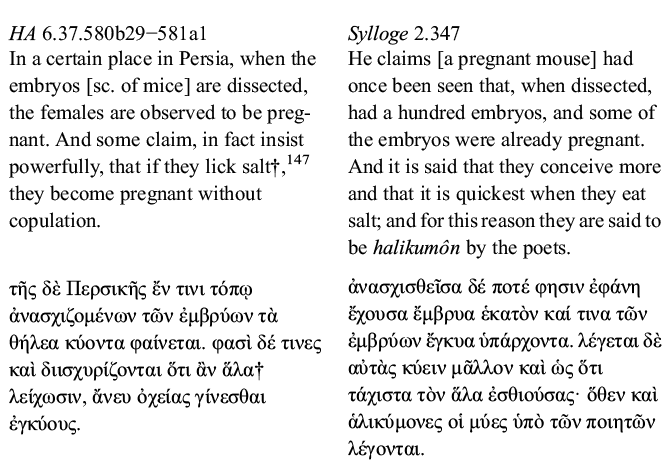
|
|
3.347 is clearly not an abridged version of HA 6.37.580b29–581a1, nor is the difference one of general versus specific. The two central claims are roughly the same – upon dissection pregnant mice were found carrying embryos that were themselves pregnant, and some claim there is a connection in mice between licking or eating salt and getting pregnant – but each contains details that the other lacks: Although they both use forms of the same verb for dissection, one mentions Persia, the other someone who made this claim and specified a number of embryos; one says the mice become pregnant without copulation when they lick something (presumably salt), the other that they become pregnant more readily or quickly when they eat salt; one refers to an epithet given to mice by poets, the other does not.
The hypothesis that best accounts for both the similarities and the differences in these two texts is that Aristotle in HA 6.37 and Aristophanes are both drawing from the same source, a section on mice in the Zoïka, though what precisely each has drawn from it is not the same. And note that HA 6.37, which is devoted to mice reproduction, begins (580b10–11): “The generation of mice is a most wondrous thing, in relation to the other animals, with respect to quantity and quickness” (ἡ δὲ τῶν μυῶν γένεσις θαυμασιωτάτη παρὰ τἆλλα ζῷά ἐστι τῷ πλήθει καὶ τῷ τάχει). There follows a number of thaumata (wonders or marvels), some of them generating aporia (ἀπορεῖται, b14), ending with the passage about the mice in Persia. Appended to this (and with it HA 6 comes to an end) is a description of two different kinds of mice (one of them from Egypt), ending with this statement: “There are also many other kinds of mice” (ἔστι δὲ καὶ ἄλλα γένη μυῶν πολλά, 581a5).Footnote 148
So I would be inclined to include all of 2.345–347 in an edition of the fragments of the Zoïka, with the usual reservations or questions about the seven-lobe liver, which I expect is more likely a minor addition from the Dissections than evidence that the entire text comes from a source other than the Zoïka.
3.13 The Shrew (2.373)
The passage on the shrew (μυγαλῆ, lit. mouse-weasel) is quite brief, the compiler making use of two sources: Aristophanes (373) and Aelian (374–375). Here is 373:
Aristophanes’. The shrew too is itself saw-toothed and fissiped; and it has eyes small and dim, and six breasts near its legs. When dissected [one observes] it is similar to a mouse.
Ἀριστοφάνους. ἡ μυγαλῆ ἐστι μὲν καὶ αὐτὴ καρχαρόδους καὶ πολυσχιδής. ὀφθαλμοὺς δὲ ἔχει μικροὺς καὶ ἀμβλεῖς, μαστοὺς ἓξ πρὸς τοῖς σκέλεσιν· ἀνατμηθεῖσα δὲ ὁμοία μυί.
Aristotle mentions the shrew only once, describing the danger of its bite (HA 7(8).24.604b19–22). Nothing in 373 comes from extant Aristotle. Moreover, the language is by now all too familiar from other passages in Aristophanes (e.g. καρχαρόδους, πολυσχιδής, ἀνατμηθεῖσα). So it is reasonable to conclude that Aristophanes’ source was the Zoïka and/or Dissections.
3.14 The Weasel (2.376–380)
Sylloge 2.376–386 is devoted to the weasel, with 376–380 coming from Aristophanes:
(376) Aristophanes’. The weasel too is itself saw-toothed, and it also has five fingers. (377) It drinks blood by destroying a vein, like the wolf. (378) When dissected it presents a six-lobe lung, a seven-lobe liver, possession of a gallbladder, large kidneys, a hard bladder, external testicles just like those of a boar. (379) Its penis is bony, similar to the claw of a bird, not having a hollow [part] in it, rather it is solid. The female has a bifurcated uterus and she gives birth to blind [young]. (380) The myth being told that [the male weasel] copulates [with the female] through the mouth is a mark of those who believe heedlessly. For he is not copulating, rather he is “taming” (her),Footnote 149 as the pigeon does.
(376) Ἀριστοφάνους. ἠ γαλῆ ἐστι μὲν καὶ αὐτὴ καρχαρόδους, ἔχει δὲ καὶ δακτύλους πέντε. (377) αἱμοποτεῖ δὲ κατὰ φλέβα λύουσα, καθάπερ ὁ λύκος. (378) ἀνατμηθεῖσα δὲ πνεύμονα ἑξάλοβον ἔχει, ἧπαρ ἑπτάλοβον χολὴν ἔχον, νεφροὺς μεγάλους, κύστιν σκληράν, ὄρχεις ἔξω καθάπερ κάπρου. (379) τὸ αἰδοῖον ἔχει ὄστινον ὅμοιον ὄρνιθος ὄνυχι, οὐκ ἔχον ἐν ἑαυτῷ κοιλότητα, ἀλλὰ στερεόν· ἡ δὲ θήλεια ὑστέραν δίκρουν καὶ τίκτει τυφλά. (380) τὸ δὲ μυθολογούμενον ὡς διὰ τοῦ στόματος ὀχεύει τῶν εἰκῇ πεπιστευμένων· οὐ γὰρ ὀχεύει, ἀλλὰ τιθασεύει ὡς ἡ περιστερά.
There is nothing like 376–378 in extant Aristotle; moreover, we have seen Aristophanes’ use of αἱμοποτεῖ κατὰ φλέβα (377) in other passages that arguably come from the Zoïka.Footnote 150 There is a more straightforward parallel between a line in HA 2.1 and the first part of 379. Sketching the differences among mammalian penises, Aristotle writes (2.1.500b23–25):
But some are bone-like, as are a fox’s and wolf’s and marten’s and weasel’s; for in fact the weasel has a bony penis.
τὰ δ’ ὀστώδη, ὥσπερ ἀλώπεκος καὶ λύκου καὶ ἴκτιδος καὶ γαλῆς· καὶ γὰρ ἡ γαλῆ ὀστοῦν ἔχει τὸ αἰδοῖον.
For the rest of 379, although Aristotle does refer to the weasel’s uterus in the Generation of Animals (in a passage presented in the next paragraph), he does not say anything about its being bifurcated. Finally, while Aristophanes states that the weasel gives birth to blind young, Aristotle in his extant works does not. In HA 6, he mentions a number of mammals that do give birth to blind young (dog [20.574a23–29], bear [30.579a23], hare [33.580a4–5], wolf [35.580a9–12], leopard, and thôs [36.580a25–27]), but not the weasel. In the passage cited on the hare, however, he writes that “it gives birth to blind [young], just like most of the fissipeds” (τίκτει δὲ τυφλά, ὥσπερ τὰ πολλὰ τῶν πολυσχιδῶν), which would include the weasel.
Perhaps the most interesting pair of seemingly related texts is 380 and a lengthy passage in GA 3.6, where Aristotle relates a report about certain animals, which he rejects (756b13–18):
It is the same way too concerning the generation of birds.Footnote 151 For there are some who say that the raven and the ibis copulate by the mouth and that, among the quadrupeds, the weasel gives birth through the mouth. For Anaxagoras and some of the other natural philosophers say these things, speaking too simply and without investigation. Now concerning the birds, people are deceived by a [false] deduction, because the copulation of ravens is seldom seen, whereas they are often seen sharing with one another with their beaks, which is what all the raven-like birds do. This is clear in the case of tamed [i.e., domesticated] jackdaws. And the weasel, just like the other quadrupeds, has uteri in the same manner as them: Where will the embryo go [to get] from them [i.e., the uteri] to the mouth? Rather, because the weasel gives birth to altogether tiny young, just like the other split-footed [animals], about which we speak later,Footnote 152 and they often carry their young in the mouth, it produced this opinion.
ὁμοίως δὲ καὶ περὶ τὴν τῶν ὀρνίθων γένεσιν ἔχει. εἰσὶ γάρ τινες οἳ λέγουσι κατὰ τὸ στόμα μίγνυσθαι τούς τε κόρακας καὶ τὴν ἶβιν καὶ τῶν τετραπόδων τίκτειν κατὰ τὸ στόμα τὴν γαλῆν. ταῦτα γὰρ καὶ Ἀναξαγόρας καὶ τῶν ἄλλων τινὲς φυσικῶν λέγουσι λίαν ἁπλῶς καὶ ἀσκέπτως λέγοντες. περὶ μὲν οὖν τῶν ὀρνίθων ἐκ συλλογισμοῦ διαψευδόμενοι τῷ τὴν μὲν ὀχείαν ὀλιγάκις ὁρᾶσθαι τὴν τῶν κοράκων, τὴν δὲ τοῖς ῥύγχεσι πρὸς ἄλληλα κοινωνίαν πολλάκις ἣν πάντα ποιεῖται τὰ κορακώδη τῶν ὀρνέων· δῆλον δὲ τοῦτο ἐπὶ τῶν τιθασευομένων κολοιῶν. καὶ ἡ γαλῆ καθάπερ τἆλλα τετράποδα τὸν αὐτὸν τρόπον ἔχει ἐκείνοις τὰς ὑστέρας – ἐξ ὧν εἰς τὸ στόμα πῇ βαδιεῖται τὸ ἔμβρυον; ἀλλὰ διὰ τὸ τίκτειν πάμπαν μικρὰ τὴν γαλῆν καθάπερ καὶ τἆλλα σχιζόποδα, περὶ ὧν ὕστερον ἐροῦμεν, τῷ δὲ στόματι πολλάκις μεταφέρειν τοὺς νεοττούς, ταύτην πεποίηκε τὴν δόξαν.
In Aristophanes’ version, “the myth being told” is that the male weasel mates with the female through the mouth, which impregnates her. These are two different false opinions about weasel reproduction, unless one is a muddled version of the other. As for the debunking of the myth, in extant Aristotle evidence from dissection (unstated) is presented – there is no way an embryo could get from the uterus to the mouth to exit – as well as an explanation of the source of the error (weasels carrying their young in their mouths). In Aristophanes, however, the terse explanation reads like a muddling of Aristotle’s explanation of the error about raven-like birds. Compare Aristotle and Aristophanes:
This is clear in the case of tamed [i.e., domesticated] jackdaws.
δῆλον δὲ τοῦτο ἐπὶ τῶν τιθασευομένων κολοιῶν.
For he is not copulating rather he is taming (= calming?) her, as the pigeon does.
οὐ γὰρ ὀχεύει, ἀλλὰ τιθασεύει ὡς ἡ περιστερά.
It is difficult to know what to make of the relationship between these two passages. On the one hand, one might well argue (as I did in the case of a thauma concerning mouse generation) that, whatever the clear similarities of subject matter, the differences between 2.380 and GA 3.6 are such that Aristotle and Aristophanes are likely both drawing from the same source, the Zoïka, but that what precisely each has drawn from it (or done with it) is not the same. (I have elsewhere argued that a version of the story about the ibis, in Cicero, might well have come from the Zoïka.)Footnote 153 But it is also possible that Aristophanes’ source, in the case of 380, is extant Aristotle, but that his abridgement of it has been muddled or corrupted. But whatever one concludes about 380, I think the likely source of 376–379 is a lost work(s) of Aristotle.
3.15 The Fox (2.390)
Sylloge 2.390–408 is devoted to the fox, with 390–391 coming from Aristophanes. The situation is straightforward: 390 has no parallel in extant Aristotle; 391 does.Footnote 154 Here is 390:
Aristophanes’. The fox too is itself saw-toothed and fissiped, and when dissected [it presents] all the internal organs similarly possessed by the dog.
Ἀριστοφάνους. ἡ ἀλώπηξ ἐστὶ μὲν καὶ αὐτὴ καρχαρόδους καὶ πολυσχιδής, ἀνατμηθεῖσα δὲ κυνὶ τὰ ἐντόσθια πάντα κέκτηται ὅμοια.
The Zoïka and/or the Dissections were likely Aristophanes’ sources.
3.16 Hare Dissection (2.409–410)
There are only two sources on the hare, Aristophanes (409–410) and Aelian (411–418). The opening of this entry is somewhat unusual, as Ἀριστοφάνους is preceded by Ἐκ τοῦ and followed by two names of the animal, in the nominative (not in the genitive preceded by περί, as in the case of the entry on the bear): “From the [work] of Aristophanes. Hare [dasupous, ‘hairy-feet’]; the same [animal] is also called lagôs [‘floppy-ears’]” (Ἐκ τοῦ Ἀριστοφάνους. Δασύπους· ὁ δ’ αὐτὸς καὶ λαγὼς λέγεται).Footnote 155 It is not clear to me what significance, if any, this has. In any case, 409 is similar to something in extant Aristotle, 410 is not, though both are worth discussing. I begin with the former case:
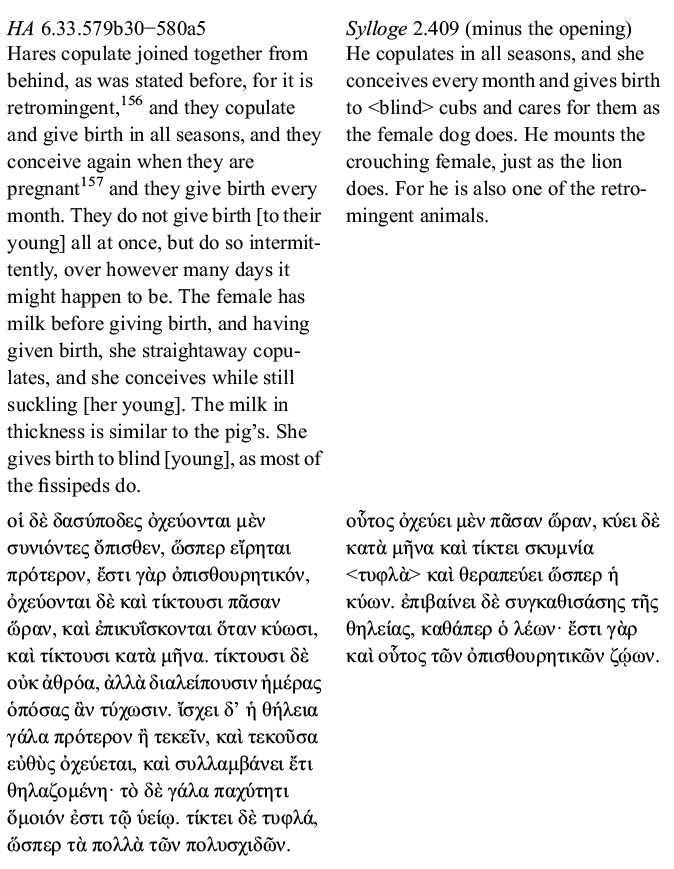
|
|
Aristophanes reverses the order of the first two claims: how they copulate and when they do. He compares the hare to other animals not mentioned in the parallel HA passage (ὥσπερ ἡ κύων, καθάπερ ὁ λέων),Footnote 158 and he omits any mention of milk, and perhaps most surprising, he does not mention superfetation. One might think these differences are sufficient to conclude that HA 6.33 was probably not Aristophanes’ source, but I think it more likely that 409 is an abridgement of part of HA 6.33.
Here is 410, for which there is no parallel passage in extant Aristotle:
When dissected it presents internal organs similar to the pig’s, a six-lobe liver, a gallbladder that is large, but in the middle of the liver.Footnote 159 It also has large testicles and a bladder and a bifurcated wombFootnote 160 and a cotyledons attached to each embryo,Footnote 161 just as was said in the case of the mouse.Footnote 162
διοιχθεὶς δὲ τὰ ἐντὸς ἔχει ὅμοια ὑί· τὸ δὲ ἧπαρ ἑξάλοβον, ἡ χολὴ μεγάλη, μέσῳ δὲ ἥπατι. ἔχει δὲ καὶ ὄρχεις μεγάλους καὶ κύστιν καὶ μήτραν δίκρουν καὶ κοτυληδόνα [ἐν] ἑκάστῳ ἐμβρύῳ προσκειμένην, καθάπερ ἐπὶ τῆς μυὸς εἴρηται.
As in earlier such cases, I think it likely that the source was Aristotle’s report on his dissection of a hare, perhaps with some of Aristophanes’ revisions based on later anatomical terminology.
3.17 The Hedgehog (424–427)
Sylloge 2.424–435 is devoted to the hedgehog, with 424–427 coming from Aristophanes. In this case, most of the work was done for me by Oliver Hellmann (Reference Hellmann, Fortenbaugh and White2006, 343–344), who presents in a table 2.424–427 alongside the few parallels to 426–427 from the extant works of Aristotle. He concludes:
The comparison for the hedgehog shows that only two pieces of information given by Aristophanes can also be found in Aristotle’s works, namely, the descriptions of the inside testicles (426) and the movement of the entrances of the burrows when the weather changes – a phenomenon which was used by a clever man in Byzantium to forecast the weather (427). For all other information about the physiology and anatomy of the hedgehog (424 and 425), no close parallels in Aristotle can be found.
As I agree with Hellmann about 2.424–425, I conclude that it comes from the Zoïka and/or the Dissections, and present the passage without further comment:
(424) Aristophanes’. The hedgehog has five-fingered feet, like the bear does too, a pig’s snout, sheep’s teeth and dog’s teeth.Footnote 163 [The female has] seven breasts, five on the right and two on the left. It has a small tail and [the male has] a penis positioned below it. The genital of the womb is a pig’s.Footnote 164 (425) When dissected it presents a tongue that is not large, viscera similar to a pig’s, though the spleen is very dark, like that of the horse.
(424) Ἀριστοφάνους. ἐχῖνος ὁ χερσαῖος πόδας μὲν ἔχει πενταδακτύλους, καθάπερ καὶ ἡ ἄρκτος, ῥύγχος ὑός, ὀδόντας οὓς μὲν προβάτου, οὓς δὲ κυνός· μαστοὺς ἑπτά, εἰς τὰ δεξιὰ πέντε καὶ εἰς τὰ ἀριστερὰ δύο· κέρκον μικρὰν καὶ αἰδοῖον ὑποκείμενον· τῆς δὲ μήτρας τὸ αἰδοῖον ὑός. (425) ἀνατμηθεὶς δέ, γλῶσσαν μὲν οὐκ ἔχει μεγάλην, τὰ δ’ ἄλλα σπλάγχνα ὅμοια ὑί, σπλῆνα δὲ λίαν μέλανα, ὅμοιον τῷ τοῦ ἵππου.
Now 2.427 seems to be a clear paraphrase of HA 8(9).6.612b4–10, slightly briefer and with some rewording. But I would modify Hellmann’s account with respect to 426 (in a way that his table makes clear, however), as I think there is something significant in 426 not found in the extant Aristotle:
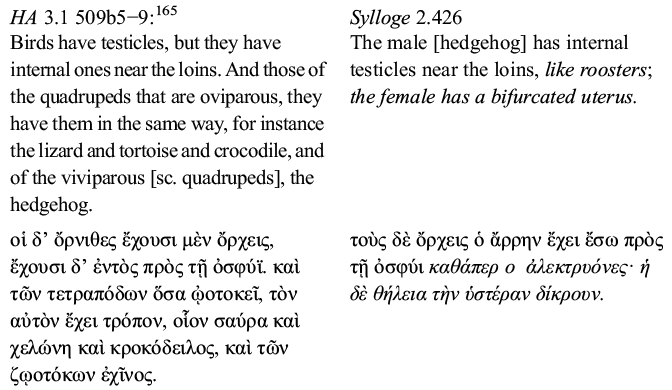
|
|
If the only difference were the comparison to roosters (καθάπερ οἱ ἀλεκτρυόνες), then one should conclude that this is likely Aristophanes’ addition, as we have seen this practice before. But the reference to the uterus makes it unlikely that 426 is a mere abridgement of HA 3.1 509b5–9. Moreover, Aristophanes uses this same language elsewhere: At 2.328, he writes of the bear: “Its testicles are internal, near the loins, just like roosters” (τοὺς δὲ ὄρχεις ἔσω πρὸς τῇ ὀσφύι καθάπερ οἱ ἀλεκτρυόνες); and at 2.379, he writes of the weasel: “the female has a bifurcated uterus and she gives birth to blind [young]” (ἡ δὲ θήλεια ὑστέραν δίκρουν). So I would be inclined to treat 426, along with 424–425, as coming from lost Aristotle.
On the question of the source of the material with no parallel in extant Aristotle, Hellmann (Reference Hellmann, Fortenbaugh and White2006, 344) concludes his discussion of the hedgehog as follows:
But where do the physiological details mentioned in Aristophanes’ Epitome but missing in Aristotle’s works come from? A clue for the answer might come from the Pseudo-Aristotelian Mirabilia (65 835a26), where we are told that the hedgehog is able to survive a whole year without nourishment. Hellmut Flashar says in his commentary [Reference Flashar1981, 99] that the source probably was Theophrastus’ work On Creatures that Hide (Περὶ τῶν φωλευόντων), because the same information is linked with hibernation in Aelian’s De Natura Animalium 3.10.69 It is certainly possible that Aristophanes excerpted information from this work, either directly or through an intermediate source. However, one could object that Aristophanes never mentions hibernation in this part of his work.
I have mentioned elsewhere that the works of Theophrastus on animals might have been used by Aristophanes to supplement his presentations. In this case, however, I think the Zoïka is the more likely source, in part for the reason given by Hellmann in his final sentence.
3.18 The BatFootnote 166 (436–440)
Sylloge 2.436–442 is devoted to the bat, with 436–440 coming from Aristophanes. Here is 436–439:Footnote 167
(436) Aristophanes’. The bat is one of the saw-toothed and fissiped and skin-winged animals. It has five fingers on each of its feet and its hands, just like mice, a face similar to a pig, large ears, teeth that are sharp and large in two rows,Footnote 168 eyes positioned over the lips. [The female] in fact has two breasts, in which there is milk too. (437) When dissected it presents internal organs similar to the pig. (438) They copulate with the male mounting the crouching female. (439) This is the only viviparous flying animal. For she gives birth to pups, and she breastfeeds them while she is flying, holding them under her armpits. She gives birth to two or three at a time. And it is said that they are covered in tiny hairs and that the hairs are difficult to observe.
(436) Ἀριστοφάνους. ἡ νυκτερίς ἐστι μὲν τῶν καρχαροδόντων καὶ πολυσχιδῶν καὶ δερματοπτέρων· ἔχει δὲ δακτύλους πέντε εἰς ἕκαστον τῶν ποδῶν καὶ τῶν χειρῶν καθάπερ οἱ μύες, πρόσωπον ὅμοιον ὑί, ὠτάρια μεγάλα, ὀδόντας διστιχεῖς καὶ ὀξεῖς, μεγάλους, ὄμματα ἐπὶ τοῖς χείλεσιν ἐπικείμενα. ἔχει δὲ καὶ μαστοὺς δύο, ἐν οἷς καὶ γάλα. (437) ἀνατμηθεῖσα δὲ τὰ ἐντόσθια ἔχει ὅμοια ὑί. (438) ὀχεύει δὲ τῆς θηλείας συγκαθισάσης ὁ ἄρρην ἐπιβαίνων. (439) ἔστι δὲ τοῦτο μόνον τῶν πτητικῶν ζῳοτόκον. τίκτει γὰρ σκυμνία, καὶ ταῦτα θηλάζει ἅμα πετομένη, ὑπὸ τὰς μασχάλας αὐτὰ ἔχουσα. τίκτει δὲ δύο ἐφάπαξ καὶ τρία· λέγεται δὲ καὶ τετριχῶσθαι μικροῖς καὶ δυσθεωρήτοις τριχιδίοις.
There is remarkably little overlap (none of any significance) between this text and what Aristotle says about bats in his extant writings. Here is a summary of the latter: Bats have feet and can walk (HA 1.1.487b22–23); bats are an example of a nocturnal animal (1.1.488a26); bats are an example of a skin-winged animal (1.5.490a7–8); bats are an example of an animal with rows of teeth on both jaws (ἀμφωδόντων)Footnote 169 and uteri with cotyledons (3.1.511a28–31); the bat, like the seal, is an animal that “tends to both sides” (τὸ ἐπαμφοτερίζειν) – in the case of bats, because they are in a sense neither or both land animals and winged animals, and in a sense they both are and are not quadrupeds (PA 4.13.697b1–13);Footnote 170 bats and seals move on the ground like maimed (ἀνάπηρον) quadrupeds (IA 19.714b10–13).
That Aristotle purportedly showed so little interest in bats has been taken as evidence that 436–440 could not have come from Aristotle.Footnote 171 But that is a non sequitur. The Zoïka could very well have included an account of the bat, containing the material in the just-cited passage and more, though Aristotle left these details out of his discussions of the bat in his extant works because what especially interested him was the fact that bats were difficult to classify: They are winged animals, but not birds; quadrupeds, but not fully. Animals that tend to both sides (e.g., bat, seal, ostrich), and hybrid animals (like mules and the dog hybrids mentioned in HA 7(8).28),Footnote 172 are of interest to Aristotle as they reveal something about animal nature, namely, as Balme (Reference Balme1972, 97–98) points out, that animal kinds are not perfect essences fixed in the mind of god, as in Stoicism and Neoplatonism.Footnote 173 And they were a challenge as well: How is the imperfect walking of a naturally “maimed” quadruped to be explained in terms of Aristotelian teleology? So I regard the whole of 2.436–439 as evidence for the Zoïka.Footnote 174
3.19 The Camel (2.446–475)
Sylloge 2.446–475 is devoted to the camel, with 446–459 coming from Aristophanes. Here I find Aristophanes’ sources particularly difficult to determine, though in the end I tentatively divide his section into three parts and consider their likely sources to be as follows: (a) 446–450 come from Aristotle’s extant works, especially the Historia animalium, though the source texts have often been muddled, and in general the material has been reorganized considerably.Footnote 175 (b) 451–455 come from works that are not extant, even though some of the information therein can be found in extant works as well.Footnote 176 (c) 456–459 seem to come from the Historia animalium, though contaminated (intentionally or not) with material from the compiler’s next source, Aelian.Footnote 177
So (b) is the part that interests me, 2.451–455:
(451) When dissected the Arabian camelFootnote 178 presents a liver scaly and large and possessing small outgrowths. It does not have a visible gallbladder, but it does have some sort of gallbladder-like impression that, in tasting it, we take to pass for gall.Footnote 179 (452) The camel also has four stomachs.Footnote 180 (453) (The female) begins to copulate and to be available for copulation when she is three years old.Footnote 181 And he copulates with the crouching female. The male mounts and, turning his penis in the opposite direction, given its large size from the outset, he inserts it,Footnote 182 and his copulating continues for one day.Footnote 183 (454) She is pregnant for ten months, and gives birth in the eleventh, and she is in heat again after a one-year interval.Footnote 184 (455) Camels suffer from two diseases, colic and rabies – that is to say, madness – and they are fatal to them.Footnote 185
(451) ἀνατμηθεῖσα δὲ Ἀραβία κάμηλος ἧπαρ ἔχει φολιδωτὸν καὶ μακρὸν καὶ ἐξοχὰς ἔχον μικράς· χολὴν δὲ οὐκ ἔχει θεωρητήν, τύπον δέ τινα χολώδη οὗ καὶ γευόμενοι χολῆς ἀντιλαμβανόμεθα. (452) ἔχει δὲ καὶ ἡ κάμηλος κοιλίας τέσσαρας. (453) ἄρχεται δὲ ὀχεύειν καὶ ὀχεύεσθαι τριετὴς γενομένη. ὀχεύει δὲ τῆς θηλείας συγκαθισάσης· ἐπιβαίνει δὲ ὁ ἄρρην καὶ ἀντιστρέψας τὸ αἰδοῖον, ἅτε μακρὸν ὑπάρχον, ἐνίησι, καὶ διατελεῖ ὀχεύων ἡμέραν μίαν. (454) κύει δὲ μῆνας δέκα, τῷ δὲ ἑνδεκάτῳ τίκτει, καὶ πάλιν διαλιποῦσα ἐνιαυτὸν σκυζᾷ. (455) κάμνουσι δὲ αἱ κάμηλοι νοσήμασι δυσί, στρόφῳ καὶ λύσσῃ, τουτέστι μανίᾳ, καὶ τούτοις ἀναιροῦνται.
I think it likely that all of 451–455 come from the Zoïka and the Dissections.
3.20 Cervine Internal Organs (2.476–482)
Sylloge 2.476–517 is devoted to the deer, with 476–492 coming from Aristophanes. Almost everything in the material from Aristophanes has parallels in the Historia animalium and Parts of Animals, especially HA 2.1, 6.29, 8(9).5, and PA 3.2.Footnote 186 Even so, it is worth looking more closely at the parallel passages in the case of 480–482. (I twice divide the section in two, labelling the parts a and b).
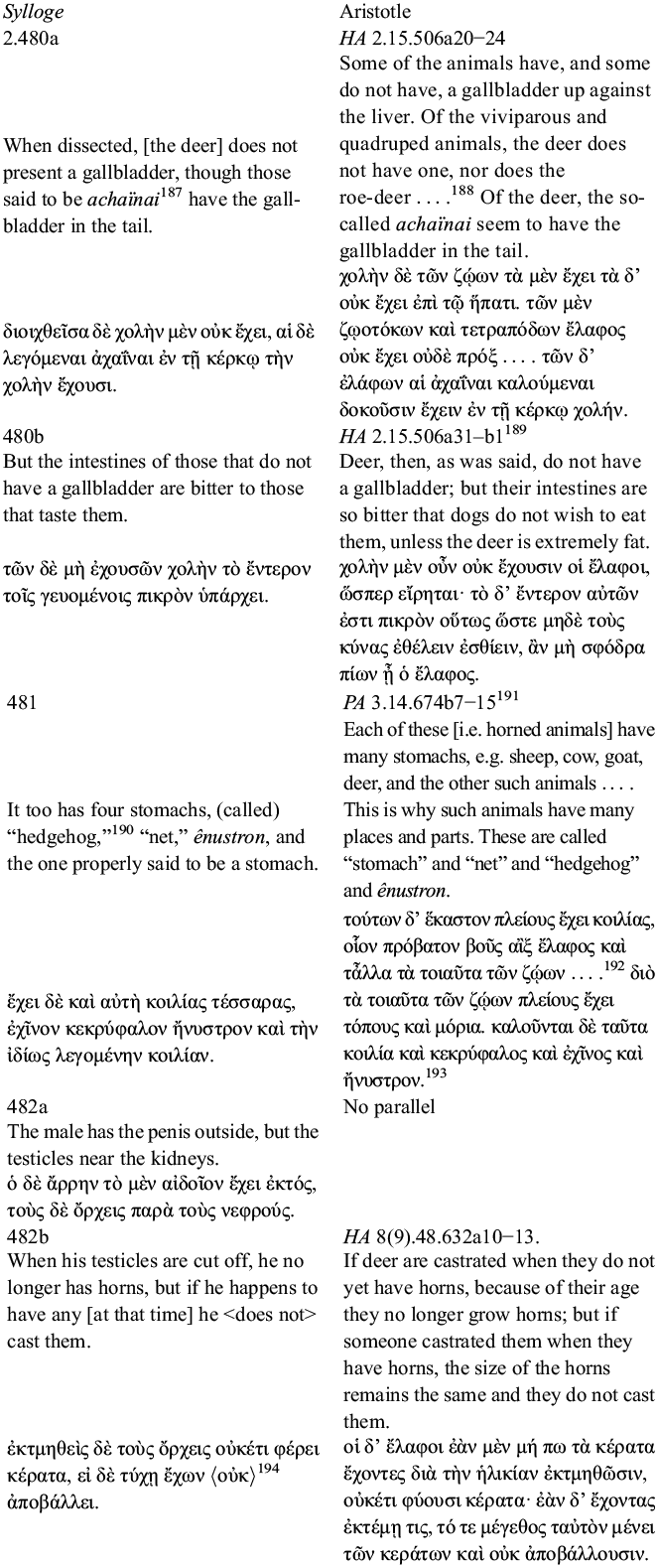
| Sylloge | Aristotle |
|
|
|
|
| PA 3.14.674b7−15Footnote 191 Each of these [i.e. horned animals] have many stomachs, e.g. sheep, cow, goat, deer, and the other such animals … . This is why such animals have many places and parts. These are called “stomach” and “net” and “hedgehog” and ênustron. τούτων δ’ ἕκαστον πλείους ἔχει κοιλίας, οἷον πρόβατον βοῦς αἲξ ἔλαφος καὶ τἆλλα τὰ τοιαῦτα τῶν ζῴων … .Footnote 192 διὸ τὰ τοιαῦτα τῶν ζῴων πλείους ἔχει τόπους καὶ μόρια. καλοῦνται δὲ ταῦτα κοιλία καὶ κεκρύφαλος καὶ ἐχῖνος καὶ ἤνυστρον.Footnote 193 |
| No parallel |
|
|
It is hard to say what to make of all of this. 480a is the sort of abridgement or paraphrase one would expect from an epitome. Only the explicit reference to dissection (διοιχθεῖσα), missing in HA 2.15, could give one reason to think otherwise. This might well have been added by Aristophanes from elsewhere, however, if it is the case that in presenting the results of dissection, he includes terminology that does not come from extant Aristotle. 480b and 481 appear to be abridgements or paraphrases. 482a has no parallel in Aristotle and so might be considered a possible fragment; but if we allow that Aristophanes sometimes embellished or supplemented his paraphrase of Aristotle, then we should expect passages like 482a, especially when they are (as here) embedded in material that mostly matches passages in Aristotle’s extant writings. Finally, 482b too looks to be an abridgement.
In the end, I find the parallels in 480–482 too close to extant Aristotle to regard this material as evidence for lost works of Aristotle, though I cannot rule out that possibility completely.
3.21 Differences in Cervine Copulation according to Differences in Location (2.484)
Aside from 482a, the only other passage on deer from Aristophanes with no parallel in Aristotle’s extant works is 484:
A different female begins to copulate and to be available for copulation differently according to the locations in which she lives.
ἄρχεται δὲ ὀχεύειν καὶ ὀχεύεσθαι ἡ θήλεια ἄλλη ἄλλως πρὸς τοὺς τόπους ἐν οἷς καὶ βιοῖ.Footnote 195
As there is nothing like this in extant Aristotle, I think its most likely source is the Zoïka. And it is worth noting that differences in the same kind of animal according to location was of great interest to both Aristotle and Theophrastus, and many such differences may have been collected in the Zoïka.Footnote 196
3.22 Equine Dissection (2.573–576)
Sylloge 2.573–625 is devoted to the horse, with 573–584 coming from Aristophanes. The Aristophanes section is unusual in that it begins: Aristophanes’ “On Solipeds” (Ἀριστοφάνους περὶ μωνύχων) – that is, animals with uncloven hooves. I assume this is likely the title of a section of Aristophanes’ work, and that μῶνυξ was the term he used to classify equine animals, though Aristotle called equine animals “the so-called ‘long-haired tail’” animals (τοῖς λοφούροις καλουμένοις) (HA 1.6.491a1–6).Footnote 197
The material from Aristophanes covers three topics: dissection (573–576), copulation and generation (577–581), and disease, diet, and longevity (582–584). The second and third parts overlap a great deal with the Historia animalium, so I do not consider them further. But this first part has virtually nothing in common with extant Aristotle. Here is 2.573–576 (minus Ἀριστοφάνους περὶ μωνύχων).Footnote 198
(573) The horse is one of the soliped animals and has teeth on both jaws; it moves kata diametron. … (574) When dissected it presents lard but not fat. … It has a gall bladder, but near the intestine. … Footnote 199 (575) It is said that some horses and mules have a mighty bone in the heart.Footnote 200 (576) Bovine spleen, porcine kidneys, firm bladder … uterus between rectum and bladder. It also presents a stomach similar. … It possesses the same viscera as both donkey and mule.
(573) ὁ ἵπ⟨πος ἔ⟩στιFootnote 201 μὲν τῶν μωνύχων καὶ ἀμφοδόντων, πορεύεται δὲ κατὰ διάμετρον (lac.). (574) ⟨διο⟩ιχθεὶςFootnote 202 δὲ πιμελὴν ἔχει ἀλλ’ οὐ στέαρ, πι (lac.) ον·Footnote 203 χολὴν μὲν ἔχει, ἀλλὰ παρὰ τὸ ἔντερον κε (lac.) η.Footnote 204 (575) λέγονται δέ τινες ἵπποι καὶ ἡμίονοι ὀστέον ἔχειν ἐν τῇ καρδίᾳ νεανικόν. (576) σπλὴν βόειος, νεφροὶ ὑικοί, κύστις στερ⟨ρά⟩· (lac.) ⟨μή⟩τραFootnote 205 μεταξὺ ἀρχοῦ καὶ κύστεως· ἔχει δὲ καὶ κοιλίαν ὁμ⟨οίαν⟩ (lac.)Footnote 206 τὰ δ’ αὐτὰ καὶ ὄνος καὶ ἡμίονος σπλάγχνα κέκτηνται.
575 has parallels in extant Aristotle; but as it comes between 573–574 and 576, which do not, I think it best to treat 573–576 together, and to consider their likely source the Zoïka and the Dissections. But given the lacunose state of this text, one must be especially cautious. And one should keep in mind that Hierocles might provide evidence for some of what is missing from this text.Footnote 207
4 Conclusions
First, I list those texts that I believe should be included in an edition of the fragments of the Zoïka.
Sylloge 1.33: Peahen egg-laying
1.37: Fire-born animals and the bees’ hostility to perfume
1.45: Spontaneous generation of hardshell animals, including the pelôris
1.78: Diogenes of Apollonia on the nourishment of embryos
1.112: Lice on the head of humans
1.127: Fish that make a sound
1.143 and 2.251: The leopard’s tail
2.68: The elephant’s gait
2.147: The lion as disease-free
2.213: Lupine blood-drinking
2.484: Differences in cervine copulation according to differences in location
Second, I list those texts that I believe should be split or shared between editions of the Zoïka and of the Dissections. I employ letters to distinguish what I would be inclined to include in a Zoïka collection (Z), and what I think should be considered a fragment from the Dissections (D).Footnote 208
2.295–297 (Z), 2.296 (D): The cat
2.308–313 (Z), 2.309 (and 310?) (D): The hyena
2.326–336 (Z), 2.328 (D): The bear
2.345 (Z), 2.345–347 (D): The mouse
2.373, first part (Z), 2.373, second part (D): The shrew
2.376–379 (Z), 378 (D): The weasel
2.390 (Z and D): The foxFootnote 209
2.424 (Z), 2.425 (D): The hedgehog
2.436–439 (Z), 437 (D): The bat
2.453–455 (Z), 451–452 (D): The camel
2.573 (Z), 574–576 (D): Equine dissection
Third, I list the texts that I believe ought to be considered fragments from the Dissections but not included in an edition of Zoïka fragments.
2.73: Female elephant dissection
2.168: Canine internal organs
2.210: Lupine internal organs
2.248: Pardine internal organs
2.284: The internal organs of the thôs
2.410: Hare dissection
I said in the Introduction that if I am right about Aristophanes’ Epitome as evidence for Aristotle’s lost Zoïka and Dissections, then the amount of information we have about these works has increased considerably. In the case of the Zoïka, where Athenaeus’ Deipnosophistae 7 provides abundant information about fish from the Zoïka, and Deipnosophistae 9 about birds,Footnote 210 the Epitome provides substantially more information on viviparous quadrupeds (i.e., mammals) than any other source. Over half the fragments on mammals would now come from Aristophanes. I think this suggests that although Athenaeus had access (directly or indirectly) to the sections of the Zoïka devoted to fish and birds, he lacked the section on mammals,Footnote 211 making Aristophanes’ Epitome all the more important as a source for lost Aristotle.
In the case of the lost Dissections, however, the increased amount of information is more of a potential, for what I have established is in effect a promising research program. That is, more research needs to be undertaken to determine whether it is more likely that in the relevant passages, Aristophanes made use of the Dissections, but revised it by using more up-to-date terminology, or did not use Aristotle at all, but instead drew from a later work(s) employing this terminology. I have offered support for the former hypothesis, but more work needs to be done, especially by anyone editing the fragments of Aristotle’s Dissections.
Appendix: Aristophanes’ Epitome in the Earlier Collections of Aristotle Fragments
Rose in all three of his collections of fragments from lost works attributed to Aristotle – (1863, 276), (1870, 1525), and (1886, 215) – labels the section on the Zoïka fragments “Ζωικά (= ἀνατομαί),” though in the third collection he expands this to “(Ἀριστοτέλους ἢ) Ἀριστοφάνους Ζωικά (= ἀνατομαί vel περὶ ζῴων ἀνατομῆς).” As this last indicates, and as was mentioned, he also claims that the Zoïka and Aristophanes’ Epitome are the same work. Further note, in connection with the lost works on animals:
– Rose1 (1863): No fragments from Aristophanes’ Epitome, though it is discussed on pp. 283–284.
– Rose2 (1870): No fragments from Aristophanes’ Epitome, and no mention of it.
– Rose3 (1886): F 280.3 = Sylloge 1.2, F 285.1 = 1.55, F 285.2 = 1.62, F 285.3 = 1.61, F 285.4 = 1.69, F 285.5 = 1.65, F 285.6 = 1.74, F 285.7 = 1.96, F 285.8 = 1.104 and 107, F 285.9 = 1.100, F 285.10–11 = 1.77, F 285.12 = 1.78, F 285.13 = 1.66, F 285.14 = 1.88.15 = 1.98, F 285.16 = 1.99, F 288.2 = 1.112, F 292.1 = 1.18, F 300.2 = 1.127, F 341.1 = 1.137, F 351 = 1.33, F 352 = 1.141, F 356 = 1.36, F 357 = 1.115, F 358 = 1.37. (All these texts come from Sylloge 1.)
A brief comment is in order about F 285 Rose3, which consists of sixteen texts that come from Sylloge 1.55–107 but are not presented in order. It is unclear to me what motivated Rose here. In any case, Falcon (Reference Falcon and Föllinger2022) demonstrates that Sylloge 1.27–95 is “a more or less continuous abridgement of the GA (with occasional additions of material taken from HA V, VII, and X).” So, of the sixteen parts of F 285, I think we can dispense with eleven – the ones that fall within 27–95 – though one of these (1.78) required further discussion (see Section 2.5). That leaves Sylloge 1.96, 98, 99, 100, 104, and 107. I believe parallels in the extant corpus Aristotelicum can be found for 96, 99, 100, and 107, though 98 and 104 required further discussion (see Sections 2.6 and 2.7).
Heitz (1869): Includes no fragments from Aristophanes’ Epitome in the sections marked Dissectiones and Zoica, though it is mentioned in the latter section (on p. 172). In his earlier work on lost Aristotle (1865), he mentions Aristophanes of Byzantium in connection with Aristotle’s lost works on animals, only to dismiss him.
Gigon (Reference Gigon1987, 442–464): F 269 = Sylloge 1–2.39 and 2.68–82, 133–150, 167–181, 207–216, 245–251, 283–289, 295–299, 308–313, 326–336, 345–347, 373, 376–380, 387, 390–391, 409–410, 419, 424–427, 436–440, 446–459, 476–492, 573–584. In effect, all of Aristophanes’ Epitome, as far as that can be determined. These are all included under the heading Περὶ ζῴων (i.e., none are under his heading Ἀνατομῶν).
Gigon (Reference Gigon1987, 420–421) offers an explanation for why he includes so much material from this and other works. But whatever the differences between the Hellenistic versions of Aristotle’s works, and the versions that come down to us in the manuscripts – even if one were to accept such a clearcut division – I do not think that this, in combination with the relative neglect of Aristotle’s works on animals, justifies the inclusion of all of Aristophanes’ Epitome in a collection of fragments of the Zoïka, which is what he claims.
Acknowledgements
I must first express my gratitude to Arnaud Zucker for sharing with me, prior to its publication and before I began to work on this Element, a draft of his annotated French translation of the Sylloge, and more recently a draft of his critical edition of the Greek text. Many thanks as well to Claire Bubb and Oliver Hellmann for their feedback on an earlier version of this Element, and to Fabio Verthuy for sharing with me an early draft of his essay on the lion in Aristophanes’ Epitome. I am extremely grateful to Gertjan Verhasselt for making possible my stay at the University of Padua as Visiting Scholar (June and July 2025) and for arranging a seminar while I was there to discuss my work on Epitome 1. I received excellent feedback on that occasion from many of the participants, and would like to single out Börje Bydén, who also sent me valuable written comments afterward. I am also grateful for the many helpful suggestions that I received from the two referees for Cambridge University Press. I must, of course, thank Seton Hall University for a summer 2025 travel grant that made possible the trip to Padua, and for granting me a course release in the fall 2025 semester that made submitting this Element on time much easier. Finally, I am especially grateful to Liba Taub, the series editor, for her many excellent comments and suggestions on three drafts of this Element.
Liba Taub
University of Cambridge
Liba Taub is Director of the Whipple Museum of the History of Science and Professor Emerita of History and Philosophy of Science at the University of Cambridge. She is the author of Ancient Meteorology (2003), Aetna and the Moon: Explaining Nature in Ancient Greece and Rome (2008), and Science Writing in Greco-Roman Antiquity (Cambridge, 2017), and editor of The Cambridge Companion to Ancient Greek and Roman Science (Cambridge, 2020).
About the Series
Cambridge Elements in Ancient Science, Technology and Medicine explores scientific, medical and mathematical learning in the ancient world, including Babylonian, Egyptian, Greek, Roman, Chinese, Indian and other early cultures of inquiry. The authors interrogate compelling questions and offer fresh interpretations to readers, including scholars, students, modern practitioners and the wider public.
