INTRODUCTION
Pragmatic knowledge entails understanding the relationship between a linguistic form and the context where that form is used. Thomas (Reference Thomas1983) conceptualizes pragmatic knowledge involving two dimensions: pragmalinguistics and sociopragmatics. The former refers to the knowledge of linguistic forms to convey our intentions, while the latter refers to our assessment of the context in which those forms occur. Existing studies have focused on learners’ use of pragmalinguistic forms, specifically lexico-grammatical forms and semantic moves as a primary criterion when assessing pragmatic development (Taguchi & Roever, Reference Taguchi and Roever2017). Other dimensions of pragmalinguistics such as prosody have been largely overlooked.
This study fills this gap by tracing prosodic properties in L2 speech acts over time. The study reanalyzes data from Taguchi’s (Reference Taguchi2012) study to illustrate changing patterns of discourse intonational features in L2 English learners’ speech acts. By reanalyzing data from the novel perspective of prosody, the study intends to break new ground for conceptualizing pragmatic development, going beyond the typical measure of lexico-grammatical forms and semantic moves. The study also examines individual and contextual influences on prosodic changes. By pursuing these investigations, this study intends to contribute to the broader area of SLA research whose goal is to reveal pace of development across different areas of linguistic competence and factors contributing to the development. By analyzing development from the novel perspective of prosody, we can address how learners use different linguistic resources (e.g., prosody, grammar, lexis, and semantics) to achieve a communicative function, how their use changes over time, and the extent of individual variation within these changes.
BACKGROUND
DEVELOPMENT IN THE PRODUCTION OF PRAGMATIC MEANING
Existing longitudinal studies have documented L2 learners’ pragmatic development through systematic, cyclical data collection, and this development has been explained by examining individual and contextual influences (Taguchi, Reference Taguchi and Trosborg2010). Among the areas of development, pragmatic production—the ability to convey one’s intention—has attracted the most interest. Pragmatic production has typically been examined in speech acts. Using discourse completion tasks (DCTs), role plays, and naturalistic observations, researchers have collected learners’ speech acts and compared their speech act strategies across time points (Taguchi & Roever, Reference Taguchi and Roever2017).
A generalization in existing findings is that L2 learners gradually expand their linguistic repertoire by adopting new speech act forms and diversifying modification devices to qualify a speech act. Taguchi (Reference Taguchi2012) examined the development of requests and opinions among L2 English learners. Oral DCT data collected three times over one academic year showed that learners shifted from direct to indirect forms to convey meaning. They also increased their use of semantic moves and modification devices (e.g., hedging) to mitigate high-imposition speech acts. A gradual diversification of linguistic forms was also found in Al-Ghatani and Roever’s (Reference Al-Gahtani and Roever2014) study, which documented L2 speakers’ increasing use of preliminary moves in requests. Ren (Reference Ren2012) also revealed L2 learners’ expansion of external modifications in refusals.
A tendency in existing research is their almost undivided focus on lexico-grammatical forms and semantic moves. Most studies have documented learners’ developing abilities to use grammatical forms, semantic moves, and discoursal strategies to convey meaning. The expansion of these forms and their functional capacities has served as a benchmark of pragmatic development. Other phenomena relevant to spoken production, particularly prosody, have remained unexplored, limiting developmental insights into syntactic and semantic aspects of pragmatic production. Neglecting such aspects is serious because prosody plays a decisive role when conveying pragmatic meaning (Kang & Kermad, Reference Kang, Kermad and Taguchi2019; Pickering Reference Pickering2018; Romero-Trio, Reference Romero-Trio2012).
PROSODY AND PRAGMATIC MEANING
The present study adopts Brazil’s (Reference Brazil1997) framework of prosody that capitalizes on the role of intonation and sentence prominence in creating and interpreting meaning in discourse. Brazil specifies three intonation patterns: proclaiming (fall or rise-fall), referring (rise or fall-rise), and level tone (neutral). The proclaiming tone is considered to signal new information to the listener and thus changes the state of the speaker-listener convergence, while the referring tone occurs when the speaker presents information that is already known to the listener. The composition of mostly falling and rising tones signals the convergence or divergence between the speaker and the listener. The level tone can often signal incomplete thought units, indicating phenomena such as verbal planning and processing. Such oblique orientation can indicate a temporary withdrawal from the context of the interaction, allowing the speaker to move toward the language sample and away from the listener (Pickering, Reference Pickering2018). Sentence prominence refers to words that are emphasized by a speaker. Sentence prominence reflects the speaker’s discourse-level decision related to which information to emphasize in a sentence. Three prosodic features signal sentence prominence: pitch (measured in hertz at the onset of a vowel), amplitude, and length (duration of a vowel).
Prosodic properties of speech like the choice of tone and prominence are affected by contextual factors such as the speakers’ relationship (e.g., dominant/nondominant) and their communicative goals (e.g., adding emphasis, showing sincerity) (Kang & Kermad, Reference Kang, Kermad and Taguchi2019; Romero-Trillo, Reference Romero-Trio2012). Prosody also greatly contributes to pragmatic meaning, signaling to the listener how to interpret the speaker’s intention. For example, intonation often adds different meanings to the same speech act utterance. Tone choices during apologies change along with the degree of offense committed. While a routine expression of “sorry” usually takes a rising or fall-rising tone, more serious apologies often end with a falling tone (Knowles, Reference Knowles2016).
Despite the critical role of prosody in pragmatic meaning, prosody has not been widely studied using a longitudinal design to generate developmental insights for pragramatic purposes. Kang and Kermad (Reference Kang and Kermad2020) examined the suprasegmental development of ESL students in an immersion context over the 3-month period, but their study did not examine tone choices. Kang et al. (Reference Kang, Ahn, Yaw and Chung2021) also explored learners’ progression of various pronunciation features over the period of 12 weeks by analyzing IELTS spoken responses by EFL Korean learners of English, but their approach was largely situated in an assessment context. Derwing et al. (Reference Derwing, Munro and Thomson2007) investigated learners’ pronunciation development over time, but their focus was mostly on global fluency and accentedness rather than prosodic features.
Other studies have provided a snapshot of how L2 speakers use prosody to convey meaning. For example, Pickering (Reference Pickering2001) found that international teaching assistants in U.S. universities used rising tones less frequently than their native speaker counters, who often used rising tones for rapport building. Pickering et al. (Reference Pickering, Hu, Baker and Romero-Trillo2012) showed that native English speakers signaled disagreement by not aligning pitch with their interlocutor’s pitch, but L2 English speakers did not demonstrate such pitch mismatching in disagreement sequences.
Although these studies demonstrated that L2 speakers’ prosodic choices generally developed over time or differed from those of native speakers, the findings do not reveal how their pragmatically related prosody can change over time as they progress toward more acceptable patterns. Furthermore, existing pragmatic research has tended to focus on tone choices, and other prosodic properties, such as prominence and pitch, have been largely neglected in L2 pragmatics research. Because prominence and pitch (just like tone choices) help structure and qualify the speaker’s meaning (Brazil, Reference Brazil1997), a more comprehensive analysis of prosody involving multiple properties can contribute to the pragmatic literature. Therefore, this study systematically traces changes in multiple prosodic properties over time in pragmatic contexts to see whether different properties show different developmental pace and patterns.
INDIVIDUAL AND CONTEXTUAL INFLUENCES ON DEVELOPMENT
While a description of prosodic changes certainly adds much to the current literature, another contribution to the field is research that explains the observed changes by examining individual and contextual impacts on those changes. Only a few longitudinal studies have uncovered a three-way relationship of time, context, and learner characteristics in pragmatics. Taguchi et al. (Reference Taguchi, Xiao and Li2016) found that increased intercultural competence led to increased language contact, resulting in improved speech act production among L2 Chinese learners while abroad. Xiao et al. (Reference Xiao, Taguchi and Li2018) examined the contribution of listening and speaking proficiency to speech act development. Finally, Taguchi (Reference Taguchi2013) showed that fluent speech act production was affected by fluent lexical judgment, while appropriateness of low-imposition speech acts was affected by integrative orientation toward English study. Proficiency had no impact on appropriateness nor fluency.
Like in the L2 pragmatics literature, studies in L2 speech have also revealed that learner-external factors (e.g., language contact) and learner-internal factors (e.g., motivation, proficiency) play a critical role in L2 pronunciation acquisition. Kermad (Reference Kermad2018) examined whether L2 English learners’ motivation, aptitude, anxiety, and language contact were related to native speakers’ judgments of their speech. While motivation and aptitude showed a strong positive correlation with learners’ pronunciation, anxiety did not. Language contact showed a positive impact on fluency. Other studies (Moyer, Reference Moyer1999; Smit & Dalton, Reference Smit and Dalton2000) also confirmed the impact of motivation on pronunciation learning. Derwing et al. (Reference Derwing, Munro and Thomson2007) showed that learners’ greater exposure to English contributed to their fluency and comprehensibility development.
While these studies focused on pronunciation and fluency, only a few studies have focused on prosody in relation to proficiency and language contact. Kang et al. (Reference Kang, Rubin and Pickering2010) analyzed 29 suprasegmental features of L2 English speakers’ TOEFL iBT responses and revealed their significant contribution to oral proficiency ratings. Kang et al. (Reference Kang, Ahn, Yaw and Chung2021) analyzed L2 speakers’ responses in the IELTS spoken test and showed that the amount of L2 use and proficiency were strongly associated with their tone choice development. Kang et al. (Reference Kang, Kermad and Taguchi2021) found that L2 English learners at low proficiency used more rising tones and stressed more words in speech acts than high proficiency learners. They also found that high proficiency learners with study abroad experience used more level tones and wider pitch range.
As shown in the preceding text, existing studies indicate that individual and contextual factors have significant effects on both L2 pragmatics and L2 speech. Yet, to our knowledge, very few studies have used a longitudinal design to examine the effects of those factors on prosody in pragmatics. This study intends to contribute to this small body of existing research. The study assesses the impact of proficiency, orientation to language study, and language contact on prosodic changes in speech acts.
THE PRESENT STUDY
This study presents a reanalysis of Taguchi’s (Reference Taguchi2012) data that revealed changing patterns of syntactic forms and semantic moves in L2 English speech acts collected using an oral DCT. While the development of speech acts was evident in the original study as seen by the increased use of indirect forms and modification devices, a question remains whether prosodic properties of speech acts also change over time. By addressing this question, this study intends to reveal whether tone choices, prominence, and pitch range can serve as benchmarks of speech act development, breaking new ground for conceptualizing pragmatic development. In addition, this study aims to reveal individual and contextual influences on prosodic development. Proficiency, orientation to language study, and amount of language contact are measured at the same time intervals with prosodic properties, and the impact of the former on the latter is examined over time. These investigations are guided by the following research questions:
-
RQ1: Do L2 English learners’ prosodic properties in speech acts change over one academic year of immersion, and if so, how do they change?
-
RQ2: Do proficiency, orientation to language study, and amount of language contact affect the changes of prosodic properties?
METHOD
PARTICIPANTS
Participants were 47 Japanese learners of L2 English in an English-medium university in Japan (16 males and 32 females; age range = 18–21). They were freshmen in the intensive English program at the university. Three students (out of 47) had experience living in the United States for 1 month. Based on class observations, interviews with instructors, and textbook analyses, the participants did not receive focused instruction on pragmatics or prosody. In addition to the L2 participants, 24 L1 English speakers (college students in the United States who speak English as their first language) served as a comparison group.
MEASURES OF SPEECH ACTS
Oral DCT
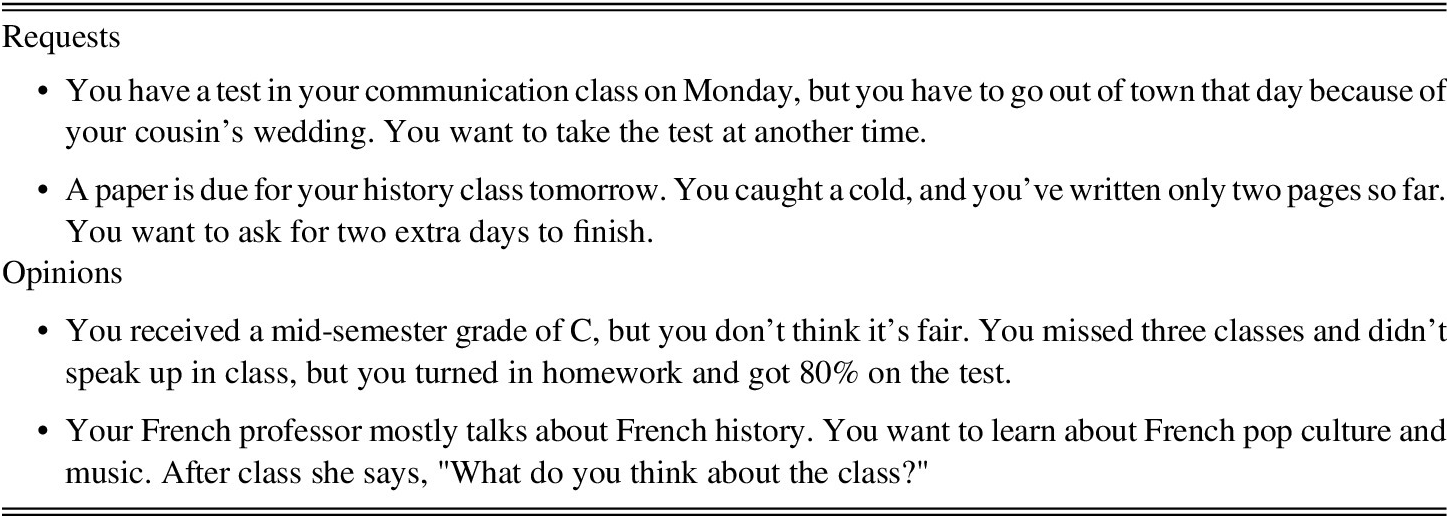
A computerized oral DCT was given three times over one academic year (8 months). Participants read scenarios and produced two speech acts: requests and opinions. These two were selected after consulting Garcia’s (Reference Garcia2004) corpus-based study, which indicated that speech acts of directives (requests) and expressives (opinions) are common in U.S. university settings. From the examples in the corpus data, request and opinion situations were adapted to create the scenarios used in this study. The scenarios were created by incorporating contextual factors from Brown and Levinson’s (Reference Brown and Levinson1987) politeness theory. According to Brown and Levinson, interlocutors’ power difference, the social distance between them, and the degree of imposition affect the directness levels of speech act utterances. In a situation in which the speech act involves a high-degree of imposition and is addressed to a person who has more power and is in more distant relationship (e.g., asking a teacher for a recommendation letter), a great degree of politeness is required to save the interlocutor’s face. This study used the social factors of power, distance, and imposition to create the scenarios. The addressee in the DCT prompts was a professor in university settings (see shortened scenarios in Table 1).Footnote 1
Abbreviated oral DCT prompts.

Two parallel versions of the oral DCT were prepared with minor wording changes and used alternatively to minimize the practice effect. The order of the items was randomized during treatment. Participants produced 103.44 words on average for each DCT item (SD = 31.22).
Prosodic Analysis
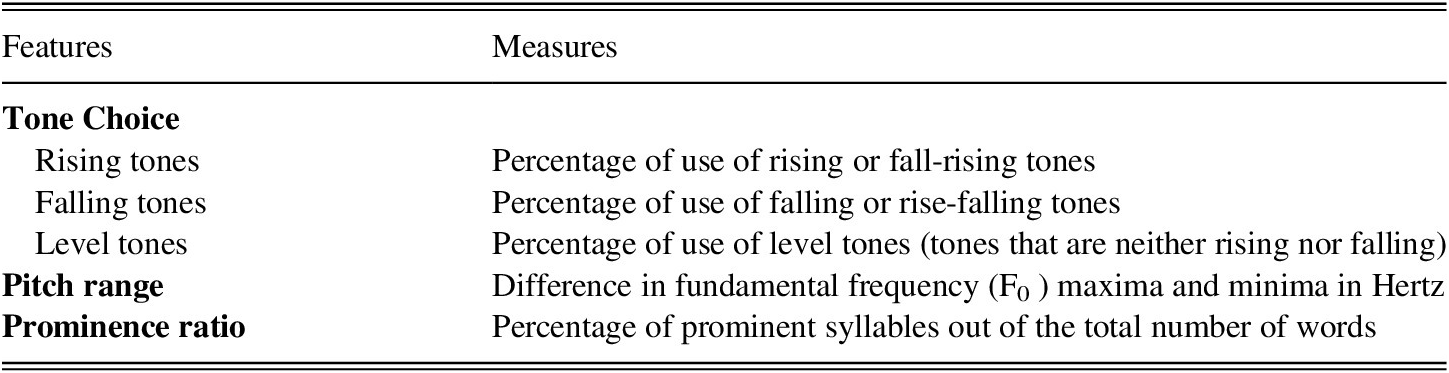
Speech acts were analyzed for three prosodic properties: tone choice (choice of intonation), pitch range, and prominence ratio (Table 2), using Kang and Johnson’s (Reference Kang and Johnson2018) automated prosody extraction program.Footnote 2
Prosodic properties and measures.

Kang and Johnson’s (Reference Kang and Johnson2018) automated prosodic feature extraction adopts Brazil’s (Reference Brazil1997) framework and incorporates machine-learning algorithms to determine phones, prominent syllables, tone units, and various pitch variables related to prominent syllables. A number of publications are available for the validation of the automated analysis. For example, Johnson and Kang’s (Reference Johnson and Kang2017) automated analysis of speech samples representing six varieties of World Englishes (American, British, South African, Indian, Chinese, Spanish) revealed a correlation of 0.94 between the computer and trained linguists in the detection of tone. In the current study, we calculated the intraclass correlation for 20% of the speech samples that were coded by a human coder and the automated software. The reliability was .76, which is considered acceptable, given that the typical machine-human correlation for unconstrained speech in the automatic annotation literature is around .71–.78 for prosody annotation (Breen et al., Reference Breen, Dilley, Kraemer and Gibson2012).
Prominent syllables are identified with consideration of pitch (i.e., F0), loudness, and syllable length. Prominent syllables are grouped into tone units, the final prominent syllable of which determines the tone choice (Brazil, Reference Brazil1997). The pitch range of prominent syllables is identified through comparisons of F0 of the lowest-pitched prominent syllable from the highest-pitched prominent syllable. The model also computes a prominence ratio value for each utterance that is the proportion of the number of prominent syllables out of total words. Due to the short responses in the audio files, 0.7% of learner utterances were not extracted using the prosody extraction program, and pitch range values were missing for 4% of learner utterances.
MEASURES OF INDIVIDUAL AND CONTEXTUAL FACTORS
Two individual factors (proficiency and orientation to English study) and one contextual factor (language contact) were measured three times at about the same time as the oral DCT.
Proficiency
Participants’ proficiency was measured using the TOEFL ITP® (https://www.ets.org/toefl_itp), which included listening, grammar, and reading sections. The reliability estimate was .95 (ETS, 2020). Different versions of the test were used to minimize influence from a practice effect.
Orientation to English Study
Yashima’s (Reference Yashima2002) survey was used to measure orientations toward English study specific to Japanese learners of English (12 items). The survey is based on Gardner and Lambert’s (Reference Gardner and Lambert1972) framework that defined orientation as a reason for studying a language involving two types: integrative and instrumental. The former involves a desire to learn a language to become a member of the language community, while the latter involves instrumental reasons for learning a language, such as improving one’s economic situation. In the survey, participants read statements and rated the degree of agreement on a 7-point scale ranging from “strongly disagree” (1) to “strongly agree” (7). A sample survey statement is “I study English because it will allow me to get to know various cultures and people” (Yashima, Reference Yashima2002, p. 66). The Cronbach’s alpha reliability was .73 in this study. The average rating of the 12 items was calculated and used for the analysis.
Language Contact
A 9-item survey adapted from the Language Contact Profile (LCP) (Freed et al., Reference Freed, Dewey and Segalowitz2004) was administered in Japanese (learners’ L1). The survey asked learners to indicate how many days per week and how many hours per day they engage in target language activities outside the class. The sum of these two numbers provides an estimate of total time per week for each activity, which was used in the analysis. A sample item (translated into English) follows. Appendix A contains the entire survey (uploaded as online supplementary materials).
-
How much time did you spend talking your classmates, friends, and roommate in English outside of class?
-
Typically, how many days per week? 0 1 2 3 4 5 6 7
-
On those days, typically how many hours per day? 0 0–1 1–2 2–3 4–5 more than 5
DATA COLLECTION
The oral DCT was given to L2 participants individually three times over one academic year (8 months): Time 1 (April), Time 2 (July), and Time 3 (December). Participants wore headphones with a microphone attached and read the directions in English with Japanese translations. They were told to respond as if they were in a real situation and performing the role. After the oral DCT, they completed the English study orientation survey and the language contact survey which took about 10 minutes. The TOEFL ITP test was administered about one week later. The same procedures were employed to collect L1 speaker data but unlike L2 participants, they completed the oral DCT only once.
DATA ANALYSIS
The first research question asked whether participants’ prosodic properties change over one academic year. The data were loaded into the R statistics package version 4.0.2 (R Core Team, 2020), and both descriptive and inferential statistics were analyzed. L1 speakers were included in the descriptive statistics, but only the data from L2 learners were used for the primary analyses. Five Linear Mixed-Effect Models (LMEM) were created using the tone choice (rise, fall, level), prominence ratio, and pitch range as dependent variables for each of the models. The fixed effect was time (Time 1, 2, 3; 3–4 months apart) and the random effect was the participant variable. The model was specified using the lme4 package in R (Bates et al., Reference Bates, Maechler, Bolker and Walker2014) version 1.1-23 and lmerTest package (Kuznetsova et al., Reference Kuznetsova, Brockhoff and Christensen2017) version 3.1-2 using the following line of code in R: Dependent_variable ˜ time + (1|participant).
We combined requests and opinions in the analysis because these two speech acts were operationalized based on Brown and Levinson’s (Reference Brown and Levinson1987) contextual factors (see the previous section). The scenarios that elicited these speech acts shared the same contextual factors of power, social distance, and degree of imposition (i.e., making a request or expressing an opinion to someone in a higher power and larger social distance). Previous studies also conducted a combined analysis of requests and opinions (Taguchi, Reference Taguchi2012). In addition, as a preliminary analysis, we used speech act type as independent variable to examine its interaction effect with time (Time 1, 2, and 3) on prosody. We found no significant interaction effect, indicating that participants did not vary their prosody by speech act type over time.Footnote 3
The second research question asked whether proficiency, orientation to English study, and target language contact affect participants’ changes in prosodic properties. LMEMs were performed by fitting five models to each of the five prosodic features as the dependent variable. Language contact, proficiency (TOEFL ITP score), and orientation to language study (integrative and instrumental orientation) were treated as fixed factors. The random factors were time (Time 1, 2, 3) and participants. The model was specified using the following R code:
Dependent_variable ˜ TEOFL_score + lang_contact + integrative_mot + intrinsic_mot + (1|time) + (1|participant)
R2 effect sizes were calculated using Nakagawa and Schielzeth’s (Reference Nakagawa and Schielzeth2013) proposed method in the MuMIn package (version 1.43.17). Backward elimination of variables for model parsimony was attempted, but a solution that retained all fixed factors was ultimately retained rather than using a subset of those factors.
RESULTS
CHANGES IN PROSODIC PROPERTIES
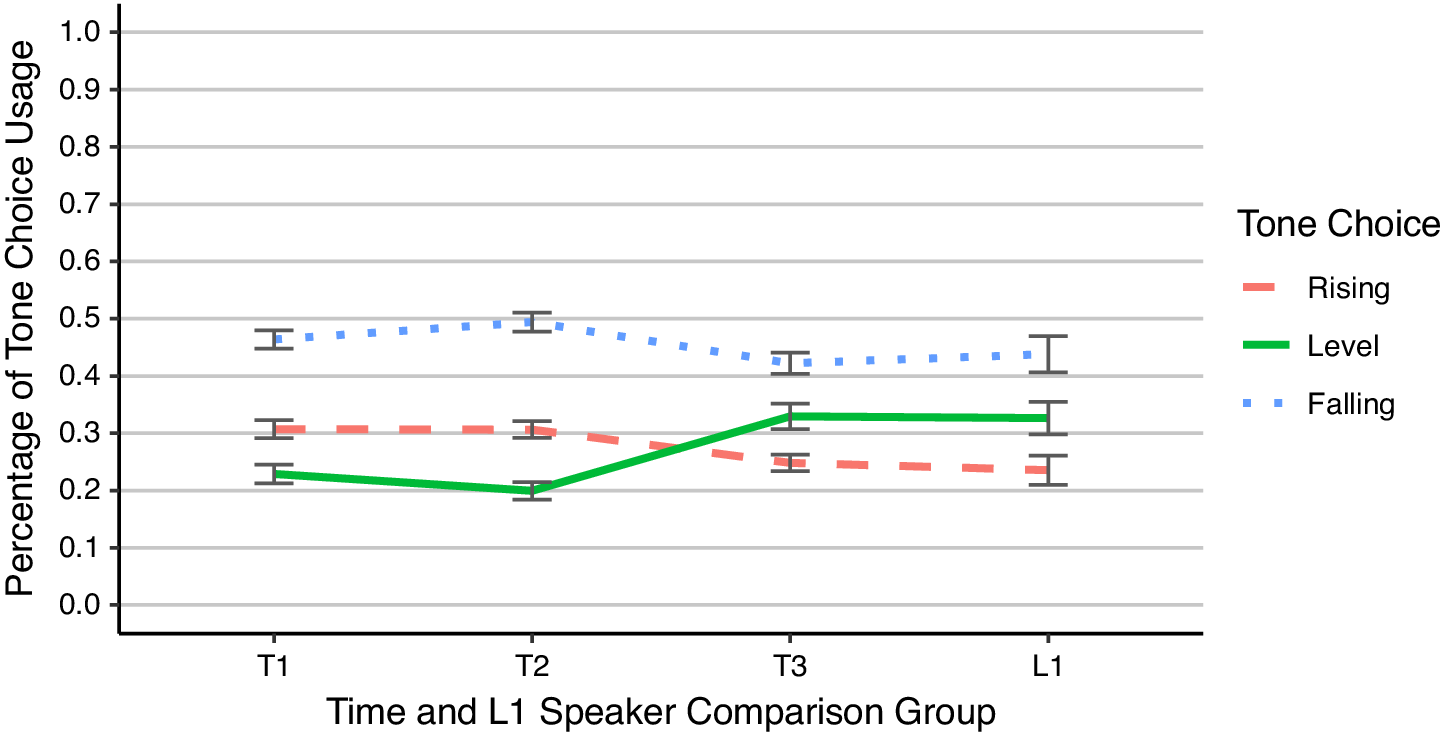
Descriptive statistics of prosodic properties across time for L2 learners (n = 47) and descriptive statistics of L1 speaker data (n = 24) were calculated (see Appendix B in online supplementary materials). The estimated means and confidence intervals were plotted for the three tone choice variables, indicating L2 tone choice percentages approaching similar rates as those of L1 speaker data (see Figure 1).
Change in tone choice over time with L1 speaker comparison.

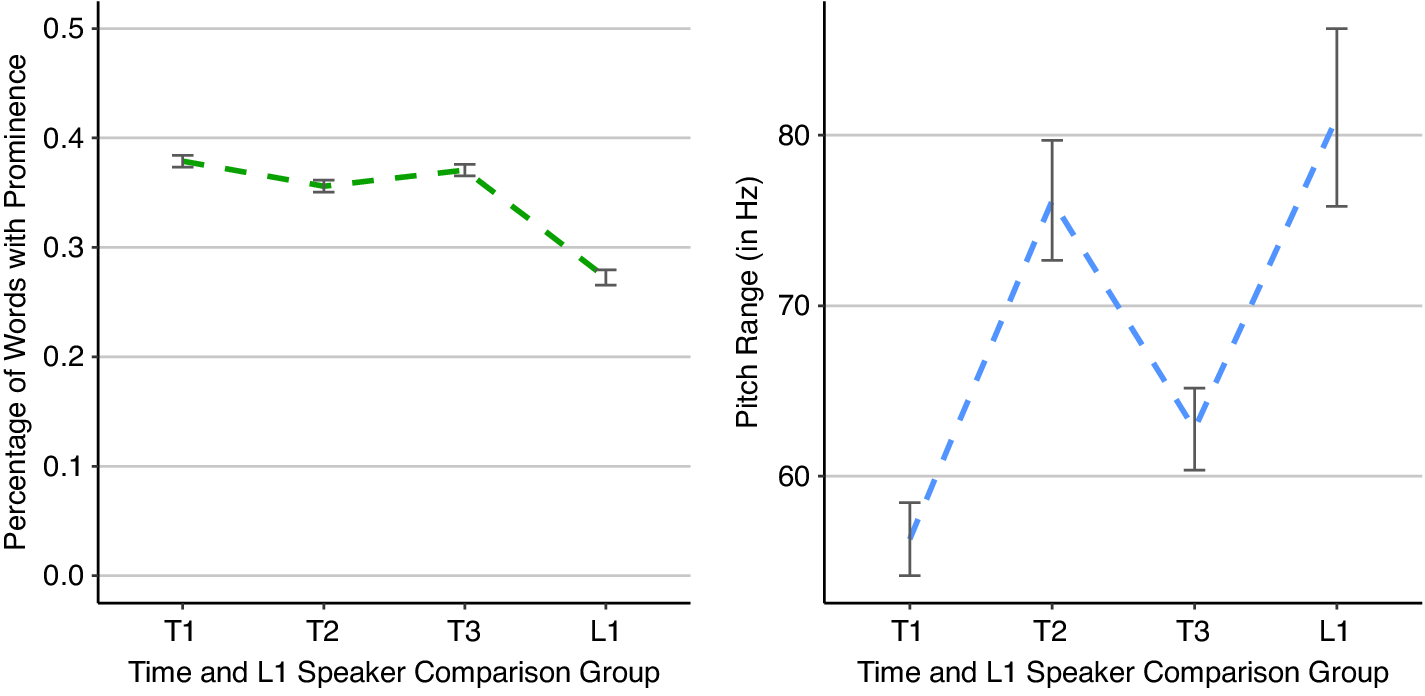
The prominence ratio and pitch ranges were also plotted across time points (Figure 2). Unlike tone choices, trends toward the L1 speaker pattern were not observed for these two features.
Changes in prominence ratio and pitch range across time with L1 speaker comparison.

There was a statistically significant main effect of time on change in rising tone (F2,470.76 = 8.30, p < .001, R2 = .03). Post hoc analyses using Tukey’s HSD detected a change only in the second period (Time 2–3) (t472 = 3.26, p = .003), that is, learners used significantly fewer rising tones during the later period, moving more toward the L1 speaker pattern. There was no change in the first period (Time 1–2) (t469 = 0.54, p = .853). The choice of falling tone showed the same patterns. There was a statistically significant overall impact of time (F2,469.86 = 6.49, p = .002, R2 = .02). A significant change was found in the second period (t471 = 3.57, p = .001), but not in the first period (t468 = –1.36, p = .365). Finally, the choice of level tone also showed the same patterns. There was a statistically significant overall effect of time (F2,469.51 = 26.99, p < .001, R2 = .06) and a significant change was found only in the second period (t470 = –6.81, p < .001). There was no significant change in the initial period (t468 = 0.93, p = .623). Overall, when comparing leaners’ tone choices with the L1 speakers’ choices, learners’ tone choices started to approximate the L1 speakers’ patterns only from Time 2 (4 months after the first performance) to Time 3, but not from Time 1 to Time 2.
There was a statistically significant main effect of time on change in the prominence ratio value, F2,472.72 = 5.60, p = .004, R2 = .02. Post hoc analyses detected a significant change only in the initial period (Time 1–2) (t470 = 3.30, p = .003, R2 = .02). There was no significant change in the later period (Time 2–3) (t474 = –2.12, p = .087). These findings show that in the earlier period, the learners’ prominence ratio started to approximate the L1 speaker data (emphasizing fewer words), but it reached the stagnation at the later period.
Finally, there was a statistically significant main effect of time on change in the pitch range, F2,466 = 15.80, p < .001, R2 = .05. Post hoc analyses detected an inconsistent pattern. The pitch range increased from Time 1 to Time 2 (t464 = –5.38 p < .001), demonstrating a wider pitch range observed in the L1 speaker data. However, the pitch range decreased from Time 1 to Time 2 (t467 = 4.00, p < .001) for Time 2–3, moving away from L1 speaker patterns.Footnote 4
INDIVIDUAL AND CONTEXTUAL INFLUENCES ON PROSODIC CHANGES
The second research question asked whether individual and contextual factors affect changes in participants’ prosodic properties. Descriptive statistics of these factors, along with tables summarizing linear mixed-effects models, are in Appendix C and D (in the online supplementary materials).
The mixed-model analyses revealed the statistically significant main effect of proficiency and reported amount of language contact on the choice of rising tone (F1,315.94 = 6.17, p = .014 for proficiency; F1,205.15 = 5.20, p = .024 for language contact), indicating that increasing proficiency and greater amount of language contact were related to decreasing rising tone (R2 = .07). The significant impact of proficiency was also found in the choice of level tone (F1,333.65 = 16.36, p < .001) with a similar overall effect size (R2 = .07), indicating that increasing proficiency was related to increasing level tone. No other significant effect of individual and contextual factors was found in any of the prosodic features, indicating that falling tone, prominence, and pitch range did not change over time corresponding to the changes in proficiency, orientation to language study, or amount of language contact.
DISCUSSION
This study investigated whether L2 English learners’ prosodic properties in speech acts changed over time (a period of 8 months), and if so, what factors affected those changes. Results indicated that all prosodic properties changed over time. Hence, the findings revealed pragmatic development from the novel dimension of prosody, showing that, besides linguistic forms and semantic moves, learners’ prosody can also serve as an indicator of speech act development.
While all three prosodic properties changed over time, there was considerable variation observed across the properties related to the pace and timing of development. A change in tone choices was observed at a later time (Time 2–3), but that of prominence ratio was seen much earlier (Time 1–2) while no change was observed at the later period (Time 2–3). Pitch range showed irregular patterns. Initially, learners’ pitch range increased (Time 1–2), but then it decreased at the later period (Time 2–3). Such variation is indeed common in longitudinal research in L2 pragmatics as development is often unevenly paced, reflecting differing rates of change and differing distributions of stability over time for various dimensions of pragmatics constructs (Taguchi, Reference Taguchi and Trosborg2010). The present findings confirm this general pattern by showing that different dimensions of prosody exhibit a different pace of development (Kang & Kermad, Reference Kang and Kermad2020).
When completing high imposition requests and opinions, the learners’ use of rising tone and falling tone decreased over time, while their use of level tone increased. These patterns were in line with those of L1 speakers. Using rising tones inappropriately in high-stakes situations (e.g., complaining a professor about a grade) can be risky for interpersonal relationships because rising tones often imply the speaker’s dominance or solidarity (Brazil, Reference Brazil1997). Studies showed that people in higher status used more rising tones (Cheng et al., Reference Cheng, Greaves and Warren2008). Hence, the fact that the learners reduced rising tones in the high imposition speech acts over time indicates their increasing sensitivity to the situational factors and corresponding development in tone choice. It is possible that, as they spent more time in the English-medium university interacting with professors in English, they gradually dropped the use of rising tones to sound more acceptable in the high-stakes situations.
Similarly, development in tone choice was observed in the learners’ increased use of level tones. Level tones often signal hesitancy because they co-occur with filled pauses for the purpose of holding the floor in an extended stretch of discourse (Pickering, Reference Pickering2018). When speakers try to focus on their linguistic message, they tend to use level tones (Brazil, Reference Brazil1997). In the high-stakes situations used in this study, longer speech was necessary because participants were expected to provide a solid justification when making a request or expressing an opinion (e.g., explaining why they think the grade they received is unfair). Level tones play an effective role when providing an extended justification and holding the floor. The learners in this study developed their ability to use this level tone effectively to convey their intentions only after Time 2 (3 months after the start of the immersion program), showing their gradual development over time.
It is important to determine which factors then explain the development of these tone choices. Analysis of individual and contextual factors revealed that, as the learners’ proficiency and language contact increased, their use of rising tone decreased. However, the learners’ choice of level tone increased along with increased proficiency as well. These findings corroborate previous longitudinal findings in L2 pragmatics. Taguchi et al. (Reference Taguchi, Xiao and Li2016) showed that L2 Chinese learners’ language contact had a direct impact on the increased appropriateness of speech acts, while Xiao et al. (Reference Xiao, Taguchi and Li2018) revealed the impact of oral proficiency on speech act development. The findings also support those in L2 speech research. Kang et al. (Reference Kang, Ahn, Yaw and Chung2021) found that that the amount of target language use and proficiency (assessed with the IELTS) had a significant relationship with tone choice development. Van Maastricht et al. (Reference Van Maastricht, Krahmer and Swerts2016) found that proficiency positively influenced L2 speakers’ production of intonation to mark focus.
Similar to tone choice, prominence and pitch range changed over time, approximating the L1 speaker patterns. The learners became able to stress fewer words and expanded their pitch range over time. Pitch range is often associated with the perceived accentedness: The wider the pitch range is, the less accented the speaker is perceived to be (Kang, Reference Kang2010). There is also evidence that, unlike L1 speakers who skillfully change pitch across discourse contexts, L2 speakers tend to emphasize too many words (Wennerstrom, Reference Wennerstrom2001). In this study, as learners spent more time in the immersive English-speaking environment, they moved away from overusing sentence stress and incorporating a more balanced use of stressed and unstressed words, producing speech more similar to the L1 speakers. These changes occurred relatively quickly after the immersion of 3 months (Time 1–2). However, the pitch range development was found uneven and irregular as they regressed to a narrower pitch range at the later period. These findings indicate that a longer time span might be necessary to detect more stable pitch patterns.
Unlike tone choice, prominence ratio and pitch range had no effect coming from proficiency, language contact, or orientation to language study. The findings are somewhat surprising because it is intuitive to think that changes in these prosodic features are promoted by a better command of language skills, greater exposure to English, and more opportunities to speak English in the immersion context. These findings could be potentially related to relatively short utterances elicited using the oral DCT. Also, regarding the orientation to language study, lack of variation in the survey data might have affected the findings (see the online supplementary materials for descriptive statistics).
While surprising, the present findings are in line with those of the original study. Taguchi (Reference Taguchi2013) revealed no impact of proficiency or orientation to language study on speech act appropriateness (assessed on a six-point scale). Hence, one conclusion drawn from this study and the original study is that there is no single factor that impacts all prosodic properties. There is a combined operation of mixed individual and contextual factors on different prosodic features.
LIMITATIONS AND FUTURE DIRECTIONS
This study traced prosodic properties in L2 speech acts over 8 months to examine whether tone choice, prominence, and pitch range can serve as criteria when assessing pragmatic development. All these prosodic properties changed over time, although the changes were distributed unevenly among the properties. Effects of individual and contextual factors on changes were also inconsistent. Given that not all suprasegmental features are equal in terms of learnability (Levis, Reference Levis2005), these features may follow differing developmental patterns. The present findings suggest that the primary focus on lexico-grammatical forms and semantic moves in speech act instruction needs to be modified so that prosody becomes an additional focus of instruction. Specifically, the fact that tone choice did not improve immediately indicates that explicit instruction on this aspect at early stages might better facilitate learners’ development.
To our knowledge, this study was the first to analyze prosodic features in pragmatics using a longitudinal design. More studies are needed to evaluate the generalizability of the present findings with a larger population, a longer study period, a diversity of L1 backgrounds, and a range of L2 proficiency levels. Critically, proficiency needs to be assessed using a standardized test involving a speaking component since the TOEFL ITP used in this study did not assess speaking. In addition, because this study analyzed only three prosodic features (i.e., intonation, pitch range, prominence), future research should address other features such as rhythm and speech tempo. In addition, future research should expand the scope of data collection tasks. Because this study used only one task focusing on pragmatics, future researchers can use a variety of pragmatic tasks. Such research can reveal whether development of different suprasegmental features can be observed in different tasks. Because existing literature on prosody and pragmatics concentrates in tone choice (Kang & Kermad, Reference Kang, Kermad and Taguchi2019), tone development may reflect pragmatic development more closely than other prosodic features. The relationship between pragmatic competence and other prosodic features needs further investigation by employing parallel tasks of different construct specifications in the longitudinal design.
Another avenue for future research is to further explore the role of individual and contextual factors on pragmatic speaking. The fact that only proficiency and language contact affected just one aspect of prosody (tone choice) suggests that there are other factors that may impact prosodic changes in pragmatic speaking. For example, given the sociocultural nature of pragmatic competence, personality and interaction styles might affect pragmatic performance in a more profound manner. Speaking ability may be more strongly affected by speech processing-related factors such as working memory. Future research can identify a specific set of individual characteristics that uniquely explain pragmatics and speech constructs and assess their impact on pragmatic speaking abilities.
Finally, future studies can compare computer-based and human-coded annotation patterns in unconstrained speech and explore various types of objective prosody analyses. Such efforts can help validate the automatic speech analysis program, improve its accuracy, and extend its application to other practices. Automated analysis has a great potential in automated assessment of L2 speech and computer-assisted speech training. Although much attention is still needed in this area, an automated tool can be used to train and assess prosodic features used to signal pragmatic meanings by analyzing L2 learners’ speech and giving systematic feedback.
SUPPLEMENTARY MATERIALS
To view supplementary material for this article, please visit http://doi.org/10.1017/S0272263121000486.