Milk proteins determine the structure and stability of dairy-based foams, due to their exceptional physico-chemical characteristics and interactions with other milk components (Walsh et al., Reference Walsh, Russell and FitzGerald2008). In recent years the use of caseinates as an ingredient in nutritional products, dietary preparations and medical applications has increased. Caseinates are well known for having exceptional functionalities such as emulsifying, foaming and gelling properties which have been widely examined and studied by many authors (Walsh et al., Reference Walsh, Russell and FitzGerald2008; Marinova et al., Reference Marinova, Basheva, Nenova, Temelska, Mirarefi, Campbell and Ivanov2009).
Camel milk has become more popular in many countries in Europe, Africa and Asia due to its claimed therapeutic properties such as anti-diabetic, anti-cancer and hypo-allergenic properties (Al haj and Al Kanhal, Reference Al haj and Al Kanhal2010; Lajnaf, Reference Lajnaf2020). Camel milk proteins are classified according to their solubility into two major components, caseins and whey proteins. Camel casein fraction contains the four known caseins with different proportions and different physico-chemical characteristics when compared to the bovine casein fraction. The main camel casein is β-CN followed by the αS1-CN representing 65 and 22% of total casein fraction respectively, compared with 39 and 38% in bovine caseins. Besides, κ-CN represents only 3.5% of the total camel casein compared with 13% in bovine casein (Kappeler et al., Reference Kappeler, Farah and Puhan2003).
Considerable research works have been carried out on the foaming properties of bovine caseinates as well as the influence of temperature on the adsorption behavior of milk proteins (Srinivasan et al., Reference Srinivasan, Singh and Munro2003; Walsh et al., Reference Walsh, Russell and FitzGerald2008; Liang et al., Reference Liang, Gillies, Matia-Merino, Ye, Patel and Golding2017). By contrast, extraction and foaming properties of camel sodium caseinates have not been reported in the literature to date. Hence, the objective of this study was to investigate the foaming, physico-chemical and interfacial properties of the extracted bovine and camel sodium caseinates as a function of different heating temperatures for potential applications of camel sodium caseinates in the industrial foam production.
Materials and methods
Milk samples
Fresh raw camel milk samples (35 samples) were collected from 20 different healthy Dromedary camel females (Camelus dromedarius) ranging between 2 and 12 months in lactation in local cattle located in the south of Tunisia (region of Gabes).
Bovine and camel sodium caseinates preparation
Sodium caseinates (hereafter noted as Na-cas) were obtained upon acidification of skim milk with hydrochloric acid (1 m) to pH 4.6 and 4.3 for bovine and camel milk, respectively. Camel and bovine Na-cas samples were freeze-dried (Bioblock Scientific Christ ALPHA 1-2, IllKrich-Cedex, France) to obtain Na-cas powders and stored at −20°C for further use.
Heat-treatment experiments
Lyophilized Na-cas samples were dissolved in demineralized water at a protein level of 1 g/l. Na-cas solutions were heated using water-bath at the following temperature values: 70, 80, 90 and 100°C during 30 min. The control was measured at 20°C, corresponding to the native proteins without heating.
RP-HPLC analysis
The effect of the different heating temperatures (70, 80, 90, and 100°C) on camel and bovine Na-cas proteins was visualized by Reverse Phase High-Performance Liquid Chromatography (RP-HPLC) using a modified method of Yüksel and Erdem (Reference Yüksel and Erdem2010).
Foaming properties
Ten milliliters of Na-cas solution at a concentration of 1 g/l were poured into a measuring cylinder (radius 1.5 cm and length 7.5 cm) and mixed using a foam-emulsion mixer (Ultra Turrax T25, IKA Labortechnik, Staufen Germany) at a speed of 13 500 rpm during 2 min at room temperature (~20°C) (Lajnaf et al., Reference Lajnaf, Picart-Palmade, Attia, Marchesseau and Ayadi2016).
The ζ-potential measurements
The ζ-potential of bovine and cow Na-cas solutions at a concentration of 1 g/l using the Zetasizer Nano-ZS90 apparatus (Malvern Instruments, Westborough, MA) (at 25 ± 1°C).
Determination of the hydrophobicity
The surface hydrophobicity for bovine and camel Na-cas solutions (1 g/l) was determined by the BPB (bromophenol blue)-bound method of Al-Shamsi et al. (Reference Al-Shamsi, Mudgil, Hassan and Maqsood2018).
Interfacial tension
The interfacial tension of each camel and bovine Na-cas was measured using a Tensiometer TSD-971 (Tensiometry System Digital Gibertini Elettronica, Italia) at 25°C.
Results and discussion
Foaming properties of Na-cas
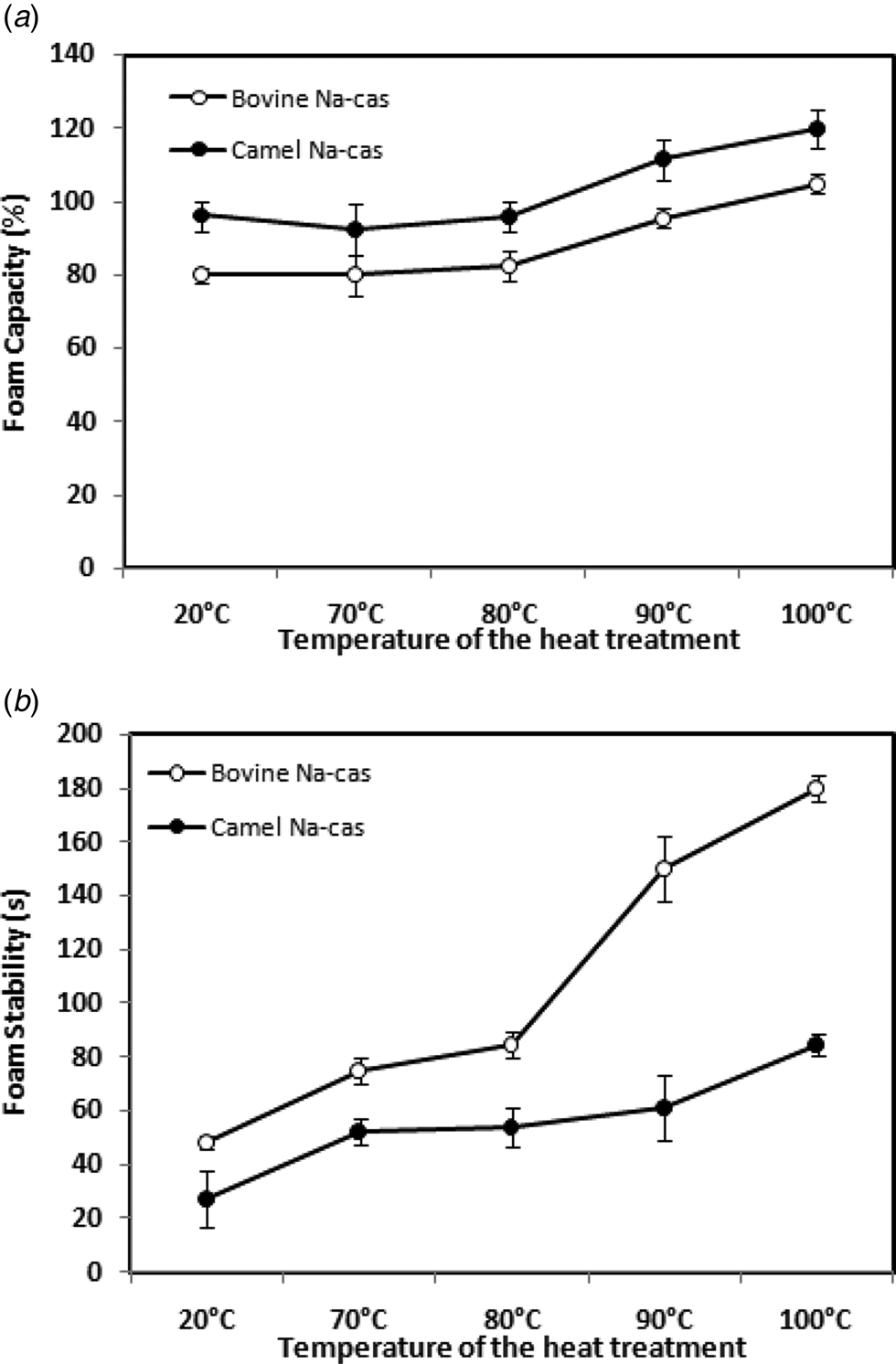
Figure 1a shows that camel Na-cas gives better FC values (FC ~ 96%) compared to bovine Na-cas (FC ~ 80%) under native conditions (20°C). This behavior can be explained by the highest β-CN content in camel milk. Previous studies reported that individual caseins, such as β-CN, are characterized by high surface activity. They are relatively flexible especially when compared to globular proteins of whey (Mellema and Isenbart, Reference Mellema and Isenbart2004). It has been reported that β-CN is the first adsorbed protein to the interface compared to other milk proteins. It is considered as a mobile disordered protein with a fast diffusion and a predominant retention at the interface. Regarding camel milk proteins, Lajnaf et al. (Reference Lajnaf, Picart-Palmade, Attia, Marchesseau and Ayadi2016, Reference Lajnaf, Zouari, Trigui, Attia and Ayadi2020) confirmed that β-CN plays the main role in the creation of camel milk foams as the foamability increased with the β-CN amount in bovine and camel protein mixtures due to its high surface hydrophobicity.
Foam capacity (a) and foam stability (b) of camel and bovine Na-cas at a concentration of 1 g/l as function of heating temperature (20, 70, 80, 90 and 100°C during 30 min).

Figure 1a shows that no significant difference in the FC values was observed between native (20°C) and heat-treated (70 or 80°C for 30 min) camel and bovine Na-cas. This behavior can be explained by the heat stability of caseins due to their lack of typical stable secondary and tertiary structures and a lack of thiol groups, which contrast with whey proteins. In the same way, Walsh et al. (Reference Walsh, Russell and FitzGerald2008) found that that thermal treatment of sodium caseinates samples (protein concentration 1% w/v) at 80°C for 20 min had no significant effect on the foam expansion at pH 6.0.
A thermal treatment at 90 or 100°C induced a significant increase of the FC value which reached a maximum at 100°C, with values of 105% and 130% for bovine and camel Na-cas, respectively (Fig. 1a). These results reinforce previous data reported by Srinivasan et al. (Reference Srinivasan, Singh and Munro2003) carried out with bovine calcium caseinates. These authors found that the surface protein coverage of emulsions created with calcium caseinate solutions heated to 121°C for 15 min was consistently higher compared to that of unheated caseinates.
Figure 1b shows the stability of the created foam by camel and bovine Na-cas, i.e. the FS values at a concentration of 1 g/l in response to the heat-treatment temperatures. Bovine Na-cas gives more stable foam than camel Na-cas regardless of heat-treatment temperature value. Under native conditions, FS values were 48.5 and 27.5 s for bovine and camel Na-cas, respectively. Lajnaf et al. (Reference Lajnaf, Picart-Palmade, Attia, Marchesseau and Ayadi2016) found that purified bovine β-CN gave a higher FS values (FS = 1200 s) compared to its camel counterpart (FS = 660 s) at a concentration of 0.5 g/l and at pH 7 due to the difference in the molecular structure between the proteins, and especially their secondary structure (β-sheet conformation) which regulated the foaming mechanism of skimmed camel milk.
The stability of foams created by bovine and camel Na-cas increased after heating with increasing temperature up to 100°C. For bovine Na-cas, an increase of the temperature from 70 to 100°C greatly increased the stability of foams from 75 to 180 s representing an increase of 105 s. Likewise, for camel Na-cas, FS values increased significantly from 52.5 to 85 s in this heating temperature range (P < 0.05). Similar findings were obtained by Srinivasan et al. (Reference Srinivasan, Singh and Munro2003). These authors noticed that the stability of emulsions formed with heated caseinates (120°C, for 15 min) was considerably higher than unheated systems at a protein concentration ranging from 1 to 5 wt% due to the protein aggregation of heated caseinate solutions and to the higher viscosity of the aqueous phase. Furthermore, for milk proteins, heating induces the increase in foam stability due to an increase in the diffusion and adsorption velocity of milk proteins at the interface and a decreased apparent viscosity.
RP-HPLC profile
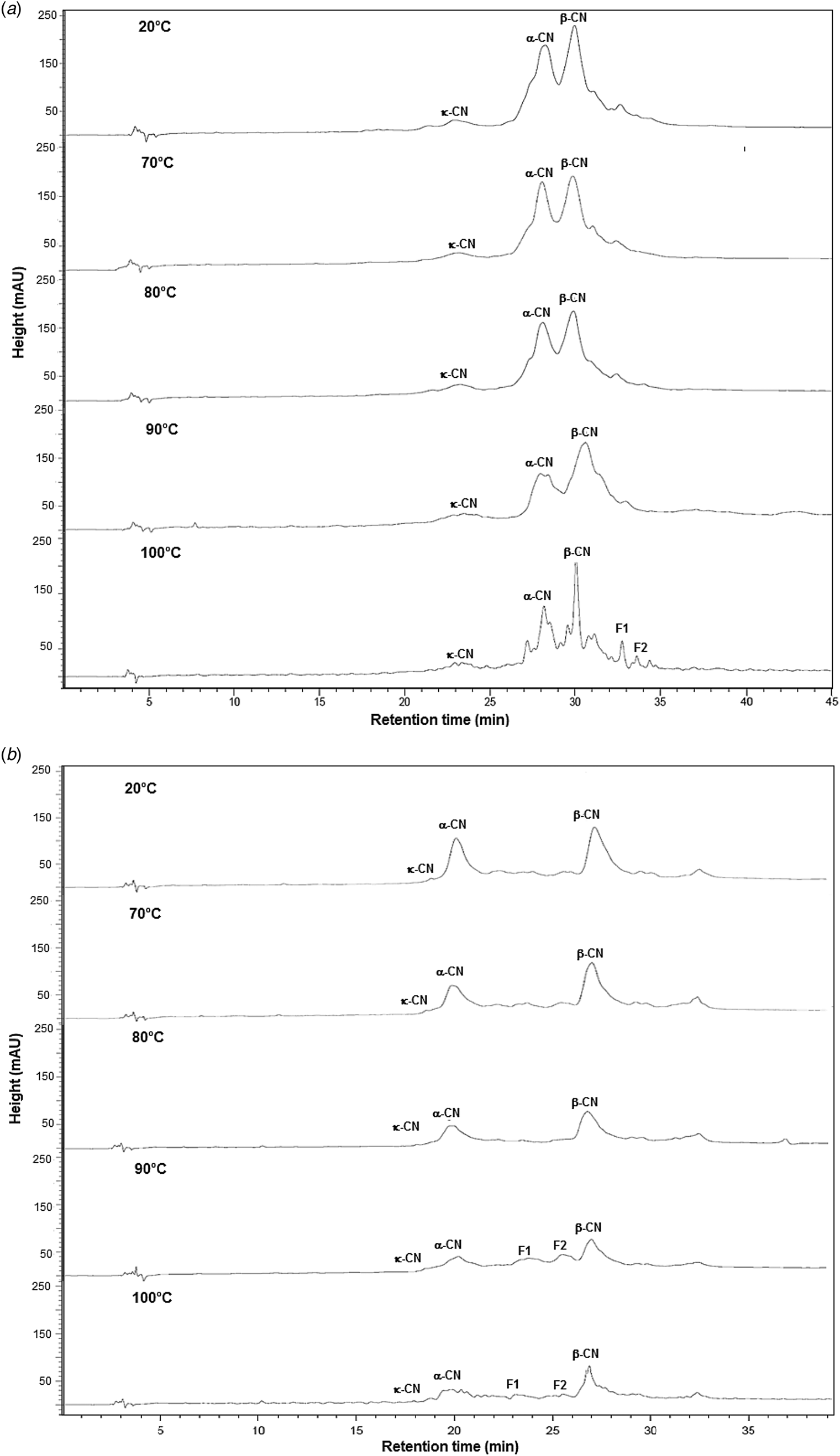
RP-HPLC chromatograms of bovine and camel milk Na-cas proteins under native conditions (Fig. 2a and b) showed three major peaks for bovine Na-cas with retention time (RT) 20.36, 25.09 and 26.59 min, which were identified using bovine standards as κ-CN (~8.4%), α-CN (~47.1%) and β-CN (~44.5%). Camel Na-cas contained the same caseins as bovine Na-cas (κ-, α- and β-CN) but with different proportions in agreement with previous works. Thus, three major protein peaks with RT of 19.28, 20.58 and 27.73 min were identified in camel Na-cas (Fig. 2b), relating to κ-CN (~1.1%), α-CN (~45.5%) and β-CN (~53.4%), respectively.
RP-HPLC chromatograms recorded at 220 nm for native and heated (at 70, 80, 90 and 100°C during 30 min) bovine and camel Na-cas (panels a and b, respectively). Abbreviations are: κ-CN: κ-casein, α-CN: α-casein, β-CN: β-casein, F: protein fraction.

The α-CN content of bovine and camel caseinates was similar (~46%), whereas κ-CN and β-CN proportions differed. Camel Na-cas exhibited a higher amount of β-CN (representing 53.4 and 44.5% of camel and bovine Na-cas, respectively) and a lower content of κ-CN (representing 1.1 and 8.4% of total bovine and camel caseins, respectively) when compared to bovine Na-cas. Thus, β-CN was the main protein in camel Na-cas and the second main protein in bovine Na-cas. These results are in agreement with the data previously reported in other work. Furthermore, the peak of κ-CN was very weak (~1.1%) probably due to its low content which makes it obscured by other major caseins (α- and β-CN) as reported by Farah et al. (Reference Farah, Rettenmaier and Atkins1992).
RP-HPLC results (Fig. 2a and b) showed that bovine caseins peaks (κ-CN, α-CN and β-CN) remained almost intact upon heating at 70 and 80°C during 30 min. However, higher temperatures (90 and 100°C) significantly affected bovine casein peaks, especially α-CN, which decreased significantly after 30 min. A noticeable degradation of caseins and an appearance of new protein fractions (F1 and F2) after heating at 100°C during 30 min were observed (Fig. 2). Subsequently, the degradation products (peptides) were generated upon heating from the parent proteins in agreement with Srinivasan et al. (Reference Srinivasan, Singh and Munro2003). These authors confirmed the heat-treatment of calcium caseinates solutions at 121°C for 15 min resulted in the liberation of several peptides, due to protein degradation and polymerization (Srinivasan et al., Reference Srinivasan, Singh and Munro2003).
Physico-chemical properties of Na-cas: surface hydrophobicity
The BPB-bound amounts were used in order to compare the hydrophobicity of bovine and camel Na-cas as a function of temperature. Figure 3a shows that BPB-bound amounts were greater for camel Na-cas than for bovine Na-cas regardless of heating temperature (P < 0.05). For example, the BPB-bound amounts under native conditions (20°C) were 7.25 ± 0.41 and 9.30 ± 0.32 μg/ml for bovine and camel Na-cas, respectively. The difference in the individual casein proportions in both Na-cas samples as well as the dominance of a highly hydrophobic protein as camel β-CN in camel Na-cas representing ~53.4% of total Na-cas proteins could explain the higher surface hydrophobicity of camel caseinates relative to bovine caseinates.
Figure 3a also shows that no significant differences in the surface hydrophobicity of Na-cas samples could be observed when heat-treatment was applied at 70 and 80°C for 30 min. A heat-treatment at 90°C for 30 min induced a significant increase of the BPB-bound amounts reaching 12.9 ± 0.5 and 8.7 ± 0.3 μg/ml for camel and bovine Na-cas, respectively (P < 0.05). This behavior was explained by the modification of proteins and to the exposure of aliphatic and aromatic amino acid residues to the protein surface.
Physico-chemical properties of Na-cas: determination of ζ-potential
Surface charge values (ζ-potential) of extracted bovine and camel Na-cas as a function of heat-treatment temperature in the temperature range of 70–100°C are shown in the online Supplementary File Fig. 1. Overall, camel Na-cas carried lower electronegative charge compared to its bovine counterparts regardless of heating temperature value. Under native conditions, the ζ-potential values were ~−29.2 ± 0.7 and ~−25.3 ± 1.2 mV for bovine and camel Na-cas, respectively. Results indicated that the net charge values of bovine and camel Na-cas were not significantly affected after heating at 70 and 80°C for 30 min. However, both camel and bovine Na-cas appeared less negatively charged at higher temperature values (90 and 100°C) with the lowest ζ-potential value after heating at 100°C for 30 min (~−19.2 and −16.3 mV for bovine and camel Na-cas, respectively). In support of these results, Srinivasan et al. (Reference Srinivasan, Singh and Munro2003) reported that the heat-treatment of caseinates at high temperatures causes the dephosphorylation of serine-phosphate groups leading to the reduction of the negative charge on the heated caseinate. The decrease of the surface charge of caseinates could promote casein-casein interactions and aggregation.
Physico-chemical properties of Na-cas: determination of the interfacial tension
The interfacial tension values (γ) between air and Na-cas solutions in response to thermal treatment temperature (in the range of 70–100°C for 30 min) are shown in the online Supplementary File Fig. 1. Under native conditions, the surface tension at the air-water interface were γ = 34.80 ± 2.25 and γ = 27.85 ± 2.1 mN/m for bovine and camel Na-cas, respectively. The behavior is suggested to be explained by the higher content of β-CN in camel Na-cas (representing 53.4% of total camel caseins) which is in agreement with our previous results of foaming properties. Furthermore, a greater efficiency to reduce the surface tension values was attributed to the Na-cas treated at higher temperature values in agreement with the findings of Borcherding et al. (Reference Borcherding, Lorenzen, Hoffmann and Schrader2008). Indeed, a thermal treatment at 80°C for 30 min induced a significant decrease of the surface tension from 34.80 to 28.90 mNm/m and from 27.85 to 24.15 mNm/m for bovine and camel Na-cas, respectively.
Finally, the overall foamability was found to be higher in camel caseinates than the bovine counterpart. This behavior was linked to the higher β-casein amount in camel caseins in agreement with the RP-HPLC results.
In conclusion, the aim of the present work was to investigate the effect of different thermal treatment temperatures on the foaming and physico-chemical properties of extracted bovine and camel Na-cas. We showed that camel Na-cas presented the highest foamability and the best efficiency in reducing the surface tension values at the air-water interface compared with bovine Na-cas due to the higher β-CN amount in camel Na-cas. Heat-treatment significantly improved the foaming properties of both camel and bovine Na-cas and also affected their physico-chemical properties with an increase of surface hydrophobicity and a decrease of interfacial tension at the air-water interface as well as decreased electronegative charge (ζ-potential). These results confirm the potential of camel Na-cas for different applications in industrial foam production.
Supplementary material
The supplementary material for this article can be found at https://doi.org/10.1017/S0022029921000893