Public health authorities including the US Centers for Disease Control and Prevention (CDC) and World Health Organization have defined carbapenemase-resistant Enterobacteriaceae (CRE) as one of the most urgent threats of emerging antibiotic resistance. 1 CRE produce a broad spectrum of infections associated with high mortality and very limited therapeutic options. A common mechanism of carbapenem resistance is production of carbapenemases (ie, carbapenemase-producing Enterobacteriaceae or CPE), which are β-lactamase enzymes (bla) that hydrolyze carbapenems. Bloodstream infections caused by CPEs carry mortality rate of ∼50%. Reference Tzouvelekis, Markogiannakis, Piperaki, Souli and Daikos2 Despite increased awareness and national and international interventions, Reference Grundmann, Glasner and Albiger3–Reference Regev-Yochay, Smollan and Tal5 these genes and bacteria are spreading and becoming endemic worldwide, being highly mobile and able to transfer between different genomic backgrounds and species. Reference Nordmann and Poirel6
In Israel, a nationwide outbreak of CPE emerged in 2006, with nosocomial spread of carbapenemase-producing Klebsiella pneumoniae (KPC), predominantly strain type (ST) 258, which was presumably introduced to Israel in 2005. Reference Nordmann, Cuzon and Naas7 The outbreak was partially contained following a national intervention in all acute-care hospitals and long-term facilities, including active surveillance of high-risk patients, carrier isolation and cohorting. Reference Schwaber and Carmeli4 Yet, CPE remain widespread in most medical centers. In recent years, other types of CPE have emerged, including NDM-1, OXA-48, and VIM-producing Enterobacteriaceae. Reference Goren, Chmelnitsky, Carmeli and Navon-Venezia8–Reference Kassem, Hoffmann and Shahar10
The major route of CPE transmission has been traditionally attributed to patient-to-patient cross transmission. Thus, colonized patients are considered the most important reservoir, and infection control breaks in hand hygiene via healthcare workers are considered the predominant transmission chain. Reference Friedman, Carmeli, Walton and Schwaber11 Recently, the role of environmental reservoirs, and particularly the hospital water environment, in the spread of multidrug-resistant organisms (MDRO) has been stressed. Reference Kizny Gordon, Mathers and Cheong12–Reference Weingarten, Johnson and Conlan14 Specifically, sink-traps and water drainage systems have been increasingly recognized as sources of gram-negative MDRO nosocomial outbreaks. Reference Regev-Yochay, Smollan and Tal5,Reference Weingarten, Johnson and Conlan14–Reference Hopman, Meijer and Kenters16 Although the mechanism of transmission from sink drains to patients has been partially understood, Reference Hota, Hirji and Stockton17–Reference Kotay, Chai, Guilford, Barry and Mathers19 the scale of the problem is unknown.
In this study, we assessed the extent and persistence of sink-drain and sink-outlet contamination and traced the possible transmission patterns between patients and hospital room sinks in our institution.
Methods
Setting
The Sheba Medical Center (SMC) is the largest tertiary-care academic medical center in Israel. SMC has a 1,600-bed capacity for both acute-care and rehabilitation patients, including 300 beds in 7 internal medicine departments, with overall 96,800 annual admissions to the acute-care hospital. Most hospital rooms accommodate 3 patients, and a few single bedrooms are available in each ward. ICUs include either semiclosed or closed single-bed units. Each room is provided with an in-room sink and a shower room with additional sink. Routine cleaning of sinks and showers in all hospital rooms takes place once to twice a day by pouring into the sink drain 500 mL NaDCC (ie, sodium dichloroisocyanurate) solution at a concentration of 1,000 ppm. Since 2007, a CPE-defined cohort area including 10–20 beds, has been allocated in a rotating system in one of the internal medicine wards. These accommodate mostly internal medicine patients but also include a few surgical patients. The CPE cohort space shifts from one ward to another every 6 months. Thus, since 2007, each of the internal medicine wards hosted the cohort area at least once. A similar, but smaller and permanent cohort area is allocated in the children’s hospital (including 4–6 beds).
CPE screening of hospitalized patients
Following a nationwide intervention program, Reference Schwaber and Carmeli4 rectal screening of high-risk patients routinely takes place at SMC. High-risk patients are defined as anyone admitted with a history of hospitalization during the previous 6 months or admitted from a long-term care facility or another medical facility. High-risk patients are screened upon their admission to SMC and no later than 48 hours from admission. On average, 20%–25% of hospital admissions are defined as high-risk admissions, and adherence to the admission screening policy is ∼70%. Moreover, ∼2% of all high-risk patients screened on admission are positive for CPE.
Additionally, high-risk units, such as ICUs and hemato-oncology units, conduct a weekly or bi-weekly routine screening of all hospitalized patients. Since 2016, every patient exceeding 14 days of hospitalization has been screened weekly to further detect any acquisition of CPE. Once a patient is detected as a CPE carrier, all patients in that department are also screened to search for the index case. An index case is defined as a carrier possessing the earliest CPE isolate with >95% similarity to isolates from patients of the same department, determined using pulsed-field gel electrophoresis (PFGE). Any identified carrier is transferred to the designated cohort space, located within one of the internal medical departments, with dedicated nursing staff and equipment.
Sink-drain screening
In April 2017, we identified the sink traps as the source of a prolonged OXA-48–producing Serratia marcescens outbreak in our ICU. Reference Regev-Yochay, Smollan and Tal5 Furthermore, most of the CPE acquisitions in all other departments could not be associated with an index-case CPE patient. This led us to screen all patient room sink-traps or sink-outlets in departments in which new CPE acquisitions were detected. Specifically, within a few months 7 internal medicine wards were screened, regardless of new CPE acquisitions because they all had hosted the CPE cohort space at some stage during the previous 4 years. One exception was a single newly renovated internal medicine ward (named IM-F).
Screening was performed by vigorously swabbing the sink-outlet surface with 4 sterile cotton swabs or inserting the 4 swabs as far as possible into the sink outlets and similarly swabbing the surface of the pipe leading to the sink-trap. To avoid enrichment of Enterobacteriacae over other bacterial species, swabs were placed in sterile saline and were transferred to the laboratory immediately. CPE isolates from sinks were compared using PFGE, to detect environmental and patients isolates from the same department, and the direction of transmission was determined according to sampling dates.
Longitudinal sink-outlet and drain screening was performed in departments where CPE acquisitions were most frequently detected. These were the 7 internal medicine wards, as well as in the general ICU and the hemato-oncology departments. The sink outlets in these departments were routinely screened on a weekly or monthly basis.
Study period
The study was conducted from April 2017 to March 2019. During this 2-year period, policy regarding active surveillance of patients did not change.
Microbiology methods
Surveillance rectal samples were obtained by Copan Amies sterile transport swabs (Copan Diagnostics, Murrieta, CA). Swabs were streaked in the classical method onto Chromagar KPC plates (Hy Laboratories, Rehovot) to achieve isolated colonies and samples were incubated overnight at 35°C in ambient air. Environmental samples were acquired as described above. The containers were vigorously spun in a vortexer prior to streaking the liquid onto Chromagar KPC plates with a new sterile swab. Suspicious colonies were identified using Maldi-TOF. Carbapenemase genes were identified by PCR using Xpert Carba-R cartridges (GeneXpert, Cepheid, Sunnyvale, CA).
Molecular characterization of isolates was performed using PFGE, where XbaI-digested bacterial DNA embedded in agarose plugs were subjected to PFGE analysis at 14°C using a CHEF-DR III system (Bio-Rad, Hercules, CA). Genetic similarity analysis was performed with BioNumerics version 7.6 software (Applied Maths, bioMérieux, Marcy-l’Étoile, France) using the dice coefficient and UPGMA clustering.
From the genetically similar pairs of sink-patient isolates, we randomly sampled 2 pairs for whole-genome sequencing. Sequencing methods are detailed in Supplement 1 (online).
Ethical considerations
The study protocol was approved by the Institutional Review Board at Sheba Medical Center. All patients were sampled based on clinical needs and/or routine institutional screening policy. Accordingly, an exemption from informed consent was granted by the committee. All methods were performed in accordance with the relevant guidelines and regulations.
Results
CPE-contaminated sinks
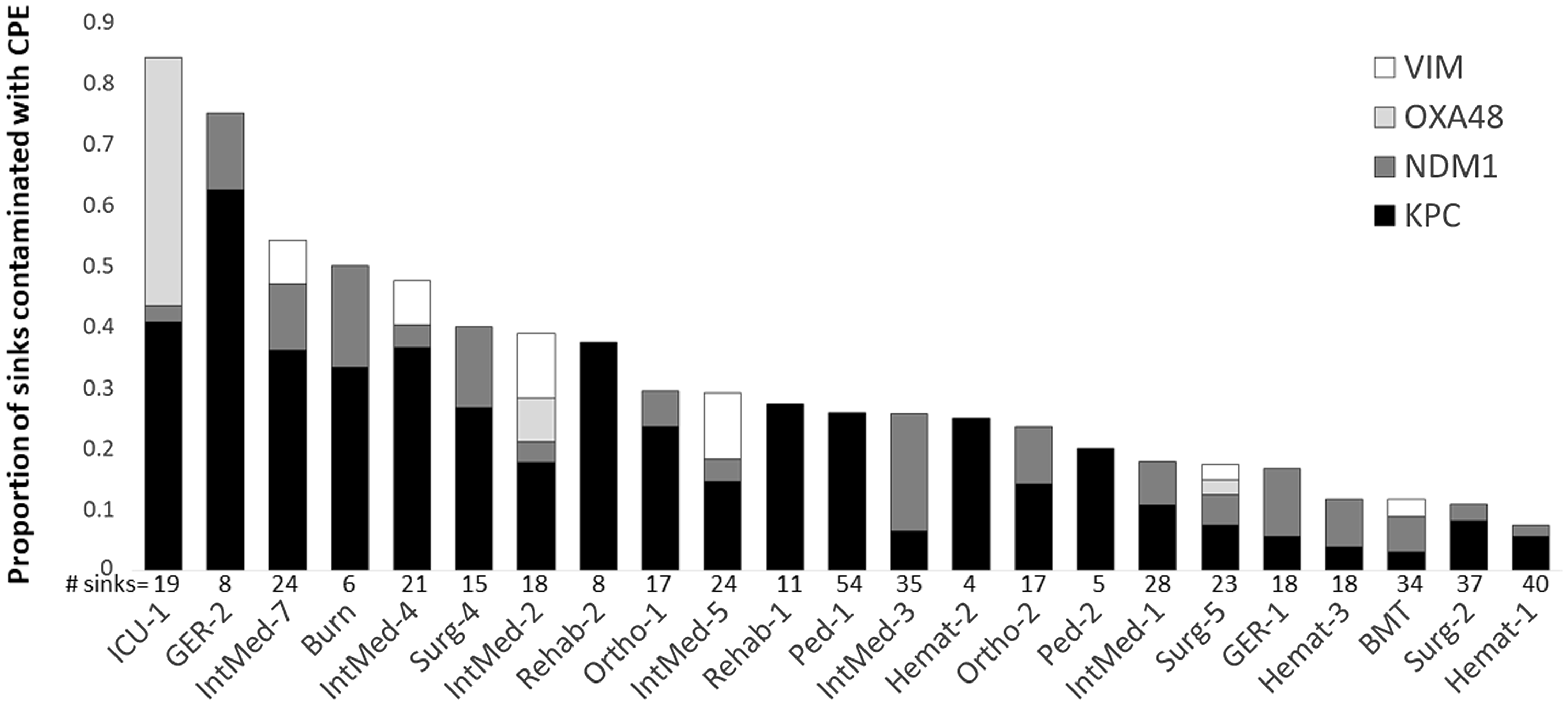
During the study period, 592 patient-room sinks in 34 departments were screened for CPE environmental contamination. In total, 144 CPE contaminated sinks (24% of all assessed sinks) were detected in 25 (73.5%) of the 34 departments. Of the 9 of 34 departments in which CPE was not recovered on initial screening, 7 were newly renovated departments in which the plumbing system had been fully replaced. The density of CPE contaminated sinks varied from CPE detection in only 1 or 2 sinks in some departments to nearly 90% of sinks in others. The leading CP-gene was bla KPC , which accounted for >50% of contaminated sinks (Fig. 1). Longitudinal serial screening in medical wards, ICUs, and the hemato-oncology wards revealed that CPE-contaminated sinks continued to be contaminated with the same CP-producing bacteria throughout the screening period.
Initial point prevalence of CPE-contaminated sink-drains among departments in which CPE-contaminated sinks were identified.

Patient acquisition of CPE
During the 2-year study period, 318 patients acquired CPE during their hospitalization. Intensive epidemiologic investigation of cases who acquired CPE were conducted, including screening of patients hospitalized in the same department during the 2-week preacquisition period and identifying potential interactions with other carriers with identical CPE strains in the other hospital wards. However, only 49 (15%) of 318 cases could the acquisition be attributed to another index-case patient (Fig. 2). In 127 patients (40%), no index case was detected, but a contaminated sink was identified with the same CPE strain (same species and same bla gene) as that acquired by the patient. In 57 additional cases, without an identifiable index case, we identified CPE-contaminated sinks with different bacterial species than that acquired by the patient but with the same bla gene, where the sink could be a possible source of transmission. In the remaining 85 patients (27%), the potential source could have been an unidentified index patient, an unrecognized community acquisition, or another environmental source.
Results of the epidemiological investigation of the 318 CPE acquisition cases during the study period.

The most commonly bacterial species acquired by patients was K. pneumoniae (46%), followed by E. coli and Enterobacter spp (23% each), whereas 2 or more different species were isolated in 11 cases (3%) (Fig. 3a). Each of the different bacterial species carried various CP-genes. We identified bla KPC as the most common gene carried (44%) followed by bla NDM (35%), bla OXA-48 (13%) and bla VIM (8%) (Fig. 3b). The daily prevalence of CPE carriers together with clinical cases was ∼40 patients per day (∼3%–4% of all hospitalized patients), and most but not all were hospitalized in the cohort area, as described above.
Distribution of the different bacterial species as defined by (A) matrix-assisted laser desorption/ionization time-of-flight mass spectroscopy (MALDI-TOF MS) and CPE genes, as defined by (B) polymerase chain reaction (PCR) among patients and sinks.

Although the distribution of CP genes detected in the sinks was very similar to that acquired by patients (Fig. 3b), the distribution of the various Enterobacter spp found in sinks differed significantly from that among patients. Escherichia coli was detected only in 2 sinks but was common in patients (<1% vs 23% accordingly), and Enterobacter spp was commonly detected in sinks but less so in patients (40% vs 23% accordingly) (Fig. 3a).
Sinks as the source of patients’ CPE acquisition
Of 132 cases with concordant sink-patient CPE, bacterial strains were available for further genotypic characterization in 107 cases. Among them, 39 (36.4%) had identical PFGE patterns, including different bacterial species harboring different genes (Table 1 and Supplementary Fig. S1 online). The bacterial species and genes of these identical pairs are reported in Supplementary Table S1 (online). In 20 cases, a sink-to-patient route of transmission was assumed due to the temporal relation, in which the sink contamination was documented before the patient was hospitalized and the patient initial screening was negative. Yet, in most cases, sinks were screened only after identifying the patient as a CPE carrier, and no assumption could be made regarding the route of transition (ie, sink-to-patient vs patient-to-sink).
CPE Isolates Acquired by 318 Patients According to CP Genes and the Attributed Factor

Note. CPE, carbapenemase-producing Enterobacteriaceae; CP, carbapenemase producing; KPC, carbapenemase-producing Klebsiella pneumoniae; NDM-1, New Delhi metallo β-lactamase-1; VIM, Verona integron-encoded; PFGE, pulsed-field gel electrophoresis.
a Sink contaminated by a different bacterial specie but with an identical CP gene and no index case suggested.
b Sink contaminated by an identical bacterial specie with an identical CP gene and no index case suggested.
c No. of patient-sink identical isolates per no. of pairs assessed by PFGE.
The 2 sink-patient pairs randomly sampled for genome sequencing included Klebsiella pneumoniae bearing bla NDM-1 and Enterobacter cloacae (appeared to be Enterobacter hormaechei) bearing bla VIM. Using hybrid genome assembly, we resolved the chromosome and plasmids in each of the 4 isolates. Also, 3 isolates harbored 3 plasmids, and 1 isolate harbored only 2 plasmids. In each sink-patient pair of isolates, we identified 2 plasmids that were nearly identical with no major structural changes. The plasmids shared by the 2 E. hormaechei isolates and 1 of the plasmids shared by the 2 K. pneumoniae isolates harbored genes conferring antimicrobial resistance (Fig. 4).
Circle plot representation of plasmids shared between patient and sink isolates. Coding domain sequences are colored based on annotations used in prokaryotic genome annotation pipeline (PGAP) with resistance cross annotated using AMRFinder software. The outer ring contains CDS on the positive strand and the inner ring contains CDS on the negative strand. The inversion between the smaller Enterobacter plasmid pair is denoted as a larger wedge.

Contamination persistence of sink-traps and pipes
During 2 years of follow-up, repeated sink sampling was performed in 9 departments where CPE carriers were frequently hospitalized. In total, 7,123 samples were collected from 166 repeatedly sampled sinks; 16 sinks of the ICU were sampled weekly for 110 weeks and sinks of the other 8 departments were sampled for at least 1 year, with 10–75 sampling times during this period. Repeated sampling of the ICU sinks rapidly revealed that 100% of sink traps were contaminated with CPE. The proportion of contaminated sinks in repeated sampling of the other departments revealed that sinks of most of the departments were heavily contaminated with CPE (52%–90% of sinks). However, 2 departments were exceptions: hemato-oncology, which was renovated 2 months after starting the environmental sampling, and the IM-F unit, which moved to a newly renovated department and did not host the CPE cohort area during the study period (Supplementary Fig. S2 online).
Although different CPE bacterial species with different CP genes were detected in different sinks, most commonly, a single dominant CPE strain was repeatedly isolated from a single sink for many weeks. Occasionally, a new strain replaced the dominant one, or 2 dominant strains were concurrently isolated. Yet, in 50 (21%) of the 240 repeatedly sampled sinks, we detected a single dominant strain (defined by PFGE). Different bacterial species carrying different CP genes persisted in the various sink-drains for over a year. Most common were KPC-producing Enterobacter spp (n = 13), followed by OXA-48–producing S. marcescens (n = 11) (Supplementary Fig. S3 online). Moreover, all of these sink traps were replaced at least once; however, recontamination with the same strain occurred rapidly. In several cases, a single strain persisted but carried different CP genes (Fig. 5a). In other cases, different species carrying the same resistance gene were detected in consecutive weeks (Fig. 5b).
Examples of patterns of prolonged CPE contamination in sinks in which a single specie was detected, but with various CP genes. Each CP gene is denoted in a different geometric shape: circle, blaKPC; square, blaNDM; triangle, blaOXA48; and rhombus, blaVIM). The colors of the shapes denote the bacterial species: yellow, Enterobacter spp; green, Klebsiella spp; red, S. marcescens; orange, Citrobacter spp.

Examples of patterns of prolonged CPE contamination in sinks in which different species were detected, but mostly with the same CP genes. Each CP gene is denoted in a different geometric shape: circle, blaKPC; square, blaNDM; triangle, blaOXA48; and rhombus, blaVIM. The colors of the shapes denote the bacterial species: yellow, Enterobacter spp; green, Klebsiella spp; red, S. marcescens; orange, Citrobacter spp.

Discussion
In this study, we have reported the frequency of CPE-contaminated sinks in an acute-care hospital, and we have demonstrated that they are frequently and persistently contaminated with a dominant clone. Most importantly, we have shown that CPE contaminated sinks are not only a source of outbreaks in high-risk units but that sink-traps serve as an important environmental niche of gram-negative MDRO (specifically CPE) that play a major role in CPE transmission in nonoutbreak settings.
Our findings suggest a broader perspective of healthcare-associated infections, implying that sink traps and wastewater pipes may play a role in CPE transmission to patients. These findings contribute to the body of knowledge regarding transmission routes of nosocomial infection and may influence the types of interventions required to prevent CPE dissemination. At the SMC, as in most medical centers in Israel, rigorous nationwide infection control efforts have been undertaken since 2007. Yet these focused mainly on hand hygiene and strict isolation of patients and establishment of CPE-defined cohort areas. This paradigm, in which the role of patient-to-patient transmission was central and exclusive, led to the policy of a rotating CPE areas between the different hospital departments. Here, we have demonstrated how this has led, at least in our medical center, to gradual contamination of the wastewater pipes in most of the departments.
Sink contamination with CPE was detected in most of the hospital departments, with point prevalence of 24%. Nevertheless, repeated sampling revealed that the realistic proportion of CPE-contaminated sinks is much higher and depends on the age of the wastewater pipes and the burden of exposure of the sinks to CPE colonized patients. Thus, sinks in newly renovated departments were generally negative for CPE, whereas sinks in departments that hosted the CPE cohort area were mostly contaminated. Using sequencing methods, we have demonstrated that the sink isolates carried similar plasmids as those found among patients hospitalized in the same hospital room. Thus, sinks are not only a habitat for MDROs and a reservoir for CPE transmission but also potentially contribute to nosocomial transmission of antibiotic resistance.
We observed that although sink contamination was persistent, there was no specific bacterial specie or CP gene. Although Serratia, Klebsiella, and Enterobacter were the most prevalent contaminating species, other Enterobacteriaceae were also detected.
Interestingly, although the distribution of different CP genes among sink isolates was very similar to the distribution among patient isolates, the distribution of bacterial species differed. For instance, E. coli was the most common bacterial species detected among patients but was only rarely detected in sinks. This may suggest the transmission of CP genes, transposons, or plasmids between common sink bacterial strains to different bacterial species, which are more common in patients. The transmission of CP genes between different bacterial species has been previously reported in vitro and in vivo. Reference Potter, Wallace and McMullen20–Reference Di Luca, Sørum and Starikova22 Thus, the sinks may serve as hubs for evolution and spread of diverse CPE strains.
Despite repeated replacements of sink traps, the new traps were rapidly recontaminated with the same strain. Because none of the hospitalized patients at that time carried these bacteria, the wastewater pipes were the likely source of this recontamination.
Particularly disturbing is the lack of reported successful interventions to eliminate sink-trap and wastewater contamination. In our experience, as in previous reports, sink-trap and even full pipe replacement resulted only in a temporary resolution. Reference Regev-Yochay, Smollan and Tal5,Reference Decraene, Phan and George23 Similarly poor results were reported with other interventions such as weekly cleaning with acetic acid, bleach, or hydrogen peroxide. Reference Kizny Gordon, Mathers and Cheong12,Reference Carling24–Reference Vergara-López, Domínguez, Conejo, Pascual and Rodríguez-Baño27 Expensive self-disinfecting siphons have also been suggested, but these do not always result in decontamination. Reference Regev-Yochay, Smollan and Tal5,Reference Mathers, Vegesana and German Mesner15 Several publications have suggested that foam disinfectants containing hydrogen peroxide may be more effective than bleach for sink drain disinfection. Reference Jones, Mana and Cadnum28–Reference Buchan, Arvan and Graham30 Prospective evaluation is warranted to assess their effect on sink-to-patient transmission. Currently, the only effective means to prevent sink-to-patient MDRO transmission may be structural aspects (eg, eliminating sinks that are not necessary) together with education to address the infectious risks of sinks and prevention of their misuse (no flushing of any substance into the sink and sole use for hand washing). Additionally, instead of rotating the cohort site between different hospitalization wards, it is reasonable to place MDRO carriers in cohorts in a single designated site. It might also be helpful to delay the reuse of hospital sites that have accommodated CPE carriers. Because there is no evidence for the efficacy of these interventions, further investigation on the topic is warranted.
Our study had several limitations. First, not all bacterial isolates were genetically characterized. Furthermore, only in 20 cases we could define the temporal relation, providing direct evidence of sink-to-patient transmission. Frequently, the sinks were sampled only after a CPE carrier patient was already detected. Last, the genetic characterization of the isolates included only PFGE and further genomic investigation of the isolates may lead to further elucidation of the route of transmission between sinks and patients. Further genomic studies of real-life settings are required to understand the evolution of CPE in wastewater pipes and their transmission to patients.
In conclusion, the persistent and widespread sink-trap contamination with CPE in our medical center, despite multiple infection control measures, is worrisome. This report adds to the accumulating data indicating the significant role of sinks in CPE transmission and suggests a paradigm change, in which infection control interventions to prevent CPE dissemination should focus on environmental control and appropriate behavior regarding the sink and its surroundings. Innovative technologies to decontaminate sink traps and wastewater are urgently needed.
Supplementary material
To view supplementary material for this article, please visit https://doi.org/10.1017/ice.2023.270
Acknowledgements
We thank all the laboratory workers involved in the laborious work assessing thousands of environmental samples. We thank the infection prevention and control team, including the students involved in the project and the Sheba Medical Center plumbing team for their assistance.
Financial support
This study was carried out as part of our routine work.
Competing interests
G.R.Y. served as a member of an advisory board for Moderna, and received speaking fees from MSD, Pfizer, AstraZeneca, and Medison. W.P.H. served as a scientific advisor to Biobot Analytics and have been a consultant for Merck Vaccines.
All other authors declare no competing interests.