Early modern monetary policy is fascinating. It is also complex, involving interactions between mints, banks, and treasuries, and arbitrageurs in domestic and international markets. It is also understudied although eighteenth-century policies remain relevant today. In fact, the motivations of important actors and the market environment in which they operated are much less understood than their more familiar nineteenth-century counterparts. For instance, it is commonly believed that Sir Isaac Newton, Master of the Mint, mistakenly overvalued gold at the mint in 1717 (Jastram 1977, pp. 12–13; Cooper 1987, pp. 44–45; Kindleberger 1993, p. 60; Redish 1990, pp. 789–90; Eichengreen 1996, p. 12). What exactly is meant by this statement? What were the reasons for this “mistake,” and what were its implications?
This article reconstructs the relevant aspects of international monetary relationships during the eighteenth century. Doing so, helps us understand the operation of bullion markets during the eighteenth century and the constraints they imposed on policymakers. Policymaking was constrained by global arbitrage, thus understanding the working of the bullion markets helps “rationalize” decisions (such as Newton's). Specifically, I show how international market integration forced policy makers to face trilemma similar to what actors of the gold standard era faced: with a fixed exchange rate and capital mobility, the stable range of policies is quite limited.
Because silver had a smaller value for a given weight, the joint circulation of gold and silver coins was advantageous. Local authorities had to select a correct bimetallic ratio to ensure that both types of coins would circulate at the same time: an excessively high ratio would drive out silver leaving only gold while an excessively low ratio would do the opposite.Footnote 1 This problem was compounded by international constraints. Bullion market integration between England and the Dutch Republic in mid-eighteenth century complicated the life of policymakers because market prices of gold and silver in different locations came ever closer under the pressure of international bullion arbitrage. Integration also entailed that policymakers could not independently establish widely different legal bimetallic ratios without some of them become effectively monometallic.
This article investigates this simple economic idea between 1734 and 1758 when high-quality data enable rigorous analysis.Footnote 2 To assess the efficiency of bullion arbitrage, I examine the gold, silver, and foreign exchange markets of London and Amsterdam—the two leading markets of the time (Van Dillen 1926; Feavearyear 1931; Chaudhuri 1978; Attman 1983; Dehing and ‘T Hart 1997; Flandreau et al. 2009a). Moreover, the political authorities of England and the Dutch Republic had established different bimetallic ratios: London's legal ratio (15.21) was 3.8 percent higher than Amsterdam's (14.65). If arbitrage was effective, then bimetallism should not have prevailed in both countries. Although qualitative evidence suggests that England was on a de facto gold standard; we still lack a quantitative exploration of the logic of arbitrage. In addition, the focus on the rise of the gold standard in England has ignored its connections with the Dutch Republic.
This article makes three contributions. To begin, I show that bullion markets were highly integrated by the middle of the eighteenth century. This is not surprising since we already knew that exchange and securities markets were well-integrated, but it is important to the argument (Neal 1990, 2000; ‘T Hart, Jonker, and Van Zanden 1997; Nogues-Marco and Vam Malle 2007; Flandreau et al. 2009a; Koudijs 2011). I also demonstrate that at the same time, Amsterdam was on an effective bimetallic standard; and Dutch people were indifferent between paying in gold or in silver. Bimetallism can collapse in one place and succeed in another. Finally, I show that in the eighteenth century the market price ratio between the two metals remained close to the Dutch legal standard. This finding echoes M. Flandreau (2004) who shows that in the nineteenth century, bimetallism was not a knife-edge monetary standard because inflows and outflows of species from the vast French specie holding kept the gold-silver market ratio close to France's legal ratio of 15.5. To establish these contributions, we start with an intuitive theoretical explanation of bimetallic stability with bullion market integration.
MODELING BIMETALLIC STABILITY WITH BULLION MARKET INTEGRATION
Unlike much of the literature which focuses on a single market, I model the stability of bimetallism with two centers: London and Amsterdam. As was the case the mid-eighteenth century, I assume that bullion markets were integrated and that each center autonomously fixed its legal ratio. The key question is: when bullion markets are integrated and each country choses it legal ratio, which ratio will prevail?
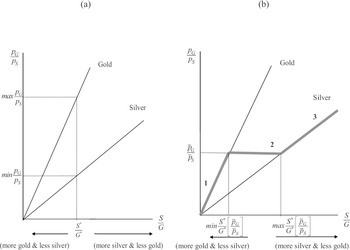
Let us begin with the simplest case and suppose that the two centers have coordinated the same legal ratio. Figure 1A maps relative prices and quantities of gold and silver and the possible equilibrium ratio (price of gold/price of silver) as a function of the proportion of total resources (quantity of silver/quantity of gold) (the online Appendix develops the mathematical model). The line “Gold” represents the gold standard equilibrium for both centers (no silver money); the line “Silver” represents the silver standard equilibrium (no gold money). Between those bands bimetallism can arise but only if prices and quantities are compatible. What matters is the relative scarcity of silver (S *) to gold (G *), or the relative stock of resources (S* /G*). Given that relative stock, bimetallism arises for any price ratio that lies between that which lead to gold standard (max (pG pS)) and that which leads to a silver standard (min (pG pS)).
THE BIMETALLIC EQUILIBRIA WHEN AMSTERDAM AND LONDON HAVE THE SAME LEGAL BIMETALLIC RATIO

Moving to Figure 1B, suppose now that the English and Dutch governments chose the same legal ratio ( ) and let the relative supply of silver-gold S/G vary. The ratio (
 ) could be compatible with the monetary use of both metals or could be a de facto gold standard or a de facto silver standard, depending on relative gold and silver stocks. Given (
 ), the thick grey line in Figure 1B traces out the relationship between total stocks and the monetary standards in both centers. Start with a relative scarcity of silver (segment 1 of the thick grey line). Here, silver is so rare relative to gold that legal ratio is higher than the equilibrium market ratio, and the English and Dutch economies operate on a de facto gold standard. At the other end, suppose that gold is scarce relative to silver, then the legal ratio is less than the equilibrium market ratio, and the English and Dutch economies operate on a de facto silver standard (segment 3 of the thick grey line).
BIMETALLIC EQUILIBRIA WHEN LONDON'S LEGAL RATIO IS HIGHER THAN AMSTERDAM'S RATIO

When the relative level of resources is compatible with the monetary use of both metals (segment 2 of the thick grey line), the monetary regime is bimetallic. As the theoretical example shows, both countries can be bimetallic if they coordinate on a legal ratio that consistent with the relative proportion of precious metals.
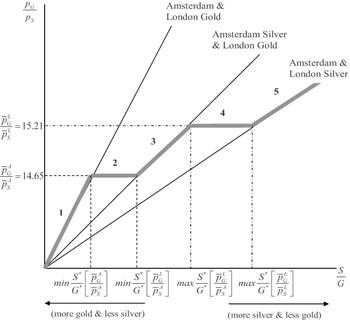
However, as we know, London and Amsterdam had different legal ratios. I chart this case in Figure 2 (the online Appendix develops the mathematical model). Because the London ratio is higher than the Amsterdam ratio, we must augment Figure 1 with a line “Amsterdam Silver and London Gold,” which represents the silver standard equilibrium for Amsterdam and the gold standard equilibrium for London. There are now five possible equilibria for any pair of bimetallic ratios (with London's ratio higher than Amsterdam's ratio), depending on the relative total resources.
First, as before, if silver is too scarce relative to gold for higher bimetallic ratio (segment 1 of the thick grey line in Figure 2), then the equilibrium market ratio will be lower than either legal ratios, and both countries will be a de facto gold standard. Second, let the relative quantity of silver-to-gold increase to the point that the relative stock of silver is now compatible with an equilibrium market price ratio that coincides with Amsterdam's legal ratio but that is lower than London's legal ratio (segment 2 of the thick grey line). London thus remains on a de facto gold standard, but Amsterdam is bimetallic. In this case, the legal ratio equals the equilibrium market ratio for Amsterdam, but silver continues to be more valuable as a commodity than as money in London so only gold is coined there. Third, let the relative quantity of silver-to-gold increase again to the point that the market price ratio is higher than Amsterdam's legal ratio but lower than London's legal ratio (segment 3 of the thick grey line). London remains on the gold standard, and Amsterdam becomes a silver standard. Silver continues to be a commodity and gold the currency in London. The situation is reversed in Amsterdam where silver is cheap and currency and gold dear and a commodity. Fourth, let the relative quantity of silver increase yet again, so that the market price ratio coincides with London's legal ratio (and thus higher than Amsterdam's) as show in segment 4 of the thick grey line of Figure 2. London is now on an effective bimetallic standard, and Amsterdam remains on a de facto silver standard: silver there is cheap and currency while gold is a commodity. Finally, when gold is too scarce relative to silver for either legal ratio (segment 5 of the thick grey line), both Amsterdam and London are on a de facto silver standard: gold is more expensive as a commodity than as money, while the reverse is true for silver.
Thus, the relationship between the legal ratios and the equilibrium market ratio tells us what monetary standard effectively operated in each center. When the market price of gold to silver equals the legal ratio, the center will be bimetallic; when the price is lower than the legal ratio, the center will be de facto on gold; and when it is higher, the center will be de facto on silver.Footnote 3 This whole theoretical discussion has been premised on the assumption that market prices were the same in London and Amsterdam, but were they?
TESTING FOR BULLION MARKET INTEGRATION
To the end of the eighteenth century, only Spain and Portugal, the empires that produced the vast majority of precious metals, maintained export prohibitions (Pallavicino 1855, p. 8; Larruga 1787–1800, vol. 3, pp. 49–57; Nogues-Marco 2011). In contrast, Dutch law had allowed ingots and foreign coin exports since 1646. Dutch Mint Masters attempted to ban bullion exports, but mercantile circles in Amsterdam opposed them and prevailed in keeping bullion exports open. England's bullion trade was liberalized in 1663. Then bars and foreign coins could be exported even though English coins could not up to 1819 (Attman 1983, p. 27; Gillard 2004, p. 132; Viner 1955, p. 4; Munro 1992, p. 212).
Because shipping specie was costly, the exchange rates can fluctuate within the “specie point”: the ratio of the bullion market prices (gold or silver) in two centers plus/minus the cost of shipping bullion between the two cities. We can use the specie-point mechanism to test bullion market integration. Gold and silver points are defined according to the Law of One Price.Footnote 4 The specie point is defined for metal i (i = gold, silver) according to equation 1

where  is the market price of metal i in Amsterdam,
 the market price of metal i in London, x is the spot exchange rate between Dutch schelling bank and British pounds sterling,
 is the cost of shipping metal i from London to Amsterdam, and
 is the cost of shipping it in the other direction.
There will be no metal shipments if the exchange rate lies within the specie points. Yet this can fail for several reasons. If the bills of exchange are sufficiently expensive in Amsterdam to break of the upper specie point  , then a Dutch debtor could buy gold or silver on the Amsterdam market and ship it to London. Symmetrically, if bills were expensive enough in London to break of the lower specie point
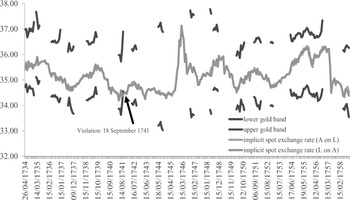
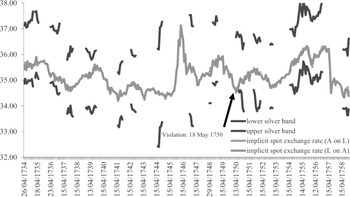
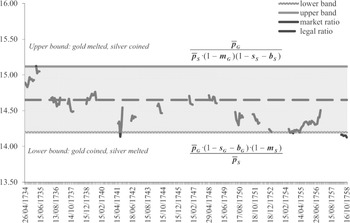
 , then an English agent would send metal to Amsterdam. When bullion markets are integrated, prices should mostly remain within the species point. Figure 3 shows the gold point, and Figure 4 shows the silver point for London-Amsterdam in the mid-eighteenth century. (These points were calculated using spot rates, using sight (three day) rates produces the same result. The Appendix details the data set used to calculate the specie points).
GOLD BAND OF THE ARBITRAGE EQUATION BETWEEN LONDON AND AMSTERDAM, 1734–1758, SCHELLING BANK/STERLING POUND (monthly observations)

Figures 3 and 4 show that there were few violations to specie points between London and Amsterdam.Footnote 5 There was only one break for the lower gold band in 18 September 1741 and one break for the lower silver band in 18 May 1750. In the first case, it paid to send gold from London to Amsterdam, in the second, it was silver. Given that there were 119 observations for each metal, violations were rare, occurring less than 1 percent of the time. Gold and silver markets were clearly integrated and the exchange rate varied within the band defined by costs of gold and silver arbitrage. We observe different behavior for the exchange rate and bullion points during periods of war and peace. In peacetime, the band that is defined by the bullion points was narrower, and exchanges rate varied little. Exchange rates fluctuated greatly during the War of the Austrian Succession (1742–1748), but the bullion points were not broken because they widened as a result of the increase in insurance costs from an average of 1.25 percent in peacetime to 3.5 percent during the war (see the Appendix).
SILVER BAND OF THE ARBITRAGE EQUATION BETWEEN LONDON AND AMSTERDAM, 1734–1758, SCHELLING BANK/POUND STERLING (monthly observations)

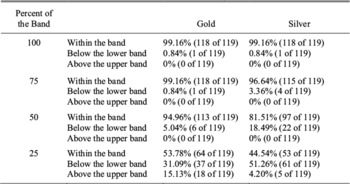
Table 1 shows the percentage of observations that fall within bands of specie points as we reduce transport costs. If the band is wide (generated by actual costs), then 99.16 percent of the observations are within the band. If we reduce costs to 75 percent of actual, then 99.16 percent of the observations lie within the ensuing hypothetical gold points and 96.64 percent of the observations within the silver points. If the band generated by considering only 50 percent of the costs, then the resulting gold points contain 94.96 percent, and silver points contain 81.51 percent of the observations. Finally, our band was narrowed so that it was generated by only 25 percent of actual costs, then the gold points still contain 53.78 percent, and silver contain 44.54 percent of the observations.
PERCENTAGE OF OBSERVATIONS FALLING WITHIN THE QUARTILES OF THE SPECIE BAND

Sources:
See the text.
The bullion markets’ behavior is consistent with what we know of capital market at the same time. L. Neal (1990) showed that the London and Amsterdam financial markets were integrated in the eighteenth century, and this section has demonstrated that same held true for bullion markets. International arbitrage ensured uniformity in the gold and silver market prices. The next section determines what standard (gold, silver, or bimetallic) actually prevailed in London and Amsterdam between 1734 and 1758.
DETERMINING THE MONETARY REGIME
In Old Regime economies, gold and silver had two prices, one when used as commodities (the market price) and one when used as money (the legal price). If these two prices diverge, agents want to melt down the metal that is more expensive as a commodity than as money and want to mint the metal that is cheaper as a commodity than as money. In other words, they want to arbitrage between market and legal price if their difference is higher than melting-minting costs (Friedman 1990; Flandreau 1997 and 2004, pp. 30–31; Quinn and Roberds 2009, pp. 41–44).
Minting point: The seller of an ingot in the market must receive at least the same amount of coins (measured in units of account) that he would receive if he sold it to the mint to be turned into coins

where p denotes the ingot's market price;  its legal price (mint equivalent); and
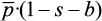 its mint price, in other words, the legal price net of seigniorage (s) and cost of minting or brassage (b).
Melting point: The buyer of the ingot in the market must receive at least the same weight of metal that he could obtain by melting down the number of coins equivalent to one unit of account

where p −1 is the weight of standard ingots received in the market per unit of account, and  denotes the weight of standard ingots obtained by melting down the number of coins that are equivalent to one unit of account net of the cost of melting them down (m).
Merging equations 2 and 3 provides two inequalities that bound the market price of gold (equation 4) and silver (equation 5)


We can use equations 4 and 5 to measure the bounds within which the market ratio should lie to prevent bimetallic arbitrage

The effective monetary regime is determined for each center, first for Amsterdam and then for London, by applying equation 6 to the relevant data for each city (the Appendix details the variables that are used to calculate the melting-minting arbitrage equation).
To start, however, we must return to monetary history. The Dutch monetary system was decentralized, the Republic had multiple provincial mints rather than a national one. Ordinances made each province's mint output legal tender in the whole republic. If a province debased its coins to increase seigniorage, debased coins would migrate to the other provinces. Decentralization caused monetary conditions to deteriorate (Dehing and ‘T Hart 1997, pp. 39–41; De Vries and Van der Woude 1997, pp. 81–82; Polak 1998, pp. 16–17 and pp. 63–68; Quinn and Roberds 2009, 2012). The Bank of Amsterdam (Amsterdamsche Wisselbank) was established in 1609 upon the request of several merchants who complained about confusion regarding currency. The Bank acted as guarantor for the legal standard, eliminating uncertainty about the intrinsic value of coins and protecting creditors against debasement (Quinn and Roberds 2009, 2012). The bank received money on deposit, provided settlement through a giro system, and traded in coined money and bullion (Vilar 1974, p. 252; Dehing and ‘T Hart 1997, pp. 46–47). Although the functions of deposit and giro are better-known, the purchase and sale of precious metal are the relevant activities to my analysis of the stability of bimetallism. Indeed, according to H. Van der Wee (1977, pp. 342 and 346–47), the specie trade became the major function of the Bank of Amsterdam during the eighteenth century.
The bank was an intermediary between private agents and the mints; it minted bullion and melted down coins (Dehing and ‘T Hart 1997, pp. 47–48). The sale of precious metals to the mints was primarily managed through the exchange banks, most importantly the Bank of Amsterdam (Van der Wee 1977, p. 341). Imported precious metals, bullion, and inferior coins sold to the bank were regularly sent to the mints for minting into coins (De Vries and Van der Woude 1997, p. 83). Private agents preferred the mediation of the bank to directly delivering precious metal to mints because it was always well-stocked with coins and could thus pay upon receipt of the bullion. The monetary reform of 1694 excluded private exchange banks and gave the Bank of Amsterdam a monopoly over distributing bullion among the Dutch mints (Gillard 2004, p. 125). Therefore, when discussing the legal price of gold and silver in Amsterdam, it is not the mint price that we consider; rather, we consider the bank price because that was what arbitrageurs would have faced.
Figure 5 shows the melting-minting arbitrage bands for Amsterdam derived from equation 6. The legal bimetallic ratio between fine gold and fine silver was 14.65, and the melting-minting band was the interval [14.20, 15.12], which represents a spread of 7.5 percent between the upper and lower bound (see the Appendix for calculations). Figure 5 shows that bimetallism was stable in Amsterdam. The market ratio was not exactly equal to the legal ratio, but it fluctuated within the band defined by the melting-minting costs of the legal ratio.
MELTING-MINTING BOUNDS IN AMSTERDAM, 1734–1758 (monthly observations)

As before, I can only document market prices for 119 observations (44.34 percent the months in the period). It is striking that the market price ratio of gold to silver never broke the upper band and only broke the lower band in 8 out of 119 observations (6.7 percent), all of them with negligible profitability: once in July 1741 (net profit 0.4 percent), once in March 1753 (net profit 0.1 percent), once in September 1754 (net profit 0.1 percent), and six times from May to October 1758 (average net profit 0.3 percent). At each break, the market prices were close to the lower bound, which indicates that gold was tending to mint and that silver was tending to melt.
Let us now turn to London. By the eighteenth century, English minting was centralized in the Royal Mint of London (Dyer and Gaspar 1992). Minting was free of seigniorage and brassage because the charges had been removed in 1666. Melting down foreign coins into ingots was permitted, but melting down or exporting English coins was forbidden (Feavearyear 1931, p. 112; Viner 1955, p. 4). However, according to Isaac Newton (1702), the liberty of melting foreign monies into ingots in private shops and houses provided opportunities to melt down English coin.Footnote 6
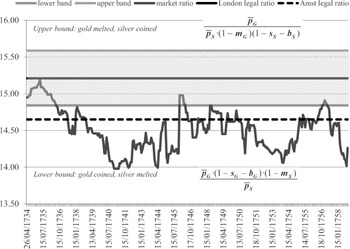
MELTING-MINTING BOUNDS IN LONDON, 1734–1758 (monthly observations)

Figure 6 shows the melting-minting bounds for London (again see the Appendix for calculations). There the legal bimetallic ratio between fine gold and fine silver was 15.21 and the melting-minting band was the interval [14.84, 15.59], with a spread of 5 percent between the upper and lower bound. The English band is smaller than the Dutch one because minting was free in London.Footnote 7 Calculating the melting-minting bounds confirms that England was on a de facto gold standard in the mid-eighteenth century: the market bimetallic ratio almost always was far below the lower bound. The sample consists of 295 monthly data points for from 1734 through 1758, for which the lower bound was broken 257 times (87.12 percent of the observations). Arbitrage where silver was melted and gold was minted was systematically profitable. The net profitability of arbitrage was high: 3.4 percent on average and more than 6 percent during the period of maximum profitability, 1740/41.
When the lower bound is broken, one expects that silver coins will be melted to be sold as a commodity while gold will be purchased in the market to be sold to the mint. One would then expect a fall in the price of silver and an increase in that of gold until arbitrage profits disappear, thereby bringing the market ratio close to the legal ratio. There was no such arbitrage because all the silver in England had already been moved from money market to the commodity market without bringing market ratio close to the legal ratio. London was on a de facto gold standard.
A legal ratio that is “too far” from the market ratio results in a de facto monometallic standard. However, how far is “too far”? The possibility of turning into a de facto monometallic standard will depend on the extent of the divergence between the legal and market ratios. This price difference in turn depends on the size of the money stocks because one might be able to push market prices back towards the legal ratio if one could move sufficiently large quantities of bullion between money market and commodity market.
THE POLITICAL ECONOMY OF THE LONDON RATIO
As the theoretical section argued, different countries could not maintain different bimetallic ratios and be effectively bimetallic at the same time. London's legal ratio was 3.8 percent higher than Amsterdam's; and as the previous section has shown, Amsterdam was effectively bimetallic because its market ratio remained close to its legal ratio. Because Amsterdam was bimetallic, London was de facto on the gold standard (segment 2 of Figure 2). London's market ratio gravitated away from its legal ratio and toward Amsterdam's legal ratio because bullion markets were integrated. One might therefore ask why England did not adopt a legal ratio closer to that of the Dutch Republic; in other words, why it did not coordinate its bimetallic ratio. The conventional wisdom is that the English bimetallic ratio remained excessively high because Newton did not adjust the legal ratio enough to support the circulation of silver coins. Newton's “inadvertent” overvaluation of gold switched England to a de facto gold standard at the beginning of the eighteenth century (Feavearyear 1931, pp. 142–43; Jastram 1977, pp. 12–13; Cooper 1987, pp. 44–45; Kindleberger 1993, p. 60; Eichengreen 1996, p. 12). But a better explanation is that the ratio remained too high not because of Newton's “mistake,” but because Parliament did not alter the monetary standard of England in 1718.
The scarcity of coined silver was already evident in England at the end of the seventeenth century. This scarcity generated a parliamentary controversy between Sir William Lowndes, Secretary of the Treasury, and the philosopher John Locke (1695/96). Lowndes exposed the problem of silver scarcity according to the melting-minting points explained in the previous section: “That whensoever the Extrinsick Value of Silver in the Coin hath been or shall be less than the price of Silver in Bullion, the Coin hath been, and will be Melted down” (Lowndes 1695, p. 68). The solution that he proposed was that “the Value of the Silver in the coins should (by any Extrinsick Denomination) be Raised, to encourage the bringing of Bullion to the Mint to be Coin'd. (…) That for this purpose we need only to consider the very Price that Silver bears in England, where these Coins are to be Currant, although if we will have Relation to Neighbouring Countries, particularly to Holland, we shall find that the Currant Price of an Ounce of Silver there, adding thereunto the Difference of Exchange from London to Amsterdam or Roterdam, will still make up the Price of Six Shillings and Five Pence for the Ounce of Silver at London [market price of silver in London at that time]” (Lowndes 1695, p. 56 and pp. 78–82).
However, Locke greatly opposed raising the nominal value of silver: “The reason why it should not be changed [value of silver] is this; because the publick Authority is Guarantee for the performance of all legal Contracts. But Men are absolved from the performance of their legal contracts, if the quantity of Silver, under setled and legal denominations be altred: As is evident, if borrowing 100 l. or 400 Ounces of Silver to repay the same quantity of Silver (for that is understood by the same sum, and so the Law warrants it) or taking a Lease of Land for years to come, at the like Rent of 100 l. they shall pay both the one and the other in Money Coin'd under the same denominations with One fifth less Silver in it, than at the time of the bargain. The Landlord here and Creditor are each defrauded of 20 per Cent. of what they contracted for, and is their due. And I ask, How much juster it would be thus to dissolve the Contracts they had made; than to make a Law, that from henceforth all Landlords and Creditors should be paid their past Debts and the Rents for Leases already made, in clip'd Money, twenty per Cent. lighter than it should be? Both ways they lose twenty per Cent. of their due, and with equal Justice” (Locke 1696, p. 9).
Locke clearly viewed the problem differently from Lowndes. He argued that the scarcity of silver was not caused by an “excessively high” bimetallic ratio but was caused by the great abundance of silver clipped coins. Contracts were denominated in the unit of account (numeraire); thus, changing the silver price would have had a redistributive effect on debtors and creditors. The court party and the landed interest (mostly creditors) accepted Locke's reasoning, whereas goldsmiths, bankers, and commercial men (mostly debtors) supported Lowndes (Feavearyear 1931, p. 124). Sir Isaac Newton, Master of the Mint from 1696, supported Locke against Lowndes, arguing that silver was the true and only monetary standard of England and as such must not be altered (Fay 1935, p. 110; Kindleberger 1993, p. 61). Locke's view prevailed, and the Great Recoinage of Silver of 1696 did not raise the legal value of silver (Feavearyear 1931, chapter 6; Vilar 1974, chapter 23; Mayhew 1999, chapter 3; Redish 2000, pp. 65–68). Although recoinage solved the problem of clipped coins, the scarcity of silver persisted because its legal price was too low in proportion to gold.
In 1698 a group of commissioners, including Locke, was appointed to reconsider the scarcity of silver in circulation. They recommended reducing the legal price of guinea because gold price was 6 percent higher in England than in Holland. In 1699 the mint price of guinea was reduced from 22s (legal bimetallic ratio of 15.93) to 21s 6d (legal bimetallic ratio of 15.58), i.e, the bimetallic ratio was reduced only 2.25 percent instead of the proposed reduction of 6 percent (mint price of gold at 20s 9d; legal bimetallic ratio of 15.03) (Kindleberger 1993, p. 61). The lower gold price caused considerable opposition and was not enough to avoid the scarcity of silver circulating as money (Feavearyear 1931, p. 145).
At the beginning of the eighteenth century, Newton provided several reports to coordinate the English bimetallic ratio with the main European centers by reducing again the legal price of gold. In the Memorial concerning the proportion of gold and silver in value in several European currencies, Newton explicitly recommended changing the English legal ratio according to the Dutch ratio as the French had done: “By the late Edicts of the French King for raising the monies in France the proportion of the value of Gold to that of Silver being altered, I humbly presume to give yr Lordps notice thereof. (…). The proportion therefore between Gold & Silver is now become the same in France as it has been in Holland for some years. (…). The state of the money in France being unsetled, whether it may afford a sufficient argument for altering the proportion of the values of Gold & Silver monies in England is most humbly submitted to yor Lordps great wisdome (28 Sept 1701).”Footnote 8
In the end, Parliament did not act. In 1717 Newton's submitted another proposal to prevent the melting down of the silver coins. He calculated the appropriate mint price of the guinea given the market prices of the European bimetallic countries. He estimated that the guinea was worth 20s 8 1/2d in France (according to the French market ratio of 15), about 20s 7 1/2d in Holland, Hungary, and the Habsburg Empire (market ratio around 14.94 there), and 20s 7d 6d or 5d in Italy, Germany, Poland, and Denmark (market ratio between 14.91 and 14.79 in these countries). Newton proposed a mint price for the guinea between 20s 8d and 20s 6d (bimetallic ratio between 14.97 and 14.85).Footnote 9
Newton had estimated his mint price for gold according to the European market ratios, which was more accurate than the contemporary English legal ratio of 15.58, but higher than the European legal ratios. The Dutch Republic had a legal ratio of 14.66 and France fixed a legal ratio of 14.625 from 1726 to 1803 (Kindleberger 1993, p. 63; Eichengreen 1996, p. 12).Footnote 10 We cannot however assess the effect on silver circulation of the bimetallic ratio proposed by Newton because it was never applied.
Because Newton was aware of the parliamentary resistance to changing the bimetallic ratio, he suggested a reduction of the gold price in two steps: first changing the mint price of the guinea to 21s and subsequently reducing the price to 20s 8d or 20s 6d. The first adjustment was approved by Parliament on 22 December 1717 (Julian calendar) with the aim of placing England on an effective bimetallic standard.Footnote 11 England's bimetallic ratio was thus fixed at 15.21, provoking so much general concern that the second adjustment never occurred (Feavearyear 1931, p. 145). On 23 January 1718, only one month after the first adjustment, Parliament argued that the expectation of the new reduction in the gold price had provoked silver hoarding: changing silver per gold, agents received 1/15.21 while waiting for the next devaluation to 1/14.85 (a 2.4 percent gain). Rather than reducing the gold price immediately to stabilize bimetallism, Parliament decided “that no Alteration be made in the Standard of the Gold and Silver Coins of this Kingdom, in Fineness, Weight or Denomination” and argued that this measure was adopted to avoid a silver shortage.Footnote 12
Effectively, no further change was made to the bimetallic ratio. England maintained its elevated ratio of 15.21 and then adopted the gold standard de jure in 1816 (Fay 1935, p. 117).Footnote 13 But by then only gold circulated as money in England, since it had been on a de facto gold standard in 1718, not because of Newton's mistake but because the English Parliament gave priority to maintain a fixed legal standard to preserve credibility over stable bimetallism. By the second half of the century, scarcely any silver coin was being struck (Feavearyear 1931, p. 145; Dyer and Gaspar 1992, p. 398).
CONCLUSIONS
This article has analyzed the mechanics of bullion markets in the eighteenth century. It demonstrates that market integration limited the freedom of policymakers: with free bullion movements among countries, it is not possible to maintain monetary policy independence (an uncoordinated legal bimetallic ratio with the countries with which one has free bullion movement) and monetary stability (an effective bimetallic standard).
Before bullion trade was liberalized, policymakers were free to define legal prices for precious metals. Countries could maintain stable bimetallic systems with different legal ratios because transport costs and smuggling risk were sufficient to avoid international bullion arbitrage. These “closed economies” could be bimetallic as long as the domestic market ratio was equal to the legal ratio. In other words, persistent differences in legal ratios across countries indicate that bullion markets are disintegrated.
Free trade in bullion constrained the legal prices. The gold-silver market ratio was uniform in Europe and bimetallism would be effective only if the legal prices converged among countries. In this framework, differences in legal ratios across countries indicate ineffective bimetallic standard (de jure bimetallism but de facto monometalism).
Amsterdam and London liberalized bullion trade during the second half of the seventeenth century. Bullion markets were well-integrated by the mid-eighteenth century: the law of one price held nearly completely. The Dutch were bimetallic in the eighteenth century because the market ratio between gold and silver in Amsterdam remained durably close to the legal ratio. In contrast, London's legal ratio was 3.8 percent higher than Amsterdam's ratio; therefore, both countries could not be bimetallic at the same time. London was on a de facto gold standard because London's market ratio did not remain close to its legal ratio, but actually gravitated toward Amsterdam's legal ratio. England had an excessively high legal ratio, and therefore, the legal gold price would have had to be reduced to adjust to Amsterdam's legal ratio to preserve bimetallism. However, English Parliament members opted not to alter the legal standard in England from 1717 to 1931 (with lapses of inconvertibility from 1797 to 1819 and from 1914 to 1925), reason for which England switched permanently to a de facto gold standard at the beginning of the eighteenth century.
Appendix: Data Sources and Elaboration
Gold and Silver Points
This section of the Appendix explains the variables that were used to calculate the gold and silver points, in other words, the gold and silver arbitrated par of exchange between London and Amsterdam  , the spot exchange rates between London and Amsterdam
 and the cost of shipping gold and silver from London to Amsterdam
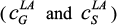 and from Amsterdam to London
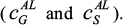 . When quotations were reported in a range, I used their midpoint. I also converted all dates from Julian calendar (Old Style) to the Gregorian calendar (New Style). All series are monthly 1734–1758, each data point was taken from the same day near the middle of each month.
Arbitrated Par of Exchange
The arbitrated par of exchange is defined by the relative market prices 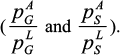
Market prices for gold and silver in London: I collected the monthly prices of gold and silver bars from The Course of the Exchange.Footnote 14
Market prices for gold and silver in Amsterdam: Amsterdam was the primary world bullion market in the eighteenth century (Van Dillen 1926; Attman 1983). However, to this date no scholar has collected price data, probably because such information is difficult to locate. Financial bulletins did give exchange rates with regularity. They occasionally included the prices of stocks but they listed bullion prices only infrequently.Footnote 15 Newspapers simply do not report bullion prices (Rotterdamsche Courant (microfilm C. 46), Amsterdamsche Courant (microfilm C. 20), Utrechtse Courant (microfilm C. 31), and Oprechte Haarlemsche Courant (microfilm C.37), Koninklijke Bibliotheek Den Haag). That leaves commercial bulletins as the last alternative.Footnote 16 The Dutch brokers’ guild compiled data and published such a bulletin, the Kours van Koopmanschappen tot Amsterdam, which circulated worldwide. On a monthly basis, N. W. Posthumus, founder of the Nederlandsch Economisch-Historisch Archief, ordered copies of the Kours van Koopmanschappen tot Amsterdam from the Vereenigde Oost-Indische Compagnie in the Arsip Nasional Republik Indonesia in the 1920s to work on his book titled Inquiry into the History of Prices in Holland. These low quality photographic copies are now housed in the Nederlandsch Economisch-Historisch Archief. Missing information is unavoidable because some data are not available (55.93 percent of the sample) and few available photos are illegible (3.73 percent of the sample). I recorded the monthly prices of fine gold and silver bars near the middle of each month from 1734 to 1758. Gold bars were measured as the percentage of premium over 355 gulden/Dutch marks (Hayes 1777, p. 253; Kelly 1835, vol. 1, p. 9; Lemale 1875, p. 48).Footnote 17 Silver bars were measured in guldens and stuivers (McCusker 1978, p. 44).Footnote 18
Amsterdam had two types of units of account (numeraire) in the eighteenth century: current money and bank money. Current money and bank money fluctuated according to the agio (Newton 1729/1731; Hayes 1739, p. 259; Shaw 1895, pp. 345–59; and McCusker 1978, p. 44). Bullion market prices were expressed in current money, whereas the exchange rates were expressed in bank money (Hayes 1739, p. 278 and 285). Because I needed to compare the arbitrated parity with the exchange rate, I converted current money to bank money according to the agio (equation A1) (Hayes 1719, pp. 12–14; Quinn and Roberds 2009, p. 60)

The agio data are obtained from Kours van Koopmanschappen tot Amsterdam (Appendix Figure 1 shows the fluctuation between the bank and current money in Amsterdam).
CURRENT MONEY FLUCTUATION IN AMSTERDAM, 1734–1758 (bank money = 1)

Spot Exchange Rate
The exchange rate that was defined in the specie-point mechanism is the implicit spot exchange rate of bills of exchange that are derived from the exchange rates at maturity compiled in the financial and commercial bulletins. I derived the spot exchange rate (x AB) from equation A2 (Flandreau et al. 2009b)

where αAB is the price for a bill drawn in location A on market B, where it matures at a certain future date.  is the shadow interest rate in center B from center A for the commercial loan concealed in the bill between today and day the bill is payable. For London-Amsterdam, comes from The Course of the Exchange and
 from Flandreau et al. (2009b). The exchange rate in London on Amsterdam was expressed in schelling and groot bank per sterling pound (Giraudeau 1796 [1756], p. 220)19 at two usances (occasionally two and a half usances) (Flandreau et al. 2009b, p. 186).Footnote 20
SCATTER DIAGRAM OF SPOT EXCHANGE RATES IN AMSTERDAM ON LONDON AND SPOT EXCHANGE RATES IN LONDON ON AMSTERDAM, MONTHLY OBSERVATIONS FROM 1734 TO 1758 (schelling bank/pound sterling)
For Amsterdam-London, αAL comes from the Kours van Koopmanschappen tot Amsterdam and  from Flandreau et al. (2009b). The exchange rate in Amsterdam on London was expressed in schelling and groot bank per sterling pound at 2 usances (Giraudeau 1796 [1756], p. 205; Flandreau et al. 2009b, p. 186).Footnote 21
The specie-point mechanism assumes that the spot exchange rate in London on Amsterdam is equal to the spot exchange rate in Amsterdam on London  . Therefore, I have denoted the spot exchange rate as simply x. Otherwise, xLA would refer to the case of transferring specie from Amsterdam to London, and xAL would refer to the case of transferring specie from London to Amsterdam. Appendix Figure 2 shows that the two spot exchange rates are extremely close. They are also closely correlated (Pearson's correlation coefficient is 0.99) (Flandreau et al. 2009a).Footnote 22
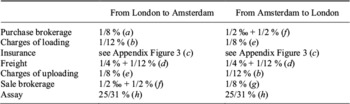
ARBITRAGE COSTS BETWEEN LONDON AND AMSTERDAM BROKEN DOWN BY MAIN ITEMS

Costs
Arbitrage costs between London and Amsterdam are broken down by the main items in Appendix Table 1.
MELTING AND MINTING POINTS
Melting-Minting Points in London
The London mint price is the legal price of precious metal used as money in London. This price was defined in the 1734–1758 period as follows: one troy pound of standard silver (37-fortieths) was struck in 12 2/5 crowns or 62 shillings.Footnote 23 One crown had a gross weight of 19 pennyweights (dw) and 8.516129 grains (gr), and one shilling had a gross weight of 3 dw and 20 9/16 gr.Footnote 24 One troy pound of standard gold (11-twelfths) was struck in 44 1/2 guineas. One guinea had a gross weight of 5 dwts 9 grains 0.4382 parts and a value of 21 shillings. The mint charges were removed in England in 1666 to encourage coinage; thus, the mint price of silver was equal to 5s 2d per standard ounce, and the mint price of gold was equal to 3£ 17s 10 1/2d per standard ounce (Feavearyear 1931, p. 109; Mayhew 1999, p. 96). Melting down or exporting English coins was forbidden, but agents illegally melted coins in private shops and houses and marked them as foreign bars in The Goldsmith Company. The melting cost for silver was 1 penny per standard ounce, and the melting plus assay was 1 1/2 penny per standard ounce (1.613 percent for melting and 2.42 percent for melting plus assay).Footnote 25 Because I could not determine the melting-down cost for gold, I assumed that this cost was the same as the cost for silver (1.613 percent for melting and 2.42 percent for melting plus assay) to calculate the melting-minting bounds.Footnote 26Appendix Figures 4 and 5 show the market prices and mint prices for gold and silver, respectively.
INSURANCE COSTS BETWEEN LONDON AND AMSTERDAM, 1734–1758 (percent)
PRICE OF STANDARD GOLD BARS IN THE LONDON STOCK EXCHANGE, 1734–1758 POUNDS STERLING/STD. OUNCE TROY (monthly observations)
PRICE OF STANDARD SILVER BARS IN THE LONDON STOCK EXCHANGE, 1734–1758 SHILLING/STD. OUNCE TROY (monthly observations)
PRICE OF FINE GOLD BARS IN THE AMSTERDAM STOCK EXCHANGE, 1734–1758 GULDEN/DUTCH MARK (monthly observations)
Melting-Minting Points in Amsterdam
The legal price in Amsterdam is the price defined by the Bank of Amsterdam, the intermediary between the Dutch agents and the mints.Footnote 27 The legal price of Dutch coins was not exactly proportional to their net weight, but different types of coins had different legal prices. In our period of study, the gold ducat had a bank price of 354.89 gulden bank/Dutch fine mark, and the gold lyon (minted from 1 August 1749) had a bank price of 354.025 gulden bank/Dutch fine mark. I consider the higher bank price of 354.89 gulden bank/Dutch fine mark based on the assumption that agents would prefer gold ducats, which were the gold coins with higher legal price. The Dutch monetary system had four types of silver coins during the period of analysis: silver ducats (bank price: 24.225 gulden bank/Dutch fine mark), silver rijder (bank price: 24.08 gulden bank/Dutch fine mark), gulden (bank price: 24.2 gulden bank /Dutch fine mark), and dreigulden (bank price: 24.085 gulden bank/Dutch fine mark). I consider the higher bank price of 24.225 gulden bank/Dutch fine mark based on the assumption that agents would prefer silver ducats, which were the silver coins with higher legal price.Footnote 28 Charges for converting bullion into Dutch coins at the Bank of Amsterdam ranged from 1 percent to 2 percent (Guillard 2004, pp. 136, 146). I assigned an average minting cost of 1.5 percent and used the same melting cost as that used for London, which is 1.613 percent of the legal price. Appendix Figures 6 and 7 show the market prices and bank prices for gold and silver, respectively.
PRICE OF FINE SILVER BARS IN THE AMSTERDAM STOCK EXCHANGE, 1734–1758 GULDEN/DUTCH MARK (monthly observations)