Introduction
Tobacco use, primarily from cigarette smoking, is the leading cause of preventable deaths worldwide, and is associated with chronic conditions such as cardiovascular disease, chronic obstructive pulmonary disorders (COPD), and various types of cancers, including lung, oral cavity, larynx, oesophagus, stomach, pancreas, colorectal, bladder and kidney (Wu, Wilson, Dimoulas, & Miller, Reference Wu, Wilson, Dimoulas and Mills2006). Currently, 20.8% of Americans still use tobacco and rates have been stagnant since the mid 2000s (Centers for Disease Control and Prevention (CDC), 1999; Cokkinides, Bandi, McMahon, Jemal, Glynn, & Ward, Reference Cokkinides, Bandi, McMahon, Jemal, Glynn and Ward2009). It is estimated that one in every five deaths in the United States is associated with diseases related to tobacco use, and approximately 440,000 people die annually from illnesses caused by cigarette smoking (CDC, 2002). Cigarette smoking not only causes personal harm, but harm to others from environmental tobacco smoke, or secondhand smoke, which is attributable to 50,000 deaths annually (Adhikari et al., Reference Adhikari, Kahende, Malarcher, Pechacek and Tong2009). Economically, the use of tobacco products costs $82 billion annually in lost productivity and $75 billion in direct medical expenditures (CDC, 2012).
Despite the harm and costs tobacco use causes, there have been great efforts related to tobacco control in recent decades. By recognising the hazards associated with tobacco use, the CDC named tobacco control one of the top 10 ‘Great Public Health Achievements’ of the twentieth century (CDC, 1998). There have been great strides in influencing social norms to prevent the initiation of tobacco use among adults and youth, promote cessation efforts, and reduce exposure to environmental tobacco smoke (CDC, 1998). Such smoking-control strategies include smoke-free laws, counter-advertising campaigns, and a hike in tobacco excise taxes, which have all contributed to a reduction in smoking prevalence. At the individual level, access to smoking cessation facilities and improvement in treatments of smoking dependence has provided smokers, as well as doctors and other health professionals, with more resources to make smoking cessation programs more customisable and effective (Cokkinides, Bandi, Ward, Jemal, & Thun, Reference Cokkinides, Bandi, Ward, Jemal and Thun2006).
Cigarettes are currently marketed more heavily towards adolescents and young adults (Henriksen, Feighery, Schleicher, Haladjian, & Fortmann, Reference Henriksen, Feighery, Schleicher, Haladjian and Fortmann2004). In this context, texting may be considered as an innovative intervention strategy to help prevent smoking initiation among the adolescent population and aid in smoking cessation and relapse prevention efforts. Texting is an act of communicating through the interchange of brief messages (160 characters) between mobile (cell) phones, and is more formally known as Short Message Service (SMS). Since 1990, texting has become one of the most popular forms of communication, with users sending 135 billion texts per month (Battestini, Setlur, & Sohn, Reference Battestini, Setlur and Sohn2010; Henriksen et al., Reference Henriksen, Feighery, Schleicher, Haladjian and Fortmann2004). With advances in mobile technology and the popularity of mobile cell phones, texting has even become the primary source of communication among some groups, but especially for adolescents and young adults. More than 75% of teenagers text, sending on average 60 texts per day (Lenhart, Reference Lenhart2012).
Recent studies suggest that texting can be integrated in smoking cessation programmes, which can help to maintain contact with clients, provide immediate and individualised information and guidance, and could also be useful for relapse prevention. Texting has also been utilised as an intervention strategy for other health-related conditions such as asthma medication adherence (Petrie, Perry, Broadbent, & Weinman, Reference Petrie, Perry, Broadbent and Weinman2012), improve compliance for self-care with heart failure patients (Bennett, Hays, Embree, & Arnould, Reference Bennett, Hays, Embree and Arnould2000), eating disorders (Bauer, Percevic, Okon, Meermann, & Kordy, Reference Bauer, Percevic, Okon, Meermann and Kordy2003), weight loss (Gerber, Stolley, Thompson, Sharp, & Fitzgibbon, Reference Gerber, Stolley, Thompson, Sharp and Fitzgibbon2009), and binge drinking (Weitzel, Bernhardt, Usdan, Mays, & Glanz, Reference Weitzel, Bernhardt, Usdan, Mays and Glanz2007). As Cole-Lewis and Kershaw (Reference Cole-Lewis and Kershaw2010) reviewed, texting is advantageous for health promotion efforts since it is low cost and widely accessible, almost all phones have the ability to send and receive texts, texting does not require a great amount of skills, text messages can be received at convenience, and will even be received at a later time in the event the phone is shut off. As technology advances newer services such as Multimedia Messaging Services (MMS), including both picture and video-messaging, are increasing in availability. Given these advances, and increase in popularity of texting as an intervention strategy, the purpose of this article was to conduct a systematic review of text-based interventions for smoking cessation and relapse prevention. The aim of the current study was to review current trends of texting based smoking cessation interventions and their effectiveness, as well as review critical elements of research designs. Specifically, the following questions will be answered:
1. What is the effectiveness of texting in increasing the success rate of smoking cessation and/or reducing relapse?
2. What are the current gaps in current research into the effectiveness of the texting to help people stop smoking?
Methods
This systematic review was written in accordance to the PRISMA (Preferred Reporting Items for Systematic Reviews and Meta-Analyses) guidelines (Moher, Liberati, Tetzlaff, & Altman, Reference Moher, Liberati, Tetzlaff and Altman2009). Only English language articles published as a peer-reviewed article between the years of 2004 and 2013 were included in the review. Eight databases were used to find and retrieve articles for this review, namely: Academic Search Premier, CINAHL Plus with Full Text, Communication & Mass Media Complete (CMMC), ERIC, Health Source: Nursing/Academic Edition, MEDLINE, and PsycINFO. Three sets of keywords were used in a Boolean search of all databases. The first set used the key word ‘smoking’ in combination with words relating to text messaging and include: ‘smoking, cell phone, AND texting’, ‘smoking, cell phone, AND SMS’, ‘smoking, mobile phone, AND texting’, and ‘smoking, mobile phone, AND SMS’. The second set searched for articles related to ‘cessation’, and the following combinations of words were used: ‘cessation, cell phone, AND texting’, ‘cessation, cell phone, AND SMS’, ‘cessation, mobile phone, AND texting’, and ‘cessation, mobile phone, AND SMS’. Finally, a search was performed looking for articles related to ‘relapse prevention’ and texting interventions, and the words included in the search are as follows: ‘relapse, cell phone, AND texting’, ‘relapse, cell phone, AND SMS’, ‘relapse, mobile phone, AND texting’, and ‘smoking, mobile phone, AND SMS’. Only articles reporting the results of an intervention that used text messaging as a form of communication were considered for the review. Articles were included even if other methods of communication, in addition to texting, were used, such as the Internet, email, postal mail, or any other form of intervention communication strategy. All types of experimental designs were considered for the study. Study protocols, review articles, or articles describing the development of the texting-based intervention were not included.
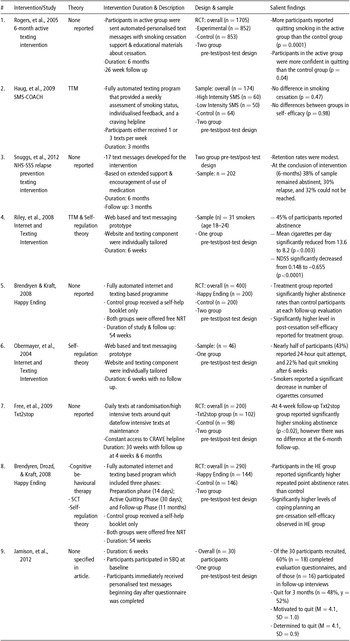
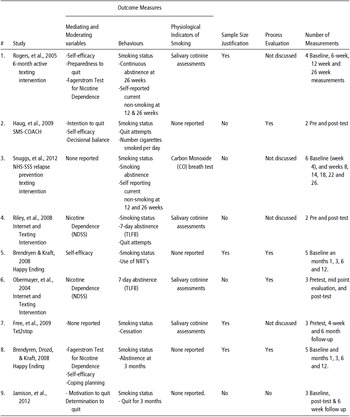
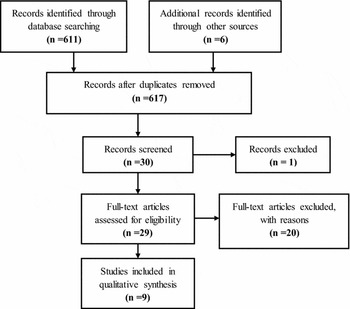
All articles (n = 617) identified by search tools were screened based on title and abstract. The authors of this article then thoroughly read 29-selected article deemed worthy of further investigation. After a full text review 20 articles were excluded due to ineligibility and remaining 9 articles were further reviewed for data collection (See Figure 1). Data included variables of interest, including: theoretical underpinnings of the intervention, intervention duration, intervention description, evaluation design, research sample, salient findings, types of outcome measures evaluated including mediating and moderating behavioural antecedents (such as self-efficacy, attitudes), behaviours (such as smoking or point abstinence), physiological indicators of smoking (such as salivary cotinine), presence of an a priori sample size justification, use of process evaluations, and the number of measurements taken (See Table 1&2). Based on each article's sampling procedures and type of measurements, biases were identified in the data collection phase of review, and bias was analysed through the data synthesis phase. For the purposes of this paper, sampling procedures were considered biased if the sample was not representative and if the results could not be generalised to the community dwelling adult population. Both publication bias and selective reporting within studies were variables that were also identified. In addition to these criteria for bias, the use of invalidated measures was also recognised as a form of bias since the results may have been invalid or unreliable. Two types of measures were identified in the data collection process. The first summary measure was the difference between pre-and post-intervention data, and the second was the group differences of treatment and control or comparison groups. After data collection, the data was synthesised by the authors of the paper. Using Table 1 and Table 2, data was synthesised based on the presence or absence of the key variables under investigation. Variables from each article were reported in the tables, then they were compared and synthesised by the authors of the paper using the tables.
Summary of texting based smoking cessation and relapse prevention interventions

Note: TTM (transtheoretical model); SCT (Social Cognitive Theory)
Important measurement and evaluation issues for texting-based smoking cessation interventions

Note: NDSS (Nicotine Dependence Syndrome Scale); NRT (Nicotine Replacement Therapy)
Article selection process for systematic review

Results
The following paragraphs show the synthesised data based on both Tables. Out of the nine studies reviewed for this article, four incorporated theory into the research design and evaluation plan (Brendryen, Drodz, & Kraft, Reference Brendryen, Drozd and Kraft2008; Obermayer, Riley, Asif, & Jean-Mary, Reference Obermayer, Riley, Asif and Jean-Mary2004; Riley, Obermayer, & Jean-Mary, Reference Riley, Obermayer and Jean-Mary2008; Snuggs, McRobbie, Myers, Schmocker, Goddard, & Hajek, Reference Snuggs, McRobbie, Myers, Schmocker, Goddard and Hajek2012). Two articles use the Transtheoretical Model and concepts of changing intentions, decisional balance, and the stages of change (Riley et al., Reference Riley, Obermayer and Jean-Mary2008; Snuggs et al., Reference Snuggs, McRobbie, Myers, Schmocker, Goddard and Hajek2012). One article mentioned self-regulation theory (Obermayer et al., Reference Obermayer, Riley, Asif and Jean-Mary2004), and another incorporated several theories, such as Social Cognitive Theory and self-regulation theory (Brendryen, Drodz et al., Reference Brendryen, Drozd and Kraft2008).
The duration of the interventions presented in this article also varied from brief (ex. 6-weeks) to long-term (54-weeks). Three of the interventions were brief, lasting only six weeks (Jamison, Sutton, & Gilbert, Reference Jamison, Sutton and Gilbert2012; Obermayer et al., Reference Obermayer, Riley, Asif and Jean-Mary2004; Riley et al., Reference Riley, Obermayer and Jean-Mary2008) and both articles reporting on the Happy Ending intervention spanned over a one-year period (Brendryen, Drodz et al., Reference Brendryen, Drozd and Kraft2008; Brendryen & Kraft, Reference Brendryen and Kraft2008). With regards to length of the interventions, six studies report a follow-up period as part of the intervention (Brendryen, Drodz et al., Reference Brendryen, Drozd and Kraft2008; Brendryen et al., Reference Brendryen, Drozd and Kraft2008; Free, Whittaker, Knight, Abramsky, Rodgers, & Roberts, Reference Free, Whittaker, Knight, Abramsky, Rodgers and Roberts2009, Haug, Meyer, Schorr, Bauer, & John, Reference Haug, Meyer, Schorr, Bauer and John2009; Jamison et al., Reference Jamison, Sutton and Gilbert2012; Rodgers, Corbett, Bramley, Riddell, Wills, Lin, & Jones, Reference Rodgers, Corbett, Bramley, Riddell, Wills, Lin and Jones2005). All interventions involved personalised text messages as a method of communication to support smoking cessation, and four of the interventions had a web-based component that offered educational and abstinence tools (Brendryen, Drozd et al., Reference Brendryen, Drozd and Kraft2008; Brendryen et al., Reference Brendryen, Drozd and Kraft2008; Obermayer et al., Reference Obermayer, Riley, Asif and Jean-Mary2004; Snuggs et al., Reference Snuggs, McRobbie, Myers, Schmocker, Goddard and Hajek2012). Two of the interventions offered a craving hotline via text message, which participants could use as a tool for smoking cessation (Free et al., Reference Free, Whittaker, Knight, Abramsky, Rodgers and Roberts2009; Rodgers et al., Reference Rodgers, Corbett, Bramley, Riddell, Wills, Lin and Jones2005). Therefore, five of the studies were texting-only interventions (Free et al., Reference Free, Whittaker, Knight, Abramsky, Rodgers and Roberts2009; Haug et al., Reference Haug, Meyer, Schorr, Bauer and John2009; Jamison et al., Reference Jamison, Sutton and Gilbert2012; Rodgers et al., Reference Rodgers, Corbett, Bramley, Riddell, Wills, Lin and Jones2005; Snuggs et al., Reference Snuggs, McRobbie, Myers, Schmocker, Goddard and Hajek2012) and four studies used texting as a component of a multi-strategic intervention (Brendryen, Drodz et al., Reference Brendryen, Drozd and Kraft2008; Brendryen et al., Reference Brendryen, Drozd and Kraft2008; Obermayer et al., Reference Obermayer, Riley, Asif and Jean-Mary2004; Riley et al., Reference Riley, Obermayer and Jean-Mary2008).
The next key variable investigated in this study was experimental design. Out of the nine studies, four were randomised controlled trials (RCT) (Brendryen, Drozd et al., Reference Brendryen, Drozd and Kraft2008; Brendryen, & Kraft, Reference Brendryen and Kraft2008; Free et al., Reference Free, Whittaker, Knight, Abramsky, Rodgers and Roberts2009; Rogers et al., Reference Rodgers, Corbett, Bramley, Riddell, Wills, Lin and Jones2005), two studies had a two group pre-test/post-test design (Haug et al., Reference Haug, Meyer, Schorr, Bauer and John2009; Snuggs et al., Reference Snuggs, McRobbie, Myers, Schmocker, Goddard and Hajek2012), and three had a one group pre-test/post-test design (Jamison et al., Reference Jamison, Sutton and Gilbert2012; Obermayer et al., Reference Obermayer, Riley, Asif and Jean-Mary2004; Riley et al., Reference Riley, Obermayer and Jean-Mary2008). Subsequently, sample sizes greatly differed among the studies, ranging from 30 participants in a small one group pre-test/post-test study (Jamison et al., Reference Jamison, Sutton and Gilbert2012) to 1700 participants in a large RCT (Rodgers et al., Reference Rodgers, Corbett, Bramley, Riddell, Wills, Lin and Jones2005), but four of the studies ranged from 174‒290 participants (Brendyren, Drodz et al., Reference Brendryen, Drozd and Kraft2008; Free et al., Reference Free, Whittaker, Knight, Abramsky, Rodgers and Roberts2009; Haug et al., Reference Haug, Meyer, Schorr, Bauer and John2009; Snuggs et al., Reference Snuggs, McRobbie, Myers, Schmocker, Goddard and Hajek2012). All studies using a RCT design contained a sample size justification or power analysis. Four studies reported that their sample came from young adults between ages 18 and 24, and three studies specifically reported the sample coming entirely from a college population (Haug et al., Reference Haug, Meyer, Schorr, Bauer and John2009; Obermayer et al., Reference Obermayer, Riley, Asif and Jean-Mary2004; Riley et al., Reference Riley, Obermayer and Jean-Mary2008). Clearly, most studies had a small sample size of around 200 participants, and most studies sampled from a young population. Other similarities existed between the articles in inclusion criteria. Eight studies wanted participants who smoked regularly, and one study looked for participants who had been abstinent for at least four weeks (Snuggs et al., Reference Snuggs, McRobbie, Myers, Schmocker, Goddard and Hajek2012). Several studies also looked for a desire to quit smoking within the next few weeks (Brendryen, Drodz et al., Reference Brendryen, Drozd and Kraft2008; Brendryen et al., Reference Brendryen, Drozd and Kraft2008; Free et al., Reference Free, Whittaker, Knight, Abramsky, Rodgers and Roberts2009; Obermayer et al., Reference Obermayer, Riley, Asif and Jean-Mary2004; Riley et al., Reference Riley, Obermayer and Jean-Mary2008; Rodgers et al., Reference Rodgers, Corbett, Bramley, Riddell, Wills, Lin and Jones2005).
Some studies demonstrated statistically significant results, whereas others did not. Four articles reported statistically significant improvements for smoking cessation (Brendryen, Drozd et al., Reference Brendryen, Drozd and Kraft2008; Free et al., Reference Free, Whittaker, Knight, Abramsky, Rodgers and Roberts2009; Obermayer et al., Reference Obermayer, Riley, Asif and Jean-Mary2004; Rodgers et al., Reference Rodgers, Corbett, Bramley, Riddell, Wills, Lin and Jones2005). Three additional studies measured and reported significant differences between treatment and control groups for smoking cessation (Brendryen et al., Reference Brendryen, Drozd and Kraft2008; Jamison et al., Reference Jamison, Sutton and Gilbert2012; Riley et al., Reference Riley, Obermayer and Jean-Mary2008). Two studies showed significant reduction in cigarette use (Obermayer et al., Reference Obermayer, Riley, Asif and Jean-Mary2004; Riley et al., Reference Riley, Obermayer and Jean-Mary2008). Three of the articles found significant improvements in post-cessation self-efficacy and confidence (Brendryen, Drozd et al., Reference Brendryen, Drozd and Kraft2008; Brendryen et al., Reference Brendryen, Drozd and Kraft2008; Rodgers et al., Reference Rodgers, Corbett, Bramley, Riddell, Wills, Lin and Jones2005). One study did not find any significant differences in smoking cessation between the treatment and control group (Haug et al., Reference Haug, Meyer, Schorr, Bauer and John2009), and one study simply measured the acceptability of the texting-based approach for smoking cessation (Snuggs et al., Reference Snuggs, McRobbie, Myers, Schmocker, Goddard and Hajek2012).
All but two of the studies measured mediating and moderating variables of behaviour change. Three of these studies measured self-efficacy (Brendryen, Drozd et al., Reference Brendryen, Drozd and Kraft2008; Brendryen et al., Reference Brendryen, Drozd and Kraft2008; Rodgers et al., Reference Rodgers, Corbett, Bramley, Riddell, Wills, Lin and Jones2005), and three studies measured intentions or willingness to quit smoking (Haug, et al., Reference Haug, Meyer, Schorr, Bauer and John2009; Riley, et al., Reference Riley, Obermayer and Jean-Mary2008; Rogers, et al., Reference Rodgers, Corbett, Bramley, Riddell, Wills, Lin and Jones2005). Other moderating variables included nicotine dependence, which was measured in three studies (Brendryen, Drozd et al., Reference Brendryen, Drozd and Kraft2008; Brendryen et al., Reference Brendryen, Drozd and Kraft2008; Snuggs et al., Reference Snuggs, McRobbie, Myers, Schmocker, Goddard and Hajek2012) and self-regulation, which was measured in two studies (Free et al., Reference Free, Whittaker, Knight, Abramsky, Rodgers and Roberts2009; Riley et al., Reference Riley, Obermayer and Jean-Mary2008). In addition to mediating and moderating variables, all nine studies measured smoking cessation as a behavioural variable through quit attempts, abstinence, or cigarette use (Table 2). Finally, with regards to physiological measures of smoking, four studies measured nicotine dependence, of which two used the Fagerstrom Test for Nicotine Dependence (Brendryen, Drozd et al., Reference Brendryen, Drozd and Kraft2008; Rogers et al., Reference Rodgers, Corbett, Bramley, Riddell, Wills, Lin and Jones2005), and two used the Nicotine Dependence Syndrome Scale (Obermayer et al., Reference Obermayer, Riley, Asif and Jean-Mary2004; Riley et al., Reference Riley, Obermayer and Jean-Mary2008). Five studies verified smoking cessation through biochemical means, of which four used the salivary cotinine test (Free et al., Reference Free, Whittaker, Knight, Abramsky, Rodgers and Roberts2009; Obermayer et al., Reference Obermayer, Riley, Asif and Jean-Mary2004; Riley et al., Reference Riley, Obermayer and Jean-Mary2008; Rogers et al., Reference Rodgers, Corbett, Bramley, Riddell, Wills, Lin and Jones2005) and one used the Carbon Monoxide (CO) breath test (Snuggs et al., Reference Snuggs, McRobbie, Myers, Schmocker, Goddard and Hajek2012).
The final variables from Table 2 are process evaluation, number of measurements, and validated measures. No studies reported the use of a process evaluation. A number of measurements was defined as having a pre-test, post-test, or follow up evaluation. Out of the studies in consideration, six interventions had both pre-test and post-test measurements (Brendryen, Drodz et al., Reference Brendryen, Drozd and Kraft2008; Brendryen et al., Reference Brendryen, Drozd and Kraft2008; Haug et al., Reference Haug, Meyer, Schorr, Bauer and John2009; Obermayer et al., Reference Obermayer, Riley, Asif and Jean-Mary2004; Riley et al., Reference Riley, Obermayer and Jean-Mary2008; Rodgers et al., Reference Rodgers, Corbett, Bramley, Riddell, Wills, Lin and Jones2005), and three studies were post-test only (Free et al., Reference Free, Whittaker, Knight, Abramsky, Rodgers and Roberts2009; Jamison et al., Reference Jamison, Sutton and Gilbert2012; Snuggs et al., Reference Snuggs, McRobbie, Myers, Schmocker, Goddard and Hajek2012). Five of the studies reported follow up measures after the intervention was complete (Brendryen, Drodz et al., Reference Brendryen, Drozd and Kraft2008; Brendryen et al., Reference Brendryen, Drozd and Kraft2008; Jamison et al., Reference Jamison, Sutton and Gilbert2012; Rodgers et al., Reference Rodgers, Corbett, Bramley, Riddell, Wills, Lin and Jones2005; Snuggs et al., Reference Snuggs, McRobbie, Myers, Schmocker, Goddard and Hajek2012). Finally, only one article discussed the validity of the measures used (Obermayer et al., Reference Obermayer, Riley, Asif and Jean-Mary2004), which may indicate a major limitation in most studies. All studies did not sample randomly, and most studies did not report the use of validated measures. Therefore, based on the criteria for bias in the data collection phase, all studies have been categorised as biased in some way due to the sampling procedures and choice of measures.
Discussion
The purpose of this study was to conduct a systematic review of text-based interventions for smoking cessation and relapse prevention. All of the studies included in this review reported that texting appeared to be an effective method for promoting smoking cessation and preventing relapse. Texting was also well received by study participants. Satisfaction of the intervention was formally evaluated in six of the studies (Brendyren, Drozd et al., Reference Brendryen, Drozd and Kraft2008; Brendryen et al., Reference Brendryen, Drozd and Kraft2008; Haug et al., Reference Haug, Meyer, Schorr, Bauer and John2009; Obermayer et al., Reference Obermayer, Riley, Asif and Jean-Mary2004; Riley et al., Reference Riley, Obermayer and Jean-Mary2008; Snuggs et al., Reference Snuggs, McRobbie, Myers, Schmocker, Goddard and Hajek2012), and overwhelmingly, participants reported the texting approach to be helpful and an enjoyable type of intervention. Smoking cessation interventions that use texting was found to be effective in supporting participants to quit smoking (Obermayer et al., Reference Obermayer, Riley, Asif and Jean-Mary2004; Rodgers et al., Reference Rodgers, Corbett, Bramley, Riddell, Wills, Lin and Jones2005), and overall reducing the average number of cigarettes smoked per day (Riley et al., Reference Riley, Obermayer and Jean-Mary2008). Texting as a smoking cessation intervention tool was also found to be effective in increasing self-efficacy (Brendryen, Drozd et al., Reference Brendryen, Drozd and Kraft2008; Brendryen et al., Reference Brendryen, Drozd and Kraft2008; Haug et al., Reference Haug, Meyer, Schorr, Bauer and John2009; Rodgers et al., Reference Rodgers, Corbett, Bramley, Riddell, Wills, Lin and Jones2005). A text-based approach could provide effective psychological support that can be implemented in an economic fashion. Texting is increasing in popularity among young adults, and smoking cessation interventions can be more effective if texting is integrated in interventions for this group in the future. A recent ‘review of reviews’ approach was used to identify and rank the most promising behavioural and policy strategies (Valery et al., Reference Valery, Anke, Inge and Johannes2008). Among behavioural strategies, authors reported the following behavioural treatments, which were most effective at promoting smoking cessation (listed in order of effectiveness): group behavioural therapy (odds ratio (OR) 2.17, confidence interval (CI) 1.37–3.45); bupropion (OR: 2.06, CI: 1.77–2.40); intensive physician advise (OR: 2.04, CI: 1.71–2.43); nicotine replacement therapy (NRT) (OR: 1.77, CI: 1.66–1.88); individual counselling (OR: 1.56, CI: 1.32–1.84); telephone counselling (OR: 1.56, CI: 1.32–1.84), nursing intervention (OR: 1.47, CI: 1.29–1.67), and tailored self-help interventions (OR: 1.42, CI: 1.26–1.61) (Valery et al., Reference Valery, Anke, Inge and Johannes2008). From this list, it is clear that texting could be used as an independent intervention strategy, such as telephone counselling, or could also be used in concurrence with existing strategies, such as a way individuals receive additional feedback as part of group behaviour therapy.
In addition to reviewing effectiveness of text-based interventions for smoking cessation and relapse prevention, another purpose of this review was to suggest recommendations for future researchers in terms of current deficiencies in programme design and evaluation. The experimental design of the studies reviewed in this article greatly varied. Four articles used RCTs, two articles used a two-group/pretest-posttest design without randomisation, and three articles used a one-group design. It is clear more RCTs are needed due to the fact that they are generally considered the golden standard for programme evaluation, and a larger number of RCTs could lead to performing a meta-analysis for this approach. The samples for the studies in this review also varied, but mostly consisted of a young adult population. Three studies used a college population (Haug et al., Reference Haug, Meyer, Schorr, Bauer and John2009; Obermayer et al., Reference Obermayer, Riley, Asif and Jean-Mary2004; Riley et al., Reference Riley, Obermayer and Jean-Mary2008). This is not to suggest that the results from these studies were biased, but readers should be aware that results from these studies may only be generalised to a college population, and not a general sample of community dwelling adults. Future researchers should consider evaluating this approach with a middle-aged sample of adults, as texting is becoming popular among this population. Another finding showed a majority of the interventions under review in this article were implemented in an international setting, including one in New Zealand (Rogers et al., Reference Rodgers, Corbett, Bramley, Riddell, Wills, Lin and Jones2005), one in Germany (Haug et al., Reference Haug, Meyer, Schorr, Bauer and John2009), two in the United Kingdom (Free et al., Reference Free, Whittaker, Knight, Abramsky, Rodgers and Roberts2009; Snuggs et al., Reference Snuggs, McRobbie, Myers, Schmocker, Goddard and Hajek2012), and two in Norway (Brendyren, Drozd et al., Reference Brendryen, Drozd and Kraft2008; Brendryen et al., Reference Brendryen, Drozd and Kraft2008). Many of the studies included in this systematic review did not include appropriate justification for sample size or a power analysis. Future researchers should provide appropriate justification for sample size as it determines the appropriate number of individuals needed to recruit.
Results from this review indicate that behavioural theories are currently underutilised in texting-based interventions for smoking cessation and relapse prevention. Only four studies reported using theories, and the Transtheoretical Model (TTM) was the most frequently used theory (Table 1). This comes as no surprise, since the TTM was developed from a review of theories of psychotherapy and studies on individuals who successfully quit smoking (Prochaska, Redding, & Evers, Reference Prochaska, Redding and Evers2008). Another review of literature cited the TTM as useful theory for smoking cessation (Spencer, Pagell, Hallion, & Adams, Reference Spencer, Pagell, Hallion and Adams2002). Nevertheless, researchers should report what theories they are operationalising in the interventions under investigation, given the inherent benefits theory-based approaches have. For example, programme developers can utilise theory in every phase of programme planning, implementation and evaluation. For planning interventions, theories have behavioural antecedents that practitioners and researchers can use as a framework for which the behaviour change process can be mediated and/or moderated. Through these behavioural antecedents, intervention activities and behaviour change techniques can be identified and used in an intervention approach. Finally, through the behavioural antecedents identified in theories, researchers can easily identify what the important moderating and mediating variables are that should be evaluated. Future practitioners and researchers should use health behaviour theories and models as they could suggest effective frameworks for smoking cessation and relapse prevention interventions, which can accumulate evidence pertaining to what theories and models are most or least effective.
Other than reporting participant satisfaction, half of the studies reported using some or other types of process evaluation (Brendyren, Drozd et al., Reference Brendryen, Drozd and Kraft2008; Brendryen et al., Reference Brendryen, Drozd and Kraft2008; Haug et al., Reference Haug, Meyer, Schorr, Bauer and John2009; Obermayer et al., Reference Obermayer, Riley, Asif and Jean-Mary2004). Process evaluations are an important component to any evaluation plan of a public health initiative. Process evaluations have been defined as methods that describe what occurs during the implementation of a health programme (Sharma & Petosa, Reference Sharma and Petosa2012). Elements of a comprehensive process evaluation typically include implementation fidelity, programme reach, quality control, programme management and the satisfaction of the target audience. For texting-based interventions, important process evaluations to assess should be whether the intended audience received, read and understood the text messages, as well as to what extent was the audience was satisfied with the intervention. Many interventions also had an internet-based component. Process evaluations to measure for this component should be whether the intended audience logged into the website periodically, the amount of time users spend logged in, and whether they accessed important pages on the website, such as smoking logs. Comprehensive process evaluations will instill greater assurance that the results are trustworthy and can be attributable to the activities in the intervention. Also, future studies can combine various social networks with texting to see if this will help to increase effectiveness of texting for smoking cessation and relapse prevention. Future research can also assess cost effectiveness of using text based intervention is compare to other form of smoking cessation intervention. This will help health practitioners to make decision in integrating texting as part of intervention.
Limitations specific to the studies of this systematic review include inadequate description of theory used, process evaluation, and sampling techniques. Due to the lack of evidence, this review was not able to explore if texting was effective on populations who were not already motivated to quit smoking. Future research can target set of smokers who do not intend for smoking cessation and assess if texting is effective for this population set. Also, most of the interventions integrated texting with other forms of smoking cessation programmes; therefore it is difficult to assess the effectiveness of a texting-only approach. For future studies, research can be conducted to determine the effectiveness of texting alone compared to combine approaches such as texting in combination with a web based programme, face to face counselling, phone counselling, and nicotine replacement therapies.
Means of communication for young adults and teens has changed drastically. As technologies are integrated in daily life, these new forms of communication methods can be added in delivering health related information. In addition to texting, other electronic aids (email, internet, social networks) can be integrated into interventions. Also, the current 1–800-QUIT-NOW (1–800–784–8669) hot lines made available from all state governments could be the best platforms to integrate these text based interventions to deliver necessary support. Evidence from the current study highlights factors like sample size, importance of theory and process evaluation, and significance of interactive and tailored text based messages. These factors may be applicable for future researchers who plan to integrate texting for smoking cessation interventions. Overall, texting can be a promising and innovative medium to deliver smoking cessation programmes. Texting can also be an efficacious form of intervention, which could be beneficial in delivering other health related interventions.
Acknowledgments
None
Financial Support
This research received no specific grant from any funding agency, commercial or not-for-profit sectors.
Conflict of Interest
None
Ethical Standards
The authors assert that all procedures contributing to this work comply with the ethical standards of the relevant national and institutional committees on human experimentation and with the Helsinki Declaration of 1975, as revised in 2008. The authors assert that all procedures contributing to this work comply with the ethical standards of the relevant national and institutional guides on the care and use of laboratory animals.