Introduction
Family members providing care for a dependent older person do so at high personal costs, as caregiving often leads to declined physical and mental health in the caregiver (National Aliance for Caregiving and AARP, 2009; Collins and Swartz, Reference Collins and Swartz2011). It is estimated that over one-third of caregivers show clinically significant symptoms of depression (Schreiner et al., Reference Schreiner, Morimoto, Arai and Zarit2006; Schoenmakers et al., Reference Schoenmakers, Buntinx and Delepeleire2010a), and these rates are even higher for caregivers caring for a care recipient with dementia, schizophrenia, or a bipolar disorder (Schulz and Martire, Reference Schulz and Martire2004; Perlick et al., Reference Perlick2007; Mohamed et al., Reference Mohamed, Rosenheck, Lyketsos and Schneider2010). Care recipients’ behavior problems, their cognitive impairment, and being in a spousal relationship increase the risk for depression in the caregiver (Schulz and Sherwood, Reference Schulz and Sherwood2008). In the face of the demographic change that will lead to at least a worldwide doubling of the number of older people (60+) from 2000 to 2050 (Crimmins and Beltrán-Sánchez, Reference Crimmins and Beltrán-Sánchez2011), the number of family caregivers is expected to increase as well. Thus, interventions that effectively alleviate depressive symptoms of family caregivers of an elderly person with a mental disorder are needed.
A wide spectrum of support services and interventions is available to caregivers of the dependent elderly, ranging from respite (e.g. a nursing service) to case management to psychosocial interventions like psycho-education, support groups, or psychotherapy. The most comprehensive previous meta-analysis investigated the effects of these interventions for caregivers of dementia patients in randomized controlled trials (RCTs) and non-randomized controlled trials and found only small effects on the alleviation of depressive symptoms (Pinquart and Sörensen, Reference Pinquart and Sörensen2006). Studies focusing on the efficacy of interventions for caregivers caring for an elderly relative with mental disorders other than dementia have previously been lacking (Schulz et al., Reference Schulz, Martire and Klinger2005). This is a research gap that needs to be filled as the care recipients' illness is an important factor to consider when designing interventions (Magliano et al., Reference Magliano1998; Sörensen et al., Reference Sörensen, Pinquart and Duberstein2002). Additionally, acceptance of caregiver interventions has rarely been studied.
The purpose of our meta-analysis on caregiver interventions was to investigate if these rather disappointing results are still valid or if effects of studies in the last ten years did improved and if there are now studies available that focus on caregiver interventions for persons with another mental illness than dementia. For that purpose, we extended the two previous reviews (Schulz et al., Reference Schulz, Martire and Klinger2005; Pinquart and Sörensen, Reference Pinquart and Sörensen2006). We focused exclusively on RCTs involving interventions for caregivers of elderly patients with a mental disorder published since 2005 and assessed their efficacy for alleviating depression in caregivers. We further extended the previous reviews by assessing study refusal and early intervention discontinuation rates as indicators of the acceptance of the interventions to the caregivers. Additionally, since results of previous reviews have been inconclusive concerning the influence of intervention characteristics on the efficacy in alleviating depressive symptoms (Sörensen et al., Reference Sörensen, Pinquart and Duberstein2002; Pinquart and Sörensen, Reference Pinquart and Sörensen2006; Selwood et al., Reference Selwood, Johnston, Katona, Lyketsos and Livingston2007; Goy et al., Reference Goy, Kansagara and Freeman2010; Schoenmakers et al., Reference Schoenmakers, Buntinx and DeLepeleire2010b; Van't Leven et al., Reference Van't Leven, Prick, Groenewoud, Roelofs, de Lange and Pot2013), we also analyzed the target of the intervention and delivery characteristics as potential moderators of the efficacy and acceptance using a comprehensive categorization system described below.
These analyses might yield important implications for future design of support interventions, because surveys have shown that few family caregivers of the dependent elderly make use of existing support services (Brodaty et al., Reference Brodaty, Thomson, Thompson and Fine2005; National Aliance for Caregiving and AARP, 2009; Di Rosa et al., Reference Di Rosa2011) and efficacy of interventions is at best small.
In our meta-analysis, the following research questions were investigated:
-
1. Which interventions for caregivers of elderly care recipients with dementia or another mental disorder were examined in RCTs in the last decade?
-
2. How well were the interventions accepted by family caregivers? Were intervention characteristics associated with the acceptance?
-
3. What was the efficacy of these interventions with respect to alleviating depressive symptoms? Were intervention characteristics associated with efficacy?
Methods
This meta-analysis was conducted according to the recommendations by the Cochrane Collaboration (Higgins and Green, Reference Higgins and Green2011).
Literature search and inclusion criteria
We searched electronic databases (Medline, EMBASE, Central, PsycINFO, PSYNDEX) in February 2014, and updated the search in July 2014. Our search strategies were highly sensitive (low precision) and based on synonyms, related words, and key words for four search terms: “support service” and “caregiver” and “RCT” and “depression.” Search strategies were specific for each database (see Data, Supplemental Material 1). Two researchers (AW; AK) independently scanned all retrieved abstracts on the basis of an inclusion protocol (see Data, Supplemental Material 2). Criteria for inclusion of a study in this meta-analysis were:
-
1. The study was published in a peer-reviewed journal between January 2005 and July 2014 (extension of two reviews including studies published prior to 2005), in English or German.
-
2. The study examined an intervention for family caregivers of dependent elderly care recipients (mean or median age > 60 years) with dementia or another mental disorder and living at home (no nursing home or weeklong day care).
-
3. The intervention was designed to support caregivers by reducing caregiving tasks or by offering psychosocial support.
-
4. The study design was an RCT.
-
5. The RCT included a control group, such as treatment as usual, information only, minimal support, attention control, or being on a waiting-list.
-
6. The minimum sample size per group had to be n = 30. We excluded studies with smaller sample sizes because of high risk of biases due to lack of statistical power and baseline group differences.
-
7. A measure of depressive symptom severity in the family caregiver (either by self-report or interviewer rating) had to be available at both baseline and post-intervention assessments.
-
8. The reported statistical parameters could be converted into effect sizes (means, F, or t values, correlations, regression coefficients). If an article did not provide sufficient information to compute an effect size for a depression outcome, corresponding authors were contacted and the study was included when the necessary information was made available.
In a second step, full text articles were retrieved for all potentially eligible abstracts and reviewed. Additionally, the ancestry method (examining the reference lists of the articles obtained) was used and recommendations of experts were considered. Disagreements between raters were resolved by consensus. For a list of selected excluded studies, see Data, Supplemental Material 3.
Data collection
Two researchers (AW; MB) extracted the data separately according to an extraction protocol (available upon request). Inconsistencies between the raters were resolved by discussion. A third researcher (AK) rated half of the included studies (selected by chance) afterwards. The average observed interrater agreement for the intervention characteristics was Cohen's κ = 0.74.
Population, study, and intervention characteristics
Extracted population characteristics include caregiver age, gender (% female), type of relationship with care recipient (% spouses), and baseline depression scores. Study characteristics include year of publication and country, sample size, type of control group, length of intervention (in weeks), as well as depression outcome measures.
We characterized interventions by modifying a system proposed by Czaja and colleagues (Reference Czaja, Schulz, Lee and Belle2003) along two dimensions: (1) the primary functional domain and (2) delivery system characteristics. The functional domain refers to the primary target of the intervention and lists four domains: (1) knowledge (provision of knowledge, e.g. counseling, psycho-education, care management), (2) skills (training caregiver's competence, e.g. problem solving, skills training, or cognitive-behavioral therapy), (3) affect (emotional support), and (4) practical support (reducing caregiver tasks). Delivery characteristics included: (i) dosage (hours that caregiver spent doing the intervention), (ii) setting (0 = individual setting; 1 = group setting included), (iii) medium (0 = delivered face-to-face; 1 = delivered via telecommunication), (iv) activation of the caregiver (0 = no; 1 = yes, e.g. actively practicing skills, engaging in pleasant activities), and (v) customization. Customization was rated as not customized (0), semi-customized (1 = detailed personal advice to individual problems), or customized (2 = different intervention components are offered depending on the individual needs).
Acceptance of interventions
We assessed three indicators of acceptance:
-
1. Study refusal (percentage of caregivers who were approached for study participation and declined). Even though non-participation in an RCT may have a number of reasons (e.g. the assessments could be perceived as too burdensome for care recipient and caregiver), our rationale was that participation/refusal rates could potentially be different for different kinds of interventions and are thus informative about which interventions are more accepted by caregivers.
-
2. Intervention discontinuation (percentage of caregivers from an intervention arm who had started an intervention and discontinued the intervention before the scheduled end). Discontinuation due to health problems of the care recipient, death, or nursing home placement was not counted.
-
3. Study withdrawal (percentage of participants who did not complete the post-intervention assessment). Study withdrawal was compared between intervention and control groups.
Study quality
To assess the risk of bias for each computed effect size, we rated each study on six criteria referring to the recommendations by the Cochrane Collaboration (Higgins and Green, Reference Higgins and Green2011): (1) sequence generation (selection bias), (2) allocation concealment (selection bias), (3) blinding of outcome assessment (detection bias), (4) completeness of outcome data (attrition bias), (5) selective outcome reporting (reporting bias), and (6) baseline imbalance. For each study, all six criteria were categorized as being of low (=0), medium (=1), or high risk (=2) of bias. We computed the total risk of bias rating per study based on the sum of all ratings (sum score of 0–2 = low, 3–4 = medium, >4 = high risk of bias). If significant baseline differences in depressive symptoms were present, the study was rated as being of high risk of bias.
Data integration and analysis
All analyses were conducted using R version 3.0.3 (The R Core Team, 2014), and an alpha level of 0.05 was applied. Meta-analysis and meta-regression were performed with the metaphor package (Viechtbauer, Reference Viechtbauer2010).
Intervention acceptance rates
To test if participation refusal rates and intervention discontinuation rates differed between different primary functional domains of the intervention (three levels: knowledge, skills, affect), univariate analyses of variance were conducted. As we did not identify a study with practical support as the primary functional domain, practical support was not considered as a factor level in this and further analyses. To test if the discontinuation rates were associated with delivery characteristics, Pearson correlations were computed for dichotomous and metric variables. A polyserial correlation was computed for the ordinal scaled variable customization.
Efficacy of the interventions
We computed the weighted overall pooled effect of all interventions. A random-effects model was applied, which is conceptually appropriate when it is assumed that the included studies are a random selection of the entire population of studies fulfilling the inclusion criteria (Viechtbauer, Reference Viechtbauer2010). This allowed for inferences about the average effect in the population of all studies.
To measure the effect of each intervention on depression scores, we computed standardized mean differences (SMD) for each study. SMD represents the difference in the post-intervention measure between the intervention and control conditions divided by the pooled standard deviation at post-intervention (Higgins and Green, Reference Higgins and Green2011). These effect size measures were assessed for post-intervention scores (direct intervention effect) and follow-up scores (long-term effect; if multiple follow-up assessments were provided, the assessment point closest to one-year post-intervention was chosen).
We analyzed the data of the completers, because most of the included studies exclusively reported these data. In four cases (Belle et al., Reference Belle2006; Callahan et al., Reference Callahan2006; Graff et al., Reference Graff, Vernooij-Dassen, Thijssen, Dekker, Hoefnagels and Olderikkert2007; Logsdon et al., Reference Logsdon2011), exclusively intention-to-treat analyses (ITT) were available. If data were provided, the effect sizes were adjusted for bias due to baseline differences on relevant variables between intervention and control condition (Higgins and Green, Reference Higgins and Green2011). If desired scores were not provided, we contacted the authors. In three cases (Fortinsky et al., Reference Fortinsky, Kulldorff, Kleppinger and Kenyon-Pesce2009; Gallagher-Thompson et al., Reference Gallagher-Thompson2010; Chu et al., Reference Chu2011), the SMD was computed based on a regression coefficient (Lipsey and Wilson, Reference Lipsey and Wilson2001).
To assess heterogeneity, the I2 statistic was used, expressing the percentage of total variability in the effect sizes that is due to heterogeneity among the true effects (Higgins and Thompson, Reference Higgins and Thompson2002).
Explaining heterogeneity
To test if the efficacy of the intervention differed between the primary functional domain (three levels: knowledge, skills, affect), a univariate analysis of variance was conducted. For possible moderators (dosage, setting, medium, customization, activation), a mixed-effects model for meta-regression was applied.
Sensitivity analysis and reporting bias
All analyses were repeated, excluding studies of high risk of bias. Influential studies were identified using DFFITS (values above 0.5 and under −0.5 were determined as influential). Reporting bias was visualized in funnel plots and evaluated with the regression test for funnel plot asymmetry.
Results
Population and intervention characteristics
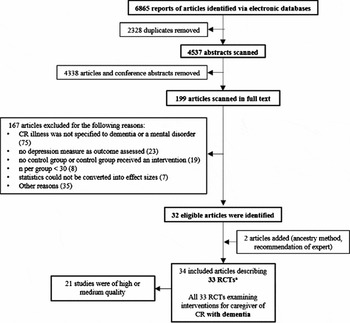
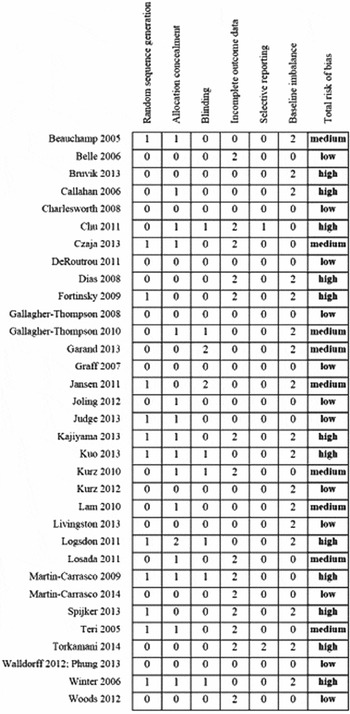
We identified 33 studies, which were included in this meta-analysis (see Figure 1). Twelve studies were categorized as being of high risk of bias, 12 as being of low risk of bias (see Figure 2). High risk of bias was mostly caused by baseline imbalance. The sensitivity analysis (see below) indicated a low validity threat caused by the quality of the studies. Thus, all studies were included in this meta-analysis.
Flowchart of search results. aFor one RCT two papers were identified and treated as one article. CR = care recipient.

Risk of bias summary. Review authors’ judgments about each risk of bias criteria for each included study. 0 indicates low risk, 2 indicates high risk, and 1 indicates unclear risk of bias.

Depressive symptoms were the primary outcome in 15 studies, the secondary outcome in ten studies. Eight studies assessed depressive symptoms as one of several outcomes, but did not a priori select a primary outcome. In approximately half of the studies (n = 17), depressive symptoms were assessed with different forms of the Center for Epidemiologic Studies – Depression Scale (Radloff, Reference Radloff1977). Three studies each used the Geriatric Depression Scale (Sheikh and Yesavage, Reference Sheikh and Yesavage1986) or the depression scale of the Hospital Anxiety and Depression Scale (Flint and Rifat, Reference Flint and Rifat1996), and the remaining studies (n = 10) used other measures.
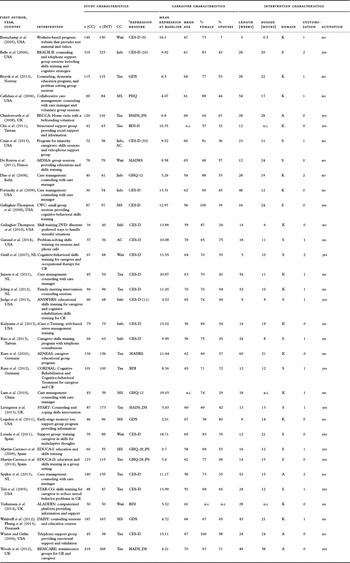
All 33 RCTs (see Table 1) investigated the efficacy of interventions for family caregivers of the elderly with dementia. Included interventions offered care management or psychosocial support, and none offered practical support. None of the identified RCTs was designed to test support interventions for caregivers of persons with another mental disorder than dementia.
Study, caregiver, and intervention characteristics of included studies

Notes: CC = control condition. INT = intervention condition. Domain = functional domain. Wait = waitlist. Tau = treatment as usual. Info = information only. MS = minimal support. Med. = medium. AC = attention control. n.i. = no information provided. CR = care recipient. BDI(-II) = Beck Depression Inventory(-II). CES-D = Center of Epidemiologic Studies Depression Scale. GDS = Geriatric Depression Scale. GHQ-12 = General Health Questionnaire 12. GHQ-28_PS = General Health Questionnaire 28 – Severe Depression Subscale. HADS_DS = Hospital Anxiety and Depression Scale – Depression Subscale. MADRS = Montgomery Asberg Depression Rating Scale. PHQ = Patient Health Questionnaire. K = Knowledge, S = Skills, A = Affect. NL = the Netherlands. REACH = Resources for Enhancing Alzheimer's Caregiver Health. BECCA = befriending and costs of caring. AIDMA = Aide dans la Maladie d´Alzheimer. CWC = Coping with Caregiving. ANSWERS = Aquiring New Skills While Enhancing Remaining Strengths. AENEAS = A European Network for the Evaluation of Alzheimer Supportgroups. CORDIAL = Cognitive Rehabilitation and Cognitive-behavioral Treatment for Early Dementia in Alzheimer Disease. START = STrAtegies for RelaTives. ALADDIN = A technology pLatform for the Assisted living of Dementia elDerly INdividuals and their carers. DAISY = Danish Alzheimer Intervention Study. REMCARE = REMiniscence groups for people with dementia and their family CAREgivers.
a for CES-D: if number of items deviates from 20, number of items shown in parenthesis.
Table 1 displays the study, population, and intervention characteristics. Five thousand nine hundred and eighty caregivers were included in this meta-analysis. Mean age of caregivers was 61.88 years (SD = 5.77, n = 31), the mean age of their care recipient was 77.83 years (SD =2.57, n = 31). Three-quarters of the caregivers were females (74.64%, SD = 10.34, n = 32) and half of them (50.23%, SD = 18.38, n = 32) were spouses. Twenty of the 33 studies provided a definition of being a caregiver by determining the minimum of hours caring per week that ranged between 0.25 and 28 hours (M = 9.81, SD = 10.95). The average number of participants randomized to the intervention condition was 97 (range = [30; 323]). The average number of participants randomized to the control condition was 89 (range = [30; 319]).
Most of the 33 interventions primarily targeted the functional domain of knowledge (n = 15) or skills (n = 14). Four interventions targeted mainly affect. The shortest program lasted five weeks, the longest 60 weeks (M = 25.67, SD = 16.45). Participants spent between 0.5 to 38 hours (M = 15.88, SD = 7.56, n = 30) utilizing the intervention. Almost half of the interventions included a group setting (n = 15), and most of them were delivered primarily face-to-face (n = 26). The majority of the identified support programs for caregivers was semi-customized (n = 15), four were completely customized, and 14 were not customized at all. Activation of the caregiver occurred, for example, by actively practicing skills, being physically active or performing pleasant activities in 13 of the 33 studies. Twelve studies offered follow-up assessments, on average seven months post-intervention (range = [1; 24]). The control groups were mainly treatment as usual (n = 13) or information only (n = 7) procedures. Most studies were conducted in the USA (n = 13) or in Europe (n = 16). Four studies were conducted in Asia.
Acceptance
Twenty-three RCTs (n = 23) provided information on study refusers. On average, one-third of eligible caregivers declined participation in the RCT upon offer (M = 30.06 %, SD = 21.51). This refusal rate was especially high in the 14 studies in which potentially eligible caregivers were identified via screening medical files (e.g. of hospitals) and subsequently approached (M = 40.49 %, SD = 21.92). The refusal rate did not significantly differ between trials with different primary functional domains of the interventions, F(2, 20) = 0.70, p = 0.51.
On average, 19.69% of the caregivers withdrew from the RCTs at some point before the final assessment (SD = 11.57). An unpaired t test revealed, that this did not differ significantly between the intervention and control condition, t(59) = −0.05, p = 0.96.
In 24 trials (n = 24), intervention discontinuation rates were reported. On average, 10.57% participants discontinued the intervention early (SD = 6.3). This did not significantly differ between trials with different primary functional domains of the interventions (F(2, 21) = 0.31, p = 0.73). Discontinuation rates tended to be higher for interventions that were delivered via telecommunication (r = −0.39, p = 0.07) compared to face-to-face interventions. All other intervention characteristics (dosage, setting, customization, activation) showed no significant association with the discontinuation rates (all p < 0.41).
Improvement in depressive symptoms
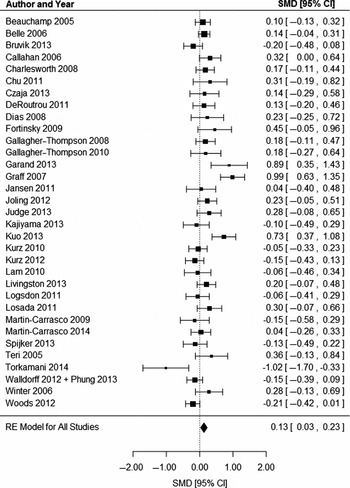
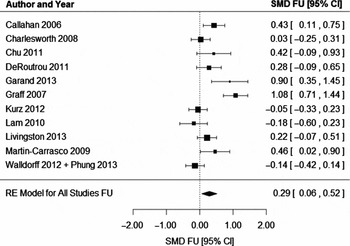
The identified support programs (n = 33) showed small positive effects on the depressive symptoms of caregivers with an overall post-intervention effect of SMD = 0.13 (CI0.95 [0.03; 0.23], p = 0.01). Eleven studies (n = 11) assessed depressive symptoms in a longer term follow-up after the immediate post-treatment assessment. The overall follow-up effect in these studies was SMD = 0.29 (CI0.95 [0.06; 0.52], p = 0.01). There was notable heterogeneity in the immediate post-intervention (I2 = 64.53, CI0.95 [51.05; 84.24]) and follow-up effect sizes (I2 = 78.29, CI0.95 [57.27; 93.71]). Consequently, it is likely that moderators influenced the effect sizes. Forest plots of the immediate post-intervention and longer term follow-up effect sizes are displayed in Figures 3 and 4.
Forest plots of standardized mean differences in depressive symptoms between intervention and control condition at immediate post-intervention assessment. SMD = standardized mean difference. RE = random effects.

Forest plots of standardized mean differences in depressive symptoms between intervention and control condition at longer-term follow-up (FU) assessment (1–24 months post-intervention). SMD = standardized mean difference. RE = random effects.

Influence of interventions characteristics
We decided to exclude studies being of high risk of bias to reduce variability caused by study quality, leaving 21 studies (n = 21) with post-intervention effect sizes. Concerning the influence of the primary functional domain on post-intervention scores, we found a mean depression score of SMD = −0.02 for studies targeting primarily affect (n = 2), of SMD = 0.04 for studies targeting primarily knowledge (n = 7), and of SMD = 0.29 for studies targeting primarily skills (n = 12), F(2, 18) = 2.34, p = 0.12.
No population characteristic (type of relationship with the care recipient, caregiver gender, caregiver age) was correlated with the effect of the interventions (all p > 0.37). Concerning the interventions’ characteristics, effect sizes were unrelated to the medium of delivery (r = 0.06, p = 0.82), activation (r = 0.11, p = 0.64), the intervention dosage (r = −0.36, p = 0.12) and whether a group setting was included (r = −0.34, p = 0.13). Customization was significantly correlated with the effect sizes (r = 0.44, p = 0.04).
This finding was replicated in the meta-regression (b = 0.15, p = 0.08; I2 = 60.20, CI0.95 [32.48; 84.08]). Customization explained 6.22% of the variance in the effect sizes.
Sensitivity analysis and reporting bias
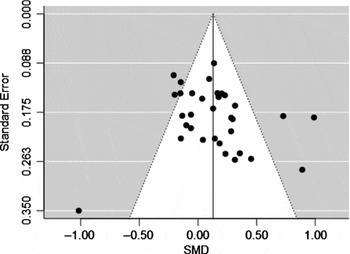
When the meta-analysis was repeated with either studies of high risk of bias excluded (n = 21) or with studies of high and medium risk of bias excluded (n = 12), comparable results were obtained. One study (Graff et al., Reference Graff, Vernooij-Dassen, Thijssen, Dekker, Hoefnagels and Olderikkert2007) was identified as being influential for both models. When performing the meta-analyses without this study (n = 32 for immediate post-intervention and n = 10 for follow-up effect sizes), the results were still comparable for the post-intervention effect size. The overall follow-up effect was reduced to 0.19 (CI0.95 [0.01; 0.37], p = 0.03). The funnel plot for the meta-analysis for post-intervention scores can be seen in Figure 5. The regression test for funnel plot asymmetry was neither significant for post-intervention scores (p = 0.86) nor follow-up effect sizes (p = 0.39), indicating no reporting bias.
Funnel plot for the random-effects model for post-intervention effect sizes. SMD = standardized mean difference.

When repeating the meta-regression with exclusively including studies of low risk of bias, comparable results were obtained (n = 12). The studies by Graff et al. (Reference Graff, Vernooij-Dassen, Thijssen, Dekker, Hoefnagels and Olderikkert2007) and by Belle et al. (Reference Belle2006) were identified as being influential. When excluding these studies from the meta-regression (n = 19), customization had no significant influence on the post-intervention effect sizes (β = 0.05, p = 0.30; I2 = 41.68, CI0.95 [0.00; 77.68]).
Discussion
This meta-analysis is an extension of a prior meta-analysis (Pinquart and Sörensen, Reference Pinquart and Sörensen2006) on the efficacy of interventions for caregivers of elderly care recipients with dementia in alleviating depressive symptoms and yielded positive, albeit small effects. It expands previous findings by showing good acceptance of interventions and examining the influence of intervention characteristics on efficacy and caregiver acceptance based on a comprehensive taxonomy system. Results indicate that more customized approaches lead to higher efficacy. Including face-to-face components as well as skills training may lead to better outcomes and acceptance respectively, but more research is needed. Moreover, we wanted to include interventions for caregivers of care recipients with other mental disorders than dementia, but no single RCT for this group could be identified. This lack of empirical investigation was already described ten years ago (Schulz et al., Reference Schulz, Martire and Klinger2005) and should be targeted in future research.
The included 33 RCTs focusing on dementia comprised a wide spectrum of interventions targeting caregiver knowledge, skills and/or affect. Interestingly, none of the 33 studies examined the effect of practical support, like respite services. Thus, to the best of our knowledge, since 2004, no RCT has been published that examined the efficacy of respite as an intervention to alleviate caregiver depression.
Acceptance
One-third of eligible carers refused study participation. This is not exceptionally high for participation in an RCT, and survey data suggests that actual use of support services is even lower in non-research settings (Brodaty et al., Reference Brodaty, Thomson, Thompson and Fine2005; National Aliance for Caregiving and AARP, 2009; Di Rosa et al., Reference Di Rosa2011). Importantly, there was no association between study participation refusal rates and type of intervention (functional domain). Intervention discontinuation rates among study participants were low indicating high acceptance once an intervention was initiated, and this was independent of intervention type, setting, customization, and dosage. However, at trend level, caregivers were more likely to discontinue an intervention if it was delivered via telecommunication. Future research should investigate if acceptance can be improved by including face-to-face components.
Improvement in depressive symptoms
Comparable to other meta-analyses (e.g. Pinquart and Sörensen, Reference Pinquart and Sörensen2006; Jensen et al., Reference Jensen, Agbata, Canavan and McCarthy2014), we found a positive but small effect of interventions on the alleviation of depressive symptoms. Consequently, although there has been an increase in intervention research focusing on depressive symptoms, the efficacy did not increase.
Of the 33 RCTs, 11 trials reported long-term follow-up data. Interestingly, these studies had slightly higher effect sizes (post SMD = 0.2, follow-up = 0.3).
Several factors should be considered when interpreting the small intervention effect. First, we averaged effects of a wide spectrum of interventions. Recent meta-analyses focusing on specific interventions like cognitive reframing (Vernooij-Dassen et al., Reference Vernooij-Dassen, Draskovic, McCleery and Downs2011) and support groups (Chien et al., Reference Chien2011) reported moderate effect sizes for depressive symptoms. Second, as Goy and colleagues (Reference Goy, Kansagara and Freeman2010) pointed out, “the relentless decline and challenge of dementia poses a stable negative impact that overwhelms more transient improvements in mood.” Thus, minor improvement or even the prevention of worsening of depressive symptoms might be the achievement. Applied psychometric instruments might not be sensitive to this.
Influence of intervention characteristics
We identified large heterogeneity in effect sizes. This indicates the importance of planning interventions carefully. In this meta-analysis, interventions focusing on the primary functional domain “skills” had the highest effects (still at a small level), whereas for interventions with the primary functional domain “knowledge” or “affect” there was no effect. However, differences were non-significant. The studies with the highest effect sizes (Graff et al., Reference Graff, Vernooij-Dassen, Thijssen, Dekker, Hoefnagels and Olderikkert2007; Garand et al., Reference Garand2014) both targeted primarily skills (studies of high risk of bias were not considered). In the study by Garand and colleagues (Reference Garand2014), skills to solve current problems of the care recipient and caregiver were taught. In the study by Graff and colleagues (Reference Graff, Vernooij-Dassen, Thijssen, Dekker, Hoefnagels and Olderikkert2007), caregivers were trained, “by means of cognitive and behavioral interventions, to use effective supervision, problem solving, and coping strategies to sustain care recipients’ and their own autonomy and social participation.”
Importantly, we found an association between the degree of intervention customization and effect sizes, with higher effect sizes for interventions being adapted (e.g. in their components and dosage) to the individual needs of the dyad. However, results have to be interpreted with caution because the association was mainly driven by two studies (Belle et al., Reference Belle2006; Graff et al., Reference Graff, Vernooij-Dassen, Thijssen, Dekker, Hoefnagels and Olderikkert2007). The adaption of the intervention to the individual needs was enabled by a comprehensive baseline assessment (Belle et al., Reference Belle2006; Spijker et al., Reference Spijker, Teerenstra, Wollersheim, Adang, Verhey and Vernooij-Dassen2013). In the study with the highest effect size (Graff et al., Reference Graff, Vernooij-Dassen, Thijssen, Dekker, Hoefnagels and Olderikkert2007), almost half of the intervention was dedicated to this assessment of individual needs. It included interviews, observation of care-recipient behavior and consideration of the dyads’ environment.
Limitations
Several limitations of this meta-analysis have to be considered:
We concentrated on the efficacy of interventions for caregivers concerning the alleviation of depressive symptoms; we did not consider results on the diagnosis of a depression (which only few studies provided) as well as other outcome measures like subjective well-being and caregiver burden were not considered. However, only few studies had depression as their primary outcome. Additionally, due to our approach to extend previous reviews which included studies published until 2005 (Schulz et al., Reference Schulz, Martire and Klinger2005; Pinquart and Sörensen, Reference Pinquart and Sörensen2006), we excluded studies published before 2005 and thus included 33 studies. This might have led to an underestimation of the statistical significance (Higgins and Green, Reference Higgins and Green2011).
Second, for a higher comparability of results, we included mainly results of completer analysis and not the ITT analysis, because the majority of studies reported only this outcome. Although clear evidence for a bias due to analyses of completers is missing (Higgins and Green, Reference Higgins and Green2011), it may be that the effects of the current meta-analysis would have been smaller with ITT analysis (e.g. Tierney and Stewart, Reference Tierney and Stewart2005).
Third, there are several methodological issues closely linked to the shortcomings of most of the included studies. A power analysis (α set at 0.05 with 80% power) showed that only two of the 33 included studies had enough statistical power to detect the effect size of 0.24 described in the meta-analysis by Pinquart and Sörensen (Reference Pinquart and Sörensen2006). Thus, most of the included studies were underpowered for the outcome depressive symptoms, even though we excluded small studies with less than 30 participants per group.
Conclusion
Intervention research in the past decade has not resulted in greater efficacy of support interventions in alleviating depressive symptoms in caregivers of dementia patients – even though participant discontinuation rates were generally low indicating good acceptance. Including skills training and face-to-face components as well as individually customizing intervention components to individual preferences might enhance efficacy and acceptance, but more comparative research is needed. Efficacy of interventions for caregivers of elderly patients with mental disorders other than dementia should be examined in future research.
Conflict of interest
None.
Description of authors’ roles
Conception and design (AW, NR, BR), Acquisition of data (AW), Analysis of data (AW, NR), Drafting the article (AW), Revising it critically for important intellectual content (BR, NR). We thank Annika Kuester (AK) and Marcel Badra (MB) for their help with the literature search and data extraction.
Acknowledgments
This work was supported in part by the Focus Area DynAge of the Freie Universität Berlin and Charité – Universitätsmedizin Berlin (http://www.fu-berlin.de/dynage).
Supplementary Material
To view supplementary material for this article, please visit http://dx.doi.org/10.1017/S1041610216000806.