INTRODUCTION
This article gives a broad overview of the relevance of islands to environmental conservation from an interdisciplinary perspective. We consider only islands in the ocean; not islands in freshwater bodies or habitat islands. Among these islands of the world's oceans, we cover both islands close to continents and others isolated far out in the oceans, and the full range from small to very large islands. Small and isolated islands represent unique cultural and biological values and the environmental challenges of insularity in its most pronounced form. However, as we will demonstrate, all islands and island people share enough come concerns to consider them together (Baldacchino Reference Baldacchino2007; Royle Reference Royle2008; Gillespie & Clague Reference Gillespie and Clague2009; Baldacchino & Niles Reference Baldacchino and Niles2011; Royle Reference Royle2014).
Islands are hotspots of cultural, biological and geophysical diversity, and as such they form the basis of the livelihoods of millions of islanders (Menard Reference Menard1986; Nunn Reference Nunn1994; Royle Reference Royle2008; Gillespie & Clague Reference Gillespie and Clague2009; Royle Reference Royle2014; Kueffer et al. Reference Kueffer, Drake, Fernandez-Palacios and Gibson2016). In total, 43 out of the world's 195 countries are islands or archipelagos, and over two-thirds include islands (global island database, http://www.globalislands.net/about/gid_functions.php, last accessed 3 April 2017). Today, islands are amongst the most vulnerable places on Earth threatened by both environmental and socioeconomic challenges (Baldacchino Reference Baldacchino2007; Caujapé-Castells et al. Reference Caujapé-Castells, Tye, Crawford, Santos-Guerra, Sakai, Beaver, Lobin, Florens, Moura, Jardim, Gómes and Kueffer2010; Baldacchino & Niles Reference Baldacchino and Niles2011; Walker & Bellingham Reference Walker and Bellingham2011; Connell Reference Connell2013). These threats include climate change (and especially sea-level rise), unsustainable use of local resources, overpopulation, the end of cheap energy with its consequences for global travel and transport on which many islands depend (e.g. tourism and import of many goods including food) and exposure of small-island economies to the vagaries of an unpredictable global economy (Baldacchino Reference Baldacchino2007; Baldacchino & Niles Reference Baldacchino and Niles2011; Walker & Bellingham Reference Walker and Bellingham2011; Connell Reference Connell2013; Royle Reference Royle2014).
Given the high concentration of biological and human values per land area and the high threat level, it might be expected that islands are listed amongst the highest priorities of international environmental conservation. However, analyses of global spending show that island conservation efforts are underfunded relative to continents (e.g. Waldron et al. Reference Waldron, Mooers, Miller, Nibbelink, Redding, Kuhn, Roberts and Gittleman2013), and island people have struggled to make their voices heard in international policy processes (Dahl Reference Dahl2017). The vast majority of endemic and threatened species in countries such as France, the UK or the USA are situated on islands associated with these countries, but conservation spending and institutional capacity on these islands are very small compared to the respective mainland (e.g. Leonard Reference Leonard2008). This might have to do with the often weak power of islanders (Royle Reference Royle2014). The continued dependence on former colonial powers is much higher among islands than on continents; most islands in the Arctic region, Mediterranean Sea and Atlantic Ocean and many islands in the Central and Eastern Pacific are part of or dependencies of continental countries, and there also remain many continental dependencies in the Caribbean Sea and Indian Ocean. Islands that gained independence are often small, highly dependent on other countries and exposed to fluctuations and shifts in the world economy. Islands might also be overlooked due to their small total area (5–6% of Earth's land area) and human population size (about 10% of the world's population).
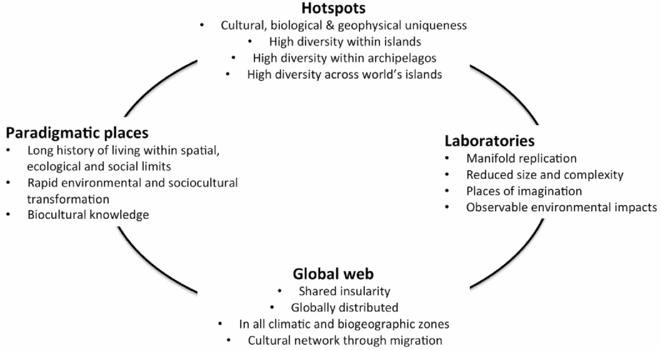
In this article, we argue that islands are fundamental to international environmental conservation, despite their small total land area and population size, for at least four interconnected reasons. First, as hotspots of biological and geophysical diversity and uniqueness, the world's islands together represent a major proportion of the natural riches on the Earth. Second, islands are paradigmatic places of human–environment relationships. Island cultures around the world hold rich cultural knowledge and experience about living within spatial, ecological and ultimately social boundaries. The corresponding biocultural knowledge is valuable in its own right as an important compound of cultural heritage and contemporary human life on Earth, and it is also a pivotal resource for revitalizing and innovating sustainable human–nature relationships on islands and beyond. Third, given their global distribution across all geographic regions and from the highest latitudes to the equator, islands sample and represent the ecological and cultural diversity of the planet comprehensively and form a global web that interlinks biogeographic regions and cultural spaces. Fourth, islands can serve as real-world laboratories that enable innovation in both the sciences and culture. We review in this article each of these four interconnected dimensions that together contribute to the unique importance of islands to environmental conservation (Fig. 1).
Islands are important to environmental conservation for at least four interconnected reasons: (i) they are global hotspots of cultural, biological and geophysical diversity and uniqueness; (ii) they are paradigmatic places of human–environment relationships; (iii) they form a global cultural and ecological web; and (iv) they serve as laboratories for scientific and social innovation.

HOTSPOTS OF GEOPHYSICAL AND BIOLOGICAL DIVERSITY AND UNIQUENESS
Islands are widely recognized as hotspots of geophysical and biological diversity and uniqueness (Fig. 1). A third of all identified global biodiversity hotspots consist mostly or entirely of islands (Zachos & Habel Reference Zachos and Habel2011): several Pacific Ocean regions, several island groups in Southeast Asia, the Mediterranean Basin, the Caribbean islands and Madagascar and Indian Ocean islands. Several other hotspot regions include islands (e.g. Indo-Burma, Western Ghats and Sri Lanka and the Guinean forests of Western Africa). Equally, many UNESCO World Heritage sites are situated on islands, including, among others, many last wilderness areas such as Aldabra Atoll, Macquarie Island or Phoenix Islands, but also many sites are on highly populated islands. Some sites are mainly protected for their biodiversity, while others are protected for their geophysical uniqueness (e.g. the volcanic landscapes of La Réunion, Tenerife, the Aeolian Islands, Surtsey and Hawaii).
In addition to terrestrial biodiversity, islands are also important as coastal areas for marine biodiversity. Islands are characterized by a particularly high ratio of coastline to land area. Therefore, the total island coastline is disproportionally higher than is suggested by their global land area. In addition, even small islands have large, exclusive economic zones with huge territorial claims to surrounding oceans. Island people are stewards for a sixth of the Earth's surface. As a result, more than half of the world's marine biodiversity and seven of the world's ten coral reef hotspots belong to island territories (CBD 2014). The marine side of islands has important implications for the global ecosystem. While terrestrial island ecosystems have, due to their small overall size, a negligible effect on global Earth system processes such as element cycles or climate, islands are central to the global marine ecosystem as widely scattered coastal areas that serve as breeding and feeding sites for marine animals (including coral reefs) and as terrestrial nesting sites for seabirds and marine mammals (Mulder et al. Reference Mulder, Anderson, Towns and Bellingham2011). Because the high productivity of marine ecosystems is largely confined to coastal areas, and nesting sites (rather than food availability) can be limiting for marine animals, islands have an ecological influence on oceans that is disproportionally higher than is suggested by their land area.
Marine island ecosystems are biodiversity hotspots because many of them harbour a very high density of species per area. In contrast, in terrestrial island ecosystems, the species number per area is low (Kier et al. Reference Kier, Kreft and Lee2009) due to their isolation from the species pools of other land areas. Instead, what makes terrestrial island biodiversity valuable is its uniqueness and great variability: across the world's islands, between islands within archipelagos and islands groups and within islands (Fig. 1). In this sense, islands are paradigmatic cases of the conservation policy concept of biodiversity hotspots. They concentrate a broad sample of unique and diverse natural features into small land areas. Islands can be considered living museums of natural heritage.
Diversity across the world's islands
The islands of the world's oceans are very diverse in their abiotic characteristics (Menard Reference Menard1986; Nunn Reference Nunn1994; Gillespie & Clague Reference Gillespie and Clague2009). Islands occur in all oceanic regions and at all latitudes, their areas and topographies vary greatly, and their geological origins are diverse. There have been attempts to assemble global databases of physical characteristics of islands such as climate, size and isolation (Weigelt et al. Reference Weigelt, Jetz and Kreft2013; Weigelt & Kreft Reference Weigelt and Kreft2013).
Depending on definition, the smallest islands have a size of only a few square metres (i.e. a single rock), while the largest landmasses that are typically considered islands – Greenland and New Guinea – have areas of over 2 million and almost 800 000 km2, respectively (i.e. if Australia is classified as a continent). Together, islands in the ocean make up c. 5–6% of total land area (excluding mostly ice-covered Antarctica and Greenland). There are at least 20 000 islands >1 km2 in area, close to 0.5 million >1 ha in area and there are probably billions of islands if all sizes are considered (Royle Reference Royle2014). More specifically, 18 islands are larger than 100 000 km2 (e.g. New Guinea, Borneo, Madagascar, Baffin and Great Britain), another 53 are larger than 10 000 km2 and c. 1500 are between 100 and 10 000 km2 (Depraetere & Dahl Reference Depraetere, Dahl and Baldacchino2007). Equally diverse is the topography of islands. Low-lying islands such as atolls reach only a few metres above sea level (m asl), while the tallest ones are major mountains that can be higher than 4000 m asl; in the subtropics and tropics, 14 islands reach the alpine zone with an elevation higher than 2750 m asl (Juvik et al. Reference Juvik, Kueffer and Juvik2014).
Although isolation by a surrounding ocean is the defining characteristic that is common to all islands in the ocean, this factor also varies greatly. Some land-bridge islands (continental peninsulas that, due to interglacial sea-level rise, lost their connection to continents) are isolated by less than 1 km from the nearest continental landmass, while the most isolated islands are at a distance of over 5000 km from any continent (e.g. different islands in French Polynesia) (Weigelt et al. Reference Weigelt, Jetz and Kreft2013). The geography of islands has changed repeatedly and strongly over geological timescales due to continental shift, ontogeny of islands and sea-level changes (e.g. Fernández-Palacios et al. Reference Fernández-Palacios, Rijsdijk, Norder, Otto, Nascimento, Fernández-Lugo, Tjørve and Whittaker2016). Because of sea-level change, some islands that are isolated in interglacial times (high sea level) are connected during glacial times (low sea level). Examples are the central island group of the Hawaiian archipelago around Maui, many islands in Southeast Asia or the Seychelles granitic islands (now c. 40 islands of a total land area of c. 235 km2, they formed a micro-continent of more than 40 000 km2 during the last glacial maximum only some 20 000 years ago).
A fourth major factor that contributes to the high abiotic diversity of islands is their diverse geological origin (Menard Reference Menard1986; Nunn Reference Nunn1994; Juvik & Juvik Reference Juvik and Juvik1998; Gillespie & Clague Reference Gillespie and Clague2009; Kueffer et al. Reference Kueffer, Drake, Fernandez-Palacios and Gibson2016). Oceanic islands in a strict sense are volcanic islands that formed through the accumulation of submarine magma and were never connected to continents. However, not all islands are of volcanic origin. Land-bridge islands and other islands on a continental shelf, as well as continental fragments or micro-continents (originally continental areas, but now isolated in the ocean through continental drift; e.g. Madagascar or the Seychelles), are built on a continental underground and consequently are characterized by a different geology (e.g. granites). While volcanic islands reach a maximal age of c. 5–10 million years, continental ones can be much older. The Seychelles granitic islands for instance have been isolated from any other landmass for c. 65 million years, and they are composed of rocks that are several 100 million years old.
The world's islands equally demonstrate high biodiversity. Islands of a given area tend to support fewer species than continental regions of the same area due to their isolation and small total land area. However, the world's islands together make a disproportionately large contribution to the world's total biodiversity due to their high level of endemism (i.e. a high proportion of species on a particular island – or in an island group – occur naturally nowhere else on Earth, neither on a different island nor on a continent). For instance, between 20% and 25% of the world's bird and plant species are endemic to islands and occur nowhere else (Johnson & Stattersfield Reference Johnson and Stattersfield1990; Caujapé-Castells et al. Reference Caujapé-Castells, Tye, Crawford, Santos-Guerra, Sakai, Beaver, Lobin, Florens, Moura, Jardim, Gómes and Kueffer2010), and very high numbers of island endemics are found in many other taxonomic groups, including, for instance, snails (Chiba & Cowie Reference Chiba and Cowie2016). The biodiversity value of islands is, however, not fully captured only by the statistics of species numbers (Gillespie & Clague Reference Gillespie and Clague2009; Kueffer et al. Reference Kueffer, Drake, Fernandez-Palacios and Gibson2016). Islands are also important because they comprehensively represent the biogeography and climate zones of the world, and therefore demonstrate a high diversity of different phylogenetic lineages from all continents (Weigelt et al. Reference Weigelt, Kissling and Kisel2015).
Further, islands are showcases of evolutionary processes. Evolutionary adaptation to island life has led to some of the most unique life forms. One general adaptation on islands is that animals and plants tend to lose their dispersability. Consequently, there are many examples of flightless birds and insects on islands, as well as plants with reduced dispersability, including the plant with the largest seed – the palm Lodoicea maldivica from the Seychelles (Edwards et al. Reference Edwards, Fleischer-Dogley and Kaiser-Bunbury2015). Also sizes of island organisms change: small species tend to become bigger and large ones smaller (Lomolino Reference Lomolino2005). Insular dwarfism has, for instance, been documented for dinosaurs, mammoths, elephants and humans, and insular gigantism has been documented for rats, lagomorphs, lemurs, tortoises and birds (e.g. the moa and dodo). Other recurrent evolutionary adaptations to island life include woodiness of plant groups that are herbaceous on continents, diminution of clutch size in vertebrates, diminution of defensive behaviour in animals and plants and development of sexual dimorphism in plants. Because island floras and faunas are small, species that are typical for occupying a particular ecological niche are often missing. As a result, ecological functions on islands are often taken up by unusual taxonomic groups; for instance, giant tortoises as large grazers, Komodo dragons as top predators or widespread pollination by lizards (Gillespie & Clague Reference Gillespie and Clague2009). In a certain sense, island evolution widened the range of species that can maintain a certain ecological function.
Diversity within archipelagos and within islands
Islands tend to be clustered by forming chains, groups and regional assemblies (Depraetere & Dahl Reference Depraetere, Dahl and Baldacchino2007). Geophysical diversity is often high within island groups, partly because they are composed of different types of islands (e.g. volcanic ones and others of continental original) and especially because they include volcanic islands of different ages. In the first phase of their ontogeny, characterized by volcanic activity, volcanic islands grow to tall mountains that, at their climax, typically reach over 4000 m above sea level and up to 10 000 m from the seabed (Mauna Kea in the Hawaiian archipelago) (Juvik & Juvik Reference Juvik and Juvik1998). Once volcanic activity stops, the work of erosion becomes increasingly visible and shapes island landforms. Old volcanic islands are eventually characterized by deep valleys, rugged topography and steep slopes carved by erosion. Ultimately, a volcanic island is completely eroded and remains only as a flat island of an elevation of a few metres – and in the case of a tropical island, it may be surrounded by a coral reef. Former tropical volcanic island in these last stages are called atolls. Because volcanic activity follows lines of tectonic rupture, volcanic islands and atolls occur in chains in a predictable way, with, at one end, new islands forming through volcanic activity still under the sea, followed by the highest and youngest islands, and finally, at the other end, the oldest volcanic islands and atolls. The Hawaiian archipelago, for instance, stretches from the southeast at 155°W, with the youngest island, Big Island, reaching over 4000 m asl and still with active volcanism, to the low-lying atolls of the northwestern Hawaiian islands at 180°W. Southeast of the Big Island, the next island (Loihi) forms as a growing volcano below sea level. Northwest of the northwestern Hawaiian Islands, the submersed former islands (guyots) of the Emperor Guyots chain reach almost to the Kamchatka peninsula in the northeast of Eurasia, which indicates the former extent of the archipelago. Soil conditions change with island age from nitrogen limitation on the youngest islands to phosphorus limitation on the oldest ones (Vitousek Reference Vitousek2004).
These geophysical forces working over the lifetime of a volcanic island produce high topographic diversity on a particular island. Older islands are characterized by a highly rugged topography with steep slopes. Younger, tall islands often have highly contrasting climates on the rain-fed windward and the dry leeward sides in the shade of the mountain peak(s). Annual rainfall can vary by a factor of 10–20 over a distance of typically less than 100 km. Such topographic and associated climatic heterogeneity leads to very high habitat diversity, so that on a single (sub)tropical island, amongst the driest, most humid and coldest tropical habitats can be present – with their associated specialized floras and faunas, and often also specialized traditional or modern land-use systems (Vitousek et al. Reference Vitousek, Ladefoged, Kirch, Hartshorn, Graves, Hotchkiss, Tuljapurkar and Chadwick2004; Rolett Reference Rolett2008). In some ways, islands are representations of whole continents at a micro-scale.
Such high geophysical variation – and associated climate, soil and habitat variation – within archipelagos and within islands is a primary driver of the production of island biodiversity in situ (i.e. of speciation on islands). Indeed, particularly spectacular features of island biodiversity are adaptive radiations: macro-evolutionary processes that produce many different and ecologically diverse species from a single ancestor species (Gillespie & Clague Reference Gillespie and Clague2009). Species that were formed through adaptive radiation contribute a disproportionally high share to the total species richness on islands. Such evolutionary radiations can unfold along island chains over time periods longer than the life of a single island (Gillespie & Clague Reference Gillespie and Clague2009).
Threatened island hotspots
Hotspots of natural heritage on islands are highly threatened. In the case of geophysical features, housing and tourism development particularly threaten the integrity of unique landscape features, as exemplified by the struggle against the further development of astronomical infrastructure in the summit area of Mauna Kea volcano (Hawaii archipelago), which is sacred to native Hawaiians.
Biodiversity loss is particularly severe on islands (Grenyer et al. Reference Grenyer, Orme, Jackson, Thomas, Davies, Davies, Jones, Olson, Ridgely and Rasmussen2006; Whittaker & Fernández-Palacios Reference Whittaker and Fernández-Palacios2007; Gillespie & Clague Reference Gillespie and Clague2009; Caujapé-Castells et al. Reference Caujapé-Castells, Tye, Crawford, Santos-Guerra, Sakai, Beaver, Lobin, Florens, Moura, Jardim, Gómes and Kueffer2010; Chiba & Cowie Reference Chiba and Cowie2016). The majority of documented species extinctions to date are from islands, including such prominent cases as the dodo and other giant birds, most honeycreeper species in Hawaii, many other birds, dwarf mammals from Mediterranean islands, many snail species across the Pacific and many plant species (e.g. Juvik & Juvik Reference Juvik and Juvik1998; Whittaker & Fernández-Palacios Reference Whittaker and Fernández-Palacios2007; Gillespie & Clague Reference Gillespie and Clague2009; Caujapé-Castells et al. Reference Caujapé-Castells, Tye, Crawford, Santos-Guerra, Sakai, Beaver, Lobin, Florens, Moura, Jardim, Gómes and Kueffer2010; Alcover et al. Reference Alcover, Pieper, Pereira and Rando2015; Chiba & Cowie Reference Chiba and Cowie2016). In addition, the proportion of threatened species is also particularly high on islands. In the Hawaiian Islands, for instance, most of the remaining honeycreeper species might be extinct within the next few decades (Paxton et al. Reference Paxton, Camp, Gorresen, Crampton, Leonard and VanderWerf2016).
In addition to past threats, new ones are emerging. New building development triggered by population growth and economic development – including tourism – encroaches on natural areas and increases pollution levels (especially in coastal areas). Climate change will have direct negative impacts on island biodiversity in particular because habitats are often very small and highly fragmented (both naturally and anthropogenically), leaving not much space for species to track their climate to new areas (Harter et al. Reference Harter, Irl, Seo, Steinbauer, Gillespie, Triantis, Fernández-Palacios and Beierkuhnlein2015). Climate change might worsen other threats (e.g. biological invasions spreading to higher elevations or increased fire risk in already highly fragmented lowland dry habitats). Major impacts can also be expected in marine ecosystems, especially on coral reefs. Besides direct impacts, indirect impacts will be important, especially when human populations are displaced by sea-level rise from coastal areas and might settle in the as-yet less developed interiors of islands (Wetzel et al. Reference Wetzel, Kissling, Beissmann and Penn2012). Lastly, many populations of island species are already too small to survive over the long term without the addition of further threats; a phenomenon called ‘extinction debt’ (Triantis et al. Reference Triantis, Borges, Ladle, Hortal, Cardoso, Gaspar, Dinis, Mendonca, Silveira, Gabriel, Melo, Santos, Amorim, Ribeiro, Serrano, Quartau and Whittaker2010). Kueffer and Kaiser-Bunbury (Reference Kueffer and Kaiser-Bunbury2014), for instance, report the following examples: 44.2% of the Hawaiian flora is restricted to 20 or fewer populations in the wild, and more than 100 species are known to have 20 or fewer remaining individuals. In Haiti, less than 4% of the land area is covered with forest, and no primary forest remains. The flora of Haiti is composed of more than 5000 vascular plants with an endemism of about a third, as well as more than 2000 animal species (most of them originally forest species). In New Caledonia, less than 2% of lowland dry vegetation remains intact, mostly as patches of less than 5 ha, the largest one being 200 ha. Such a reduction and fragmentation of remaining habitat will have major consequences not only for well-documented organism groups such as plants or birds, but also for invertebrates, for which data are often lacking (e.g. beetles in the Azores; Terzopoulou et al. Reference Terzopoulou, Rigal, Whittaker, Borges and Triantis2015).
PARADIGMATIC PLACES OF HUMAN–ENVIRONMENT RELATIONSHIPS
Islands can be considered paradigmatic places of human–environment relationships (Fig. 1). Island societies often build on long traditions of living within spatial, ecological and ultimately social boundaries and are still often highly dependent on local resources and social cohesion. In addition, islanders had to learn how to deal with rapid and major environmental and socioeconomic transformations that often had severe consequences for biodiversity, the environment and livelihoods. At present, many environmental problems are particularly acute and tangible on islands, and in this sense islands are at the forefront of contemporary environmental conservation (e.g. Kelman Reference Kelman2010).
Human history on islands includes some of the most impressive human achievements. In the Pacific, for instance, the greatest marine migration in human history happened, being one of the most impressive examples of human determination, creativity and adaptability (Gillespie & Clague Reference Gillespie and Clague2009; Low Reference Low2013). Much later, the mutineers of HMS Bounty found their way to the tiny and very isolated island of Pitcairn, where they established a colony, adapting their European knowledge to the new challenges and apparently profiting from plants that remained on the island from earlier Polynesian settlements (e.g. breadfruits and sweet potatoes) (Gillespie & Clague Reference Gillespie and Clague2009). Similar stories of human exploration and adaptation happened in the Arctic, or in the other oceans.
Upon arrival, humans had to adapt to a life on a small and isolated piece of land, often characterized by limited resources. Such a recurrent experiment of human adaptation happened in very different climates and geographic zones and on very diverse islands, including atolls and young to old volcanic islands with contrasting topographies and soil conditions. On high tropical islands, they had to find different agricultural solutions for the very wet windward compared with the very dry leeward sites (Vitousek et al. Reference Vitousek, Ladefoged, Kirch, Hartshorn, Graves, Hotchkiss, Tuljapurkar and Chadwick2004). In some cases, the island's terrestrial flora and fauna provided a rich food source (e.g. in the Mediterranean Basin or on Southeast Asian islands), while in other cases, humans depended mostly on the few plants and animals that they carried with them on their journeys across the oceans, plus marine resources (e.g. on many islands in the Pacific) (Juvik & Juvik Reference Juvik and Juvik1998; Gillespie & Clague Reference Gillespie and Clague2009; Whistler Reference Whistler2009). Human colonization was conducted by very different cultural groups, and at very different times, sometimes in prehistory, while in other cases not before the colonial expansion of Europeans. Many of these human explorations of island life have in common that people depended on scarce resources, small land areas, few opportunities to migrate and establish a new life elsewhere (as individuals or groups), a life at the interface of the sea and the land and limited exchange with other societies on other islands or continents (Fitzpatrick & Keegan Reference Fitzpatrick and Keegan2007; Rolett Reference Rolett2008; Royle Reference Royle2014). On some islands, people had to adapt to a harsh climate (e.g. at the highest latitudes in the Artic or on dry islands such as in the Socotra archipelago in the Indian Ocean).
Indigenous people or early colonial settlers had to invent long-term subsistence systems based on local resources and restricted land (Rolett Reference Rolett2008; Gillespie & Clague Reference Gillespie and Clague2009; Whistler Reference Whistler2009; Koshiba et al. Reference Koshiba, Besebes, Soaladaob, Ngiraingas, Isechal, Victor and Golbuu2014; McMillen et al. Reference McMillen, Ticktin, Friedlander, Jupiter, Thaman, Campbell, Veitayaki, Giambelluca, Nihmei, Rupeni, Apis-Overhoff, Aalbersberg and Orcherton2014; Royle Reference Royle2014; Braje et al. Reference Braje, Leppard, Fitzpatrick and Erlandson2017). Practices involved, for instance, terracing and stonewall enclosures, polycultural cultivation and fallowing, water management, agriculture and agroforestry adapted to local conditions, aquaculture and sustainable harvesting practices of wild plants and animals. These diverse practices were and still often are embedded in local knowledge systems, institutional arrangements, customs and mythologies. Initial land use on newly settled islands typically led to substantially transformed coastal and lowland anthropogenic landscapes and different degrees of exploitation of interior habitats (Juvik & Juvik Reference Juvik and Juvik1998; Rolett & Diamond Reference Rolett and Diamond2004; Fitzpatrick & Keegan Reference Fitzpatrick and Keegan2007; De Nascimento et al. Reference De Nascimento, Willis, Fernández-Palacios, Criado and Whittaker2009; Gillespie & Clague Reference Gillespie and Clague2009; Braje et al. Reference Braje, Leppard, Fitzpatrick and Erlandson2017). While some islands had to be abandoned at some point due to overexploitation, on other islands, traditional land-use systems persisted for thousands of years (Rolett & Diamond Reference Rolett and Diamond2004; Fitzpatrick & Keegan Reference Fitzpatrick and Keegan2007; Rolett Reference Rolett2008; Gillespie & Clague Reference Gillespie and Clague2009; Koshiba et al. Reference Koshiba, Besebes, Soaladaob, Ngiraingas, Isechal, Victor and Golbuu2014; Braje et al. Reference Braje, Leppard, Fitzpatrick and Erlandson2017). Indigenous people also contributed to species extinctions, such as among birds (Duncan et al. Reference Duncan, Boyer and Blackburn2013; Braje et al. Reference Braje, Leppard, Fitzpatrick and Erlandson2017), dwarf mammals (Hadjisterkotis et al. Reference Hadjisterkotis, Masala and Reese2000; Braje et al. Reference Braje, Leppard, Fitzpatrick and Erlandson2017), megafauna (Braje et al. Reference Braje, Leppard, Fitzpatrick and Erlandson2017) or tree species (e.g. De Nascimento et al. Reference De Nascimento, Willis, Fernández-Palacios, Criado and Whittaker2009).
However, on most islands, the environmental impacts of indigenous people were much smaller than habitat degradation and biodiversity loss triggered through the arrival of Western people during colonial times (e.g. Fitzpatrick & Keegan Reference Fitzpatrick and Keegan2007; Cheke & Hume Reference Cheke and Hume2008; Gillespie & Clague Reference Gillespie and Clague2009; Royle Reference Royle2014; Braje et al. Reference Braje, Leppard, Fitzpatrick and Erlandson2017). In many cases, islands were largely deforested within a few decades after arrival, which reduced native habitats to tiny pockets in inaccessible places and mostly at higher elevations. As a consequence, today, on many islands, the only habitats that are still represented at a substantial scale in a relatively undisturbed state are montane or alpine habitats (Juvik et al. Reference Juvik, Kueffer and Juvik2014). Besides habitat destruction (including through fires), overexploitation of animal and plant populations (especially through hunting and for timber) and the introduction of invasive alien animals and plants were often major threat factors (Sodhi & Brook Reference Sodhi and Brook2006; Caujapé-Castells et al. Reference Caujapé-Castells, Tye, Crawford, Santos-Guerra, Sakai, Beaver, Lobin, Florens, Moura, Jardim, Gómes and Kueffer2010; Kueffer & Kaiser-Bunbury Reference Kueffer and Kaiser-Bunbury2014).
Biocultural heritage of islands
As a consequence of their socioecological histories, island cultures around the world represent a unique biocultural heritage and hold rich local knowledge (Loh & Harmon Reference Loh and Harmon2005; Royle Reference Royle2008; Gillespie & Clague Reference Gillespie and Clague2009; Hong Reference Hong2013; McMillen et al. Reference McMillen, Ticktin, Friedlander, Jupiter, Thaman, Campbell, Veitayaki, Giambelluca, Nihmei, Rupeni, Apis-Overhoff, Aalbersberg and Orcherton2014; Kealiikanakaoleohaililani & Giardina Reference Kealiikanakaoleohaililani and Giardina2016; Lauer Reference Lauer2017). The local knowledge of islanders encompasses far more than only a static collection of natural history facts (Lauer Reference Lauer2017); it also includes knowledge that is tacit, transmitted in oral form and encoded in mythologies, social innovations or land-use practices (Rolett Reference Rolett2008; Kealiikanakaoleohaililani & Giardina Reference Kealiikanakaoleohaililani and Giardina2016; Lauer Reference Lauer2017). Local knowledge is embedded in particular worldviews, epistemologies, languages, symbolic systems and cultural practices. In addition, biocultural knowledge is dynamic. It is continuously adapting to environmental and social change, and it is evolving through learning and the incorporation of knowledge from outsiders (Lauer Reference Lauer2017). This means that much of local knowledge cannot simply be subsumed under Western thinking (Kealiikanakaoleohaililani & Giardina Reference Kealiikanakaoleohaililani and Giardina2016; Lauer Reference Lauer2017). However, non-hierarchical and reciprocal dialogue between Western and local perspectives is still often lacking (Lauer Reference Lauer2017). A more equal relationship is possible, as demonstrated by the Cook/Forster Collection held at the Georg-August-University in Goettingen (Germany), which has been reinterpreted from a Māori perspective, thereby acknowledging the value of alternative epistemologies from islands (Schorch et al. Reference Schorch, McCarthy and Hakiwai2016).
The biocultural history of islands also has great potential to inspire the imaginations of islanders and outsiders. Sailing across the Pacific using a replica of a Polynesian voyaging vessel, the Hōkūlea, has occurred several times since the 1970s, illustrating how ancient traditions inspire modern hopes (Low Reference Low2013). Modern literature from the Caribbean and Pacific oceans tell stories of environmental loss and hope, and transport alternative ways of thinking about nature, non-human living beings and human–nature relationships to our time (DeLoughrey Reference DeLoughrey2007). Environmentalism needs stories of the manifold possibilities of human life and future society that transgress the promise of technoscientific progress, and island stories provide one rooting of alternative narratives of current and future human–nature relationships. Teresia K. Teaiwa (an I-Kiribati and American poet and academic) proposed to make ‘island’ a verb (Baldacchino Reference Baldacchino2007, p. 514). She argued that we have to learn how to ‘island’ the world – how to “behave as if we were all living on islands.”
Threatened livelihoods and the biocultural heritage of islands
Island societies and cultures and their biocultural heritage are threatened (Juvik & Juvik Reference Juvik and Juvik1998; Baldacchino Reference Baldacchino2007; Baldacchino & Niles Reference Baldacchino and Niles2011; Connell Reference Connell2013; Royle Reference Royle2014). During colonial times, armed force and the introduction of diseases led to the massive reduction of indigenous populations on many islands, including the loss of power and cultural identity and practices. In the Hawaiian archipelago, for instance, the population size of native Hawaiians was reduced by c. 90% during the 19th century (Juvik & Juvik Reference Juvik and Juvik1998). In post-colonial times, the vulnerability and powerlessness of islanders have remained high (Royle Reference Royle2014). In particular, the dependence on former colonial powers remains much higher among island territories than on continents: most islands in the Arctic region, Mediterranean Sea and Atlantic Ocean, as well as many islands in the Central and Eastern Pacific, are part of or dependencies of continental countries, and there also remain many continental dependencies in the Caribbean Sea and Indian Ocean. Further, small-island states are often characterized by an economy with a low diversification and high dependence on the outside, and they are therefore highly exposed to external interests and influences. An increasing ratio of tourists to the local population and an increasing foreign ownership of land on islands can further weaken local identities (e.g. Royle Reference Royle2014). Ultimately, unsustainable use of land and resources, as well as pollution and poor waste management, threaten the viability of many island societies (Juvik & Juvik Reference Juvik and Juvik1998; Baldacchino & Niles Reference Baldacchino and Niles2011; Walker & Bellingham Reference Walker and Bellingham2011; Connell Reference Connell2013).
Recognition of the value of the biocultural heritage of islands
Recognition of the value of the biocultural heritage of islands has, in recent decades, been growing both locally (e.g. a renaissance of Polynesian culture in Hawaii) and internationally. Local knowledge is today considered a crucial component of any effective ecosystem management programme on an island (e.g., Jupiter et al. Reference Jupiter, Wenger, Klein, Albert, Mangubhai, Nelson, Teneva, Tulloch, White and Watson2017; Lauer Reference Lauer2017). International organizations are paying attention to the biocultural diversity on islands (Hong Reference Hong2013; Dahl Reference Dahl2017). The Representative List of the Intangible Cultural Heritage of Humanity of UNESCO listed many cultural innovations on islands; for instance, the Maloya dance music that originated among African and Malagasy slaves in La Réunion and the Sega dance in Mauritius; woven handcraft of the people of Papua; sand drawings in Vanuatu; or singing traditions in Corsica. There are also many cultural island landscapes listed on the UNESCO World Heritage List of cultural or mixed sites, such as the subsistence agriculture and sheep farming landscape on St Kilda in the Hebrides (Scotland), the vineyard culture on Pico Island in the Azores (dating back to the 15th century), the Le Morne Cultural Landscape of Mauritius that was used as a shelter by runaway slaves throughout the 18th and early 19th centuries or the Southern Lagoon Rock Islands in Palau with remains of a c. 3000-year-old culture that was abandoned in the 17th and 18th centuries (illustrating both the persistence and vulnerability of small-island communities).
GLOBAL CULTURAL AND ECOLOGICAL WEB
Islands occur in all world regions and at all latitudes (Fig. 2). By latitude, the highest number and density of islands is found between 50°N and 80°N, where they also make up c. 60–70% of the total land at these latitudes. In contrast, they make up only c. 20% of the total land in the subtropics and tropics, and less than 5% between –40°N and –65°N (Depraetere & Dahl Reference Depraetere, Dahl and Baldacchino2007). At the highest latitudes, the Arctic islands (in the northern hemisphere) and the sub-Antarctic islands (in the southern hemisphere) host some of the last wilderness areas on the planet. The largest ocean is the Pacific, ranging from Southeast Asia in the West to the Americas in the East. It encompasses almost half of the surface of the world's oceans and about a third of the total surface of the Earth. Thousands of islands are scattered across the Pacific, with most of them confined to subtropical and tropical latitudes. In contrast, the mid-latitudes of the Atlantic Ocean between Africa and the east coast of the Americas are relatively free of islands. The only island groups occurring in this region are those of Macaronesia in the northwest of Africa, some islands close to the coasts of Africa and South America and the isolated British islands of Ascension and Saint Helena. Other oceanic regions include the Caribbean Sea, Mediterranean Sea, Western Indian Ocean region and the archipelagos of Southeast Asia. For a bibliography of key reference literature for the different world's oceanic regions, see Kueffer et al. (Reference Kueffer, Drake, Fernandez-Palacios and Gibson2016). Gillespie and Clague (Reference Gillespie and Clague2009) include short entries about different island groups and oceanic regions. As a consequence of their global distribution, islands represent all climate zones, biogeographic regions and many human cultural groups. This global representation and association with the different world oceanic regions is essential for the manifold cultural and ecological riches of islands. The islands of the world can be imagined as a global web of local nodes of high biological and cultural value (Fig. 1).
The global distribution of the world's islands. Black dots indicate the location of 17 883 islands listed by Weigelt et al. (Reference Weigelt, Jetz and Kreft2013); most of them are located along coastlines of continents or larger islands. Seventy islands or island groups that are mentioned in the text or are otherwise of special significance are indicated with a number (from west to east): 1: Tonga; 2: Northwestern Hawaiian Islands; 3: Samoa; 4: Aleutian Islands; 5: Hawaii Archipelago; 6: Tahiti (French Polynesia); 7: Marquesas Islands; 8: Pitcairn; 9: California Channel Islands; 10: Rapa Nui (Easter Island); 11: Galapagos; 12: Cuba; 13: Juan Fernandez Islands (Robinson Crusoe, Alejandro Selkirk, Santa Clara); 14: Jamaica; 15: Bahamas; 16: Hispaniola (Haiti and Dominican Republic); 17: Puerto Rico; 18: Guadeloupe; 19: Trinidad and Tobago; 20: Saint Lucia; 21: Falkland Islands; 22: Azores; 23: Cape Verde; 24: Iceland (including Surtsey); 25: Madeira; 26: Canary Islands (e.g. Tenerife, El Hierro); 27: Ascension; 28: Gough; 29: Ireland; 30: Saint Helena; 31: Balearic Islands (e.g. Majorca); 32: Gulf of Guinea Islands; 33: Corsica; 34: Eolie (Aeolian Islands); 35: Svalbard; 36: Aegean Islands (Greece); 37: Cyprus; 38: Zanzibar; 39: Comoros; 40: Aldabra Atoll; 41: Madagascar; 42: Socotra; 43: Seychelles (main group of mostly continental islands); 44: Mascarenes (Mauritius, La Réunion, Rodrigues); 45: Kerguelen; 46: Diego Garcia; 47: Maldives; 48: Sri Lanka; 49: Andaman and Nicobar Islands; 50: Sumatra (Indonesia); 51: Borneo; 52: Sulawesi (Indonesia); 53: Taiwan; 54: Philippines; 55: Okinawa (Ryukyu Islands, Japan); 56: Moluccas; 57: Palau; 58: Japan; 59: New Guinea: 60: Guam; 61: Tasmania; 62: Macquarie; 63: Solomon Islands; 64: New Caledonia; 65: Nauru; 66: Vanuatu; 67: New Zealand; 68: Phoenix; 69: Tuvalu; 70: Fiji.

The web-like nature of islands becomes more accentuated when considering the interconnectedness of island peoples and cultures. Many island societies are today melting pots of different cultures: indigenous, early seafaring people (e.g. Arabs or Vikings), colonial settlers, slaves and workers that arrived on islands for different economic opportunities (first jobs on plantations, later in tourism or trade, now, for example, also banking). As a result, European influences are recognizable on islands in the Caribbean Sea, as well as in the Indian, Atlantic or Pacific oceans. In the Bonin (Ogasawara) Islands – an island group in the Pacific that was settled by immigrants from many different countries and now belongs to Japan – inhabitants speak a pidgin version of English with elements from different European and Austronesian languages and Japanese (Long Reference Long2007). Indian communities are established in the Caribbean, as well as in Mauritius (Indian Ocean) or Fiji (Pacific Ocean). African slaves were brought to La Réunion and Madagascar in the Indian Ocean, as well as to the islands of the Caribbean Sea, and as a consequence of French and African influences, islands at opposing sides of the planet share similar creole languages. Workers that came in the late 19th century to Hawaii for plantation work were Chinese, Japanese, Okinawans, Koreans, Puerto Ricans, Portuguese from the Azores archipelago in the middle of the Atlantic Ocean and Filipinos (Juvik & Juvik Reference Juvik and Juvik1998). All of them tried to maintain some of their lifestyle from home (often other islands) with what was available in Hawaii, while adopting new elements from their new home; for instance, in cooking (Laudan Reference Laudan1996). In return, there is a growing diaspora community of islanders now living on continents (and in many cases, the money that these diaspora communities send to their relatives represents a major proportion of an island's income). Lastly, many islands still maintain close relationships with former colonial powers or are still part of continental countries, and there are increasingly regional and global networks among island nations.
Thus, island societies are globally interconnected through multiple and interwoven threads. Islands are places where people and traditions meet in a particular and bounded place that allows for multicultural exchange, but also enables the focusing of the creativity of individuals and groups. Not surprisingly, islands have been innovation hubs of world culture, such as Reggae in Jamaica, Haitian Voodoo tradition, Cuban music, Björk Guðmundsdóttir from Iceland, Jane Campion's films from New Zealand, or the Nobel Prize in Literature winner Derek Walcott from the Caribbean island of Saint Lucia.
Environmentalism promotes strengthening local actors so that they can speak up for their particular needs and perspectives, but it is also evident that local concerns and environmental issues need a strong voice internationally (Heise Reference Heise2008; Turnhout et al. Reference Turnhout, Bloomfield, Hulme, Vogel and Wynne2012). The need to strengthen the local voices of islanders at an international level is increasingly recognized in environmental politics (Kelman Reference Kelman2010; Dahl Reference Dahl2017). Similarly, environmental sciences struggle with integrating detailed knowledge about the complexities of local environmental issues with much coarser global data and analyses (Kueffer Reference Kueffer2012; Sagarin & Pauchard Reference Sagarin and Pauchard2012; Greschke & Tischler Reference Greschke and Tischler2013; Lauer Reference Lauer2017). Islands are widely replicated and share many common environmental concerns, providing a unique opportunity to deal with this tension between the local and the global. Regional and global networking and multi-island research and policy programmes could help to pool institutional capacity and enable cross-island learning (Baldacchino Reference Baldacchino2007; Kueffer Reference Kueffer2012; Kueffer et al. Reference Kueffer, Drake and Fernández-Palacios2014). Indeed, networked conservation action can be more cost effective than isolated efforts, as has been demonstrated in the Mediterranean Basin, for instance (Kark et al. Reference Kark, Levin, Grantham and Possingham2009).
There are global networks such as the Alliance of Small Island States (AOSIS), the Global Island Partnership (GLISPA), the Small Island Developing States Network (SIDSnet), the Society for Island Biology (SIB), the International Small Islands Studies Association (ISISA) and the Network of Island Universities (RETI), and there are numerous local and regional networks focused on specific islands, archipelagos and oceanic regions (Baldacchino Reference Baldacchino2007; Kelman Reference Kelman2010; Kueffer et al. Reference Kueffer, Drake, Fernandez-Palacios and Gibson2016; Dahl Reference Dahl2017). There are also several examples of multi-campus universities and shared teaching and research programmes that link experts on several islands, such as the University of the West Indies (UWI), the University of the South Pacific (USP) and the University of the Highlands and Islands (UHI). Together, these networks can assist in linking global support of environmental policies on islands with regional and local action and the expertise of island-based stakeholders, policy-makers and experts. Emerging opportunities for sharing knowledge among environmentalists on islands include internet-based communication tools such as online courses or video-conferences (Norder & Rijsdijk Reference Norder and Rijsdijk2016).
ISLANDS AS LABORATORIES
Islands have often been and still are the basis of major scientific breakthroughs in disciplines ranging from anthropology and the social sciences to geosciences, biogeography, ecology and evolutionary biology, and they have inspired indigenous cultures as well as modern literature and arts for centuries (DeLoughrey Reference DeLoughrey2007; Royle Reference Royle2008; Gillespie & Clague Reference Gillespie and Clague2009; Kueffer et al. Reference Kueffer, Drake and Fernández-Palacios2014; Royle Reference Royle2014; Kueffer et al. Reference Kueffer, Drake, Fernandez-Palacios and Gibson2016; Braje et al. Reference Braje, Leppard, Fitzpatrick and Erlandson2017). Islands are used as model systems in a wide range of disciplines, including ecology, evolutionary biology and biogeography (Vitousek Reference Vitousek2004; Kueffer et al. Reference Kueffer, Drake and Fernández-Palacios2014), systems ecology (Davies et al. Reference Davies, Field, Gavaghan, Holbrook, Planes, Troyer, Bonsall, Claudet, Roderick and Schmitt2016), conservation biology (Kueffer Reference Kueffer2012; Ewel et al. Reference Ewel, Mascaro, Kueffer, Lugo, Lach, Gardener, Hobbs, Higgs and Hall2013; Kueffer & Kaiser-Bunbury Reference Kueffer and Kaiser-Bunbury2014), the environmental sciences (Walker & Bellingham Reference Walker and Bellingham2011), historical ecology (Rolett & Diamond Reference Rolett and Diamond2004; Vitousek et al. Reference Vitousek, Ladefoged, Kirch, Hartshorn, Graves, Hotchkiss, Tuljapurkar and Chadwick2004; Braje et al. Reference Braje, Leppard, Fitzpatrick and Erlandson2017), sustainability science (McDaniel & Gowdy Reference McDaniel and Gowdy2000; Diamond Reference Diamond2005; Kelman et al. Reference Kelman, Burns and des Johansson2015), socioecological research (Chertow et al. Reference Chertow, Fugate, Ashton, Singh, Haberl, Chertow, Mirtl and Schmid2013) and anthropology and the social sciences (Royle Reference Royle2014; Coulthard et al. Reference Coulthard, Evans, Turner, Mills, Foale, Abernethy, Hicks and Monnereau2017). Some of the reasons why islands are attractive as model systems are related to the three general features of islands discussed above. As hotspots of unique biological and cultural features, they provide many opportunities for discovery. Evolution on islands, for instance, has inspired modern evolutionary biology since its formulation through Charles Darwin and Alfred Russel Wallace (Kueffer et al. Reference Kueffer, Drake and Fernández-Palacios2014). High geophysical variability between islands and within islands enabled the studying of how ecosystem processes respond to varying abiotic conditions (Vitousek Reference Vitousek2004). As paradigmatic places of human–environment relationships, they provide a wealth of case studies of how past societies in different ecological, social and cultural contexts dealt with limited resources (e.g. Braje et al. Reference Braje, Leppard, Fitzpatrick and Erlandson2017). Today, many environmental problems are already very acute, which forces agents on islands to act. This enables scholars working on the adaptation to and mitigation of environmental problems in fields ranging from conservation biology and restoration ecology (Ewel et al. Reference Ewel, Mascaro, Kueffer, Lugo, Lach, Gardener, Hobbs, Higgs and Hall2013; Kueffer et al. Reference Kueffer, Drake and Fernández-Palacios2014) to ecosystem management (Jupiter et al. Reference Jupiter, Wenger, Klein, Albert, Mangubhai, Nelson, Teneva, Tulloch, White and Watson2017), sustainability science (Kelman et al. Reference Kelman, Burns and des Johansson2015) and social wellbeing (Coulthard et al. Reference Coulthard, Evans, Turner, Mills, Foale, Abernethy, Hicks and Monnereau2017) to work in situations where environmental problems are already real that are only predicted in other places. On islands, global challenges become concrete: we know which species might die out within decades; we know which areas will be threatened by sea-level rise; we can see coral reef bleaching; on many islands it has become obvious that traffic, energy consumption, waste and population densities have reached the carrying capacity of the land; and we can guess what it will mean for island economies when cheap energy is not available anymore.
The global distribution of islands allows for the replication of studies and datasets, which was central for the development of MacArthur and Wilson's dynamic theory of island biogeography, for instance – by far the most widely discussed theory in biogeography (Kueffer et al. Reference Kueffer, Drake and Fernández-Palacios2014). Multi-island comparative studies also allow for the exploitation of differences between islands as natural experiments; for instance, enabling us to understand how different political systems on otherwise-similar islands affected sustainable land use (Diamond Reference Diamond2005). In addition, practitioners on different islands can learn from each other's experiences (Kueffer Reference Kueffer2012).
Another reason why islands are considered to be good model systems is their small size and isolation. This makes it easier to define boundaries for analysis, collect comprehensive or almost complete data across whole systems and compile and integrate perspectives of multiple disciplines and many datasets on the same phenomenon. Davies et al. (Reference Davies, Field, Gavaghan, Holbrook, Planes, Troyer, Bonsall, Claudet, Roderick and Schmitt2016), for instance, attempt to build computer simulations of entire social–ecological systems based on data from Moorea, French Polynesia. The deCODE Genetics database in Iceland is built on the vision of compiling a comprehensive genetics and health data database of the Icelandic population (Greenhough Reference Greenhough2006). Islands are also ideal locations for long-term place-based research (Kueffer Reference Kueffer2006; Chertow et al. Reference Chertow, Fugate, Ashton, Singh, Haberl, Chertow, Mirtl and Schmid2013). As with any model, framing islands as model systems is always a simplification and a way of favouring some understandings and valuations of a particular island (or islands in general) over others (e.g. Greenhough Reference Greenhough2006).
Seeing islands as laboratories encompasses more than understanding them only as model systems. It positions them as places for experimentation and imagination. In Western literature and arts, islands have, for thousands of years, been places of social experimentation and utopia or dystopia, e.g. Homer's Odyssey in ancient Greek times, Thomas More's Utopia from 1516, Robinson Crusoe by Daniel Defoe from 1719, Lord of the Flies by William Golding from 1954, T.C. Boyle's San Miguel from 2012, Craigie Horsfield's artwork from El Hierro (Canary Islands) or many ‘real’ individuals or groups that tried to find a place removed from the world on islands (Clark Reference Clark2001; Royle Reference Royle2014). Both T.C. Boyle and Craigie Horsfield portray islands as the ultimate frontier of the human exploration of space. Today, islands are often discussed as experimental spaces for the resurrection and innovation of sustainable living (Baldacchino Reference Baldacchino2007; Rolett Reference Rolett2008; Baldacchino & Niles Reference Baldacchino and Niles2011; Kelman et al. Reference Kelman, Burns and des Johansson2015; Kealiikanakaoleohaililani & Giardina Reference Kealiikanakaoleohaililani and Giardina2016). Due to their small size, it is often easier to bring stakeholders and experts from different political or economic sectors together to work on a common issue. Islands have also become laboratories for experimenting with new biodiversity conservation strategies for highly disturbed novel ecosystems and landscapes (Ewel et al. Reference Ewel, Mascaro, Kueffer, Lugo, Lach, Gardener, Hobbs, Higgs and Hall2013; Kueffer & Kaiser-Bunbury Reference Kueffer and Kaiser-Bunbury2014). Island conservationists have been leaders in bringing species back from the brink of extinction through ex situ conservation in zoos and botanical gardens and later reintroduction to the wild. There are also many successful examples of habitat restoration (e.g. Florens & Baider Reference Florens and Baider2013), including on small offshore islands, where all invasive species can be eradicated, which then can become new safe places for threatened species (Towns et al. Reference Towns, Daugherty and Atkinson1990; Zino Reference Zino, Hounsome, Buckle and Biscoito2008; Kueffer & Kaiser-Bunbury Reference Kueffer and Kaiser-Bunbury2014). In addition, there have been first experiments with designing new nature, such as through rewilding (i.e. the introduction of alien species to the wild that are functional analogues of extinct native species, with the idea that they can replace lost ecological functions; Hansen Reference Hansen, Pérez-Mellado and Ramon2010). All of these new conservation strategies will grow in importance on continents, but have first been recognized and addressed and are most evident on islands (Kueffer & Kaiser-Bunbury Reference Kueffer and Kaiser-Bunbury2014).
The use of islands as laboratories also has a problematic history. External forces used islands recurrently to do their dangerous experiments far away from home, including for nuclear weapon tests (Royle Reference Royle2014). In addition, framing islands as model systems or laboratories has frequently imposed external understandings and values on local island peoples. In environmental conservation in particular, islands have in the past too often been the playgrounds of foreign countries and international organizations and their predefined environmental management approaches (compare, for example, Rodríguez et al. Reference Rodríguez, Taber, Daszak, Sukumar, Valladares-Padua, Padua, Aguirre, Medellín, Acosta and Aguirre2007). The idea of islands as real-world laboratories for innovating environmental solutions is therefore only valid if such experiments are guided through local communities. Local and traditional knowledge on islands has to be recognized as the basis for environmental conservation with external knowledge complementing it, not vice versa. Relying on the biocultural wisdom of islanders might often mean that current environmental policies on islands are fundamentally reconsidered. Environmental problems must be framed according to local needs and perspectives, and knowledge must be represented, encoded and communicated in locally sensitive forms (i.e. by using local forums of communication; e.g. oral communication, or embedded in ritual settings), relying on local metaphors, stories, language, words and images, and by reflecting upon who is doing the research, communicating it and acting upon it. On islands, such a change of perspective is particularly pertinent, both because of the rich cultural heritage of island people and the too frequent and too prominent neglect of local perspectives by international conservation actors and bodies.
ISLAND FUTURES
Islands are globally distributed, but share through their insularity many common values and threats. They are hotspots of cultural, biological and geophysical riches, and they can serve as globally connected laboratories of environmental conservation, sustainable living and sociocultural innovation. We have highlighted the threats affecting the unique values of islands. Much of the cultural and biological heritage on islands might disappear within the 21st century without major action. There is therefore an immediate need to demonstrate on islands how sustainability and environmental conservation can be achieved in real places, and now.
However, beyond their vulnerabilities, islands should foremost be seen as places of hope and innovation. This will require that local livelihoods and their actions and biocultural knowledge and heritage are better recognized. In the coming decades, the environmental crisis will likely develop into a perfect storm of multiple major challenges – climate change, overexploitation of natural resources and associated food and energy crises, amongst others. These crises are too big to be tackled in their entirety, which gives many people a feeling of hopelessness. Islands have been used as illustrations of the severity of our environmental crisis – as examples of past or imminent environmental collapse and of major biodiversity and cultural loss. But islands can also be places of hope, where new ways of sustainable living and environmental conservation might be developed at a manageable scale.
ACKNOWLEDGEMENTS
An early version of this manuscript benefitted from helpful comments from Nicholas Polunin, Paulo Borges and two anonymous reviewers.
FINANCIAL SUPPORT
This research received no specific grant from any funding agency, commercial or not-for-profit sectors.
CONFLICT OF INTEREST
None.
ETHICAL STANDARDS
None.