Since the French presidential term was shortened from seven to five years in 2002, the president and representatives in France’s lower house of parliament (i.e., the National Assembly) each have been elected to five-year terms, and legislative elections now are scheduled “just after” the presidential election. In the past two decades, the party of the new or reelected president systematically triumphed in the legislative elections held a few weeks later. It is as though these back-to-back, two-round elections have coalesced to form a single, four-round electoral sequence, with the result of each round determining the outcome of the round that follows. The winner of the presidential election thus has enjoyed a certain “state of grace” that has enabled him to emerge victorious in the ensuing legislative race. Was this “honeymoon” election scenario destined to repeat itself in the presidential and legislatives elections scheduled for April 10 and 24 and June 12 and 19, 2022?
AN ELECTORAL CYCLE DESIGNED TO AVOID DIVIDED GOVERNMENT
France’s Fifth Republic has been a semi-presidential system since the Constitution was modified in 1962 at the initiative of Charles de Gaulle to allow the president to be elected by direct universal suffrage (Elgie Reference Elgie1999). Until 2002, the president was elected for a seven-year term and members of the National Assembly for a five-year term. In the first two decades of the Republic, this had no institutional impact whatsoever. The French “political game” of the era was essentially a simple one: each election pitted the Left against the Right; in the end, the Right always won. Until 1981, the Right held on to the presidency while also systematically sealing a majority in the National Assembly, thereby facilitating political coherence among the president, the prime minister, and the National Assembly. On assuming the presidency in 1981, François Mitterrand immediately dissolved the National Assembly to secure a parliamentary majority and enable his administration to govern. The Socialist Party (PS) then successfully won an absolute majority in the National Assembly, thereby marking France’s first “honeymoon” elections. Thus, from 1962 to 1986, the French president systematically enjoyed a parliamentary majority that allowed him to govern the country.
However, Mitterrand’s election signaled the start of a new era for the Fifth Republic, which would be characterized by the systematic defeat of the parliamentary majority in place in subsequent elections. Between 1981 and 2002, power systematically shifted with each parliamentary election cycle. Each of the three seven-year presidential terms in the 1980s and 1990s systematically included a period of joint majority rule by the president and the parliament and another period of divided government (i.e., cohabitation): 7 = 5 + 2 (for each of Mitterrand’s seven-year terms) or 2 + 5 = 7 (for Jacques Chirac’s first seven-year term).
The extended duration of the third period of divided government—spanning from 1997 to 2002—demonstrated that it was no longer a simple parenthesis until the next presidential election. Instead, the risk was real that it might become the norm, spelling the demise of the constitutional framework instituted by de Gaulle. The peril was made even more dire by the fact that the next legislative elections were slated for March 2002, only weeks before the presidential vote in April. Two major successive reforms were advocated for and adopted to prevent this risk. In 2000, former President Giscard d’Estaing and then socialist Prime Minister Lionel Jospin, with support from influential pundits, succeeded in forcing a politically weakened Chirac to assent to a shift to the five-year presidential term designed to “modernize” French politics. Second, the electoral calendar was inverted to avoid any “risk” of cohabitation, restoring the “spirit” of the Fifth Republic.
The two rounds of presidential elections and the two rounds of legislative elections had coalesced into a single, four-round electoral sequence (Dupoirier and Sauger Reference Dupoirier and Sauger2010; Parodi Reference Parodi2007). Following the presidential election, the “momentum” was such that the president’s party was virtually guaranteed to win the legislative elections. This was a foreseeable outcome: it already had occurred in the dissolutions of 1981 and—albeit less spectacularly—1988. However, it is true that Mitterand’s statement that “It is not a good thing for a single party to govern”—made during his presidential campaign in which he advocated for a “united France”—had not encouraged turnout from Socialist voters. On April 21, 2002, the eve of the first round of presidential elections, Jospin was eliminated. Chirac emerged ahead of the pack in the first round with less than 20% of the votes cast. Two weeks later, in the first sequential elections, he was reelected against Jean-Marie Le Pen in the second round with close to 80% of the vote. In June, his Union pour la Majorité Présidentielle (Union for the Presidential Majority) (UMP) party and its allies won 365 legislative seats (63.3%).
THE MECHANISM BEHIND FRENCH HONEYMOON ELECTIONS
This scenario is not unique to France and has been well documented. Using data from approximately 30 recent elections in “pure” and “semi-” presidential systems, Shugart and Taagepera (Reference Shugart and Taagepera2017) showed that the “honeymoon election surge” is dependent on the length of time between the two elections. They empirically devised the following equation:
 $$ {\mathrm{R}}_{\mathrm{p}}\hskip0.35em =\hskip0.35em 1.20\hskip0.35em \hbox{--} \hskip0.35em 0.725\mathrm{E} $$
where Rp is the vote share of the president’s party in the legislative elections divided by the president’s vote share in the first round of the presidential election and E is the number of months between presidential and legislative elections (zero indicates simultaneous elections—on the same day).
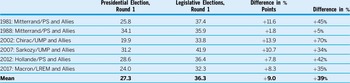
Stated another way, based on the data collected by Shugart and Taagepera (Reference Shugart and Taagepera2017), whenever E is close to zero (i.e., when legislative voting takes place “just after” the presidential elections, as it does in France), legislative elections theoretically enable the president’s party to achieve a score that is 20% higher, on average, than the new president’s score in the first round. In France, however, this surge is considerably higher. The presidential party scores an average of 9 points higher than the president himself—an increase of more than one third of the vote share (table 1).
Presidential and Legislative Elections Results in the First Round Since 1981 (in % of Votes Cast—France Total)

Source: Laurent de Boissieu, www.france-politique.fr/elections-legislatives.htm.
The legislative elections not only confirm the results of the presidential race; they also profoundly amplify the outcome in terms of both votes and seats. But which mechanisms are at work?
From 1981, it became apparent that the presidential party’s victory in the legislative elections is less the result of the defection—temporary or otherwise—of the voters who supported defeated candidates in the presidential race than the consequence of differential turnout, with supporters of vanquished presidential candidates heading to the polls in far lower numbers (Goguel Reference Goguel and Goguel1983). This phenomenon also was observed in 2017, when an Institut Français d’opinion Publique survey found that a mere 45% of Marine Le Pen’s and Jean-Luc Mélenchon’s voters turned out for the first round of legislative voting, compared to 68% of Emmanuel Macron’s supporters.
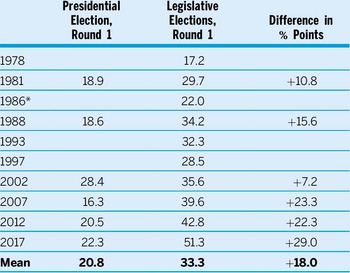
It is as though the drama of the presidential race quenched the voters’ thirst for politics for the next five years, leaving them weary until the next presidential race. Yet, there is more to it than that: voters also have the impression that the outcome of elections is all but a foregone conclusion. As Shugart (Reference Shugart2017) noted, “The purpose of the upcoming election is to ratify the new executive’s direction, not to be a second chance for an alternative vision.” This impression has only intensified over time. The gap in turnout levels between the two elections, which stood at slightly more than 10 points in 1981, has regularly surpassed 20 points since the late 2000s, thereby mechanically favoring the victory of the president’s party (table 2).
Abstention in Legislative Elections from 1978 to 2017 (France Total)

Note: *Only the 1986 legislative elections featured a party-list proportional representation race held at the level of each département.
Source: Laurent de Boissieu, www.france-politique.fr/elections-legislatives.htm.
In addition, France’s legislative-elections system contributes significantly to forging a parliamentary majority. In practice, the two-round electoral system used in France is even more brutal than the single-round voting system used in the United Kingdom (i.e., the country of the “cube law”), in which—according to Taagepera (Reference Taagepera1973)—amplification long took the form of an exponent of 3, or as follows:
 $$ \mathrm{S}\left(\mathrm{a}\right)/\mathrm{S}\left(\mathrm{b}\right)\hskip0.35em =\hskip0.35em {\left(\mathrm{Va}/\mathrm{Vb}\right)}^3 $$
where V(a) and S(a), respectively, correspond to the share of votes and seats won by party (a), and V(b) and S(b) correspond to those won by party (b).
However, in France, analysis based on the results of the six legislative elections held under the two-round majority system between 1978 and 2002 showed that the seat-vote equation did not follow the “cube law” but instead generally obeyed the “fourth-exponent law.” This means that during this period, the amplification effect was stronger in France than in the United Kingdom (Dolez and Laurent Reference Dolez and Laurent2005).
Two factors explain this phenomenon. The first, strategic voting, is not unique to France. It contributes to marginalizing candidates, district by district, with ostensibly low chances of being elected—or at least of making it to the second round (i.e., the threshold for qualification in a district is set at 12.5% of registered voters). Competition thus tends to focus on one or two major political parties or on one or two major alliances in which electoral coalitions have formed (Di Virgilio, Dolez, and Laurent Reference Di Virgilio, Dolez and Laurent2015). The result was that until 2012, in most cases, the second round consisted of a duel between the Left and the Right, typically between one candidate from the PS and the other from the UMP.
The second factor, however, is unique to France, clearly distinguishing it in this respect from the United Kingdom (and even more so from the United States). In France, legislative races are not particularly “local” in nature, which has the following two concrete meanings:
-
(1) The scores for political parties in each constituency mirror their national averages relatively closely. In other words, for a given political party, variations among different districts have been the result of the local specificities of the French election map and the quality of the local foothold of incumbent contenders (Loonis Reference Loonis2006). This is especially important in the case of multiple officeholders—a particularity of the French system, which until recently allowed mayors of large cities to simultaneously serve in the National Assembly (Foucault Reference Foucault2006). Throughout the 2000s and into the early 2010s, these two phenomena helped consolidate the power of the two major governing parties—the UMP and the PS—over French politics.
-
(2) The same shifts in opinion have been observed in districts throughout the country: when the Left has gained support, it has gained support everywhere, and the same is true for the Right.
Thus, in each sequential legislative election, the president’s party systematically succeeded in achieving an appreciable lead not only nationally but also across most of the country’s electoral districts, handily carrying most of them in either the first or the second round. The dynamics of this lead can be demonstrated using the following equation devised by Taagepera (Reference Taagepera2007):
 $$ {\mathrm{s}}_1\hskip0.35em =\hskip0.35em 1/{\left(\mathrm{MS}\right)}^{1/8}\hskip0.35em =\hskip0.35em 0.45 $$
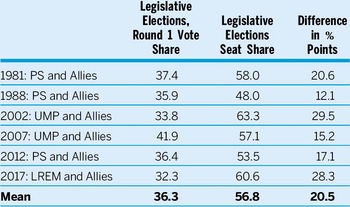
where s1 corresponds to the share of seats that the presidential party could have hoped to win given the district magnitude (M) and the number of districts in the election (S = 577 since 1988). As shown in table 3, the proportion of seats won was significantly higher than the proportion that was expected in both 1981 and 1988 and from 2002 to 2012.
Vote Share and Seat Share of the President’s Party in Legislative Elections Since 1981 (France Total)

Source: Laurent de Boissieu, www.france-politique.fr/elections-legislatives.htm.
2017: THE HONEYMOON ELECTION MODEL APPLIED TO MACRON’S ELECTION
Would the victory of an outsider in the 2017 presidential race call this model into question? Two factors seemed to coalesce to complicate the task facing the new president—a fact that pundits were happy to underscore. Some were betting on the resiliency of the two major parties, which have structured French political life for decades, as well as on their ability to immediately bounce back from their defeat in the presidential race, in part due to the “localness” of the legislative elections and the strong foothold of their incumbent candidates. Other pundits, in parallel, pointed to the difficulty that La République En Marche (LREM)—founded only one year prior—would face in finding candidates capable of securing a seat in each of the country’s 577 electoral districts. Indeed, only 29 incumbents had chosen to defect to the LREM and, in most districts, the party selected novice candidates who had no political experience.
However, the uncompromising logic of sequential elections ultimately won out (Dolez and Laurent Reference Dolez and Laurent2017). The political landscape was decimated by the presidential election, and the shockwave that it generated extended to the ensuing legislative race. The opprobrium cast on the PS in the wake of François Hollande’s term and the chaos that reigned among the country’s right-wing candidates—deprived of a clear leader—facilitated the LREM victory. Turnout plummeted by 29 points compared to the first round of presidential elections, due in part to low participation from voters who had backed Le Pen and Mélenchon. Although candidates for the LREM and its allies earned 1.3 million fewer votes than Macron had only two months earlier, they nevertheless received 32.3% of the votes cast—an 8% gain compared to Macron’s score (24%).
Two new factors even worked in favor of an LREM victory. The first factor relates to the ban on holding multiple elected offices. Most members of parliament who then also were serving as mayors opted to retain their mayoral seat. More than 200 representatives (i.e., approximately 40% of incumbents) did not run for reelection, thereby providing inroads for LREM candidates (Evans and Ivaldi Reference Evans and Ivaldi2017). The second factor favored LREM in the second round of voting: its central position on the political spectrum, which allowed it to win in the second round in face-offs against both the Right (273 cases), through support from left-wing voters, and against the Left (135 cases), through support from right-wing voters (Dolez and Laurent Reference Dolez and Laurent2018). As a result, the LREM and its allies succeeded in securing an absolute majority of the seats in the National Assembly.
The electoral outcome in 2017 demonstrates that a candidate capable of rallying more than half of the vote in the second round of the presidential election—regardless of the strength of his or her local party’s local presence—has the ability to win a legislative majority by taking advantage of the honeymoon election surge.
THE OUTLOOK FOR 2022
In light of these factors, all signs pointed to a scenario in which the next president again would benefit from a honeymoon election surge in June 2022. The last six sequential elections demonstrated that:
…all signs pointed to a scenario in which the next president again would benefit from a honeymoon election surge in June 2022.
-
1. Between the presidential and legislative elections, the presidential party gathers substantial momentum—surging by an average of 9 points as a result of the differential abstention of voters supporting the candidates who were defeated two months prior. The newly elected president’s party systematically scores more than 30% higher in the first round of the legislative elections, and this percentage often exceeds 35%.
-
2. In the second round of voting, votes from supporters of candidates eliminated in the first round and the inherent effects of the two-round system provided the president’s party an absolute legislative majority five of six times. The share of seats secured by the presidential party in the second round has been significantly more than the share of the vote received in the first round. The difference has never been less than 12 points; the average difference has been 20.5 points.
Given this information, the seat share (SL) obtained by the presidential party depends on the vote share (VL) that it obtains in the first round, itself dependent on the vote share (VP) received by the future president in the first round of presidential voting. Thus:
 $$ {\mathrm{S}}_{\mathrm{L}}\hskip0.35em =\hskip0.35em \mathrm{f}\left({\mathrm{V}}_{\mathrm{P}}\right) $$
However, this is not enough to produce reliable electoral forecasts.
These forecasts would make sense only after the presidential election. However, it was possible to imagine three potential scenarios. Macron’s reelection seemed to be the most likely outcome, which therefore would be his second term. The LREM, of course, would be able to count on the local presence of its incumbent contenders. Above all, the presidential party, which benefited from the collapse of the Left in 2017, now stood to benefit from the fragmentation of the Right, caught in a stranglehold between Macron and Far Right candidates. Nevertheless, it is important to remember that in 1988, when Mitterrand was reelected, the Socialists were able to win a plurality only in the National Assembly—a far cry from the “Pink Wave” of 1981. Likewise, in 2007, the Right had been in power for five years and, although it was able to keep a majority in the wake of Nicolas Sarkozy’s election, it ultimately surrendered 45 seats in the National Assembly. If Macron were to be reelected, it was likely that a similar scenario would play out, especially that LREM candidates in the second round would benefit less from their central position than they did in 2017, whether they were facing the Left, the Right, or the Far Right.
If Valérie Pécresse were elected, however, it would be her first term. She would benefit from the local presence of Les Républicains candidates and also would be the first beneficiary of the reclassification of Macron’s voters, whose champion would have been defeated in a few weeks. Pécresse certainly would secure a large parliamentary majority.
Finally, it was possible that Le Pen or Mélenchon might win. At the time, it seemed unlikely but, if it were to occur, they doubtless would find securing a legislative majority to be a more complicated endeavor as a result of their respective places on the political spectrum and the limited local foothold of their parties—particularly the low number of incumbents already in office. However, the shockwave that would be created by the presidential election should not be underestimated. Who, in January 1981, would imagine the “Pink Wave” later that year in June? Likewise, who, in January 2017, would imagine that Macron would win the election and boast the support of 350 representatives only six months later? Whereas the likelihood that there would be new honeymoon elections in June seemed quite high, the actual extent of a future parliamentary majority will be contingent on factors that would become clear only after the presidential election was decided.
As such, we recommend that legislative-elections forecasts made after the presidential election account for whether the president was being elected for the first or the second time (i.e., dummy variable) and his or her place on the political spectrum (i.e., center or non-center). Leveraging data gathered from individual electoral districts also is a good way to improve the quality of these forecasts. In particular, at the electoral-district level, we suggest considering (1) the score of the newly elected president in the first round of presidential elections; and (2) whether the incumbent is running for reelection.
ACKNOWLEDGMENT
We thank the reviewers for their many helpful comments.
CONFLICTS OF INTEREST
The authors declare that there are no ethical issues or conflicts of interest in this research.