Introduction
Paediatric tracheostomy indications have changed over the last decades because of modifications in the airway disease profile, partly as a result of modern therapeutic approaches.Reference Ogilvie, Kozak, Chiu, Adderley and Kozak1 Long considered an emergency procedure to treat respiratory obstruction, currently tracheostomy is mainly an approach to decrease intensive care morbidity.Reference Gergin, Adil, Kawai, Watters, Moritz and Rahbar2,Reference Line, Hawkins, Kahlstrom, MacLaughlin and Ensley3
Despite the plethora of reports concerning surgical techniques and complications associated with paediatric tracheostomy, only a few have evaluated tracheostomy decannulation.Reference Beaton, Baird, Clement and Kubba4–Reference Wirtz, Tibesar, Lander and Sidman9 Reported tracheostomy decannulation rates range, over distinct patient subgroups, from 56 per cent to 95 per cent.Reference Beaton, Baird, Clement and Kubba4,Reference Leung and Berkowitz6–Reference Wirtz, Tibesar, Lander and Sidman9 Clinical factors previously associated with unsuccessful tracheostomy decannulation are: younger age, neurological impairment, inadequate bronchial toilet procedures, vocal fold paralysis, failure in the tracheostomy tube capping trial, and tracheostomy decannulation attempts without a preceding endoscopic diagnosis.Reference Beaton, Baird, Clement and Kubba4,Reference Leung and Berkowitz6–Reference Wirtz, Tibesar, Lander and Sidman9
Decision on the proper moment for a tracheostomy decannulation attempt in a paediatric patient frequently poses a therapeutic dilemma given a wide range of uncertainty. The evaluation of potentially influential clinical factors is essential to predict the probability of tracheostomy decannulation success. Determination of such factors can optimise treatment timing, possibly prevent recannulation and decrease adverse events.
This study aimed to assess the characteristics of a multicentric paediatric cohort of patients undergoing tracheostomy and to identify potential factors associated with tracheostomy decannulation success. It was hypothesised that tracheostomy indications and complications, along with patient demographic and clinical characteristics, would significantly influence the probability of tracheostomy decannulation.
Materials and methods
This multicentric retrospective cohort study comprised paediatric patients who underwent tracheostomy, managed by the otolaryngology department staff at four high complexity healthcare referral centres in Brazil. The institutions participating in this research and their respective sites (city, state) were: Hospital de Clínicas de Porto Alegre (Porto Alegre, Rio Grande do Sul), Hospital da Criança Santo Antônio (Porto Alegre, Rio Grande do Sul), Hospital Estadual de Sumaré (São Paulo, São Paulo) and Hospital das Clínicas da Universidade Federal de Goiás (Goiânia, Goiás). Institutional research ethics committee approval was obtained from all contributing sites.
The study enrolled all paediatric patients (under 18 years of age) undergoing tracheostomy at the participating centres (convenience sampling), from January 2013 to December 2015.
Medical records were reviewed and data were extracted for variables including: age at tracheostomy, demographics, co-morbidities (pulmonary, cardiac, gastrointestinal, neurological, prematurity (32–36 weeks) or extreme prematurity (less than 30 weeks), and genetic disease), indication for tracheostomy (any given cause leading to tracheostomy – multiple causes could be issued), complications (any event directly or indirectly related to the surgical procedure or post-operative follow up), and data concerning the eventual tracheostomy decannulation process during follow up. The follow-up period began at the moment of tracheostomy and persisted until tracheostomy decannulation, or the last medical visit for those not undergoing tracheostomy decannulation.
The tracheostomy decannulation protocol in all four centres began with an endoscopic airway assessment to ensure that the previous airway pathology had resolved and that no new pathology related to tracheostomy itself had arisen. Once a favourable endoscopic airway evaluation was obtained, the tracheostomy tube was downsized to one of a smaller diameter and capped for a variable period. Tracheostomy decannulation was performed only if the child presented an adequate respiratory pattern during tube capping. This was an in-patient procedure, and observation for a period of 24–48 hours was required before discharge. Given the nature of this tracheostomy decannulation protocol, the frequency of procedure failures was negligible.
All tracheostomy decannulation trials were performed according to this protocol, except in two situations: children submitted to a single-stage laryngotracheal reconstructive procedure, when the cannula was withdrawn at the time of the surgery; and children too small to allow downsize of the cannula, for whom the tube was withdrawn soon after the airway endoscopy.
The authors assert that all procedures contributing to this work complied with the ethical standards of the relevant national and institutional guidelines on human experimentation, and with the Helsinki Declaration of 1975, as revised in 2008.
Statistical analysis
Continuous variables were reported as mean and standard deviation for symmetrical distributions, or as median and interquartile range (25–75th percentiles) for asymmetrical distributions, according to the Shapiro–Wilk test. Categorical variables were described as absolute frequency and percentile fraction.
Mathematical modelling was performed to establish associations among different groups of predictors (mainly indications, co-morbidities and definitive diagnosis) and the primary outcome of ‘successful tracheostomy decannulation’. We fitted a Cox proportional hazards regression model (considering time to tracheostomy decannulation) to evaluate the predictors of tracheostomy decannulation outcome. We used a backward stepwise strategy for predictor selection. After the final model was adjusted, the linearity of continuous predictors was formally tested using the log likelihood ratio statistic. Goodness-of-fit for both models was ascertained by residuals analysis (Schoenfeld, Martingale, deviance and Cox–Snell residuals). Possible interactions were also tested and maintained in the model when significant. Hazard ratios are presented as the ‘risk’ of tracheostomy decannulation; therefore, estimates above the value of 1 were considered beneficial, while those under the value of 1 were considered harmful (related to the maintenance of tracheostomy). Patients were censored at the last medical visit date they attended.
No subgroup analysis was predefined. Patients with missing data were not included in the final multivariate analysis. A significance level of p < 0.05 was required for all comparisons.
Results
A total of 160 patients were enrolled during the study period. Median time on tracheostomy was 14.5 months (interquartile range = 3.7–21.5 months). Baseline characteristics are described in Table 1. Outcomes data were available for the whole cohort.
Baseline characteristics

IQR = interquartile range
The mortality rate was 18.1 per cent (29 events), with a mean overall survival time of 27.8 months (interquartile range = 25.5–30.2 months), which was mainly attributed to associated co-morbidities (15 per cent, 24 events). Tracheostomy-related complications resulted in two fatal events (1.25 per cent). For three patients (1.9 per cent), the cause of death was considered unclear.
Tracheostomy decannulation
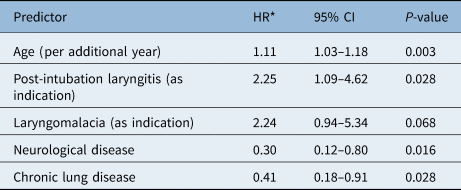
The tracheostomy decannulation rate was 22.5 per cent (36 out of 160 cases). The multivariable regression model identified five significant predictors for tracheostomy decannulation outcome (Table 2). All except one parameter reached the significance level of 0.05. Nonetheless, this one parameter showed a trend to significance and was considered clinically plausible, and was therefore maintained in the final model.
Final multivariable Cox regression model, showing predictors of decannulation outcome

* Predictors with hazard ratio exceeding a value of 1 indicate an increase in the chance of decannulation; those hazard ratios lower than 1 indicate a decreased chance of the same outcome. HR = hazard ratio; CI = confidence interval
As the model indicates, for each additional year of age at the time of tracheostomy, there was an 11 per cent increase in the probability of tracheostomy decannulation. In addition, post-intubation laryngitis as an indication for tracheostomy was associated with more than twice the basal probability of tracheostomy decannulation, and there was a trend for a similar effect with laryngomalacia (p = 0.068). Neurological and pulmonary co-morbidities decreased the probability of successful tracheostomy decannulation by 70 per cent and 59 per cent, respectively.
Co-morbidities were identified in almost half of the patients. More than 40 per cent of patients had two or more concomitant co-morbidities. The number of cumulative associated conditions seemed an important risk factor for tracheostomy decannulation failure. Thus, the probabilities of tracheostomy decannulation for different quantities of cumulative co-morbidities were determined. The probability of tracheostomy decannulation decreased significantly with increasing numbers of associated baseline conditions (p < 0.001), as shown in Figure 1.
Decannulation rate according to the number of cumulative co-morbidities.

Complications
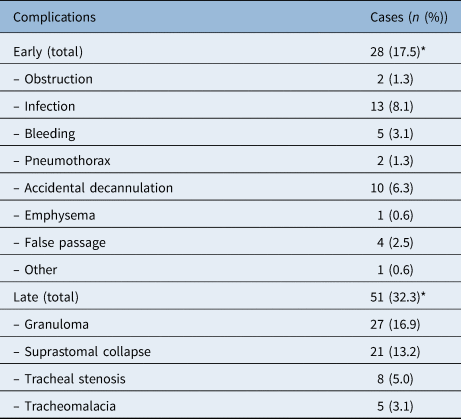
The incidence rates of early and late complications are described in Table 3. The lack of a specific co-morbidity and the presence of more than one co-morbidity were associated with an increased incidence of complications (p > 0.05). Age at tracheostomy was not a predictor for those complications.
Incidence of early and late complications

* Some patients had more than one complication.
Discussion
In this study, the tracheostomy decannulation rate was low, mainly a result of the characteristics of the patient sample and the restricted follow-up time. Older age at tracheostomy and post-intubation laryngitis (and a trend for laryngomalacia) as indications for tracheostomy were associated with a higher probability of tracheostomy decannulation. However, neurological and respiratory co-morbidities significantly hindered tracheostomy decannulation. A relatively high rate of early (17.5 per cent) and late (32.3 per cent) complications was observed, but those events did not seem to contribute to mortality in this cohort, which was also prominent (18.1 per cent) during the follow-up period (median overall survival time of 27.8 months).
This study successfully reviewed outcome data for a specific sample of severely compromised tracheostomised paediatric patients. Few studies have evaluated this in such a robust number of patients. The completeness of data extracted should also be considered, which contributed to the precision of the final results.
Children with conditions that require long-term and complex clinical and surgical treatments, such as those with craniofacial malformations, Pierre Robin sequence, and functional diseases such as neurological and pulmonary pathologies, comprised more than 50 per cent of our population (the clinical profile of patients from this sample is reported elsewhereReference Maunsell, Avelino, Caixeta Alves, Semenzati, Lubianca Neto and Krumenauer10). This is a result of the referral structure in Brazil: severely compromised patients are treated and followed up only in specialised hospitals, while patients with less severe conditions, and an increased potential for tracheostomy decannulation, remain in intermediate care facilities. A report from one of the healthcare centres participating in the present study (a referral centre for craniofacial anomalies) revealed that 84 per cent of patients referred to their high complexity facility had a co-morbid condition.Reference Schweiger, Manica, Becker, Abreu, Manzini and Sekine11 This could explain the low incidence of tracheostomy decannulation and the extended period of tracheostomy observed.
Indeed, a recent publication has identified the presence of isolated structural or anatomical disorders as a positive predictive factor for successful tracheostomy decannulation, when compared to functional disorders. Moreover, the intact functions of swallowing and normal ambulation may positively influence tracheostomy decannulation.Reference Takahashi, Takano, Mitsuzawa, Kurose and Himi8 Patients in whom the tracheostomy indication was poor bronchial toilet required cannula maintenance for a longer time as compared to those whose indication was airway obstruction and/or prolonged mechanical ventilation. Additionally, trauma and neurological diseases have been shown to increase the time until tracheostomy decannulation.Reference Leung and Berkowitz6
A recent study from Glasgow showed a 58 per cent success rate for tracheostomy decannulation.Reference Beaton, Baird, Clement and Kubba4 There was no association between age or weight at the time of the tracheostomy decannulation trial or mean time of tracheostomy persistency and the failure of tracheostomy decannulation. Four and 7 out of 45 children had neurological or pulmonary co-morbidities, respectively.Reference Beaton, Baird, Clement and Kubba4 This population differs from ours, as more than 50 per cent of our patients presented with neurological or pulmonary diseases, and/or craniofacial malformations.
Data from a study conducted in Philadelphia showed a tracheostomy decannulation failure rate of only 9 per cent in selected patients.Reference Prickett and Sobol7 The worst results were found in younger patients and those with a diagnosis of vocal fold paralysis. Patients who had obstructive symptoms during a previous trial of tracheostomy cannula capping also showed a greater rate of failure.Reference Prickett and Sobol7 In our population, the diagnosis of vocal fold paralysis as the indication for the tracheostomy was very rare (7.5 per cent), which makes it difficult to compare our findings. However, older patients also showed a higher tracheostomy decannulation rate in our population. Contrary to the Philadelphia study, we do not attempt cannula withdrawal if the child is symptomatic during the tube capping trial.
Another factor considered crucial for successful tracheostomy decannulation is the performance of an airway endoscopic evaluation before the trial attempt. A previous report described a 100 per cent success rate for cannula withdrawal when the patients had airways considered adequate for tracheostomy decannulation in the endoscopic evaluation.Reference Wirtz, Tibesar, Lander and Sidman9
As part of our tracheostomy decannulation protocol, all our patients underwent airway endoscopy before the tube capping trial, to determine the airway patency and the likelihood of tracheostomy decannulation success. However, as almost 50 per cent of the children presented with complex airways and required multiple surgical procedures before a tracheostomy decannulation attempt, our rate of ‘adequate airway for tracheostomy decannulation’ was very low.
Polysomnography may be a useful tool in determining tracheostomy decannulation timing. Some algorithms include polysomnography with the capped cannula as important for ascertaining the patency of the airway before the tracheostomy decannulation trial.Reference Gurbani, Promyothin, Rutter, Fenchel, Szczesniak and Simakajornboon12–Reference Robison, Thottam, Greenberg, Maguire, Simons and Mehta14 The lack of polysomnographic data in our cohort reflects regional difficulties in the availability of sleep laboratory facilities.
In our population, increasing age and post-intubation laryngitis as the indication for tracheostomy were positively associated with tracheostomy decannulation success, while neurological and pulmonary co-morbidities decreased the probability of tracheostomy decannulation. In addition, an increased number of cumulative co-morbidities lowered the chances of tracheostomy decannulation. The presence or absence of such predictors could aid tracheostomy decannulation planning, and, more importantly, help the attending physician to set real expectations regarding tracheostomy decannulation with patients, carers and family. Our results differ from those reported by other studies, mainly because of peculiarities inherent to our set of severely compromised patients.
• Older age at tracheostomy and post-intubation laryngitis (and a trend for laryngomalacia) as indications for tracheostomy were associated with eventual decannulation
• Almost half of patients had co-morbidities; tracheostomy decannulation probability decreased with increasing numbers of co-morbidities
• Neurological and pulmonary co-morbidities decreased decannulation probability by 70 and 59 per cent, respectively
• Early (17.5 per cent) and late (32.3 per cent) complication rates were high, but did not seem to contribute to mortality
• Mortality was prominent (18.1 per cent) during the follow-up period (median overall survival time of 27.8 months)
• Tracheostomy-related complications resulted in two fatalities (1.25 per cent); cause of death was unclear in three patients (1.9 per cent)
A limitation of this study is its retrospective design. Nevertheless, the significant amount of data collected from four high complexity centres in different regions of Brazil provides an accurate and up-to-date picture of current paediatric tracheostomy in our country. Our particular sample of severely compromised patients is not representative of the whole population of tracheostomised patients, but it does represent an accurate scenario of the real-life challenges of referral healthcare centres.
Tracheostomy may be a life-saving procedure in many situations. However, it poses some risks, and impacts on the children's and parents’ quality of life. Therefore, tracheostomy decannulation should be pursued systematically. Unfortunately, this is not an achievable goal for every patient, as we have demonstrated. Understanding the potential clinical factors that predict tracheostomy decannulation can help with long-term tracheostomy planning, and carer or family counselling.
Competing interests
None declared