INTRODUCTION
Scaphopods constitute a very uniform class of exclusively marine and infaunal molluscs characterized by a tusk-shaped shell and unique tactile organs called captacula (Poon, Reference Poon1987; Shimek, Reference Shimek1990; Fontoura-da-Silva et al., Reference Fontoura-da-Silva, Dantas and Caetano2013). Scarce in shallow waters (less than 1% of the molluscan fauna) and relatively abundant in deep-sea communities, these animals are distributed worldwide and can be found at sandy and muddy bottoms from the intertidal zone to depths that exceed 6000 m (Shimek, Reference Shimek1988; Palmer & Steiner, Reference Palmer, Steiner, Beesley, Ross and Wells1998; Reynolds & Steiner, Reference Reynolds, Steiner, Ponder and Lindberg2008). Important members of the marine benthic communities, the Scaphopoda display a variety of ecological relationships with other organisms (Reynolds, Reference Reynolds2002).
Considered to be micro-carnivores, omnivores or even deposit-feeders, these animals are reasonably well-known for preying mostly upon benthic foraminiferans; other minor items like ostracods, bivalve spat and eggs have also been reported (Reynolds, Reference Reynolds2002). Nevertheless, the feeding ecology of this taxon has seldom been examined, with just a few studies that comprise a total of 11 species (order Dentaliida: 4; order Gadilida: 7). Bilyard (Reference Bilyard1974) was the first to execute a qualitative/quantitative analysis of a scaphopod diet. He studied the feeding habits of the subspecies Antalis entalis stimposoni Henderson, 1920 at the Boothbay region of the Gulf of Maine, USA, and described a diet based on calcareous Foraminifera and a few minor items; moreover, the author stated that the sensory cells on the surface of the captacula could be responsible for prey selection, thus enabling this scaphopod to be a selective feeder. The diet and feeding behaviour of Gadila tolmiei (Dall, 1897) was investigated by Poon (Reference Poon1987) at Barkley Sound, Canada. This study also revealed a feeding preference for Foraminifera and the foraging behaviour of this gadilid was reported to be similar to that already portrayed for some dentaliids (Dinamani, Reference Dinamani1964a, Reference Dinamani1964b; Gainey, Reference Gainey1972). At this same study area, Shimek (Reference Shimek1990) examined the diets and habitat utilization of three scaphopod species: Rhadbus rectius (Carpenter, 1864), Gadila aberrans (Whiteaves, 1887) and Pulsellum salishorum Marshall, 1980. He found all three species to be specialist feeders of Foraminifera that appeared to alter relative abundances and size-frequency distributions of their prey populations. Rhadbus rectius was the only one to thrive in habitats with low populations of foraminiferans, since it could utilize alternative food sources, such as faecal pellets, kinorhynchs and several invertebrate eggs.
Langer et al. (Reference Langer, Lipps and Moreno1995) analysed the predation on Foraminifera by the dentaliid Fissidentalium megathyris (Dall, 1890) at various sites off the coast of California, USA, therefore being the first to bring knowledge to the diet of a deep-sea scaphopod of larger dimensions. Their research pointed out a diet almost exclusively composed of benthic foraminiferans (99%) with directed attack to the last chambers of these protozoans (where the cytoplasm may contain a more protein-rich content). Further investigations on scaphopods inhabiting greater depths were carried out by Gudmundsson et al. (Reference Gudmundsson, Engelstad, Steiner and Svavarsson2003) at Icelandic waters; the species assessed were Polyschides olivi (Scacchi, 1835), Pulsellum affine (M. Sars, 1865), Pulsellum teres (Jeffreys, 1883) and Siphonodentalium lobatum (Sowerby, 1860). Overall, these molluscs seemed to be preying upon some of the most common foraminiferan species in the study sites; also, the microdistribution and the large individual size of the Foraminifera were underlined as important factors in avoiding predation by scaphopods. Finally, as the only study performed in the southern hemisphere, the paper of Glover et al. (Reference Glover, Taylor, Whittaker, Wells, Walker and Jones2003) brought some novel information regarding the diet of the intertidal scaphopod Laevidentalium lubricatum (Sowerby, 1860) at the Burrup Peninsula, Western Australia. The mollusc apparently rejected some of the most abundant foraminiferan species and consumed preferentially those less frequent.
This work focuses on the dentaliid Fissidentalium candidum (Jeffreys, 1877), a large deep-sea scaphopod (~100 mm in length) found all over the Atlantic Ocean, from Greenland to Namibia in the eastern waters, and from Greenland to Brazil in the western (Steiner & Kabat, Reference Steiner and Kabat2004; Souza et al., Reference Souza, Araújo and Caetano2013). The species is reported for the Brazilian south-eastern continental margin at Santos Basin and, more recently, Campos Basin, between 1000 and 1600 m depth (Steiner & Kabat, Reference Steiner and Kabat2004; Souza et al., Reference Souza, Araújo and Caetano2013).
The nature of Scaphopoda enables very detailed diet analyses, mostly due to their conspicuous feeding process, where food particles are transported to the mouth in three possible ways: by being captured or trapped by the tip of captacula; one group of captacula can be used together to capture larger prey; or the particles may be carried from the bulb to the base of the captacula by ciliary action – in this case the existence of a ciliary band at the filaments of the captacula is needed (Fontoura-da-Silva et al., Reference Fontoura-da-Silva, Dantas and Caetano2013). The labial palps evert and select the material to be taken in, which is held in a pair of buccal pouches inside the oral tube until it passes through a constriction into the pharynx (where the radula efficiently grinds all prey into small pieces) (Bilyard, Reference Bilyard1974). For this reason, the use of almost intact digestive content recovered from the buccal pouches in studies regarding the feeding ecology of scaphopods has been a valuable tool in the identification of their ecological role and understanding of the environment inhabited by these organisms (Reynolds, Reference Reynolds2002; Glover et al., Reference Glover, Taylor, Whittaker, Wells, Walker and Jones2003; Gudmundsson et al., Reference Gudmundsson, Engelstad, Steiner and Svavarsson2003). Therefore, as the first insight into the trophic ecology of a scaphopod in the South Atlantic, this study assesses the diet of the widespread Fissidentalium candidum, exploring important topics such as: food preferences, dietary diversity and uniformity, influence of predator–prey dimensions, spatial variation and feeding strategies.
MATERIALS AND METHODS
Sampling
Individuals of Fissidentalium candidum (Figure 1) were collected at Campos Basin, south-eastern Brazil, in April 2008, during an environmental characterization project called HABITATS (Environmental Heterogeneity in the Campos Basin), sponsored by PETROBRAS. The samples were obtained through bottom trawling at three different stations, between 1182 and 1244 m depth (Table 1); all specimens were preserved in 70% ethanol immediately after collection.
Details of the scaphopod Fissidentalium candidum: shell (A), oral tube (B), buccal pouches with food items inside (C, D), labial palps (E) and muscular foot (F).

Scaphopod collection sites at Campos Basin, south-eastern Brazil.

Gut contents and prey identification
The 40 specimens of F. candidum were dissected following the methods of Bilyard (Reference Bilyard1974) and the contents of its buccal pouches were removed and stored in microfossil slides; no staining method was performed in these samples. Prey items were counted and identified to the lowest taxonomic level possible using reference guides for Foraminifera (Boltovskoy, Reference Boltovskoy1959; Barker, Reference Barker1960; Cushman, Reference Cushman1969; Boltovskoy et al., Reference Boltovskoy, Giussani, Watanabe and Wright1980; Loeblich & Tappan, Reference Loeblich and Tappan1988; Holbourn et al., Reference Holbourn, Henderson and MacLeod2013) and Mollusca (Rios, Reference Rios1994, Reference Rios2009); other taxa were determined with the assistance of experts (see Acknowledgements). Also, in order to avoid the use of synonymies, the name of each taxa was confirmed through the digital database WoRMS (2014).
Each scaphopod specimen had its shell length and anterior aperture diameter measured with a digital Vernier caliper (accuracy of 0.01 mm). Additionally, they were separated in six size classes with intervals of 10 mm from 30–120 mm; the 40, 50 and 70 mm size classes did not have any representatives. Comprising 1/4 of the total sample, 10 exemplars were selected and all the prey in the guts of these individuals were examined under a stereoscopic microscope with an eyepiece micrometer (accuracy of 0.1 mm) in order to measure their individual critical diameter (sensu Shimek, Reference Shimek1990), which is the size dimension that defines if the food item can pass through the scaphopod anterior opening (i.e. the second largest measure of any food item).
Data analysis
To explore the individual importance of each prey species in the diet of Fissidentalium candidum, the frequency in number (i.e. total specimens of a prey taxon) and frequency of occurrence (i.e. percentage of samples containing a specific prey type) were calculated. As previously done by Shimek (Reference Shimek1990), Shannon-Weaver and Pielou Indexes were also applied aiming to meet, correspondingly, the dietary diversity (H) and evenness (J) of Fissidentalium candidum and the other scaphopod species formerly studied. Both indexes were calculated through the following formulae:
 $(H = - \sum\nolimits_{i = 1}^n {\,pi\ \ln \ pi)} $
and (J = H/ln S)., where pi stands for the proportion of a species in the diet, and S stands for the total number of taxa in the diet of F. candidum.
A t-test was used to compare the frequency in number of the benthic and planktonic species preyed upon by the scaphopod. Linear regressions were employed to investigate the existence of a positive relationship between the scaphopod body dimensions (i.e. shell length and anterior aperture diameter) and the prey critical diameter. Furthermore, in order to determine the occurrence of spatial variation in the diet of Fissidentalium candidum (amongst the three collection sites), five distinct variables were evaluated. Both, species richness and total amount of food items ingested were tested through an analysis of variance (ANOVA), while the frequencies in number of the three most abundant prey species were tested by a one-way permutational multivariate analysis of variance (PERMANOVA) using the Bray–Curtis resemblance matrix for multivariate measurements; homogeneity of multivariate dispersion was also tested with PERMDISP, never resulting in significant values.
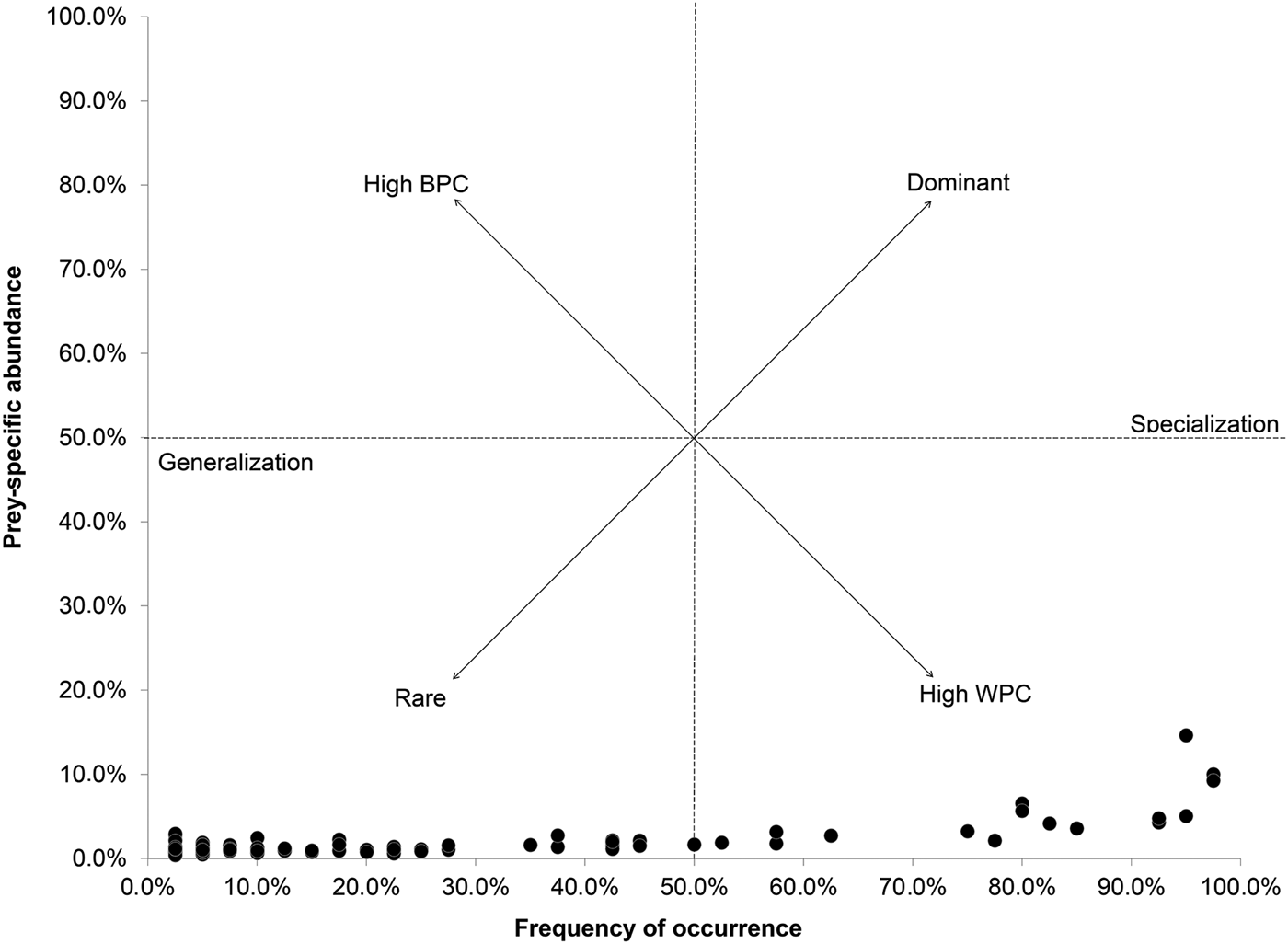
Finally, in order to assess the feeding strategies of this dentaliid, the frequency of occurrence and the prey-specific abundance (i.e. the percentage a prey taxon comprises of all prey items in only those predators in which the actual prey occurs) were plotted and interpreted through Amundsen's diagram (Amundsen et al., Reference Amundsen, Gabler and Staldvik1996), a method that has, hitherto, been used more often in the field of ichthyology. Using such data, the diagram provides a measure of prey importance (i.e. dominant × rare or unimportant taxa) as a function of the variables; the predator is classified as more generalist or specialist as a reflection of the positioning of the prey points on the lower or upper part of the graph, respectively; what is more, it reveals if the population follows the same feeding strategy or if there are individual differences amongst the predators and its effects on their niche width (Amundsen et al., Reference Amundsen, Gabler and Staldvik1996).
RESULTS
Diet composition
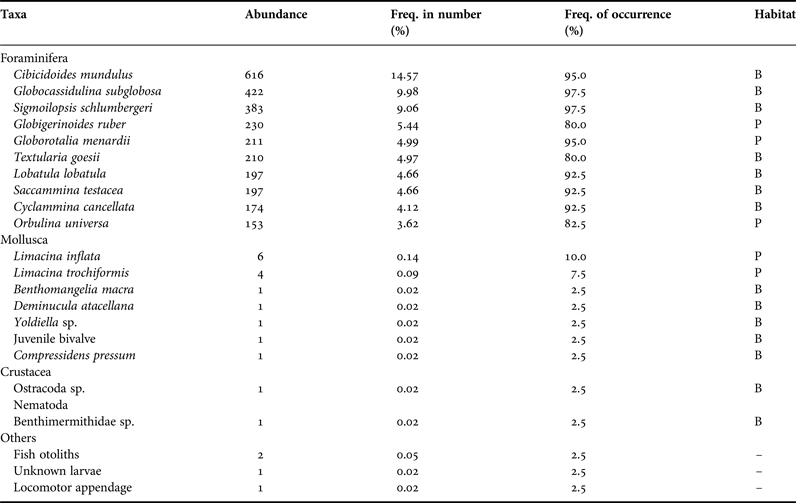
A total amount of 4228 food particles was recovered from the buccal pouches of 40 specimens of Fissidentalium candidum. The mean number of food items and taxa per scaphopod was, respectively, 105.7 ± 52.9 and 25.9 ± 8.4. With a species richness of 118 taxa, the scaphopod diet was mostly composed of foraminiferans (99.5%, 106 taxa); the remaining components included a few molluscs, a nematode, an ostracod, a pair of fish otoliths and two unknown partial organisms (Table 2). Substantial amounts of fine sediment grains and unidentifiable detritus were ingested together with food particles, as well as a few polymetallic nodules. However, such items were not accounted for in any analysis.
Taxa composition of the scaphopod diet with respective values of abundance, frequencies in number and occurrence and the natural habitat of each prey (B: benthos; P: plankton), including only the most abundant Foraminifera.

Three species of Foraminifera were the most common prey in the diet of the scaphopod: Cibicidoides mundulus (Brady, Parker & Jones, 1888), Globocassidulina subglobosa (Brady, 1881) and Sigmoilopsis schlumbergeri (Silvestri, 1904). Together, they comprised about 35% of the diet composition. Moreover, the foraminiferan species Cyclammina cancellata Brady, 1879, Globorotalia menardii (d'Orbigny, 1826), Lobatula lobatula (Walker & Jacob, 1798) and Saccammina testacea (Flint, 1899), despite their low frequencies in number, presented high frequencies of occurrence that were comparable to those of the most common prey (Table 2 and Figure 2).
SEM images of the most frequent prey taxa in the scaphopod diet: (A) dorsal and (B) lateral views of Cibicidoides mundulus, (C) Globocassidulina subglobosa, (D) Sigmoilopsis schlumbergeri, (E) Globorotalia menardii, (F) Saccammina testacea, (G) Lobatula lobatula and (H) Cyclammina cancellata.

Diversity and evenness values for the diet were 3.36 and 0.70, respectively. The t-test showed a significant difference amongst the frequencies in number of benthic and planktonic prey, with a major contribution of the sediment-living taxa in the diet of Fissidentalium candidum (t-test = 2.21, P = 0.02, df = 113).
Predator-prey dimensions, spatial variation and feeding strategies
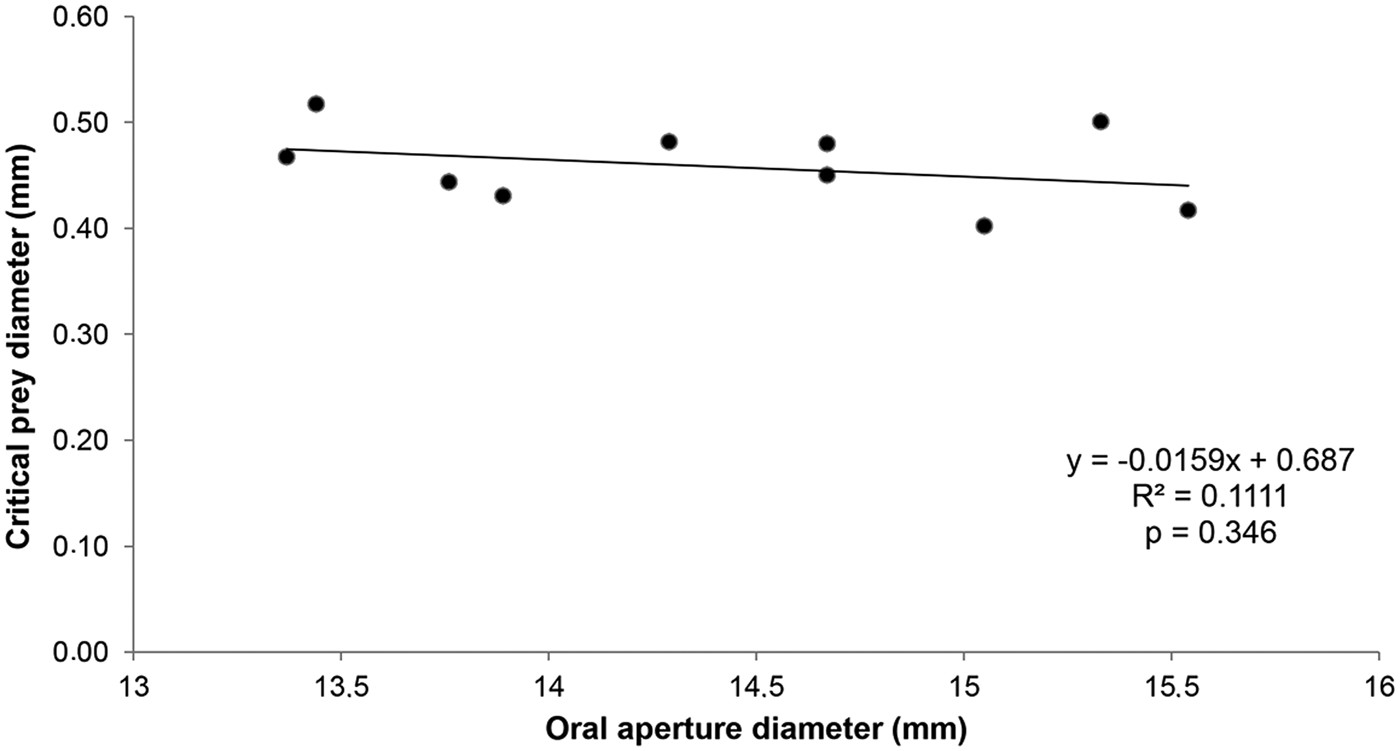
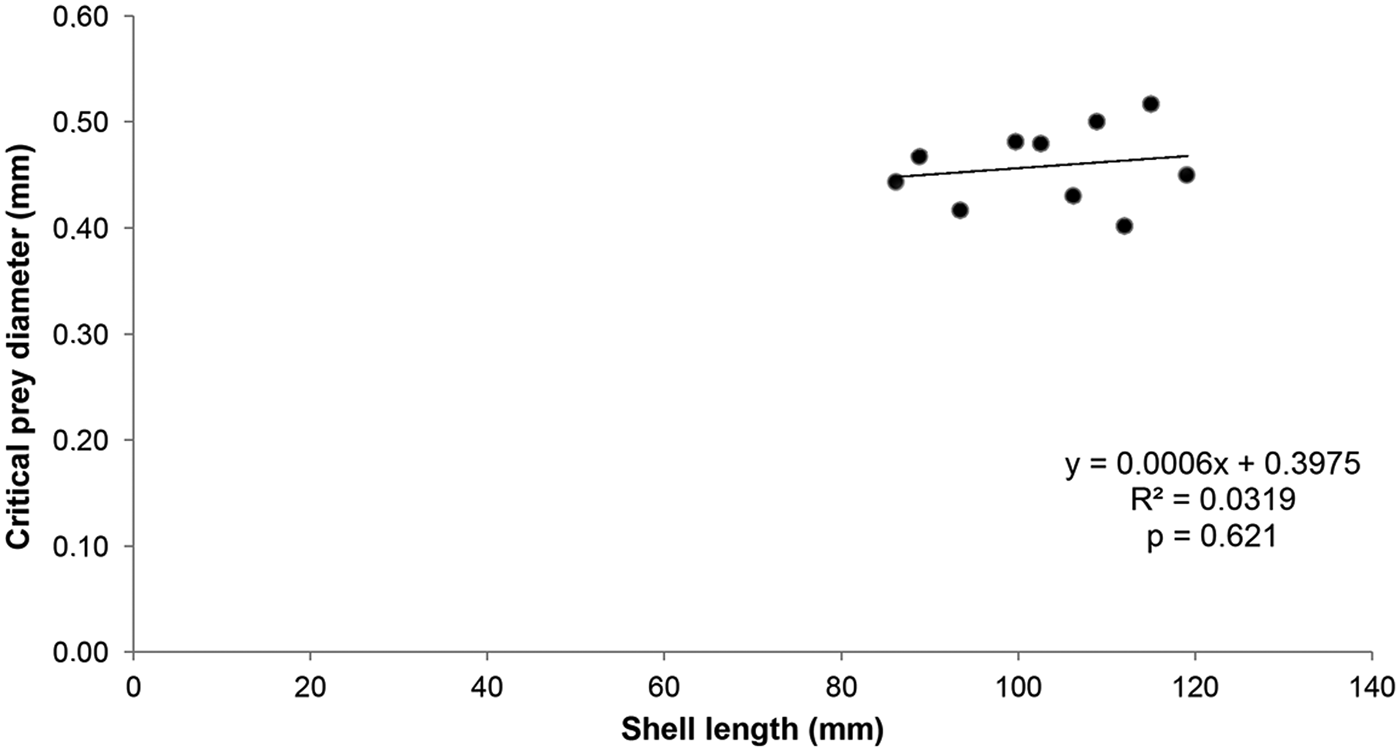
Scaphopod individuals measured an average of 99.8 ± 14.5 mm in length and 13.8 ± 1.7 mm in diameter of the anterior aperture, whereas the mean critical diameter of the prey was 0.4 ± 0.2 mm. Linear regressions pointed no significant correlations between the scaphopod body dimensions (shell length: R 2 = 0.03, P > 0.05; oral aperture diameter: R 2 = 0.11, P > 0.05) and its prey size (Figures 3 & 4).
Linear regression relating the Fissidentalium candidum shell length (mm) and the critical diameter of its prey (mm).

Linear regression relating the Fissidentalium candidum oral aperture diameter (mm) and the critical diameter of its prey (mm).

Both ANOVA and PERMANOVA results were not significant, indicating an absence of spatial variation in the diet of F. candidum along the three collection sites at Campos Basin (Table 3).
Results of ANOVA and PERMANOVA for the spatial variation in the diet of Fissidentalium candidum.

In the light of Amundsen's diagram, the graphical representation of the relation between the prey frequency of occurrence and prey-specific abundance showed a generalist feeding strategy, with all the prey points located at the lower part of the graph. High rates of rare or unimportant prey species and high contribution of within-phenotype components were also evident (Figure 5).
Relation between the prey frequencies of occurrence and prey-specific abundances. Amundsen's diagram: crossed arrows highlight where the existence of points would indicate the presence of dominant and rare or unimportant species in the diet, as well as the high contribution of the between phenotype component (BPC) or the within phenotype component (WPC) to the niche width; the horizontal line separates the superior and inferior portions of the graph, where the gathering of points would demonstrate, respectively, specialization or generalization of the predator feeding strategy.

DISCUSSION
The feeding habits of Fissidentalium candidum were very similar to those previously observed for other scaphopod species. With a micro-carnivore diet, this mollusc plays the role of a secondary or higher consumer in the detritus food chain, preying extensively upon the foraminifera assemblage that inhabits the deep waters of Campos Basin. According to Nomaki et al. (Reference Nomaki, Ogawa, Ohkouchi, Suga, Toyofuku, Shimanaga, Nakatsuka and Kitazato2008), phytodetritus and its degraded components form the basic energy and carbon sources that fuel benthic ecosystems, where foraminifera are commonly one of the most important consumers of fresh phytodetritus, especially in deep-sea settings (Moodley et al., Reference Moodley, Middelburg, Boschker, Duineveld, Pel, Herman and Heip2002; Nomaki et al., Reference Nomaki, Heinz, Nakatsuka, Shimanaga and Kitazato2005). Therefore, these protozoans constitute an important link between the microbial loop and the detritus food chain, processing up to 80% of the energy originated from autotrophs and passing about 30% of it to the next trophic level (Kirchman, Reference Kirchman2000; Nomaki et al., Reference Nomaki, Ogawa, Ohkouchi, Suga, Toyofuku, Shimanaga, Nakatsuka and Kitazato2008; Laut & Laut, Reference Laut, Laut, Meniconi, Silva, Lima, Lima, Lavrado and Figueiredo2012). Based on such information, it is likely that F. candidum is taking great advantage of this energy source, connecting the benthic microfauna and its natural predators, the benthic and demersal macroconsumers (e.g. naticid gastropods, chimaeras and other fishes) (Reynolds, Reference Reynolds2002).
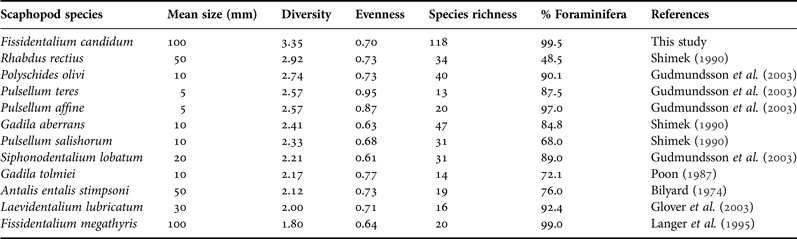
The compilation of a few aspects regarding the diets of all scaphopods analysed in the past, as well as the use of Shannon–Weaver and Pielou indexes, allowed some interesting comparisons (Table 4). With the exception of R. rectius, all the remaining scaphopods presented more than half of their diet composed by foraminiferans; F. candidum showed the highest percentage of foraminifera prey, followed by its congener F. megathyris, the dentaliid L. lubricatum and the gadilids P. olivi and P. affine. The greatest dietary diversity and species richness were also accredited to F. candidum and, although some may use its larger dimensions as an argument favouring a broader prey spectrum, this can be rapidly turned down by the fact that F. megathyris (with the same mean size) has the lowest diversity and one of the less rich diets. The apparent generalist predation upon foraminifera and the high number of rare or unimportant species in F. candidum diet are probably the most consistent reasons for these observations (i.e. highest percentage of foraminiferan prey, greatest dietary diversity and species richness so far). As a whole, the evenness values were low and did not appear to have any relevant divergences amongst the species, which might imply a general lack of uniformity in the feeding habits of the Scaphopoda, since their diet has consistently exhibited the same pattern (i.e. composed of a few preferential/more abundant prey species and other several rare ones) (Bilyard, Reference Bilyard1974; Poon, Reference Poon1987; Shimek, Reference Shimek1990; Langer et al., Reference Langer, Lipps and Moreno1995; Glover et al., Reference Glover, Taylor, Whittaker, Wells, Walker and Jones2003; Gudmundsson et al., Reference Gudmundsson, Engelstad, Steiner and Svavarsson2003).
Compilation of general results for the other scaphopod species studied and comparison with those found for Fissidentalium candidum.

The t-test supported the hypothesis that prey originated from plankton have no significant numerical value when compared with those from benthos. Bilyard (Reference Bilyard1974) stated that scaphopods feature a great capacity in detecting organic matter amid the bottom deposits. Thereby, it is possible to speculate that the ingestion of apparently empty tests may indicate the presence of remains of internal material with some nutritional value or even bacterial film working on the decomposition of such organisms. Still, considering that no staining method was done in this study in order to find organic matter amongst the foraminiferan tests, it is not plausible to officially make such affirmation; a more secure inference is accidental ingestion.
Investigations concerning the influence of scaphopod body dimensions in the composition and structure of their diet have been performed in the past through different methods by Bilyard (Reference Bilyard1974), Poon (Reference Poon1987), Shimek (Reference Shimek1990) and Gudmundsson et al. (Reference Gudmundsson, Engelstad, Steiner and Svavarsson2003). Nonetheless, with the exception of Gudmundsson et al. (Reference Gudmundsson, Engelstad, Steiner and Svavarsson2003), who found a significant relationship between the shell length of Polyschides olivi and the critical diameter of its foraminiferan prey, none of these authors had any relevant results in their inquiries. Fissidentalium candidum reflected the same pattern, exhibiting very weak and non-significant associations between its body measures (i.e. shell length and anterior aperture diameter) and the critical diameter of its food items, supporting the absence of any directly proportional size-relationship amid this predator and its prey.
Spatial variation in the diet of scaphopods was only tested once by Shimek (Reference Shimek1990) with the species R. rectius, G. aberrans and P. salishorum, for which he found considerable differences amongst the collection sites at Barkley Sound, Canada. Regardless, in this paper, the diet composition of F. candidum did not vary significantly from one sampling station to another, which were all located at the mid-slope of Campos Basin, between 1180–1245 m. According to Viana et al. (Reference Viana, Faugeres, Kowsmann, Lima, Caddah and Rizzo1998, Reference Viana, Almeida and Almeida2002), this area presents a bottom mostly constituted of fine sediment and empty shells of foraminifera and pteropods; also, it receives cold water masses (i.e. Antarctic Intermediate Water and Upper Circumpolar Water) that maintain the temperature around 2–4°C. Therefore, this set of attributes probably produces a stable environment, where the only heterogeneity amongst the study sites results from the proximity to some submarine canyons and occasional bathymetric divergences.
As shown by the application of Amundsen's diagram, all prey points are scattered in a very balanced way at the lower portion of the graph, which indicates three meaningful features of its feeding strategy: high within phenotype contribution (WPC) to the niche width, generalization and large amount of rare or unimportant species in the diet composition. The high WPC means that most of the individuals are actually utilizing several types of nutritional resources, simultaneously. This is supported by the generalization, which does not indicate inexistence of feeding selectivity, but the lack of a strong species-specific specialization in its feeding habits (Amundsen et al., Reference Amundsen, Gabler and Staldvik1996). Furthermore, the consumption of many food resources explains the greatly diversified diet of Fissidentalium candidum and its consequential high rate of rare or unimportant species (45% of the prey taxa had frequencies of occurrence ≤5%, which clearly separates them from the dominant taxa in the diet of this predator). Together, these peculiarities define this scaphopod as a highly specialized foram predator (99.5% of its diet) with moderate preference for, and moderate selection against, several species.
Finally, it is important to emphasize that this work does not reflect the feeding habits of this mollusc throughout its entire amphi-Atlantic distribution, but it does on a local scale, thus supporting future comparisons with other species and improving understanding of the obscure ecology of the Scaphopoda.
ACKNOWLEDGEMENTS
The authors would like to thank PETROBRAS for collecting the material studied here; Dr Ricardo S. Cardoso (UNIRIO, Brazil) and Dr Luciano N. Santos (UNIRIO) for their clarifying considerations regarding this manuscript and the statistical support; Dr Adriana C. Braga (UNIRIO), Dr Tatiana F. Maria (UNIRIO) and MSc Natalia P. Benaim (UFRJ, Brazil) for determining some uncertain taxa; Dr John Taylor (NHM, UK) for providing a copy of his work and Dr Gudmundur Gudmundsson (IINH, Iceland) for sharing important data regarding his research on scaphopods; Mr Herval Dantas and Mr Ricardo Junqueira for graphical support; and, finally, the staff of the Laboratório de Zoologia de Invertebrados Marinhos (UNIRIO): Vanessa Fontoura, Jéssica Carneiro, Leonardo Souza, Isabella Araújo, Flávia Fernandes, Tarciso Araújo and Igor Miyahira for their continuous assistance and friendship.
FINANCIAL SUPPORT
This work was funded by the Carlos Chagas Filho Research Support Foundation of Rio de Janeiro State (FAPERJ) and the Federal University of the State of Rio de Janeiro (UNIRIO).