INTRODUCTION
The majority of parasites extract nutrients from their hosts and, thus, are expected to damage and/or exert an energetic deficiency in them. As a result, host fitness is expected to decrease under parasitism. Nevertheless, although some studies found negative effects caused by parasites on fitness-related traits of their hosts (see reviews by Lehmann, 1993; Gulland, 1995; Moller, 1997), many studies failed to detect any measurable negative parasite-mediated effects (e.g. Munger and Karasov, 1989, 1991; Bloomer et al. 1995; Christian and Bedford, 1995; Dufva, 1996; Ostfeld et al. 1996; Pacejka et al. 1998; Tripet and Richner, 1999). Relationships between the intensity of parasite infestation and host's body mass provide a good example for this discrepancy, ranging from negative (e.g. Shields and Crook, 1987; Puchala, 2004; Gwinner and Berger, 2005; Holmstad et al. 2005) to positive (e.g. Mead-Briggs et al. 1975; Arneberg et al. 1998), to no relationship between these two parameters (e.g. Bennett et al. 1988; Christian and Bedford, 1995; Pacejka et al. 1998; Henry et al. 2004). Knowledge of the factors that determine the relative impact of parasites on their host is of significant importance for public health, and may also enhance our understanding of mechanisms underlying host-parasite relationships.
Fleas (Siphonaptera) are characteristic ectoparasites of higher vertebrates, and are most abundant and diverse on small burrowing mammals. They are obligatory haematophagous (blood-eaters), usually spending time either on the body of their host or in its burrow or nest. Potential negative effects of flea parasitism on the host are not limited only to blood sucking. Fleas also damage the skin of hosts, give irritating bites, inject salivary toxins into the wound and inoculate pathogens (Nelson et al. 1977; Marshall, 1981). Blood loss due to flea parasitism and energy cost of behavioural and immune defence against fleas could be reflected in the body mass loss of parasitized rodents. Change in body mass has been associated with a variety of physiological and ecological responses; Peters (1983) related 88 physiological functions to animal body mass. Various rodent-flea associations have been studied both in the field and in laboratory experiments with the aim of using change in body mass of parasitized hosts as an indicator of flea effect (Krasnov et al. 1997; Hawlena et al. 2006). However, no measurable negative effect of fleas on host body mass was found in any of these studies, at least for the natural levels of flea infestations. This lack of an effect of flea parasitism on host's body mass could be due to various reasons. For example, flea parasitism may not cause loss of body mass in the studied rodent species because animals compensated for the negative effects of parasitism by prolonged and/or less selective foraging. Alternatively, natural levels of flea infestation may be too low for a negative effect on host body mass to be manifested. In addition, the subsample of a rodent population used in the laboratory experiments (adult, non-reproductive males; Hawlena et al., unpublished observations) may represent an exceptional case of tolerant host cohort, whereas other host cohorts (e.g. adult females, juveniles, reproductive hosts) may suffer more from flea infestation.
Here, we studied the effect of the flea Synosternus cleopatrae (Rothschild, 1904) on body mass of its principal rodent host, the gerbil Gerbillus andersoni (de Winton, 1902). G. andersoni is a common nocturnal granivore inhabiting sandy areas of the western Negev Desert, Israel (Harrison and Bates, 1991). S. cleopatrae, the predominant ectoparasite of G. andersoni (Lehmann, 1992), occur on almost all individuals (97–100% of hosts are infested by this flea; Krasnov et al. 1997; Hawlena et al. 2006). In our previous field and laboratory experiments, we found no evidence of an effect of S. cleopatrae on body mass of this host under natural levels of flea infestation (Hawlena et al. 2006; Hawlena et al., unpublished obseravtions). Consequently, this model system provided us with an opportunity to look for the factors that may amplify the negative effects of parasites on a host individual and thus extend our ability to understand mechanisms underlying host-parasite relationships. We tested 2 of the 3 above-mentioned hypotheses. First, we tested the ‘level of infestation’ hypothesis and asked whether the absence of a measurable effect of flea infestation on host body mass found in our earlier studies was related to a low level of flea infestation. To test this hypothesis, we infested adult gerbils with fleas above the level of their natural infestation. Second, we tested the ‘susceptible cohort’ hypothesis and asked whether juvenile animals, in contrast to adult animals, would show a negative response under natural flea intensities. For this, we infested juvenile gerbils with fleas at the level of their natural infestation and measured changes in their body masses. In order to avoid foraging compensation by rodents, we kept their diet below their requirements for maintenance (see below).
MATERIALS AND METHODS
Study animals
Gerbils were captured in 2 locations in the Western Negev desert, southern Israel; Beer Malaga (30 °56′N, 34 °24′W) and Retamim (31 °04′N, 34 °41′E). Animals with sparse fur and body mass below 18 g were considered as juveniles. These are individuals between 1 and 3 months old that live independently of their mother but do not reproduce yet (Abramsky, 1984; Stenseth and Lidicker, 1992 and references therein). Animals with dense fur and body mass above 24 g are physiologically ready to reproduce (Abramsky, 1984; Shenbrot, personal communication) and were considered as adults. We removed all ectoparasites from gerbils upon capture and then maintained them individually in 20×30 cm plastic cages, in an animal room with an air temperature of 25 °C and photo-period of 12D[ratio ]12L. Fleas, mites and ticks were removed manually from the host fur and the fur was scanned 3 times to ensure that it was devoid of ectoparasites.
Fleas for laboratory experiments were obtained from laboratory colonies initiated from field-collected specimens from G. andersoni. The rodent hosts were placed in glass cages containing a steel nest box with a screen floor and a pan with a mixture of sand and dried bovine blood (larvae nutrient medium) on the bottom. The gravid female fleas left the host and deposited eggs in the substrate in which the development of larvae took place. Every 2 weeks, all substrate and bedding material were collected from the nest box and transferred into an incubator, where flea development and emergence took place at 25 °C and 75% relative humidity. The newly emerged fleas were placed on clean animals. Colonies of fleas were maintained at 25 °C and 75% RH with a photo-period of 12D[ratio ]12L.
We carried out 2 experiments. In Experiment I, we used adult rodents and infested them daily with fleas above the maximum natural infestation. In Experiment II, we used juvenile rodents and infested them daily with fleas within the range of their natural infestation. The mean natural intensities of infestation of G. andersoni by S. cleopatrae are 7·97 fleas per juvenile gerbil (95% confidence limits for mean intensity 6·38 to 10·03) ranging from 0 to 53 fleas per rodent and 17·61 per adult gerbil (95% confidence limits for mean intensity 9·91 to 13·78) ranging from 4 to 81 fleas per rodent (Hawlena et al., unpublished data). Confidence intervals were calculated using Quantitative Parasitology 3.0 (Rozsa et al. 2000).
The experimental protocol met the requirements of the 1994 Law for the Prevention of Cruelty to Animals (Experiments on Animals) of the State of Israel and was approved by the Ben-Gurion University Committee for the Ethical Care and Use Animals in Experiments.
Experiment I (adult gerbils)
The aim of this experiment was to test if higher than natural flea infestation could lead to body mass loss in adult hosts. Six adult males (body mass averaged 29·19±1·32 g) were infested daily with fleas, whereas 6 other males (body mass averaged 30·66±1·32 g) represented the control group and remained non-parasitized. On the first day of the experiment, we infested each experimental gerbil with 100 fleas. Then, we daily added 50 fleas to each experimental gerbil during 13 consecutive days to compensate for flea mortality. Preliminary experiments demonstrated that the daily flea mortality rate at these conditions was about 50%. Thus, the effective number of fleas (e.g. number of fleas being alive) per gerbil per day in Exp. I was approximately 100. Each experimental and control gerbil was offered 2·5 g millet seeds and 0·5 g Medicago sp. leaves (as a water source) daily. This diet is considered to be below the rodent's requirements for maintenance (Degen and Kam, 1991).
As all individuals in this experiment had a short period of steady body mass, we could additionally determine daily energy requirements for maintenance (average daily metabolic rate, ADMR) over the period when daily body mass change was lower than 0·05 g/day, following the protocol of Degen (1997). Offered and remained food (separated into seeds and leaves) as well as collected feces from rodents were weighed daily to the nearest 0·0001 g (Mettler-Toledo AB, Switzerland). Then, we oven-dried the faeces and food remains at 70 °C to constant mass (Ecocell Drying Oven, MMM Medcenter, Germany) to determine dry matter content (DM). Dry matter intake (DMI) was calculated by the differences between DM offered and food remains. DM digestibility was calculated by the differences between DMI and DM of fecal output. Digestible energy intake (DEI) was calculated as differences between gross energy intake (intake of each item multiplied by its approximate gross energy value, taken from Khokhlova et al. (1995), Khokhlova, unpublished observations) and fecal energy output. Metabolizable energy intake (MEI) was assumed to be 98% of DEI (Grodzinski and Wunder, 1975). We weighed the animals every morning to the nearest 0·01 g (Ohaus CT200-S electronic balance, Ohaus Corporation, USA). We used metabolic mass of g−0·54 to compensate for the differences in body mass of the animals (French et al. 1976). MEI over the period when daily body mass change was about zero, was considered as daily energy requirements for maintenance (ADMR; see Degen, 1997).
Experiment II (juvenile gerbils)
The aim of Exp. II was to test the effect of flea parasitism on body mass of the juvenile gerbils. In this experiment, we used 23 juvenile gerbils (10 females and 13 males) that initially weighed 13·3–17·7 g. Five females (body mass averaged 15·91±0·52 g) and 6 males (body mass averaged 15·14±0·37 g) were infested daily with fleas whereas the other 5 females (body mass averaged 15·57±0·60 g) and 7 males (body mass averaged 15·55±0·37 g) represented the control group and remained non-parasitized. At the first day of the experiment, we infested each experimental gerbil with 30 newly emerged fleas. Then, we added 15 fleas to each experimental gerbil daily during 25 consecutive days without removing fleas later. This yielded an effective number of fleas per gerbil per day to be approximately 30. Since energy requirements of growing juveniles increase with time, we varied the food availability for gerbils during the experiment. During the first 4 days, each animal was offered 1·6 g of millet seeds per day. This amount appeared to be too low to cover their energy requirement for maintenance as in this period they lost body mass (see Results section) (period of decreasing body mass). During the following 4, 6 and 12 days they were offered 2, 2·2 and 2·4 g of millet seeds per day, respectively (period of increasing body mass). In addition, all gerbils were daily offered 0·5 g Medicago sp. leaves as a water source. We weighed the animals every morning to the nearest 0·01 g (Ohaus CT200-S electronic balance, Ohaus Corporation, USA).
Data analysis
We applied ANCOVA to test for the effect of flea parasitism on gerbil's daily body mass change. The latter was calculated as the difference between final and initial body mass, divided by number of experimental days. Initial body mass was used as a covariate. In Exp. II, the effect was also tested for male and female gerbils and analyses were conducted with repeated measures ANCOVA where time (the periods of increasing and decreasing body mass) served as repeated variable. The assumption of homogeneity of slopes was tested prior to analysis, by including in the ANCOVA model the interactions between the continuous predictors (covariates) and categorical predictor variables (Zar, 1999). We applied ANOVA to compare energy requirements for maintenance between parasitized and non-parasitized adult gerbils. All statistical tests were one-tailed because we had a priori expectation for the negative effect of flea parasitism on host parameters.
RESULTS
Experiment I
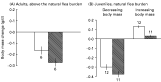
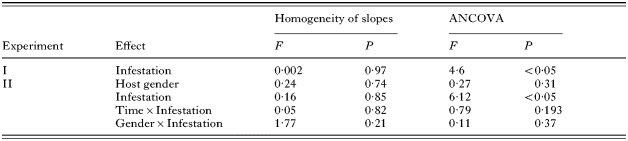
Average energy requirements for maintenance of parasitized adult gerbils was 1·43±0·06 kjċg−0·54ċd−1 (N=6), whereas average energy requirements for maintenance of non-parasitized adult gerbils was 1·27±0·04 kjċg−0·54ċd−1 (N=6). The energy requirements for maintenance of parasitized gerbils were significantly higher than those of non-parasitized gerbils (ANOVA: F=4·89, P<0·05). The higher energy requirements of adult gerbils infested with fleas above the natural infestation level, was expressed in their high loss of body mass in comparison to non-parasitized individuals with similar initial body mass (Table 1; Fig. 1A).

Fig. 1. Adjusted mean (±S.E.) daily body mass change of (A) parasitized (hatched columns) and non-parasitized (white columns) adult hosts over 14 days of Exp. I and (B) parasitized (hatched columns) and non-parasitized (white columns) juvenile hosts over 4 days of decreasing body mass and 22 days of increasing body mass of Exp. II. Numbers near columns indicate sample size.
Table 1. Summary of ANCOVAs testing the effect of flea parasitism on daily body mass change of adult and juvenile gerbils in Exps I and II, controlling for the effect of initial body mass (covariate) (In Exp. II, the effect was also tested for male and female gerbils and analyses were conducted with repeated measures ANCOVA where time (the periods of increasing and decreasing body mass) served as repeated variable (see text for explanations).)

Experiment II
Parasitism significantly affected daily body mass change of juvenile gerbils (Table 1). Parasitized juveniles lost body mass faster, and gained body mass slower, than non-parasitized juveniles (Fig. 1B). The effect of infestation was not significantly different between the periods of decreasing and increasing body mass (Table 1). In addition, no significant effect of gender on daily body mass change was found in either parasitized or non-parasitized juveniles (Table 1).
DISCUSSION
The ‘level of infestation’ hypothesis
Our hypothesis that the effect of fleas on rodent body mass is intensity dependent was confirmed. We showed that fleas have the potential to damage their host when occurring at densities higher than those found in nature. Loss of body mass appears to occur due to higher energy requirements of the parasitized gerbils. A density-dependent macroparasite effect is included in almost every model of epidemiology (Roberts et al. 1995), and is supported by empirical studies that manipulated parasite numbers (see reviews by Lehmann, 1993; Gulland, 1995). However, most of these empirical studies show that natural infestation levels are costly for the host and the removal of ectoparasites improves host body conditions, survival, and reproductive success (e.g. Brown and Brown, 1986; Moller, 1991). Our results describe a different situation, in which ectoparasites have the potential to harm their adult hosts only when their abundance is above natural levels. Assuming that we estimated natural densities correctly, we may conclude that equilibrium natural densities of fleas are at a point in which the negative effect on a host is small enough to be below our measurement accuracy. Possible mechanisms regulating ectoparasite numbers may be density-dependent population processes of the parasites themselves (e.g., competition between larvae, Tripet et al. 2002) or host-mediated behavioural (Moore, 2002) or physiological response (e.g. induced immune response, Walker et al. 2003). For example, Bloomer et al. (1995) suggested that nematode parasites occurred at low numbers due to well-developed immunity of their snowshoe hare hosts (Lepus americanus), and thus played no detectable role in hare population dynamics. In another study, Pacejka et al. (1998) suggested that male house wrens (Troglodytes aedon) reduced numbers of blood-feeding mites by removing the old nests before construction of a new nest. Gerbils, in our study, may regulate flea numbers either by grooming or by frequent replacement of their burrows, but this should be tested further. Whatever they are, regulation processes may have an important role in determining the outcome of the ‘arms race’ between host and parasites. In the absence of these regulation processes, density-dependent negative effects of parasites would induce strong selection against the preferred host individuals.
The ‘susceptible cohort’ hypothesis
Our hypothesis that the effect of fleas on rodent body mass is age-specific was also confirmed because juveniles, in contrast to adults, were negatively affected by fleas at natural infestation levels. Non-parasitized juveniles lost body mass more slowly during the period of decreasing body mass and gained mass faster during the period of increasing body mass than did parasitized animals of the same age.
The higher susceptibility of juvenile hosts to infestation is likely not a result of higher capabilities of adult hosts to defend themselves against fleas (Hawlena et al. 2006). It could be attributed to higher energy demands of the hosts. Even a relatively low pressure of parasites can be ecologically important when the energy requirements of the host are very high. Juveniles have a larger surface to volume ratio and thus, higher energy requirements for maintaining unit body mass (Kleiber, 1961). They also require energy for somatic growth.
In contrast to this study, we found no differences between the body mass of parasitized and non-parasitized juvenile gerbils in the field (Hawlena et al. 2006). The reason for this could be among-gerbil variation in the rate of food consumption and energy expenditure which could obscure the negative effect of parasites. The absence of the ectoparasite effect on host body mass in the field may be also due to food compensation by foraging for longer periods, as suggested for the case of the snowshoe hares (Lepus americanus) parasitized by nematodes (Murray et al. 1997). Controlled conditions and limited diet, provided in this study, minimized the variance among individual hosts and prevented compensation effects. Whether fleas in nature directly affect juvenile hosts by reducing their body condition or indirectly by exposing parasitized juvenile to predators, their effects have important ecological consequences for the host population; parasitism by fleas leads to an annual reduction of reproducing hosts by about 48% (Hawlena et al. 2006).
These results combined with other indirect (Moller et al. 1990; Lehmann, 1992; Richner, 1998; Neuhaus, 2003; Mooring et al. 2004; Puchala, 2004) and direct (Hawlena et al. 2006) evidence suggest that age-specific effects of parasites on body condition and survival of the host is a rather common rule in nature. The inter-cohort effect of parasitism may have a number of important ecological and evolutionary consequences for the population dynamics of hosts and parasites by causing spatial and temporal variation in parasite abundance (Gregory et al. 1992), and affecting the life-history traits of host species (Martin et al. 2001).
The results show that negative effects of parasites on host body mass could be detected while minimizing the among-individual variation and limiting the diet of the hosts. The detection of negative effects then may depend on the identity of the target host cohort and the intensity of parasite infestation.
We thank Nadezhda Burdelova for her help in maintaining the fleas. We are grateful for the thoughtful comments of Jennie McLaren on an earlier version of the manuscript and to Arnon Tsairi for his invaluable help with all aspects of the study. Financial support during this study was provided by Ministry of Science, Culture and Sport of Israel (grant 3-571). This is publication no.204 of the Ramon Science Center and no. 521 of the Mitrani Department of Desert Ecology.