Introduction
Based on functional imaging studies (e.g. Heinz et al. Reference Heinz, Romero, Weinberger, Lawrie, Weinberger and Johnstone2004; Hill et al. Reference Hill, Mann, Laws, Stephenson, Nimmo-Smith and McKenna2004) and to some extent on neuropathological findings (e.g. Harrison & Lewis, Reference Harrison, Lewis, Hirsch and Weinberger2003), the frontal lobes are widely believed to be a key area of brain dysfunction in schizophrenia. Almost as widespread is the belief that they are responsible for some of the symptoms of the disorder. Thus, authors such as Liddle (Reference Liddle1987a) and Weinberger (Reference Weinberger1988) have proposed that the negative symptoms of schizophrenia are essentially the same phenomenon as the apathy and emotional indifference seen in the frontal lobe syndrome. Liddle (Reference Liddle1987a) and others (e.g. McGrath, Reference McGrath1991; Chaika, Reference Chaika, France and Muir1996) have also proposed that an executive-type dysfunction affecting speech might give rise to formal thought disorder, for example by causing poor planning of discourse and/or an inability to inhibit inappropriate verbal responses. Similar concepts run through the most fully articulated theory of schizophrenic symptoms to date, Frith's (Reference Frith1992) integrative cognitive neuropsychological account. He also argues that certain positive symptoms such as passivity and auditory hallucinations could reflect a specialized form of frontal/executive impairment, the inability to monitor willed intentions.
Although there are several potential ways of testing the ‘frontal lobe’ hypothesis of schizophrenic symptoms, investigation has mainly taken place at the neuropsychological level. Such studies have examined the correlations between scores on different classes of schizophrenic symptoms and impairment on one or more measures of executive function. Typically, they find significant correlations with negative symptoms and disorganization, but not with ‘reality distortion’, that is delusions and hallucinations (for reviews see Liddle, Reference Liddle2001; Donohoe & Robertson, Reference Donohoe and Robertson2003; McKenna & Oh, Reference McKenna and Oh2005). However, a number of studies, some with large sample sizes, have either had negative findings (e.g. Joyce et al. Reference Joyce, Hutton, Mutsatsa, Gibbins, Webb, Paul, Robbins and Barnes2002) or have found significant correlations with only a minority of the executive tests used (e.g. Mohamed et al. Reference Mohamed, Paulsen, O'Leary, Arndt and Andreasen1999; O'Leary et al. Reference O'Leary, Flaum, Kesler, Flashman, Arndt and Andreasen2000). Another problem is that these studies commonly also find associations between negative symptoms and/or disorganization and impairment on non-executive tests (see McKenna & Oh, Reference McKenna and Oh2005).
Drawing on a distinction between ‘apathetic’ and ‘disinhibited’ clinical pictures seen in neurological patients with the frontal lobe syndrome, Liddle (Reference Liddle1987a, Reference Liddle2001) has further proposed that negative and disorganization symptoms are not just associated with executive impairment but that they show different patterns of associations with different executive tests. According to Liddle, negative symptoms should be particularly associated with difficulty on tasks that require the generation of responses, for example verbal fluency, whereas disorganization should be associated with impairment on tasks such as the Stroop test, where prepotent responses have to be inhibited. Liddle & Morris (Reference Liddle and Morris1991) found some support for these distinct patterns of correlation, but the dissociation was not complete. Considerable overlap in the pattern of associations of negative and disorganization symptoms with different executive tests was also found by Donohoe & Robertson (Reference Donohoe and Robertson2003) and McKenna & Oh (Reference McKenna and Oh2005) in their reviews.
Existing reviews of clinical–neuropsychological correlations have mostly been of the narrative or ‘vote counting’ variety (e.g. Liddle, Reference Liddle2001; Donohue & Robertson, Reference Donohoe and Robertson2003; McKenna & Oh, Reference McKenna and Oh2005). One meta-analysis has been carried out (Nieuwenstein et al. Reference Nieuwenstein, Aleman and Dehaan2001), but this only pooled data from studies using a single executive test, the Wisconsin Card Sorting Test (WCST). The aim of this systematic review was therefore to provide a comprehensive examination of the relationship between executive impairment and schizophrenic symptoms using meta-analytic techniques.
Method
Papers reporting neuropsychological data in relation to schizophrenic symptoms were searched electronically. The earliest dates used were the defaults for Medline (1980), PsycINFO (1985) and EMBASE (1980), and the search was carried out up to March 2008. Studies were identified using the key words ‘schizophrenia’ and related terms, ‘negative symptoms’, ‘positive symptoms’, ‘poverty syndrome’, ‘disorganization’, ‘delusions’, ‘hallucinations’, ‘formal thought disorder’, and ‘deficit schizophrenia’. These were combined with ‘frontal lobe’, ‘executive function’, ‘frontal cortex’, ‘neuropsychological tests’, ‘cognition’, ‘working memory’ and ‘memory short-term’. We also entered the acronyms for symptom scales such as SANS, SAPS, BPRS and PANSS, and the names of commonly used executive tests, such as the Wisconsin Card Sorting Test, Stroop, verbal fluency, Tower of London/Hanoi, Trail Making Test, digit span (for reverse digit span) and the Cognitive Estimates Test.
The electronic search was supplemented by checking book chapters and review articles on the neuropsychology of schizophrenia, and the reference lists of all papers reporting relevant data. Finally, the names of chief investigators of known first-episode studies of schizophrenia were also searched electronically, as these studies typically include detailed neuropsychological assessments. Both English- and foreign-language papers were included. Unpublished studies were not included but publication bias was examined.
The same databases were searched over the same period for the supplementary meta-analysis of symptoms and overall intellectual function, for which current IQ was used as a measure (see below). Here the search terms used were IQ, intelligence, intelligence tests, intellect and general intellectual ability.
To be included studies had to report data on adult patients meeting any diagnostic criteria for schizophrenia. Studies where some of the patients had a diagnosis of schizo-affective disorder were also included. Studies reporting findings on adolescents or where the sample consisted only of patients over 65 were excluded. Studies were required to assess symptoms using a published rating scale [e.g. the Brief Psychiatric Rating Scale (BPRS), Manchester Scale, Positive and Negative Syndrome Scale (PANSS), Positive and Negative and Disorganized Symptoms Scale (PANADSS), Schedule for Affective Disorders and Schizophrenia (SADS), Scales for the Assessment of Positive and Negative Symptoms (SAPS, SANS), Thought, Language and Communication (TLC) scale for formal thought disorder, High Royds Evaluation of Negativity (HEN) and Iager scales for negative symptoms].
The analysis was based on scores on Liddle's three syndromes, hereafter referred to as positive (‘reality distortion’, delusions and hallucinations), negative (‘psychomotor poverty’) and disorganization (thought disorder and inappropriate affect with some authors also including bizarre behaviour). Where individual classes of symptoms were reported separately (e.g. delusions and hallucinations or individual SANS subscale scores for affective flattening, alogia, anhedonia-asociality, etc.), the relevant correlations were averaged, providing these permitted a reasonable approximation to the full range of symptoms in a particular syndrome.
Studies that only reported partial symptom data (e.g. correlations for delusions only or hallucinations only) were excluded. During the course of the meta-analysis, however, a relative lack of studies reporting correlations with disorganization became apparent, and so it was decided to also include studies reporting only formal thought disorder. This was on the grounds that this is arguably the main constituent of disorganization (inappropriate affect is an uncommon symptom and authors often do not include bizarre behaviour as part of the syndrome).
Several studies, rather than reporting correlations for positive, negative and disorganization symptoms, reported correlations for the older, dichotomous concept of positive and negative symptoms. The concept of positive symptoms was broader in these studies, encompassing delusions, hallucinations and formal thought disorder. Accordingly, it was not possible to include these studies in the meta-analysis of the correlates of positive or disorganization symptoms. However, their data for negative symptoms could still usually be included. For this reason there were many more studies in the meta-analysis of negative symptoms.
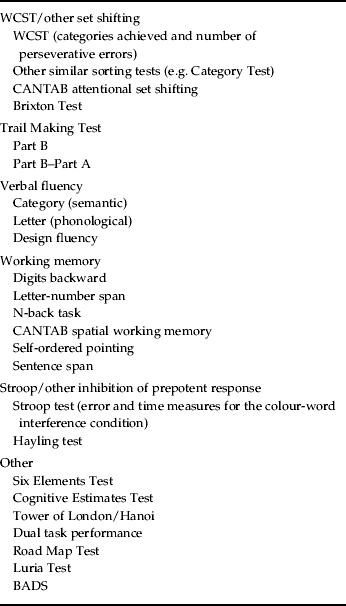
The neuropsychological inclusion and exclusion criteria are summarized in Table 1. Only tests considered to be executive within the current cognitive meaning of the term were included. Hence, we included working memory tasks only if they engaged the central executive component of Baddeley's (Reference Baddeley1986) model of working memory (i.e. those requiring manipulation rather than just holding of information in short-term memory); as a result, forward span tests were not included. Tasks that are known to activate the prefrontal cortex but do not have any executive component in the neuropsychological sense were not included (e.g. long-term memory tasks, vigilance tasks). Where studies reported composite measures of executive function, these were only included if a majority of the contributing tests were executive according to the above definition.
Types of executive tests included in the meta-analysis

WCST, Wisconsin Card Sorting Test; CANTAB, Cambridge Neuropsychological Test Automated Battery; BADS, Behavioural Assessment of the Dysexecutive Syndrome.
Exclusions: studies reporting only WCST percentage perseverative errors were not included as this measure can be criticized (see Laws, Reference Laws1999). Studies reporting only Trail Making Test part A time, or time for both parts A and B together, were also not included. The Continuous Performance Test and other vigilance tests were also excluded (see text).
We included studies that reported both Pearson and Spearman correlations. Studies reporting partial correlations were excluded, unless the raw correlations could be obtained from the authors. Where data were reported but could not be extracted, the authors were contacted by email. A small number of studies, rather than reporting correlations between syndrome scores and neuropsychological test performance, provided data on two groups of patients, typically those with high and low scores on negative symptoms or ‘deficit’ and ‘non-deficit’ patients. Such data can be used to provide a correlation coefficient by calculating the effect size (d) for the difference between the high and low symptom groups, and then converting this to r, which is mathematically related to d. This procedure yields a point biserial correlation, which was used in preference to the also derivable biserial correlation, as the latter makes assumptions about the normality of the distribution (see Howell, Reference Howell1997).
Calculations were performed using d-stat 1.10 (Johnson, Reference Johnson1993), which uses a fixed-effects model, and Comprehensive Meta-Analysis v.2 (Borenstein et al. Reference Borenstein, Hedges, Higgins and Rothstein2006), where the fixed-effects option was again used. Homogeneity was examined using the Q statistic and QB was used to test for significant differences between mean effect sizes. Various moderating variables were examined including age, length of illness, treatment status and type of executive task. Carpenter et al. (Reference Carpenter, Heinrichs and Wagman1988) have drawn a distinction between transient negative symptoms in schizophrenia (i.e. present at the height of an acute episode) and those that are enduring (‘deficit’ symptoms in Carpenter's terminology), with the latter being proposed to have a greater implication of poor outcome and being more closely related to underlying neurobiological mechanisms. In a similar vein, Liddle (Reference Liddle1987a) and Baxter & Liddle (Reference Baxter and Liddle1998) suggested that patients with persistent symptoms show higher correlations with neuropsychological test impairment than those who have relapsing and remitting illnesses. Therefore, we also examined stability of symptoms as a moderator variable.
The question of the specificity of the association between symptoms and executive impairment was examined by carrying out a supplementary meta-analysis of the correlations between positive, negative and disorganization symptoms and general intellectual impairment. For this purpose current IQ was chosen, as this was by far the most commonly used measure in the studies. Included here were studies reporting Wechsler Adult Intelligence Scale (WAIS)/WAIS-R/WAIS-III full-scale IQ or verbal or performance IQ. We did not include studies reporting only single WAIS subtest scores, but if correlations on three or more subtest scores were provided these were averaged to approximate an index of overall IQ. We also included other current IQ measures including the Quick Test, Raven's Matrices, and armed forces aptitude tests.
Results
Correlations of clinical syndromes with executive test impairment
Eighty-eight studies were found that included usable data. These used a range of different executive tests. The purpose of this initial analysis was to establish the correlations between positive, negative and disorganization syndromes and a broad index of executive impairment. Therefore, studies reporting any measure of executive function were included in the analysis. Where a study reported multiple correlations with different executive test scores, these were averaged to provide a composite correlation.
Eighty-one papers reporting 83 studies included data on the executive correlates of negative symptoms. The pooled r for these studies was −0.21 [95% confidence interval (CI) −0.24 to −0.18]. The studies were significantly heterogeneous [Q(82)=321.84, p<0.0001]. Homogeneity was achieved by excluding 21 studies; this left the pooled effect size similar at −0.20 (CI −0.23 to −0.17).
The effect size for 40 studies examining the correlates of disorganization was −0.17 (CI −0.21 to −0.13). These data were heterogeneous [Q(39)=148.14, p<0.0001]. Homogeneity was achieved by excluding eight studies, and this increased the pooled r to −0.28 (CI −0.33 to −0.23).
At +0.01 (CI −0.04 to +0.05), however, the pooled r for 34 studies of positive symptoms was negligible. These studies were again heterogeneous [Q(33)=110.43, p<0.0001], but removing four outlying studies had little effect on the pooled r (+0.02, CI −0.03 to +0.07).
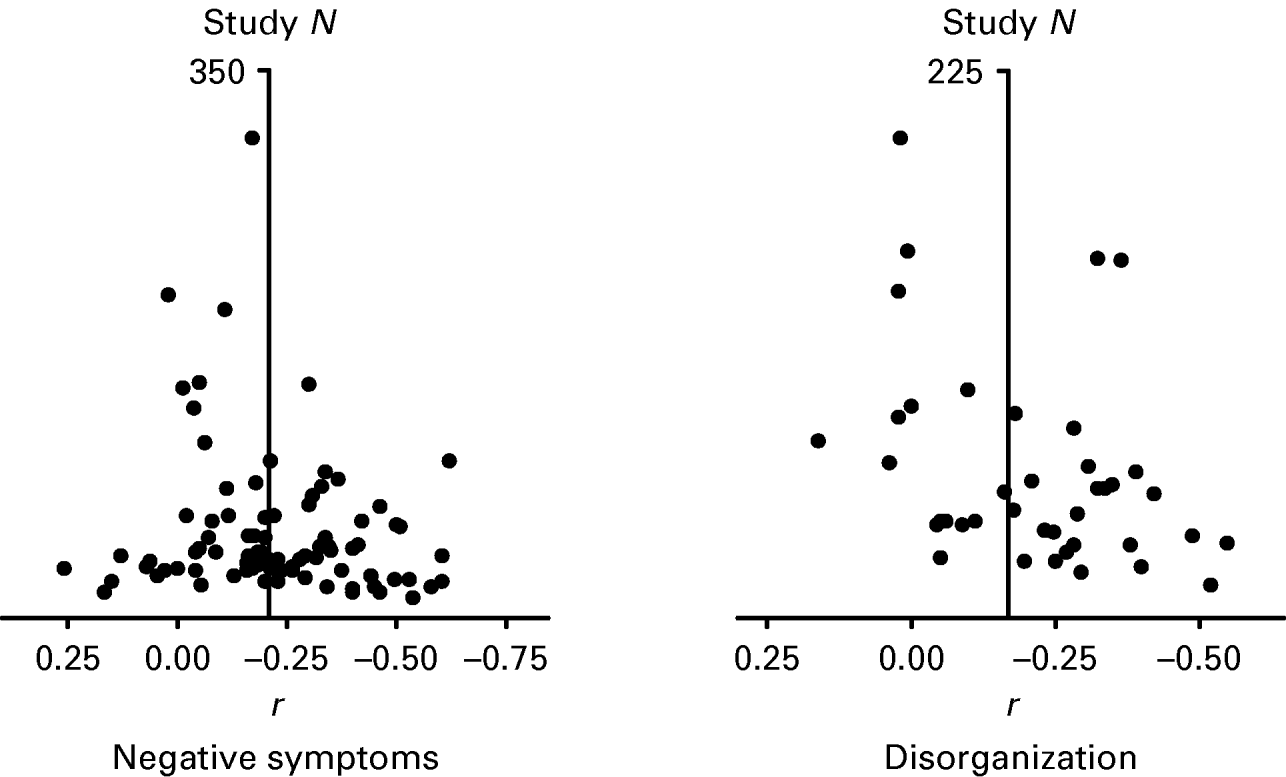
Funnel plots of the correlations for negative symptoms and disorganization are shown in Fig. 1. It can be seen that the correlations for negative symptoms were fairly evenly distributed around both sides of the overall effect size (with a small number of studies finding better performance with higher negative symptom scores). However, for disorganization there was an obvious absence of studies with small sample sizes that failed to find significant correlations, suggesting publication bias.
Funnel plots of the correlations between executive test scores and negative symptoms and disorganization.

Moderating factors
Age did not moderate the clinical–neuropsychological correlations for negative symptoms (n=80 studies, Z=0.37, p=0.71) and was marginally significant for disorganization (n=40 studies, Z=−1.96, p=0.05) (correlations were higher in older patients). Duration of illness did not significantly moderate the size of the correlation between negative symptoms and executive impairment (n=72 studies, Z=−1.08, p=0.28), but it did for disorganization (n=36 studies, Z=−3.39, p=0.0006); correlations were higher in studies on patients with longer duration of illness.
Treatment moderated the pooled correlation for negative symptoms [r for 58 studies on treated patients=−0.19 v.−0.29 for seven studies on untreated patients, QB(1)=6.28, p=0.01]. This was also true for disorganization [r for 27 studies on treated patients=−0.22 v.−0.14 for five studies on untreated patients, QB(1)=4.09, p=0.04]. However, it should be noted that in both analyses the number of studies carried out on untreated patients was small.
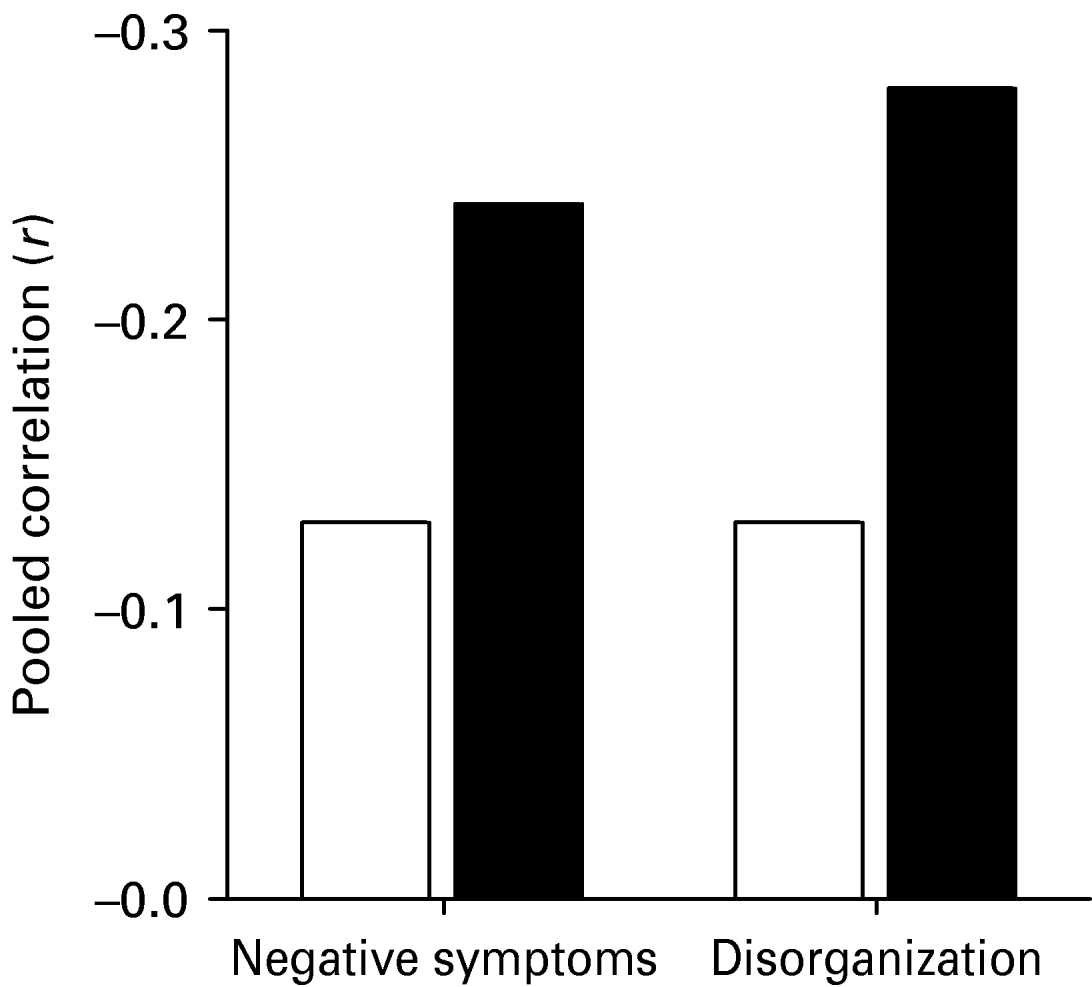
As mentioned earlier, Liddle (Reference Liddle1987a) and Baxter & Liddle (Reference Baxter and Liddle1998) have suggested that correlations between negative symptoms and neuropsychological test impairment may be more marked in patients with persistent symptoms than in those who have relapsing and remitting illnesses. To examine this issue, we dichotomized studies into those carried out on patients with ‘acute/remitting’ symptoms and those on patients with ‘stable/persistent’ symptoms. Patients in the former category were described in terms such as ‘acute’, ‘acutely ill’ or ‘relapsed’; studies on in-patients described as stabilized or just prior to discharge were excluded. Studies in the latter category were carried out on out-patients, or on chronically hospitalized patients, if it was also specified that they were in a clinically stable condition. This distinction significantly moderated the correlations with negative symptoms [r for 19 studies on acute/remitting patients=−0.13 v. −0.24 for 35 studies carried out on stable/persistent patients, QB(1)=20.93, p<0.0001]. It also significantly moderated the correlations with disorganization [r for 11 studies on acutely relapsed patients=−0.12 v. −0.28 for 16 studies carried out on stable patients, QB(1)=18.46, p<0.0001]. The findings are illustrated in Fig. 2.
Pooled correlations between negative symptoms and executive impairment and disorganization and executive impairment in studies carried out on patients with ‘acute/remitting’ (□) and ‘stable/persistent’ (■) symptoms.

Correlations with different executive tests
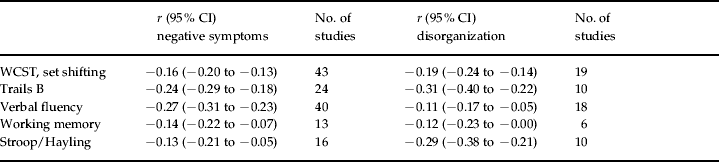
The correlations between negative symptoms and disorganization and the five main categories of executive tests identified in Table 1 are shown in Table 2. For both negative symptoms and disorganization there was significant heterogeneity among the correlations [negative symptoms: QB(4)=42.27; disorganization: QB(4)=33.71, both p<0.001], indicating that there was significant variation among the correlations with the five types of tests. For negative symptoms the correlations ranged from −0.27 on verbal fluency and −0.24 on the Trail Making Test, part B down to −0.14 on working memory and −0.13 on the Stroop test. For disorganization the range was similar, from −0.31 on the Trail Making Test, part B down to −0.12 on working memory and −0.11 on verbal fluency.
Significant pooled correlations between negative and disorganization syndromes and different executive tests

CI, Confidence interval; WCST, Wisconsin Card Sorting Test.
It can be seen from Table 2 that verbal fluency impairment was nearly three times more strongly associated with negative symptoms than with disorganization (−0.27 v. −0.11). This difference was significant [QB(1)=40.44, p<0.0001]. Impairment on the Stroop Test, by contrast, was twice as highly correlated with disorganization as it was with negative symptoms (−0.29 v. −0.13), with the difference again being significant [QB(1)=8.29, p=0.004].
Correlations between clinical syndromes and IQ
The pooled correlation between IQ and negative symptoms in 30 studies was −0.21 (CI −0.26 to −0.17), rising to −0.23 (CI −0.28 to −0.17) after six outliers were removed. The pooled correlation between IQ and disorganization was −0.21 (CI −0.28 to −0.14). This increased to −0.28 (CI −0.35 to −0.19) after excluding two outlying studies.
Discussion
This meta-analysis found that negative schizophrenic symptoms and disorganization, but not positive symptoms, are significantly associated with impairment on executive tests. Insofar as executive tests index frontal lobe function, meta-analysis therefore provides support for the view that frontal dysfunction underlies these two classes of symptoms. At the same time, at −0.20 and −0.28 (homogenized) respectively, the correlations were modest, falling between the ‘rule-of-thumb’ values of ‘small’ (0.1) and ‘medium’ (0.3). These values are broadly in keeping with those of an earlier meta-analysis by Nieuwenstein et al. (Reference Nieuwenstein, Aleman and Dehaan2001), who found a pooled correlation of −0.27 with negative symptoms in 15 studies and of −0.25 with disorganization in six studies using the WCST, but no significant correlation with positive symptoms (pooled r of −0.04) in four studies. As Nieuwenstein et al. (Reference Nieuwenstein, Aleman and Dehaan2001) pointed out, this means that symptom dimensions account for less than 10% of the variance in performance on executive tests in schizophrenia, and suggests that any relationship between symptoms and underlying pathophysiological abnormality is relatively remote. Further caution is necessary in interpreting the relationship between disorganization and executive impairment, where we found that there was evidence of publication bias.
Nevertheless, significant moderating factors were identified in our meta-analysis, indicating that the associations may be stronger in some types of patient. High correlations between executive impairment and negative symptoms and/or disorganization have been a feature of several studies carried out on chronically hospitalized patients (e.g. Liddle & Morris, Reference Liddle and Morris1991; Brown & White, Reference Brown and White1992), whereas correlations have sometimes been low or negligible in studies of first-episode patients (e.g. Mohamed et al. Reference Mohamed, Paulsen, O'Leary, Arndt and Andreasen1999; Joyce et al. Reference Joyce, Hutton, Mutsatsa, Gibbins, Webb, Paul, Robbins and Barnes2002; Rund et al. Reference Rund, Melle, Friis, Larsen, Midboe, Opjordsmoen, Simonsen, Vaglum and McGlashan2004). However, there are numerous exceptions to this rule and our meta-analysis did not find robust evidence that duration of illness was a moderating factor: it was significant for disorganization but not for negative symptoms. When the studies were divided according to a somewhat related distinction, into those carried out on patients with relapsing and remitting symptoms versus those with stable, persistent symptoms, a clearer moderating effect emerged that applied to both negative symptoms and disorganization. It seems that schizophrenic patients with established, relatively unchanging clinical pictures – one definition of chronicity – show stronger associations between symptoms and neuropsychological deficits than those whose symptoms come and go in acute attacks.
Why this should be so is not known. However, it is a theme that has surfaced before in the literature. Over 50 years ago, Kleist (Fish, Reference Fish1957; Kleist, Reference Kleist1960) argued that the initially somewhat amorphous presentations of schizophrenia crystallized into a large number of stable states as the disorder evolved, each of which was dominated by one or a few symptoms that reflected dysfunction in a particular brain area. For Kleist, the end states of ‘drive poor catatonia’ (roughly equivalent to negative symptom schizophrenia) and hebephrenia were psychiatric analogues of the apathetic and disinhibited forms of the frontal lobe syndrome respectively. More recently, Carpenter and co-workers (Carpenter et al. Reference Carpenter, Heinrichs and Wagman1988; Kirkpatrick et al. Reference Kirkpatrick, Buchanan, Ross and Carpenter2001) have argued that pathophysiological correlates of negative symptoms are most evident in patients who have enduring symptoms of this type, and have elevated this into the principle of a conceptual separation of deficit and non-deficit forms of schizophrenia. Liddle and co-workers (Liddle, Reference Liddle1987a); Liddle et al. Reference Liddle, Friston, Frith, Hirsch, Jones and Frackowiak1992; Baxter & Liddle, Reference Baxter and Liddle1998) have also argued that different pathological processes might underlie symptoms, particularly negative symptoms, in chronic and remitting illnesses.
The other main moderating factor identified in this meta-analysis was neuroleptic treatment, where we found higher correlations in treated patients. However, the fact that there were few studies on untreated patients (7/83 in the case of negative symptoms and 5/40 in the case of disorganization) suggests this finding should be interpreted with caution.
A supplementary meta-analysis revealed that both negative symptoms and disorganization showed similar levels of correlation with IQ as with executive impairment. This raises questions about the specificity of the relationship between symptoms and executive impairment. General intellectual impairment is prevalent in schizophrenia and will in itself give rise to poor performance on executive tests without implying the presence of a specific neuropsychological deficit (see Goldberg et al. Reference Goldberg, Gold, David, Hirsch and Weinberger2001 for a review). The same reasoning suggests that, when correlations are found between symptoms and executive impairment, this could also reflect correlations with coexistent general intellectual impairment. Of course, IQ is far from perfect as a measure of general intellectual impairment, as it varies widely across normal individuals. Nor is IQ ideal as a non-executive control measure; executive function is variably but overall moderately highly correlated with IQ in normal subjects (e.g. Obonswain et al. Reference Obonsawin, Crawford, Page, Chalmers, Cochrane and Low2002), and frontal lobe lesions tends to lower IQ, at least as measured on ‘fluid’ as opposed to ‘crystallized’ tests (Duncan et al. Reference Duncan, Burgess and Emslie1995). An extreme view is that executive function and (fluid) IQ are one and the same thing (Duncan, Reference Duncan and Gazzaniga1995). Given these complexities, as well as the relatively small number of studies we were able to find that included measures of IQ, our findings should probably not be regarded as discrediting the association between negative symptoms/disorganization and executive impairment, but they clearly indicate that general intellectual function ought to be taken into consideration in future studies.
The findings of this meta-analysis support the view that the correlation between executive impairment and schizophrenic symptoms is specific in another sense, that of showing distinct patterns of association with different executive tests. Thus, negative symptoms were associated with verbal fluency but considerably less so with the Stroop test, whereas disorganization showed the reverse pattern. These differences accord well with Liddle's (Reference Liddle1987a, Reference Liddle2001; Liddle & Morris, Reference Liddle and Morris1991) proposal that the psychomotor poverty syndrome is a form of frontal lobe apathy, leading to slowness and failure to generate actions, whereas the disorganization syndrome reflects a frontal disinhibition syndrome characterized chiefly by failure to inhibit prepotent responses. At the same time, both negative symptoms and disorganization showed significant correlations with the Trail Making Test, part B (r=−0.24 and −0.31) and with the WCST (−0.16 and −0.20). It might be possible to explain these failures of dissociation, however. Thus, the WCST is sensitive to both frontal and non-frontal lesions (e.g. Lezak et al. Reference Lezak, Howieson and Loring2004) and so successful performance might be considered to require a range of different executive (and non-executive) cognitive process. Similarly, impairment on the Trail Making Test, part B can obviously be due to failure to inhibit prepotent responses, but performance on this test should also be sensitive to the occurrence of perseveration.
An aside to these findings is that the correlations between working memory impairment and both negative symptoms (−0.14) and disorganization (−0.12) fell into the ‘small’ range, and were among lowest levels of association seen in the study. In recent years working memory impairment has been regarded as a key explanatory neuropsychological construct in schizophrenia (e.g. Goldman-Rakic & Selemon, Reference Goldman-Rakic and Selemon1997; Silver et al. Reference Silver, Feldman, Bilker and Gur2003). Whatever merits this proposal has, our meta-analysis suggests that it has little role in explaining the symptoms of the disorder. This is despite the fact that we were scrupulous about including only tests that tapped the central executive component of working memory and not just Baddeley's (Reference Baddeley1986) two slave systems, the articulatory loop and the visuospatial sketch pad.
Neuropsychology is not the only way to investigate the ‘frontal lobe’ hypothesis of schizophrenic symptoms. Nevertheless, the other evidence, which derives essentially from functional imaging studies, is surprisingly limited. In the first study using modern voxel-based techniques, Liddle et al. (Reference Liddle, Friston, Frith, Hirsch, Jones and Frackowiak1992) found that negative symptoms were associated with underactivity in wide areas of the prefrontal cortex bilaterally, and that disorganization was significantly associated with underactivity in Broca's area on the left and its analogue in the right frontal lobe cortex (and also hyperactivity in the right anterior cingulate cortex). However, further studies have been approximately equally divided between those supporting and those failing to support the association with prefrontal abnormality (for a review, see McKenna, Reference McKenna2007). The even smaller number of functional imaging studies of formal thought disorder (e.g. McGuire et al. Reference McGuire, Quested, Spence, Murray, Frith and Liddle1998; Kircher et al. Reference Kircher, Liddle, Brammer, Williams, Murray and McGuire2001, Reference Kircher, Liddle, Brammer, Williams, Murray and McGuire2002; Weinstein et al. Reference Weinstein, Werker, Vouloumanos, Woodward and Ngan2006) tends to implicate the temporal lobes more than the frontal lobes. It thus seems that, although neuropsychological studies may have demonstrated a link between certain classes of schizophrenic symptoms and the dys-executive syndrome, the related question of whether negative symptoms and disorganization are analogues of the apathetic and disinhibited forms of the frontal lobe syndrome remains unanswered.
Declaration of Interest
None.