Single ventricle heart disease is a heterogeneous group of diagnoses that until 50 years ago was almost universally fatal. Since the description of the Fontan palliation in 1971 by Francis Fontan, Reference Fontan and Baudet1 staged palliation for single ventricle heart disease culminating in the Fontan palliation has evolved in surgical technique, perioperative and outpatient care, Reference dʼUdekem, Iyengar and Cochrane2,Reference Stewart, Pasquali and Jacobs3 and now allows the majority patients with single ventricle heart disease to survive well into adolescence and adulthood. Recent studies based on multi-centre data estimate 20-year post-Fontan survival at 75–85% Reference Poh and dʼUdekem4 , while more modern era survival estimates approach 90%. Reference Atz, Zak and Mahony5 However, Fontan palliation survivors experience a myriad of comorbidities related to their cardiac condition and face the possibility of Fontan circulatory failure, with even the most optimistic reports estimating that 10% of survivors will die or require heart transplant by early adulthood. Reference McCormick and Schumacher6 Physical and neurodevelopmental comorbidities affect not only the physical health status of patients with single ventricle heart disease but also their well-being, quality of life Reference Marshall, DʼUdekem and Sholler7 and mental health. Reference DeMaso, Calderon and Taylor8
This growing population of patients with single ventricle heart disease seeks primary care from paediatricians as well as routine care from paediatric cardiology providers. Reference Luthy, Yu, Donohue, Loccoh, Goldberg and Lu9 It is well known that many children who would benefit from treatment of mental health conditions do not receive appropriate care, Reference Jensen, Goldman and Offord10 and the American Academy of Pediatrics has focused on preparedness of physicians to address mental health appropriately in their patients. Reference McMillan, Land, Tucker and Leslie11 Despite this, literature on psychological functioning in the single ventricle heart disease population has not been synthesised. The research gap regarding psychological outcomes in the paediatric single ventricle heart disease population has been identified as a priority for exploration. Reference Sanz, Anixt and Bear12,Reference Sood, Jacobs and Marino13 Given the known association between poor psychological health and cardiovascular risk in adult patients, Reference Levine, Cohen and Commodore-Mensah14 better characterisation of psychological functioning and outcomes in the paediatric single ventricle heart disease population is of utmost importance.
Building upon the current literature in adult cardiovascular disease and paediatric and adult CHD, this study aimed to review and summarise the existing literature on psychological functioning and outcomes in paediatric single ventricle heart disease patients guided by the following questions: (1) what is the impact of paediatric single ventricle heart disease on psychological functioning? and (2) what variables, if any, have been identified as risk factors for adverse psychological sequelae in the single ventricle heart disease population? This systematic review will provide targets for intervention and underscore future research directions in this critical area for the single ventricle heart disease paediatric and emerging adult population.
Materials and methods
This systematic review followed the Preferred Reporting Items for Systematic Review and Meta-Analysis (PRISMA) statement. 15 The protocol is available in the University of Michigan’s institutional repository Deep Blue and is accessible here: https://doi.org/10.7302/1165.
Search strategy
The review team met with health informationist (KMS) in early 2020. After discussion of included patients and outcomes, a search strategy was crafted to inform the selection of potential databases, concepts and search terms. The databases selected for this project include MEDLINE via PubMed, Embase (Elsevier), PsycInfo (EBSCO), CINAHL Complete (EBSCO) and Scopus (Elsevier). When available, publication limits were applied to exclude commentaries and book chapters. Reviews were included in the initial search for evaluation of additional articles through the ancestry method but were not included in manuscript review. The final searches were run on 21 April, 2020 and 15 June, 2020, with an additional search update to identify more recent articles on 10 May, 2021. EndNoteX9 was used to manage citations and to identify and remove duplicates. The deduplicated set of records was imported into Rayyan for screening where a few additional citations were identified as duplicates.
The searches were built around three main concepts: single ventricle heart disease, paediatrics and psychological functioning. Each search consisted of a combination of controlled terms appropriate for the selected databases and keywords limited to relevant fields. The PubMed search strategy is included in Appendix A and all reproducible search strategies and associated search files are available at https://doi.org/10.7302/087c-9g95. The ancestry method was also utilised, in which authors examined reference sections of studies meeting the review’s predefined inclusion criteria for additional studies examining psychological functioning among paediatric patients with single ventricle heart disease.
Inclusion criteria
The following inclusion criteria were established prior to conducting the search: (1) study included a sample majority of paediatric patients between 0 and 25 years of age with single ventricle heart disease, (2) contained a quantitative measure of patient psychological functioning (e.g., measurement of symptomatology via self or parent report form, or participant reported diagnosis by a clinician) (3) published in a peer-reviewed journal and (4) published in English. Studies that primarily evaluated neurodevelopmental outcomes (e.g., cognitive development, motor development) or quality of life/health-related quality of life were included in the full-text article review, but only findings specific to patient psychological functioning were extracted for analysis.
Data extraction and study coding
Titles and abstracts of all search results were reviewed by one of two authors (AM and MW), with 20% of articles reviewed by both reviewers for reliability. Full articles were selected based on the inclusion criteria above and reviewed for inclusion by at least two reviewers (AM, MW, CC/MC). Reviewers extracted data from each study including sample characteristics (sample size, mean/median age/range, sex, CHD diagnosis/% of sample with single ventricle heart disease, presence of control group), measures of psychological functioning and reporter of measure and results.
Study quality was evaluated independently by two reviewers. The National Institutes of Health National Heart, Lung and Blood Institute Quality Assessment Tool for Observational Cohort and Cross-Sectional Studies 16 was adapted based on applicable criteria for the current literature. Assessment items included reference to an established research objective or study aim, description of study population including time period and geographical location of recruitment, participation rate of greater than or equal to 50%, established selection criteria and procedure, consideration of sample size, statistical power or effect sizes in interpretation, defined and validated outcome measures and consideration of potential confounding variables in analyses. Each study was assessed for all items and received a “yes” when quality indicators were met and a “no” when quality indicators were not met. Additional responses included “not applicable (NA)”, “not reported (NR)” and “cannot determine (CD)”. Based on these indicators, studies received a rating of “good”, “fair” or “poor” quality. Discrepancies in ratings were discussed between the two rating authors and an agreement was made. Quality assessment is reported in Results section.
Defining psychological functioning and outcomes can methodologically be a challenge due to the wide range of metrics used. For the purpose of this review, analyses were divided into two large groups: studies that measured internalising problems (e.g., mood problems and symptoms of anxiety and depression) and studies that measured externalising problems (e.g., behavioural problems and symptoms of attention-deficit/hyperactivity disorder). Some studies also evaluated for symptoms of schizophrenia and autism spectrum disorder which were considered separately. While important, quality of life and neurodevelopmental outcomes are considered elsewhere in the literature and not included in this review.
Meta-analysis
The articles that provided adequate (t-score) data of the Achenbach Child Behavior Checklist, which is widely used to detect behavioural and emotional problems in children and adolescents, Reference Achenbach17 , were included in the meta-analysis for evaluation of total t-score, internalising t-score and externalising t-score compared to the Child Behavior Checklist normative t-value of mean 50 with 10 SD. The effect sizes were estimated by Hedges’ g18 for the Child Behavior Checklist t-scores across each domain (total, internalising and externalising). The equal sample size of the articles included in the meta-analysis was used for the sample size of the Child Behavior Checklist norms. For the article in which the SD of the t-score was not reported, a pooled SD was used. All meta-analyses across the three Child Behavior Checklist domains were conducted using a fixed-effect model, assessing heterogeneity between studies. Heterogeneity between studies was examined using Cochran’s Q19 and I2 statistic Reference Borenstein, Hedges, Higgins and Rothstein20 with I2 ≥ 50% indicating substantial heterogeneity. Reference Higgins, Thompson, Deeks and Altman21 Considering that the numbers of the studies included were relatively small (five studies for total scale and four studies for both internalising and externalising scales) and the studies included in the meta-analysis were homogeneous based on Cochran’s Q and I2 statistics (Table 2), a random-effect model was not performed.
Results
Study characteristics
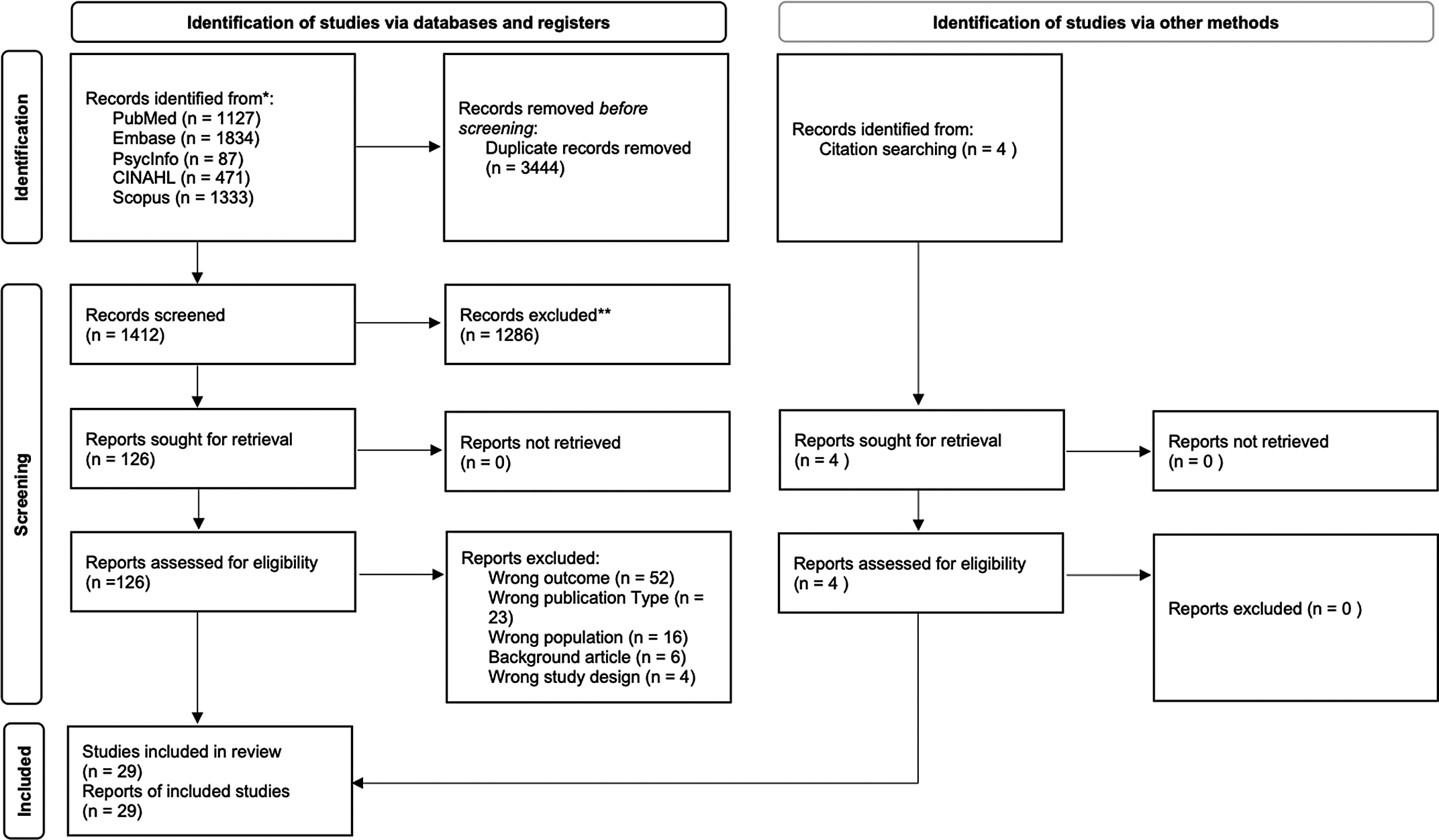
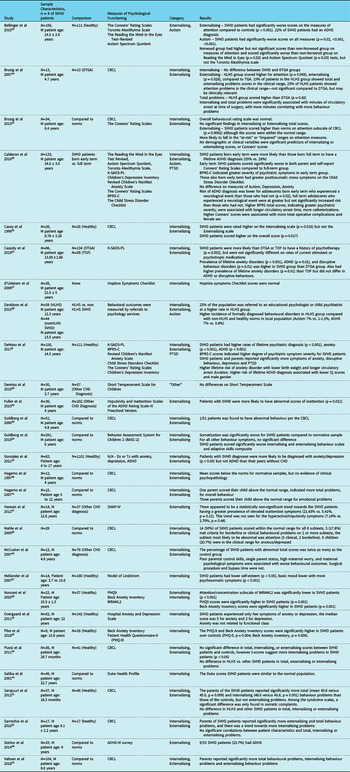
The searches yielded 1416 studies after the removal of duplicate results. See Figure 1 for the PRISMA flow diagram. After title and abstract screening, 130 articles were included for full-text article review. Of the studies excluded at the full-text review, the majority did not include a quantitative measure of psychological functioning (e.g., did not include measurement of symptomatology via self or parent report form, or participant reported diagnosis by a clinician, n = 52) or were the wrong publication type (n = 23). The remaining 29 articles met the criteria. For a full summary of study results, see Table 1. Within these 29 studies, approximately 30% were published in the last 5e years. Study sample sizes ranged from 12 to 1164 participants. Participate age ranges were vast, ranging from 1 year to adulthood. In paediatric patients with single ventricle heart disease, 24 studies assessed risk for internalising disorders and 22 studies assessed risk for externalising disorders.
PRISMA diagram.

Included Study Characteristics and Results

Abbreviations: SVHD = Single Ventricle Heart Disease, DTGA = D-Transposition of the Great Arteries, CBCL = Child Behavior Checklist, K-SADS-PL = Schedule for Affective Disorders and Schizophrenia for School-Aged Children, BRPS-C = Brief Psychiatric Rating Scale for Children, TOF = Tetralogy of Fallot, PTSD = Post Traumatic Stress Disorder, CHD = Congenital Heart Disease, ADHD = Attention Deficit/Hyperactivity Disorder, WRAML2 = Wide Range Assessment of Memory and Learning, Second Edition, PHQ-9 = Patient Health Questionnaire-9 HLHS = Hypoplastic Left Heart Syndrome.
Meta-Analysis Results comparing CBCL t-scores in paediatric single ventricle heart disease patients to CBCL norms (mean t-score 50 with SD 10)

Abbreviations: CBCL = Child Behavior Checklist, SVHD = Single Ventricle Heart Disease, CI, confidence interval.
Study quality assessment
Across included studies, all (n = 29, 100%) explicitly defined the research objective or study aim. All studies established inclusion criteria and consistent selection procedures (n = 29, 100%), defined the study population, including time period and geographical location of recruitment, and utilised defined outcomes with validated measures (n = 29, 100%). Nineteen (66%) studies reported a participation rate of greater than 50%. Thirteen studies (45%) justified sample size or utilised effect sizes, and 18 (62%) statistically considered potential confounding variables in analyses. Based on the results of this quality assessment, 90% of included studies were rated as “good” quality (n = 26) and 10% of included studies were rated as “fair” quality (n = 3). No studies were excluded from the current literature review based on the quality assessment.
What is the impact of single ventricle heart disease on patient psychological outcomes?
Internalising disorders (anxiety, depression)
Twenty-four studies examined internalising problems (e.g., depression, anxiety) in the present review. Of these, 13 concluded that there was an increased risk of internalising problems in patients with single ventricle heart disease compared to healthy controls or other CHD patient populations. Reference DeMaso, Calderon and Taylor8,Reference Casey, Sykes, Craig, Power and Mulholland22–Reference Vahsen, Broder, Hraska and Schneider33 Eleven studies found no increase in risk of internalising problems as compared to controls. Reference Brosig, Mussatto, Kuhn and Tweddell34–Reference Saliba, Butera and Bonnet44
Anxiety symptoms were measured in 23 studies with 12 showing a higher risk of anxiety disorders compared to single ventricle heart disease compared to controls. One study showed as much as a fivefold increase in the rate of lifetime anxiety diagnosis in patients with single ventricle heart disease compared to referents (35% vs. 7%). Reference DeMaso, Calderon and Taylor8 Cassidy and colleagues found that patients with Fontan physiology had higher rates of anxiety than Transposition of the Great Arteries and Tetralogy of Fallot groups. Reference Cassidy, Bernstein, Bellinger, Newburger and DeMaso23 Twenty-four studies included measures of depressive symptoms. Results from 13 studies showed patients with single ventricle heart disease had a higher likelihood of developing depression or having a lifetime depression diagnosis compared to normed samples or other CHD groups. Gonzales and colleagues reported a 7x higher odds of diagnosis or treatment of anxiety and/or depression in patients with single ventricle heart disease compared to controls. Reference Gonzalez, Kimbro and Cutitta25 One study found that patients with single ventricle heart disease reported lower self-esteem and mood than healthy peers. Reference Mellander, Berntsson and Nilsson27
Health-related correlates of anxiety and depressive symptoms were examined across some studies. Deep hypothermic arrest time was found to be associated with greater total internalising problems Reference Brosig, Mussatto, Kuhn and Tweddell34 and a higher likelihood for lifetime anxiety disorder Reference DeMaso, Calderon and Taylor8 in patients with single ventricle heart disease. Lower birth weight was also found to be associated with greater likelihood for lifetime anxiety disorder diagnosis. Reference DeMaso, Calderon and Taylor8 Overgaard and colleagues detected a significant positive correlation between impairment of physical abilities and depression, whereas anxiety was not observed to be correlated. Reference Overgaard, Schrader and Lisby43
Externalising disorders (disruptive behaviors, attention-deficit/hyperactivity disorder)
Twenty-two studies examined externalising problems in the present review, with 16 studies concluding that single ventricle heart disease patients had increased risk or a trend towards increased risk of externalising problems. Ten studies included measures looking broadly at externalising problems. Of these, four found that patients with single ventricle heart disease demonstrated greater risk of externalising problems than healthy controls, Reference Goldberg, Hu and Brosig24,Reference Sarrechia, Miatton and De Wolf32–Reference Brosig, Mussatto, Kuhn and Tweddell34 and six found no statistical difference in externalising problems. Reference Casey, Sykes, Craig, Power and Mulholland22,Reference Puosi, Korkman and Sarajuuri30,Reference Sarajuuri, Lonnqvist, Schmitt, Almqvist and Jokinen31,Reference Goldberg, Schwartz and Brunberg39–Reference Hagemo, Skarbo, Rasmussen, Fredriksen and Schage41
Seven studies evaluated symptoms of inattention, which are sometimes used as proxy for attention-deficit/hyperactivity disorder assessment. Four studies showed that patients with single ventricle heart disease performed significantly worse on measures of attention than healthy control groups. Reference Noorani, Roy and Sahib28,Reference Brosig, Mussatto, Kuhn and Tweddell34,Reference Bellinger, Watson and Rivkin45,Reference Fuller, Rajagopalan and Jarvik46 An additional three studies showed trends towards increased attention deficits between patients with single ventricle heart disease and controls. Reference Mahle, Clancy, Moss, Gerdes, Jobes and Wernovsky26,Reference Brosig, Mussatto and Hoffman35,Reference Hansen, Poole and Nguyen47
In addition to symptoms, multiple studies showed that patients with single ventricle heart disease have an increased rate of diagnosis of attention-deficit/hyperactivity disorder as compared to healthy control groups and local prevalence data. Two studies showed higher rates of lifetime attention-deficit/hyperactivity disorder diagnosis in patients with single ventricle heart disease when compared with patients with other forms of CHD. Reference DeMaso, Calderon and Taylor8,Reference Cassidy, Bernstein, Bellinger, Newburger and DeMaso23 Rates of attention-deficit/hyperactivity disorder diagnosis within study-specific cohorts of patients with single ventricle heart disease widely ranged from 5.1% to 23.7% among four different studies. Reference Gonzalez, Kimbro and Cutitta25,Reference Davidson, Gringras, Fairhurst and Simpson38,Reference Bellinger, Watson and Rivkin45,Reference Sistino, Atz, Simpson, Ellis, Ikonomidis and Bradley48
Five studies examined additional correlates of risk for externalising disorders in patients with single ventricle heart disease. One study evaluated single ventricle heart disease patients who were born at early term versus those that were born at full term. This study found that patients with single ventricle heart disease born early term (37–38 weeks gestation) were more likely than those born full term (39–40 weeks gestation) to have a lifetime attention-deficit/hyperactivity disorder diagnosis (55% vs. 26%). Additionally, higher scores on measures of attention-deficit/hyperactivity disorder were associated with more total operative complications and female sex. Reference Calderon, Stopp and Wypij36 A second study found higher risk of lifetime attention-deficit/hyperactivity disorder diagnosis was associated with lower IQ scores and male sex. Reference DeMaso, Calderon and Taylor8 Two additional studies found no significant correlations between patient characteristics and externalising problems. Reference Sarrechia, Miatton and De Wolf32,Reference Brosig, Mussatto and Hoffman35
Four studies examined type of single ventricle heart disease diagnosis as a risk factor for externalising problems. One study found that patients who underwent a Norwood palliation had higher but not significantly different scores than patients with other palliations on measures of attention. Reference Bellinger, Watson and Rivkin45 A second study found an increased rate of attention-deficit/hyperactivity disorder diagnosis in patients with hypoplastic left heart syndrome than other patients with single ventricle heart disease. Reference Davidson, Gringras, Fairhurst and Simpson38 Two more studies found no difference in externalising problems between patients with hypoplastic left heart syndrome and other single ventricle heart disease diagnoses. Reference Puosi, Korkman and Sarajuuri30,Reference Sarajuuri, Lonnqvist, Schmitt, Almqvist and Jokinen31
Other disorders (Autism spectrum disorders, schizophrenia spectrum disorders and post-traumatic stress disorders)
Three studies examined symptoms or diagnoses of autism spectrum disorder. One study found that patients with single ventricle heart disease had significantly worse scores on three measures of autism spectrum disorder as compared to healthy controls. Reference Bellinger, Watson and Rivkin45 A second study found higher incidence of autism spectrum disorder diagnoses in patients with single ventricle heart disease compared with local prevalence rates (7% vs 1–1.5%). Reference Davidson, Gringras, Fairhurst and Simpson38 Two studies evaluated symptoms of post-traumatic stress disorder with one study demonstrating that patients with single ventricle heart disease were more likely to report symptoms of post-traumatic stress disorder than healthy controls. Reference DeMaso, Calderon and Taylor8 Three studies evaluated measures of Schizophrenia symptoms with no significant findings. Reference DeMaso, Calderon and Taylor8,Reference Cassidy, Bernstein, Bellinger, Newburger and DeMaso23,Reference Calderon, Stopp and Wypij36 One study evaluated measures of temperament, with no significant findings. Reference Denniss, Sholler, Costa, Winlaw and Kasparian49
Meta-analysis
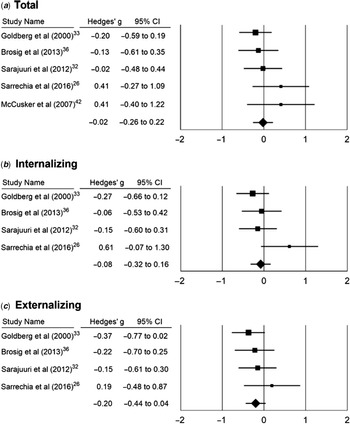
Of 12 studies that utilised the CBCL, only five studies provided mean t-scores to allow for inclusion in the meta-analysis. Reference Sarajuuri, Lonnqvist, Schmitt, Almqvist and Jokinen31,Reference Sarrechia, Miatton and De Wolf32,Reference Brosig, Mussatto and Hoffman35,Reference Goldberg, Schwartz and Brunberg39,Reference McCusker, Doherty and Molloy42 One study only reported data for the total problems scale, Reference McCusker, Doherty and Molloy42 and thus four studies were included in the externalising and internalising domain analyses. The pooled effect sizes for all three domains (total, internalising and externalising problems) were insignificant, suggesting no significant difference between mean t-scores of the studies and the mean t-scores for normative values. For a full summary of meta-analysis results, see Table 2 and Figure 2.
Forest plots from meta-analysis for CBCL total (A), internalising (B) and externalising (C) t-scores. Square sizes are proportional to the weight of each study’s sample size in the analysis, and the lines represent their 95% CIs. The diamond represents the pooled effect size by Hedges’ g with 95% CI.

Discussion
Results of the current review present the first known synthesis of the literature regarding psychological functioning in the paediatric single ventricle heart disease population. Overall, review of results of individual studies underscores increased risk for psychological sequelae, including anxiety, depression and behavioural symptoms and disorders in paediatric patients with single ventricle heart disease. However, a small meta-analysis of 4–5 studies failed to show significant differences in total, internalising or externalising problems.
Of the 24 studies in the review that examined internalising problems, the majority found an increased risk of internalising problems in paediatric single ventricle heart disease patients when compared with control groups. This is consistent with the existing, albeit few, studies of the paediatric CHD population at large which show that children with CHD have increased incidence of depression when compared with their peers. Reference Luyckx, Rassart, Goossens, Apers, Oris and Moons50,Reference Karsdorp, Everaerd, Kindt and Mulder51 Increased rates of internalising problems have been well described in the more robust adult CHD literature. Some studies estimate that over half of adult patients with CHD have significant symptoms of a mood or anxiety disorder, Reference Kovacs, Saidi and Kuhl52 although it is also likely that these symptoms are underrecognized and this estimate does not fully capture the extent of psychological morbidity.
This review also found increased risk of externalising problems in paediatric patients with single ventricle heart disease, with 16 of 22 studies that examined externalising problems describing increased risk compared to controls. The few existing studies in paediatric CHD show similar findings of increased risk of inattention symptoms and attention-deficit/hyperactivity disorder. Reference Karsdorp, Everaerd, Kindt and Mulder51,Reference Wang, Weng and Chang53–Reference Yamada, Porter and Conway55 There is minimal literature on adult CHD or adult cardiovascular disease and associations with attention-deficit/hyperactivity disorder, which could be an important area for further exploration given known associations with adult attention-deficit/hyperactivity disorder and poor physical and mental health outcomes. Reference Cherkasova, Roy and Molina56 It is important to note that the broad category of externalising problems also includes aggression and conduct problems. It is possible that if children do not have aggression or conduct problems that their total externalising score may not be elevated, despite attention or self-regulation concerns. Further studies with more specific metrics can better identify the risk of attention-deficit/hyperactivity disorder in this patient population.
It is important to highlight that the meta-analysis of 4–5 studies did not show significant differences between single ventricle heart disease patients and normative values in total, externalising or internalising problems as measured by a well-validated metric of child emotional and behavioural problems. This non-significant finding amidst the broader literature review, which highlights a greater risk for adverse psychological sequalae for patients with single ventricle heart disease, should be interpreted with the following considerations in mind. First, only a small number of studies could be included in the meta-analysis due to the various measures of psychological functioning used across studies. Furthermore, it is possible that certain patients within the single ventricle heart disease population are at higher risk for poor psychological functioning than others. It is notable that in this small meta-analysis sample, four of the studies had a mean age of participant below age 5. Karsdorp et al previously found in their meta-analysis that older children and adolescents were at higher risk for poor psychological functioning. Reference Karsdorp, Everaerd, Kindt and Mulder51 Likewise, Gonzalez et al found that the rate of diagnosis or medication for anxiety and depression increased as patients with CHD aged. Reference Gonzalez, Kimbro and Cutitta25 It is feasible that studies with older single ventricle heart disease patients may find more significant differences in rates of poor psychological functioning than those of younger patients. Lastly, a number of studies in the review noted normative sample mean scores in terms of psychological functioning but found percentage of patients with at-risk scores to be greater than population prevalence. As such, sample mean scores provide only a snapshot of psychological risk.
Several limitations to the current body of literature must be noted, which may direct future research in the field. First, few studies examined association of poor psychological functioning and health outcomes. It is known that in adults with CHD, depression is responsible for the variability of self-reported health status of patients, including physical functioning. Reference Ko, Tecson and Rashida57 A recent study of adult patients with CHD found that major depression was associated with impaired functional status, heart failure and increased risk for adverse outcomes. Reference Carazo, Kolodziej and DeWitt58 Mental health disease may also impact healthcare utilisation, as has been demonstrated in adult patients with CHD. Reference Desai, Patel, Dave and etal59 Further studies of associations of health outcomes and psychological functioning in paediatric patients with single ventricle heart disease are important to better understand the impact of mental health disorders in this population.
Five studies Reference Cassidy, Bernstein, Bellinger, Newburger and DeMaso23,Reference Brosig, Mussatto, Kuhn and Tweddell34,Reference McCusker, Doherty and Molloy42,Reference Fuller, Rajagopalan and Jarvik46,Reference Hansen, Poole and Nguyen47 within the present review found increased risk of poor psychological functioning in patients with single ventricle heart disease when compared to patients with other forms of CHD. The findings presented here may suggest that patients with single ventricle heart disease have different risk for worse outcomes in psychological functioning, and thus should be considered separately from other patients with CHD. A previous systematic review and meta-analysis by Latal et al similarly looked at psychological functioning in the broader CHD population which found that psychological outcomes were worse for patients with more severe CHD. Reference Latal, Helfricht, Fischer, Bauersfeld and Landolt60 A recent large international study of adult patients found worse psychological patient-related outcomes in patients with cyanotic heart disease compared to other CHD. Reference Moons, Luyckx, Thomet and etal61 Future studies examining contributors of additive psychological burden in single ventricle heart disease are important next directions for the field.
This review highlights several important practice considerations. Mental health disorders are not reliably identified in the paediatrics population at large, and many children who would benefit from treatment of mental health conditions do not receive appropriate care. Reference Jensen, Goldman and Offord10 It is suspected that mental health disorders are under-identified and undertreated in children for a myriad of reasons. The integration of experienced social work and psychology clinicians into paediatric cardiology care is supported by international consensus statements. Reference Rychik, Atz and Celermajer62 Screening for psychological functioning with brief, validated instruments at routine clinic visits may also help to identify those patients at highest need for referral and intervention. The Cardiac Neurodevelopmental Outcome Collaborative has made recent recommendations for a core battery of developmental testing including the Behavior Assessment System for Children, Third Edition Reference Reynolds and Kamphaus63 for consistent and validated screening methodologies across centres. Reference Ware, Butcher and Latal64,Reference Ilardi, Sanz and Cassidy65
Notably, lack of preparedness by the paediatric provider to address mental health concerns in their patients has also been highlighted as a contributor to the under-identification of mental health concerns in children. Reference McMillan, Land, Tucker and Leslie11 As a result, the American Board of Pediatrics and American Academy of Pediatrics have focused on preparedness of physicians to address mental health appropriately in their patients. Reference McMillan, Land, Tucker and Leslie11 For this reason, mental health training in paediatric residency is a target of graduate medical education groups across paediatric care. Reference McMillan, Land, Tucker and Leslie11,Reference Harris, Bowden, Greiner and Duby66,Reference McMillan, Land and Leslie67 To our knowledge, mental healthcare has not been a focus of education in paediatric cardiology fellowship. As it has been shown that some parents seek routine care from their cardiology providers, Reference Luthy, Yu, Donohue, Loccoh, Goldberg and Lu9 paediatric cardiology providers should also be comfortable with identifying patients who would benefit from referral for mental health services. While mental health assessments are taught in many paediatric residency programmes, this is not consistent across training programmes. Further education in addressing mental health concerns would better prepare paediatric cardiology trainees to meet the needs of their complex population. This education and training should also be expanded to all members of the multidisciplinary team providing cardiology specific care to this patient population, including nurses, social workers, therapists, psychologists, and developmental experts.
Mental health intervention design, implementation and effectiveness study are necessary next steps for research and practice. Reference Cassidy, Butler and Briend68 A recent review of the literature identified only two published psychological intervention studies involving adolescents with CHD. Unfortunately, the interventions were not found to be highly efficacious, Reference Tesson, Butow, Sholler, Sharpe, Kovacs and Kasparian69 but mental health interventions in adults with heart disease have demonstrated some successes to build upon. Reference Moon, Huh, Kang, Park, June and Lee70 Cognitive behavioural therapy and positive-psychology based interventions in particular have shown promise in adult heart disease populations. Reference Levine, Cohen and Commodore-Mensah14 Therefore, examination of such intervention effects on both psychological and cardiovascular outcomes in paediatric single ventricle heart disease should be priorities for research study in the coming years.
The results of the current review must be interpreted in light of several limitations. Given the limited available research on psychological functioning in the paediatric single ventricle heart disease population, and the paediatric CHD population in general, studies for review were limited in number and often with varying methodology. A meta-analysis was conducted on studies utilising the same metric and methodology but given the wide range of measures and methodologies available, a more comprehensive meta-analysis was not feasible. Further, studies in the current review widely varied in sample size with 18 of the 29 studies having sample sizes of 40 participants or fewer. While this is reflective of smaller populations of patients with single ventricle heart disease at some single centres, future research would continue to be improved by multi-site collaborations and registry-level studies to better understand psychological functioning in this population. While every effort was made to include all published studies on the presented topic, it is possible some studies were missed. Finally, qualitative studies were not included in the review given inconsistency in methodology but may add valuable insights into psychological functioning in this population.
This systematic review provides an important synthesis of the literature and a starting point for further research on risk factors and interventions for psychological functioning in patients with single ventricle heart disease. Results demonstrate that patients with single ventricle heart disease are at increased risk for poor psychological functioning when compared to healthy peers and to peers with other forms of CHD. Likely there are characteristics within the single ventricle heart disease population that put certain patients at even greater risk, potentially age and specific single ventricle heart disease diagnoses, however, these specific characteristics have yet to be well studied. The suggestion but lack of clear associations of single ventricle heart disease and psychological functioning through single centre studies supports the prospective integration of psychological outcomes into emerging registries like the Fontan Outcomes Network Reference Alsaied, Allen and Anderson71 and the exisitng Cardiac Neurodevelopmental Outcome Collaborative, Reference Sood, Jacobs and Marino72 which in addition to neurodevelopmental outcomes is also collecting psychosocial outcomes data. Based on the findings of this systematic review and in keeping with the current American Heart Association statements, Reference Levine, Cohen and Commodore-Mensah14 we would recommend that paediatric cardiologists prioritise mental health in their care of patients with single ventricle heart disease, with future research guiding best practices on screening techniques and intervention strategies.
Supplementary material
For supplementary material accompanying this paper visit https://doi.org/10.1017/S1047951122000063
Acknowledgements
The authors would like to acknowledge the Michigan Congenital Heart Outcomes Research and Discovery (MCHORD) group at the University of Michigan Congenital Heart Center, for their support in the development of this project.
Financial support
This research received no specific grant from any funding agency, commercial or not-for-profit sectors. Dr Cousino’s research is supported by the National Heart, Lung, and Blood Institute (K23HL145096) of the National Institutes of Health.
Conflicts of interest
None.