Introduction
In the past two decades, significant research efforts have been undertaken to discover attractants for woodboring beetles, due in no small part to invasions by the Asian longhorned beetle, Anoplophora glabripennis (Motschulsky) (Coleoptera: Cerambycidae) (Dodds and Orwig Reference Dodds and Orwig2011), and the emerald ash borer, Agrilus planipennis Fairmaire (Coleoptera: Buprestidae) (Poland and McCullough Reference Poland and McCullough2006), into North America. With the exception of Millar et al. (Reference Millar, Mitchell, Mongold-Diers, Zou, Bográn and Fierke2018), most trapping experiments with the cerambycid pheromones 2,3-hexanediols and 3,2-hydroxyketones have occurred in the eastern United States of America, likely because of the high diversity of beetle species associated with the high diversity of hardwoods found there. A few trapping efforts have focused on cerambycid species associated with conifer forests in the western United States of America, using compounds such as pheromones used by bark beetles (ipsenol and ipsdienol; Allison et al. Reference Allison, Borden, McIntosh, de Groot and Gries2001; Miller et al. Reference Miller, Dodds, Eglitis, Fettig, Hofstetter and Langor2013a) or Monochamus spp. of Cerambycidae (monochamol; Miller et al. Reference Miller, Allison, Crowe, Dickinson, Eglitis and Hofstetter2016).
Our goal was to conduct a preliminary field assessment of three common hardwood cerambycid pheromones (syn-2,3-hexanediol, 3-hydroxyhexan-2-one, and 3-hydroxyoctan-2-one) on catches of bark and woodboring beetles in ethanol-baited traps in the Pacific Northwest of the United States of America. Given the low level of diversity and abundance of hardwood species in western forests, our expectations for responses by western species of Cerambycidae were low. To maximise our ability to detect such responses, we employed two different trapping designs based on successful designs employed in the southeastern United States of America (Miller et al. Reference Miller, Crowe, Mayo, Silk and Sweeney2015, Reference Miller, Crowe, Mayo, Reid, Silk and Sweeney2017). The two studies were conducted at two different locations (approximately 240 km apart) within the Cascade Mountain Range of Oregon and Washington states, United States of America to provide further opportunities for detection of responses.
Methods
We used black 10-unit multiple-funnel traps (Synergy Semiochemicals Inc.; Delta, British Columbia, Canada), modified to allow lures to be hung within the funnels (Miller et al. Reference Miller, Crowe, Barnes, Gandhi and Duerr2013b). Black ethanol ultra-high release pouches, white syn-2,3-hexanediol (racemic) lures, brown 3-hydroxyhexan-2-one (racemic), and brown 3-hydroxyoctan-2-one (racemic) lures were obtained from Contech Enterprises (Victoria, British Columbia, Canada). Release rates (determined by the manufacturer at 20–23 °C) from these lures were 0.5 g/d, 1.5 mg/d, 20–25 mg/d, and 20–25 mg/d, respectively.
In 2012, we conducted two trapping experiments in mature stands of Douglas-fir, Pseudotsuga menziesii (Mirbel) Franco (Pinaceae), in the Cascade Mountain Range in the Pacific Northwest, United States of America: one in Oregon and the other in Washington. In both experiments, 40 traps were deployed in a randomised complete block design, with 10 blocks of four traps per block. Traps were hung by twine between trees, such that the collection cup of each trap was approximately 0.5 m above ground level. Traps were spaced 10–25 m apart within blocks; blocks were spaced 20–30 m apart. Each collection cup contained approximately 300 mL of an aqueous solution of propylene glycol to kill and preserve insects (Miller and Duerr Reference Miller and Duerr2008). The solution was changed after each two-week collection period. Voucher specimens were deposited in the University of Georgia Collection of Arthropods, Athens, Georgia, United States of America.
Experiment 1 was conducted from 25 June to 11 September 2012 in the Mount Baker–Snoqualmie National Forest, King County, Washington (47.398° N, 121.493° W). One of the following four lure combinations was randomly applied to a trap within each block: (1) ethanol alone; (2) ethanol + syn-2,3-hexanediol (D6); (3) ethanol + 3-hydroxyhexan-2-one (K6); and (4) ethanol + 3-hydroxyoctan-2-one (K8). Experiment 2 was conducted from 21 June to 15 August 2012 in the Mount Hood National Forest, Clackamas County, Oregon (45.444 °N, 122.157 °W). One of the following four lure combinations was randomly applied to a trap within each block: (1) ethanol alone; (2) ethanol + syn-2,3-hexanediol (D6); (3) ethanol + 3-hydroxyhexan-2-one + 3-hydroxyoctan-2-one (K); and (4) ethanol + syn-2,3-hexanediol (D6) + 3-hydroxyhexan-2-one + 3-hydroxyoctan-2-one (K). Ethanol was used as the control for comparing additional lures because ethanol alone is attractive to bark and woodboring beetles (Miller Reference Miller2006; Miller and Rabaglia Reference Miller and Rabaglia2009; Sweeney et al. Reference Sweeney, Silk, Grebennikov and Mandelshtam2016) and increases attraction of cerambycids to pheromone-baited traps (Miller et al. Reference Miller, Crowe, Mayo, Silk and Sweeney2015). In each experiment, syn-2,3-hexanediol, 3-hydroxyhexan-2-one, and 3-hydroxyoctan-2-one lures were replaced after six weeks.
Statistical analyses for species caught in sufficient numbers (N ≥ 30) were conducted with the SYSTAT, version 13, and SigmaStat, version 3.01, statistical packages (SYSTAT Software Inc., Point Richmond, California, United States of America). As needed, data were transformed by ln (Y + 1) to attain normality and homoscedasticity, verified by the Shapiro–Wilk and equal variance tests, respectively. In both experiments, data were analysed by mixed-model analysis of variance, with treatment as the fixed factor, followed by the Holm–Sidak multiple-comparison test for species showing effects of treatments (α = 0.05). For species affected by treatments in experiment 2, data were further analysed by a mixed-model analysis of variance using the following model factors: (1) syn-2,3-hexanediol (D6); (2) 3-hydroxyhexan-2-one + 3-hydroxyoctan-2-one (K); and (3) syn-2,3-hexanediol (D6) × 3-hydroxyhexan-2-one + 3-hydroxyoctan-2-one (K; i.e., D6 + K).
Results and discussion
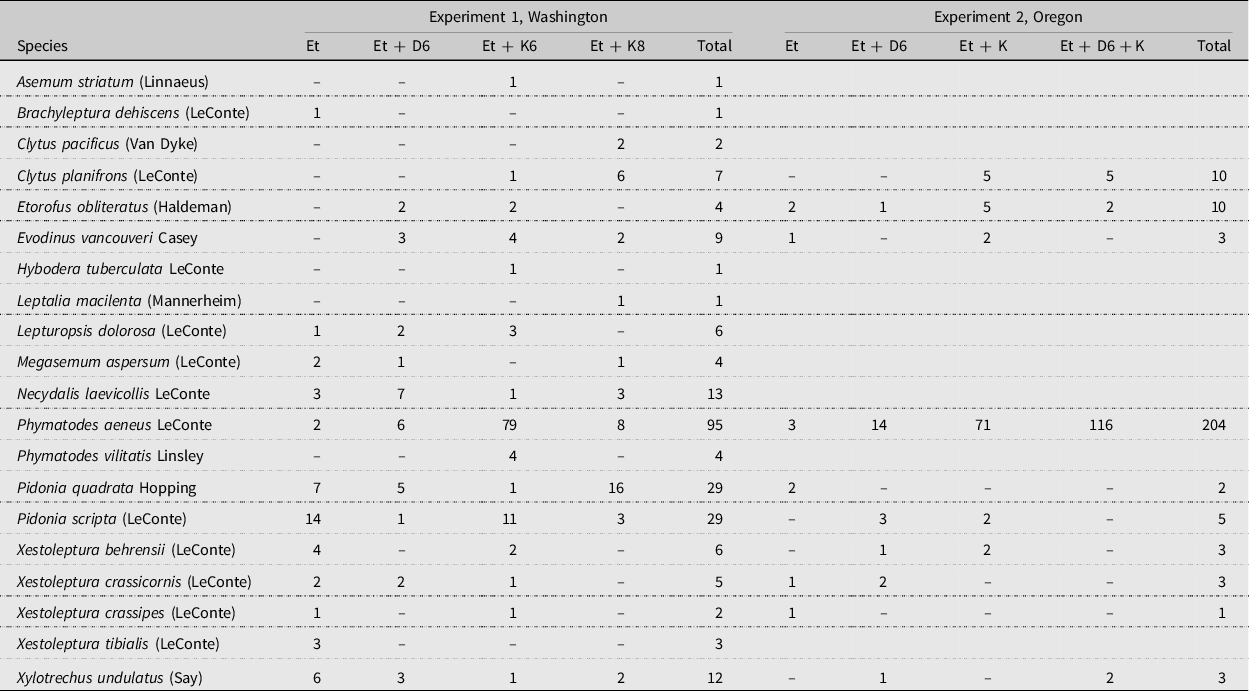
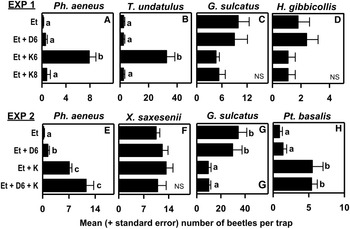
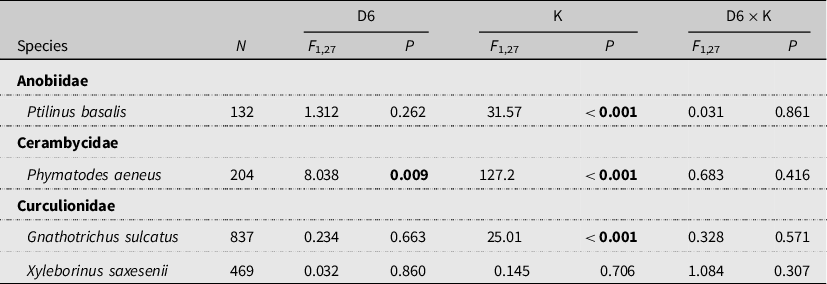
We captured a total of 478 longhorned beetles across the two experiments, detecting 20 cerambycid species (Table 1). Only Phymatodes aeneus LeConte (Coleoptera: Cerambycidae) was caught in sufficient numbers for statistical analyses. Similar to Millar et al. (Reference Millar, Mitchell, Mongold-Diers, Zou, Bográn and Fierke2018), lure treatments had a significant effect on catches of Ph. aeneus (N = 95) in experiment 1 (F 3,27 = 33.89, P < 0.001). Traps baited with ethanol + 3-hydroxyhexan-2-one caught more beetles than traps baited with the other three treatments did (Fig. 1A). In experiment 2, the 3, 2-hydroxyketone blend had a significant effect on catches of Ph. aeneus (Table 2). Catches were greatest in traps baited with the 3,2-hydroxyketone blend (with or without syn-2,3-hexanediol; Fig. 1E).
Catches of Cerambycidae (Coleoptera) in two experiments with multiple-funnel traps baited with ethanol (Et), syn-2,3-hexanediol (D6), 3-hydroxyhexan-2-one (K6), 3-hydroxyoctan-2-one (K8), and a blend of K6 + K8 (K) in the Pacific Northwest, United States of America.

Effects on mean (± standard error) catches of A, Phymatodes aeneus, B, Gnathotrichus sulcatus, C, Thanasimus undatulus, and D, Hemicoelus gibbicollis by syn-2,3-hexanediol (D6), 3-hydroxyhexan-2-one (K6), and 3-hydroxyoctan-2-one (K8) in experiment 1, and of E, Ph. aeneus, F, G sulcatus, G, Xyleborinus saxesenii, and H, Ptilinus basalis in traps baited with syn-2,3-hexanediol (D6) and 3-hydroxyhexan-2-one + 3-hydroxyoctan-2-one (K) in experiment 2. Traps were control baited with ethanol (Et). Means for a species followed by the same letter are not significantly different at P = 0.05 (Holm–Sidak test).

Analysis of variance results for effects of syn-2,3-hexanediol (D6) and 3-hydroxyhexan-2-one + 3-hydroxyoctan-2-one (K), and the interaction of syn-2,3-hexanediol (D6) × 3-hydroxyhexan-2-one + 3-hydroxyoctan-2-one (K; i.e., D6 × K) on catches of beetles in 10-unit modified multiple-funnel traps baited with ethanol. N, total number of beetles.

A common feature among Cerambycidae is the use of the same pheromones among related species (Hanks and Millar Reference Hanks and Millar2013), allowing for the operational use of lure blends to detect multiple cerambycid species simultaneously (Hanks et al. Reference Hanks, Millar, Mongold-Diers, Wong, Meier, Reagel and Mitchell2012). 3-Hydroxyhexan-2-one is a pheromone or attractant for several congeners of Ph. aeneus in North America: Phymatodes aereus Newman, Ph. amoenus Say, Ph. lecontei Linsley, Ph. lengi Joutel, Ph. obliquus Casey, Ph. testaceus Linnaeus, and Ph. varius (Hanks et al. Reference Hanks, Millar, Moreira, Barbour, Lacey and McElfresh2007, Reference Hanks, Mongold-Diers, Mitchell, Zou, Wong and Meier2019; Hanks and Millar Reference Hanks and Millar2013; Mitchell et al. Reference Mitchell, Reagel, Wong, Meier, Silva and Mongold-Diers2015; Millar et al. Reference Millar, Mitchell, Mongold-Diers, Zou, Bográn and Fierke2018; Collignon et al. Reference Collignon, Cale, McElfresh and Millar2019).
We found that syn-2,3-hexanediol had an effect on catches of Ph. aeneus in experiment 2 (Table 2), with catches in traps baited with ethanol + syn-2,3-hexanediol greater than those in traps baited solely with ethanol (Fig. 1E). In contrast, Millar et al. (Reference Millar, Mitchell, Mongold-Diers, Zou, Bográn and Fierke2018) found that attraction of Ph. aeneus to traps baited with 3-hydroxyhexan-2-one in Oregon was interrupted by the addition of the blend of syn- + anti-2,3-hexanediols; the effect of syn-2,3-hexanediol alone on catches of beetles in traps baited with 3-hydroxyhexan-2-one was not determined. Hanks and Millar (Reference Hanks and Millar2013) and Hanks et al. (Reference Hanks, Mongold-Diers, Mitchell, Zou, Wong and Meier2019) previously noted the congeners Ph. aereus and Ph. varius were attracted to traps baited with syn-2,3-hexanediol in the United States of America.
A thorough understanding of the chemical ecology of this genus will require determinations of pheromone production by all these species; determinations have only been conducted for a few species. Additional studies testing the effects of host kairomones and other pheromones such as 2-methylbutanol on behavioural responses need to be conducted (Collignon et al. Reference Collignon, Swift, Zou, McElfresh, Hanks and Millar2016). Dose and chemical composition can affect trap catches (Collignon et al. Reference Collignon, Cale, McElfresh and Millar2019). Enantiomeric composition may be an important issue for these species because the following compounds are chiral, existing in (+) and (–) forms: syn-2,3-hexanediol, anti-2,3-hexanediol, 3-hydroxyhex-2-one, and 3-hydroxyoctan-2-one (Ray et al. Reference Ray, Barbour, McElfresh, Moreira, Swift and Wright2012; Mitchell et al. Reference Mitchell, Millar and Hanks2013, Reference Mitchell, Reagel, Wong, Meier, Silva and Mongold-Diers2015; Hanks et al. Reference Hanks, Mongold-Diers, Mitchell, Zou, Wong and Meier2019). Such studies should help to clarify the effects of interspecific competition, geographic variation, host-specific kairomones, and predation on these species.
Catches of Thanasimus undatulus (Say) (Coleoptera: Cleridae) in experiment 1 (N = 399) were affected by lure treatments (F 3,27 = 23.79, P < 0.001), with the greatest number captured in traps baited with ethanol + 3-hydroxyhexan-2-one (Fig. 1B), mirroring the response profile of P. aeneus (Fig. 1A). Thanasimus undatulus is a generalist predator of bark and woodboring beetles, with adults feeding on adult prey and larval T. undatulus feeding on larval prey (Furniss and Carolin Reference Furniss and Carolin1980).
Prey and predators attracted by the same compounds to the same sites likely increase the likelihood of predation events. Understanding the chemical ecology of predators can provide insights into their ecological roles with native species of bark and woodboring beetles, as well as their potential role in mitigating the impacts of future nonnative species. Responses of predators mirroring the pheromone responses of cerambycids are not uncommon with traps baited with syn-2,3-hexanediol and 3,2-hydroxyketones. In the southeastern United States of America, 3-hydroxyhexan-2-one was attractive to six common species of Cerambycidae and to the predators Temnoscheila virescens (Fabricius) (Coleoptera: Trogossitidae) and Apiomerus crassipes (Fabricius) (Hemiptera: Reduviidae); A. crassipes and the woodborer Clytus marginicollis Laporte and Gory (Coleoptera: Cerambycidae) were attracted to traps baited with 3-hydroxyoctan-2-one (Miller et al. Reference Miller, Crowe, Mayo, Silk and Sweeney2015, Reference Miller, Crowe, Mayo, Silk and Sweeney2022).
Similarly, catches of the predators Chariessa pilosa (Forster), Madoniella dislocata (Say), and Enoclerus ichneumoneus (Fabricius) (all Coleoptera: Cleridae) were greatest in traps baited with syn-2,3-hexanediol; catches of all three species were reduced by the addition of the blend of 3-hydroxyhexan-2-one + 3-hydroxyoctan-2-one (Miller et al. Reference Miller, Crowe, Mayo, Silk and Sweeney2022). The same response profile was found for three species of woodborers at the same sites (Miller et al. Reference Miller, Crowe, Mayo, Silk and Sweeney2015, Reference Miller, Crowe, Mayo, Reid, Silk and Sweeney2017, Reference Miller, Crowe, Mayo, Silk and Sweeney2022). The cerambycid pheromone sulcatol (Meier et al. Reference Meier, Millar, Mongold-Diers and Hanks2019) attracted the woodborer Leptostylus asperatus (Haldemann) (Coleoptera: Cerambycidae) and four species of predators in Georgia (Miller and Crowe Reference Miller and Crowe2020). In Europe, traps baited with blends of 3,2-hydroxyketones were attractive to two cerambycid species and to the predator Clerus mutillarius Fabricius (Coleoptera: Cleridae) (Imrei et al. Reference Imrei, Domingue, Lohonyai, Moreira, Csonka and Fail2021).
Lure treatments had no effect on catches of the corthyline ambrosia beetle, Gnathotrichus sulcatus (Coleoptera: Curculionidae), (N = 288) in experiment 1 (F 3,27 = 1.620, P = 0.208; Fig. 1C). In contrast, the 3,2-hydroxyketone blend affected catches of G. sulcatus in experiment 2 (Table 2). Traps baited with the blend (with or without syn-2,3-hexanediol) caught fewer beetles than traps baited with ethanol (with or without syn-2,3-hexanediol) did (Fig. 1G). In contrast, the xyleborine ambrosia beetle, Xyleborinus saxesenii (Coleoptera: Curculionidae), was unaffected by lure treatments in experiment 2 (Table 2; Fig. 1F). In Georgia, catches of X. saxesenii in ethanol-baited traps were unaffected by the addition of syn-2,3-hexanediol, 3-hydroxyhexan-2-one, or 3-hydroxyoctan-2-one individually (Miller et al. Reference Miller, Crowe, Mayo, Silk and Sweeney2015) but increased by the addition of the blend of 3-hydroxyhexan-2-one + 3-hydroxyoctan-2-one (Miller et al. Reference Miller, Crowe, Mayo, Silk and Sweeney2022).
Catches of the xylophagous species Hemicoelus gibbicollis (Coleoptera: Anobiidae) (N = 64) were unaffected by lure treatments in experiment 1 (F 3,27 = 1.248, P = 0.312; Fig. 1D). In contrast, lure treatments affected catches of Ptilinus basalis (Coleoptera: Anobiidae) in experiment 2 (Table 2). Traps baited with the 3,2-hydroxyketone blend (with or without syn-2,3-hexanediol) caught the most beetles (Fig. 1H). In Georgia, catches of another xylophagous beetle, Xylobiops basilaris (Say) (Coleoptera: Bostrichidae), were higher in traps baited with ethanol + syn-2,3-hexanediol than in those baited with ethanol or ethanol + 3,2-hydroxyketones (Miller et al. Reference Miller, Crowe, Mayo, Silk and Sweeney2015, Reference Miller, Crowe, Mayo, Silk and Sweeney2022); 3-hydroxyoctan-2-one interrupted attraction of beetles to traps baited with ethanol + syn-2,3-hexanediol (Miller et al. Reference Miller, Crowe, Mayo, Silk and Sweeney2022).
Bark and woodboring beetles are broadly attracted to traps baited with ethanol (Miller Reference Miller2006; Miller and Rabaglia Reference Miller and Rabaglia2009; Sweeney et al. Reference Sweeney, Silk, Grebennikov and Mandelshtam2016). Determining the effects of cerambycid pheromones on responses of phloeo- and xylophagous species to ethanol-baited traps is important in optimising the use of traps baited with ethanol and cerambycid pheromones to detect nonnative species of bark and woodboring beetles simultaneously. The use of multispecies trap lure combinations is a cost-effective method for assessing the biodiversity of cerambycids (Dodds et al. Reference Dodds, Allison, Miller, Hanavan and Sweeney2015; Handley et al. Reference Handley, Hough-Goldstein, Hanks, Millar and D’amico2015; Wickham et al. Reference Wickham, Harrison, Lu, Chen, Hanks and Millar2021). This approach may also be a cost-effective method for assessing the biodiversity of bark and ambrosia beetles (and associated predators) simultaneously. Determining the biodiversity of these groups could be important as an environmental monitoring tool in assessing subtle forest health impacts arising from climate change, invasions by nonnative species, harvesting practices, and wind disturbance events.
Acknowledgements
The authors thank Jon Sweeney and Peter Mayo (Canadian Forest Service) for technical support, Roy Magelssen (United States Department of Agriculture Forest Service) for field assistance, and Richard Hoebeke (University of Georgia Collection of Arthropods) for verification of insect identifications. The use of trade names and identification of firms or corporations does not constitute an official endorsement or approval by the United States government of any product or service to the exclusion of others that may be suitable. The United States Department of Agriculture is an equal opportunity provider, employer, and lender.
Competing interests
The authors declare no competing interests.