Introduction
The white grub beetle, Dasylepida ishigakiensis Niijima et Kinoshita (Coleoptera: Scarabaeidae), is one of the most destructive sugarcane pests in the Miyako Islands (Sadoyama et al., Reference Sadoyama, Oroku and Nakamori2001). This beetle has a two-year life cycle. Larvae hatch in March and April and grow by feeding on sugarcane roots. Third-instar larvae that appear around September vigorously feed on the sugarcane's roots and underground stems, often killing the plants shortly before harvest (Oyafuso et al., Reference Oyafuso, Arakaki, Sadoyama, Kishita, Kawamura, Ishimine, Kinjyo and Hirai2002). The larvae continue to feed until late June and subsequently move to a deeper layer of soil for aestivation, pupating in this location in October and reaching adulthood in November. Adults remain in the soil for another two months, emerging for mating for just a short time in the winter evenings to mate (Tanaka et al., Reference Tanaka, Yukuhiro, Yasui, Fukaya, Akino and Wakamura2008; Fukaya et al., Reference Fukaya, Yasui, Akino, Yasuda, Tanaka, Wakamura, Maeda, Hirai, Yasuda, Nagayama and Arakaki2009). Controlling this species is necessary for improving sugarcane production on the Miyako Islands; but, because this insect spends most of its life in the soil, pesticides may not be as effective on it as they would be on insects living above ground. Adults do not feed because of their degenerated mouthparts, so that much higher rates of pesticide should be applied than if they did ingest the toxicant. Furthermore, sprayed pesticides may pollute the ground water on which the islands' residents depend. One compromise may be to spray the sugarcane fields only when the adult beetles emerge from the soil to mate. However, the adults' emergence from the soil is influenced by various intrinsic and extrinsic factors (Arakaki et al., Reference Arakaki, Sadoyama, Kishita, Nagayama, Oyafuso, Ishimine, Ota, Akino, Fukaya, Hirai, Yamamura and Wakamura2004; Tanaka et al., Reference Tanaka, Yukuhiro, Yasui, Fukaya, Akino and Wakamura2008; Harano et al., Reference Harano, Tanaka, Tokuda, Yasui, Wakamura, Nagayama, Hokama and Arakaki2010; Tokuda et al., Reference Tokuda, Tanaka, Maeno, Harano, Wakamura, Yasui, Arakaki, Akino and Fukaya2010) and is not always predictable. Because adults of this species do not eat (Arakaki et al., Reference Arakaki, Sadoyama, Kishita, Nagayama, Oyafuso, Ishimine, Ota, Akino, Fukaya, Hirai, Yamamura and Wakamura2004), the amount of energy resource that can be allotted to mating activity must be limited. Given these circumstances, it is believed that using the beetle's sex pheromone to disrupt mating activity may be more effective in controlling this pest. In order to develop this control method, it is necessary to determine the quantitative and qualitative dynamics of sex pheromone emissions in the reproductive life of this beetle.
Female white grub beetles emit the sex pheromone (R)-2-butanol (Wakamura et al., Reference Wakamura, Yasui, Akino, Yasuda, Fukaya, Tanaka, Maeda, Arakaki, Nagayama, Sadoyama, Kishita, Oyafuso, Hokama, Kobayashi, Tarora, Uesato, Miyagi and Osuga2009a). Both (R)-2-butanol and (S)-2-butanol are electroantennographically (EAG) active. However, the enantiomerically pure (R)-2-butanol was the only compound attractive to male beetles in prior laboratory and field experiments (Wakamura et al., Reference Wakamura, Yasui, Akino, Yasuda, Fukaya, Tanaka, Maeda, Arakaki, Nagayama, Sadoyama, Kishita, Oyafuso, Hokama, Kobayashi, Tarora, Uesato, Miyagi and Osuga2009a,Reference Wakamura, Yasui, Mochizuki, Fukumoto, Arakaki, Nagayama, Uesato, Miyagi, Oroku, Tanaka, Tokuda, Fukaya, Akino, Hirai and Shigab). We previously demonstrated that adult females emit both (R)- and (S)-2-butanol. However, the R/S ratio of 2-butanol emitted by females has not yet been determined (Wakamura et al., Reference Wakamura, Yasui, Akino, Yasuda, Fukaya, Tanaka, Maeda, Arakaki, Nagayama, Sadoyama, Kishita, Oyafuso, Hokama, Kobayashi, Tarora, Uesato, Miyagi and Osuga2009a) because the quantity of 2-butanol directly collected by SPME from the air surrounding the calling female was insufficient. Recently, we developed a method for effectively trapping and analysing this highly volatile and hydrophilic compound (Yasui et al., Reference Yasui, Wakamura, Tanaka, Harano, Mochizuki, Nagayama, Hokama and Arakaki2010). Our method significantly improved the trapping rate of emitted 2-butanol and enabled us to quantify the total amount of 2-butanol emitted by individual D. ishigakiensis females (Yasui et al., Reference Yasui, Wakamura, Tanaka, Harano, Mochizuki, Nagayama, Hokama and Arakaki2010; Fujiwara-Tsujii et al., Reference Fujiwara-Tsujii, Yasui, Wakamura, Tanaka and Arakaki2011). Moreover, we determined the differences in the R/S ratio of 2-butanol emissions of females of various ages in preliminary experiments. In this study, we focused on age-dependent changes in the R/S ratio of 2-butanol emitted by females and on the male EAG and behavioural responses to various R/S ratios of 2-butanol. With this information, we sought to develop optimal trap baits and a control agent.
Materials and methods
Insects
Third-instar larvae of D. ishigakiensis were collected from the soil in sugarcane fields on Miyako Island, Okinawa Prefecture, Japan in early February 2010. The larvae were individually kept at 24 °C on a long photoperiod (14L:10D) and maintained in plastic cups (inner diameter, ca. 5.7cm; height, 3.5cm), each containing humus and fertile soil as substrate and a piece of sugarcane stem (diameter, ca. 1.5cm; length, 2cm) as food. The sugarcane stems were changed every three weeks until the larvae stopped feeding. The larvae pupated after 6–8 months, and the pupae reached adulthood approximately four weeks later. Adults terminate reproductive diapause and become sexually mature if they are first kept at 25 °C for one week and then exposed to 20 °C or 15 °C for eight weeks (Tanaka et al., Reference Tanaka, Yukuhiro, Yasui, Fukaya, Akino and Wakamura2008). In this study, newly emerged adults were kept at 24 °C for several days, incubated in the dark at 18 °C for 45 days, and subsequently incubated at 22 °C under a 12L:12D photoperiod with abruptly darkening condition to avoid make calling (Fukaya et al., Reference Fukaya, Yasui, Akino, Yasuda, Tanaka, Wakamura, Maeda, Hirai, Yasuda, Nagayama and Arakaki2009). The day of transfer to 18 °C was designated as day 0. Two days before pheromone collection (female) and assay (male), each beetle was transferred from the rearing cup, where it was placed on a folded piece of wet paper (JK Wiper, Nippon Paper Crecia Co., Ltd, Tokyo, Japan).
Chemicals
(R)-2-Butanol (R2B) (>99% purity, >98% ee) was purchased from Wako Pure Chemical Industries, Ltd (Osaka, Japan), and (S)-2-butanol (S2B) (>98% purity, >98% ee) and 2-butanol (racemic mixture, rac-2B) (>99% purity, 0% ee) were purchased from Tokyo Kasei Kogyo Co., Ltd (Tokyo, Japan). We analysed R2B and S2B with GC on a chiral column (for details, see Wakamura et al., Reference Wakamura, Yasui, Akino, Yasuda, Fukaya, Tanaka, Maeda, Arakaki, Nagayama, Sadoyama, Kishita, Oyafuso, Hokama, Kobayashi, Tarora, Uesato, Miyagi and Osuga2009a). We also analysed rac-2B with GC on an achiral column, which exhibited a single peak. The lures used in the bioassay were prepared in the laboratory of the Shin-Etsu Chemical Company.
R2B, S2B, rac-2B and a 10:1 mixture of R2B and S2B, respectively, were separately sealed in type A high-density polyethylene tubes as described by Wakamura et al. (Reference Wakamura, Yasui, Mochizuki, Fukumoto, Arakaki, Nagayama, Uesato, Miyagi, Oroku, Tanaka, Tokuda, Fukaya, Akino, Hirai and Shiga2009b). The inner and outer diameters of the tube were 0.84mm and 1.54mm, repectively. The type A tubes were 1cm long and contained approximately 5.0mg of the 2-butanol isomer(s). The release rate of rac-2B was estimated at approximately 3.5ng per min (100ng 30min−1) at approximately 23 °C in the laboratory using the method established by Yasui et al. (Reference Yasui, Wakamura, Tanaka, Harano, Mochizuki, Nagayama, Hokama and Arakaki2010). The amount of 2-butanol emitted from this lure over 30min corresponded to the total 2-butanol emission of a single female during her one instance of calling (Wakamura et al., Reference Wakamura, Yasui, Akino, Yasuda, Fukaya, Tanaka, Maeda, Arakaki, Nagayama, Sadoyama, Kishita, Oyafuso, Hokama, Kobayashi, Tarora, Uesato, Miyagi and Osuga2009a; Yasui et al., Reference Yasui, Wakamura, Tanaka, Harano, Mochizuki, Nagayama, Hokama and Arakaki2010).
Sex pheromone collection and determination of R/S ratio of 2-butanol
Female D. ishigakiensis emit detectable amounts of sex pheromone throughout their reproductive lives (Fujiwara-Tsujii et al., Reference Fujiwara-Tsujii, Yasui, Wakamura, Tanaka and Arakaki2011). However, they become reproductively mature on approximately day 64 after transfer to an 18 °C environment. In this study, we considered females to be young on day 53, fully mature on day 63 and old on day 73. On the day 53, after transfer to 18 °C, no female possessed chorionated oocytes. In contrast, on day 63, all females possessed at least one chorionated oocyte, and on day 73, all females possessed fully chorionated oocytes (Fujiwara-Tsujii et al., Reference Fujiwara-Tsujii, Yasui, Wakamura, Tanaka and Arakaki2011).
The calling behaviour of this beetle has been known to be induced by gradual (or stepwise) reduction in light intensity observed in the sugarcane field at dusk (Arakaki et al., Reference Arakaki, Sadoyama, Kishita, Nagayama, Oyafuso, Ishimine, Ota, Akino, Fukaya, Hirai, Yamamura and Wakamura2004; Fukaya et al., Reference Fukaya, Yasui, Akino, Yasuda, Tanaka, Wakamura, Maeda, Hirai, Yasuda, Nagayama and Arakaki2009). Under abruptly darkening condition, females do not make calling. Using this control method of stepwise light darkening, we could induce their calling behavior at the certain timing. The sex pheromone emitted by the females during their calling activity was collected one hour before the lights were turned off. We used two types of female groups, and determined the R/S ratio of the 2-butanol emitted from each group type. Relatively large quantities of 2-butanol are required to determine the R/S ratio with a chiral column in GC-MS analysis (at least several nanograms per each isomer), whereas smaller quantities are required for quantification using an achiral column (Yasui et al., Reference Yasui, Wakamura, Tanaka, Harano, Mochizuki, Nagayama, Hokama and Arakaki2010). Therefore, pheromones were collected from groups that included six or seven females rather than from individual females. We used the first type of group to study possible age-dependent qualitative changes. Groups of 53-, 63- and 73-day-old virgin females (six or seven individuals per group, n = 3) were formed, and the volatiles (including 2-butanol) emitted during the first instance of calling behaviour were collected. We used the second type of group to investigate possible qualitative changes in the females' sex pheromone profiles over the first, second and third instances of calling. Using the same individuals (six or seven individuals per group, n = 3), the volatiles emitted during the first (day 53), second (day 63) and third (day 73) instances of calling were collected.
Sex pheromones were collected using the method described by Yasui et al. (Reference Yasui, Wakamura, Tanaka, Harano, Mochizuki, Nagayama, Hokama and Arakaki2010). A glass beaker (200ml) was moistened with 1ml of distilled water. Six or seven females held in a wire mesh cage were placed in the beaker, which we then covered with a glass Petri dish and placed on a table at room temperature (23 °C). The beaker was indirectly lit with a 40 W incandescent lamp (Toshiba Co., Tokyo, Japan), and the light intensity was decreased stepwise from 175 lx to 0.91 lx (7 steps, 3min step−1). This diminishment of light intensity stimulated the calling behaviour of the females, and was roughly equal to the diminishment observed during mating activity in a sugarcane field (Arakaki et al., Reference Arakaki, Sadoyama, Kishita, Nagayama, Oyafuso, Ishimine, Ota, Akino, Fukaya, Hirai, Yamamura and Wakamura2004; Fukaya et al., Reference Fukaya, Yasui, Akino, Yasuda, Tanaka, Wakamura, Maeda, Hirai, Yasuda, Nagayama and Arakaki2009). Pheromone collection was conducted for 21min for each group. After the collection of volatiles, the water inside the beakers was collected individually into an 8-ml glass vial. Each beaker was rinsed twice with distilled water to make the final sample amount to 4ml. Potassium carbonate (4.4g) was added to the water extract as a salting-out agent. An SPME fibre (black: 75μm polydimethylsiloxane/Carboxen™, Supelco, Bellefonte, PA, USA) was then immersed in the liquid and held there for 40min. The SPME fibre was then immediately inserted into a GC-MS equipped with a capillary column for chiral compounds. The GC-MS apparatus was a Hewlett-Packard 6890 gas chromatograph equipped with a split/splitless injector and a JEOL JMS-T100GC AccuTOF spectrometre. The chiral column used was an Astec CHIRALDEX™ bounded B-PM fused-silica capillary column (30m × 0.25mm ID × 0.12μm film thickness; Supelco). Helium was used as a carrier gas at a constant flow mode of 1.25mlmin−1. The SPME fibre was inserted into the GC injection kept at 220 °C for 0.2min in splitless mode. The column oven temperature was kept at 35 °C for 2min, programmed at 1 °Cmin−1 to 45 °C and held at the final temperature for 8min.
R2B and S2B showed good separation at t R = 7.2min and t R = 7.6min, respectively. The R/S ratios were calculated from the peak area of the extracted ion at m/z 45.0 of R2B and S2B in the same sample, in which the profiles of ions at m/z 59.0 and m/z 31.0 were also used to identify the compounds. In this analysis, the ratio of areas for the R2B and S2B peaks of rac-2B was confirmed to be 1:1.
GC-EAG
The GC analysis was conducted on a Hewlett-Packard 5890 II gas chromatograph equipped with a split/splitless injector and a flame ionisation detector (FID). An INNOWAX fused-silica column (30m × 0.25mm ID × 0.25μm film thickness; Agilent) was used at a column head pressure of 110kPa. The compound solutions were injected in 1:40 split mode at 120 °C. The column temperature was held at 50 °C.
An EAG response was obtained simultaneously using the FID recording. The EAD system was prepared according to Struble & Arn (Reference Struble, Arn, Hummel and Miller1984). The electrode was modified to load an individual beetle's antenna (see text and fig. 1 in Wakamura et al., Reference Wakamura, Yasui, Akino, Yasuda, Fukaya, Tanaka, Maeda, Arakaki, Nagayama, Sadoyama, Kishita, Oyafuso, Hokama, Kobayashi, Tarora, Uesato, Miyagi and Osuga2009a). The negative electrode was curved towards the positive electrode, and a small glass capillary tube was fixed on the negative electrode with fine silver wire. The flagellum of a male lamellate antenna was inserted into the glass capillary to keep open the lobes of the excised antenna between the electrodes. To establish the electrical connection, the distal tip of the terminal lobe was cut off using a pair of microscissors. These procedures were essential for recording the EAG response because the sensilla on the inner surface of the lobes are dense (Tanaka et al., Reference Tanaka, Yukuhiro and Wakamura2006; Wakamura et al., Reference Wakamura, Yasui, Akino, Yasuda, Fukaya, Tanaka, Maeda, Arakaki, Nagayama, Sadoyama, Kishita, Oyafuso, Hokama, Kobayashi, Tarora, Uesato, Miyagi and Osuga2009a).
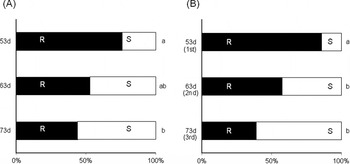
R/S ratio of 2-butanol emitted by virgin Dasylepida ishigakiensis females. (A) Emission during the first instance of calling for different-aged female groups. (B) Emission during the first, second and third instances of calling for different-aged female groups. The ratios of the mean values of R2B (closed bar) and S2B (open bar) are shown. Values accompanied by the same letter do not differ significantly at the 5% level according to Ryan's method after arcsine transformation of the data.

Dose relation of EAG responses
Dose-response curves were drawn with the GC-EAD system. To measure the dose-response relationship in the EAG response to R2B, S2B and rac-2B, the GC was operated as described above. A single antenna was used for a series of measurements from low concentrations to high concentrations of the authentic compounds in hexane. Because considerable variation was observed in the raw EAG voltage when different antennae were used, the EAG values were normalised to 1.0 at 1.25ng of a racemic mixture of 2-butanol injected immediately after a series of measurements. To avoid the memory effect of the rubber septum at the GC injection port, the septum was exchanged before injecting of the solution at the lowest concentration of each series (Wakamura et al., Reference Wakamura, Yasui, Akino, Yasuda, Fukaya, Tanaka, Maeda, Arakaki, Nagayama, Sadoyama, Kishita, Oyafuso, Hokama, Kobayashi, Tarora, Uesato, Miyagi and Osuga2009a). The measurements were replicated six times for each compound using six different antennae.
Flight tunnel assay
A flight tunnel assay was performed using a flight tunnel developed by Yasuda (Reference Yasuda1996) to evaluate male behaviour towards a female model. The assay followed the basic protocol described in previous research (Fukaya et al., Reference Fukaya, Yasui, Akino, Yasuda, Tanaka, Wakamura, Maeda, Hirai, Yasuda, Nagayama and Arakaki2009; Wakamura et al., Reference Wakamura, Yasui, Akino, Yasuda, Fukaya, Tanaka, Maeda, Arakaki, Nagayama, Sadoyama, Kishita, Oyafuso, Hokama, Kobayashi, Tarora, Uesato, Miyagi and Osuga2009a). The flight tunnel was made of transparent acrylic plates and was 75cm long, 18.5cm wide and 18.5cm high. A fine wire screen separated the tunnel's flight and windward chambers, and a second wire screen was affixed to the tunnel's other end. An electric fan supplied air inside the flight tunnel at approximately 20cms−1, and outlet air was exhausted to the outside of the tunnel. The main tunnel floor was covered with a sheet of white paper.
A model of a female was constructed by wrapping a wad of absorbent cotton in a piece of brown polyester cloth. One or two type A tubes (single lure of R2B and S2B, double lure of rac-2B for completing the amount of R2B emission) were attached to the female model using thin wire and placed at the centre of the flight tunnel 10cm from the tunnel's windward end. One male was placed on a paper disk (9cm in diameter; filter paper; No. 2, Toyo Roshi Kaisha, Tokyo, Japan) in a plastic container (5cm high) at the downwind end of the flight tunnel. The male was covered with a transparent plastic cup (6cm diameter × 4cm high), which was opened to expose him to the test chemical once observations began. Males were 59- to 63-day-old virgins and were used in the flight tunnel assay once per day. Males were used maximally three times. Data on males that could not take flight were omitted. A 40 W light bulb lit the flight tunnel floor, and the light intensity was reduced stepwise according to the method used for pheromone collection. Each test male was observed to see if he hovered within 5cm of the leeside of the female model (orientation) for more than two seconds. Each assay was continued until the male stopped flying (21min maximum). The experiments were conducted between 1.5 and 0 hours before the light was turned off (as around the dusk of their controlled light cycle) in the laboratory at approximately 22 °C. The number of males used in each lure is shown in fig. 3.
Statistics
To test the statistical significance of qualitative differences in pheromone emission among the different-aged female groups, we used a two-way variance analysis with repeated measures. If a significant difference was obtained (P < 0.05), we used Ryan's method after arcsine transformation of the data (Ramsey, Reference Ramsey1981).
To compare the relative EAG response to R2B, rac-2B and S2B at the same dose level, we used Tukey's methods when ANOVA was significant at P = 0.05. Values accompanied by the same letter within the same dose level are not significantly different at P = 0.05.
Likewise, to compare rate values obtained in the flight tunnel assay, if the n × 2 chi-squared test was significant (P < 0.05), the paired chi-squared tests were subsequently calculated. Significance was determined with Bonferroni's corrected P value (Sokal & Rohlf, Reference Sokal and Rohlf1995).
Results
Qualitative changes in sex pheromone emission in different-aged females
A significant age difference was detected in the R/S ratio of 2-butanol emitted from groups of 53- and 73-day-old females during their first instance of calling (fig. 1A; Ryan's method, P < 0.05). The proportion of the R-enantiomer in 53-, 63- and 73-day-old females was 76 ± 15%, 53 ± 12% and 44 ± 13% (average ± SE, each n = 3), respectively. The proportion of R2B was highest in the 53-day-old female groups and gradually decreased with age. Compared with 53-day-old females, 73-day-old females emitted significantly more S-enantiomer biased pheromone. Similar changes in the R/S ratio of 2-butanol emitted during the first, second and third instances of calling on days 53, 63 and 73 were observed (fig. 1B). The proportions of the (R)-enantiomer for the first, second and third instances of calling were 86 ± 4.1%, 58 ± 15% and 39 ± 8.2% (each n = 3), respectively. The proportions of R2B gradually decreased as the opportunities for calling increased (Ryan's method, P < 0.05). Compared with first calling on 53-, 63- and 73-day-old females emitted significantly more (S)-enantiomer biased pheromone.
Dose-response relationship of rac-2B in EAG
The dose-response relation curve of the EAG response for rac-2B, in which a strong response was observed at 1.25pg and at 12.5pg, was similar to that for R2B (fig. 2) and the differences were not significant. The dose-response curves indicated that the antennae of this beetle were ten times more sensitive to rac-2B and R2B than they were to S2B.
Dose-response curves for EAG responses of male D. ishigakiensis to R2B (solid line with diamond), rac-2B (broken line with square) and S2B (grey line with triangle). Doses were the amount passed over the antenna. EAG values are normalised to 1.0 at 1.25 ng of a racemic mixture of 2-butanol injected immediately after a series of measurements (n = 6 each, bar = SE). Values accompanied by the same letter within the same dose level are not significant different at P = 0.05 ( , (R)-2-butanol;
 , rac-2-butanol;
 , (S)-2-butanol).

Male responses to the female model emitting R2B, S2B, rac-2B, and a mixture of R2B and S2B in a ratio of 10:1
No significant differences in male orientation responses were detected among the female models baited with R2B and 10:1 mixture lures (fig. 3). Almost all of the males (96%) oriented toward the female model baited with R2B. Male orientation behaviour was also observed for the 10:1 mixture (91%) containing the same level of R2B. In contrast, male orientation behaviour was significantly lower for the 1:1 mixture (20%) (double rac-2B lures). The males showed no positive response to S2B.
Male orientation responses to R2B, S2B, rac-2B and a 10:1 mixture of R2B and S2B in the flight tunnel assay. Values accompanied by the same letter are not significantly different at the 5% level according to the n × 2 chi-squared test and paired chi-squared tests using Bonferroni's corrected P value (P=0.0033). The numbers in parentheses are the number of males examined (=no. of males taking off).

Discussion
This study examined the qualitative changes in the sex pheromone emitted by D. ishigakiensis females of various ages and during various calling opportunities. The sex pheromone 2-butanol was collected from young, mature and old females. The major component of 2-butanol shifted gradually with age from (R)- to (S)-enantiomer (fig. 1A). As the number of calling opportunities increased, the major component of the sex pheromone also changed from (R)- to (S)-enantiomer (fig. 1B). It is hypothesised that qualitative and/or quantitative changes in 2-butanol reflect a female beetle's reproductive status. However, this hypothesis is primarily applicable to involatile, contact sex pheromones (Bonavita-Cougourdan et al., Reference Bonavita-Cougourdan, Theraulaz, Bagnères, Roux, Pratte, Provost and Clément1991; Cuvillier-Hot et al., Reference Fujiwara-Tsujii, Yasui, Wakamura, Tanaka and Arakaki2001). Same information is also available on volatile, sex-attractant pheromones in some aphids and Lepidoptera (Shorey et al., Reference Shorey, McFarland and Gaston1968; Hardie et al., Reference Hardie, Holyoak, Nicholas, Nottingham, Pickett, Wadhams and Woodcock1990; McNeil, Reference McNeil1991). To the best of our knowledge, no studies have examined temporal changes in the R/S ratio of enantiomers in relation to age in females. Our study confirmed the existence of such changes.
In order to examine the males' responses to the above-mentioned females beetles under various conditions, we observed male behaviour in the presence of rac-2B (representing the emissions of old females), a mixture of R2B and S2B in a ratio of 10:1 (representing the emissions of young females), and R2B and S2B alone. (R)-isomer-rich 2-butanol lures produced more orientation behaviour in males than the S2B or rac-2B lures (fig. 3). The release of (R)-isomer-rich 2-butanol by the young females, suggests that males are more attracted to young females than to old females. The timing of the emergence of the beetles from the soil is not always predictable and is influenced by various intrinsic and extrinsic factors (Arakaki et al., Reference Arakaki, Sadoyama, Kishita, Nagayama, Oyafuso, Ishimine, Ota, Akino, Fukaya, Hirai, Yamamura and Wakamura2004; Tanaka et al., Reference Tanaka, Yukuhiro, Yasui, Fukaya, Akino and Wakamura2008; Harano et al., Reference Harano, Tanaka, Tokuda, Yasui, Wakamura, Nagayama, Hokama and Arakaki2010; Tokuda et al., Reference Tokuda, Tanaka, Maeno, Harano, Wakamura, Yasui, Arakaki, Akino and Fukaya2010). It is possible that females remain in the soil for an extended period to await suitable mating conditions. Even during the first instance of calling, old females only emitted (S)-enantiomer-rich 2-butanol. This mixture is not highly attractive to males. Furthermore, once a female had released sex pheromone, the amount of 2-butanol emitted at the second or third instance of calling decreased substantially (Yasui et al., Reference Yasui, Wakamura, Tanaka, Harano, Mochizuki, Nagayama, Hokama and Arakaki2010). We found that the attractiveness of females decreased markedly with the rapid decrease in the quantity of R2B and to the relative increase of (S)-enantiomer. This observation suggests a working hypothesis: if a female fails to copulate during her first appearance above ground and initial calling, a reduction of the quantity and relative proportion of R2B may occur in the mixture of pheromones she emits in the field. This change may reduce the female's opportunity to copulate at the second or later appearance and instance of calling.
The EAG activity dose-response curve for the racemic mixture did not occupy an intermediate position between the curves for R2B and S2B, but showed a substantial overlap with the curve for pure R2B (fig. 2). At certain doses (0.125, 1.25 and 12.5pg), S2B seemed to enhance the EAG response to the R2B. Thus, in combination with R2B, S2B has both an additive effect and a synergistic or more complicated effect. In contrast, the EAG activity dose-response curve for a racemic mixture in a particular lepidopterous insect occupies an intermediate position between the curves for two enantiomers (Wakamura et al., Reference Wakamura, Ichikawa, Yasuda, Arakaki and Fukumoto1996). The two enantiomers showed a simple additive effect in Wakamura's study. Furthermore, in D. ishigakiensis, the male beetles' behaviour in the flight tunnel (fig. 3) revealed that the frequency of male attraction to the female model decreased when S2B content increased, confirming the attractive effect of R2B and the inhibitory effect of S2B.
Disrupting white grub beetle mating by artificially releasing sex pheromone may be a feasible method of controlling this pest. A substantial number of females remained single in plots treated with R2B or rac-2B during our previous mating disruption test in the field (Yasui et al., Reference Yasui, Wakamura, Fujiwara-Tsujii, Arakaki, Nagayama, Hokama, Mochizuki, Fukumoto, Oroku, Harano and Tanaka2012). After a female lost the opportunity to copulate, her sex pheromone emission decreased markedly (Yasui et al., Reference Yasui, Wakamura, Tanaka, Harano, Mochizuki, Nagayama, Hokama and Arakaki2010). In addition, we found that the R/S ratio in the sex pheromone released by a female shifted towards and beyond 1:1, a racemic mixture. Consequently, a female may become less attractive to males at the second or subsequent mating opportunity. These results and interpretations may support our finding that rac-2B and pure R2B exert equal effects on mating disruption in sugarcane fields (Yasui et al., Reference Yasui, Wakamura, Fujiwara-Tsujii, Arakaki, Nagayama, Hokama, Mochizuki, Fukumoto, Oroku, Harano and Tanaka2012).
Acknowledgements
We thank Hiroaki Oroku of the Miyakojima Branch of OPARC for his kind support of our project. We also wish to thank Seiji Tanaka of NIAS and Atsushi Nagayama of OPARC for their cooperation and stimulating discussions. Thanks are also due to Ayako Yamaguchi of the Okinawa Prefectural Plant Protection Center, Miyako Branch Office, for her cooperation in collecting larvae and Ikuko Hashimoto, who helped with rearing the beetles at NIAS and with assisting us in our experiments.