Wir ordnens. Es zerfällt.
Wir ordnens wieder und zerfallen selbst.
Rainer Maria Rilke, Duineser Elegien Footnote 1‘What is time then?’Footnote 2 asks Saint Augustine in Confessions, noting the ambiguity of the very notion of time: it is familiar, yet mysterious. ‘If nobody asks me, I know; but if I were desirous to explain it to one that should ask me, plainly I know not’.Footnote 3 Huw Price, in Time's Arrow and Archimedes’ Point, deals with the difficult problem of time: we live in time – we have a temporal point of view.Footnote 4 In order to eliminate this anthropocentric bias, he uses the spatial concept of Archimedes’ notion of an external point from which the observer can watch its object; therefore from the object's point of view the observer is located ‘nowhere’. Price translates this shifting to an external point from spatial relations to temporal relations, and hence his out-of-time point is located ‘nowhen’. I shall adopt Price's terminology and postulate that theatre, as a temporal medium, is an apparatus in which time can be experienced in a closed-condensed form, and which therefore expands our insight into time. Theatre can offer its spectators a certain proximity to the ‘view from nowhen’.Footnote 5
‘Nowhen’ must be dealt with cautiously. Of course, in the theatre, there is no clear-cut separation between subject (in this case, the spectator) and object (time). From the hypothetical point of view of the characters, however, the spectators have a vantage point of view beyond fictional space and time. It is the interaction between the two times – fictional and real – that contributes to the uniqueness of theatre.
In dealing with the notion of time, one must consider the three categories of temporal order – past, present and future – and the connections between them. Here, however, I shall focus specifically on the connection between the present and the future: how does the future evolve from the present? This is a basic problem in physics: predicting the unknown future from the known present. Saint Augustine noted, ‘I look upon the day breaking; and I foreshew upon it, that the sun is about to rise. That which I look upon is present, that which I fore-signify is to come’.Footnote 6 Augustine thus concluded that the future has no real existence: ‘past is now no longer, and that to come is not yet’.Footnote 7 What remains is only a dimensionless point of the instant present. Theatre can expand our experience of time in having a dual set of times (real and fictional) and in its ability to demonstrate and investigate temporal problems, thus, in a sense, predicting the future.
Physics has developed several mechanisms to describe the evolution of time, including the famous paradox that at the microscopic level there is time-symmetry (if time is reversed, the equations remain the same), while the macroscopic level reveals time-asymmetry (a hot cup of tea in a cold room will cool down until it reaches room temperature; but a cup of tea at room temperature will never spontaneously become hotter). The second law of thermodynamics governs this evolvement of time. It uses the concept of entropy, which at the microscopic level can be understood as a measure of disorder. A system of a hot cup in a cold room is more ordered than a system of a cup at room temperature in a room, and thus the first system has less entropy. The second law states that in a closed system, entropy will not decrease, and hence disorder can only be increased. This law establishes a time arrow: from order to disorder.
The second law of thermodynamics merges time-order with spatial-order. Order is not only a physical concept, but can be found at the core of various types of theatre discourse: aesthetic ‘order’ is often used in definitions of ‘beauty’;Footnote 8 social sciences investigate the creation and evolution of social orders; critical theory traces hierarchies established by the order of categories.Footnote 9 Theatre combines aesthetics with ethics, and it does so in space and time. Order, and its time-ordered evolution, because it is found in the core of these discourses (physics, aesthetics, social sciences and critical theory), provide concepts that might help to establish a common ground and bridge these separate discourses around theatre.
I shall take a close look at two productions staged by the Khan Theatre in Jerusalem, both with the same set designer (Roni Toren), which deal with time evolution from the present to the future in opposing ways. I shall focus particularly on the relation between the beginning and the future-end of each production.
The first production is Shakespeare's Measure for Measure, directed by Gadi Roll in 1999. At the beginning of the play, Angelo is appointed governor of Vienna, due to his ability to enforce ‘strict statutes and most biting laws’.Footnote 10 Mathematically, order is the result of a law. The fewer and simpler the laws, the stricter the induced order. The simplest order is derived from a one-to-one ratio, in which the distance between two points, a and b, equals to the distance between points b and c.Footnote 11 One-dimensionally, this ratio produces a line of equally spaced points; on the surface of a two-dimensional stage, this same ratio produces a grid of equally spaced points. This grid pattern was reproduced scenically in Measure for Measure as the different fictional spaces of the play were represented by different grids: a grid of candelabras represented the nunnery; rows of desks stacked with binders and papers, the court; and an ante-room was formed by a row of chairs. The design emphasized the common ground of the different spaces of the performance-text: places that exhibit supervision and discipline, and social constructs that enforce power, to invoke Foucault.Footnote 12
What does this spatial order have to do with time? To answer this question, I first want to point out that Angelo's ethics is also based on a one-to-one ratio, that between sin and punishment. The title of the play explicitly invokes this relationship: ‘death for death. / Haste still pays haste, and leisure answers leisure; / Like doth quit like, and Measure still for measure’.Footnote 13 The origin of this moral is, of course, that of biblical ethics, which represents its ordered notion not only in its contents, but also in its obsessively repetitive structure: ‘But if any harm follows, then you shall give life for life; eye for eye, tooth for tooth, hand for hand, foot for foot; burn for burn, wound for wound, stripe for stripe’.Footnote 14 This rule induces a temporal order: an action will cause an identical, retaliatory action in the future. The future is a one-to-one reflection of the present, and the role of society, through its rulers, is to perform this rule.
The Latin ratio is the root of ‘rationalism’.Footnote 15 Descartes's famous cogito prefers reason (with mathematics as its notable example) over sensual experience. Angelo, in an anachronistic description, wishes to be a rationalist, but his irrational senses defeat him. The time arrow breaks the order. This time evolution is deliberately depicted here as a form of natural law, with the play revealing the tremendous artificial effort involved in ordering, an effort that nonetheless cannot overcome the primal libidinal drive. Angelo is torn between his ordered ethics and his disordered instinct – to do with Isabella the exact forbidden deed for which he has sentenced Claudio.
The well-ordered social categories collapse in the last act, demonstrated when the Duke inquires of Mariana,
- duke:
What, are you married?
- mariana:
No, my lord.
- duke:
Are you maid?
- mariana:
No, my lord.
- duke:
A widow, then?
- mariana:
Neither, my lord.
- duke:
Why, you are nothing then.Footnote 16
When she fits no category, her existence is annihilated.
The design in the last act of Roll's production represented this disorder. It featured a cluster of all the articles previously used in the grids: doors on the floor, chairs, candelabras, desks – all upside down, and with the characters stepping on them.
Can the theatre stage really represent disorder? The question is not so simple. The play itself deals with the problem of theatrical representation through the many disguised characters in the last act. Mariana and the Duke are both in disguise. Isabella describes Angelo as a disguised villain, and the Duke sees in her words a mixture of sanity and insanity: ‘If she be mad, as I believe no other, /Her madness hath the oddest frame of sense, /Such a dependency of thing on thing, /As e'er I heard in madness’.Footnote 17 This can be understood as another example of collapsed categories: madness and sanity are no longer two different mindsets. However, the Duke's insight is deeper: there is a frame to this performed madness. Foucault claims that the fool in the theatre always remains inside the limits of order and reinforces it.Footnote 18 The Duke's words correlate with Foucault's observations: it is impossible, even in a disordered future, to neglect order. Discourse – here, theatrical discourse – always produces order. This too was very clear in the Khan production. The set did not become disordered just from the movement of actors while playing in it, bumping into objects or throwing down others. On the contrary, there was no effort to disguise the stage action of the time arrow towards the future. Between the scenes stagehands in gray uniforms appeared like a Metropolis army (referring to the film) and, in one exhaustingly long action, changed the set. This was the case also before the last act, when they ‘arranged’ the disordered stage by putting all the props upside down deliberately according to a well-ordered plan. Perhaps the second law of thermodynamics describes nature, but the law itself is an artificially ordered construct.
A contradictory example can be found in Chekhov's The Seagull, in a production in 2000 at the Khan Theatre, directed by Ofira Henig and, again, designed by Roni Toren. Here the stage evolved from disorder to order, as if time had flowed backwards.
The play itself bears the frame of the opposing states of its beginning and ending. Nina in the last scene characterizes the mental and physical space of the first scene: ‘You remember? How clear and warm, how joyful and how pure our life was! And our feelings – they were like the sweetest, daintiest flowers . . . You remember?’Footnote 19 Through the evolution of time this warm space gradually freezes, as represented in Treplev's complaint: ‘I am alone in the world, unwarmed by any affection; it chills me like a dungeon, and whatever I write is hollow, dull and gloomy’.Footnote 20
In thermodynamics, ‘hot’ and ‘cold’ are relative measurements of temperature. At the microscopic level this temperature is an outcome of the statistical average of the kinetic energy of the particles. Hot gas has faster particles, which move freely in a container, randomly hitting each other and the side walls. A solid state is characterized by particles that are strongly attached to their sites, ideally constituting a well-ordered three-dimensional grid (with collective movements only). It is interesting that Chekhov, a physician but not a physicist, also creates a connection between a hidden order and the external phenomenon of temperature. The beginning is warm and free; the end is cold, ordered and disciplined (the dungeon image).
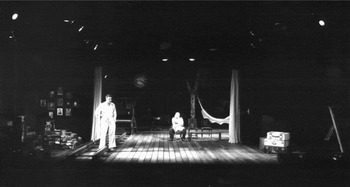
Toren's stage represented these microscopic phenomena (Fig. 1). There appeared to be no consistency in the decor: surrealistic at the beginning, realistic at the end. A thermodynamic reading, however, can tie it together. At the beginning the design was constructed from several objects scattered in space: a clock that was not working hung from the ceiling; a large mirror and a big tree were placed upstage; a railroad track erupted downstage; a ladder, a few chairs and a bench stood close to the audience. These isolated objects, themselves clichés of ‘theatricality’ (especially in Toren's own productions), and of ‘dreams’ (the clock invoking Ingmar Bergman's Wild Strawberries), also refer to a dream-like, free, creative space characterized by disorder. They are isolated objects that refer to different realities, separate from each other, with much empty space between them.
Chaotic dream like setting of the first act in Chekov's The Seagull at the Khan Theatre, Jerusalem (2000). Stage Director: Ofira Henig, Set designer, Roni Toren, Photograph Gerard Alan.

In the course of the performance the space shrinks: curtains appear and the floor itself is removed. The last scene occupies only a small part of the original stage. This also reflects the tragic future of Treplev's vision. In the first act his theatre manifesto – a manifesto that he also realizes in his production – is of an ‘empty space. No scenery’.Footnote 21 At the end we observe a stage that reflects his nightmare: ‘a room with three sides to it’.Footnote 22 The space has become compressed, from gas to solid, and the audience is confronted with a setting of a dinner table in the centre, chairs around it, a map on it, and all the ‘necessary’ tableware. Everything is in its own place, highly ordered. There is, of course, little motion in this set. The characters, like particles in a solid, are almost glued to their seats. All the artistic freedom of the first scene has frozen to a rigid solid.
If order is transformed into disorder, however, how can we explain the opposite flow of time here? The answer lies in a very important condition of the second law of thermodynamics. It states: in closed systems the entropy will not be decreased. Disorder can be ordered, however, if the system is not closed; in other words, if energy is put into the system. There is a way to make ice out of water: put it in the freezer. But, for that, the freezer must be plugged in. It is not a closed system. The external electrical energy must be supplied in order to change disorder into order.
Although the implied spectator is not a physicist, his or her daily experience fits the laws of thermodynamics. Thus a set design that emphasizes the hidden microscopic phenomena of order forces this spectator to locate the missing external source of energy. In the inner fictional world of the play, Arkadina and Trigorin are agents of this energy (the equivalent term used by Foucault is force, but in physics ‘force’ and ‘energy’ are two different quantities). The complete answer, however, must include an external source, and this can be found in an external fictional society. Arkadina herself accepts external rules, as is clearly demonstrated in her representation of the highly ordered dress code:
I am always ‘correct’, like an Englishman. I keep myself up to the mark, as they say, and am always dressed, and have my hair done comme il faut. I should never dream of leaving the house, even to come into the garden like this, in a négligée, or with my hair undone. Never. The reason I am so well preserved is that I have never been a dowdy, never let myself go as some do . . .Footnote 23
Because this external society is not onstage – only its representatives are – the spectator can easily confuse the fictional offstage society with another offstage society: the audience. In this way, designing a stage that reveals hidden orders and their time-evolution towards a cold future, Toren leads the spectator to search for the missing source of the freezing energy. And he or she is led to point at him- or herself.
As noted, thermodynamics can be deduced statistically from microscopic behaviour, and this production also reflected this aspect of time evolution. The characterization of Treplev as a unique genius is emphasized through an array of pictures on the wall. These are pictures of geniuses from different times in history and different fields of action (like Freud and Marx). The production thereby addresses the question of the ability of individuals to change the future. The historical examples are all of success, in the sense of becoming famous, but the situation is more complicated if we think about their goals (Marx's, for example, and the failure of communism). Treplev can be described metaphorically as a statistical fluctuation, and as such he is rare and (again, like a fluctuation) literally short-lived. It is the statistical average that dictates the direction towards the future. The approach towards equilibrium is inevitable. The individual must surrender the external energy of society, and he is doomed to freeze.
Furthermore, Arkadina's dress-code monologue is not merely an explanation of her ordered behaviour; it is also a lesson by which to educate Masha. Unlike physical rules, which only govern future predictions and do not concern themselves with ethical value, obeying social rules coincides with enforcing them. The spectator may be seated in an external ‘nowhen’ and consider the relations between present and future, as they are all theatrically compressed into one unit from beginning to end, but he or she must also become aware of his or her own role in creating rules, obeying and enforcing order – and, by extension, of his or her own responsibility for creating the future.