Introduction
Mass gatherings are an increasingly common feature of the world. Planning and execution of these events involves various challenges. The decision to host a planned mass gathering is usually made well in advance and the agencies involved have time for planning. Such planning is of paramount importance for the success of the event, and preparing the public health and safety systems ranks among its most important aspects. Such events usually represent significant challenges for the public health and safety sector of the host countries as they involve a large number of participants.Reference Flabouris, Nocera and Garner 1 – Reference Nguyen, Milsten and Cushman 3 The goal for public health and safety during mass gatherings is to prevent or minimize the risk of injuries or illnesses, to triage effectively, to decrease hospital burden, and to maximize the safety for participants, spectators, staff, and residents.Reference Grange 4
Running mass events, such as marathons, have been increasing in interest and participation world-wide.Reference Tan, Tan, Kok, Lee and Lee 5 The “Athens Marathon, The Authentic” is a tough course of 42,195m (26.2mile), which has turned into the biggest and most important of all long-distance running sports events in Athens, Greece over the last years. Host countries need to strengthen their health systems, and more specifically their Emergency Medical System, to be able to deal with a variety of potential health problems and emergencies. The majority of the presenting injuries or illnesses are not severe and require minimal treatment.Reference Turris, Lund, Mui, Wang, Lewis and Gutman 6 Usual medical emergencies include dehydration, heat exhaustion, asthma, chest pain, syncope, and musculoskeletal injuries including cramping. Several disruptions due to unexpected incidents have occurred in a number of marathons, such as the cancellation of the 2012 New York City (New York USA) Marathon as a result of Hurricane Sandy and the reroute of the 2008 London (England) Marathon due to a potential gas leak.Reference Basdere, Ross, Chan, Mehrotra, Smilowitz and Chiampas 7 Despite the events that occurred at the 2013 Boston Marathon (Massachusetts USA) where a catastrophic bombing took place, there is limited evidence regarding medical preparedness of marathon races.Reference Glick, Rixe, Spurkeland, Brady, Silvis and Olympia 8 Successful preparation for such an event requires the participation of a variety of organizations across all sectors. Collaboration between many diverse agencies, even from sectors that do not usually work together, is necessary to ensure that each organization will respond effectively to a potential emergency and provide streamlined integration of the responses of all the agencies.
Literature has shown that well-organized collaboration between public health and safety agencies is an important factor during mass gatherings.Reference Enock, Jacobs, Olympic and Games 9 , Reference Tsouros and Efstathiou 10 A recent study on interagency collaboration in mass gatherings reported that leadership plays a significant role in such events.Reference Bistaraki, McKeown and Kyratsis 11 Furthermore, race organizers of the Chicago Marathon (Illinois USA) designed the Chicago Model (CM) to organize such events more effectively and facilitate integrated responses in changing environment;Reference Basdere, Ross, Chan, Mehrotra, Smilowitz and Chiampas 7 this model focused on creating an environment where all the agencies can contribute and included three key components: organizational structure, information systems, and communication. The necessity for the development of such a model became apparent in 2007, when the event organizers of the Chicago Marathon had to cancel the event mid-race due to extreme weather conditions and faced confusion regarding the message communicated.
Therefore, it is necessary to establish strong collaboration and excellent coordination systems to ensure that all the key leading stakeholders understand their respective roles and responsibilities. However, there is limited research looking explicitly at how this collaboration unfolds in practice and what are its main elements for the professionals involved in the marathon command center. This study used the 2017 “Athens Marathon, The Authentic” and the related races as the empirical setting to examine how interagency collaboration was perceived among the multiple health and safety professionals involved in the command team of the event and to discuss the key characteristics of such partnership.
Methods
Study Design
A qualitative, single case study design with multiple data sources was used. A single case study approach is appropriate when researchers aim at understanding perceptions that individuals or organizations have about their activities within their social context.Reference Creswell 12 Case study methodology usually explores the meaning of experience and is best utilized when a holistic and in-depth investigation is needed.Reference Stake, Denzin and Lincoln 13 , Reference Yin 14 The research took place in three stages: (1) during the planning stage (2) during the actual marathon, and (3) after the completion of the event.
Setting and Selection of Participants
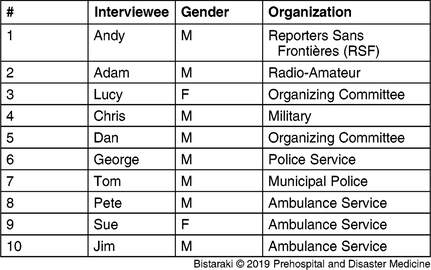
The study population consisted of health and safety professionals who had a key role in the marathon command center on the day of the event. The command center included representatives from several organizations such as the organizing committee of the event, police, ambulance service, military, radio-amateurs, Red Cross, and voluntary organizations. Purposive sampling was employed covering diverse types of senior roles.Reference Denzin and Lincoln 15 The sample size was 10 professionals (Table 1) who belonged to the above organizations. Recruitment in qualitative research mainly seeks to include participants who represent the diversity of the population relevant to the study. Since the sample consisted of representatives from the majority of the organizations involved in the command center, it was deemed adequate for the given research problem. To be eligible for the study, participants had to be willing to participate and have a key role in the marathon command center on the day of the event. Written informed consent was obtained from all the respondents and their identities remained confidential by using pseudonyms. Ethical approval was granted from University of Peloponnese Ethics Committee (Tripoli, Greece) in November 2017.
Participants’ Characteristics

Data Collection
The study was conducted during the planning stage of the event, at the marathon command center on the day of the event on November 12, 2017, and after the completion of the event. Data were collected through: semi-structured interviews, direct observations, and documentary analysis. The use of multiple sources of data increased the validity of the study as “no single source has a complete advantage over all the others.”Reference Yin 16 First, the principal investigator conducted direct observations of interagency meetings during the preparations for the event and of the marathon command center on the day of the event. The observations supported the interview data, helped to provide an integrated overview of the context, and allowed the examination of the phenomenon of collaboration as it naturally occurred.Reference Merriam 17 They included observations of one interagency meeting during the planning phase, the organizations’ preparations the day before the event, and the actual marathon resulting in 30 hours of field observation.
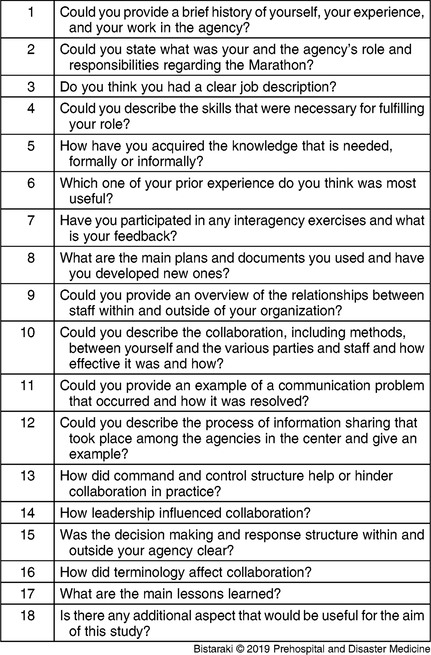
Second, 10 semi-structured, in-depth interviews were conducted after the completion of the event and they all took place within two months after the marathon. This approach provided the opportunity to discuss new issues brought up by the participants and for interviewees to elaborate on the subject. Furthermore, it allowed an open-ended nature of questions. The list of the interview questions that was used is provided in Table 2. The interviews occurred in a place mutually agreed upon by both the researcher and the participant. Participants received a detailed explanation of the purpose of the study before the beginning of the interviews. Interviews were digitally recorded and fieldnotes were also kept to capture researcher’s insights. The average duration of the interviews was 60 minutes. Finally, a range of documents produced by the agencies such as reports, strategic, and procedures manuals were used and analyzed as secondary sources of evidence to complement evidence from other sources.Reference Yin 14
Interview Questions

Data Analysis
All interviews were transcribed verbatim, and then the transcribed interview word files were imported into NVivo 7 qualitative data analysis Software (QSR International; Melbourne, Australia). Transcriptions of interviews, observations’ fieldnotes, and documents were coded using thematic analysis.Reference Crabtree, Miller, Crabtree and Miller 18 Analysis was open-ended by which issues were identified as they emerged. After completing the coding phase, the research team discussed each code separately to better understand the meaning. The different codes were also compared to identify relationships between the categories. The final four key components of interagency collaboration were decided through discussion with the whole research team, focusing on findings that were useful for future planners. Trustworthiness was assured through the methods of audit trail, triangulation, member check, and peer review of data analysis.Reference Merriam 17 Transcripts were returned to participants for verification.
Results
Findings indicated four key components of interagency collaboration in such an event: organizational culture, team synthesis, on-site spatial planning, and the usage of radio-amateurs. These four themes represent those areas participants identified as crucial to influencing interagency collaboration and they are discussed below in detail and are accompanied by exemplar data quotations.
Organizational Culture
Usually, there are huge cultural differences among emergency services that operate during a mass event and a limited understanding of each other’s norms and procedures. More specifically, during the Athens Marathon, the diverse composition of people and agencies which acquired different structures, procedures, and cultures sometimes hindered interagency collaboration. Moreover, the implicit cultural rules in the form of communication etiquette shaped how interorganizational collaboration was perceived. Participants acknowledged that the existence of implicit behavioral expectations they had from other individuals, namely “communication etiquette,” influenced how they perceived their collaboration with other agencies. Willingness to collaborate seemed to play a significant role in interagency collaboration:
There is the logic of cooperating with anyone who wants to cooperate and do not argue with anyone who wants to fight. We are in the logic of working with whoever wants to work together and do not fight with anyone who wants to fight, so when someone wants to argue we say ‘why do you want to fight for that?’ (Andy, Reporters Sans Frontières [RSF]).
It was widely reported by the participants that trusting relationships seemed to win over the formal structures and standardized mechanisms because they minimized professionals’ uncertainty about working with other disciplines as they were more open to exchanging information. In addition, clear boundaries of responsibility between the professionals optimized their collaboration:
Well…look…in the first place it is the person…if you have the style: I will do it all and I don’t need anyone else, etc…obviously there will be disputes. From the moment we all exchange information and we can work while respecting each other’s boundaries, there are no issues (Adam, Radio Amateur).
Therefore, irrespective of the nature and the structure of the agencies, professionals need to build relationships and establish communication channels in order to start working together. Participants also highlighted that understanding each other’s roles and structures encouraged them to work in partnership with other disciplines. Furthermore, regular information sharing among professionals from different services enabled the immediate resolution of conflicts and assumptions and gave the opportunity to clarify questions.
Team Synthesis
An appropriate synthesis of the command team, including professionals with established relationships, improved interprofessional collaboration and facilitated coordinated responses to several incidents during the event. Using the same professionals with similar past experience had a positive influence on collaboration because they acquired a common mental model of responsibilities and information requirements. It was widely reported by the participants in this study that experience helped professionals to understand other agencies’ roles and practices. In this way, individuals were able to absorb others’ viewpoints, learned to “speak” their language, and created a more collaborative environment:
We are the same people…police usually send us another person every year, but in the last two Marathons, it happened to be the same person, which was excellent! It is good to work with the same people with whom you had good cooperation in the past and you can get in touch…it is different (Lucy, Organizing Committee).
Previous experience in such events emerged as a necessary qualification of professionals for being effective leaders and enabled the decision-making process at the operational level. For example, it was particularly evident among the respondents that most professionals in the marathon command center were good at decision making because they had significant experience with emergencies and making quick decisions. All the involved organizations had their own operating environment based on their knowledge, tasks, training, and organizational structure. The relationships between the participating agencies varied depending on their history of interaction. Participants indicated that familiarity with each other’s roles and policies made collaboration easier. Experience enabled professionals to learn communication methods and know-how processes of other partners and improved interagency collaboration:
If you know how the other works, if you know his behavior, even if he turns to look at you…you understand…Over the years, we learned the process, so I know that the Ambulance Service cannot send a doctor because someone scratched his foot, so we learned to collect all the information the Ambulance Service needed and send the requirements once. We have learned the terminology and the mentality of each service (George, Police Service).
The more experience you have, it is easier to identify a possible failure and prepare yourself to deal with it, and the more you know the people in the command center, the greater communication is (Tom, Municipal Police).
However, some professionals indicated that experiential learning in which participants learn through experience would have helped them more to understand others’ views and build relationships. It was widely reported by the participants in this study that conducting interagency exercises before the marathon would be a useful, interactive way of accessing new knowledge by other partners. During exercises, professionals can create both formal and informal relations, which may increase the number of interactions across organizational boundaries and knowledge can be transferred more frequently. For instance, it was suggested that by exercising and defining the exact communication procedures, professionals’ assumptions would be limited and preparedness would be maximized:
Look, I believe the most basic thing, in table-top exercises, the most important part you test is communication (…) (Pete, Ambulance Service).
There is a need to conduct exercises, especially for the health services…an exercise testing collaboration I would say (Sue, Ambulance Service).
On-Site Spatial Planning
Fundamental to interagency collaboration was the shared and adequate situational awareness of the professionals about the health and safety issues during the event. Situational awareness is individuals’ perception and understanding of the situation they face. It is influenced not only by the information received, but also by the person’s assumptions based on their experience of similar situations, their knowledge, and their professional background. The capability of the agencies to ensure effective communication during the event was considered to be a cornerstone for reaching collective awareness. Participants stressed the importance of spatial planning in breaking down the organizational boundaries and facilitating interagency communication and collaboration. An appropriate physical structure of the agencies on-site enabled professionals to make appropriate decisions and deliver coordinated responses. For example, according to many respondents, the size of the marathon command center’s tent in the finish area played an important role in receiving timely information among the different professionals. More specifically, many participants noted during the interviews that the big size of the tent hindered interprofessional communication and maximized the risk of losing useful information:
The space has grown and we lost it…the teams were far away…they did not talk so easily; they didn’t hear each other so easily. It was something I didn’t expect, to tell the truth (Dan, Organizing Committee).
The ability to share accurate and timely information and provide a common operating picture and situational awareness was deemed as a key element essential in facilitating interagency collaboration. Achieving an adequate situational awareness in a big tent was a challenge because it was difficult to integrate all the information collected. After the completion of the event, professionals noted that one of the lessons learned was that a smaller tent size was necessary to ensure that they would receive the information needed:
This year was the first year that we had a big space as a command center…last year, we were closer to each other and, in fact, information was automatically reached. Many times, I caught myself getting out of my position to ask something, whereas in past years it came automatically. I can say that we’ve missed the communication part as professionals not as services. Architecture was the same, but I think we were closer last year…I was sitting next to the Red Cross; I watched their monitor, they did not need to tell me. I watched the monitors of the Radio Amateurs, I knew where everyone was, `and they did not need to tell me anything. This is what we missed this year (Jim, Ambulance Service).
Usage of Radio-Amateurs
Radio-amateurs allowed stakeholders to collect timely information from other agencies during the event and gain a common situational awareness. Using radio-amateurs was perceived by respondents as being a critical component to the interagency collaboration because it was an efficient way for the agencies to receive information relevant to them very quickly. It was a significant mechanism linking an organization to other organizations and mainly involved the sharing and exchange of information. Therefore, the fundamental task of these professionals was to make decisions only regarding the information received. Their role during the event was formal and their purpose was to filter information that was not relevant to each agency, prevent the information overload, and ensure timely and accurate information sharing across the agencies:
These people receive a lot of information, but they manage it…it was decided to use them and it was good as we managed to have coordinated information. That was very important! (Lucy, Organizing Committee).
Radio-amateurs managed to create shared meanings among organizations while maintaining interoperable communication systems among them. Participants also suggested that a number of useful skills of these individuals supported interagency collaboration. Being explicit, straightforward, and honest were thought to be necessary communication skills to foster the collaborative engagement of the agencies. One of the challenges that was noted was the unfamiliarity among different agencies. Radio-amateurs needed to be accurate while interacting with other organizations in order to foster shared meanings amongst individuals. As noted earlier, the different language and terminology that each agency used, because of the different culture and norms, may cause confusion and minimize the understanding of the information. Some participants noted that in some cases, radio-amateurs were not familiar with some terminology of the health services, and this could lead to misunderstandings in information sharing and confusion during their collaboration. The use of specialized language that some professionals cannot understand or may assign wrong meaning to may have a negative impact on collaboration because of the limited understanding of other agencies’ needs and functions:
People who are not health care professionals do not have the necessary education. So, if you tell someone that a doctor has 10 victims because of an explosion and among them three blacks, two reds, and one green, he does not know what this means (Andy, RSF).
Discussion
Collaboration between different organizations is a critical factor during mass gatherings.Reference Enock, Jacobs, Olympic and Games 9 , Reference Bistaraki, McKeown and Kyratsis 11 , Reference Hiltunen, Kuisma and Maatta 19 – Reference Memish and Al-Rabeeah 22 This study identified the key components of interagency collaboration among health and safety personnel in the marathon command center during the 2017 “Athens Marathon, The Authentic.” Consistent with the literature, organizers of such events may face challenges caused by communication and coordination failures.Reference Basdere, Ross, Chan, Mehrotra, Smilowitz and Chiampas 7 , Reference Hanken, Young, Smilowitz, Chiampas and Waskowski 23 Also, good relationships between different services can accelerate the decision-making process.Reference Basdere, Ross, Chan, Mehrotra, Smilowitz and Chiampas 7 However, as demonstrated in this study, the organizational culture of each agency and the willingness of the professionals to collaborate played a key role in building trusting relationships. Participants suggested that being eager to understand each other’s roles and practices encouraged them to work in partnership with other disciplines.
Another factor that also influenced interagency collaboration involved the synthesis of the command team inside the marathon command center. The interviewees indicated that using the same professionals with similar past experience had a positive influence on collaboration because they acquired a common mental model of responsibilities. The literature has also recognized the importance of knowing other organizations’ responsibilities in interagency collaboration.Reference Basdere, Ross, Chan, Mehrotra, Smilowitz and Chiampas 7 Team synthesis is an important issue that has not been explicitly discussed in the literature. According to this study, previous experience in mass events emerged as a necessary qualification of professionals for being effective leaders in the command center and enabled the decision-making process.
An appropriate, on-site spatial planning was essential to ensure effective communication among the professionals during the event and reach collective situational awareness. This factor was considered to be more fundamental for interagency collaboration than it was perceived by the literature. One study has suggested that being in the same physical environment enables communication and improves relationships among different agencies.Reference Basdere, Ross, Chan, Mehrotra, Smilowitz and Chiampas 7 Findings from another study have also indicated that seating arrangements in the tent and physical proximity of the agencies can facilitate information flow.Reference McCarthy, Chiampas, Malik, Cole, Lindeman and Adams 24 The current study showed that the big size of the marathon command center’s tent hindered interprofessional communication and maximized the risk of losing useful information, and that a smaller tent size was necessary to receive the information needed.
Radio-amateurs ensured clear and timely flow of information and facilitated the decision-making process in the command center during the event. The existing literature has also recognized the importance of fast and clear information flow among the agencies in providing coordinating responses regarding incidents and the need for developing data visualizations systems to achieve efficient communication among the agencies.Reference Hanken, Young, Smilowitz, Chiampas and Waskowski 23 , Reference Chiampas and Jaworski 25 This study highlighted that using radio-amateurs was a useful mechanism that managed to create shared meanings among organizations while maintaining interoperable communication systems among them. This is consistent with findings of another study which suggested that a medical team communication coordinator and a dispatcher allowed in-person interactions among the agencies and coordinated information sharing.Reference Turris, Lund, Mui, Wang, Lewis and Gutman 6 One area that seemed to be problematic when using this mechanism was the lack of these professionals’ knowledge about other agencies’ terminology; therefore, according to this study, critical to the successful use of this mechanism was the appropriate training of the radio-amateurs in technical language of health and safety agencies.
Limitations
Established approaches were used to enhance the validity of the findings.Reference Yin 14 , Reference Miles and Huberman 26 – Reference Guba and Lincoln 28 Limitations of the current study relate mainly to the research setting since the researcher captured only the perspectives and experiences of professionals based in the command center of the 2017 “Athens Marathon, The Authentic” and related events. The marathon represents a typical mass gathering, but other types of smaller or bigger mass events also exist, such as the World Cup and religious festivals. Hence, to fully comprehend the issue of interagency collaboration in the command center of a mass gathering, an exploration of other settings is required. Studying the unique setting of the Athens Marathon limits the transferability of the findings, and hence, the data should be transmitted with great caution to other fields. Another potential limitation is the relatively small sample size. However, based on a literature review on justifying sample size of qualitative interviews, 73% of the codes are usually identified within the first six interviews transcripts and 92% are identified within the next six interviews transcripts.Reference Marshall, Cardon, Poddar and Fontenot 29 In this study, because the sample included representatives from the majority of the organizations involved in the marathon command center, it was deemed to be adequate for the current research problem.
Conclusion
This study extends the understanding of how interagency collaboration in the command center of a mass gathering is shaped. The findings suggest that four key elements influence interagency collaboration in such an event: organizational culture, team synthesis, on-site spatial planning, and the usage of radio-amateurs. As these events bring together a variety of health and safety agencies and large numbers of participants, it is necessary that the professionals working in the command center collaborate effectively. This study’s findings may assist future event planners of marathons or other similar events to better organize the command center of the event.
Conflicts of interest
none