INTRODUCTION
Giant clams are highly specialized bivalves (family Tridacnidae (Munro, Reference Munro, Wright and Hill1993)) that evolved in the Eocene period, and are currently represented by ten living species confined to shallow waters of tropical reef ecosystems in the Indo-Pacific faunal region (Rosewater, Reference Rosewater1965; Richter et al., Reference Richter, Roa-Quiaolt, Carin, Al-Zibdah and Kochzius2008). Reef resources have supported human communities with a multitude of diverse benefits (Whittingham et al., Reference Whittingham, Campbell and Townsley2003), and giant clams particularly the Tridacna maxima (Roding, 1798) have been extensively harvested throughout most of the range for local consumption and supply to international markets (Rosewater, Reference Rosewater1965; Pearson, Reference Pearson1977; Munro, Reference Munro and Caddy1989; Kinch, Reference Kinch2002). Conditions where the coastline is considerably bordered by coral reefs as well as inhabited by dense human populations have led to further intensification of such dependence (Whittingham et al., Reference Whittingham, Campbell and Townsley2003). Our current initiative to conserve reef ecosystems of Lakshadweep Archipelago through community participation uses the small giant clam T. maxima as the focal monitoring species. This is primarily because of its highly specialized life history traits and selectivity to good quality of live coral cover. Owing to an obligatory symbiotic association with zooxanthellae (Andrefouet et al., Reference Andrefouet, Gilbert, Yan, Remoissenet, Payri and Chancerelle2005), these organisms are vulnerable to climatic events like the sea surface temperature rise which is potentially hazardous to their coral substrates also (Addessi, Reference Addessi2001). Moreover, they are long lived, hence can be monitored over time (Comfort, Reference Comfort1957; Rosewater, Reference Rosewater1965), and being brightly coloured and sedentary inhabitants of shallow waters, monitoring becomes easier and cost effective.
Growing research on biology and mariculture of giant clams during the early 1970s to late 1980s (see Wada, Reference Wada1952; Rosewater, Reference Rosewater1965; LaBarbera, Reference LaBarbera1975; Jameson, Reference Jameson1976; Yamaguchi, Reference Yamaguchi1977; Yonge, Reference Yonge1980; Beckvar, 1981; Rutzler & Santavy, Reference Rutzler and Santavy1983; Rutzler et al., Reference Rutzler, Santavy and Antonius1983; Fitt et al., Reference Fitt, Fisher and Trench1984; Heslinga et al., Reference Heslinga, Perron and Orak1984; Antonius Reference Antonius1985, Reference Antonius1988; Alcazar & Solis, Reference Alcazar and Solis1986; Bruckner & Bruckner, Reference Bruckner and Bruckner1997) has revealed that populations become unsustainable when densities decline below certain undefined levels, primarily due to their mode of spawning (Lucas, Reference Lucas, Copland and Lucas1988). These protandric functional hermaphrodites exhibit selective mode of spawning induced by environment and conspecifics, which renders recruitment dependent on adult density and sporadic even in healthy populations (Yamaguchi, Reference Yamaguchi1977; Adams et al., Reference Adams, Lewis, Leuda, Copeland and Lucas1988). Further, growth is slow (Wada, Reference Wada1942, Reference Wada1952; Jameson, Reference Jameson1976) and mortality is extremely high (Faasili et al., Reference Faasili, Bell, Mulipola and Time1998) particularly between egg and juvenile stages, reaching up to 99% (LaBarbera, Reference LaBarbera1975; Beckver, Reference Beckver1981), and primarily attributed to natural climatic events (typhoons, monsoons, sea surface temperature rise etc.; see Andrefouet et al., Reference Andrefouet, Gilbert, Yan, Remoissenet, Payri and Chancerelle2005) followed by predation and poaching (Calumpong et al., Reference Calumpong, Apao, Lucanas and Estacion2000). Years of overexploitation for local consumption and supply to commercial markets, have caused several giant clam populations to decline worldwide (Bartlett, Reference Bartlett1975; Pearson, Reference Pearson1977; Planes et al., Reference Planes, Chauvet, Baldwin, Bonvallot, Fontaine-Vernaudon, Gabrie, Holthus, Payri and Galzin1992; Kinch, Reference Kinch2002; Raymakers et al., Reference Raymakers, Ringuet, Phoon and Sant2003). Such ecological insight has highlighted the necessity of regular stock assessments of giant clams in reefs that are subjected to fishing, along with providing these organisms legal protection under international (IUCN (Wells et al., Reference Wells1983), CITES Appendix II (Wells, Reference Wells1983)) and national jurisdictions.
Out of the four giant clam species inhabiting the Indian waters, namely Tridacna maxima, T. squamosa, T. crocea and Hippopus hippopus, all except the T. crocea are legally protected as Schedule I species (Wildlife Protection Act, 1972). Apart from these four species, there are unconfirmed reports of T. gigas from Andaman and Nicobar Islands. Small giant clam T. maxima occurs in Lakshadweep and the Andaman and Nicobar Island complexes. Unlike most other Indo-Pacific reefs, where giant clams are harvested, and monitored to prevent stock depletion, Lakshadweep reefs are not subjected to commercial giant clam fishery, and subsequently no status assessment of their populations has been undertaken in these waters. But ever increasing economic interactions between the densely populated island communities and the adjoining coral reefs of Lakshadweep can indirectly affect these organisms, rendering the monitoring of these populations, imperative. We monitored the T. maxima populations across 24 islands and 12 reefs, within 11 lagoons of the Lakshadweep Archipelago during 2005–2007, to generate baseline information for this insufficiently known species (Groombridge, Reference Groombridge1993) in Indian waters.
Any population monitoring programme is a compromise between science and logistical constraints. Although, estimate of absolute abundance forms the most authentic monitoring index, achieving it particularly in a marine environment, at an Archipelago scale, and over years is time and labour intensive. Use of a relative index on the other hand, will include unknown levels of non-detection of individuals that may blur the applicability of the index in comparison across sites or years. We have adopted the distance sampling method (Burnham et al., Reference Burnham, Anderson and Laake1980; Buckland et al., Reference Buckland, Anderson, Burnham and Laake1993, Reference Buckland, Anderson, Burnham, Laake, Borchers and Thomas2001, Reference Buckland, Anderson, Burnham, Laake, Borchers and Thomas2004); a relatively unexplored approach in marine ecosystems (Kulbicki & Sarramegna, Reference Kulbicki and Sarramegna1999), to arrive at reliable estimates of the T. maxima population, and have further proposed an alternative monitoring protocol for rapid surveys in the future.
MATERIALS AND METHODS
Study area
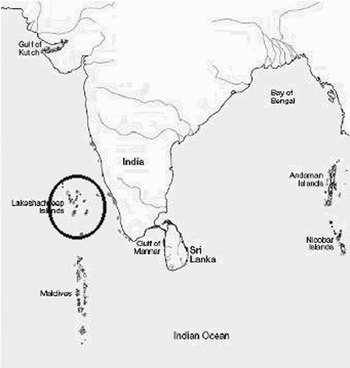
Lakshadweep Archipelago is the smallest Union Territory of India with a land area of 32 km2 spread over 36 islands, and a lagoon area of around 4200 km2 in 11 atolls and five submerged reefs and sand banks, scattered in the Arabian Sea (Figure 1). Atolls are special coral reef formations that are highly productive and diverse in the otherwise nutrient-poor, oligotrophic oceans. A typical Lakshadweep island has a north–south orientation and a shallow lagoon on the west with an average depth of 6 m that is connected to the open sea through entrance channels. Island communities of the region have traditionally subsisted on fishing and coconut cultivation for centuries, tuna fishing and tourism being their major economic activities. Lakshadweep waters harbour rich faunal diversity of vertebrates and invertebrates. This includes 93 species of marine algae, 406 species of molluscs, 58 species of echinoderms, 86 species of annelids, 736 species of fish, 2 species of amphibians, 18 species of reptiles and 95 species of birds.
Map of Lakshadweep Archipelago. Map not to the scale.

Water currents around Lakshadweep are part of the global ocean conveyor belt, and are uniquely known to change directions of flow seasonally; for instance, the Monsoon Drift of the Arabian Sea and Indian Ocean that have profound effects on the biological productivity of the marine ecosystemsFootnote 1, Footnote 2. The 1997–1998 El Niño Southern Oscillation (ENSO) event which elevated sea surface temperatures (SSTs) of tropical oceans by more than 3°C, was one of the most extreme ENSO events in recent history, resulting in extensive bleaching of reefs (82%) in Lakshadweep and bleaching related mortality of about 26% within lagoons of Kavaratti and Kadmath (Arthur, Reference Arthur2000). Its effect on giant clam, if any, however, was not documented.
Our study encompassed 12 reefs and 24 islands in 11 lagoons of the Archipelago, namely: (1) Kavaratti (10033′N 72036′E) with lagoon area of 4.96 km2; (2) Kalpeni (1004′N 73038′E) with lagoon area of 25.6 km2; (3) Bangaram (10055′N 72016′E) and Tinakkara (10056′N 72018′E) with combined lagoon area of 46.25 km2; (4) Agatti (10051′N 72011′E) with lagoon area of 17.5 km2; (5) Kadmath (11013′N 72046′E) with lagoon area of 37.5 km2; (6) Amini (1107′N 72044′E) with lagoon area of 1.5 km2; (7) Bitra (11035′N 7209′E) with lagoon area of 45.6 km2; (8) Chetlat (11041′N 72041′E) with lagoon area of 1.6 km2; (9) Kiltan (11029′N 7300′E) with lagoon area of 1.76 km2; (10) Cheriyakara (10002′N 72015′E) and Vallyakara (1008′N 72018′E) of Suheli with combined lagoon area of 78.96 km2; and (11) Minicoy (8016′N 7303′E) with lagoon area of 30.6 km2.
Methodology
We conducted surveys in the confined waters of 12 reefs in Lakshadweep Archipelago, once in a year during 2005 to 2007. Populations of the giant clam T. maxima were monitored through 100 m line transects (Burnham et al., Reference Burnham, Anderson and Laake1980) in a hierarchically stratified random sampling design (Krebs, Reference Krebs1989). Our decision of setting sample size at the Archipelago level was adaptive to the fulfilment of two conditions: (a) a minimum coverage area of 1% of the potential giant clam habitat in each lagoon; and (b) a coefficient of variation of ≤30% in giant clam density estimate in each lagoon for effective detection of temporal population trend. At the lagoon level, following a reconnaissance survey, we deducted ~70% of the lagoon area that was dominated by sand and seagrass, and hence unoccupied by giant clams, from our sampling. The remaining ~30% of the lagoon area was then converted into 1 km2 grids and each grid was sampled through 2 randomly placed line transects spaced at a minimum distance of 200 m from each other.
Transects were marked by recording their GPS locations at the start and end points, and planting coloured clubs on boulders and coral reefs along them. This facilitated repeated monitoring of fixed transects over years by three-member teams through snorkelling. Each transect visit required 2.5 hours time, and two transects could be covered in a day. This cost us approximately Rs 1458 (19.4 GBP) on logistics per transect visit. Corresponding to each sighting of giant clam by the researcher, its perpendicular distance from the transect line was measured by one assistant using a measuring tape, and its age-class was recorded by another assistant. A parallel study by the same authors found that T. maxima followed an asymptotic growth curve where tip to tip shell length surrogated clam age. Also clams required around 10 years to reach 100 mm shell-length (juvenile to sub-adult transition) and 50–60 years to reach 200 mm shell-length (sub-adult to adult transition). Thus we categorized clams into juvenile (<100 mm shell-length), sub-adult (≥100 mm– <200 mm) and adult (≥200 mm) age-classes. We purposefully ignored observations at a perpendicular distance of >10 m since visibility declined sharply beyond this distance, rendering the line transects a maximum width of 10 m. Under the hypothetical assumption of complete detection of individuals, these transects could be considered as belts covering a sampling area of 0.20 ha each.
To arrive at unbiased density estimates of giant clam population(s), we analysed distance and detection functions (Buckland et al., Reference Buckland, Anderson, Burnham and Laake1993, Reference Buckland, Anderson, Burnham, Laake, Borchers and Thomas2001, Reference Buckland, Anderson, Burnham, Laake, Borchers and Thomas2004) using program DISTANCE version 5.0 (http://www.ruwpa.st-and.ac.uk/distance/) (Thomas et al., Reference Thomas, Leake, Strindberg, Marques, Buckland, Borcher, Anderson, Burnham, Hedley, Pollard, Bishop and Marques2005). Prior to analysis, we structured line transect data based on years and reefs, and set the program to truncate all observations beyond 10 m. For global (Archipelago level) population status of T. maxima, we considered detection probability to be unique for each reef, and estimated density for years 2005 and 2006 as the average of 12 reefs weighted by their area. We could not extrapolate giant clam density for the Archipelago in year 2007, as only 4 out of 12 reefs were sampled in that year. Change in population density between years was tested for significant difference through paired t-test (Zar, Reference Zar1999) on annual replicates of transects.
For the local (reef level) population status of T. maxima, we expected that factors affecting visibility in a reef would remain unchanged through successive sampling years. Subsequently, detection probability of giant clam in each reef was pooled over study years, and year-wise densities were estimated through post-stratification. Such an adjustment provided adequate sightings (60–80) to reliably estimate densities in all reefs excepting Amini, for which, we used pooled detection probability across all lagoons. Age-class was used as factor covariate in the multi-covariate distance sampling models using a combination of half-normal and hazard-rate key functions with cosine and polynomial series adjustment factors, and model selection was subjected to Akaike information criteria (Buckland et al., Reference Buckland, Anderson, Burnham and Laake1993). Mean densities in different reefs were compared through one-way ANOVA with post hoc Newman–Keuls test (Zar, Reference Zar1999).
For age structure of T. maxima reef populations, detection probability of juvenile, sub-adult and adult age-classes were separately estimated at each reef by pooling across study years, and their densities were post-stratified for each year. Adjustments were made where sightings were unreliably low, which included pooling of detection probability across reefs or age-classes. We compared the relative proportions of each age-class in the giant clam populations of different reefs for the base year 2005 through the Chi-square test (McNemar, Reference McNemar1974) to find if the age structures of these populations were uniform, or not.
Further, we estimated densities of giant clam populations from total counts in belts of: (a) 100 m × 2 m; (b) 100 m × 4 m; (c) 100 m × 10 m; and (d) 100 m × 20 m dimensions using the same data. These estimates were expected to be biased by the false assumption of complete detection in a known coverage area of sampling, but represented a declining gradient of higher time and cost efficiency. The biased (belt transect) density estimates for each reef were compared to the corresponding unbiased (distance sampling) estimates to calculate correction factors for each of the aforesaid sampling methods (a–d). We evaluated the accuracy (correction factor close to 1 is expected to be more accurate) and precision (low coefficient of variation of the correction factor) of these methods to obtain quasi-absolute estimations of the giant clam population(s). Adequacy of sample size for precise (CV < 20%) density estimate was determined from data/variable randomization and resampling simulations using POPTOOLS (Hood, Reference Hood2005). Finally, we incorporated the above information to propose an alternative sampling protocol for rapid monitoring of giant clam population(s) in Lakshadweep lagoons.
RESULTS AND DISCUSSION
We estimated the overall density of the giant clam T. maxima in confined reef waters of Lakshadweep Archipelago at 141.2/ha in 2005 (95% confidence limit (CL) 118.17–168.74, N = 165 transects and 2748 sightings) and 122.7/ha in 2006 (95% CL 103.60–145.37, N = 134 transects and 1948 sightings). DISTANCE sampling revealed that detection probabilities of T. maxima varied considerably among twelve reefs ranging between 0.42 (in Kadmath) and 0.83 (in Bangaram). Further, the actual coverage area of sampling (2 * Effective Strip Width * Length) was around 0.13 ha, although considerably varying among reefs. Evidently, fixed-width transects with an expectation of complete detection of individuals in a sampling coverage area of 0.20 ha would have underestimated density from the actual estimate, inconsistently across reefs.
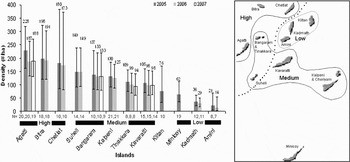
Tridacna maxima density compared pair-wise between annual replicates of the transects showed significant reduction from 2005 to 2006 (t = 5.35, df = 79, P < 0.001) but did not differ between 2006 and 2007 (t = 1.40, df = 38, P > 0.05). Considerable reduction in density between successive years (2005–2006) was observed in Amini (33% decline), Tinakkara (33% decline), Kavaratti (22% decline), Kadmath (18% decline) and Agatti (17% decline) reefs. Density estimates across twelve reefs varied (F = 4.39, df = 134, P < 0.001) within a range of 20.84/ha to 227.84/ha in 2005 and 13.66/ha to 187.01/ha in 2006. Relatively high densities of T. maxima (>150/ha) were observed in Agatti followed by Bitra and Chetlat. Moderate densities (>100/ha to <150/ha) were observed in Suheli followed by Bangaram, Kalpeni, Tinakkara and Kavaratti. Densities were less than 100/ha in Kiltan and Minicoy, and even lower (<50/ha) in Kadmath and Amini (Figure 2). Four non-exclusive subgroups among the twelve reefs were identified from their clam densities at a confidence level of 95%. Out of these, Amini and Kadmath formed one subgroup at the lower end of giant clam density gradient, while Agatti, Bitra, Chetlat, Suheli, Bangaram & Tinakkara, Kalpeni and Kavaratti formed one sub-group at the higher end.
Comparison of density estimates (number/ha) of giant clam Tridacna maxima population across 12 reefs (within 11 lagoons) of Lakshadweep Archipelago during 2005–2007. Error bars are 95% confidence intervals. Densities of T. maxima across twelve reef/lagoon populations are represented as closed dark grey bar for 2005, closed light grey bar for 2006 and open bar for 2007; along with estimated values over bars. Sample size (number of transects) have been indicated below X-axis. Groups of reefs based on density variation have been outlined by polygons and dotted line in inset map.

We crudely estimated population abundances across 12 reefs for the base year 2005 from a fairly realistic observation that 30% of a lagoon was suitable for the clams. Suheli was found to be the largest population (mean 352.2 thousand clams, 95% CL 219.8–564.2 thousands) followed by Bitra (271.7, 167.4–440.9 thousands) > Agatti (119.6, 85.3–167.8 thousands) > Kalpeni (100.2, 70.9–141.5 thousands) > Bangaram (95.2, 57.6–157.2 thousands) and Tinakkara (75.9, 53.3–108.1 thousands) > Minicoy (57.2, 31.8–102.8 thousands) > Kadmath (40.3, 23.6–68.8 thousands) > Kavaratti (15.7, 10.4–23.7 thousands) > Chetlat (8.6, 4.0–18.4 thousands) >Kiltan (4.0, 1.8–9.0 thousands) and finally, Amini (3.1, 0.9–10.3 thousands).
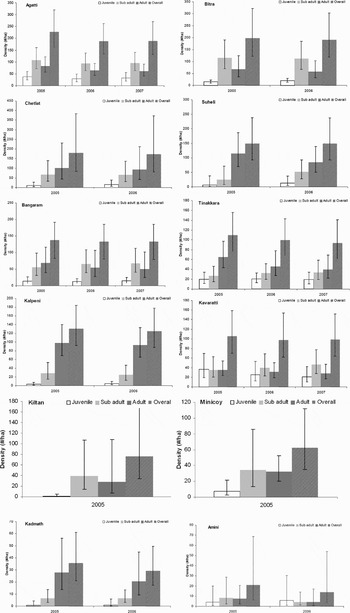
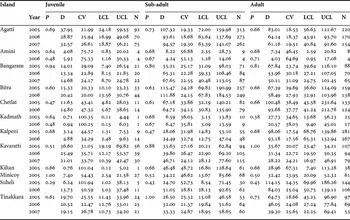
We estimated the age structure of T. maxima populations across twelve reefs from densities of different age-classes for each study year. Detection probabilities of individuals were similar among juvenile (0.62 ± SE 0.49), sub-adult (0.67 ± SE 0.40) and adult clams (0.66 ± SE 0.44), and considerably higher than that of recruits of the successive years (0.24 ± SE 0.04). Adults dominated Chetlat, Kadmath, Kalpeni, Suheli and Tinakkara populations; sub-adults dominated the Agatti, Bangaram, Bitra, Kavaratti and Kiltan populations; and juvenile densities were generally low in all the lagoons. Relative percentages of juveniles were particularly low (<10%) in Bitra, Chetlat, Kadmath, Kalpeni, Kiltan and Suheli lagoons. Among these, Kadmath and Kiltan lagoons showed extremely low juvenile densities (<1/ha) indicating very low success rates of recruitment. The Kavaratti and Amini populations showed higher representation of juveniles (>30% relative percentage) in the population. In Amini, however, this was an artefact of very low adult density (Appendix). The relative percentages of three age-classes in the T. maxima populations for the base year 2005 varied considerably among reefs (χ2 = 143.9, df = 32, P < 0.0001). Populations of Amini, Bangaram, Tinakkara and Kavaratti reefs exhibited unstable age-class distribution across successive years (Figure 3).
Comparison of juvenile, sub-adult, adult and overall densities (number/ha) of Tridacna maxima population across the study years (2005–2007) in 12 reefs (within 11 lagoons). Error bars are 95% confidence intervals. Densities of T. maxima in 12 reefs (within 11 lagoons) are represented by open bar for the juvenile, closed light grey bar for the sub-adult, closed dark grey bar for the adult and closed hashed bar for the overall population.

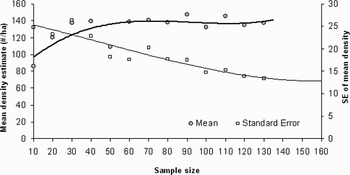
Density indices of 12 reefs generated from total clam counts by a posteriori fixing transect widths in a stepwise increasing order of dimension, were compared to the corresponding, accurate (distance sampling generated) densities, to estimate correction factors under sampling designs (a–d). Sampling designs (b) (correction factor 0.93 ± 20.3% (mean ± CV)) and (c) (1.17 ± 17.0%) provided more reliable monitoring indices than designs (a) (0.76 ± 24.9%) and (d) (1.41 ± 30.8%). Further, sampling design (c) would provide marginally better results than (b) against a substantially larger demand of time and labour investment. Adoption of sampling design (c) would in fact require only two members (one researcher and one assistant) in the sampling team, and roughly 1.5 hours per transect visit; enabling three transects to be covered in a day. Consequently, per transect logistic expenditure would reduce to a range of Rs 715–969 (9.5–12.9 GBP). As we increased our sample size from 10 to 130 transects distributed across the lagoons in a stratified random design, the mean density estimation curve stagnated after the accumulation of 60 samples. The standard error curve, however, continued to decline steadily until the accumulation of 130 samples, and showed stagnation at a projected accumulation of ≥140 samples (Figure 4).
Sampling adequacy for density estimation (number/ha) of Tridacna maxima population in Lakshadweep Archipelago from stagnation of the mean density and standard error curves.

Effectiveness of many holistic natural resource conservation programmes like the one being undertaken, are assessed by selecting a few focal or indicator species, and monitoring their populations through time following a standardized protocol. Population size assessments of giant clams have so far followed various techniques such as the transect based method to estimate relative abundance following abundance class codes (Planes, Reference Planes, Chauvet, Baldwin, Bonvallot, Fontaine-Vernaudon, Gabrie, Holthus, Payri and Galzin1992), remote sensing of stocks (Green & Craig Reference Green and Craig1999; Green et al., Reference Green, Mumby, Edwards and Clarck2000; Andréfouët et al., Reference Andrefouet, Gilbert, Yan, Remoissenet, Payri and Chancerelle2005), or more recently, a combination of remote sensing and in situ data collection (Gilbert et al., Reference Gilbert, Yan, Remoissenet, Andrefouet, Payri and Chancerelle2005, Reference Gilbert, Andrefouet, Yan and Remoissenet2006). The latter study in French Polynesia has suggested that high resolution images coupled with adaptive sampling through quadrats under high clam densities, and belt transects of increasing dimensions under moderate to low densities, can provide reasonably good clam stock assessments and habitat characterization of coral reefs. However, under circumstances of very low clam densities like the Lakshadweep waters, which also typifies clam populations over the majority of their range, belt transects of much larger dimensions are required to detect individuals and generate precise abundance estimates. But larger belt transects in highly heterogeneous marine ecosystems are severely impaired with unknown levels of non-detections, that is hazardous in answering ecological questions beyond trade related, crude stock assessments. The line transect based distance sampling technique which releases the burden of non-detection related problems has thus been found more suitable in our ecological monitoring programme and expected to be useful in other similar situations. However, for rapid assessment of clam population, use of relative index instead of absolute estimate is often more judicious under time and logistical constraints. Since such a population monitoring index demands accuracy and precision to allow meaningful temporal comparisons, we propose from this study, a total clam count along transects of 100 m length and 2–5 m strip width, in a minimum of 140 replicates, stratified among lagoons on the basis of equal lagoon area coverage, as a viable alternative monitoring plan for rapid assessment of T. maxima population in confined waters of Lakshadweep Archipelago.
Results from three initial years of our monitoring programme, published in this paper, reveals that Lakshadweep Archipelago harbours one of the low density populations of T. maxima. Remarkably high densities of T. maxima occur in French Polynesia (40,000–60,000 clams/ha; see Salvat, Reference Salvat1967, Reference Salvat1971, Reference Salvat1972; Richard, Reference Richard1977; Green & Craig, Reference Green and Craig1999; Andrefouet et al., Reference Andrefouet, Gilbert, Yan, Remoissenet, Payri and Chancerelle2005; Gilbert et al., Reference Gilbert, Andrefouet, Yan and Remoissenet2006) followed by moderate density populations (2900–5000 clams/ha) in Palmerston Atoll of Cook Island and Samoa (see Preston et al., Reference Preston, Lewis, Sims, Bertram, Howard, Maluofenua, Marsters, Passfield, Tearii, Viala, Wright and Yeeting1995; Green & Craig, Reference Green and Craig1999). Barring these few exceptions, T. maxima generally occurs in low densities of 10–300 clams/ha over the majority of its range in the Indian Ocean, and South and South-East Asian countries (Richard, 1982; Braley, Reference Braley1988, Reference Braley1989; Basker, Reference Basker1991; Kinch, Reference Kinch2002). There exists strong heterogeneity in densities among Lakshadweep reefs with Agatti harbouring 10 folds more dense population than Amini. Reefs towards the north and west in the Archipelago have higher clam densities than reefs towards the south, east and centre (indicated by the dotted line in Figure 2). Although such density variation among reefs can only be explained from historical and eco-geographical data, coral quality and cover (expectedly) seems to be a crucial factor. Among two adjacent reefs of Amini and Kadmath that hold very low clam densities, whilst Amini have highly degraded and mostly exposed coral reef, Kadmath has most badly been affected by the 1998 El Nino event with 80% Acropora coral mortality (Arthur, Reference Arthur2000) which has not recovered even after 10 years. On the other hand, Agatti has rich Acropora and Porites dominated coral cover while Chetlat has considerable Poritis dominated coral cover, the most preferred substrate for giant clams (Apte et al., unpublished data); these reefs correspondingly harbouring much higher clam densities. Moreover, the twelve reef populations have showed varied age structure and population fluctuations over study years, implying that intrinsic and/or extrinsic forces regulating population growth are varying among reefs. Thus clam populations need to be prioritized based on their vulnerability and monitored separately. As mentioned earlier, owing to stochastic, environment dependant recruitment and high early stage mortality, giant clam populations are vulnerable to stock depletion when threatened with overharvesting, and/or habitat alterations. We have observed a considerable fall in populations between 2005 and 2006, more so in Amini, Tinakkara, Kavaratti, Kadmath and Agatti reefs (range 18–33% decline) since mortality exceeded the low recruitment in that year (Apte et al., unpublished data). Although we have not monitored all the reef populations in 2007, the ones with available data have not shown any further decline in clam population. Nonetheless, such temporal fluctuations particularly in the smaller populations due to environmentally sensitive rate parameters threaten the persistence of a species when subjected to unsustainable human pressures.
For thousands of years, giant clams have provided a protein rich diet to peoples, finding a place in the folklore and mythology of Pacific Island communities (Faulkner, Reference Faulkner1974). But the boundlessly exploding human population has increased the harvest pressure on giant clams by many folds, thereby overexploiting natural stocks, and diminishing many clam populations to non-recoverable levels. Although tridacnids are currently considered as endangered and data deficient species, their illegal catering to Asian markets for highly prized adductor muscle still continues (Bryan & McConnell, Reference Bryan and McConnell1976; Pearson, Reference Pearson1977; Summerhays, Reference Summerhays1979; Cropp, Reference Cropp1982; Dawson, Reference Dawson1984). In Lakshadweep, giant clams are not removed for trade purpose, but in islands such as Kiltan, Chetlat, Bitra and Amini, T. maxima and T. squamosa are occasionally consumed. Lakshadweep lagoons vary considerably in their areas. Suheli is the largest lagoon (78.96 km2), whereas Chetlat, Kiltan and Amini are the smaller ones (~1.6 km2). Although we admit that our population size estimates need refinement based on the habitat suitability assessment for T. maxima, still, populations of these smaller lagoons are most likely less than 10,000 clams each. Amini, the smallest lagoon, also harbouring the least density of T. maxima, appears to hold the most impoverished population. This lagoon is probably most susceptible to environmental calamities and intrinsic life history traits of the species compounded with harvesting practices targeted towards adult or sub-adult clams that threaten recruitment.
Repopulation of a reef that is entirely depleted of giant clam stock will depend on planktonic larva being transported from adjoining reefs by the prevailing current, or artificially through sea ranching technology. Under conditions like reef isolation or unfavourable current regimes, this process may take hundreds of years (Munro, Reference Munro, Wright and Hill1993). And it is only through effective detection of incipient population changes followed up by active management of lagoon beds for habitat improvement, that we will probably be able to stabilize the declining trend of T. maxima populations in many lagoons of Lakshadweep Archipelago.
ACKNOWLEDGEMENTS
The Project Giant Clam was a collaborative endeavour between BNHS, Mumbai and LEAD International, UK, and was initially funded by Darwin Initiative, UK (grant sanction number 162/13/029) followed by Whitley Fund for Nature, UK through Shears Foundation. We are grateful to Simon Lyster (CEO, LEAD International), Julia Marton-Lefevre (Director General, IUCN), David Reid (NHM, UK), M.G. Harasewych (Curator of Mollusca, Smithsonian Institution) and Asad Rahmani (Director, BNHS) for their various supports. We acknowledge Jafer Hisham, Avani Patel, Karamathulla Sahib and Salahuddin V.K. who collected crucial field data as our team members and volunteers. B.V. Selvaraj, Parimal Rai, S.I. Koya, G. Kumar, George Jecob, Madhup Vyas, A.K. Tewari, Ashish Mohan, Vinod Rishi, Aseem Srivastava, Anmol Kumar, Abdul Raheem and Syad Ali facilitated the process of official permissions for the execution of the project, and are being acknowledged for their logistic support and cooperation. We are grateful to the Ministry of Environment and Forests, Government of India and Department of Environment and Forests, Lakshadweep for necessary permissions to carry out the field work. We also acknowledge the two anonymous referees for their inputs to improve this paper.
Model information, detection probability and density estimates (number/ha) of different age-classes of Tridacna maxima population across 12 reefs (within 11 lagoons) of Lakshadweep Archipelago during 2005–2007.