

Berber (or Tamazight) is an Afro-Asiatic language spoken by an estimated 15–25 million in North Africa. It is mainly spoken in Morocco, Algeria, and by the Touareg population in Niger and Mali. Berber is also a native language of populations living in Libya, Tunisia and Egypt, though their numbers are less significant. Large Berber communities also live in Diasporas mainly in France, Spain, Holland, and Belgium. Three varieties of Berber are spoken in Morocco: Tarifit, spoken in northern Morocco, Tamazight, spoken in the Middle-Atlas, and Tashlhiyt, spoken in southern Morocco. Tashlhiyt, the variety presented here, is sufficiently homogeneous for all native speakers, who number an estimated 7–9 million, to communicate without difficulties (Stroomer Reference Stroomer, Lubotsky, Schaeken and Wiedenhof2008). There is nonetheless a measure of sub-dialectal variation, which affects mainly the way some stop consonants are produced. Three subsystems, corresponding roughly to three distinct geographical locations, can be identified: the ‘occlusive’ subsystem spoken in Agadir and its suburbs, the ‘fricative’ subsystem spoken mainly in the High-Atlas area, which spirantizes noncoronal obstruents /b k g/ in some contexts, and the ‘sibilant’ subsystem spoken in the Anti-Atlas area, where /t/ and /d/ are realized in some contexts as [s] and [z], respectively (Boukous Reference Boukous1994). This study is based on the speech of Tashlhiyt speakers who originate from Agadir. The text of ‘The North Wind and the Sun’ was read by a 27-year-old female speaker.
The term Tashlhiyt /t-a-ʃlʜ-ij-t/ or /t-a-ʃlʜ-i-t/ designates both the language and a female speaker of the language (hereafter, hyphens mark morphological boundaries inside words, while equal signs mark boundaries between clitics and their hosts). Its masculine form /a-ʃlʜ-i/ designates a male speaker of the language. Readers are invited to consult the detailed introduction to Tashlhiyt-speaking regions and people presented in Schuyler (Reference Schuyler1979: 9–18). For references to work on the language, see Chaker (Reference Chaker1992, Reference Chaker and Camps1994) and Dell & Elmedlaoui (Reference Dell and Elmedlaoui2002: 5–8). For works on Tashlhiyt phonetics, see Ouakrim (Reference Ouakrim1993, Reference Ouakrim1994, Reference Ouakrim2003), Louali & Puech (Reference Louali and Puech1994, Reference Louali and Puech2000), Ridouane (Reference Ridouane2003, Reference Ridouane2007, Reference Ridouane2008, Reference Ridouane2010), and the references therein. This list is by no means exhaustive.
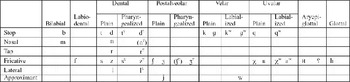
Tashlhiyt has the consonantal inventory shown in the above chart, abstracting away from the lexical contrast between singleton and geminate (or tense) segments exemplified in the following list:
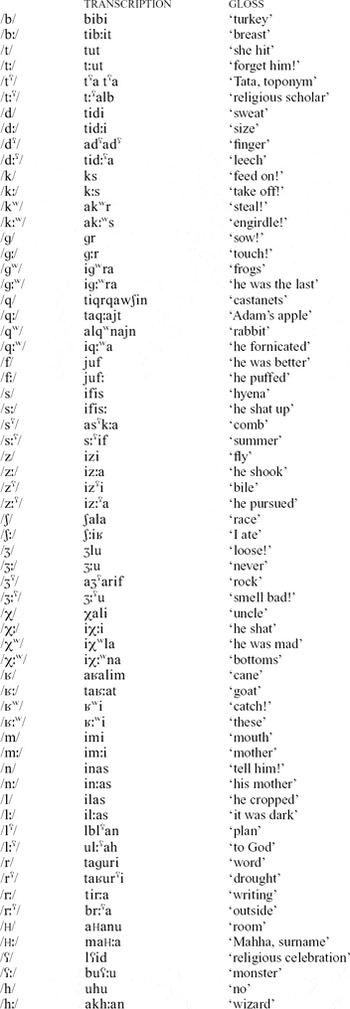
The next subsections provide an account of the core phonetic structures of each consonantal group as well as some of the more interesting phonetic structures and phonological facts of the language.
Stops and fricatives
Except for labial and uvular stops and glottal fricative, all Tashlhiyt obstruents contrast in voicing. Singleton voiced stops are fully voiced in pre-vocalic position. They get devoiced when they are immediately followed by a voiceless obstruent (e.g. /idqːi/ [itqːi] ‘clay’). Voiced geminate stops are usually produced with incomplete voicing, mainly in non-intervocalic position. The amount of this devoicing varies according to speaker and place of articulation. Velars have a higher tendency to devoice compared to dentals, since – all else being equal – air pressure build-up is higher in velars than in dentals (Ridouane Reference Ridouane2003). Voiced fricatives, either singleton or geminated, are normally fully voiced. They are either completely or partially devoiced when they are immediately followed by a voiceless obstruent (e.g. /fi-ʁ = t/ [fiχt] ‘I gave it’). Though aspiration is not distinctive, prevocalic voiceless /t/ and /k/ can be produced with a VOT of 50–60 ms, whereas /tˁ/ is always produced with no aspiration (approximately 10–20 ms VOT). The uvular stop /q/, which is usually produced with pre-release, displays an intermediate VOT (approximately 30 ms). In utterance-final position, voiceless stops are always produced with a notable release. In preconsonantal position, stop release may be obligatory, optional, or forbidden. Stop release is obligatory before another stop which is not homorganic with it (e.g. [tqːama] ‘she stayed’). Stop release is optional between two singleton identical stops separated by a word boundary (e.g. /ifak#kra/ ‘he gave you something’, where /k#k/ may be pronounced either [k k] where the first stop is released or as a long stop [kː]). The release of a stop is forbidden between a suffix or a clitic and a preceding morpheme (e.g. /ut = t/ ‘hit him!’, where /t = t/ must be pronounced as one long stop [tː]). Stop release is also forbidden when /t/ is followed by the homorganic nasal /n/ (e.g. [t˺nːa] ‘she said’) (Applegate Reference Applegate1958, Dell & Elmedlaoui Reference Dell and Elmedlaoui2002).
So-called ‘pharyngeal’ fricatives are better described as epiglottals or aryepiglottals rather than pharyngeals, produced with a tight constriction between the arytenoids and the base of the epiglottis. This constriction, as shown by Ridouane (Reference Ridouane2003) based on fiberscopic data, is tighter in the case of the voiced series. The voiced aryepiglottals are rather rare in the lexical inventory of the language, and much of these are Arabic loans. /h/ is a voiced laryngeal segment produced with vocal fold vibration. The geminate counterpart of this glottal fricative is not frequent in the lexicon. The laryngeal stop [ʔ], which is not a phoneme, can sometimes be produced in utterance-initial position in words starting with a vowel.
Sonorants
Tashlhiyt has eight sonorant consonants: labial and coronal nasals /m mː n nː/, and liquids /r rː l lː/. These consonants can occur in all word positions. /r/ is often produced as a tap [ɾ] with a single contact between the tongue and the alveolar ridge. Its geminate counterpart is always produced as a trill [rː]. The taps of the alveolar trill are almost always accompanied by short, central vocoids (Coleman Reference Coleman2001).
Gemination
Each consonant in Tashlhiyt has a geminate or tense counterpart, and gemination is lexically contrastive. The distinction between single and geminate consonants is attested in medial position as well as in absolute initial and final positions. All geminate consonants display this wide distribution, though some geminate consonants are rather marginally attested in the lexicon (especially pharyngeals /hː ʕː/ and laryngeal /hː/ as well as labialized uvulars in initial and final positions, and pharyngealized /dːˁ zːˁ/ in word-final position). In addition, there are numerous other positions which a geminate can occupy within a word. It can be preceded or followed by one or more consonants (e.g. [ɡːr] ‘touch!’, [bkːs] ‘engirdle!’, [tkːstː] ‘you took it off’). A word may contain one geminate consonant only (e.g. [ʃː] ‘eat!’, [ɡːʷ] ‘wash!’).
At the phonetic level, the distinction between simple and lexical geminate consonants is carried not just by duration but by a combination of properties (Louali & Puech Reference Louali and Puech1994, Ouakrim Reference Ouakrim1994, Ridouane Reference Ridouane2003). The primary property is the extra duration of geminates,Footnote 1 since this property appears in every context in which the contrast occurs, even in voiceless stops following pause. In this context closure duration is extra long even though it has no direct acoustic manifestation.Footnote 2 In addition, the singleton/geminate contrast is enhanced by further acoustic attributes such as shorter preceding vowel duration, higher RMS amplitude, and complete stop closure (Ouakrim Reference Ouakrim1994, Ridouane Reference Ridouane2007). These correlates, which may be interpreted as manifestations of greater articulatory energy or tenseness, serve to enhance the primary feature by contributing additional acoustic properties which increase the perceptual distance between singletons and geminates. These enhancing correlates can take on a distinctive function in cases where the primary correlate is not perceptually recoverable. This is, for instance, the case for voiceless stops after pause (e.g. [tut] ‘she hit’ vs. [tːut] ‘forget him!’), where duration differences between singletons and geminates is not detectable by listeners (Ouakrim Reference Ouakrim2003, Ridouane & Hallé Reference Ridouane and Hallé2011).
In addition to lexical geminates, Tashlhiyt presents two additional types of geminates: phonologically derived and morphologically derived ones. Phonologically derived geminates can surface either through concatenation (e.g. [fas sin] ‘give him two!’) or through complete assimilation (e.g. /rad = k i-sli/ [rakː isli] ‘he will touch you’). The morphological alternations include imperfective gemination, whereby certain Tashlhiyt verbs form their imperfective stem by geminating one consonant in their perfective stem (e.g. [ftu] ‘go! pf’, [ftːu] ‘go! impf’), and quantity alternations between singular and plural forms (e.g. [afus] ‘hand’, [ifasːn] ‘hands’).
The acoustic investigation in Ridouane (Reference Ridouane2010) shows that phonologically derived geminates (either through concatenation or total assimilation) display the same temporal values as lexical geminates, all being produced with virtually the same consonant durations (closure and release duration for stops). However, compared to underlying geminates, a major difference has been observed between assimilated and concatenated geminates. While assimilated geminates, like lexical ones, shorten the preceding vowel and display higher RMS amplitude, concatenated geminates do not (see also Ouakrim Reference Ouakrim1994).
Pharyngealization
Pharyngealization (or emphasis) in Tashlhiyt has been examined from a phonological perspective by different authors (Elmedlaoui Reference Elmedlaoui1985, Reference Elmedlaoui1995; Boukous Reference Boukous1987, Reference Boukous1990; Lasri Reference Lasri1991; Dell & Elmedlaoui Reference Dell and Elmedlaoui2002). The questions dealt with include the phonemic status of the emphatic consonants, the domain of the propagation of pharyngealization, and the factors underlying it. At the phonemic level, Tashlhiyt includes the following set of emphatic consonants, all of which are coronal: /tˁ tːˁ dˁ dːˁ sˁ sːˁ zˁ zːˁ ʒˁ ʒːˁ rˁ rːˁ lˁ lːˁ/. This set is uncontroversial, because of the existence of various lexical items attesting its underlying status and its lexical function in distinguishing words. Note, however, that /lˁ/ and /lːˁ/ have a rather limited distribution and are more frequent in Arabic loanwords:
-
(1) Minimal or near-minimal pairs showing the lexical distinctiveness of pharyngealization


Other coronal consonants may be considered to be underlyingly pharyngealized, since they occur in items which lack other coronal segments. This is the case with [ʃːˁ] in the form [amuʃːˁ] ‘cat’ and [nːˁ] in the French adapted word [mnːˁk] ‘miss!’ from French manquer. But, to the best of my knowledge, these are the only items which contain these coronal emphatics. In the form [mnːˁk], the presence of the emphatic /nːˁ/ could be attributed to the fact that the French back vowel adjacent to /n/ is identified with the Tashlhiyt allophone [ɑ] that appears in emphatic context in the native phonology (see below). This mapping is adapted into Tashlhiyt by the introduction of pharyngealization on the adjacent consonant /n/.Footnote 3
At the surface level, emphasis is a property which can be displayed by any segment. For instance, in /matˁiʃa/ ‘tomato’, which contains only one underlying emphatic phoneme /tˁ/, all the segments contained in the word are pharyngealized [!mɑteʃɑ] (such words will be henceforth preceded by an exclamation mark). The exact delimitation of the propagation of this feature is a source of some controversy. It is generally considered that the minimal and maximal domains of this propagation are the syllable and the word, respectively. The parameters underlying this propagation are both linguistic and paralinguistic. The linguistic factors include the structure of the syllable (open syllables being more sensitive to emphasis spread), vowel quality (more propagation in front vowels), and gemination (more propagation to singletons than to geminates). The paralinguistic parameters include speech rate, tempo, and style. For instance, the propagation of emphasis is more important in a fast speech rate, than in slow speech rate (Boukous Reference Boukous1990, Elmedlaoui Reference Elmedlaoui1995).
There are important acoustic and articulatory differences between pharyngealized coronals and their plain counterparts, which induce clear auditory differences between items containing emphatic consonants and items containing plain ones. The acoustic differences are observed in terms of VOT durations for voiceless stops (the emphatic /tˁ/ has the shortest VOT duration among the voiceless stops) as well as in terms of qualitative effects on adjacent vowels (see below). The articulatory differences are observed both at the supralaryngeal and laryngeal levels (Ridouane Reference Ridouane2003, Reference Ridouane2009). At the supralaryngeal level, the emphatic coronal /tˁ/ is produced with a backward movement of the tongue towards the posterior pharyngeal wall, while the anterior part of the tongue is substantially lowered. At the laryngeal level, /tˁ/ has a smaller glottal opening, compared to its plain counterpart. The small glottal opening of /tˁ/ is the most likely reason for the shorter VOT displayed by this segment. Differences in glottal opening amplitude are attested between /s/ and /sˁ/ as well, the latter being produced with smaller glottal opening (Ridouane Reference Ridouane2003).
Labialization
Tashlhiyt has five labialized consonants /kʷ ɡʷ qʷ χʷ ʁʷ/ and their geminate counterparts. The phonological identity and behavior of these segments have been discussed in various works (Galand Reference Galand1953; Elmedlaoui Reference Elmedlaoui1985; Jebbour Reference Jebbour1985; Boukous Reference Boukous1987; Lasri Reference Lasri1991; Dell & Elmedlaoui Reference Dell and Elmedlaoui1992, Reference Dell and Elmedlaoui2002). Are these labialized consonants single segments or C+w sequences? Are they phonemes or contextually conditioned variants? As for the first question, there is a general agreement that unlike C+w sequences (e.g. [lkwaʃː] ‘blankets’), the labialized consonants are single segments. Arguments put forth are drawn from their behavior in syllabification, which is identical to that of single segments (Dell & Elmedlaoui Reference Dell and Elmedlaoui2002) and in templatic morphology (Boukous Reference Boukous1987, Dell & Elmedlaoui Reference Dell and Elmedlaoui1992).
The second question has been a matter of less agreement. This is related to the fact that labialization sometimes functions as a contrastive feature at the lexical level, witness the minimal pairs in (2), and sometimes as a rule-based alternation as shown in (3) below.
-
(2) Minimal and near-minimal pairs showing the lexical distinctiveness of labialisation

Lexical labialized consonants are most often attested in word-initial and word-medial positions, and only [kʷ], [kːʷ] and [ɡːʷ] are attested in word-final position in a few items. Labialized consonants are never attested when followed by a labial vocoid [u w] or preceded by a labial consonant [b m f], witness forms like [ɡʷra] ‘glean, pf’ and [ɡʷmr] ‘hunt!’, but [ɡru] ‘glean, aor’ and [imɡra] ‘gleaners’. Labialized consonants can optionally delabialize when they are immediately preceded by a rounded vowel belonging to the same word: e.g. [uɡʷːiʁ] ‘I had a look at’ is in free variation with [uɡːiʁ].
The alternation between labialized and non-labialized consonants is rather common and can be observed both in verbal and nominal morphological alternations. Data in (3) show that this alternation depends on the nature of the vowels contained in the stem: no labialized consonants are attested when the stem contains a rounded vowel.
-
(3) Alternation between labialized and non-labialized consonants
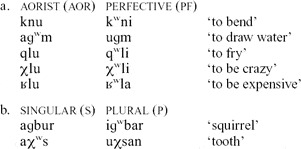
Labialization is generally defined as a secondary articulation implemented by the rounding and protrusion of the lips, superposed on the primary dorsal articulation. As far as I know, no published study has investigated the articulatory and acoustic correlates of Tashlhiyt labialization. Impressionistic observations suggest that Tashlhiyt labialized consonants are not only labialized but also velarized: [kʷ] in [ikʷla], for example, seems to have a more posterior place of articulation than [k] in [ikla]. Segments in the vicinity of these labialized consonants are also affected by this secondary articulation. In [tɡʷmr] ‘she hunted’, for instance, [t] seems to be produced with a raised tongue dorsum and rounded lips. As can be expected from their articulation and from a preliminary study on this issue in Taqbaylit Berber (Hamouma Reference Hamouma1985), the labialized consonants could be acoustically implemented by a lower F2 on the following vowel, a consequence of the backed position of the tongue dorsum during their production.
Semivowels
Tashlhiyt has two underlying semivowels, /j/ and /w/. These semivowels may contrast underlyingly with high vowels (e.g. [rwl] ‘escape!’ vs. [ru h] ‘go away!’). This contrast is neutralized after a vowel. In this context, the high vowels /i/ and /u/ are produced as their correspondent glides [j] and [w], respectively (compare /urta uri-ʁ/ [urta wriʁ] ‘I have not written yet’ and [urd awriʁ] ‘it is not sickness’). The geminated semivowels /jː/ and /wː/ are produced as sequences of high vowel+glide, making the sequence /wː/, for example, homophonous with a high vowel followed by a glide /u+w/ (compare /t-ʃwːaʃ/ [tʃuwaʃ] ‘disturb!’ and /i-ʃuwaʃ/ [iʃuwaʃ] ‘catapults’). Semivowels may occur in all positions, with the exception of utterance-final position if preceded by a consonant. A detailed presentation of the behavior of these segments and their syllable status is presented in Dell & Elmedlaoui (Reference Dell and Elmedlaoui2002: Chapter 7).
Vowels
At the underlying level, Tashlhiyt has three vowels, /i a u/. Any of these three vowels may occur word-initially, word-medially, or word-finally:
-
(4)

Unlike consonants, these vowels do not contrast in length at the underlying level, though long vowels exist at the surface level. The long [aː] can derive from the succession of two short [a]s (e.g. [ifka ak] ‘he gave you’, which can be produced either [aː] or [aja]). The long vowels [iː] and [uː] are manifestations of tautosyllabic /ij/ and /uw/ (e.g. [miːk] ‘ignore! pf’, [suːr] ‘take a photo! pf’). When the sequences /ij/ and /uw/ are heterosyllabic, they are not produced as lengthened high vowels, but rather as a sequence of a high vowel and a corresponding glide (e.g. [tːmijak] ‘ignore! impf’, [tːsuwar] ‘take a photo! impf’) (see Dell & Elmedlaoui Reference Dell and Elmedlaoui2002).
As already stated, the acoustic characteristics of Tashlhiyt vowels are affected in the neighborhood of emphatic consonants. As illustrated in Figure 1, based on vowel productions in the context of /tˁ/ and its plain counterpart /t/ (e.g. [itˁi] vs. [iti]) by five Tashlhiyt speakers, emphasis raises F1 and lowers F2 of the adjacent vowels in a systematic way (Ridouane Reference Ridouane2003). In this context, the vowel /u/ is realized as a mid vowel [o], the realizations of /i/ range between [e] and [ɯ], and /a/ is close to [ɑ].
Average formant values for the three vowels in emphatic (capital letters) and plain contexts.

The quality of the underlying vowels may also be affected by other neighboring consonants. The vowel /u/, for instance, is systematically fronted and lowered when it occurs between two coronal consonants. In that context, the realizations of /u/ range between [ö] and [œ], e.g. whereas /su/ ‘drink!’ is realized as [su], /su = t/ ‘drink it!’ is realized as [söt]. The vowel /a/, on the other hand, sounds more as a back vowel [ɑ] before a pause, and as an anterior [æ] elsewhere, e.g. whereas /dawa = t/ ‘treat him!’ is realized as [dæwæt], before a pause /dawa/ ‘treat!’ sounds more or less like [dæwɑ] (Dell & Elmedlaoui Reference Dell and Elmedlaoui2002: 68–69).
In addition to the surface realizations of /i a u/, a fourth schwa-like element (transcribed here as [@]) is sometimes present in the acoustic record of Tashlhiyt underlying consonantal clusters (e.g. in [kʷ@dˁiʁ] ‘I smelt’, displayed in Figure 2). Where does this vocalic element come from? This question has important theoretical implications and bears crucially on the syllable structure of Tashlhiyt (see below). According to Coleman (Reference Coleman, Durand and Laks1996, Reference Coleman2001), these elements are the phonetic realizations of empty nuclei. Dell & Elmedlaoui (Reference Elmedlaoui1985, Reference Dell and Elmedlaoui2002), on the other hand, argue that these vocalic elements are transitional vocoids which do not play any role in syllable structure (see also Boukous Reference Boukous1987). Ridouane (Reference Ridouane2008) discusses a range of arguments against a phonological treatment of these elements: Native speakers are largely unaware of them; they do not affect intuitions about syllabification; they do not contribute to syllable weight in versification of traditional songs; and phonological processes such as assibilation ignore them. Phonetically, they have been shown to be predictable from the laryngeal and supralaryngeal specification of the consonantal environment (Ridouane & Fougeron Reference Ridouane and Fougeron2011). Their occurrence within a #C1C2 sequence depends on the presence of voicing in the sequence (either C1, C2 or both). In sequences composed of only voiceless obstruents, no such vocoid is observed (e.g. between /k/ and /t/ in [ktin] ‘they remembered’). Neither do they occur in words composed of only coronals (e.g. in [tntltːnt] ‘you hid them’). Examination of the linguopalatal profiles shows that during the production of such homorganic words, the speakers never move the tongue away from the alveolar ridge, a gesture necessary for schwa to surface (Fougeron & Ridouane Reference Ridouane2008a). The bulk of arguments leads to the conclusion that these @s are transitional vocoids, and thus a matter of phonetic detail rather than phonological segments in their own right.
Acoustic waveform and spectrogram illustrating the presence of [@] within the sequence [kdˁ] included in the sentence [inna kʷ@dˁiʁ jat twaltː] ‘He said “I smelt” once’ produced with a vowel-like element by a female native speaker.

A note on vowel-less words and syllables
Tashlhiyt can be described as a ‘consonantal language’. As shown above, the language has a rich system of consonant phonemes and only three underlying vowels. In addition, it allows particularly long consonantal sequences. These sequences are attested word-initially (e.g. [brːʢziz] ‘hornet’), intervocalically (e.g. [asqːsi] ‘question’), and word-finally (e.g. [asɡrs] ‘bag’). The language allows monomorphemic word-initial clusters that violate traditional principles of sonority well-formedness. Words may begin with consonants having the same sonority value (e.g. [χsi] ‘extinguish!’, [kti] ‘remember!’), or sonority reversals (e.g. [zdi] ‘fasten!’, [rku] ‘be dirty!’), in addition to more common obstruent–sonorant clusters (e.g. [ɡnu] ‘sew!’, [kru] ‘rent!’).
What makes Tashlhiyt a ‘consonantal language’ par excellence is the existence of words composed of consonants only (e.g. [rɡl] ‘close!’, [trzmtːnt] ‘you opened them (f)’). Some of these words may contain voiceless obstruents only (e.g. [tkːststː] ‘you took it (f) off’, [tsːkʃftstː] ‘you dried it (f)’). A whole sentence may also be vowel-less: [tsχrbqːtːnt tsrstːnt ʁ lqːʷbːt] ‘you mixed them (f) up and put them (f) in the dome’. Tashlhiyt also allows what one might call ‘homorganic words’, words composed of consonants which are all produced with the same articulator (e.g. [ntl] ‘hide!’, [tntltːnt] ‘you hid them (f)’). Vowel-less words, which are much more common in verbs, conform in every respect to the structure of other lexical words in the language, and cannot be viewed as lexically or morphologically marginal (Ridouane Reference Ridouane2008).
Related to this is the syllable structure of Tashlhiyt, often cited as a typologically unique phenomenon, because it allows any segment, including voiceless stops, to be a syllable nucleus. In addition to the more conventional syllable types V, CV and CVC, Tashlhiyt syllables may consist of only consonants: C, CC and CCC (where the underlined C is the nucleus). Branching onsets or codas are not allowed. The onset is obligatory, except at utterance-initial position. In this analysis, syllables of the shape [fl tk] are common, as in (5).
-
(5) Nucleus types in Tashlhiyt syllables
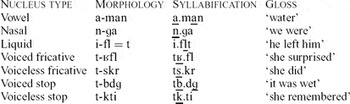
Dell & Elmedlaoui (Reference Dell and Elmedlaoui2002) presented impressive evidence in favour of the above syllabification (see also Boukous Reference Boukous1987, Ridouane Reference Ridouane2008, Fougeron & Ridouane Reference Ridouane2008b, Ridouane, Hermes & Hallé Reference Ridouane2013). These include native speakers’ intuitions and native judgments about well-formedness in versification, as well as insights into various morphological regularities captured by assuming the proposed syllabification of consonant clusters.
Stress and intonation
Tashlhiyt has no lexical stress (Applegate Reference Applegate1958). According to preliminary observations from Dell & Elmedlaoui (Reference Dell and Elmedlaoui2002: 14), ‘the main pitch event’ in an Intonational Phrase occurs near its end, i.e. on the prefinal or final sonorant nucleus. Recent work on tonal placement in the language investigated the nature and distribution of Intonation Phrase medial h tones in declaratives (Grice et al. Reference Grice, Röttger, Ridouane and Fougeron2011) and Intonation Phrase final h tones in both declaratives and interrogatives (Röttger, Ridouane & Grice Reference Röttger, Ridouane and Grice2012, Reference Röttger, Ridouane and Grice2013, see also Gordon & Nafi Reference Gordon and Nafi2012).
In both declarative and interrogative sentence types there is a rise to an f0 peak represented as an h tone followed by a fall in pitch to a low point at the end of the phrase. In general, questions reveal an overall greater pitch range and register and a concomitant steeper rise to the h peak than statements. In productions of target words with only one sonorant nucleus (vowel or sonorant), the h peak is almost always located on this syllable. In words with two sonorant nuclei available, the association of tones is subject to the influence of a number of interacting factors. We have identified four of these: sentence modality, i.e. interrogatives are more likely to be realized with an h tone located on the final syllable than declaratives; sonority, i.e. more sonorous nuclei were more likely to attract the h tone; syllable weight, i.e. heavy syllables were stronger attractors for the h tone than light syllables; and there was a general preference for rightmost: i.e. the h tone was located preferentially at the rightmost available position.
If the target word contained neither a vowel nor a sonorant consonant, it sometimes had no f0 peak at all. Alternatively, the peak was either on a vowel nucleus of the previous word (Figure 3a) or on a transitional vocoid @ within the consonant string of the target word (Figure 3b).
Waveform, spectrogram, and f0 contour of questions (a) is inna tkʃf ‘Did he say “It dried”?’ and (b) is inna tbdgt ‘Did he say “You are wet”?’ produced by a male native speaker.

Interestingly, the language can allow the peak to be on transitional schwa-like vocoids that are not incorporated into the phonological structure of the word. This suggests that both phonological and phonetic aspects of tonal placement are at work, and both aspects have to be taken into account for a full account of tonal placement in Tashlhiyt.
Transcriptions
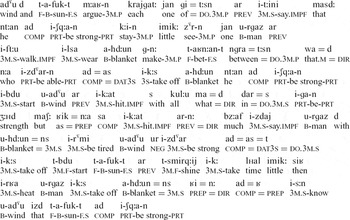
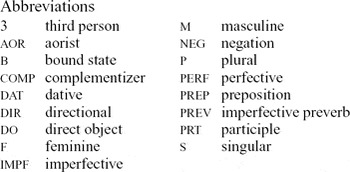
In the phonemic transcription, hyphens mark morphological boundaries inside words, while equal signs mark boundaries between clitics and their hosts. Abbreviations used in glosses are explained in a list immediately below the transcribed passage. The exclamation mark preceding words in the phonetic transcription indicates that these words are pharyngealized. In anticipation of some of the forms in the transcription, a few words must be said about nominal morphology of Tashlhiyt. Nouns in Tashlhiyt typically start with a vowel. These vowels fall into two types: either they belong to the stem (e.g. /adˁu/ ‘wind’) or they are augments (e.g. /a-rɡaz/ ‘man’). In bound state forms, which are derived by the prefixation of /u/, augments systematically drop (e.g. /u-rɡaz/), while vowels belonging to the stem maintain their position (e.g. /u-adˁu/ [!wɑdo], where /u/ becomes [w] to avoid hiatus).
Phonemic transcription of the recorded passage
Semi-narrow transcription of the recorded passage
!ɑdˁo tːfukt mːæʁn│kræjɡætː jæn ɡitsn ær itːini mæsdː ntːæn æjʃqːæn ║ kːin imikː !zrn ja wrɡaz ær iftːu │ilsæː hdːun ║ ɡnː tæʁnːænt nɡrætːsn│wænːɑ !jzdɑrn æd æs ikːs æhdːön ntːæn æjʃqːæn ║ ibdu !wɑdo ær ikːæt s kulːu mædːærs iɡæn ʒːhd │ mæʃː │ ʁiknːɑ sæ jkːæt ærnː bzːæf izdæj urɡæz d uhdːönːs ║ !erme !wɑdo │ur !ezdɑr ædæstː ikːs ║ tbdu tfukt ær tsmirqːij │ ikː lʜæl imikː │ siʁ irʁɑ wrɡæz ikːs æhdːön ns ║ ʁinː æʁ isːn !wɑdo is tːæfukt æjʃqːæn ║
Acknowledgements
This work has been partially financed by the Labex EFL (ANR/CGI). I am grateful to John Esling and three anonymous reviewers for JIPA for their valuable feedback. Any errors are solely my responsibility.



