In May 401 bce the Persian prince Cyrus the Younger started out for Mesopotamia from his satrapy in western Anatolia with an army of levies and Greek mercenaries. Although he did not declare his intentions at the outset, his aim was to win control of the empire from his brother, King Artaxerxes. At the battle of Cunaxa in Babylonia Cyrus was killed, though the engagement itself was inconclusive. Emerging practically unscathed, the Greek contingent began what became an epic march to safety through hostile territory. The journey took them north along the middle course of the Tigris river, into the Armenian Mountains, and finally, in late April 400, to the peaks overlooking the Black Sea. From the Greek colony of Trapezus they proceeded alternately by foot and ship to Byzantium. Their story is told in the Anabasis of Xenophon the Athenian, the only first-hand account of the journey that has come down to us.
In modern times much of the army's route has been pieced together. Important stages of the retreat through eastern Anatolia still remain uncertain, however, and some commentators believe that there is information missing from the record.Footnote 1 Possibly as a result of the focus on this part of the retreat, other sections of the journey have enjoyed less attention than they deserve. This is especially true of the stages that follow the army's departure from Trapezus. In this article my focus is on one of these, namely the route through the territory of the Mossynoikoi, a tribal federation which controlled an area of the south-eastern Black Sea littoral (see Figure 1). Although no physical trace of these people survives, they left an indelible impression on travellers in antiquity, and by virtue of the surviving reports a distinct picture of their culture emerges. In this regard, the most important account is that of Xenophon, who witnessed the Mossynoikoi at close hand over the course of more than a week fighting and trekking through their land.
Army's route from Trapezus to Kotyora as described in the Anabasis. Source: adapted from the forthcoming Landmark Anabasis (see acknowledgements note); my thanks to Bob Strassler for permission to use it.

By all accounts they were a warlike people and at the same time distant in their customs and habits from Greeks. Xenophon writes (An. 5.3.4) that:
when they were in a crowd they did whatever others might do in solitude, and when they were by themselves they behaved just as if they were in the company of others: they would talk to themselves and laugh at themselves and stand and dance wherever they happened to be.
They seem to have lived in tree houses, their name deriving from the word used for the turrets in which they dwelt, the ‘mosyni’.Footnote 2 Their livelihood was based on subsistence farming, primarily hulled wheat, and on hunting and fishing (dolphin seems to have been a favourite, as Xenophon mentions that they used its oil and he reports finds of this mammal's meat in looted villages; their rudimentary boats are described at 5.4.11). They also harvested wild honey and nuts and produced their own wine. A king, maintained by common contributions, resided in a wooden tower on a symbolic height in their territory. This king was not allowed to leave the tower, and although Diodorus (14.30.7) may be right that he issued edicts from the spot, it could be that he was more of a spiritual figure, perhaps mediating between earth and a universal power. Where such prohibitions on movement existed in ancient societies, the control in turn was sometimes believed to afford a degree of influence over the natural world.Footnote 3
The ordinary settlements of the Mossynoikoi were situated up on valley sides, far enough inland to avoid becoming prey for passing pirates.Footnote 4 This location would also fit with the prevailing climatic conditions, being removed from the danger of floods on the valley floors during winter and spring. Herodotus (3.94) names the Mossynoikoi as a constituent people of the Persian Empire's nineteenth satrapy, although in reality their allegiance to the king may only have been nominal.Footnote 5 The experience of the Ten Thousand and the tribe's appearances in later history, notably an attack on Pompey's army which resulted in 600 of his men being lost, suggest a determinedly independent tradition.Footnote 6
In early June 400, having remained a month at Trapezus on the Black Sea, the Greeks started west along the coast, arriving in Kerasous on the third day.Footnote 7 Their plan had been to sail homeward but, in spite of efforts at piracy, a sufficient number of ships could not be found; the sick, those over forty, and assorted non-combatants were put on the vessels they had secured at Trapezus, while the main fighting force proceeded by land. Shortly after leaving Kerasous the army came to the eastern frontier of Mossynoikoi territory and dispatched an envoy to learn whether they would be allowed to proceed unopposed. The refusal to grant them safe passage led to the Greeks allying with another Mossynoikoian group living further to the west; it transpired that the nearer group had control over a symbolic location which was traditionally held in common but had apparently been seized by them unjustly.
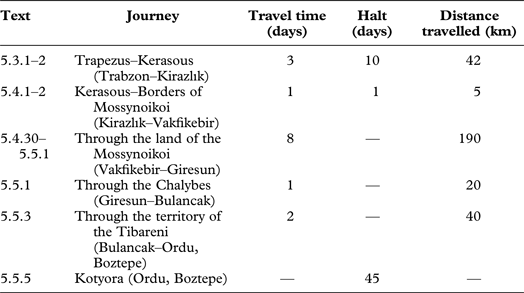
Following an initial setback, which saw a number of the Greeks killed and decapitated, the joint force overcame their opposition and gained control of the high ground. The king, who had remained inside his tower there, would not come down and was burned up, together with the structure (Xen. An. 5.4.22–6). For their part in this triumph, the Greeks were guided across the valleys to the next tribal territory, that of the Chalybes, who we are told were subjects of the Mossynoikoi. This march took them up to eight days to complete and would have covered a distance of around 190 kilometres.Footnote 8 During it they passed a number of the native settlements, which were mostly situated on valley sides. Xenophon writes (An. 5.4.31):
The cities were separated from each other by eighty stadia [14.2 kilometres], more or less, but by calling out to each other from high up people could communicate from one city to another, as the terrain consisted of lofty crags and hollow valleys.Footnote 9
The Greek army's journey from Trapezus to Kotyora (Anabasis 5.3–5)
In the light of the fact that Xenophon is a witness to the calling out (ἀναβοώντων) between inhabitants, and the natural physical limitations on such communication, the cited distance between the settlements gives pause for thought.Footnote 10 At first glance it would seem an extraordinary way for even the most stentorian of voices to carry, and this sense, as we shall see, is confirmed by a look into human sound propagation.
The first question to address is the basis of the estimate: is it on sight – as the crow flies – or the distance taken to cross the valleys going from one settlement to the next? In this second case, given the terrain and non-linear line that the path would take, the effective (direct) distance for the sound to carry would be much less, perhaps only as much as half. To be more specific, if the 80 stadia refers to the line of sight from one ridge to the next, then the distance across the valleys would be 12–16 kilometres. However, if the 80 stadia indicates the route traversed, the actual distance for voices to carry across the valleys might be just 6–8 kilometres. We should probably expect the basis to be the actual route, given that distances reported in Xenophon's record invariably apply to the way taken by the army on its journey. Nonetheless, that would not in principle preclude the author from basing his estimate on what he is seeing: he is seeing the facing settlements and he has acquired a good sense of distance on his travels. In the account he does offer similar, if usually shorter, estimates: for instance, on the battlefield at Cunaxa he reports at one point that the two armies were separated from each other ‘by less than 3 or 4 stades’ (An. 1.8.17).
Of more direct relevance are those occasions where he is either viewing from a height or on a plain looking up, and provides us with a figure for distance. Notable in the second circumstance are: his view back to the mountains of the Kardouchians from the Centrites river, which he puts at 7 stadia (4.3.1); the army halting about 30 stadia from a mountain pass where enemies were waiting (4.6.6); and an estimate of the length of a stretch of mountain ridge north of the Phasis (Aras) river, ‘more than 60 stadia’ (4.6.11). Viewing from a height, we have at 6.3.20 a night sighting of enemy campfires at about 40 stadia away, and, famously, from Mount Theches a sighting of the sea (4.7.21–5), which would have been at least 190 stadia away.Footnote 11 Given that Xenophon was crossing the valley ridges, weight has to be given to the possibility that the figure he cites is based on what he is seeing rather than the length of the path travelled, however that might have been calculated in such an area.Footnote 12 I return to this question later.
A more immediately pressing one is the distance which Mossynoikoian voices could have carried. The answer, even for rudimentary messages, is probably not very far ordinarily. Barely 200 metres is the normal maximum for intelligible speech, although a pattern of sound according to pre-agreed formulae could be used for common messages and would go further.Footnote 13 In both cases the topography, marked out by Xenophon as making the (evidently extraordinary) communication possible, would have significantly extended the normal limits. Other possibilities to consider are that the Mossynoikoi used a series of people to relay messages, such as Caesar reports the Gauls as doing (B Gall. 7.3), or that they deployed some kind of technical aid to amplify sound. The first would seem incompatible with what Xenophon says, and in the second case we might have expected him to have commented on such a device. So we are left with a situation whereby communication beyond a kilometre would have been challenging, with the distances under discussion, 6–8 and 12–16 kilometres respectively, way beyond the normal voice range.
One way of potentially resolving the matter is to postulate an error in the manuscript tradition: that what Xenophon actually reported was eight (ὀκτώ) or eighteen (ὀκτωκαίδεκα) stadia, but that a copyist misread him and wrote eighty (ὀγδοήκοντα). As the dozen or so versions which have come down to us apparently show no variation for the figure, by this theory the error would seem to have occurred in antiquity.Footnote 14 Leaving other considerations aside for the moment, in palaeographic terms eighteen would have the superior claim: whereas a slip from ὀκτώ to ὀγδοήκοντα is possible, it would be easier to see the latter (‘eighty’) being written for ὀκτωκαίδεκα (‘eighteen’).Footnote 15 While it may seem odd that no-one subsequently picked up on the extraordinary statement about the distance, the copyist's task was to reproduce, not interrogate, the material at hand. But this may be putting the cart before the horse. Can we be confident that Xenophon's figure, whatever in fact it was, was accurate? I think we can. As I have shown elsewhere, the detail in his march record, whether emanating from a diary or being the result of research on the part of the author, is generally reliable.Footnote 16 It is notable that the figure at 5.4.31 (80 stadia) is not an obviously impressionistic one – as 50 or 100 might be said to be – giving us a degree of confidence that here, too, Xenophon has taken care to get his detail right. All that said, it cannot be discounted that any error was his: that, although he had ascertained the right figure, in the composition he wrote it down wrong.Footnote 17
The surest way to set the issue of the distance on firmer ground is to take an overview of the geography of the region. This should serve as a check on Xenophon's autopsy, shedding light in the process on the matter of a possible error in the manuscripts and on the basis for the measurement of distances (whether sight- or route-traversed).Footnote 18 A preliminary remark is that travel along the coast, even up until relatively recent times, was difficult on account of the numerous steep headlands and absence of serviceable roads for long stretches. Travellers in the nineteenth century would sometimes have to wade in to the sea to round rocky outcrops, or go inland to find a crossing place for a river.Footnote 19 As already noted, the Greeks had wanted to go in one body by sea, but a lack of sufficient vessels forced them to give up this idea. In the circumstances it was quite sensible for those on foot to take an inland route toward the next Greek colony, Kotyora, and this appears to have been on the advice of their guides (see Xen. An. 5.1.13, 5.4.10).Footnote 20
Turning to the terrain, while not uniform, the pattern is of contiguous valleys which deepen with distance from the coast as the Black Sea Mountains rise up and rivers fall down from their heights. These are not always orientated north–south and their breadth can vary, notably in those cases where ridges fall away on the mountain (southern) side, leaving extended gaps into adjacent valleys. While Xenophon's description of the journey through the Mossynoikoi is broadly consistent with this topography, by virtue of specific detail in the account we can go further than a general statement and take the opportunity to test the accuracy of the record for this section.
The first control comes from the time given for the journey, ‘eight days’ march to make their way through…both the hostile and the friendly parts of this country’ (5.5.1).Footnote 21 If one were to follow the modern road along the coast, blasted out of the rock and laid across artificial causeways, the distance between the northern boundary points of the ancient territory would be approximately 90 kilometres, a straightforward walk of three to four days.Footnote 22 However, by the inland way, where paths wind up and down the slopes at angles, the same journey would take much longer; taking into account that the rate of progress in this terrain would be slower, a factor of around two seems reasonable.
The second control is the figure given for the distances between Mossynoikoian settlements. The text (5.4.31) says that this was around 80 stadia (12–16 kilometres), with the implication that these places straddled ridgelines or rested just beneath them, as from high up in the valleys the inhabitants could hear one another calling out. If we take first the distance based on line of sight, there would be a very small number of places where this figure would fit the landscape, these being configurations where, as mentioned above, depressions effectively extend the space between valley sides. However, if we take the distance to be that covered on the ground, this would fit quite well with a broad swathe of the topography, the direct length between facing ridgelines in many cases being in the range of 4–6 kilometres or around 8–12 kilometres by path (see Figure 2). The landscape itself therefore seems simultaneously to answer the subsidiary question about the basis of Xenophon's measurement and to lessen the possibility that there is a transcription error in the text; nevertheless, the alternative of 18 stadia (3.2 kilometres) on a line-of-sight basis cannot be ruled out. An important factor keeping that alternative in the margins is that the figure would leave us with denser habitation than we would expect: instead of having ‘cities’ every 8–12 kilometres they would be as frequent as every 3 kilometres. On balance, then, when set against the geography and probable settlement pattern, it looks like the figure in the text is about right.Footnote 23
View toward şalpazar ridge. Source: author photograph.
Still, even if we can be confident in the accuracy and meaning of the number given, the problem remains that 6–8 kilometres is too far for a voice to carry intelligibly. The solution must lie with some technique of enhanced sound propagation. One such technique familiar from mountainous areas is yodelling, associated especially with remote Alpine landscapes where it has been traditionally used for communication among cowherds. The maximum distances typically seen are, however, some way short of what we would need to see, perhaps in the order of 1–2 kilometres; while this distance can be significantly boosted by use of the alphorn, a long, wooden wind pipe, as was said earlier it seems likely that Xenophon would have included such a feature in his report. A similar, if more rudimentary, form of singing is practised in parts of Scandinavia. Studies of kulning indicate that in theory relatively long distances could be achieved in an ideal alignment of atmospheric and topographical conditions (presumably the same would apply to yodelling), but this would not fit with a system in regular use such as described by Xenophon.Footnote 24
Another possibility is whistling. Some think that what the author could have witnessed on his journey through the Black Sea valleys was the phenomenon of ‘whistled speech’, a system of communication whereby a native language is expressed by whistling. By proper usage of the fingers whistling can be directed quite accurately, and strong lungs combined with the natural acoustics of valleys can send messages some distance. Linguists believe that the language originated from the need to enable communication between settlements in areas of low population density and difficult terrain. The phenomenon is not linked with any particular linguistic group or language type and can be observed today in mountainous areas of Mexico, the Canary Islands, Greece, and Turkey. Intriguingly, the area in Turkey, a remote pocket on the eastern Black Sea coast, lies within the territory of the ancient Mossynoikoi, where Xenophon and his men passed through 2,500 years ago. Could this be what he witnessed? Could it be that, as Andriëtte Staathi-Schoorel wrote in her article on whistled speech, he ‘heard the people of the region whistling in a “barbarian” language and described this phenomenon (thirty years later) as anaboao, meaning calling out’?Footnote 25 It is notable that Xenophon attributes the communication to the locals and did not make a general statement, such as ‘one's voice could carry’, and that he does not elsewhere remark on people calling out, though much of the land he passed through on the retreat was remote and mountainous. It is equally notable, though, that he does not use the verb for whistling, surizein, albeit it is not certain that the meaning, or rather the practice, would correspond exactly to the modern understanding. But perhaps it was the fact that the Mossynoikoi were in effect ‘speaking’ that led him to use the term he did.Footnote 26
Regarding the utility and range of the technique, the linguist and bio-acoustician Julien Meyer writes that:
it is a natural alternative to the constraints observed for shouted speech…Amplitude, frequency and duration, which are the three fundamental parameters of speech, can be more comfortably adapted to the distance of communication and to the ambient noise. Whistled speech is so efficient that full sentences are still intelligible at distances ten times greater than shouted speech.Footnote 27
Indeed, under the right conditions it has been estimated that a whistler can be understood as far away as 10 kilometres, the equivalent of 55 stadia. Busnel and Classe observe that:
it is not surprising that in wooded, open valleys the range is generally limited to 2 to 3 km, whereas where the valleys are narrow, for example at La Gomera [Canary Islands], with rock sides of low absorption, it is possible to reach 8 to 10 km.Footnote 28
The area we are examining would fit better into the former category, but perhaps the heights and hollows that Xenophon described would allow for an extension of the normal limits, if not approaching those seen under ideal conditions. A look at whistled speech as it is practised today in the same area to which the author is referring may help settle the question about his description raised in this article.
While Turkish whistlers may be found among the swathe of remote valleys between Tonya and Giresun, an acknowledged centre for the practice is Kuşköy, a village lying some 27 kilometres in from the coast at Görele (see Figure 1). The name in Turkish means ‘bird village’, doubtless a recognition of the particular strength of the whistlers in these parts. The tradition here has been alive for as long as anyone can remember, being unconsciously passed on from one generation to the next. The durability of the practice has been accounted for by the village's comparative remoteness, a five-hour hike from the coast up a winding river valley. Even if in recent times a paved road has connected it to the outside world and mobile phones have taken a toll, the locals seem determined to retain this unique aspect of their heritage. On my visit with Andriëtte Staathi-Schoorel in 2001, the village had a population of about 500 people. There was a small commercial heart – shops, school, tea-house – on the east side of the valley floor, with a number of homes scattered further along on both sides of a steep V-shaped valley. As in much of the rural Black Sea region, the local economy is based on the farming of hazelnuts, and it is up in the plantations that the utility of the method becomes apparent. A man high on the slopes, for example, might whistle down to a relation asking for water, or a replacement tool, to be brought up, while his wife, an hour’s walk away on the opposite side, might inform him that his dinner will be ready at six (in the conservative Black Sea culture the reverse scenario is all but unheard of). Unfortunately, the dimensions of this particular valley – 1–2 kilometres from ridge to ridge – don't furnish the sort of direct evidence that would help make the case for whistled speech being what Xenophon reported on; neither, however, does the example of Kuşköy preclude the practice being effective in the larger, more typical valleys of the region. In principle we would expect the ranges of skilled whistlers to increase up to a limit defined by conditions in the larger spaces.Footnote 29
Conclusions
Xenophon's observation about communication between Mossynoikoian settlements on the Black Sea is remarkable on two counts, first, as something which he considered worth reporting to his audience, and second, for the distance that is reported. The latter has been the focus of this article, its starting point being that the 80 stadia cited in Anabasis as the approximate distance between cities of the Mossynoikoi is too great in light of the natural limits on communication by voice. A number of solutions to this problem were considered, including assisted communication and the possibility of an error in the text – that what Xenophon wrote (or intended to write) was eight, or more likely, eighteen, instead of eighty. With these discounted following scrutiny of text and topography, it was concluded that a technique of enhanced sound projection must be the explanation for the report. Two alternatives were looked at: a form of singing such as yodelling or kulning and whistled speech. The first would work over distances of 1–2 kilometres but would struggle, and even be unrealistic, at the longer range of 6–8 kilometres under discussion. Whistled speech seems to be more effective over longer distances, as ranges of those in question here are attested in some of the places where it is practised. Even if one of these is not the Black Sea region of Turkey, it is interesting that it is in everyday use today in the same area that the Greeks passed through 2,500 years ago, on their retreat from Mesopotamia.
Did the Mossynoikoi whistle? I am inclined to think that they did. For all the strangeness to outsiders of their habits, it is apparent that they adapted well to their environment, living in wooden structures and off the land and sea around them. Given that the topographical conditions and traditional settlement pattern were favourable for the emergence of whistled speech, there seems to me to be a fair chance that the Mossynoikoi developed this linguistic innovation. But they could also, at a stretch, have been early yodellers, pre-dating their better known Alpine counterparts by many centuries. The fact that the verb which Xenophon uses, ‘to call out’, would fit better with this than with whistling might persuade some to this solution.