Introduction
Which factors affect the probability of becoming a centenarian among older European adults? In the past four decades, with advancements in modern medicine and significant improvements in life conditions, the number of centenarians has increased dramatically worldwide (Berr et al., Reference Berr, Balard, Blain and Robine2012; Mao et al., Reference Mao, Zhao, Pu, Wang, Zhang and He2013). Hence, researchers have begun to focus on the health and number of centenarians by regional level of development (Mackenbach et al., Reference Mackenbach, Stirbu, Roskam, Schaap, Menvielle, Leinsalu and Kunst2008; Mackenbach & Looman, Reference Mackenbach and Looman2013) – in particular the effect of socioeconomic inequalities on the probability of surviving to become a centenarian among people in European and OECD (Organisation for Economic Co-operation and Development) countries (Kim, Reference Kim2013, Reference Kim2014; Kim & Kim, Reference Kim and Kim2014a).
Most developed countries have accepted the chronological age of 65 years as a threshold for being elderly or an older person. Although this cut-off is somewhat arbitrary, it is often associated with the age at which people can begin to receive pension benefits (WHO, 2015). The survival probability of becoming a centenarian (SPBC) at age 65 [SPBC (65)] is the number of centenarians produced by a population who at any time were 35 years from turning 100: that is, people aged 65 years (Robine & Paccaud, Reference Robine and Paccaud2005). This study assessed the SPBC (65–69), defined as the survival probability of becoming a centenarian for those aged 65 to 69.
The SPBC is a representative measure for evaluating longevity (Kim & Kim, Reference Kim and Kim2014a, Reference Kim and Kim2015b), and estimates a given population’s production of centenarians (Robine & Paccaud, Reference Robine and Paccaud2005). The longevity index was first suggested by Sachuk (Reference Sachuk1970) as the proportion of centenarians in a population (Kim, Reference Kim2014), but the value of this depends on the population’s structure (Gavrilov & Gavrilova, Reference Gavrilov and Gavrilova2010). The SPBC (65–69), on the other hand, overcomes the problem of migration, which changes a country’s population structure. The SPBC was first suggested by Robine and Paccaud (Reference Robine and Paccaud2005) as an indicator of successful ageing in response to the imperfection of the longevity index (Sachuk, Reference Sachuk1970; Robine & Paccaud, Reference Robine and Paccaud2005; Magnolfi et al., Reference Magnolfi, Petruzzi, Pinzani, Malentacchi, Pazzagli and Antonini2007; Gavrilov & Gavrilova, Reference Gavrilov and Gavrilova2010; Kim, Reference Kim2014; Kim & Kim, Reference Kim and Kim2014a, Reference Kim and Kim2015b). The retrospective analysis of the factors that contribute to the SPBC (65–69) may help to identify those associated with successful ageing (Kim, Reference Kim2013; Kim & Kim, Reference Kim and Kim2014a).
Recent studies have assessed the influence of social factors on the centenarian rate in 32 OECD countries (Kim, Reference Kim2013; Kim & Kim, Reference Kim and Kim2014a). Another study by Robine et al. (Reference Robine, Herrmann, Arai, Willcox, Gondo, Hirose and Saito2012) examined the impact of geographic factors on the centenarian rate in Okinawa, Japan. These studies found that SPBC was affected by health expenditure, living standards, human development and climate conditions, but they did not analyse the association with gender inequality. In particular, differences in health at the socio-cultural level in more and less developed regions of a country (Mackenbach et al., Reference Mackenbach, Stirbu, Roskam, Schaap, Menvielle, Leinsalu and Kunst2008; Aksan et al., Reference Aksan, Ergin and Ocek2010) can have direct and indirect impacts on a nation’s SPBC (65–69). Over the past four decades, the Gender Inequality Index (GII) has been decreasing (Backhans et al., Reference Backhans, Lundberg and Månsdotter2007), but disparities between countries continue to exist (Kim & Kim, Reference Kim and Kim2014b). Therefore, there is a need to study the GII as a socioeconomic indicator to identify the influence of gender inequality on the probability of surviving to become a centenarian.
Successful ageing in centenarians is influenced by biological, psychosocial and environmental factors (Candore et al., Reference Candore, Balistreri, Listi, Grimaldi, Vasto and Colonna-Romano2006; Kim & Kim, Reference Kim and Kim2014a, Reference Kim and Kim2015b). Of these, socioeconomic indicators have not been studied sufficiently. Briefly, previous studies have shown that environmental factors such as economic level predict a population’s health status as represented by life expectancy (Hájek et al., Reference Hájek, Grebeníček, Popesko and Hrabinová2012; Kim & Kim, Reference Kim and Kim2014a), and that social and environmental factors such as health care expenditure predict improved health and longevity (Kim & Kim, Reference Kim and Kim2014a). Previous reports have supported the hypothesis that the associations between national economic indicators and fitness are positive (Theou et al., Reference Theou, Brothers, Rockwood, Haardt, Mitnitski and Rockwood2013). However, the association between country-level socioeconomic indicators of gender inequality such as the gender inequality index (GII) (Rahi, Reference Rahi2011; Kim & Kim, Reference Kim and Kim2014b), proportion of women in parliaments (PWP) (Krook, Reference Krook2010; Ruedin, Reference Ruedin2012) and male labour force participation (MLP) rate (Costa, Reference Costa1996; Schirle, Reference Schirle2008) and the survival probability of becoming a centenarian among older adults has not been studied.
Rowe and Kahn (Reference Rowe and Kahn1987) proposed that successful ageing is the balance of three components: the absence of disease and disease-related disability, high functional capacity and active engagement with life (Baker et al., Reference Baker, Meisner, Logan, Kungl and Weir2009). Successful ageing of centenarians indicates the physical state of living for at least one hundred years with the absence of disease alongside a mental state characterized by preserved functional capacity and social well-being, as exemplified through an active life and participation in society (Kim, Reference Kim2013; Kim & Kim, Reference Kim and Kim2014a, Reference Kim and Kim2015b). The longevity of centenarians as reflective of successful ageing is a multi-factorial, quantitative trait that is influenced by physical and mental states and social well-being: that is, biological, psychosocial and environmental factors (Candore et al., Reference Candore, Balistreri, Listi, Grimaldi, Vasto and Colonna-Romano2006; Mossakowska et al., Reference Mossakowska, Barcikowska, Broczek, Grodzicki, Klich-Raczka, Kupisz-Urbanska and Zyczkowska2008).
In the field of gerontology, understanding older adults’ well-being and quality of life has long been an important research topic (Fenge et al., Reference Fenge, Hean, Worswick, Wilkinson, Fearnley and Ersser2012; Bowling et al., Reference Bowling, Hankins, Windle, Bilotta and Grant2013). For all human beings, successful ageing is the goal in later life; to live a long life is good, but there are objective factors in successful ageing. As populations age, countries may experience gender inequality (Backhans et al., Reference Backhans, Lundberg and Månsdotter2007; Kim & Kim, Reference Kim and Kim2014b), varying experiences with women’s rights (Krook, Reference Krook2010) and differing male labour force participation rates (Costa, Reference Costa1996). However, the association of SPBC (65–69) with these socioeconomic indicators has not been studied sufficiently in older populations in Europe (Ringard et al., Reference Ringard, Sagan, Sperre Saunes and Lindahl2013; Hall et al., Reference Hall, Bernhardt, Dodd and Vollrath2015). This study therefore evaluates the association between the country-level socioeconomic factors of GII, MLP rate and PWP and SPBC (65–69) as an indicator of successful ageing among older adults in European counties.
Methods
Conceptual framework
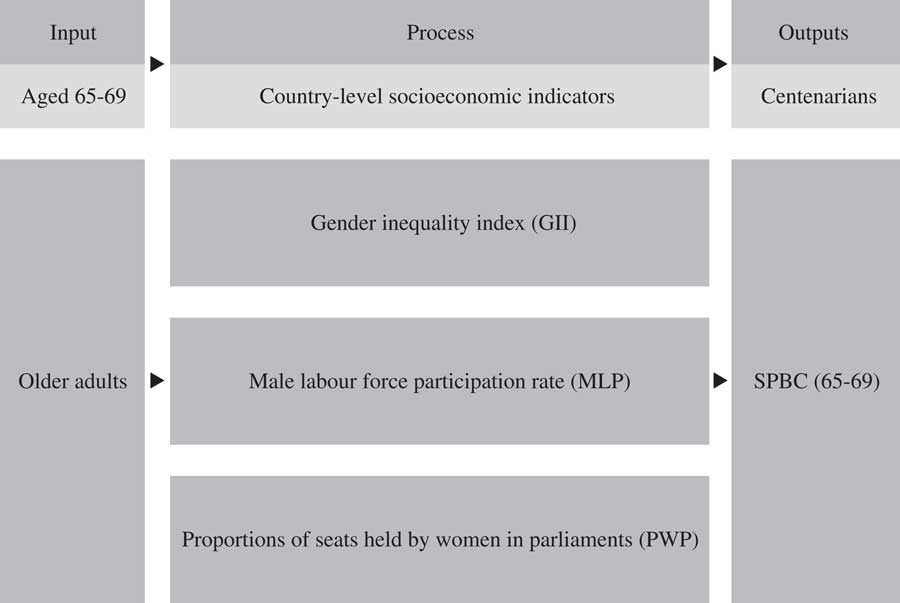
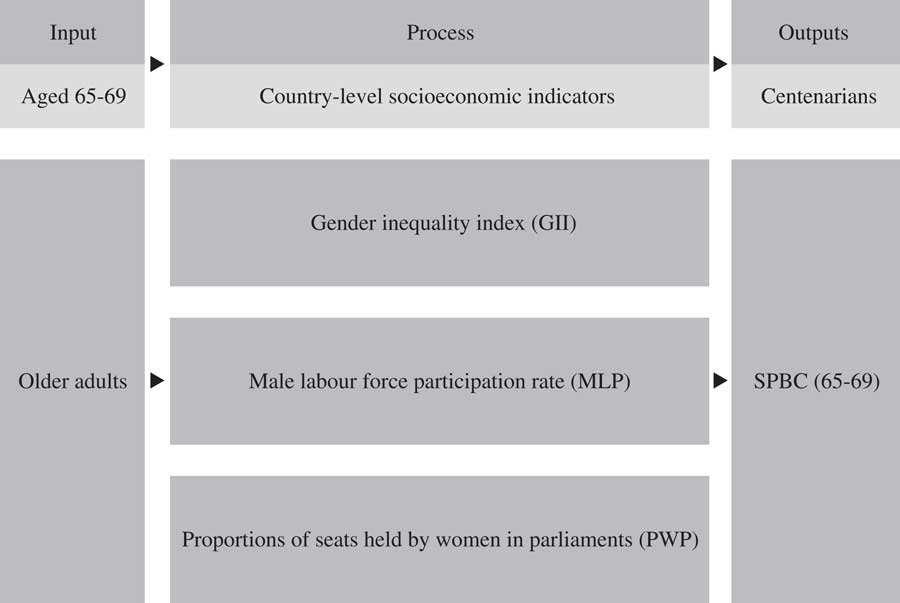
The study’s conceptual framework is shown in Fig. 1. The hypothesis is that the associations between output [SPBC (65–69)] and socioeconomic ‘progress’ factors (country-level GII, MLP and PWP) could predict the probability of becoming a centenarian. In addition, as healthy ageing will affect the probability of becoming a centenarian, these factors also predict successful ageing. The SPBC (65–69) was determined from the survival probability of those who were aged 65 to 69 in 1975 and became centenarians in European countries in 2010 using Pearson’s correlation coefficients and multivariate regression models. In addition, the outputs [SPBC (65–69)] were averaged across all populations and compared using standard statistical methods (Kim & Kim, Reference Kim and Kim2015a).
The conceptual framework. SPBC (65–69): survival probability of becoming a centenarian for those aged 65–69 (per 10,000), 1975–2010. GII: gender inequality index (value: 0, women and men are equal, to 1, women are worse off), 2000–2010. MLP: male labour force participation rate (% of male population ages 15–64), 1990–2010. PWP: proportions of seats held by women in national parliaments (%), 1990–2015.
Analytical models
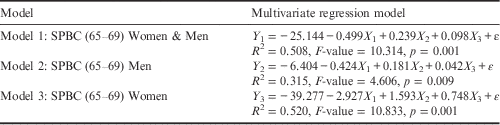
The associations between SPBC (65–69) and GII, MLP and PWP were examined using three models, i.e. the SPBC (65–69) for women and men; the SPBC (65–69) for men; and the SPBC (65–69) for women. The study’s hypothesis was that a lower GII and higher MLP and PWP would result in higher survival probabilities. The associations between SPBC (65–69) and GII, MLP and PWP were assessed using correlation coefficients and multivariate regression models. In addition, a regression analysis was run to determine whether each socioeconomic indicator was independently and significantly correlated with SPBC (65–69). The final analysis used multivariate regression models (see Table 3).
Estimation of the SPBC (65–69)
The SPBC (65–69) has the advantage of controlling for potential confounding factors such as mortality, which could affect the number of centenarians, and migration, which changes a country’s population structure (Kim, Reference Kim2013; Kim & Kim, Reference Kim and Kim2014a). The SPBC (65–69) is the number of survivors who are aged 100 on a given date divided by the size of the corresponding cohort at a given age (Robine & Paccaud, Reference Robine and Paccaud2005; Kim, Reference Kim2013; Kim & Kim, Reference Kim and Kim2014a, Reference Kim and Kim2015b). Thus, the SPBC (65–69) is the number of centenarians in the year 2010 divided by the size of the corresponding cohort aged of 65 to 69 in 1975: SPBC (65–69)=(number of those aged 100 or older in 2010/number of those aged 65 to 69 years in 1975)×10,000. Thus, SPBC (65–69) comprises cohorts who were born in 1905 to 1910.
Data collection and analysis
Data were obtained from the World Population Prospects project conducted by the United Nations (2014); countries and overseas island dependencies were selected according to the UN’s classification system. The age composition of population indicators in the UN is the annual population by five-year age groups beginning on 1st July: 0–4, 5–9, 10–14,…, 65–69,…, 95–99, 100+. Thus, the SPBC (65–69) reflects the number of centenarians by the size of the corresponding cohort at the ages of 65–69. Countries for which information on the number of centenarians was insufficient were excluded, and a total of 34 European countries were selected.
The mean rate of change index (MRCI) was used to measure changes in GII, MLP and PWP over the past 35 years to reflect the centenarians after they were age 65. However, data were only used for the independent variables GII, MLP and PWP for the periods 2000–2010, 1990–2010 and 1990–2015, because of a lack of data; in particular, European parliament election years differed by country, so data from 1990 and 2015 were used; whereas the dependent variables refer to SPBC (65–69) from 1975 to 2010. The MRCI was used to supplement this lack of information because some countries experienced greater progress than others over the 35-year period. The MRCI is the change in the value of a quantity divided by the elapsed time (Lenzen, Reference Lenzen2006, Simmons, Reference Simmons2014). Thus, the socioeconomic indicators in this study reflected the sum of the changes in the values of the quantity indicators from 2000 to 2010 divided by the number (N) of elapsed years. For example, the GII from the period 2000 to 2010 was used. The MRCI equals the value of the 2000 indicators + the changed value in 2010/N and estimates the time-serial data on country-level GII as a socioeconomic indicator (Kim & Kim, Reference Kim and Kim2014a, Reference Kim and Kim2015b), although that study excluded GII when the data were insufficient.
The GII data for this study were obtained from a UN dataset (United Nations, 2014a). The GII ranges from 0 to 1, with a value of 0 indicating that women and men are equal and a value of 1 meaning that women are worse off than men on the dimension being measured (United Nations, 2014b). The GII reflects disadvantages to women in three dimensions and five indicators: reproductive health (maternal mortality and adolescent fertility), empowerment (representation in government, secondary education attainment) and the labour market (labour force participation) (Rahi, Reference Rahi2011; United Nations, 2014b). The data on MLP and PWP were obtained from a World Bank dataset (World Bank, 2015a, b); the male labour force participation rate (MLP) is the proportion of the male population aged 15–64 who are economically active and who supply labour for producing goods and services during a specified period (World Bank, 2015a). Women in parliament refers to the percentage of parliamentary seats held by women (World Bank, 2015b).
Results
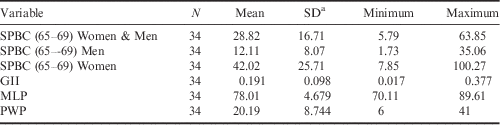
Table 1 presents the descriptive statistics for SPBC (65–69) by gender along with the GII, MLP and PWP values for the 34 studied European countries. The SPBC (65–69) (survivors per 10,000 population) for older adults ranged from 5.79 in Bulgaria to 63.85 in France. For women, the mean SPBC (65–69) was 42.02, but that for men was 12.11 survivors per 10,000, a gap of 29.91 survivors. Mean GII was 0.191, with the lowest in the Netherlands (0.017) and the highest in the Russian Federation (0.377). Mean MLP was 78.01, with the lowest in Serbia (70.11) and the highest in Switzerland (89.61). Finally, the PWP ranged from 6 in Ukraine to 41 in Sweden, with a mean of 20.19 and a between-country disparity of 35.
Descriptive statistics of the study variables
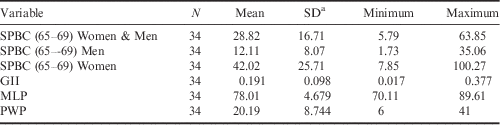
a Standard deviation.
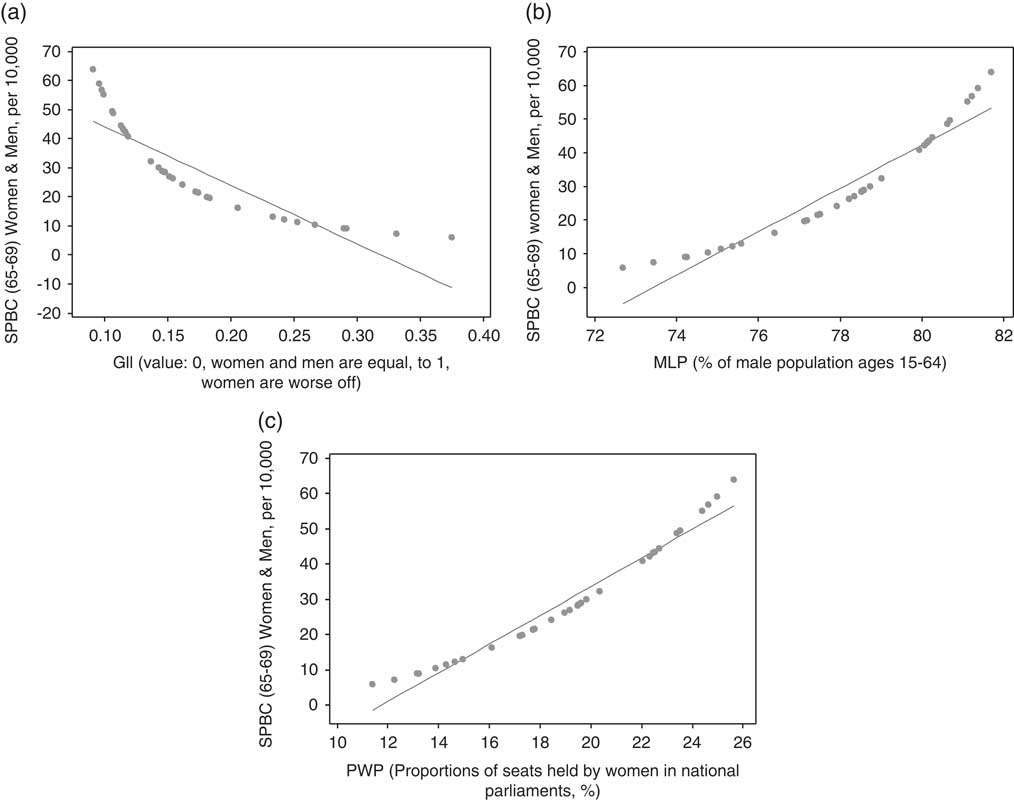
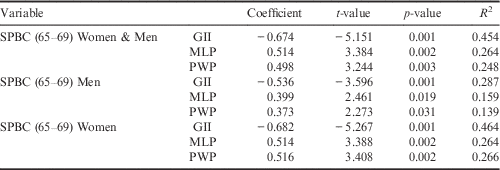
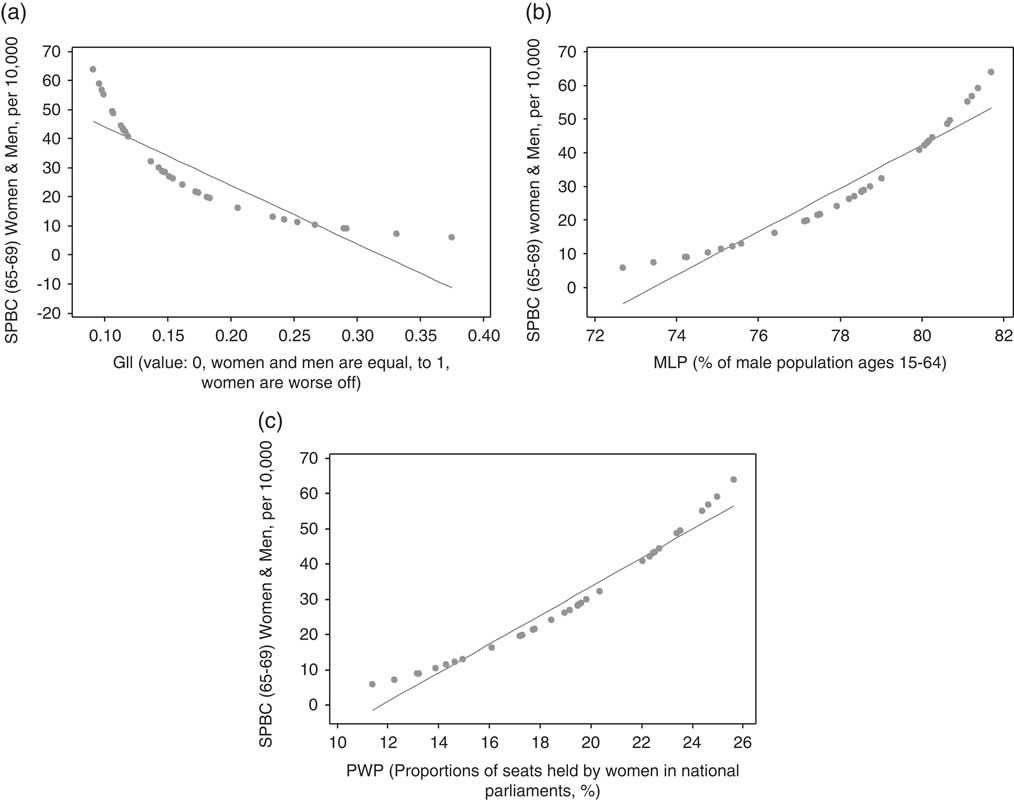
The results for the influence of GII, MLP and PWP on the SPBC (65–69) for the 34 studied European countries are presented in Table 2. Significant negative correlations were found between SPBC (65–69) for older adults (women and men) and GII (r=−0.674, p=0.001). Significant positive correlations were found between SPBC (65–69) and MLP (r=0.514, p=0.002) as well as for PWP (r=0.498, p=0.003). The relative ratios were also analysed on a log scale for all explanatory variables (Fig. 2).
Association of SPBC (65–69) for women and men (per 10,000 population) with: a) GII; b) MLP (%) and; c) PWP (%).
Univariate prediction variables for SPBC (65–69)
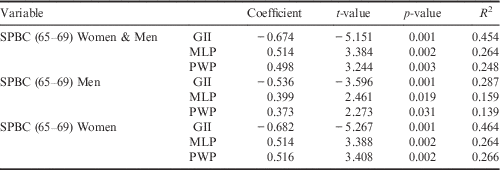
To investigate the direct relationships between SPBC (65–69) and socioeconomic indicators, multivariate regression analyses were conducted. The indicator GII was found to be the strongest predictor in the multivariate regression models, and overall the predictor variables had higher explanatory power for women than for men (Table 3). Finally, a model for predicting the SPBC (65–69) of older women was built that included lower GII and higher MLP and PWP as socioeconomic variables (R 2=0.520, p=0.001) in the multivariate regression models. It was found that the lower a country’s GII and higher its MLP and PWP, the greater its SPBC (65–69), indicating a significant influence of these country-level socioeconomic influences on the probability of older adults surviving to be centenarians.
Predicting SPBC (65–69) using multivariate regression models
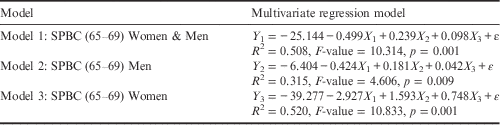
X 1=GII; X 2=MLP; X 3=PWP.
SPBC (65–69) is the survival probability of becoming a centenarian for those aged 65–69 (per 10,000); GII is gender inequality index (value: 0, women and men are equal, to 1, women are worse off); MLP is the male labour force participation rate (% of male population aged 15–64); and PWP is the proportion of seats held by women in national parliaments (%).
Discussion
Positive affect as a physiological function is associated with longevity (Steptoe et al., Reference Steptoe, O’Donnell, Marmot and Wardle2008), and men and women can benefit differently from social relationships because of cultural differences in gender roles. The structural aspects of social networks make a unique contribution to survival (Rodriguez-Laso et al., Reference Rodriguez-Laso, Zunzunegui and Otero2007), and the high chronic stress caused by gender inequality in social relationships is a negative affect that may be disadvantageous for health outcomes. Thus, longevity may be affected by gender inequality.
Although some older people have poor health and functioning upon reaching age 100, others are able to achieve exceptional longevity with relatively good health and functioning (Ailshire et al., Reference Ailshire, Beltrán-Sánchez and Crimmins2015), and good health levels are predictors of survival in centenarians (Mossakowska et al., Reference Mossakowska, Broczek, Wieczorowska-Tobis, Klich-Rączka, Jonas, Pawlik-Pachucka and Puzianowska-Kuznicka2014). The present study demonstrates the association of factors that affect country-level gender inequality with SPBC (65–69) among older adults in a macro view. Country-level gender inequality and quality of life may be associated with longevity. Lower health-related quality of life has been found to be associated with a significantly increased risk of mortality (Xie et al., Reference Xie, Laskowitz, Turner, Egger, Shi, Ren and Wu2014).
The present study investigated whether national differences in SPBC (65–69) were associated with country-level socioeconomic indicators of gender inequality. It was found that countries with higher SPBC (65–69) values had lower GII and higher MLP and PWP values, but only for older adults as a group rather than by gender. Lower SPBC (65–69) among older adults and high country-level GIIs and low MLP and PWP coincided with unequal international income distribution between wealthy and poor countries. Country-level GII, MLP and PWP levels have improved significantly over the years, but have not led to lower GIIs or higher MLP and PWP at the global level; disadvantages in gender equality, male labour force participation and women in parliaments are a primary source of inequality. Higher GII or lower MLP and PWP have been shown to have negative repercussions for individual development (Kim & Kim, Reference Kim and Kim2014b). It was hypothesized that the associations between SPBC (65–69) and country-level GII, MLP and PWP could predict successful ageing and productivity of centenarians in Europe.
The socioeconomic factors GII, MLP and PWP have been demonstrated to contribute to the quality of life of older adults (Barrientos et al., Reference Barrientos, Gorman and Heslop2003; Kabeer, Reference Kabeer2005; Backhans et al., Reference Backhans, Lundberg and Månsdotter2007; Rahi, Reference Rahi2011; Kim & Kim, Reference Kim and Kim2014b). For this reason, the current study was undertaken to explore the association of GII, MLP and PWP and SPBC (65–69) in European countries. Lower GII and higher MLP and PWP led to increased SPBC (65–69), suggesting that these factors are significant contributors to the survival probability of becoming a centenarian for those aged 65–69 in Europe (see Fig. 2). The Russian Federation had the highest GII and the Netherlands had the lowest, and Switzerland and Sweden had the highest MLP and PWP, whereas Serbia and Ukraine had the lowest; these findings reflect the highly variable SPBC (65–69) in Europe. As such, GII, MLP and PWP are likely to be major contributing factors to higher SPBC (65–69) in European countries and thus to reflect successful ageing.
The GII reflects women’s disadvantages in reproductive health, empowerment and the labour market, whereas PWP reflects women’s empowerment in gender equality (Kim & Kim, Reference Kim and Kim2014b). Gender equality is a central component of the process of democratization that encourages the expansion of women in public life (Inglehart et al., Reference Inglehart, Norris and Welzel2002). Empowering women will bring about changes in decision-making, which can lead to improved health and nutrition (Duflo, Reference Duflo2012). Moreover, given that individual psychosocial factors associated with longevity improve with gender equality (Fernández-Sáez et al., Reference Fernández-Sáez, Ruiz-Cantero, Guijarro-Garví, Carrasco-Portiño, Roca-Pérez, Chilet-Rosell and Álvarez-Dardet2013), reducing stress caused by this equality might have beneficial effects on the survival probability of becoming a centenarian among older adults, because reducing stress offers the potential for effective life prolongation and increased health (Johnson et al., Reference Johnson, de Castro, de Castro, Cypser, Henderson and Tedesco2001). Low stress as a health-related quality of life indicator can potentially empower older adults about their own health and ultimately improve it. Therefore, the socioeconomic indicators of gender equity and women’s empowerment appear to have important latent effects on the survival probability of becoming a centenarian among older adults in Europe.
Meanwhile, the MLP reflects men’s advantages in economically active populations and the country-level income that is necessary for the probability of surviving to become a centenarians (Kim & Kim, Reference Kim and Kim2015a, Reference Kim and Kimb). Furthermore, given that the economic factors associated with longevity improve with higher national income (Mackenbach & Looman, Reference Mackenbach and Looman2013), higher income countries will have a lower prevalence of frailty and people will tend to live longer (Theou et al., Reference Theou, Brothers, Rockwood, Haardt, Mitnitski and Rockwood2013). Countries with higher incomes and health expenditures have higher longevity among older adults because their decreased disease-related mortality is mainly attributable to higher national incomes (Mackenbach & Looman, Reference Mackenbach and Looman2013). Therefore, high country-level incomes and health expenditures appear to have important latent effects on the survival probability of becoming a centenarian among older adults in Europe.
However, in the present study, the SPBC (65–69) for older women had a higher mean value than that for men (roughly 3.46 times; see Table 1). Specifically, women’s SPBC (65–69) better predicted the influence of GII than did men’s (see Table 2). In addition, the GII for women had roughly 1.61 times the explanatory power than did the GII for men. This finding suggests that inequality-related stress is more meaningful for women and that reducing that stress might have greater beneficial effects on women’s survival probability of becoming centenarians than it will for men. It is expected that the GIIs in countries with high SPBC (65–69) will be lower because of the combination of greater advantages from gender equality and fewer social disadvantages.
The study’s limitations regarding the socioeconomic indicators were insufficient information on the time-serial data and country-level quality of life data. Some countries, particularly Russia and other Eastern European ex-communist countries, experienced radical societal changes in and around 1990, and the European parliaments had very different election years, which made it difficult to estimate the true GII, MLP and PWP scores for 1975 to 2010. To live a long life is good, but there is a subjective aspect to successful ageing; often as they age, older adults experience tremendous mental and physical pain, trauma and losses. However, this study examined the associations between SPBC (65–69) and country-level socioeconomic indicators in order to objectively predict successful ageing. The findings, however, might not apply to individuals in other population groups, which is a limitation of ecological studies. However, this problem also applies to other observational studies and randomized controlled trials (Kim & Kim, Reference Kim and Kim2015a).
In conclusion, the study hypothesis states that the associations between SPBC (65–69) and country-level socioeconomic indicators could predict successful ageing in a population. The models for women and men show that countries with lower GIIs and higher MLP and PWP had higher SPBC (65–69) values. Therefore, policy to improve country-level gender inequality, male labour force participation and proportions of women in parliaments should have latent effects on SPBC (65–69). In addition, one lesson from the experiences of the 34 countries is that country-level gender equality policies may decrease the risk of unhealthy old age and increase the probability of longevity in elders through greater national gender equality; disparities in GII and other country-level socioeconomic indicators impact longevity probability. Thus, the findings of this study could to be used to plan longevity strategies, and these should include targeting country-level gender inequality.
Acknowledgments
The authors would like to thank the reviewers for their valuable comments, which helped to improve this manuscript significantly.