Mortality in childhood from CHD has reduced markedly over recent decades owing to advances in surgical and intensive care management. As a result, morbidity metrics are increasingly important in evaluating the outcome of CHD treatment. Concurrently, increasing access to the internet and communication through social media has had an impact on how those affected by CHD seek information and manage their own healthcare. Online discussion among patients has begun to reveal common but under-reported issues that have an impact on daily living and may also indirectly influence healthcare outcomes.Reference Ronksley, Sanmartin and Quan 1 , Reference Ronksley, Sanmartin and Quan 2
Evidence from those living with cystic fibrosis suggests that online support enables young people and parents to share experiences of living with long-term conditions and thus develop expertise to empower them in interactions with healthcare professionals.Reference Kirk and Milnes 3 The understandable caution with which clinicians have approached social media has more recently been rivalled by the recognition of the opportunity to better understand the patient experience and thus focus efforts to improve outcomes.Reference George, Rovniak and Kraschnewski 4 , Reference Hall, Chen and Kao 5
In this study, we responded to anecdotal, but common, complaints of leg pains in children and young adults with CHD by carrying out a questionnaire investigating the key characteristics and circumstances of the pain, as well as methods used for alleviation.
Materials and methods
Study population
Little Hearts Matter is a United Kingdom-registered charity dedicated to supporting and enabling families of children and adults with a diagnosis of a single-ventricle heart conditions (www.lhm.org.uk). Through a shared Facebook site, the charity identified concerns among patients and their carers regarding the issue of leg pains. A questionnaire was devised by one of the authors (S.H.) in order to gain insight into the prevalence of their concerns. Participation was offered to all members (3200) of the Little Hearts Matter support group through their social media sites and disseminated to other congenital cardiac charities. The study was also publicised in paediatric outpatient settings, allowing others with CHD, who were not members of Little Hearts Matter, to participate.
Survey design
The survey contained questions on general demographic information, diagnosis, medications, comorbidities, diet, and activity. Specific questions addressed the nature of leg pains and exacerbating and relieving factors. Questions were also asked regarding siblings, including whether they experienced leg pains. The survey questions are available in the Supplementary Table 1. The survey was performed using the SurveyMonkey web tool (https://www.surveymonkey.net) and results were collated by S.H. before being passed in fully anonymised form to the remaining authors for analysis.
Ethical approval
As the survey was initiated, developed, and administered by the Little Hearts Matter patient group (S.H.) and analysis was limited to data provided without patient-identifiable information, ethical approval was not required. This study was reviewed and the non-requirement for approval by a National Health Service Research Ethics Committee was confirmed by the chair of North East – Tyne & Wear South Research Ethics committee.
Statistics
Data are presented numerically and also as a percentage of the stated denominator. Associations were tested using χ2 or Fisher’s exact tests. When assessing the association between precipitating factors and methods of alleviating pain, p values were corrected using the sequential Bonferroni method and ϕ reported to reflect the degree of association. Data were analysed in SPSSv.24, with p<0.05 considered statistically significant.
Results
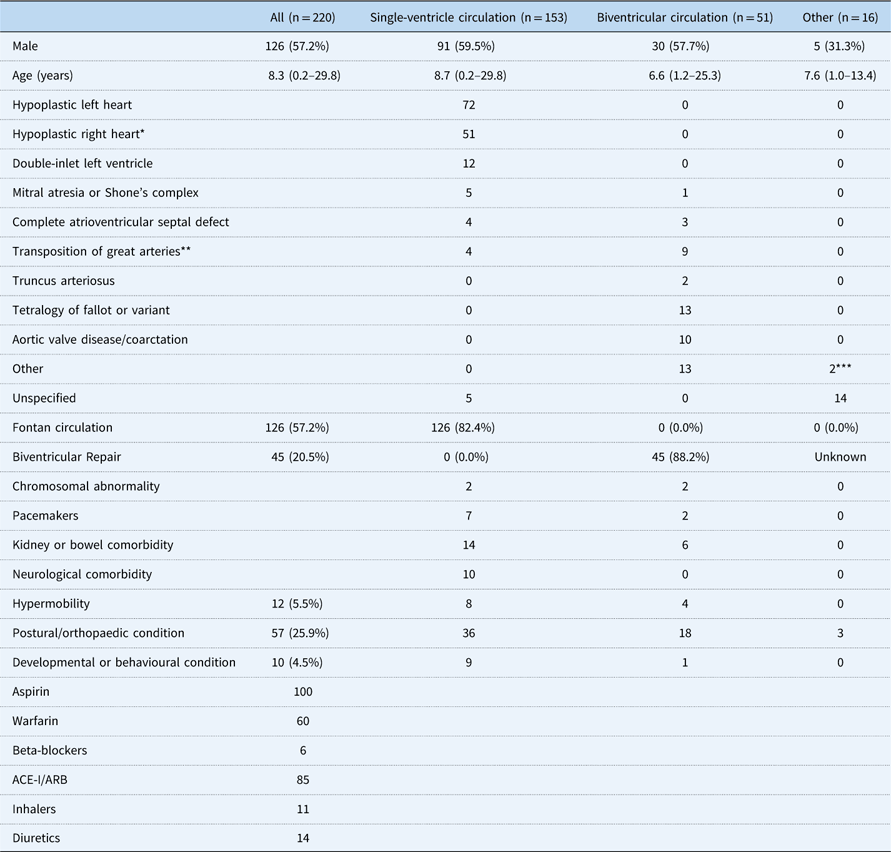
A total of 220 respondents, of whom 57.4% were male, with a mean age of 8.3 years (0.2–29.8), completed the survey. Although parents and carers often completed the survey on behalf of the patient, the subject of the survey is described as the respondent in the resulting analysis. Demographic and diagnostic details are shown in Table 1.
Demographic details, diagnosis, comorbidities, and medications.

ACE-I = angiotensin converting enzyme inhibitor; ARB = angiotensin receptor blocker
* Including tricuspid atresia and pulmonary atresia
** Including simple and complex forms and congenitally corrected
*** Including hypoplastic left heart syndrome with heart transplant, and Ebstein with Glenn shunt
The response rate was >90% for 14/16 questions, and all questions had a response rate >80%. The survey was available for 1 year; however, the majority of responses occurred within the first 3 months.
Description and impact of leg pains
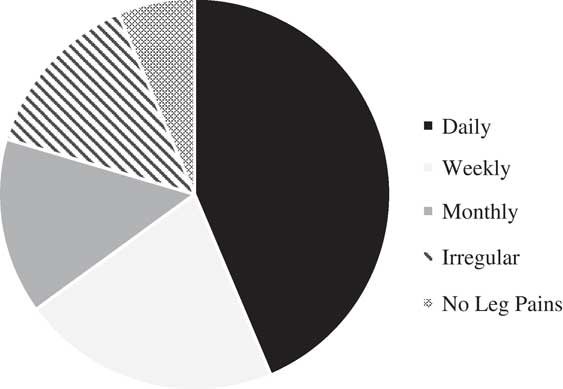
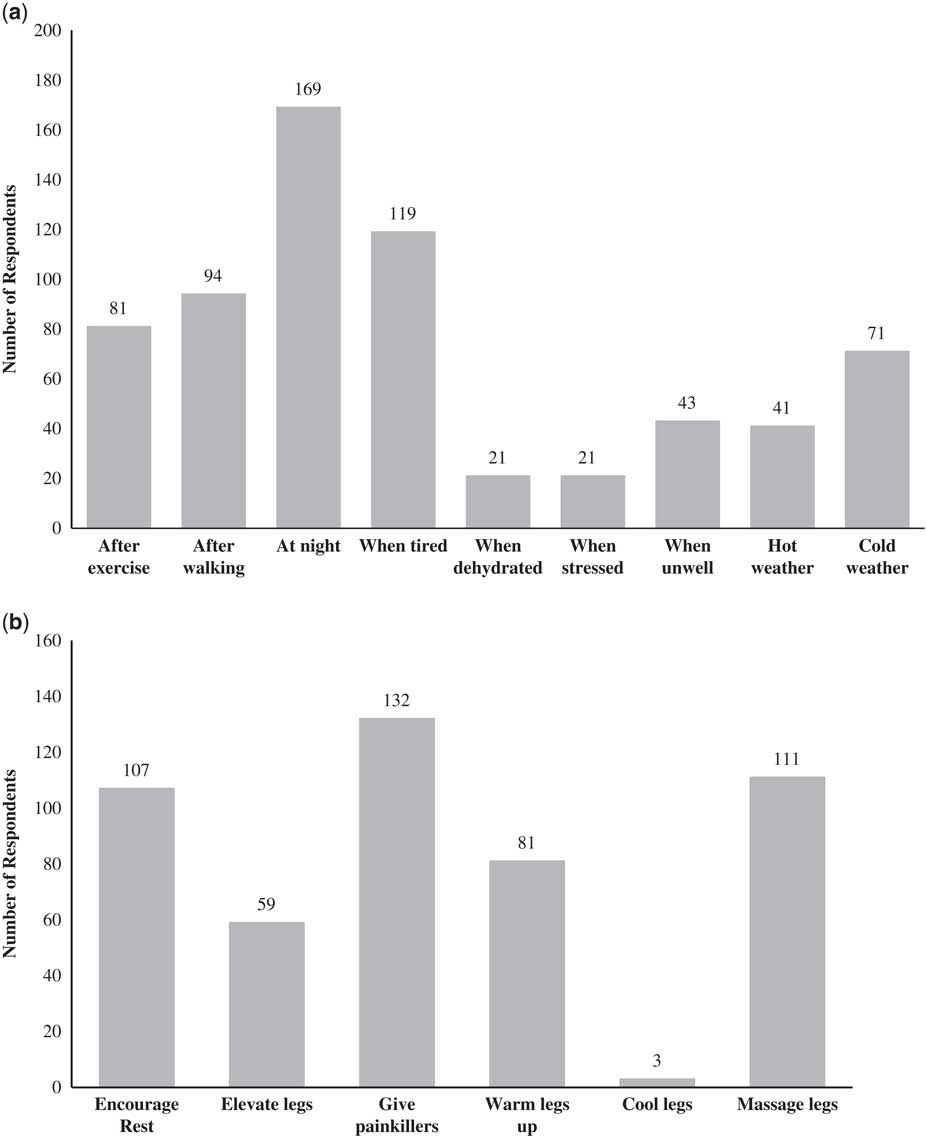
In all, 206/220 (93.6%) survey respondents reported leg pain. The frequency of leg pains and precipitating factors are shown in Figures 1 and 2a. Each respondent identified a median of three out of nine precipitatory factors, with an inter-quartile range of zero to four). The majority of affected respondents experienced leg pains nocturnally (169/206, 82.0%) – a feature consistent with “growing pains” of childhood.Reference Peterson 6 Other features consistent with growing pains were an association with day-time activity and an intermittent course. The location of the pain was typically bilateral and involved the lower legs including knees, shins, and muscles, but not thighs, hips, or toes. A range of phrases were used by respondents to describe the pains, including “cramps”, “tightening”, or “aches”. Importantly, however, respondents mainly used the word “pain” itself to describe their symptoms, with just under half (101/206, 49.0%) reporting associated crying or screaming.
Frequency of leg pain in respondents.

(a) Factors precipitating leg pains and (b) methods used to alleviate leg pains.

The methods used to alleviate pains are depicted in Figure 2b: analgesia (132/206, 64.1%), massage (111/206, 53.9%), and rest (107/206, 51.2%) were the most frequently used options. Improvement with resting was significantly associated with pain occurring after walking (ϕ = 0.277), brought on by stress (ϕ =0.260), and with pain occurring while unwell (ϕ = 0.279). Relief with elevation (ϕ=0.248) was also associated with pain brought on by stress, whereas relief with warming was associated with pain occurring in response to cold (ϕ =0.294). It is interesting that the strongest significant association was seen between nocturnal pain and relief with painkillers (ϕ =0.335). Nocturnal pain was also associated with relief with massage (ϕ =0.276).
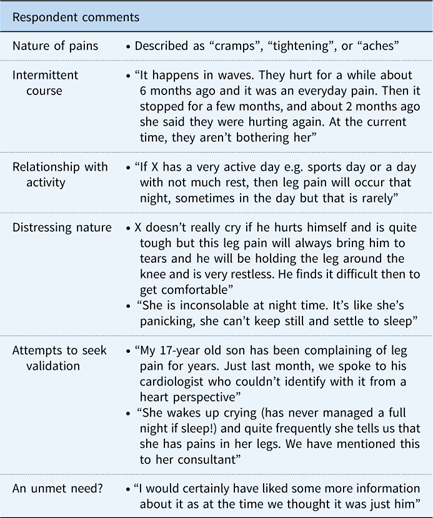
Respondents also described their attempts to seek validation of these symptoms and the lack of available information to them. The nature and impact of leg pains is reflected in free text comments made by individual respondents (Table 2). A small number of respondents (8/206, 38.8%) described organic features of pain including limping, knee swelling, and unilateral symptoms. A total of 170 respondents reported having siblings, although only 107 (62.9%) provided information as to the presence or absence of leg pains. Leg pains were more frequently reported in respondents than their generally healthy siblings (32/107, 29.9%, p<0.001).
Respondent comments reflecting nature of leg pains and their impact on the patient and family.

Associations of leg pains with other factors
There was no gender bias in the reporting of leg pains – 94.6% were females and 92.9% were male, with p=0.60 – or the frequency at which they occurred (p=0.57). Although there was no relationship between reported leg pain and age, older respondents were more likely to associate leg pains with times when they felt stressed (p=0.02) and at night (p=0.05). Frequency of pains did not differ significantly between groups (p=0.28). Individuals taking aspirin were more likely to report leg pains (98.2 versus 89.0%; p=0.01). In all, 48% (105/220) of respondents described themselves as active either outdoors or indoors, whereas 51.8% (114/220) reported reduced levels of activity, with five being wheelchair-bound. Those who were more active were more likely to have frequent leg pains – more than once a week (50.0 versus 37.1%, p=0.04).
In all, 69/220 (31.4%) described hypermobility, postural, or orthopaedic defects – including flat feet, high arches, talipes, hypochondroplasia, or scoliosis. All respondents with hypermobility (n=12) reported leg pains. Individuals with hypermobility reported pain predominantly after exercise as is typical in this condition (n=9, p=0.011), and in hot weather (p=0.019). Leg pains were not more prevalent in those with orthopaedic or postural issues.
Discussion
This is the first study to report leg pains in children and young people with CHD. Using an online survey, 93.6% respondents reported having leg pains, which was significantly higher than that reported in their generally healthy siblings (29.9%). The majority experienced pains nocturnally or when tired, and most of them alleviated symptoms with painkillers or massage.
Although reported pains are likely to reflect a mixture of aetiologies, the dominant features, such as nocturnal occurrence, intermittent nature, and focus in knees and calves, share clear similarities with benign childhood “growing pains”.Reference Peterson 6 “Growing pains” are a clinical diagnosis made when other potentially serious causes are excluded. Persistence of symptoms, presence of joint involvement, systemic features, limping, or abnormalities on examination or investigation should alert the clinician to other diagnoses.Reference Mohanta 7 Although the condition is self-limiting and the acknowledged prognosis benign, symptoms can be highly distressing. The precise cause remains poorly understood. Various mechanisms are proposed and associations with obesity, orthopaedic factors such as flat feet, reduced bone strength, lowered pain thresholds, and psychosocial factors are documented.Reference Hawksley 8 – Reference Naish and Apley 13 Positive family history and suggested overlap with restless legs syndrome also indicate a possible genetic component.Reference Evans, Scutter, Lang and Dansie 10 , Reference Walters, Gabelia and Frauscher 14 Treatment with vitamin D supplementation, in a small Italian cohort study of healthy 5–11-year-olds, and efficacy of a twice-daily muscle stretching programme, in a small Canadian unblinded randomised controlled trial in 5–14-year-old healthy children, have suggested benefit in relieving symptoms.Reference Morandi, Maines and Piona 15 , Reference Baxter and Dulberg 16
In our selected cohort with CHD, leg pains occurred more often than in their generally healthy siblings. Skeletal muscle and bone deficits, as well as vitamin D deficiency, have been observed in patients post Fontan completion, a dominant component group among respondents, and may therefore be implicated in the aetiology of their leg pains.Reference Avitabile, Leonard and Zemel 17 , Reference Avitabile, Goldberg and Zemel 18 Patients with Fontan completion understandably report reduced quality of life; however, little work has been done to elucidate the effects of this on pain thresholds and reporting of symptoms.Reference Uzark, Zak and Shrader 19 Progress in CHD has been measured by stepwise improvements in survival. At present, most children born with these conditions are expected to survive into adulthood, and focus has shifted to functional capacity, morbidity, and quality of life as outcome measures. Although questionnaires such as PEDSQL, PCQLI, SF 36, and ConQol are validated and may provide useful information, these mainly explore areas defined by clinicians, although PCQLI does include some patient-defined measures.Reference Macran, Birks and Parsons 20 – Reference Marino, Shera and Wernovsky 22 Patients use social media and join online health communities to complement rather than bypass healthcare professionals, fulfilling unmet needs including informational and network support, as well as emotional expression or social comparison.Reference Kirk and Milnes 3 , Reference Smailhodzic, Hooijsma, Boonstra and Langley 23 The relationship with the healthcare professional is generally viewed by patients as a clinical one, where the professional provides expertise and treatment based on medical knowledge, but not first-hand experience.Reference Smailhodzic, Hooijsma, Boonstra and Langley 23 , Reference Colineau and Paris 24 Although patient groups can offer practical and emotional support between patients with similar experience, which is more difficult to provide in the traditional medical setting, support may be limited if problems and potential solutions are not recognised and addressed by clinicians.
In this study, the poorly documented yet clearly distressing symptom of leg pain was identified by Little Hearts Matter from their patient base, and a larger survey was undertaken. Although limitations (see below) exist for this type of data, the results can direct researchers to investigate new areas of unmet need, which may be of growing importance to patients as issues of mortality and morbidity are addressed. However, focused efforts are required to validate patient-reported outcome tools relevant to this population to facilitate this. Better education of CHD healthcare professionals in the patient experience could also help alleviate perceived contradictions with scientific knowledge, which in other domains has been a recognised source of distress to patients, resulting in detrimental consequences.Reference Koschack, Weibezahl, Friede, Himmel, Makedonski and Grabowski 25
This study suffers from reporting bias, as it is likely that individuals with leg pains were more likely to respond to a questionnaire on this subject than those without. Parents and carers responding on behalf of their children may also influence reporting rate. Although we cannot provide exact numbers, it is apparent that around 90% of respondents were parents or carers responding on behalf of their child. Discrepancies in patient and parent reporting of quality-of-life issues are recognised and may reflect differences in illness perception.Reference Eiser and Varni 26 It is interesting that in a few cases parents reported leg pains in young babies, where it may be difficult to conceive how this symptom could be expressed. This may reflect unaddressed needs in the carers, as well as the physical symptoms of the child. Nevertheless, the difference seen between patients and their healthy siblings, whose rate of leg pains was consistent with that reported in normal children, suggests that this condition is more common in those with CHD, although admittedly the age of the siblings is unknown and sibling data were incomplete.Reference Mohanta 7 The overall response rate as a proportion of Little Hearts Matter members may be interpreted to be low, but it is likely that not all Little Hearts Matter members engage with the social media sites through which it was publicised. Further, because of the methodology used, it is not possible to be completely certain how many potential respondents there were. It would be important to repeat the survey, or a modified version, in another CHD population to validate the results. However, nearly everyone had leg pains, and thus there was low statistical power to analyse associations. In addition, we tested multiple associations in this study, and therefore there is an increased risk of type I errors. It is evident, for example, that participants report several precipitatory factors each for their leg pains; elucidating the contribution of each is likely to require both more detailed questioning and larger sample populations than available in the present study.
It is also the case that not all leg pains should necessarily be attributed to “growing pains”, as this was not a validated questionnaire, rather a survey designed by a patient group to address their members’ needs. Other limitations to the results reported are that comorbidities in this population are likely to be under-reported as, although members of this group are typically well-educated about their condition, lay understanding or description of medical terms may be restricted. Equally, a degree of subjective interpretation has had to be applied by the investigators to permit the responses to be analysed using statistical methods. In addition, more refined open questions could have enhanced the richness of the qualitative data set obtained with respect to the nature of the leg pains.
Leg pains are an under-recognised, distressing symptom for patients with CHD and are reported more frequently than in their generally healthy siblings. It would be interesting to know how leg pains have an impact on the quality of life, participation in sports and school, and to understand whether and how medical and surgical intervention may influence their manifestation. This requires further investigation and offers an important example of how patient experiential knowledge can identify new areas for research and thus address perceived inconsistencies with existing medical knowledge.
Acknowledgements
Little Hearts Matter thanks charity members and friends of the organisation for raising concerns about leg pains and for taking part in the survey. The charity also thanks the Cardiovascular Research team at Newcastle University for their support of the project and their dedicated analysis of the survey’s data.
Financial Support
This research received no specific grant from any funding agency or from commercial or not-for-profit sectors.
Conflicts of Interest
Dr David Crossland is a Medical Advisor to Little Hearts Matter.
Ethical Standards
Analysis of data was carried out by Newcastle University as a contracted service provider on behalf of the charity Little Hearts Matter. All data shared were fully anonymised. These arrangements were approved by the Chairman of North East – Tyne & Wear South NHS REC and further ethical approval was not required.
Supplementary material
To view supplementary material for this article, please visit https://doi.org/10.1017/S104795111800094X