Introduction
Seed germination is thought to be under the control of complex environmental cues, which affect expression of specific sets of genes. This process is regulated by plant hormones and at the level of transcription (Hubbard et al., Reference Hubbard, Nishimura, Hitomi, Getzoff and Schroeder2010) and translation (Holdsworth et al., Reference Holdsworth, Finch-Savage, Grappin and Job2008). In maize (Zea mays L.), gene expression at the very first stages of germination is supported exclusively by the pool of stored mRNAs in the embryonic axes (Sanchez de Jimenez and Aguilar, Reference Sanchez de Jimenez and Aguilar1984). This pool mainly contains transcripts that are required for seed germination. At subsequent germination stages, other mRNAs are synthesized to complete root emergence. The stored or newly transcribed mRNA pools are selectively translated in terms of timing (Sanchez de Jimenez and Aguilar, Reference Sanchez de Jimenez and Aguilar1984).
The translation is mainly controlled at the initiation step and by the cap (m7GpppN, where N is any nucleotide)-binding protein eIF4E (Fischer, Reference Fischer2009; Van Der Kelen et al., Reference Van Der Kelen, Beyaert, Inze and De Veylder2009). The interaction between eIF4E and the platform protein eIF4G allows formation of eIF4F complex that recruits other translation initiation factors and the 40S ribosomal subunit to the 5′ end of the mRNA to initiate scanning toward the first AUG codon (Pestova et al., Reference Pestova, Lorsch, Hellen, Mathews, Sonenberg and Hershey2007). The regulation of eIF4E in animals is mediated by inhibitory proteins that bind to the same region recognized by eIF4G and by eIF4E transcription (Fischer, Reference Fischer2009). The interaction between eIF4E and eIF4G is mediated by a motif (YXXXXLΦ, where X is any amino acid and Φ is any hydrophobic residue) in eIF4G, which is also shared by inhibitory eIF4E-binding proteins. Particularly, a group of proteins termed 4E-BP sequester eIF4E preventing formation of the eIF4F complex and inhibiting cap-dependent translation, depending on cellular growth conditions (Pause et al., Reference Pause, Belsham, Gingras, Donze, Lin, Lawrence and Sonenberg1994). The YXXXXLΦ sequence is also present in other proteins that interact with eIF4E and regulate translation initiation, nucleo-cytoplasmic shuttling or stability of particular mRNAs (Sonenberg and Hinnebusch, Reference Sonenberg and Hinnebusch2007; Volpon et al., Reference Volpon, Osborne, Capul, de la Torre and Borden2010).
The general features of translation are similar in all eukaryotes. However, the regulation of initiation factors in plants differs from that in animals and yeast in several aspects (Browning, Reference Browning2004). Plants contain at least two different cap-binding complexes: eIF4F and eIF(iso)4F, formed by eIF4G/eIF4E and eIF(iso)4G/eIF(iso)4E, respectively. Contrary to animals, 4E-BPs have not been found in plants, although two reports have shown that plant proteins, which are different from eIF4G, are able to interact with either eIF(iso)4E or eIF4E (Freire et al., Reference Freire, Tourneur, Granier, Camonis, El Amrani, Browning and Robaglia2000; Freire, Reference Freire2005). Whether they function in eIF4E regulation remains unknown.
In vitro studies support eIF4F and eIF(iso)4F selectivity in cap-binding and their mRNA structure preference (Carberry and Goss, Reference Carberry and Goss1991; Mayberry et al., Reference Mayberry, Allen, Dennis and Browning2009). However, studies in several plant species indicate that single mutants lacking either of eIF4E or eIF(iso)4E are viable and display no obvious phenotype, except for enhanced resistance to specific viral infection (Robaglia and Caranta, Reference Robaglia and Caranta2006). eIF4E and eIF(iso)4E are differentially expressed in different plant tissues (Rodriguez et al., Reference Rodriguez, Freire, Camilleri and Robaglia1998) and during seed germination (Dinkova and Sanchez de Jimenez, Reference Dinkova and Sanchez de Jimenez1999). An important question is whether eIF4E and eIF(iso)4E perform a particular selective role in translation regulation during development or under particular conditions, or their presence in plants is a simple matter of redundancy.
Our previous study revealed that eIF(iso)4E was more abundant than eIF4E at both protein and mRNA levels during maize seed germination, whereas eIF4E expression and accumulation started a few hours before the completion of germination (Dinkova and Sanchez de Jimenez, Reference Dinkova and Sanchez de Jimenez1999). Furthermore, the translation of eIF(iso)4E, but not eIF4E, is selectively up-regulated in maize through a signal transduction pathway stimulated by insulin or insulin-like growth factors (Dinkova et al., Reference Dinkova, Reyes de la Cruz, Garcia-Flores, Aguilar, Jimenez-Garcia and Sanchez de Jimenez2007). In the present study, we investigated the function of the plant eIF4E and eIF(iso)4E proteins particularly on selective mRNA translation during maize germination.
Materials and methods
Plant materials
Maize (Zea mays L.) caryopses (called ‘seeds’ hereafter) of a Mexican landrace Tuxpeño, var. Chalqueño were used for all experiments. Seeds were imbibed on moist cotton in the dark at 25°C in an incubator. Embryonic axes were excised manually from dry or 24-h-imbibed seeds and were used for protein and RNA extraction.
Native eIF4F complex purification
Cap-binding complexes were purified by m7GTP-Sepharose affinity chromatography as previously reported (Dinkova and Sanchez de Jimenez, Reference Dinkova and Sanchez de Jimenez1999), with some modifications. Briefly, 2.5 g of axes were macerated in liquid nitrogen and suspended in 25 ml Buffer A containing 20 mM HEPES, pH 7.6, 100 mM KCl, 0.2 mM EDTA, 10% (v/v) glycerol, 0.1% (v/v) Triton X-100, 0.5 mM dithiothreitol (DTT) and EDTA-free protease inhibitors (Complete™, Roche Molecular Diagnostics, Pleasanton, California, USA). The extract was clarified by centrifugation at 24,000 g and 4°C in a Sorvall J-20 rotor for 30 min. The supernatant was filtered through eight layers of cheesecloth and incubated with 0.5 ml of m7GTP-Sepharose (GE Healthcare Bio-Sciences AB, Uppsala, Sweden) for 1 h at 4°C. The slurry was poured on to a 10 ml Column (Bio-Rad Laboratories, Inc., Hercules, California, USA) and the resin was washed with 5 ml of Buffer A, followed by 5 ml of Buffer A including 0.1 mM guanosine triphosphate (GTP). The bound proteins were eluted with 1 ml of Buffer A containing 0.5 M KCl.
Recombinant eIF4E and eIF(iso)4E expression and purification
The open reading frames of the maize eIF4E and eIF(iso)4E (AF076954 and AF076955) were expressed as gluthatione S-transferase (GST) fusion proteins in Escherichia coli BL-21(DE3)pLysS (Invitrogen Corp., Carlsbad, California, USA). Protein expression was induced with 0.25 mM isopropyl-β-d-thiogalactopyranoside for 3 h at 28°C. Cells were recovered by centrifugation at 5000 g for 10 min and stored at − 70°C until needed. Unfrozen cells were washed in 1 × phosphate-saline buffer (PBS) containing 137 mM NaCl, 2.7 mM KCl, 100 mM Na2HPO4 and 2 mM KH2PO4, and lysed by sonication (0550 Sonic Dismembranator, Fisher Scientific International, Inc., Pitsburg Pennsylvania, USA) for 20 s at 30 kHz in 20 mM HEPES buffer containing 0.1 mM EDTA, 20% (v/v) glycerol, 1 mM DTT, 1 mM phenylmethanesulphonyl fluoride (PMSF) and Complete™ EDTA-free protease inhibitors. Triton X-100 was added to the lysate to 1% (v/v), which was then incubated with gentle agitation for 30 min at 4°C. After centrifugation at 32,000 g, a clear supernatant was recovered and incubated with 1/50 volume of Glutathione-Sepharose 4B (GE Healthcare, Bio-Sciences) for 1 h at room temperature. The resin was washed with 50 volumes of PBS and the bound protein was eluted with one volume of 10 mM reduced glutathione in 50 mM Tris-HCl, pH 8.0. For some experiments, the GST tag of the recombinant proteins was removed by enzymatic cleavage with thrombine (GE Healthcare, Bio-Sciences). The digestion was performed while the fusion protein was bound to the Glutathione-Sepharose 4B resin, which was incubated with thrombine for 4 h at room temperature. Following incubation, the eluate containing the GST-free, recombinant eIF4E or eIF(iso)4E protein was recovered.
Electrophoresis and protein identification
Proteins from the native cap-binding complexes were resolved on 15% (w/v) SDS-PAGE gel, which was subject to silver staining. For immunodetection, proteins were blotted on to a polyvinylidene fluoride (PVDF) membrane (Millipore Corp., Billerica, Massachusetts, USA), which was blocked with 5% (w/v) milk and incubated with the primary antibody for 2 h at room temperature. After several washes in PBS, the membrane was incubated for 1 h with the appropriate secondary antibody at a 1:5000 dilution. Detection was performed with the Immobilon Western Chemiluminescent HRP Substrate (Millipore Corp.). The antisera against wheat eIF4F and eIF(iso)4F or against wheat eIF4E, eIF(iso)4E, eIF4G and eIF(iso)4G were kindly donated by Karen S. Browning, University of Texas, Austin, USA and were used at 1:5000 dilution.
RNA isolation
Total RNA was obtained from 0.4 g dry or 24-h-imbibed embryonic axes using TRIZOL (Invitrogen). Messenger RNAs were isolated from 1 mg total RNA with the PolyA Tract system (Promega Corp., Madison, Wisconsin, USA). The final mRNA solution was brought to 100 ng ml− 1 by vacuum concentration (SpeedVac, Labconco Corp., Kansas City, Michigan, USA).
In vitro translation
Wheat germ extract (WGE; Promega Corp.) was used in all in vitro translation experiments. Control translation reactions were set as recommended by the manufacturer. To obtain an extract of the endogenous cap-binding factors that are depleted (called ‘depleted WGE’ hereafter), the WGE was treated with an equal volume of m7GTP-Sepharose (GE Healthcare Bio-Sciences) for 30 min at 4°C with rotation. The depleted WGE was recovered as the supernatant by centrifugation at 1000 g for 3 min and used immediately. The activity of the purified, native cap-binding complexes from maize (see above) was added to the depleted WGE with 3.7 × 10⁶ Bq ml− 1 [35S]methionine (GE Healthcare Bio-Sciences) and 0.5 μg of mRNA in a 50-μl reaction, and tested for translational activity. For recombinant protein activity assay, depleted WGE was supplemented with 7.5 μg ml− 1 either of maize eIF4E or eIF(iso)4E factors. Triplicate translation reactions were performed at 25°C for different time points between 0 and 60 min. The counts per minute (cpm) of 1 μl reaction at each time point were obtained by 10% (w/v) trichloroacetic acid (TCA) protein precipitation on Glass Fiber Binder-free (GFC) filter paper circles (GE Healthcare Bio-Sciences). The GFC filter washes were performed as recommended by the in vitro translation system manufacturer (Promega Corp.). The counts obtained in a reaction without any RNA added (blank) were subtracted from counts in each sample. Results were statistically analysed for differences with the Student's t-test. Translation products from 60 min reactions were subjected to two-dimensional (2D) electrophoresis (O'Farrell, Reference O'Farrell1975). Labelled proteins were detected by autoradiography of dried gels. Differential spots between gels were obtained using the PDQuest software (Bio-Rad Laboratories).
Results
Maize recombinant eIF4E and eIF(iso)4E differentially assist translation of stored mRNAs
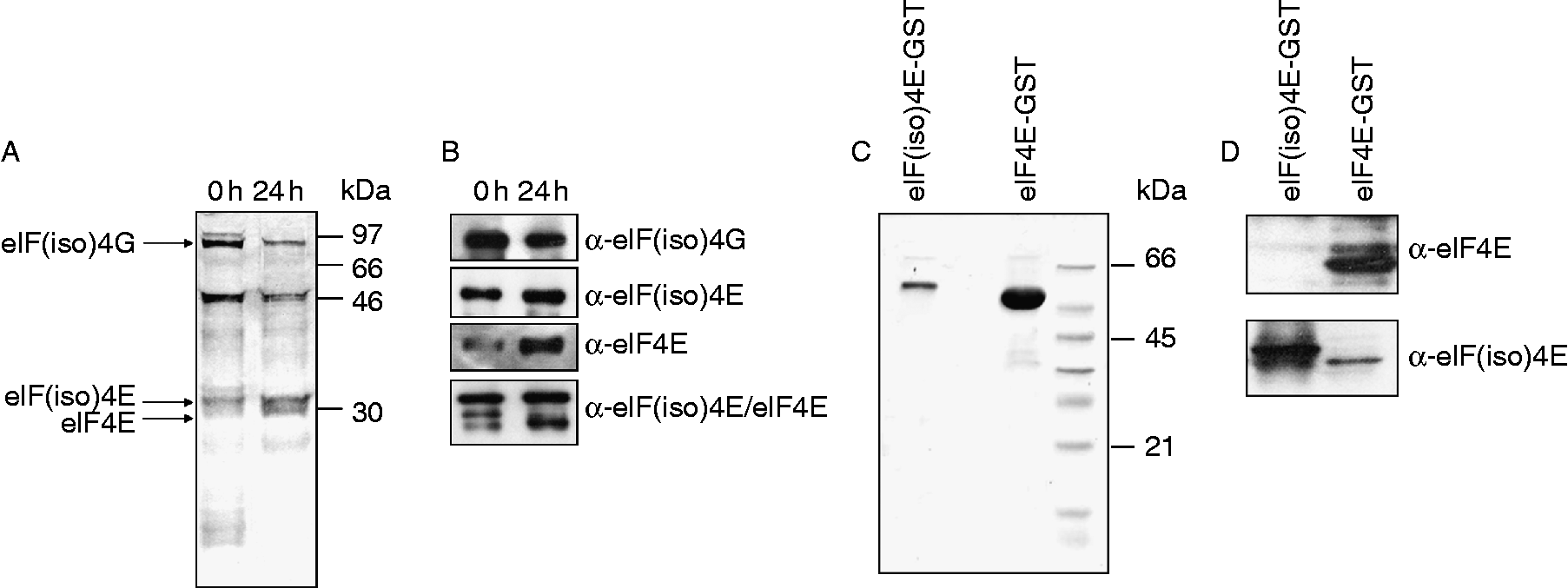
Maize cap-binding complexes contain different ratios of eIF(iso)4E and eIF4E proteins during seed germination (Dinkova and Sanchez de Jimenez, Reference Dinkova and Sanchez de Jimenez1999). Silver staining of cap-binding complexes resolved by SDS-PAGE indicated that eIF(iso)4E was more abundant than eIF4E in dry seeds, while they were present at similar levels in 24-h-imbibed seeds (Fig. 1A). The identity of each band detected by silver staining was confirmed by immunoblot with an antiserum against each protein or in a combination of antisera (Fig. 1B), and by mass spectrometry analysis (to be published elsewhere). To examine whether the greater abundance of eIF(iso)4E in dry seeds is relevant to some role of this protein, such as selective translation of stored mRNA in early germination, maize eIF4E and eIF(iso)4E were expressed as GST fusion proteins in bacteria and were characterized. The GST fusion proteins with predicted molecular masses (53 kDa and 56 kDa for eIF4E and eIF(iso)4E, respectively) were obtained (Fig. 1C). The identity of each protein was confirmed by immunoblot (Fig. 1D). The eIF(iso)4E recombinant protein was obtained in lesser quantity than that of eIF4E due to its solubility. However, the amount of purified soluble protein was sufficient for in vitro translation experiments.
Purified maize cap-binding complexes and recombinant eIF(iso)4E and eIF4E proteins. (A) Silver staining of the cap-binding complexes from dry (0 h) and 24-h-imbibed (24 h) maize embryonic axes. Protein extracts were applied to m7GTP-Sepharose and the bound fraction was eluted with 0.5 M KCl (cap-binding complexes). Each lane contained 20 μl of eluate. Arrows indicate proteins identified by immunoblots in (B). (B) Identification of cap-binding complex components for each germination stage, by Western blot using the indicated antibodies. A mixture of both eIF4E and eIF(iso)4E antibodies [α-eIF(iso)4E/eIF4E] allowed the simultaneous identification of these proteins to compare their levels during germination. (C) Coomassie blue staining of the purified recombinant maize eIF4E and eIF(iso)4E proteins which were expressed as carboxyl-terminal GST fusions in E. coli. (D) Identification of the recombinant eIF4E and eIF(iso)4E with an antiserum against each protein individually, by reciprocal hybridization of the same blot. Such identification allowed confirmation that the α-eIF4E did not hybridize with maize eIF(iso)4E, whereas the α-eIF(iso)4E reacts slightly with maize eIF4E.

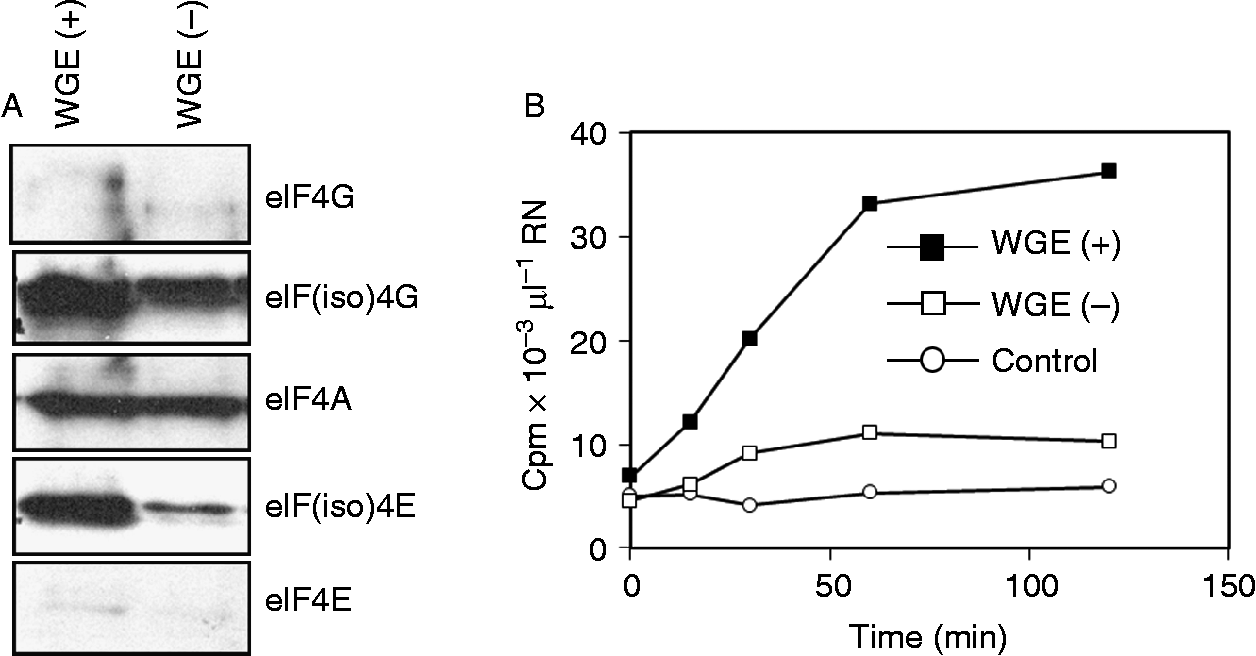
The native wheat eIF4E and eIF(iso)4E were depleted from WGE, to test the activity of each recombinant maize protein therein. Western blot was performed with specific antiserum against eIF4F and eIF(iso)4F complexes (Fig. 2A). In agreement with previous reports, the amount of endogenous eIF4E in WGE was very low compared to the amount of eIF(iso)4E (Fig. 2A), probably because the extract was obtained from wheat seeds at a quiescent stage (Browning et al., Reference Browning, Webster, Roberts and Ravel1992). The depletion procedure using the affinity chromatography efficiently removed eIF4E and reduced eIF(iso)4E to a very low level (Fig. 2A), The depletion procedure did not significantly affect the concentration of eIF4A, another component of the translation initiation complex, while it reduced eIF(iso)4G to some extent (Fig. 2A).
In vitro translational activity in wheat germ extracts (WGE) examined with stored mRNA from dry maize seeds. (A) Immunoblots of WGE which were non-depleted (+) or depleted ( − ) of the native wheat cap-binding complexes using an m7GTP-Sepharose affinity chromatography. Two microlitres of intact WGE (+) or supernatant from the chromatography ( − ) were analysed by immunoblot using the antiserum against wheat eIF4F or eIF(iso)4F complexes. The antiserum against eIF4F identified eIF4G, eIF4A and eIF4E, whereas the antiserum developed against eIF(iso)4F identified eIF(iso)4G, eIF4A and eIF(iso)4E. Each band was assigned according to the identification by the antisera and the molecular weight. (B) Time course of in vitro translational activity expressed as the incorporation of 35S-labelled methionine, using maize mRNAs obtained from dry axes. Counts (cpm) in the TCA-precipitated fraction from 1 μl reaction mix (RN) are presented. Intact WGE (+) or WGE depleted of the native wheat cap-binding complexes ( − ) were examined. A control reaction was intact WGE (+) without stored mRNA.

Translational activity in intact or depleted WGE was assayed using maize stored mRNAs wth different reaction periods at 25°C (Fig. 2B). A strong increase in the incorporation of [35S]methionine into the TCA-precipitated fraction was observed in intact WGE, while weak and little increase was observed in depleted WGE and control (intact WGE without stored RNA), respectively (Fig. 2B). The increase in intact WGE was linear over 60 min, suggesting an enzymatic translational activity without saturation over this period. Therefore, the incorporation of [35S]methionine after 60 min was monitored for further experiments.
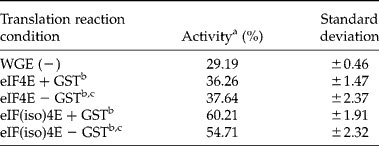
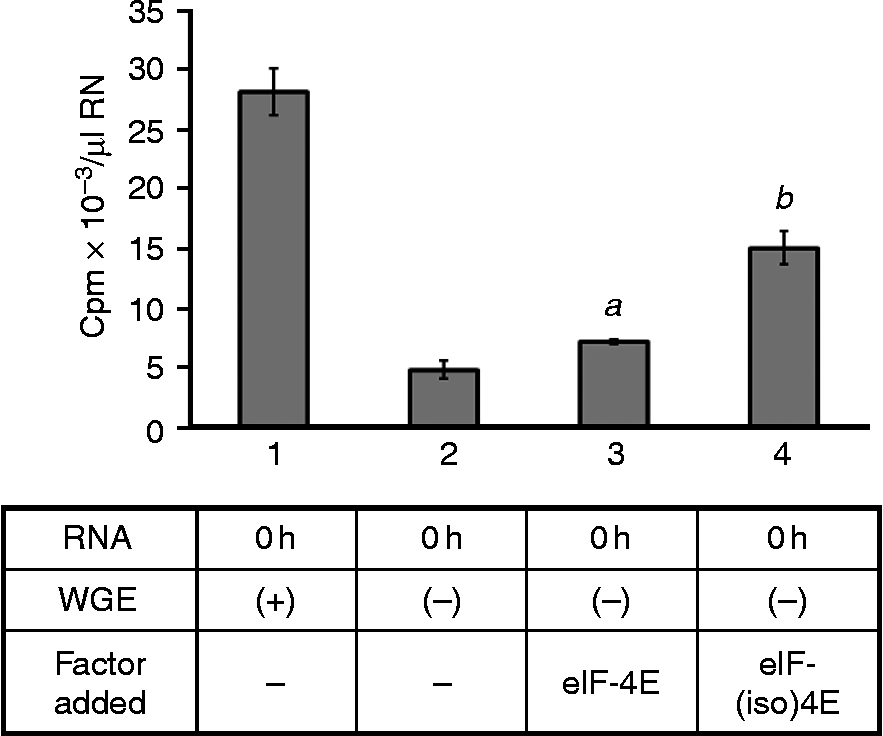
Preliminary experiments indicated that the activities of the recombinant maize eIF4E and eIF(iso)4E in depleted WGE did not differ before and after their cleavage from GST (Table 1). Therefore, the fusion proteins were used for further experiments. The translation of stored mRNA in the depleted system, based on the radioactivity incorporation into proteins, was about 17.1% of stored mRNA translation by the native WGE (Fig. 3). Addition of recombinant eIF4E slightly stimulated translation of stored mRNAs (25%, Fig. 3, lane 3). In contrast, addition of the same amount of eIF(iso)4E induced translation to a greater extent (52%, Fig. 3, lane 4). These data indicated that eIF(iso)4E preferentially stimulated the overall translation of stored mRNA in the maize embryonic axis.
In vitro translation activity of recombinant eIF4E and eIF(iso)4E with or without gluthatione S-transferase (GST) tag

a The activity was calculated monitoring the incorporation of radioactive methionine (cpm μl− 1) after 60 min in vitro translation with 10 ng of dry-seed mRNA. The value obtained for the intact wheat germ extract (WGE) was considered as 100%.
b Each factor was added to the WGE depleted of the wheat endogenous cap-binding factors [WGE( − )].
c The GST tag was removed by thrombine treatment during the affinity purification (see Materials and methods).
Activities of the recombinant maize eIF4E and eIF(iso)4E fused to GST on stored mRNA in in vitro translation. The activities of eIF(iso)4E and eIF4E were tested at 20 nM using WGE depleted of the native wheat cap-binding complexes ( − ). Translation was performed with 35S-labelled methionine and mRNAs obtained from dry axes at 10 μg ml− 1. TCA-precipitated counts (cpm) for 1 μl reaction mix (RN) are presented in the graph as a mean of three independent translation reactions. Bars represent standard deviation. The letters a and b indicate significant differences by t-test (P < 0.005). The table below indicates the composition for reactions 1–4.

To confirm the selectivity of recombinant eIF4E and eIF(iso)4E on stored mRNA translation, the in vitro translated products from the above experiment (Fig. 3) were resolved by 2D gels and the labelled protein patterns were compared (Fig. 4). In agreement with the previous results, the patterns in the presence of eIF(iso)4E were qualitatively different from those corresponding to eIF4E (Fig. 4A). Quantitative analysis revealed reproducible changes in the relative amount of certain proteins between eIF4E- and eIF(iso)-4E-stimulated translation. Some proteins were preferentially translated by eIF4E, whereas others were enhanced by eIF(iso)4E (circled in Fig. 4B). In addition, at least one spot was detected in the depleted WGE, which was also detected in the eIF4E or eIF(iso)4E samples (Fig. 4A, white triangle). This spot probably corresponds to a protein translated by a cap-independent mechanism. Overall, these data demonstrate that stored mRNAs are preferentially translated in the presence of eIF(iso)4E.
Selective activities of maize recombinant eIF(iso)4E and eIF4E on the in vitro translation of maize stored mRNAs. (A) The products from the translation reactions 1, 2, 3 and 4 in Fig. 3 were subjected to isoelectric focusing on pH 4–7 strips and then resolved by 12% SDS-PAGE. Fluorography of the gels is shown. White triangles indicate a spot differential to the native, WGE (+) translation reaction. (B) Detailed views of differentially labelled spots in the presence of recombinant eIF(iso)4E or eIF4E from the in vitro translation reactions. Circles indicate the spots preferentially labelled in the presence of eIF4E (left two columns) or eIF(iso)4E (right two columns). Autoradiographs were analysed with the PDQuest software (BioRad). Gels are representative of two independent experiments.

Differential translation of maize mRNAs from dry and 24-h-imbibed axes by the native cap-binding complexes
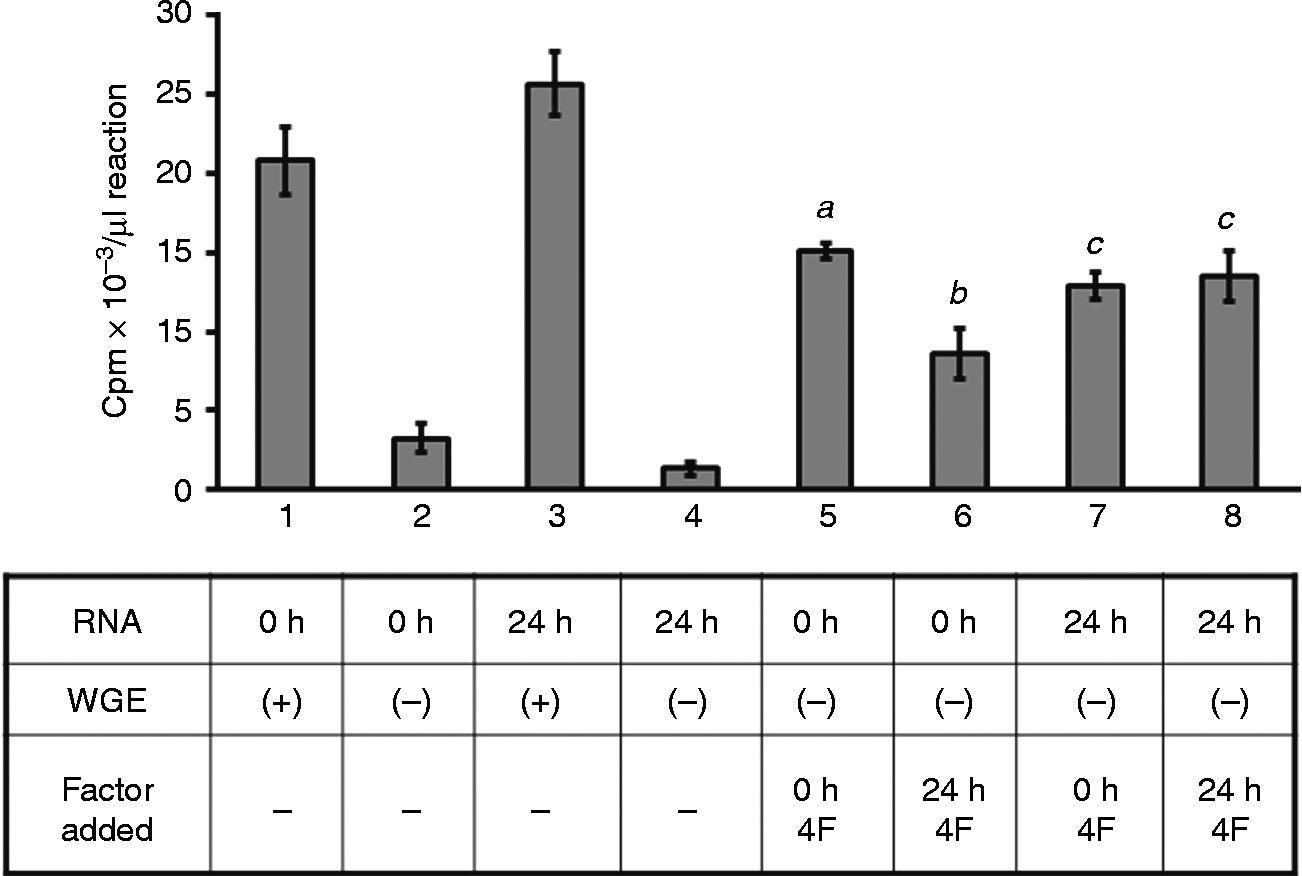
Considering the different ratios of eIF4E and eIF(iso)4E present in dry and imbibed maize embryonic axes (Fig. 1A), and the selective mRNA translation preference by eIF(iso)4E or eIF4E, we hypothesized that the increase in eIF4E protein level during germination might correspond to the translation needs of this factor for specific proteins required within this period. To test this hypothesis, the isolated cap-binding complexes [eIF4F/eIF(iso)4F] from dry and 24-h-imbibed seeds were assayed for their in vitro translation activities on mRNAs obtained from either stage. Both cap-binding complexes were able to stimulate translation of either stage of mRNA in the reconstitution experiments (Fig. 5, lanes 5–8). Compared to the translational activities in the native WGE on mRNA from dry axes (lane 1), the translational activities detected in the reconstitution experiments using the cap-binding complex from dry (lane 5, 0 h 4F) and imbibed (lane 6, 24 h 4F) axes were 72% and 41%, respectively. These radioactivity values were statistically different at P < 0.005 (a and b in lanes 5 and 6). On the other hand, the translational activities of the native cap-binding complex on mRNA from 24-h-imbibed axes were similar (around 52%) (lanes 7 and 8, both compared to lane 3). These results support the idea that translation of stored mRNAs is more dependent on a particular eIF(iso)4E/eIF4E ratio in the cap-binding complex than the 24-h-imbibed seed mRNA set.
Differential function of the cap-binding complexes from two distinct stages (dry and 24-h-imbibed seeds) in translation. The cap-binding complexes isolated from dry (0 h 4F) and 24-h-imbibed (24 h 4F) axes were tested with mRNAs obtained from each germination stage in WGE ( − ). Native, WGE (+) was used as positive control for each mRNA set. Activity is reported in the graph as mean of TCA-precipitable counts (cpm), for 1 μl reaction mix, from three independent experiments. Bars represent standard deviation. Columns labelled with a and b showed significant differences by t-test (P < 0.005), whereas those labelled with c did not show significant differences by the same analysis. The components of the reactions 1–8 are presented as a table under the graph.

To further examine whether particular mRNAs are selectively translated by the endogenous cap-binding complexes from the two distinct stages, the labelled proteins from the in vitro translation experiments were resolved by 2D-gel electrophoresis and autoradiography (Fig. 6A). Detailed analysis was performed focusing on gel regions devoid of smearing. Particular spots appeared exclusively, or at least more intensely labelled, in the presence of the native cap-binding complex from dry axes (Fig. 6B, left two columns). Likewise, a small number of spots were observed mostly in the presence of the cap-binding complex from 24-h-imbibed axes (Fig. 6B; right two columns). These results demonstrate that the cap-binding complexes present in the maize embryonic axis before and after hydration display different selectivity on specific mRNA translation.
Distinct translational patterns obtained from the native cap-binding complexes from dry or 24-h-imbibed seeds, using the 24-h-imbibed seed mRNA pool. (A) Products from the translation reactions identified as 4, 7 and 8 in Fig. 5 were subjected to isoelectric focusing on strips (pH 4–7) and then resolved by 12% SDS-PAGE. Autoradiography of the gels is shown. Labels of gels are as follows: WGE ( − ), reaction 4; 0 h 4F, reaction 7; and 24 h 4F, reaction 8. (B) Detailed views of spots differentially labelled in the presence of 0 h 4F or 24 h 4F in the in vitro translation reactions. Circles indicate the spots preferentially labelled in the presence of 0 h 4F (left two columns) or 24 h 4F (right two columns). Autoradiographs were analysed with the PDQuest software (BioRad).

Discussion
The presence of different members of the eIF4E family has intrigued researchers since their discovery (Rhoads, Reference Rhoads2009). Particular roles of plant eIF4E and eIF(iso)4E have been suggested through in vitro translation assays using a single mRNA (Carberry and Goss, Reference Carberry and Goss1991; Mayberry et al., Reference Mayberry, Allen, Dennis and Browning2009). However, in vivo studies with Arabidospsis thaliana mutants suggested partial redundancy for these two proteins (Duprat et al., Reference Duprat, Caranta, Revers, Menand, Browning and Robaglia2002). Many studies related to gene expression during seed germination have been performed in Arabidopsis or other dicot plants (Catusse et al., Reference Catusse, Job and Job2008; Holdsworth et al., Reference Holdsworth, Finch-Savage, Grappin and Job2008), whereas similar approaches in monocots are scarce. Particularly in maize, a set of stored mRNAs in the dry non-germinated seed has been shown to account for early germination translation, whereas both stored and de novo transcribed mRNAs are translated during late germination (18–24 h) (Sanchez de Jimenez and Aguilar, Reference Sanchez de Jimenez and Aguilar1984).
In the present work, we demonstrated that the cap-binding proteins eIF4E and eIF(iso)4E promoted selective translation of the mRNAs stored in the dry maize seeds. These mRNAs are mostly dependent on eIF(iso)4E (Figs 3 and 4B) although eIF4E also enhanced the translation of some proteins in the in vitro translation system (Fig. 4B), indicating the selectivity of each isoform on particular stored mRNAs. Indeed, the cap-binding complexes from two different germination stages (0 h and 24 h) clearly exhibited mRNA translation selectivity, when used in the translation of the mRNA pool present in the 24-h-imbibed axes (Fig. 6), even though the overall translational activity was similar to each other (Fig. 5). This result suggests that many of the newly synthesized transcripts during seed germination can be translated by either of the two cap-binding complexes, while a certain group among them would specifically require one of the two complexes.
Therefore, the cap-binding complex composition is relevant to the production of particular proteins at different germination stages. Upon seed imbibition, translation relies on the available, eIF(iso)4F-enriched cap-binding complex and stored mRNAs, whereas eIF(iso)4F-non-enriched, cap-binding complex become predominant following imbibition, which translates a set of de novo transcribed mRNAs. These data are in accordance with the complex composition found in the ungerminated seeds of cereal crops such as wheat and maize, where more accumulation of eIF(iso)4E and eIF(iso)4F than eIF4E and eIF4F was observed (Browning et al., Reference Browning, Webster, Roberts and Ravel1992; Dinkova and Sanchez de Jimenez, Reference Dinkova and Sanchez de Jimenez1999) (Fig. 1). Recently, a study on the Arabidopsis eIF(iso)4G [the partner of eIF(iso)4E in the eIF(iso)4F complex] was reported, revealing a role of this protein in plant development and germination (Lellis et al., Reference Lellis, Allen, Aertker, Tran, Hillis, Harbin, Caldwell, Gallie and Browning2010). This information further supports the results described here, since the effect of eIF(iso)4E on mRNA translation is exerted mostly through its interaction with eIF(iso)4G and the formation of a stable eIF(iso)4F complex to recruit other components of the translation machinery (Browning, Reference Browning2004).
Selective translation of seed-stored mRNAs has been known for many years, but the molecular mechanisms underlying this phenomenon were not completely understood. Extensive work on plant eIF4E and eIF(iso)4E and the corresponding eIF4F and eIF(iso)4F complexes revealed specific interaction with differentially methylated cap structures, RNA secondary structure preference, and in vitro translation enhancement of viral and cellular mRNAs (Carberry and Goss, Reference Carberry and Goss1991; Mayberry et al., Reference Mayberry, Allen, Dennis and Browning2009). However, in these studies, the activity of cap-binding proteins was tested separately on individual mRNA. In the present research, a similar question was approached in a more physiological context, where both complexes were present and the proportion between their components varied. Besides, translation activity was assayed with a pool of mRNAs in which individual transcripts have to compete for the translational machinery (Figs 4 and 6). Under such conditions, the selectivity for either a particular eIF4E isoform, or for the entire cap-binding complex from a particular germination stage, was demonstrated.
In agreement with the functional relevance demonstrated for the cap-binding complexes used in this study, there is a recent study in Arabidopsis thaliana cell suspension cultures revealing particular changes in the components of cap-binding complexes according to the cell proliferation stage (Bush et al., Reference Bush, Hutchins, Jones, Naldrett, Jarmolowski, Lloyd and Doonan2009). Therefore, we conclude that the greater abundance of eIF(iso)4E in non-germinated maize seeds is required to translate selectively the stored mRNA pool during early germination, whereas the increase of eIF4E in the cap-binding complex is most adequate for translation of mRNAs during late germination. Flexibility in eIF(iso)4E/eIF4E ratios in the cap-binding complexes of maize might provide adaptation to environmental changes or developmental stages for particular tissues, by modulating translation of specific mRNAs.
Acknowledgements
We thank Dr Karen Browning (University of Texas at Austin, Texas, USA), for antibodies against wheat eIF4E, eIF(iso)4E, eIF4G and eIF(iso)4G. We are also grateful to Dr Robert E. Rhoads (Louisiana State University – Health Sciences Centre at Shreveport, Louisiana, USA) for critical review of the manuscript and helpful suggestions. We acknowledge financial support from: Programa de Apoyo a Proyectos de Investigación e Innovación Tecnológica, México [IN204309 (to T.D.D), and IN212910 (to E.S.J.)] and Consejo Nacional de Ciencia y Tecnología, México [81708 (to T.D.D.)].