The lives of contemporary dancers and choreographers in Argentina are currently marked by the undeniable circumstances of precariousness. This condition is not just limited to modes of production characteristic of the contemporary dance scene, nor to the fairly low esteem in which artistic work is held by most of Argentinian society. Precariousness is actually a constitutive element of Argentinian contemporary dance from a historical and aesthetic point of view. It is the expression of an unfinished process of cultural modernization following European and American colonialist models. However, even if precariousness represents a constraint for artistic practice, it can also be subverted in and by artistic practice. This article explores precariousness through the analysis of three artistic interventions by members of the contemporary dance community in Buenos Aires. It explores the participation of dancers in political groups, which petition the state for an improvement of the working conditions of nonofficial dance artists. It examines how Marina Sarmiento's artistic research related to dance history stages a precarious body as an archive that deals with aesthetic colonialism. And lastly, it discusses the emergence of an aesthetics of precariousness in Fabian Gandini's work, which exposes precarious modes of production in dance and brings to the fore the importance of artistic ethics. These case studies touch upon issues of working conditions, history, and aesthetics. By way of this somewhat eclectic approach, I would like to stress that these three aspects of dance practice operate simultaneously and determine the way contemporary dance practice is conceived in the Argentinian context.
Impressions of Precariousness
Precariousness has become a common topic in the social sciences and humanities in recent years. Especially in the field of dance and performance studies, it has been theorized by authors like Randy Martin and Brazilian artist and scholar Eleonora Fabião. In the case of Randy Martin, he introduces the concept in his article “A precarious dance, a derivative sociality” (2012). There he explores the idea of the derivative as a social logic, which can be applied to the analysis of popular dance practices such as hip-hop. From his point of view, precariousness seems to have an unexpected positive consequence or derivative in the dissemination of political practices of self-production, self-organization, and self-representation. From a similar perspective, Eleonora Fabião, in her article “On Precariousness and Performance: 7 Actions for Rio de Janeiro” (Reference Fabião2010), explores precariousness as a conceptual tool and as an artistic working material. Rather than considering the lack of resources as a weakness, as something to be avoided according to the logic of capitalism, she proposes to valorize precariousness—to investigate its political force, its aesthetic potency, and its philosophical energy.
The theorization of precariousness offered here is of course influenced by these writings, even though my perception of the subject is to a certain degree less optimistic. My research has tried not to use a fully preconceived idea of precariousness; it rather endeavored to be attentive to the uses of this concept by individuals in the field of contemporary dance in Buenos Aires. Hence, considering different historical and philosophical sources, this article offers a conceptualization of precariousness from and for the Argentinian artistic periphery. First, the basic elements of an understanding of the concept will be introduced. Then I will try to show how the concept of precariousness can be used as a tool to analyze particular cases in the context of the Buenos Aires dance scene.
Definitions of Precariousness
The origin of the word “precarious” in English dates back to the seventeenth century. It shares a common root with the word prayer and means “obtained by entreaty,” which alludes to an earnest or humble request. The precarious is then originally related to a performance: the act of requesting something, and to a condition—the condition of indebtedness. Moreover, the precarium was a form of land tenure that existed in the late Roman Empire, in which a petitioner received a property for a specific amount of time without any change of ownership (Boudinhon Reference Boudinhon1911). It was a free gift made on request through which the grantor could reclaim the land and evict the grantee at any time. As a consequence, the grantee's hold on the land was said to be “precarious.” The idea of precariousness is originally related to a debt, to the condition of being indebted to someone else, and to have land (i.e., a field of work) that can be taken at any time.
This approach to the concept of precariousness could be strengthened by the ideas of the Italian sociologist Maurizio Lazzarato in his book The Making of the Indebted Man. There he asserts that “the neoliberal economy is a subjective economy,” which means that it is “an economy that solicits and produces processes of subjectivation” (Reference Lazzarato2012, 37). For Lazzarato, in this regard, the indebted man is the subjective figure of modern-day capitalism. Actually, Lazzarato's analysis of neoliberalism is inspired by Nietzsche's writings On the Genealogy of Morals ([Reference Nietzsche and Kaufmann1887] 1967). Nietzsche affirmed in that book, quoted by Lazzarato, that “the constitution of society and the domestication of man [results] from the relation between creditor and debtor” (Lazzarato Reference Lazzarato2012, 39), which represents the paradigm of social relations. As a consequence, the task of a community or society throughout history has been to engender a person capable of paying his or her debts. The promise of payment is then a condition inscribed in the body itself (Lazzarato Reference Lazzarato2012, 39–40). According to this approach, social order—or power—is originally conceived as a moral issue, and the precarious body could be defined basically as a morally indebted body.
Precariousness usually designates a situation of economic instability (Pewny Reference Pewny2011). It has a material substrate as the product of a material condition, but it also has an effect at an ontological level, generating a form of precarious subjectivity. Power is not only articulated by the economic structure that produces precariousness but also by a sociocultural environment that produces precarious subjectivities (i.e., subjects that accept precariousness as a constitutive element of their individuality). There is a reason for this acceptance at the individual level, a moral justification, and I contend it is the fact of feeling indebted to power. It is the subjective feeling of having an obligation to a superior authority. Consequently, subverting precariousness requires the denial of the condition of indebtedness that occasions it. The following case studies demonstrate three different modes of precariousness understood as outcomes of psychic and physical indebtedness.
Dance Activism in Buenos Aires
The debate about the idea of the dancer as a worker was initiated by the publication of the book The Work of Dance by Mark Franko (Reference Franko2002). In 2012, a special issue of Performance Research Journal, On Labour and Performance, edited by Gabriele Klein and Bojana Kunst (Reference Klein and Kunst2012), reintroduced the subject in the field of dance and performance studies, which was further developed by Kunst (Reference Kunst2015) and Rudi Laermans (2015). One of the issues involved in these discussions is the conception of the dancer as a sort of ideal example of a modern-day, post-Fordist worker (see also Martin Reference Martin2012; Kunst Reference Kunst2015), valued for his or her constant adaptability to new forms of production and to unstable employment. In post-Fordism there is potentially no difference between work and personal life. Ideally, workers are not supposed to conceive of working as something that they need to do to earn money; their work should fulfill them. It is evident that the way an artist visualizes his or her work fits perfectly in this scheme. The artist is the paradigm of the modern-day overexploited worker, which also implies mechanisms of self-exploitation (Vujanović Reference Vujanović, Siegmund and Hölscher2013, 191; Cvejić Reference Cvejić and Ribeiro2015, 72).
Nonetheless, a similar scheme of artistic production has existed in Argentina since the 1940s. According to Argentinian dance scholar Eugenia Cadús (Reference Cadús2018), the two main modes of dance production and work up to the present were established in that period. They are the official mode, typically associated with ballet and developed by state-sponsored theaters—such as the Teatro Colón—and the nonofficial mode—also known as independent—mostly associated with modern and contemporary dance, and developed through the freelance activity of dancers. During the 1940s, professional ballet dancers started to be employed as state workers, whereas modern dancers remained in a precarious working situation encouraged by a specific altruistic ideology. Nonofficial dancers usually accepted living on the margins of poverty or having a second job in order to support their artistic careers. They embodied a romantic archetype of the artist as someone who exists outside society, who does not expect to earn money, and who is only motivated by his or her devotion (Cadús Reference Cadús2018, 239). Therefore, in the Argentinian dance community, mechanisms of self-exploitation, which are characteristic of post-Fordism, merged with an already established tradition of self-sacrifice and a moral difficulty in visualizing dance as a career that deserves material reward. Essentially, the peripheral dancer feels indebted to society because his or her work is considered to be economically irrelevant—suffering actually constitutes a form of repayment.
Many authors think of precariousness as an element that characterizes not only the economy but also twenty-first-century culture. Isabell Lorey (Reference Lorey2015), for instance, affirms that precariousness is not an accident but a form of government. It is not an exception; it is the rule in our societies. As a consequence, the action of governing always involves negotiating the amount of precariousness that a given society is ready to endure without becoming ungovernable. According to Lorey, precariousness needs to be accepted as an intrinsic condition of our time, and political action should be articulated from precariousness. We should find new forms of association, new ways of resistance, and new modalities of organization of life in common.
Nonetheless, in the Argentinian context, there is another element that supplements precariousness. It is the exclusion considered as a socioeconomic and cultural phenomenon. Precariousness designates a situation of instability, whereas exclusion refers to the condition of being permanently excluded from the social and political system. Admittedly, exclusion is also a perennial and constitutive mark of modern-day societies.Footnote 1 Moreover, the situation of the excluded reveals another dimension of the problem because it highlights the mechanisms through which individuals become a politically visible and legitimate actor in a given context. During the 1990s in Argentina, the unemployed movement faced that challenge. In these years, Argentina faced unemployment levels of more than 20 percent, lacking any sort of unemployment benefits like the ones people have in Europe nowadays. The unemployed, in the context of economic depression, are not even in a precarious or instable situation but are excluded from society, because the labor market does not and will not have the capacity to incorporate them as workers, especially in the short- and medium-term.
As they did not have the right to organize a strike, the unemployed needed to find another way of protesting. If capitalism were defined as an endless movement of bodies (Lepecki Reference Lepecki2006), the unemployed form a body that is forced into stagnation. As the unemployed are forbidden to move, they can only protest by stopping the movement of the others. In the nineties in Argentina, picketing, an action of protest that consists in blocking the roads, was the only way the unemployed could have a voice in the political arena (see also Svampa and Pereyra Reference Svampa and Pereyra2003). Picketing was not an act of resistance but an act of existence. During that period in Argentina, the unemployed became political subjects through the choreopolitical Footnote 2 action of stopping the circulation of people and merchandise.
Apart from showing the importance of exclusion as a sociopolitical problem, the example of the unemployed movement allows us to understand the role of the dancer's political activism in relation to past struggles, mostly after 2001. As stated by American scholar Victoria Fortuna: “[The Argentinian] contemporary dance community demonstrated a commitment to the postcrisis emphasis on collectivity and initiated unprecedented explorations of the relationship between dance and politics on and off the theatrical stage” (Reference Fortuna, Kowal, Siegmund and Martin2017, 432). Even if, as proposed by Lorey (Reference Lorey2015), a political alternative can be built from precariousness, it cannot be built from exclusion, and this is the very problem that nonofficial dancers face in Argentina. Dance is not considered as a productive work—nor are nonofficial dancers considered as real workers—by most of the cultural, political, and labor institutions in the country, either implicitly or explicitly.
Precariousness is essentially determined by the lack of official support to independent dance production. Actually, the situation that determined the organization of the Foro Danza en Acción in 2013—which is currently one of the most important political action groups related to dance—was the exclusion of contemporary dance from the programming of the Buenos Aires International Festival (FIBA), which is the most important festival in the country. That year, the festival included in its program only three dance works versus thirty-three plays. As stated on its blog (Foro Danza en Acción 2017), the project was founded by a group of dance workers (choreographers, dancers, teachers, and researchers) who decided to explore methods of collective action to try to influence public policies against what they interpreted as an abandonment of contemporary dance by official institutions. Up to 2018, they have held many artistic performances as political protests, raising public awareness on these issues.
Another form of exclusion that determines the precarious situation of nonofficial dancers in Buenos Aires is that there is no specific dancer's labor union. Argentina is a special case in this matter because the labor unions have control over most of the medical insurance funds. As a consequence, in the Argentinian working system, the fact of being covered by a labor union is very important. Independent dancers can choose to adhere to the Asociación Argentina de Actores or to another union called Unión Argentina de Artistas de Variedades, which is for entertainers, but there is no organized union specifically for dancers. This exclusion from the labor system is aggravated by the fact that dancers have special working conditions and health insurance needs: they work for a very short period of time in a very intense way, and they are continuously exposed to injuries. A response by the dance community came with the foundation in 2015 of the Asociación Agentina de Trabajadores de la Danza, which has been unsuccessfully dealing up to 2018 with the creation of a dancer's labor union.Footnote 3
These dynamics of exclusion and precariousness have determined that political actions by the dance community were focused on the state. The group COCOA-DATEI, which stands for Coreógrafos Contemporáneos Asociados—Danza Teatro Independiente and which was established in 1997, has developed different strategies to influence the Buenos Aires city government to generate public policies that would support and encourage the development of nonofficial dance. In 2000, their lobbying resulted in the creation of PRODANZA,Footnote 4 a special fund for independent dance projects, subsidized by the municipal ministry of culture.
Another example of dancer's activism in Argentina is the case of the Compañía Nacional de Danza Contemporánea, created in 2009 and documented by filmmakers and researchers Konstantina Bousmpoura and Julia Martinez Heimann (Reference Bousmpoura, Heimann, Cossu, Holtaway and Serafini2018).Footnote 5 The Compañía Nacional de Danza Contemporánea is an initiative by a group of dancers who were unfairly dismissed by the Ballet Contemporáneo del Teatro San Martín in 2007, following a struggle for labor rights.Footnote 6 In their analysis of this case, Bousmpoura and Martinez Heimann highlight the importance of the idea of democratization put forward by Argentinian political scientist Eduardo Rinesi (Reference Rinesi2013). This mechanism, which characterized the government terms of center-left presidents Néstor Kirchner (2003–2007) and Cristina Fernández de Kirchner (2007–2015), sought to strengthen democracy and equal opportunities for people by enlarging the spectrum of demands from the state and making them rights. In this sense, dancers struggling for labor rights equated with the civil rights conquests of that period, such as gay marriage and gender identity laws.
EIR by Marina Sarmiento
As Argentinian dance scholar Susana Tambutti (Reference Tambutti and Diz2013) has argued, stage dance in Argentina has been conditioned by Eurocentrism since the beginning of the twentieth century. Dance was conceived as a way to imitate European colonizing culture and, through this, a way to contribute to the modernization of the country (Tambutti Reference Tambutti and Diz2013; Fortuna Reference Fortuna2016). For this reason, Tambutti (Reference Tambutti and Diz2013) criticizes the way many Latin American historians identify the beginning of modern dance in their countries as an initiation determined by the arrival of a foreign master, which is not interpreted as an encounter between different choreographic cultures but as an event that erases the local past and creates a new field. In texts by, for example, Laura Falcoff (Reference Falcoff and Durante2008) and Marcelo Isse Moyano (Reference Isse Moyano2006), the visit of European masters such as Miriam Winslow or Dore Hoyer and their reception by local practitioners are described as turning points in Argentinian dance history. According to Tambutti, Argentinian historians thereby often perpetuate a colonized discourse.
Seen from the periphery, “universal” dance history is in reality nothing but European and American dance history (Tambutti Reference Tambutti and Diz2013). Hence, the most important question for a historical discourse on the periphery is to determine the place of local dance in the universal realm. Argentinian dance history only seems to be relevant to the field of dance studies when an affiliation to the “universal history” of dance is highlighted. Aesthetic colonialism in peripheral dance history could be understood as an expression of the “coloniality of power” as it was conceived by Peruvian sociologist Aníbal Quijano (Reference Quijano2007).Footnote 7 It could also be regarded as a form of postcolonial mimicry, defined by Homi K. Bhabha as the way a colonized society imitates and embodies the culture of the colonizers, offering a recognizable Other for the colonists (Bhabha Reference Bhabha1994). However, following Frantz Fanon, it should be emphasized that (aesthetic) colonialism is the result of the “unreflected imposition of a culture” (Fanon Reference Fanon2008, 147). Colonialist discourse of dance historians should be recognized as the expression of an unreflected force that operates in the subjectivity of the colonized. In sum, the precariousness of peripheral dance comes from its precarious insertion into universal dance history, as if contemporary dance represents a field that does not belong to the peripheral dancer.
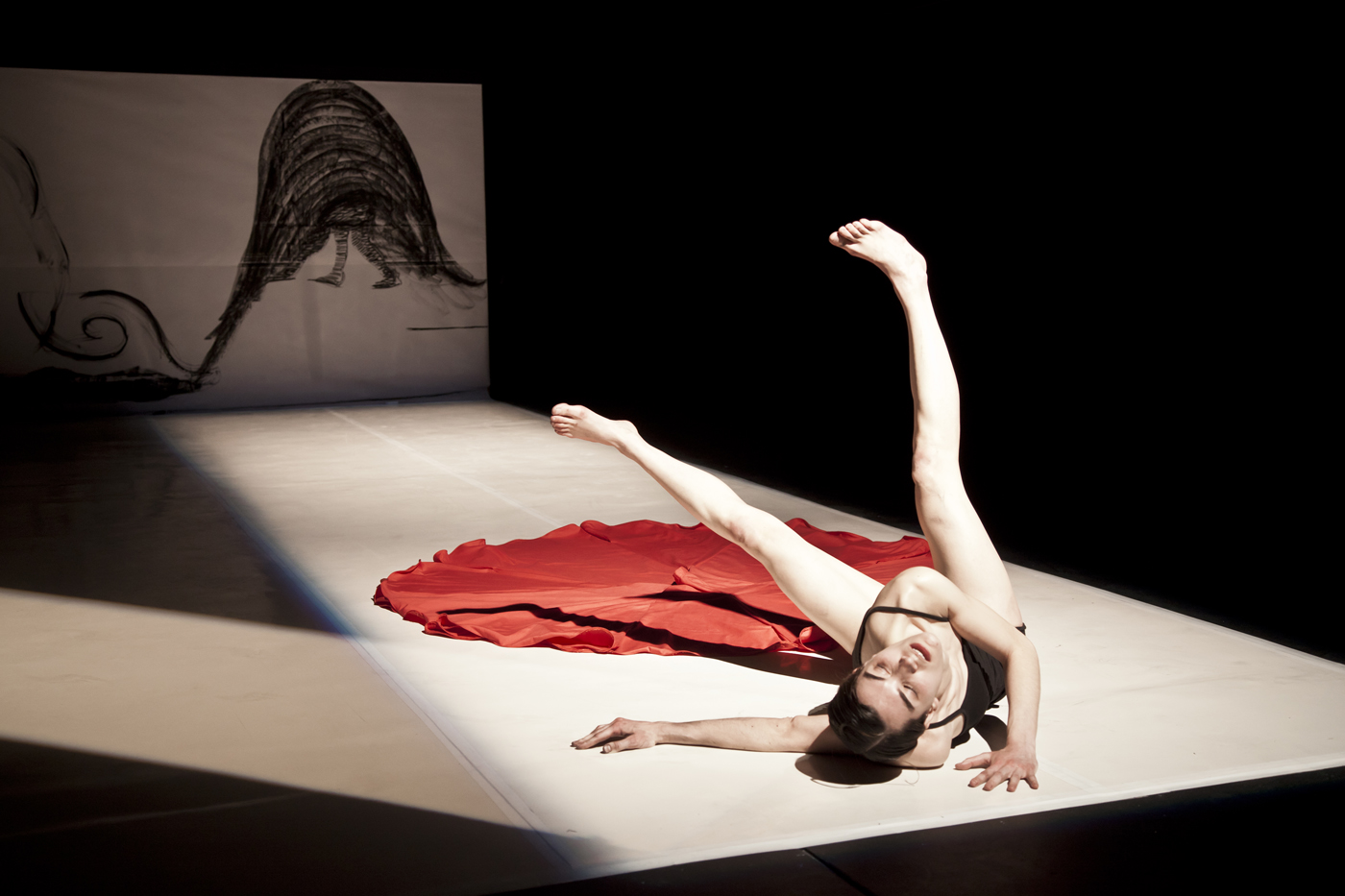
This situation of precariousness has determined the relation of Argentinian dancers and choreographers with their own peripheral history. I would like to approach this problem through the analysis of EIR, a contemporary dance solo directed by the Argentinian choreographer Marina Sarmiento and performed by the actress, dancer, and art historian Lucia Savloff. EIR is the result of a commission Sarmiento received at the end of 2011 for La Plata Arde (La Plata Burns), a program organized by the artistic community of La Plata, the capital of Buenos Aires Province. The idea behind the edition of 2011 was to stage a number of pieces that would pay homage to the dancer Iris Scaccheri, a native of that city.
Lucía Savloff in EIR (2013) by Marina Sarmiento. Photography by Mariana Roveda, courtesy of the photographer.

In the 1960s, Scaccheri was an icon of the “new Argentinian woman,” a sort of female revolutionary also associated with the rise of the feminist movement during that period. In a personal interview with the author (Reference Szeinblum2018), the Argentinian choreographer Diana Szeinblum recounts seeing Scaccheri at the Sala Martin Coronado, the biggest auditorium of the San Martín Theater in Buenos Aires. For Szeinblum, it looked as if Scaccheri did not dance for the public but against the public. Scaccheri never taught seminars and did not have a single student or disciple during her entire career. Neither would you see her often in social meetings. While contemporaries such as Ana Itelman or Renate Schottelius, two emblematic teachers of modern dance in Buenos Aires at that time, can be considered strict masters, Scaccheri was an improviser. As Scaccheri moved around freely onstage during the performance at Sala Martin Coronado, improvising in front of one thousand spectators, Szeinblum had the impression she was merely the receiver of a force that overwhelmed her.
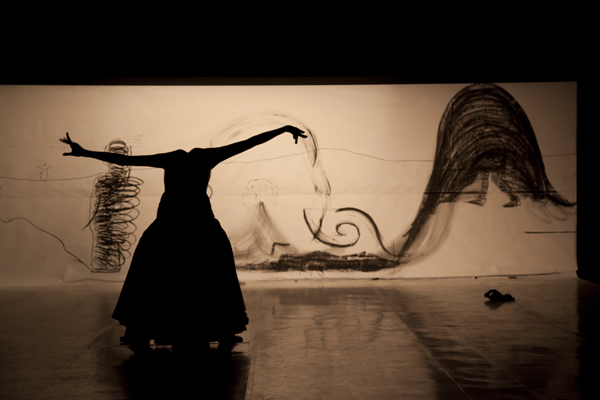
EIR premiered in March 2012 at the Centro de Experimentación y Creación del Teatro Argentino de La Plata. In what follows, I will describe a later staging of Sarmiento's performance I attended, at the Centro Cultural San Martín in Buenos Aires, on September 8, 2013. While the audience enters the auditorium, Savloff is drawing lines and figures with a cinder on a long wall at the back of the stage. When the lights go on, the dancer starts a sequence of slow movements, and we can see how she transforms herself into different, subsequent physical appearances. Later in the performance, she undresses. She maintains her slow movements until she utters a mute scream. She goes back to the wall, traces her own shadow and draws another line. She also draws the line on her own body. Then the dancer goes to the center of the stage and kneels. There is a red skirt on the floor. She takes out a book—Acerca de Iris Scaccheri by Susana Thénon (Reference Thénon1988)—and shows us pictures of Iris Scaccheri, which she caresses as if they were portraits of a beloved relative. The dancer tries to reproduce the movements they show. Afterward, she puts on the red skirt and stands up. A recording of Beethoven's Symphony no. 7 is played and she dances to it. In the performance, the dancer becomes Iris, becomes part of her drawing, and becomes a dancing shadow. At the end, she vanishes into the darkness.
Lucía Savloff in EIR (2013) by Marina Sarmiento. Photography by Mariana Roveda, courtesy of the photographer.

The purpose of this segment of the article is not to analyze the choreography of EIR, but instead, to focus on Marina Sarmiento's subjective experience in the process of producing the piece. Sarmiento explains the circumstances that affected her work in an unpublished text she wrote for a dance conference in Reference Sarmiento2015. In that text, she starts by admitting that she did not know of Iris Scaccheri's work before starting the piece. Her creation was also a personal investigation. As Sarmiento did not have access to comprehensive video material or to any historical archives on Scaccheri, she made the decision to base her research on oral history methods. She interviewed people who worked with Scaccheri and even became friends with her nephew. Although Scaccheri herself was alive at that time, she never agreed to meet Sarmiento, despite her insistence. Scaccheri never saw the piece and died in 2014, two years after the premiere. At first, we might say EIR expresses an improbable representation: it is the result of an encounter between two people that never took place. But that is not exactly the case.
The piece was not intended as a reconstruction of a specific solo but was conceived as an attempt to recover what Sarmiento called Scaccheri's “stage intensity.” The title EIR was taken from Richard Wagner's opera The Valkyrie, which was used by Scaccheri in one of her dance works. It is the name of the Valkyrie who has the power to heal and resurrect. The title chosen for the piece allows for a first interpretation: EIR comes on the stage to heal our memories of the past, and she has the mission to resurrect Iris Scaccheri. Nevertheless, she does not want to bring her back in the form of an image but in the form of an intensity, a sort of presence. In this way, the dance work becomes an exploration of the performer's body: her affects, her desires, and her biography. Conceived as a reenactment—following Mark Franko's definition—the piece exhibits a body that destabilizes historical time and “produces dance as self-reflexively performative knowledge of itself for an audience” (Franko Reference Franko2017, 14). EIR’s body was built on a tension between the past and the present, between historical research and a search for identity.
In his article “The Body as Archive,” Andre Lepecki states that the “will to archive” “as performed by re-enactments” refers to “a capacity to identify in a past work still non-exhausted creative fields” (Reference Lepecki2010, 31). Marina Sarmiento seems to follow this approach in her work EIR. Instead of trying to precisely imitate Scaccheri's movements onstage—which might have resulted in a more easily sellable and marketable piece—Sarmiento chose to reenact her presence, which involved a reinterpretation and an actualization of her artistic energy. So how does the body function as an archive in a peripheral culture in which the past is not inscribed in a universal Eurocentric history of dance and in which the local culture is defined as being part of a delayed and unfulfilled modernization process? It could be said that, as archive, the precarious or peripheral body, unlike the centric body, not only explores creative fields of the past but also has the mission to heal a history disrupted by aesthetic colonialism. This dancing body expresses an act of affection toward its own history: dancing becomes a way of taking care of the past, of paying homage to it. By rescuing their own history, dancers manage to establish a relation with the past detached from the narratives of the reception of European aesthetics and the cultural indebtedness to European modernity they entail. In Argentina, many pieces related to local dance history were conceived as homages that reenact the figure of the artist instead of a specific repertoire. Examples other than EIR include Itelmanía (2014) by Josefina Gorostiza and Jimena Pérez Salerno, which is dedicated to Ana Itelman; Renate virtual y sus actuales (2017) by Susana Szperling, dedicated to Renate Schottelius; and María sobre María (2017) by Lucía Llopis, inspired by María Fux.
The writing of a peripheral history of dance that is conceived of as a history in its own terms represents a political act, because it confronts aesthetic colonialism. Eleonora Fabião interconnects what she calls the “three pathological modes of subjectivity” of the colonized body, which are “catatonic fear, paranoiac mimicry, and historical amnesia” (2010, 109). According to her analysis, the problematic access to history is determined by the recurrent failed act of mimicry, which is implicit in aesthetic colonialism. Therefore, the homage, as a genre of reenactment, empowers the peripheral dancer, because it makes possible a divergent historiography to which his or her artistic work can potentially contribute.
Fabian Gandini and the Aesthetics of Precariousness
I met Fabian Gandini in 2013, when Professor Susana Tambutti introduced us to each other. At that time, I had just received my PhD with a dissertation on pantomime ballet, and Gandini had just presented a performance called Cartas a mi querido espectador (Letters to my dear spectator). Susana invited us to collaborate in a project, but I could not accept because of time constraints. However, we quickly became friends. One year later, in 2014, Gandini began rehearsing his new choreography at his home with the performers Paula Almirón, Dalilah Spritz, German “Patan” Cunese, and Sofia Grenada. I started my collaboration by attending some rehearsals. Then, in 2015, a more suitable space for work was required and Gandini requested a residency at the Centro Cultural Sábato of the University of Buenos Aires. The grant for the production from PRODANZA was about $4,000 US and was not enough to rent a rehearsal room. A specific condition of the residency in the Centro Cultural Sábato was that the project should include a pedagogical feature. Hence, we made an open call for students and artists in order to organize a study group that would interact with the artist in residence. Gandini asked me to coordinate this group and, for that reason, I managed to have a fairly important proximity to the creative process, collaborating as a theoretician. The experience allowed me to learn on the inside the conditions in which independent contemporary dance is produced in Buenos Aires, something that strongly influenced my perception of the choreographic work.
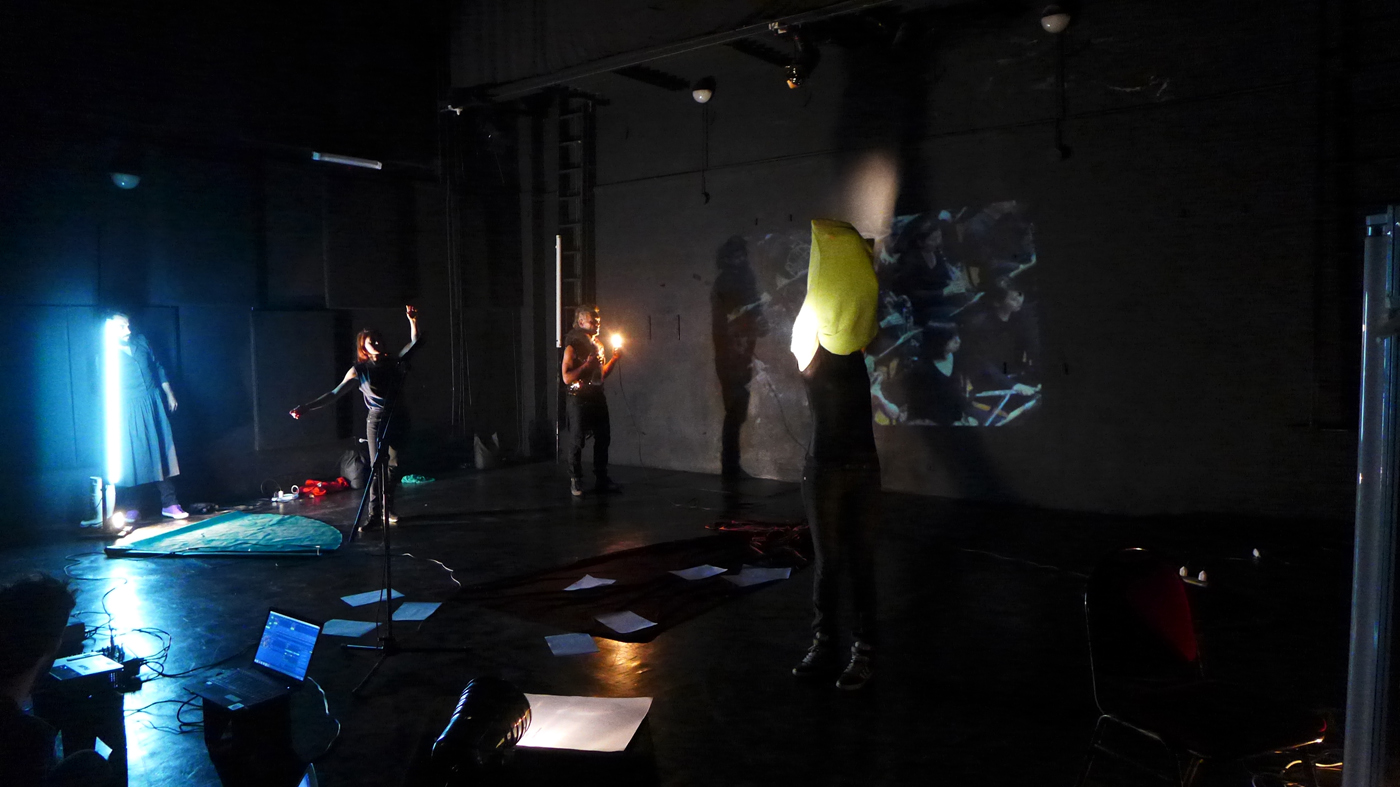
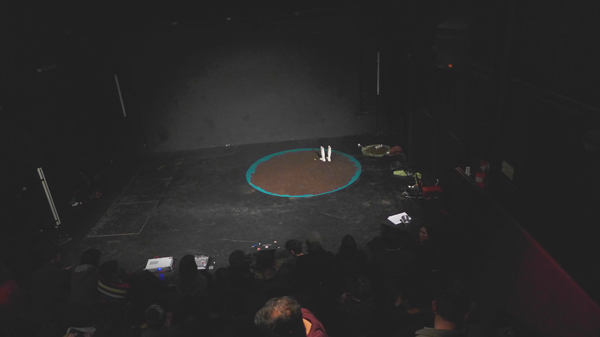
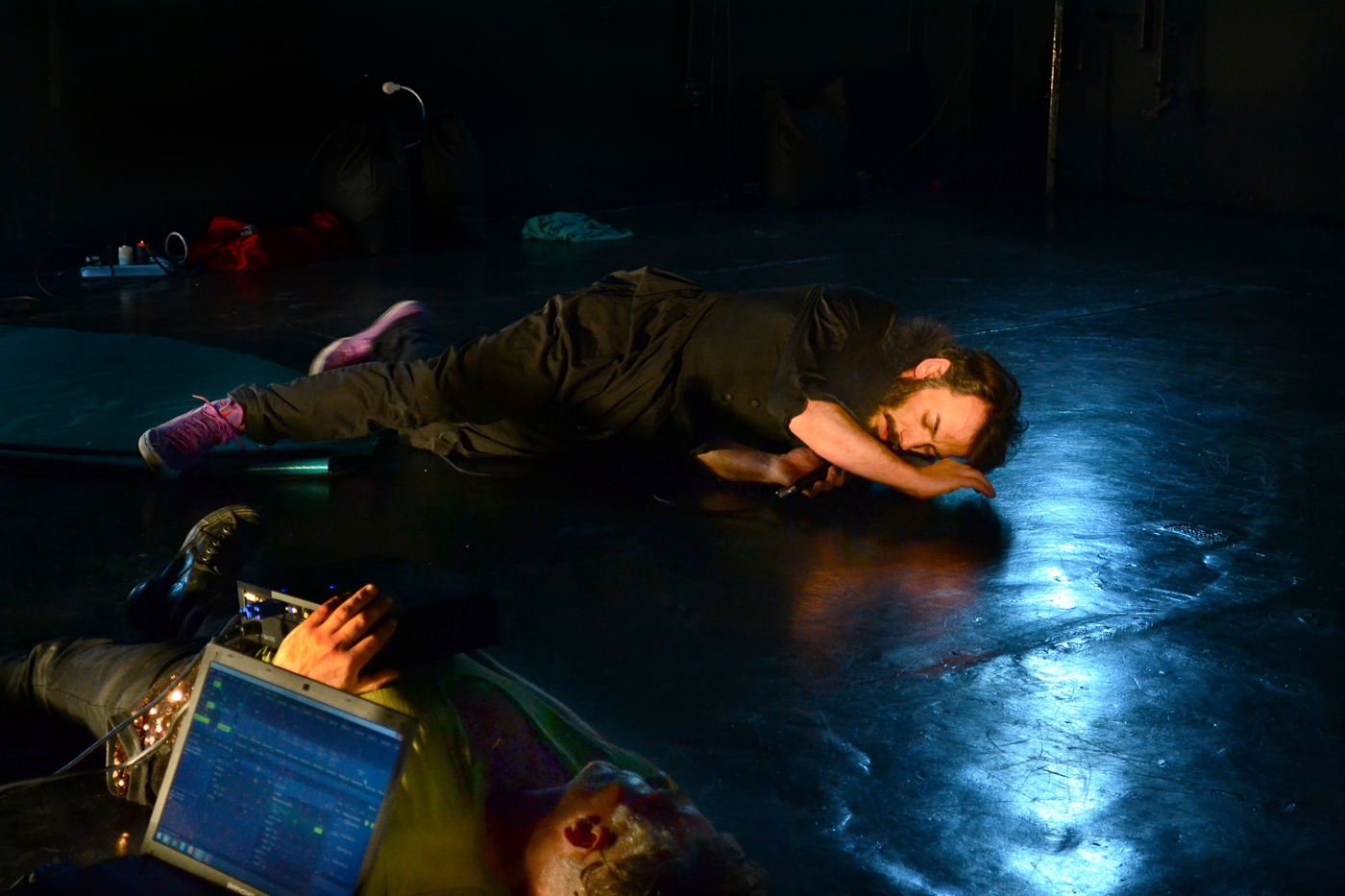
The title of the piece created by Gandini during the residency in the Centro Cultural Sábato was En la boca de la tormenta (In the mouth of the storm) and premiered at the El Extranjero Theater in Buenos Aires, on October 3, 2015. In what follows, I will describe the first part of that performance. Two performers enter the stage; each of them is located on a precise place, and they act like workers in a factory, with each having a specific role. The first performer takes a long red cloth and covers himself with it, extending his arms over the shoulders. The image creates suspense: an actor who hides behind a miniature curtain preparing to go onstage. The other performer pulls a digital recorder out of his pocket and begins recording the sound produced by rubbing the microphone of the recorder against the fabric. It is an intimate sound, completely inaudible to the spectators of the performance. A female performer enters and hides behind the red curtain. Then the female performer and the performer with the microphone walk to the other end of the stage. There, the audience can see a laptop, a projector, a mixer, and an amplifier connected to two speakers. The performer with the microphone now records the sound of a puff of air. Another female performer enters, and he records the sound of her footsteps and the noises produced by unfolding a round plastic carpet on the floor at the right corner of the stage. The second female performer stands with a bag of soil on the edge of the carpet. A rectangle of light is projected on the back of the stage, functioning as a sort of frame for an imaginary painting that divides the wall. A fifth performer enters, who settles in the middle of the scene and begins a sculptural action: in one hand she holds a power strip and in the other a light bulb, which she unsuccessfully tries to unite. The new action introduces an element of tension that is added to the other actions that make up the scene. The performer holding the digital recorder stands in front of the laptop, downloads the recorded sound, and creates a loop that is played through the speakers. Then he replaces the performer holding the red cloth and hides himself behind it. The latter performer walks to the other end of the stage and holds a muted lamp pointing at the center of the stage. On the background wall, the following sentence is projected: “The amount of human hours that things carry in a hidden way produce infinite invisible presences.”
En la boca de la tormenta (2015) by Fabián Gandini. Photography by Jorge Leiva, courtesy of the photographer.

Gandini's dance work could be described in the terms of an aesthetics of precariousness linked not only to an artistic singularity but also to a criticism of local dance practices. By using the perception of time and the stilling of movement as dramaturgical resources, Gandini tends to subvert the strong expressionist tendency in Argentinian dance. His choreographic work embodies a political statement by exposing a specific form of performative fragility, which stands at the frontier of theatrical fiction. A few days before the premiere, the journalist Maximiliano Diomedi interviewed Gandini and the performers. During that interview he stated the following:
It is not that we take a theoretical framework, the conceptual, this fashion or whatever … There is something social for me. … I mean, I am producing a piece and luckily I received a grant … but actually I do not have any money yet. The money we used was the money I gave or the performers gave. And this situation is suggested on stage but without transforming the piece into a demagogic statement. Then all this structure of the light bulb, the chair and the performer, even the actions made on stage have the power of this political core. It is precariousness that forges poetics. (Diomedi Reference Diomedi2015)
The idea of conceiving of precariousness as a creative power is put forward by many current artistic discourses. Some people cynically praise the vitality and freshness of artists from poor countries who work hard for their love of art, and others understand precariousness as a limit that generates a true creative power. In line with the latter sense, the performer Paula Almirón maintained during the interview with Diomedi that the precariousness of the choreography enunciates an ethical position since it raises the following questions: “What defines a work of art? What does a performer on the stage or a person in the society value in a piece of art?” (Diomedi Reference Diomedi2015) En la boca de la tormenta posits an aesthetics and ethics of the essential in the form of a criticism of consumer society. According to Almirón, the frame that was established on the scene sought to question the spectator's ideology; it was not casual. For his part, Gandini affirmed that there was indeed a willingness to make visible the “artifice of the device” and its precariousness, to show the specific conditions of production.
Latin American artists often feel compelled to set up artworks with technical resources similar to artists from centric countries. This is a goal very difficult to achieve, considering the low budget that they have in most cases. Their desire to be accepted by European or American mainstream institutions often drives them to emulate aesthetic models that do not represent the economic reality in which they actually live. One of the main problems in contemporary dance production in Argentina is that the biggest part of the budget is used to pay for costumes, lighting technicians, stage sets, rehearsal rooms, or electronic devices, instead of performers’ working hours. In this sense, Gandini stated in the interview that if he could manage to obtain a bigger budget, he would try to pay more to the performers because “it is not possible that the work of art earned more money than the performers; it is illogical” (Diomedi Reference Diomedi2015).
In analyzing the behavior of the Argentinian bourgeoisie, sociologists claim that Argentina is a country of rich businessmen and poor factories (Graciarena Reference Graciarena1987). In the field of performing arts, this relationship is reversed, and Argentina is often a country of expensive artworks and poor artists. The artwork often becomes a fetish, an expensive artwork that tries to mimic American and European aesthetics. The basis of this phenomenon at the individual level is the dissemination of an entrepreneurial business ethos, a culture that has failed to settle among the Argentinian bourgeoisie but not in the artistic field. The artists invest all their money in their works in the hope that one day, their success on the market will return more than the amount invested. Thus, the work of art turns into a fetish that colonizes and impoverishes the life of the creator.
Nevertheless, when discussing this question, Gandini turned his attention to another subject: the quest for artistic success (that is, being invited to major festivals, traveling the world, earning money) and how that quest conditions the body of the performer and his or her artistic sensibility.
I do not know if … maybe I would have wanted to [be successful]. Because one thinks “the place to be” is the International Festival, but what do I know? I do not know. Maybe you can change your mind and say I do not care. Accepting this premise allows you to say: “This is it [I do not have anything] and I will build my work from this.” And that is when your body becomes an entity, at least this is what happened to me. It is like when you let go and say: “I do not know if I want to be loved” and then you become a thing. One always wants success, but there is something you can also let go of a little bit. (Diomedi Reference Diomedi2015)
For Gandini, this “letting go” represents a precondition for developing a stage presence. To produce a dance work is to expose the body of the performer onstage, and it is after this exposure that the performer “makes the choreography.” This is the reason why, according to Gandini, spectators are able to see in his dance works the performer as a person; they can see bodies with names, with stories, with a particular sensibility. The living conditions of the performers are part of the scene.
En la boca de la tormenta (2015) by Fabián Gandini. Photography by Jorge Leiva, courtesy of the photographer.

In a recent article, Gerald Siegmund introduces a problem he often finds in his work as a teacher: the “student's impulse not to move at all anymore, since according to their understanding, any kind of movement can be exploited by creative capitalism” (Siegmund Reference Siegmund2016, 27). The stillness or slowness of actions as a form of resistance or disobedience has gained considerable acceptance during the last years. In particular, Bojana Kunst (Reference Kunst2015, 131) states that choreographic work that is focused on the duration of movement may have a culturally subversive imprint because it shows how our accelerated perception of time is socially constructed and economically conditioned. Kunst's book ends by proposing as a motto of disobedience in defense of art the following: “do less, precisely when confronted with the demand to do more” (Reference Kunst2015, 192). André Lepecki also problematizes the definition of dance as movement and its implicitly positive connotation (Reference Lepecki2006, 12). He takes the concept of the “still-act” from anthropologist Nadia Seremetakis and states that “the still acts because it interrogates economies of time, because it reveals the possibility of one's agency within controlling regimes of capital, subjectivity, labor, and mobility” (Lepecki Reference Lepecki2006, 15).
Gandini is not necessarily influenced by these authors, although his choreographic work is strongly marked by the slowness and even by the stillness of the body onstage. He relates it to a performer's skill: that is to be present on the scene, to be exposed in front of the public. The presence is thus related to slowness, to the time of action, and to an abandonment of the desire—in this case, the desire to succeed on the international art market. For Gandini, slowness is not an act of resistance; there is no strategic reasoning behind it. Slowness is the vehicle to attain the affective fragility of the performer and the spectator. As a result, the work of Gandini could be considered as a “theater of the precarious” as defined by Katharina Pewny, because it performs “instability in two senses: in the sense of the vulnerability of the human on an ontological level, and in the sense of economic instability” (Pewny Reference Pewny2014, 288).
Fabian Gandini in En la boca de la tormenta (2015) by Fabián Gandini. Photography by Jorge Leiva, courtesy of the photographer.

The aesthetics of precariousness in Fabian Gandini's work is an artistic form that exposes the peripheral artistic working conditions. They distinguish themselves from the act of aestheticizing poverty and also from the philanthropic or romantic regard to peripheral art. Aestheticizing poverty means to represent a world without political struggles, a society in which the poor live in harmony with the rich, in which inequality is accepted as a natural fact. Aesthetics of precariousness does the opposite by foregrounding the inequality and the struggles of society. It does not hide conflict but exposes it. The romantic regard celebrates the devotion and the giving in of peripheral artists that suffer from precariousness. They are supposed to be the real artists because real art is rooted in suffering and commitment. This is a condescending and cynical understanding of art that confirms the exclusion of the peripheral artist, that is to say, their impossible participation in contemporaneity (Barba Reference Barba and Franko2017).Footnote 8 The aesthetics of precariousness, by contrast, does not embrace suffering; it embodies suffering as a form of protest.
Ultimately, the fragility in the aesthetics of precariousness relates back to an ethical demand, which involves the act of being confronted to the face of the other (Pewny Reference Pewny2014).Footnote 9 Through her interpretation of Levinas's concept of “the face,” Judith Butler asserts: “to respond to the face … means to be awake to what is precarious in another life or, rather, the precariousness of life itself” (Reference Butler2004, 134). It is not an act of empathy with the other, but “it has to be an understanding of the precariousness of the Other” (Butler Reference Butler2004, 134). I believe the aesthetics of precariousness (re)presents peripheral dance as “an Other” that requires to be understood in its own terms, in its deep-rooted precariousness. Judith Butler affirms this: “for representation to convey the human, then, representation must not only fail, but it must show its failure” (Reference Butler2004, 144). I would say Gandini's aesthetics of precariousness are based on the same paradox. It is through the exposure of its own failure in being contemporary that it finally attains contemporaneity. Subverting precariousness entails artistic political actions that contribute to “the creation of a human world—that is, of a world of reciprocal recognitions” (Fanon Reference Fanon2008, 170).