Introduction
Maize (Zea mays L., Poaceae) is an important cereal grain that is widely cultivated in the tropics, both for human consumption and as livestock feed. It is the most important cereal in the world after wheat and rice, in terms of area under cultivation and total production (Purseglove, Reference Purseglove1992).
Insect damage to stored grain is a serious problem in the developing countries in the tropics, primarily due to favourable climate conditions and poor storage (Bekele et al., Reference Bekele, Obeng-Ofori and Hassanali1997). Important losses are incurred due to the tunnelling activity of adults and larvae of many storage pests, including moths like the tropical warehouse moth Ephestia cautella (Walker) (Lepidoptera: Pyralidae) whose larvae attack and consume the grain germ. Contamination of the infested commodity also occurs from the large quantity of webbing this moth spins over the surface of the grains (FAO, Reference Semple, Hicks, Lozare and Castermans1992).
Insect pest control in stored produce relies heavily on the use of fumigants and residual contact insecticides. However, indiscriminate use of synthetic insecticides to control storage pests causes the serious problems of toxic residues in grains, environment hazards and the development of resistant insect strains. Furthermore, in developing countries, foreign exchange constraints and fluctuations lead to ever-rising cost and erratic supply of the chemicals (Obeng-Ofori et al., Reference Obeng-Ofori, Reichmuth, Bekele and Hassanali1997).
The need for products that effectively protect stored produce, which are readily available, affordable, relatively less poisonous and less detrimental to the environment, is therefore acute, and has stimulated interest in alternative control strategies, including the re-evaluation of traditional botanical pest control agents (Talukder and Howse, Reference Talukder and Howse1995). These include different plant materials used by resource-poor farmers in developing countries to protect stored grains against pest infestation.
Many botanical pesticides are effective against pests as antifeedants, repellents or toxicants, and are less hazardous than synthetic pesticides to people and the environment (Obeng-Ofori, Reference Obeng-Ofori2007). Pesticides derived from neem (Azadirachta indica) are broad spectrum in their activity, affecting over 300 species of insects, as well as mites, nematodes, fungi, bacteria and viruses (Schmutterer, Reference Schmutterer1985). Neem products are relatively harmless to most beneficial arthropods, are biodegradable and appear less likely to build up genetic resistance in target pests (Obeng-Ofori, Reference Obeng-Ofori1999). However, in spite of the highly positive benefits derived from the use of neem products, their utilization as pesticides is still limited in Africa (Obeng-Ofori, Reference Obeng-Ofori1999, Reference Obeng-Ofori2007).
To promote the adoption and utilization of neem-based pesticides in Ghana, a local non-governmental organization called Aqua Agric Community Project (AACP) has started producing neem oil and cake in Dawhenya for pest control and other agricultural uses. In this study, laboratory and field bioassays were used to evaluate the efficacy of Calneem oil produced by AACP for the control of the tropical warehouse moth E. cautella in stored maize. Actellic™ (pirimiphos-methyl), a common storage grain protectant, was used as a positive control.
Materials and methods
Culturing of insects
Ephestia cautella moths were obtained from the Crop Science Department of the University of Ghana, Legon. With the aid of an aspirator, 40 unsexed moths were transferred into poultry mash (poultry mash+honey+glycerine), and sieved out after 1 week of oviposition. The emerging generations of moths of nearly same age (1–4 days) were used to set up subsequent rearing cultures.
Contact toxicity via topical application
Twenty fifth-instar E. cautella from the stock culture were placed separately in Petri dishes, and 1 μl of three concentrations of Calneem oil (3, 5 and 7 ml/l) and Actellic (2 ml/l) were applied to the dorsal surface of the thorax of each larva using a micro-applicator. Water was used as a control, and each treatment was replicated four times. Mortality was recorded after 24, 48, 72, 96 and 120 h. Insects that did not move or respond to probing three times with a blunt probe were considered dead.
Effect of Calneem oil on oviposition
One hundred grams of maize were weighed into five glass jars. Three of the jars were treated with Calneem oil (3, 5 and 7 ml/l), one treated with Actellic (2 ml/l) and the other treated with water as a control. The treated grain was left for 3 h to allow the water to evaporate. With the aid of an aspirator, 20 adults of E. cautella (2–4 days old) of mixed sexes were introduced into the jars. Adult insects were sieved out after the oviposition period of 4 days. The eggs were sieved onto a cardboard paper and counted. Each treatment was replicated four times.
Toxicity of Calneem oil on immature stages
Toxicity to eggs
One hundred grams of maize grains were put into each of five glass jars, and 20 E. cautella adults were used to infest the maize grains in each jar. The infested grains were treated with Calneem oil (3, 5 and 7 ml/l) and Actellic (2 ml/l) after 4 days of infestation. The control was treated with water, and each treatment was replicated four times in a completely randomized design. Emerging adults were counted and recorded for 5 days. Thus the whole experiment lasted 6 weeks.
Toxicity to larvae
One hundred grams of maize grains were put into five glass jars and infested with 20 E. cautella adults. The parent adults were removed after 7 days of infestation. The grains were treated with Calneem oil (3, 5 and 7 ml/l) and Actellic at 2 ml/l after 2 weeks of infestation, by which time larvae had emerged. The control was treated with water, and each treatment was replicated four times. The adults that emerged were counted and recorded for 5 days. Thus the whole experiment lasted 6 weeks.
Toxicity to pupae
Twenty fifth-instar E. cautella were transferred into a Petri dish containing poultry mash and allowed to pupate. The poultry mash was carefully removed leaving 15 pupae in each Petri dish. The pupae in each dish were treated with 1 μl each of Calneem oil (3, 5 and 7 ml/l) and Actellic (2 ml/l) using a micro-applicator, and the control was treated with acetone. Each treatment was replicated four times. Adult moths that emerged were counted and recorded. The experiment lasted 3 weeks.
Damage assessment
Damage assessment was carried out by taking samples of 100 grains from the control grains used in progeny assessment assays. The number of damaged grains (with characteristic holes) and undamaged grains was counted and weighed. A thousand grains were used as sample in calculating damage to grains stored in a crib. Percentage weight loss was calculated using the method of FAO (1985) as:

where U is the weight of undamaged grains in the sample, D is the weight of damaged grains in the sample, Nu is the number of undamaged grains in the sample, and Nd is the number of damaged grains in the sample.
Repellent effect
The repellent action of the Calneem oil on E. cautella was assessed in the laboratory at 27 ± 2 °C and 68–72% relative humidity, using the method described by Obeng-Ofori and Reichmuth (Reference Obeng-Ofori and Reichmuth1997). The bioassay consisted of two glass jars connected together at their rims by means of a nylon mesh tube with a small hole in its middle. Samples of maize grain (100 g) were treated with Calneem oil (3, 5 and 7 ml/l) and another with Actellic (2 ml/l) to serve as treatments and positive control, respectively. The treated grains were left for 1 h to allow the water to evaporate completely. In each set-up, one jar contained treated grains, while the other jar had untreated maize as a control. Twenty-five E. cautella adults (3–5 days old) were introduced into the nylon mesh tube through the hole, with the aid of a funnel. Each treatment was replicated four times, and the number of insects present in the control (N c) and in treated grains (N t) was recorded after 30 min. Percentage repellency (PR) values for both tests were computed as: PR = [(N c − N t)/(N c+N t)] × 100. The PR data were analysed using analysis of variance (ANOVA), and all negative PR values were treated as zero (Obeng-Ofori et al., Reference Obeng-Ofori, Reichmuth, Bekele and Hassanali1997).
Persistence of Calneem oil in the field
Four sets of treatments were set up, each consisting of 10 kg of maize grains placed in three (40 × 25 cm) jute sacks. The grains were treated with either Calneem oil (5 ml/l) or Actellic (2 ml/l), and the control was treated with water, with each treatment replicated three times. Sixty unsexed E. cautella adults aged 3–5 days were used to infest the first set of treated grains, which were then stored in a crib for 5 weeks, after which grain samples were taken for damage assessment as described above. The second set of grain was infested in the second month, the third set in the third month and the fourth set in the fourth month. Grains were sampled for damage assessment after 5 weeks of infestation.
Effects on resistance development
Twenty 2- to 5-day-old unsexed fifth instars of E. cautella were placed in separate Petri dishes, and 1 μl of nine different concentrations of Calneem oil (6–14 ml/l) was applied to the dorsal surface of the thorax of each insect with a micro-applicator. Acetone was used as the control, and each treatment was replicated four times. Mortality was recorded after 48 h; insects that did not move or respond to probing three times with a blunt probe were considered dead. The LC90 concentration of the oil was determined using Probit analysis. Twenty-five adults of the E. cautella that survived the LC90 treatment were used to infest maize grains. After 3 days, eggs laid were counted and then transferred onto poultry mash for development into adults. The emerging F1 generation of the insects was treated with the above LC90 concentration, and the survivors were used to infest another set of grains so as to obtain the F2 generation. F2 and F3 generations of the insects were also treated as above. In each case, mortality and number of eggs laid were counted and recorded.
Data analysis
Data were corrected for mortality in the control using Abbott's formula (Reference Abbott1925) and subjected to ANOVA. Differences between means were separated by determining the least significant difference whenever ANOVA indicated a significant difference.
Results
Contact toxicity via topical application
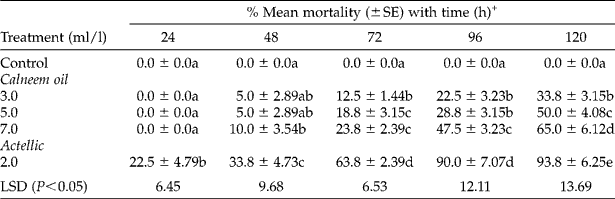
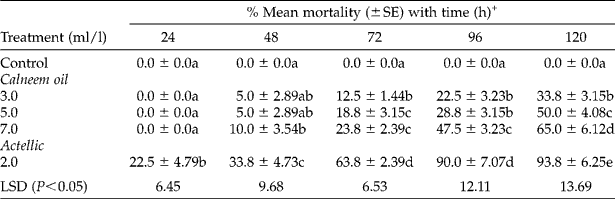
Mortality of E. cautella following topical application of Calneem oil is summarized in Table 1. The toxicity of the oil increased with increasing concentration and with time. Within 48 h, there were no significant differences among the different concentrations of the oil on E. cautella. The highest mortality (65%) was recorded at the highest concentration used, after 120 h.
Contact toxicity of Calneem™ oil to Ephestia cautella adults
LSD, least significant difference.
+ Means in a column followed by different letter(s) are significantly different at P < 0.05; LSD test.
Effect on oviposition
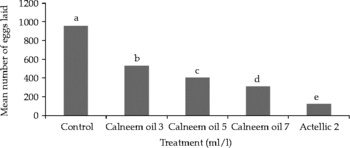
Oviposition data of E. cautella on grain treated with different concentrations of Calneem oil and 2 ml Actellic are summarized in Fig. 1. The number of eggs laid decreased with increasing concentration. There was a significant (P < 0.05) difference between the number of eggs laid on the treated grains versus the control, and also between the Calneem oil and Actellic treatments.
Effect of Calneem oil on oviposition of Ephestia cautella. Bars followed by different letters are significantly different at P < 0.05; LSD test.

Toxicity to immature stages
Toxicity to eggs
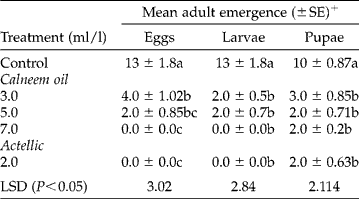
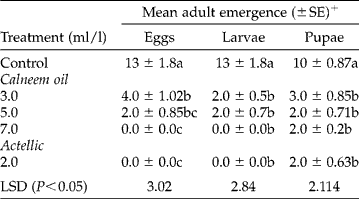
Calneem oil significantly reduced the emergence of E. cautella following treatment of grains containing eggs (Table 2). There was no emergence from grains treated with Calneem oil (7 ml/l) or Actellic.
Effect of Calneem™ oil on adult emergence from 20 immatures each of Ephestia cautella
LSD, least significant difference.
+ Means in a column followed by different letter(s) are significantly different at P < 0.05; LSD test.
Toxicity to larvae
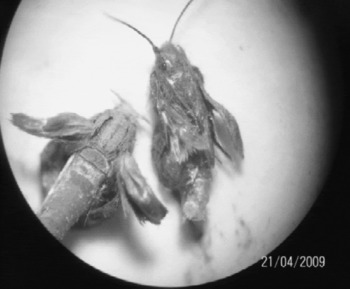
Calneem oil reduced the emergence of E. cautella adults from treated grain containing larvae (Table 2). There was no emergence of E. cautella from grains treated with Calneem oil (7 ml/l) and Actellic. There was a significant (P < 0.05) difference between the insecticidal treatments and the control, but no significant differences were observed between the Calneem oil (7 ml/l) and Actellic. Some of the adults of E. cautella that emerged from treated grains were deformed (Fig. 2).
Deformed progeny of Ephestia cautella following Calneem oil treatment

Toxicity to pupae
Calneem oil reduced the emergence of E. cautella adults from treated grain containing pupae (Table 2). There was a significant difference (P < 0.05) between the insecticidal treatments and the control, but E. cautella emergence from grains treated with different concentrations of Calneem oil and Actellic was not significantly different.
Repellent effects
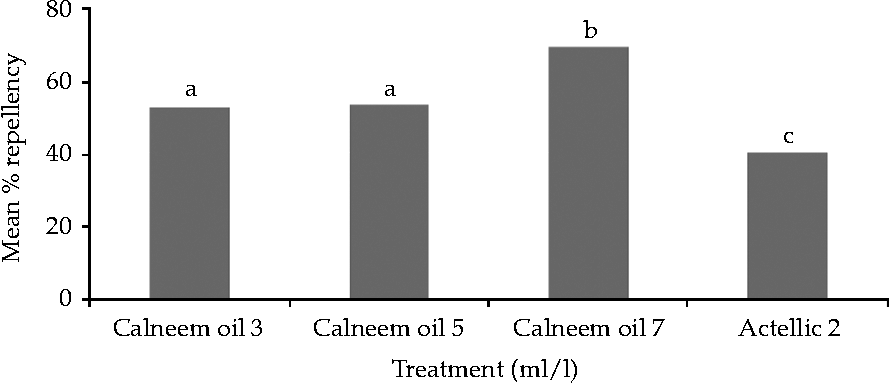
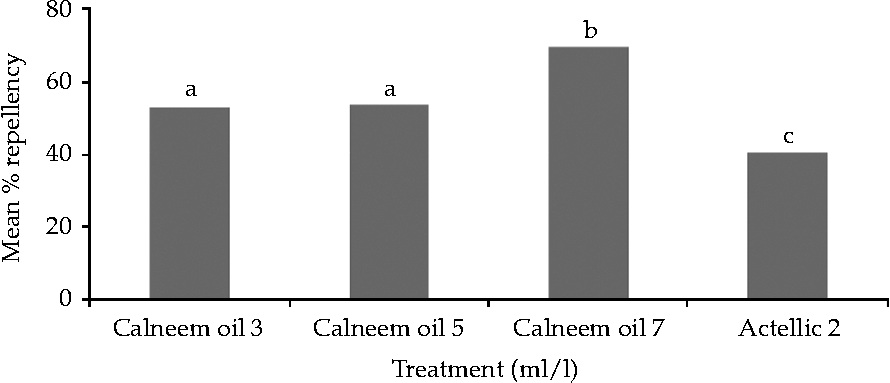
Calneem oil was moderately repellent to E. cautella, with a concentration-dependent repellency ranging from 53 to 70%. In contrast, Actellic had 40% repellency (Fig. 3).
Mean percentage repellency of Calneem oil against Ephestia cautella. Bars followed by different letter(s) are significantly different at P < 0.05; LSD test.
Damage assessment
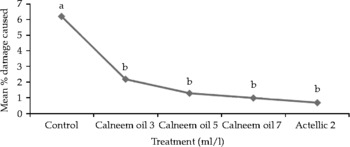
Calneem oil gave good protection to treated grains against damage by E. cautella compared with untreated controls, with weight losses of 0.99–2.22% after 2 months of storage (Fig. 4). There was a significant (P < 0.05) difference between the insecticidal treatments and the control, but none between Calneem oil and Actellic.
Effect of Calneem oil and Actellic on damage caused by Ephestia cautella to stored grains. Means followed by different letter(s) are significantly different at P < 0.05; LSD test.

Persistence in the field
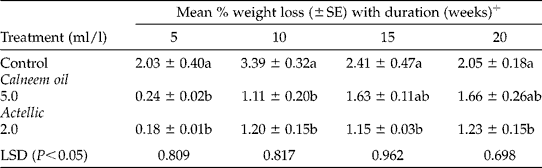
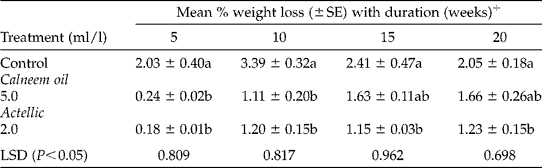
Calneem oil at the 5 ml/l concentration gave significantly higher (P < 0.05) protection to grains than the untreated control, with weight losses of 0.24 and 1.11% to E. cautella 5 and 10 weeks post-treatment, respectively (Table 3). There was a significant (P < 0.05) difference between the insecticidal treatments and the control, but none between the protectant ability of the Calneem oil and Actellic 10 weeks post-treatment. However, no significant (P < 0.05) differences between the oil treatment and the control were seen after 15 weeks of treatment. Therefore, the protectant effect of Calneem oil appeared to decline with time.
Effect of Calneem™ oil on weight loss due to Ephestia cautella on stored maize grain
LSD, least significant difference.
+ Means in a column followed by different letter(s) are significantly different at P < 0.05; LSD test.
Effects on resistance development
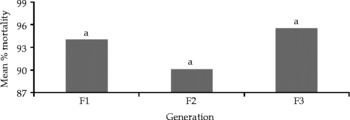
Contact toxicity of Calneem oil to three generations of E. cautella is summarized in Fig. 5. Using Probit analysis, the LC90 concentration of Calneem oil was 12.2 ml/l. At this concentration, there were no significant (P < 0.05) differences between mortalities in the three generations of E. cautella, which ranged from 90.4 to 95.6%. Thus resistance development had not set in by the F3 generation treated with Calneem.
Contact toxicity of LC90 concentration of Calneem oil on Ephestia cautella over three generations. Bars followed by different letter(s) are significantly different at P < 0.05; LSD test.

Discussion
Calneem oil applied to the dorsal surface of E. cautella was toxic to the moths. Mortality increased with increasing dosage and time, with low mortality observed within the first 24 h of treatment. Raguraman and Singh (Reference Raguraman and Singh1997) reported that topical application at the rate of 0.5 μl per insect at 3, 2 and 1% concentrations of neem oil produced negligible mortality after 24 and 48 h of treatment, corroborating our observations. Calneem oil at 7 ml/l induced about 65% mortality on fifth-instar E. cautella within 5 days. The effectiveness of the oil against E. cautella indicates a possible contact action of the major active constituent of the oil (azadirachtin). Crude seed extract of A. indica acts as a strong growth inhibitor, is acutely toxic and an active feeding deterrent against two lepidopteran species, cabbage looper Trichoplusia ni and the armyworm Pseudaletia unipuncta (Akhtar et al., Reference Akhtar, Yeoung and Isman2008). Azadirachtin prevents both ecdysis and apolysis, and can cause death before or during moulting (Mordue and Blackwell, Reference Mordue and Blackwell1993). The toxicity of the oil results in its protectant effect against insect damage to stored grain.
Calneem oil was effective in reducing the number of eggs laid by E. cautella. Oviposition rates in grain treated with all three concentrations of the oil (3, 5 and 7 ml/l) were significantly (P < 0.05) different from the control. Laying fewer eggs could be due to the fact that neem oil can cause sterility in adult insects (Schmutterer, Reference Schmutterer and Schmutterer1995; AFR, 2006).
Calneem oil inhibited the development of eggs, larvae and pupae of E. cautella. At a concentration of 7 ml/l, the oil caused complete inhibition of the development of eggs and larvae of E. cautella. Some of the emerging adults were deformed, as also reported by Sunarti (Reference Sunarti2003), who showed that application of neem oil to cocoa beans deterred feeding by E. cautella larvae 92% and observed only 10% normal adult emergence from the neem oil-treated larvae. Ascher (Reference Ascher1993) observed developmental, post-embryonic, reproductive and growth-inhibitory effects of neem oil, which caused malformation and mortality in insects in a dose-dependent manner. Neem oil is not an instant killer (Raguraman and Singh, Reference Raguraman and Singh1997) but has strong ovicidal and antifeedant effects that inhibit the development of eggs and larvae of E. cautella. Inhibition of the development of immature stages of the insect by the oil could be due to the presence of the decalin, hydroxyfuran, nimbin and salinnin fragments of azadirachtin. Nimbin and salinnin are reported to have a potential sterilizing effect on eggs (Ascher, Reference Ascher1993); decalin is reported to have regulatory effects on growth and development, while hydroxyfuran has antifeedant effects (Ascher, Reference Ascher1993; Sclar, Reference Sclar1994). The complete inhibition of egg development and the inhibition of development in immature stages contribute to Calneem oil's action as a grain protectant.
The oil was moderately repellent to E. cautella, with repellency ranging from 50 to 75% compared with the 40% repellency of Actellic. The oil contains many sulphur compounds, which potentially act as repellents (Ascher, Reference Ascher1993). This action of Calneem oil increases its value as a grain protectant against insect pests. Blum and Roitberg (Reference Blum and Roitberg1999) reported that one of the most frequently used natural insect repellents is margosa oil (neem oil), which repels many species of insects, including moths.
Calneem oil and Actellic significantly reduced the damage caused by larvae of E. cautella compared with the control. The persistency test of the oil and Actellic confirmed that at a concentration of 5 ml/l, the oil remained effective for 10 weeks. Sunarti (Reference Sunarti2003) reported that the application of neem oil deterred E. cautella larval feeding by 92% and prevented damage by E. cautella to cocoa beans for more than 3 months of storage.
No significant difference was observed in the mortality of E. cautella following three generations of selection. Neem oil contains a complex mixture of active ingredients that limit the ability of pests to develop resistance (Ellis et al., Reference Ellis, Bradley and Atthowe1996; Salako, Reference Salako2002; Capinera, Reference Capinera2008). This is a significant merit for its use against various pests (Aslam and Naqvi, Reference Aslam and Naqvi2000). Laboratory studies have revealed that insects are capable of developing resistance to pure azadirachtin but not to neem extracts containing equivalent amounts of azadirachtin (Capinera, Reference Capinera2008). Thus it is evident that Calneem oil would reduce some of the resistance development problems associated with continuous use of synthetic insecticides.
Conclusion
Our study showed that Calneem oil contains insecticidal, anti-oviposition, ovicidal and repellent properties against E. cautella. Furthermore, the insect did not develop resistance to the oil for three generations. Farmers in Africa and elsewhere could use Calneem oil for field and storage pest control, as part of a holistic integrated pest management strategy.