Introduction
Innovation is essential for organizations to improve their results and compete in a turbulent and globalized world. Over the years, a stream of research that tries to disentangle what are the factors that promote it has been consolidated in the academic field (e.g., Mokhber, Khairuzzaman, & Vakilbashi, Reference Mokhber, Khairuzzaman and Vakilbashi2018).
Different theories have been used to analyze how innovation flourishes in an organizational context, such as resource and capability based theory (Camisón & Villar-López, Reference Camisón and Villar-López2014), organizational learning theory (Kim & Lui, Reference Kim and Lui2015), human capital theory (Ko & Choi, Reference Ko and Choi2019) or contingency theory (Naranjo-Gil, Reference Naranjo-Gil2009), to name a few. The current study is grounded on the behavioral theory of leadership, which emerged as a means to clarify the relationship between leader's behaviors and subordinates' performance, productivity or satisfaction (Yukl, Reference Yukl1971). Behavioral theories of leadership study the nature and consequences of shared, participative or empowering leadership (Dinh, Lord, Gardner, Meuser, Liden, & Hu, Reference Dinh, Lord, Gardner, Meuser, Liden and Hu2014). According to this approach, behavioral theory of leadership ‘emphasizes what leaders and managers actually do on the job, and the relationship of behavior to managerial effectiveness’ (Yukl, Reference Yukl1989: 257). This approach has been followed in previous research, so different leader behaviors and their influence on different types of innovation have been studied (e.g., Vaccaro, Jansen, Van Den Bosch, & Volberda, Reference Vaccaro, Jansen, Van Den Bosch and Volberda2012). According to Vaccaro et al. (Reference Vaccaro, Jansen, Van Den Bosch and Volberda2012), leaders influence the conditions in which innovation is generated and implemented due to their role within the organization, promoting an organizational context that fosters experimentation, and the introduction of new processes or practices. Similarly, Crossan and Apaydin (Reference Crossan and Apaydin2010: 1156) stated that leadership is ‘paramount for spearheading innovation as a process and maintaining its momentum until innovation as an outcome ensues.’
Therefore, and according to the former literature, one of the main elements that promote innovation is leadership (Mokhber, Khairuzzaman, & Vakilbashi, Reference Mokhber, Khairuzzaman and Vakilbashi2018). In the current competitive context, new leadership styles and new leaders' behaviors are increasingly demanded (e.g., Van Dierendonck & Nuijten, Reference Van Dierendonck and Nuijten2011). Managing people in a more humane way, considering their feelings and needs, has been placed into the spotlight. Leadership typologies such as servant and transformational are good examples of these new trends in management that, in addition, lead to positive outcomes both in innovation and performance (e.g., Aragón-Correa, García-Morales, & Cordón-Pozo, Reference Aragón-Correa, García-Morales and Cordón-Pozo2007; Tipu, Ryan, & Fantazy, Reference Tipu, Ryan and Fantazy2012). However, these leadership styles are too broad and include many variables, which difficult the interpretation of the results. Consequently, it is recommendable to analyze specific behaviors of the leaders when studying their influence on performance or innovation (Domínguez-Escrig, Mallen Broch, Chiva Gomez, & Lapiedra Alcami, Reference Domínguez-Escrig, Mallen Broch, Chiva Gomez and Lapiedra Alcami2016; Yukl, Reference Yukl2012).
Yukl (Reference Yukl2012) proposed a hierarchical taxonomy of leadership behaviors that influence performance. According to his classification, the current study focuses on empowerment, analyzing the effect of leaders' empowerment on organizational performance, taking into account the mediating role played by radical innovation. Although empowerment has been established as one of the most powerful predictors of individual and organizational performance (Behrendt, Matz, & Göritz, Reference Behrendt, Matz and Göritz2017), and its potential to promote creativity and innovation in the organizational context has been proved, the complexity of innovation demands clarification to distinguish between innovation typologies, processes, outcomes or stages. All of them have different characteristics, need different promoters and provide different results or outcomes to companies and organizations. By delimiting the characteristics of the innovation under study, it is possible to clarify the implications of the study for organizations and managers, and the academic literature. The main contribution of this research is on the analysis of the mediating effect of radical innovation to boost organizational performance. Former research provided evidence of the positive effect of empowerment on innovative behavior (Abukhait, Bani-Melhem, & Zeffane, Reference Abukhait, Bani-Melhem and Zeffane2019; Slåtten, Svensson, & Sværi, Reference Slåtten, Svensson and Sværi2011), team innovativeness (Zhu & Chen, Reference Zhu and Chen2016), service innovation (Hsiao, Lee, & Hsu, Reference Hsiao, Lee and Hsu2017), open innovation (Naqshbandi, Tabche, & Choudhary, Reference Naqshbandi, Tabche and Choudhary2019), creativity (Amundsen & Martinsen, Reference Amundsen and Martinsen2015; Zhang & Bartol, Reference Zhang and Bartol2010), and so on. However, to the best of our knowledge, the effects of empowerment on radical innovation have been overlooked in empirical studies. This is somehow surprising, as radical innovation is one of the most relevant mechanisms to achieve success and improve firm performance (e.g., Rubera & Kirca, Reference Rubera and Kirca2012). The current study covers this gap and meets the demands of scholars who advocate for analyzing the antecedents of radical innovation from a leadership approach (e.g., Chang, Chang, Chi, Chen, & Deng, Reference Chang, Chang, Chi, Chen and Deng2012). We have developed a model that centers on leader behavior, because, in this way, it is possible to increase the understanding of ‘the basic building blocks of leader influence’ (Hughes, Lee, Tian, Newman, & Legood, Reference Hughes, Lee, Tian, Newman and Legood2018: 564).
Empowerment has been a very popular concept in business in recent years because of its potential to improve organizational performance and innovation (Biron & Bamberger, Reference Biron and Bamberger2011). This is a broad concept that has been studied from different points of view, leading to different conceptualizations, such as psychological and structural empowerment. Given the focus of the current study, empowerment was analyzed from a leadership approach. Conger and Kanungo (Reference Conger and Kanungo1988: 473) defined empowerment as ‘the process by which a leader or manager shares his or her power with subordinates.’
In fact, leaders play an essential role in the process of empowering employees (Amundsen & Martinsen, Reference Amundsen and Martinsen2015). Van Dierendonck and Nuijten (Reference Van Dierendonck and Nuijten2011) considered that empowerment promotes personal development, proactive attitudes and self-confidence in followers, being its main characteristic the belief in the intrinsic value of each person. Seibert, Wang, and Courtright (Reference Seibert, Wang and Courtright2011) stated that, despite the literature related to this concept, it is important to keep studying the consequences of empowering employees.
Therefore, although there are evidences of the relationship between empowerment, innovation and performance (e.g., Zhang & Bartol, Reference Zhang and Bartol2010), to our knowledge there are no references of previous studies that have studied these relationships, distinguishing between typologies of innovation. Therefore, the current research sets out a model that reflects how leaders' empowerment affects radical innovation and performance. In the current research, performance refers to the results of the organization, which include consumers' loyalty, profitability, sales growth and return of investment (Tippins & Sohi, Reference Tippins and Sohi2003). An empirical study was conducted in a sample frame of 11,594 Spanish companies.
Literature Review
Leaders' empowerment
The theoretical review pays particular attention to empowerment from the leadership perspective. Sun, Zhang, Qi, and Chen (Reference Sun, Zhang, Qi and Chen2012) argued that studies about empowerment in leadership analyze the motivational behaviors transmitted by the leaders. Gao, Janssen, and Shi (Reference Gao, Janssen and Shi2011) defined these leaders as those who share with their employees authority, autonomy and responsibility in order to make them more receptive and adaptive to the work environment.
Empowerment involves giving power to others, showing confidence in their capabilities and reinforcing the meaning of the work they do (Thomas & Velthouse, Reference Thomas and Velthouse1990; Zhang & Bartol, Reference Zhang and Bartol2010). This not only means delegating responsibilities on the subordinates, it also implies motivating them to carry out their tasks by feeling that they are autonomous and effective (Conger & Kanungo, Reference Conger and Kanungo1988; Randolph & Kemery, Reference Randolph and Kemery2011). In addition, these leaders emphasize the importance of the work done by their employees, facilitate their participation in decision-making, promote self-leadership, boost information sharing, establish meaningful objectives, inspire and give an exciting view of the future (Amundsen & Martinsen, Reference Amundsen and Martinsen2015; Zhu & Chen, Reference Zhu and Chen2016). Empowerment redefines both assignments on the workplace and power relationships between managers and subordinates (Vecchio, Justin, & Pearce, Reference Vecchio, Justin and Pearce2010).
By generating a more open working environment, in which employees are responsible for the work they do, the development of a series of factors that can be positive for both employees in particular and the organization in general are favored (Amundsen & Martinsen, Reference Amundsen and Martinsen2015; Randolph & Kemery, Reference Randolph and Kemery2011). Empowerment has positive effects on subordinates' welfare (Biron & Bamberger, Reference Biron and Bamberger2011); improves job satisfaction (Aydogmus, Camgoz, Ergeneli, & Ekmekci, Reference Aydogmus, Camgoz, Ergeneli and Ekmekci2018), reduces stress and encourages employees to remain in the company (Seibert, Wang, & Courtright, Reference Seibert, Wang and Courtright2011); it is positively related to commitment to work (Bhatnagar, Reference Bhatnagar2012; Pentareddy & Suganthi, Reference Pentareddy and Suganthi2015); and fosters proactive attitudes and self-confidence in their employees (Rodríguez-Carvajal, de Rivas, Herrero, Moreno-Jiménez, & Van Dierendonck, Reference Rodríguez-Carvajal, de Rivas, Herrero, Moreno-Jiménez and Van Dierendonck2014). Moreover, empowerment increases intrinsic motivation for the tasks performed (Thomas & Velthouse, Reference Thomas and Velthouse1990; Zhang & Bartol, Reference Zhang and Bartol2010). At that point, employees feel that their work is important, believe in their own capabilities to carry out the tasks, are free to decide how to perform their work, feel that they have more control and think that their contributions may be more positive for the organization (Srivastava & Dhar, Reference Srivastava and Dhar2016; Zhang & Bartol, Reference Zhang and Bartol2010).
It could be argued that empowerment allows those employees that usually do not have any control over their work to become responsible for it. Nonetheless, to be meaningful and truly effective, all these characteristics promoted by empowerment must be perceived by the employees, and is the responsibility of managers and leaders that this happens (Biron & Bamberger, Reference Biron and Bamberger2011; Randolph & Kemery, Reference Randolph and Kemery2011). Thus, for empowerment to exist, employees must perceive that they work in a liberating and unconstrained context (Biron & Bamberger, Reference Biron and Bamberger2011), feeling that their contributions positively impact on the organizational results (Spreitzer, Reference Spreitzer1995; Thomas & Velthouse, Reference Thomas and Velthouse1990). However, despite the positive consequences related to empowerment, some potential unwanted effects may also occur such as overconfidence or errors of judgment by the employees (Conger & Kanungo, Reference Conger and Kanungo1988).
Additionally, empowerment is a specific construct for the workplace that is not usually extended to other domains of life. It is a personality trait related to the work context, not generalizable to other situations and that must be addressed within an organizational environment (Randolph & Kemery, Reference Randolph and Kemery2011). Besides, different degrees of empowerment can be identified, distinguishing between more or less empowered employees (Biron & Bamberger, Reference Biron and Bamberger2011; Spreitzer, Reference Spreitzer1995). This concept began to spread due to the growing need to face the new competitors that appeared with globalization, which forced companies to cope with uncertain contexts and seek management styles that would facilitate the commitment of their employees, risk taking and innovation (Spreitzer, Reference Spreitzer1995; Thomas & Velthouse, Reference Thomas and Velthouse1990).
Radical innovation
One of the most popular classifications in the academic literature distinguishes between incremental and radical innovation according to the degree of change they produce in the organization and markets. Some authors consider that radical and incremental innovations are two extremes within a continuum and put these concepts in the limits of the scale when they measure the degree of innovation (Alexander & Van Knippenberg, Reference Alexander and Van Knippenberg2014). Other researchers analyze the antecedents and consequences of radical and incremental innovation considering them as two separated and differentiated constructs (Chang, Franke, Butler, Musgrove, & Ellinger, Reference Chang, Franke, Butler, Musgrove and Ellinger2014). These concepts have completely different characteristics and effects, so they need to be managed differently (Leifer, O'Connor, & Rice, Reference Leifer, O'Connor and Rice2001). As a result, several authors suggest analyzing their antecedents and consequences separately (Slater, Mohr, & Sengupta, Reference Slater, Mohr and Sengupta2014).
Incremental innovation may be defined as doing things better while radical innovation entails working in a different way (Bessant, Öberg, & Trifilova, Reference Bessant, Öberg and Trifilova2014). Consequently, radical innovation supposes a bigger challenge for organizations (Büschgens, Bausch, & Balkin, Reference Büschgens, Bausch and Balkin2013) as it implies a higher degree of innovation and creativity, and faces greater risks both in its development and commercialization stages (Alexander & Van Knippenberg, Reference Alexander and Van Knippenberg2014).
Radical innovation may refer to completely new products, services or productive processes (Leifer, O'Connor, & Rice, Reference Leifer, O'Connor and Rice2001). These products or services offer new benefits to the consumers and satisfy their needs better than the current offer (Chandy & Tellis, Reference Chandy and Tellis2000). Moreover, as this type of innovation involves moving away from routine and the willingness to work differently, it usually entails changes in the productive process (Keupp & Gassmann, Reference Keupp and Gassmann2013).
The development of radical innovations is a complex and uncertain process which faces all kinds of contingencies (Alexander & Van Knippenberg, Reference Alexander and Van Knippenberg2014). Results that will be obtained are hardly predictable beforehand and organizations must be prepared not to achieve success, as the failure rate in these projects is usually high. Nonetheless, radical innovation may contribute to achieve a better performance and more positive results, which makes it possible to compensate for the uncertainties and risks faced (Rubera & Kirca, Reference Rubera and Kirca2012). However, given that radical innovation may provoke unexpected results and that not every radical innovation achieves success, compromising the viability of the company, it is essential to determine which are the factors that promote not only radical innovation, but its success.
Hypotheses
A conceptual model (Figure 1) was developed to explain the effects of leader's empowerment on performance through radical innovation. Leader's empowerment better explains the improvement of performance when the mediating effect of radical innovation is taken into account. This model not only sets out the possibility of a direct effect between leader's empowerment and organizational performance, it also suggests that it may have a positive effect on the generation of radical innovations.
Conceptual model.

Leader's empowerment and radical innovation
Either directly or using different mediating variables, some previous research positively linked empowerment to creativity (e.g., Audenaert & Decramer, Reference Audenaert and Decramer2018; Moulang, Reference Moulang2015; Sun et al., Reference Sun, Zhang, Qi and Chen2012; Zhang & Bartol, Reference Zhang and Bartol2010) and innovation (e.g., Bhatnagar, Reference Bhatnagar2012; Seibert, Wang, & Courtright, Reference Seibert, Wang and Courtright2011; Zhu & Chen, Reference Zhu and Chen2016). Although creativity does not directly involve innovation, it is related to the production of novel ideas that may become innovations.
As the current research is grounded on the conceptualization of leader's empowerment behavior originally developed by Van Dierendonck and Nuijten (Reference Van Dierendonck and Nuijten2011: 251), who considered that empowerment is ‘a motivational concept focused on enabling people and encouraging personal development,’ the hypotheses section pays special attention to motivational theories to clarify the relationship between empowerment and innovation. Amabile (Reference Amabile1988) stated that employees that are motivated, show more enthusiasm for their work, are committed to the organization and feel that their contribution is relevant, are more creative. In addition, intrinsically motivated individuals are more interested in their job and search for new approaches or alternative ways of solving problems, triggering innovation (Yidong & Xinxin, Reference Yidong and Xinxin2013).
Konczak, Stelly, and Trusty (Reference Konczak, Stelly and Trusty2000) stated that one of the defining behaviors of empowering leaders is coaching for innovative performance, which includes encouraging calculated risk taking and new ideas, providing performance feedback, and treating mistakes and setbacks as opportunities to learn. Correia de Sousa and van Dierendonck (Reference Correia de Sousa and van Dierendonck2014) considered that empowerment facilitates motivational contexts that promote learning, creativity and innovation. In fact, by boosting employees' motivation is how empowering leaders may foster creativity and innovation (Correia de Sousa & van Dierendonck, Reference Correia de Sousa and van Dierendonck2014; Van Dierendonck & Patterson, Reference Van Dierendonck and Patterson2015). Thomas and Velthouse (Reference Thomas and Velthouse1990), who conceptualized empowerment as increased task motivation, highlighted the importance of empowerment to innovate by pointing out that this concept appeared at a time when competition and change forced companies to search for alternative management strategies that encourage commitment, risk taking, and innovation. Some empirical research has provided evidence of these relationships. For instance, Zhang and Bartol (Reference Zhang and Bartol2010) found that empowering leaders promote employee creativity through psychological empowerment, intrinsic motivation and engagement in the creative process.
Conger and Kanungo (Reference Conger and Kanungo1988) considered that empowerment is a means for leaders to promote change in their organizations. By unlocking the potential of employees, they may introduce positive changes and improvements in their organizations. When employees believe their work is meaningful, feel they are competent to do the tasks and have autonomy to take decisions that impact in the organization (Spreitzer, Reference Spreitzer1995; Thomas & Velthouse, Reference Thomas and Velthouse1990), they are motivated to be creative and suggest new ideas that may result in more change and innovation (Seibert, Wang, & Courtright, Reference Seibert, Wang and Courtright2011).
On the other hand, the relationship between empowerment and innovation may be explained from alternative approaches. Drawing upon social learning and self-determination theories, Sun et al. (Reference Sun, Zhang, Qi and Chen2012) clarified the mediating role of structural and psychological empowerment in the relationship between transformational leadership and creativity. Grounded on social exchange theory, Yildiz, Uzun, and Coşkun (Reference Yildiz, Uzun and Coşkun2017) found that organizational support and psychological empowerment facilitate innovative behaviors of proactive employees, as they are more attached to their organizations and behave more innovatively. Abukhait, Bani-Melhem, and Zeffane (Reference Abukhait, Bani-Melhem and Zeffane2019) highlighted that empowerment promotes employee innovative behavior through knowledge sharing but, based on social role theory, found gender differences.
Previous research has also highlighted the positive impact of empowerment on employee's behaviors that may be, in turn, related to innovation. For instance, empowerment fosters commitment with the organization, participative decision making, work involvement or self-leadership. Employees that are emotionally attached to the organization are concerned about the organization's well-being, and consequently are more inclined to approach work-based problems innovatively (Xerri & Brunetto, Reference Xerri and Brunetto2013). Through participative decision-making, employees share new ideas and creative solutions, which are essential to promote innovation (Satsomboon & Pruetipibultham, Reference Satsomboon and Pruetipibultham2014). Self-leadership motivates individuals to achieve a better performance. These employees make decisions, identify opportunities, and participate in solving problems, which finally facilitates innovation (Gomes, Curral, & Caetano, Reference Gomes, Curral and Caetano2015). Autonomy gives employees freedom to introduce new ideas and knowledge, search for solutions to new or existing problems, that may be more innovative and efficient (Martínez-León & Martínez-García, Reference Martínez-León and Martínez-García2011).
A culture of empowerment provides the necessary flexibility for employees to respond and anticipate the changing needs of the market (Schultz, Reference Schultz2014). These employees are less fearful to try new things, experiment, adopt new approaches to problems and produce really new outcomes (Moulang, Reference Moulang2015).
Focusing on radical innovation, motivation is essential to promote the conditions that may lead to this type of innovation. Radical innovation involves unanticipated challenges and demands motivational drivers to deal with uncertainty. Motivational mechanisms help organizational members not to be defeated or disappointed by failure (Alexander & Van Knippenberg, Reference Alexander and Van Knippenberg2014). According to Pihlajamaa (Reference Pihlajamaa2017), managers may motivate employees who work on the development of successful radical innovations. Cheong, Yammarino, Dionne, Spain, and Tsai (Reference Cheong, Yammarino, Dionne, Spain and Tsai2019) pointed out that empowering leaders motivates individuals and teams to achieve work success by sharing power or facilitating autonomy. Radical innovation needs employees that are independent, self-determined and highly motivated. These workers have freedom to experiment and discover breakthroughs without much managerial control (Pihlajamaa, Reference Pihlajamaa2017).
On the other hand, those features that are promoted by empowering leaders such as delegation of authority, employees' autonomy, power sharing, participative decision making, information sharing, or self-determination are positively related to radical innovation. For instance, among different promoters of radical innovation, McLaughlin, Bessant, and Smart (Reference McLaughlin, Bessant and Smart2008) stated that autonomy is necessary to do things differently and allows thinking that goes beyond what currently exists; these authors also pointed out that confidence in the subordinates' capabilities supports employees to work in a different way. Moreover, information and knowledge sharing reinforce cooperation, offer the opportunity to seek new combinations of knowledge, connect ideas in an unusual pattern, and promote learning, which may stimulate new ideas for radical innovation (Zhou & Li, Reference Zhou and Li2012).
Radical innovations represent a challenge for organizations. They are complex projects that force companies to transit through unknown territories, and take decisions that may involve changes in both organizations and market, often, with a high possibility of failure. Empowerment allows mobilizing the members of the organization to face difficult challenges, keep working despite of the obstacles and reducing the emotional impact of organizational changes (Conger & Kanungo, Reference Conger and Kanungo1988).
Hypothesis 1
Leader's empowerment has a positive effect on radical innovation.
Radical innovation and performance
According to Schumpeter's theory of profit extraction, companies improve their economic performance through innovations that allow them to reduce costs of production or increase the demand of their products. By developing innovations firms gain a temporary quasi-monopoly position that enables them to extract rents (Rubera & Kirca, Reference Rubera and Kirca2012). Although the process to develop radical innovations is complex and uncertain, this type of innovation may help companies to achieve a better performance and more positive results (Rubera & Kirca, Reference Rubera and Kirca2012). It usually offers advantages to consumers who find, in these innovations, products and services that meet their needs more efficiently than the existing ones (Chandy & Tellis, Reference Chandy and Tellis2000). This in turn assists companies to differentiate more clearly from their competitors, improving their image and consumers' satisfaction (Avlonitis, Papastathopoulou, & Gounaris, Reference Avlonitis, Papastathopoulou and Gounaris2001).
These successful outcomes remain in the long-term (Leifer, O'Connor, & Rice, Reference Leifer, O'Connor and Rice2001) as the changes they introduce in the market are profound. Usually, competitors are not capable to react quickly in the new scenario, losing their competitive position and worsening their results (Chandy & Tellis, Reference Chandy and Tellis2000). Radical innovation creates new markets; destroy services and product categories; reinforces barriers and redefines sectors. Companies and organizations that lead the way in radical innovation may be the leading corporations of the future. Therefore, we state our second hypothesis.
Consequently, through radical innovation, companies may enhance their financial results, increase the profitability of the business, outperform and beat the competition and facilitate the growth of the company (e.g., Büschgens, Bausch, & Balkin, Reference Büschgens, Bausch and Balkin2013; Chang et al., Reference Chang, Franke, Butler, Musgrove and Ellinger2014).
Hypothesis 2
Radical innovation has a positive effect on performance.
Leader's empowerment and performance: the mediating effect of radical innovation
Van Dierendonck and Patterson (Reference Van Dierendonck and Patterson2015: 126) stated that empowerment ‘is expected to enhance follower's intrinsic motivation, which is generally believed to be positively related to performance through the facilitation of creativity, cognitive flexibility and conceptual understanding.’ Empowered employees are considered to be more productive and competent in their jobs (Srivastava & Dhar, Reference Srivastava and Dhar2016), which allows to set higher performance goals and motivate employees to accept them (Conger & Kanungo, Reference Conger and Kanungo1988). These employees feel that they can optimally do their work (Thomas & Velthouse, Reference Thomas and Velthouse1990), increasing their motivation and commitment to the organization. When employees feel more motivated and have more support from the leaders of the organization, they are actively oriented to their work, make greater efforts to solve problems, get more information and generate more new and useful ideas (Seibert, Wang, & Courtright, Reference Seibert, Wang and Courtright2011; Zhang & Bartol, Reference Zhang and Bartol2010).
Empowerment is a support tool to achieve the objectives targeted by the organization (Randolph & Kemery, Reference Randolph and Kemery2011), and companies use it to try to improve their outcomes (Avery, Wang, Volpone, & Zhou, Reference Avery, Wang, Volpone and Zhou2013). In fact, leaders who empower have confidence in the capability of their employees to achieve a higher performance (Zhang & Bartol, Reference Zhang and Bartol2010). Employees' empowerment is based on the idea that subordinates, by having more autonomy and responsibility over their own work, may achieve better results (Vecchio, Justin, & Pearce, Reference Vecchio, Justin and Pearce2010). The conclusions of some previous researches bear this out. For instance, Faraj and Sambamurthy (Reference Faraj and Sambamurthy2006) highlighted the positive role of this type of leader on team performance; Vecchio, Justin, and Pearce (Reference Vecchio, Justin and Pearce2010) empirically demonstrated that empowering leaders are positively related to greater employee performance and satisfaction; Seibert, Silver, and Randolph (Reference Seibert, Silver and Randolph2004) related empowerment to individual performance; Biron and Bamberger (Reference Biron and Bamberger2011) differentiated between degrees of empowerment (surface and deep empowerment) and showed that only deep empowerment improves performance.
Considering that leaders' behaviors serve as contextual factors that may affect both innovation and performance (Zhu & Chen, Reference Zhu and Chen2016), and innovation is a path to improve organizational results, the last hypothesis is proposed:
Hypothesis 3
The relationship between leader's empowerment and performance is mediated by radical innovation.
Research Methodology
Data collection
From a sample frame of 11,594 Spanish companies, according to a list of organizations set out by the Ministry of Economy and Competitiveness of Spain, 300 companies were randomly selected to participate in the study. A total of 600 valid questionnaires were obtained, 300 answered by the general managers of the organizations and 300 by human resources managers. Fieldwork was carried out in 2015.
Human resources managers answered the questions related to leader's empowerment, while general managers provided information about radical innovation and organizational performance. In this way, we prevent common method bias. The selection of the respondents was motivated by their position, experience and knowledge, which made them a reliable information source.
All the constructs were measured using a 7-point Likert scale (from 1 to 7) that was used to test the degree of agreement or disagreement of the respondents to each statement included in the survey (from totally disagree to totally agree).
To encourage participation in the study, the anonymity of all the participants was guaranteed. This is a way to promote honesty in the responses, which may increase the reliability of the results. The method selected to complete the survey was the telephone interview.
As the research was focused on Spain, the questionnaire was addressed to respondents in Spanish. Scale that measured leader's empowerment was originally published in Spanish, while radical innovation and performance scales were initially developed in English. A double-back technique was used with each of the constructs to ensure the accuracy of the translation.
Measurement instruments
The selection of the measurement instruments began with a literature review. The scales have been used and validated in previous research. To determine the reliability of this scales Cronbach's α, compound reliability and average mean extracted were calculated.
Leader's empowerment was based on the items by Rodríguez-Carvajal et al. (Reference Rodríguez-Carvajal, de Rivas, Herrero, Moreno-Jiménez and Van Dierendonck2014). This construct has the following items: (1) The leaders of this company give people the information they need to do their work well. (2) The leaders of this company encourage people to use their talents and knowledge. (3) Thanks to the leaders of this company, people have been able to further develop themselves as professionals. (4) The leaders of this company encourage their staff to come up with new ideas. (5) The leaders of this company give people the authority to take decisions which make their work easier. (6) The leaders of this company try to give people support to find their own solutions instead of telling them directly what to do. (7) The leaders of this company give people abundant opportunities to develop new skills. With seven items, the construct is reliable with a Cronbach's α of .95.
Radical innovation scale was based on the studies of Marvel and Lumpkin (Reference Marvel and Lumpkin2007), and Gatignon, Tushman, Smith, and Anderson (Reference Gatignon, Tushman, Smith and Anderson2002). These are the items that make up this construct: (1) These innovations represent an entirely new type of product. (2) These innovations can be described as totally new innovations. (3) These innovations meet a want or a need that has not been addressed by other products/services. (4) These innovations involve a revolutionary change from the latest generation of these products. (5) These innovations could be described as a new product line. (6) These innovations are significant or leading innovations. This construct obtained a Cronbach's α of .97.
Finally, performance refers to the results achieved by an organization. In the current research, we followed the approach by Tippins and Sohi (Reference Tippins and Sohi2003) who used subjective measures to test customers' loyalty, sales growth, profitability and return of investment. Firm performance was computed as a reflective construct, as other studies have previously done (Para-González, Jiménez-Jiménez, & Martínez-Lorente, Reference Para-González, Jiménez-Jiménez and Martínez-Lorente2018; Rodríguez-Sánchez, Guinot, Chiva, & López-Cabrales, Reference Rodríguez-Sánchez, Guinot, Chiva and López-Cabrales2019). The construct can be considered reliable, with a Cronbach's α of .86 (Table 2).
Control variables
Number of employees, turnover and company's age were used as control variables. Regarding the number of employees, the sample is distributed as follows: less than 50 employees (20.7%), between 51 and 100 employees (15.3%), between 101 and 250 employees (19.3%), between 251 and 500 employees (20.7%), between 501 and 1,000 employees (21.3%), and more than 1,000 employees (2.7%).
With respect to annual turnover, the companies of the sample are classified as follows: less than 1 million euros (8.8%), between 1 and 5 million (17.7%), between 6 and 10 million (39.5%), between 11 and 20 million (26.5%), and more than 20 million (7.5%).
Finally, according to their age, companies have the following distribution: less than 15 years (26.0%), between 16 and 25 years (35.3%), between 26 and 35 years (18.7%), between 36 and 50 years (11.7%), and more than 50 years (8.3%).
Analyses
To test the mediating effect of radical innovation in the relationship between leaders' empowerment and performance, structural equations and the statistical software AMOS-23 were used to empirically validate the proposed model. Mardia's coefficient (Mardia, Reference Mardia1970) showed that the data do not satisfy the assumption of multivariate normality. To tackle this issue, we used maximum likelihood and bootstrapping to test the significance of the indirect effect (Hancock & Liu, Reference Hancock, Liu and Hoyle2014; Hayes, Reference Hayes2009; Yung & Bentler, Reference Yung, Bentler, Marcoulides and Schumacker1996).
Structural equation modeling analyses were conducted following the approach by Baron and Kenny (Reference Baron and Kenny1986) who proposed two models; one corresponds to a direct effect model and the other is a mediated one. Initially, the direct effect model is analyzed, in which the relationship between dependent and independent variables is tested. In the current study it analyzes the effect of leader's empowerment on performance. Subsequently, and only in the case of the relationships posed on the direct effect model are significant, the mediated model is developed, in which mediating variables are introduced to explain the relationships between the dependent and independent variables in the direct effect model. In the current research, the role of the mediating variable is played by radical innovation.
Therefore, the mediated model tries to disentangle the mediating role of radical innovation in the positive effect of leaders' empowerment on performance. The model includes these effects: the effect of leaders' empowerment on radical innovation, the effect of radical innovation on performance and the direct effect of leader's empowerment on performance (Figure 1). Additionally, a bootstrapped confidence interval was used to validate the proposed indirect effect.
Results
Descriptive statistics and psychometric properties of the measurement scales
The mean of the items in each construct was calculated and correlation analysis between factors was conducted (Table 1). First, the psychometric properties of the measurement scales were evaluated to determine the validity of the constructs (Anderson & Gerbing, Reference Anderson and Gerbing1988), studying their dimensionality, reliability, as well as their convergent, discriminant and content validity (Tippins & Sohi, Reference Tippins and Sohi2003).
Factor correlations, means and standard deviations

Note. For the standard deviations and factor correlations, we used the mean of the items making up each dimension. Cronbach's α coefficients are given in parenthesis.
EMP = leader's empowerment; RI = radical innovation; PER = performance.
*Significant correlation (p < .05). Other correlations not marked with an asterisk present a significant correlation at p < .01.
In addition, a full measurement model that includes all the variables (Anderson & Gerbing, Reference Anderson and Gerbing1988) was assessed to establish the structure of the variables in the context of other variables measured in the study. In this way we ensure that the measures used in the study are different from one another. The overall fit of this general model was: χ2(d.f.) = 363.445 (116); p = .00; CFI = .95; RMSEA = .08. The χ2 statistic was non-significant and all the standardized estimates were significant and in the expected direction. Therefore, it is confirmed that the constructs are different from one another.
Following Nunnally (Reference Nunnally1978), the results of the reliability analysis are also satisfactory. Cronbach's α values, as well as those of composite reliability exceeded the minimum accepted value of .7. On the other hand, the average variance extracted passes through the agreed lower limit of 50% in each construct (Table 2). Given that the measurement scales were used in previous research, content validity is supported.
Reliability of the measurement scales

Convergent validity of all the constructs is supported. Average variance extracted is above the minimum recommended threshold of 50% for all the constructs; the results of BBNI reached or exceeded .9 in all the constructs; and the magnitude of factorial loadings are above .5 in all the constructs (Fornell & Larcker, Reference Fornell and Larcker1981).
Finally, it can be stated that discriminant validity exists. As shown in Table 3, the average variance extracted is greater than the square root of the construct correlations, which suggests that each construct is more strongly related to its own measures than others.
Discriminant validity

Note. In parentheses, average mean extracted.
EMP = leader's empowerment; RI = radical innovation; PER = performance.
Testing the research hypotheses
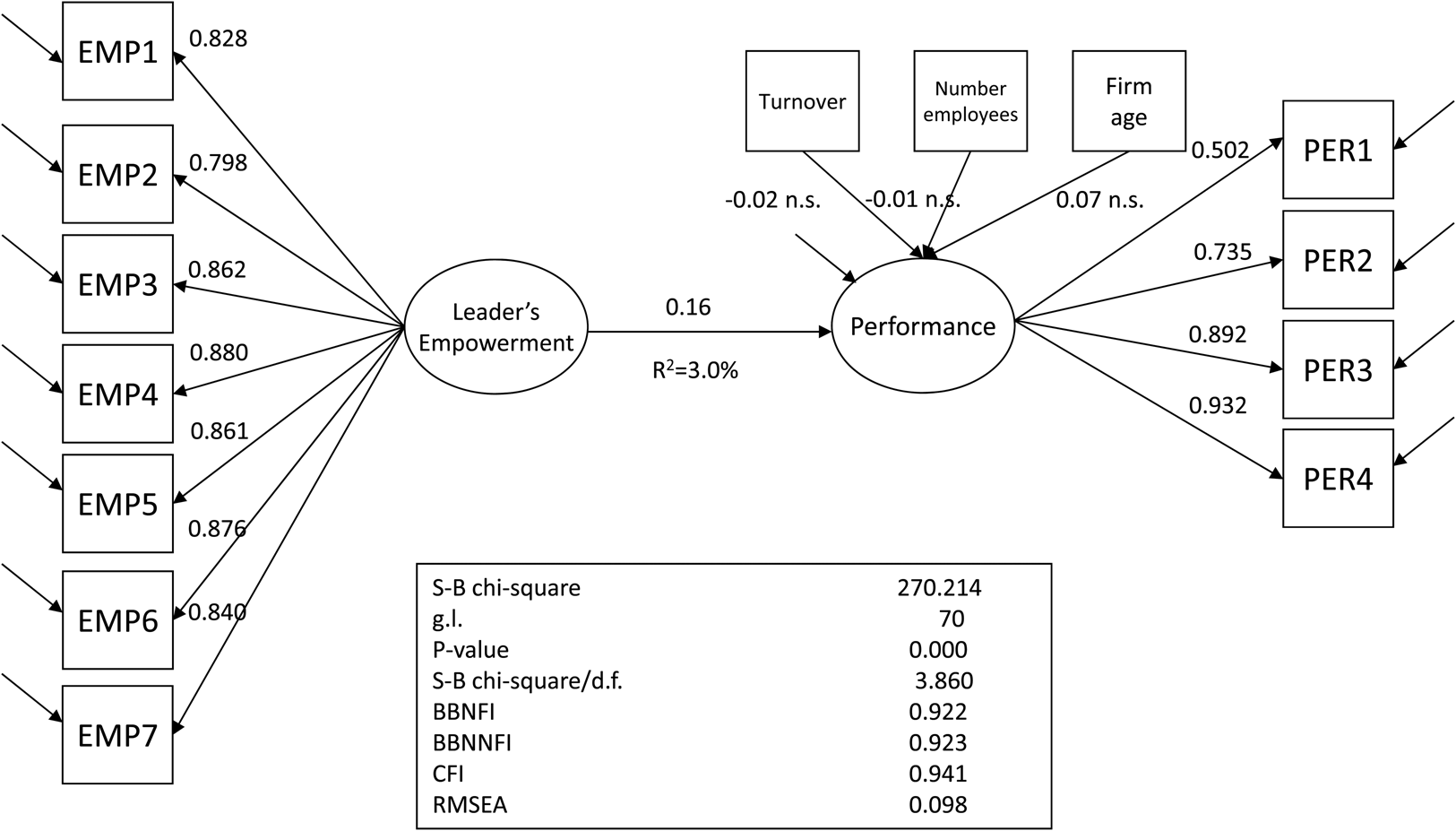
First, the results of the direct effect model are analyzed. All the standardized parameters are statistically significant (t ⩾ 1.96, for a significance level of .05), except in the case of the control variables. Results show a good fit of the direct effect model (Figure 2).
Direct effect model: empowerment and performance.

The direct effect model confirms the positive relationship between leaders' empowerment and performance. The value of the structural parameter corresponding to the effect of leaders' empowerment on performance is statistically significant (α = .16; t = 2.53). Based on the result, the first condition to validate the proposed model is satisfied, which allows to continue with the analysis and test the hypotheses suggested in the mediated model (Figure 3).
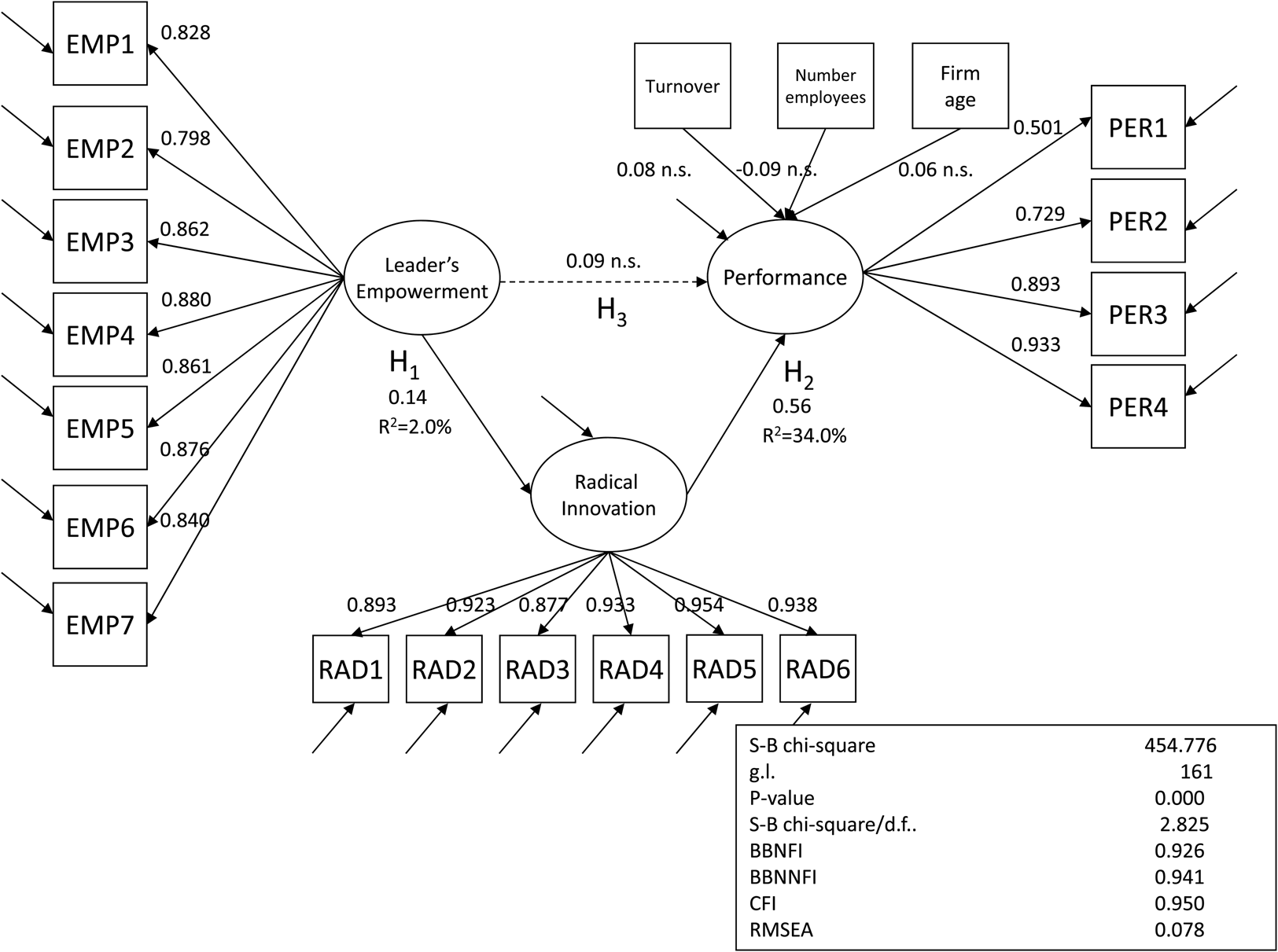
Mediating effect model.

Regarding the mediated model (Figure 3), and taking into account the χ2 values and the fit indices, it may be assured that this model also shows a good fit (SB χ2(d.f.) = 454.776 (161); p-value = .00; NFI = .93; NNFI = .94; CFI = .95; RMSEA = .08). As in the direct effect model, all the estimated parameters were significant, with t-values exceeding the minimum threshold of 1.96, except in the case of the control variables.
Regarding the conditions that must be fulfilled to confirm the mediation: the mediated model explains more variance than the direct effect model (.03 vs. .34); the significant relationship in the direct effect model between leaders' empowerment and performance (α = .16; t = 2.53; p < .01) decreases by including the mediating effect of radical innovation and becomes non-significant (β1 = .09; t = 1.61); there is a significant relationship between leaders' empowerment and radical innovation (β2 = .14; t = 2.26; p < .01), and between radical innovation and performance (β3 = .56; t = 7.21; p < .01).
Finally, bootstrapping analysis was conducted. The estimated indirect effect of leaders' empowerment on performance is .08. The 95% bias-corrected confidence interval for the indirect effect based on 5,000 bootstrap samples was entirely above zero (.01 to .15). Consequently, the indirect effect of leaders' empowerment on performance is significantly different from zero, so the null hypothesis of no mediation can be rejected. Consequently, the hypotheses are fulfilled and, in the light of the results, it can be assured that this is a full measurement model.
Discussion
The current research highlights the essential role played by leaders in the development of radical innovations that, in turn, improve organizational performance. Although there are evidences of the relationship between empowerment and innovation, to our knowledge, this is the first time that the relationship between leader's empowerment and radical innovation has been empirically tested. Given that differentiating between innovation typologies is important when studying the antecedents and consequences of innovation, this research represents a step forward and sheds light on how leaders who empower generate a context that may lead to radical innovation. By focusing on the mediating effect of radical innovation, this study covers a gap in the academic literature of empowerment, leadership and innovation.
Results confirmed all the hypotheses of the model, providing empirical evidence of the positive relationship between leader's empowerment and radical innovation (Hypothesis 1), confirming the positive effect of radical innovation on performance (Hypothesis 2), and disentangling the mediating effect of radical innovation in the relationship between leaders' empowerment and performance (Hypothesis 3).
We may conclude that with these results, the study theoretically contributes to the fields of leaders' empowerment, radical innovation and performance. This research contributes to empowerment and leadership literature by highlighting the importance of leaders' empowerment to foster radical innovation. The current study is part of the research that analyzes the effects of leadership on innovation. Although leadership is important to favor an appropriate context within organizations that promote innovation, little is known about how different leader behaviors influence innovation. Previous research has traditionally analyzed the effects of leadership styles, such as transformational or transactional, on innovation. However, modern approaches, such as empowering or servant leadership, have received less attention (Hughes et al., Reference Hughes, Lee, Tian, Newman and Legood2018). By focusing on empowerment as a specific leader behavior, this study sheds light on how, by empowering employees, leaders may promote radical innovation.
On the other hand, results make possible to broaden the literature about radical innovation antecedents, furthering the role played by leaders. In the latest years, several authors have emphasized the importance of continue analyzing the facilitators of radical innovation and demanded more research on the effects of leadership on radical innovation (Chang et al., Reference Chang, Chang, Chi, Chen and Deng2012; Domínguez-Escrig et al., Reference Domínguez-Escrig, Mallen Broch, Chiva Gomez and Lapiedra Alcami2016). By focusing on radical innovation, the conclusions of the current research contribute to expand the current knowledge about the relationships between leader's empowerment and its potential effects on creative and innovative outcomes in the business environment.
In addition, results confirm the potential of radical innovation to improve organizational performance. A great deal of research has shown that radical innovations are an important vehicle for organizations to achieve success and improve their performance. In the same vein, the conclusions of this study highlight the relevance of radical innovation to improve organizational results. Although radical innovation involve many risks and may potentially fail, the organizational context promoted by leaders' empowerment may facilitate the conditions in which this type of innovation is successfully developed.
Implications for practitioners
The study also has practical implications. To improve their results, companies may develop radical innovations. To achieve this type of innovation, a working environment in which leaders empower employees, show confidence in their capabilities and emphasize the importance of their work must be favored. To do this, it is necessary that leaders delegate authority, share power with employees, encourage subordinates to use their talents, give workers autonomy to take decisions, share information, promote the development of new ideas, support people to find their own solutions and give them opportunities to develop new skills. Additionally, these leaders must also identify all the conditions that may limit the potential of their employees and eliminate them (Conger & Kanungo, Reference Conger and Kanungo1988).
Taking into account the results of this study and former research, it appears that empowerment is a relevant means to improve organizational performance, so companies should facilitate this behavior within their structures. Empowerment in companies must be promoted through human resources policies and organizational culture (Conger & Kanungo, Reference Conger and Kanungo1988). Special attention should be paid to selection and training. Leaders should be selected according to their capability to motivate subordinates, to thrill them with the company project, to reduce rules and control, to promote autonomy and to reduce routine work. In addition, training programs should be focused on developing the skills that characterize empowering leaders.
The results achieved in the current study also provide some clues that may potentially contribute to improve the economic, commercial and social impact of organizations. By analyzing the factors that boost firm performance, it is possible to disentangle what are the elements that make some companies more competitive than others. These are organizations that may achieve leading positions in national and international economies, placing them in a situation in which may contribute to strengthen living standards. By developing radical innovations, organizations contribute to the economic growth of firms and nations (Büschgens, Bausch, & Balkin, Reference Büschgens, Bausch and Balkin2013), and may provoke a positive impact on society and environment (Shevchenko, Lévesque, & Pagell, Reference Shevchenko, Lévesque and Pagell2016), which can be maintained in the long-term. In addition, by highlighting the positive results that can be obtained through empowering leadership behaviors, the study offers evidence of how companies may improve workplace conditions by promoting a more positive, humane and virtuous leadership (Cheong et al., Reference Cheong, Yammarino, Dionne, Spain and Tsai2019).
Limitations and future research
Finally, the study has some limitations. Future research should be focused on other innovation typologies, such as incremental. Given the lack of empirical research that link leaders' empowerment to specific innovative typologies, it would be highly interesting to analyze if the results are limited to radical innovation or can be extrapolated to other types of innovation.
On the other hand, the scale used to analyze radical innovation was focused on new products. Taking into account that service or process innovations have different characteristics, future studies should compare between radical product, service and process innovations.
Besides, as the study was conducted in Spain, more research should be conducted in other countries. According to the European Innovation Scoreboard (2017), innovative performance differs among countries. This report differentiates between leader innovators, strong innovators moderate innovators and modest innovators. Spain is a moderate innovator so conducting this research in countries classified in other categories may provide an interesting comparative study.
On the other hand, organizational performance was measured through subjective assessment. A great deal of research defends the use of subjective variables to measure performance. However, objective indicators could be considered in future research to confirm the present results.
In addition, this research is focused on leaders who empower, so future studies could study the role of psychological and structural empower. Besides, there are other prosocial leader behaviors not considered in this study, such as humility or accountability, that may have a positive influence on innovation and performance. Further research should widen the knowledge of how leaders can enhance organizational results, improving the workplace conditions and being concerned of the consequences of their acts.
Besides, as in former research the relationship between leadership and innovation has been studied examining other variables, it is also suggested to consider other constructs when analyzing the relationship between leader's empowerment and radical innovation. For instance, following Hughes et al. (Reference Hughes, Lee, Tian, Newman and Legood2018), it would be interesting to study motivational, cognitive, organizational, affective and identification-based mechanisms as mediating variables, and team or organization context, and follower, leader or relationship attributes as moderator variables.
Moreover, although in this study special emphasis has been placed on motivational theories, researchers should also consider other theoretical perspectives to study the relationships suggested in the present model. For instance, social exchange theory, that analyzes how followers reciprocate leader's positive behaviors; social learning theory, that focus on how employees see their leaders as role models and try to emulate and imitate them; or social identity theory, which analyzes how employees feel engaged or identified with their organizations (Eva, Robin, Sendjaya, van Dierendonck, & Liden, Reference Eva, Robin, Sendjaya, van Dierendonck and Liden2019), may be interesting lines for future research, by studying how empower leader behavior affects helping behaviors, organizational trust or follower's identification, to name some variables, and their subsequent effects on performance and innovation.
Finally, the sample included companies with different turnover, size or age. Future research should take into account this limitation, and differentiate between large and SMEs, incumbent companies and start-ups, etc.
Acknowledgements
The authors thank the University Jaume I (Ref. P1.1B2013-14 and UJI-A2017-05) and the Spanish Ministry of Economy and Competitiveness (Ref. ECO2011-26780) for its financial support for this research.