The Kingdom of Saudi Arabia (KSA) has experienced several health disasters as a consequence of overcrowding, terrorist attacks, natural disasters, and epidemic diseases, such as the current coronavirus disease 2019 (COVID-19) health disasters. Reference Alzahrani and Kyratsis1,Reference Sham, Musa and Mohamed2 In response to the current COVID-19 pandemic, the Saudi Ministry of Health planned and applied preventive and precautionary actions that government agencies in Saudi Arabia delivered and monitored, especially the Ministry of Health (MOH), 3 which shows the deep crisis responsiveness and the government keenness to control the pandemic outbreak of the novel coronavirus. Moreover, the results of researchers found that the number of disasters has increased in recent years, Reference Al Khalaileh, Bond and Alasad4,Reference Tichy, Bond and Beckstrand5 Accordingly, health organizations and communities, both, face a significant challenge in the issue of responding to these disasters. Reference Hodge, Miller and Dilts Skaggs6
Background
Disaster is defined by the Asian Disaster Reduction Center, 7 as “a serious disruption of the functioning of society, causing widespread human, material, or environmental losses that exceed the ability of affected society to cope using only its resources”. Disasters not only cause loss of life and obliteration of public infrastructure, but moreover they may cause interruption of normal health-care delivery systems and appropriate response to disaster victims. Reference Bedford, Enria and Giesecke8 The negative results of these disasters need to be managed through development and implementation of management strategies, Reference Al Thobaity, Plummer and Williams9 Consequently, disaster management must be prepared, based on a clear plan and collaborative responses of different organizations. Reference Alshehri10
Disaster preparedness is the first stage of managing disaster, which is defined as “all measures and plans occupied before the occurrence of an event.” The preparedness stage comprises designing warning systems, planning for evacuation and transportation, storing water and food, holding disaster drills and exercises, building temporary shelters, and formulating management strategies. The second stage is the mitigation stage that involves activities undertaken to decrease the impact of a disaster, as hazard and risk assessment, vulnerability, allocation of financial resources, as well as employee cross-training. Reference Latifi and Doarn11 The third stage is the response stage that includes the timely implementation of the disaster plan, activation of incident command, mobilization of staff kits and equipment, treatment, and other relief activities, like providing medicines and shelter to the victims. The last stage is the recovery stage, which includes action taken to promote human welfare and restore properties and services. This stage can span from a few weeks to years to return the affected area to its normal predisaster livelihood. Reference Zhou, Emery and Flasch12 In hospitals, health-care providers structure the majority of the front-line responders in disaster, so they need to be actively involved and prepared to respond at all stages of disaster. Reference Alrazeeni13
A successful disaster response by health-care providers depends on appropriate disaster preparedness at all levels and specific resources. Reference Alrazeeni13 According to World Health Organization (WHO), 14 nurses and physicians as health-care providers play a vital role in disaster management, and they have the ability to promptly and efficiently discover, manage, and mitigate disaster events that may disturb patients’ physical, emotional, and psychological well-being. Disaster management and preparation must take place because disasters strike without any warning (National Association of EMS [emergency medical services] Physicians). 15 For this reason, nurses and physicians must be prepared for disaster to improve their confidence, knowledge, and clinical skills. This preparedness can be achieved through extensive disaster management education programs, disaster drills, and exercises, as well as incorporating disaster management into health undergraduate curricula. Reference Al Khalaileh, Bond and Alasad4
Significance of the Study
Within late past year, a new coronavirus was recognized in Wuhan City, Hubei Province, China (World Health Organization), 16 which is affecting amassed numbers of illnesses and death worldwide. This novel virus outbreak, a “public health disaster of international concern,” has now been declared a “global pandemic” by the WHO. Reference Wu and McGoogan17 In the first quarter of 2020, the COVID-19 global pandemic, started to be identified in KSA by cases who returned from the infected counties with the novel COVID-19, and the infected cases started to be detected on a daily basis, which were recorded and published by the ministry of health. Hospitals resources and services became affected by the global pandemic with high spreading rates in a very short amount of time. Reference Ru, Yang and Zou18 Consequently, this pandemic crisis has a high rate of spreading in KSA and affected the governorate health-related resources and even the annual Hajj season management as it is closed to only people from KSA only. Therefore, the occurrence of disasters, like the above-mentioned, shows an increased concern regarding preparedness for disaster management.
Frontline health-care providers in hospital departments play a crucial role in responding to disasters, and their knowledge and skills are essential to accomplish this significant clinical role. Health-care providers perform an imperative role in disaster preparedness, such as public awareness to condense disaster vulnerability and working in a disaster situation. Reference Alzahrani and Kyratsis1 When a disaster occurs, health-care providers are required to have adequate skills related to disaster management. Although the study suggests that health-care providers are often not adequately prepared to deal with disaster-related responsibilities. Reference Grimes, Sparke and Rouen19 Accordingly, the study results would be a valuable contribution to understanding the knowledge of disaster management stages preparedness for health-care providers in the Saudi context.
In this cross-sectional study, researchers aimed to assess and compare nurses’ and physicians’ knowledge of disaster management preparedness, using The Disaster Preparedness Evaluation Tool (DPET). A tool specifically developed to assess the health-care providers’ knowledge of disaster preparedness. Reference Tichy, Bond and Beckstrand5 The research question addressed by the current study was, “what is the level of nurses’ and physicians’ knowledge of disaster management preparedness?”
Methods
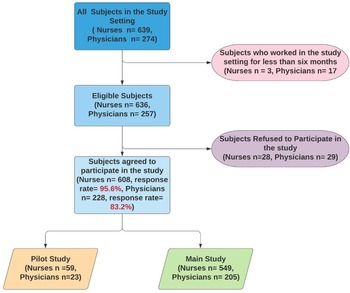
This is a quantitative, cross-sectional, comparative, descriptive research design. This study was conducted in a conveniently selected University Hospital in Riyadh, Saudi Arabia. The hospital includes a total of 300 beds and has outpatient clinics, hypnosis chambers, an emergency department, a maternity health center, an adolescent health center, and a child growth and development center. Participants of the current study were nurses and physicians who were working in the study setting for more than 6 months, regardless of their clinical department (Figure 1). Data were collected over 4 months (February 2020 to May 2020) using an online questionnaire with an introduction about the concept of real disaster and the importance of the study. The questionnaire assessed participants’ demographic data, and their knowledge regarding the disaster management process, and took approximately 20 min to be completed. Before data collection, a pilot study was conducted on 10% of the study sample (Figure 1) to examine the feasibility of the study. Participants in the pilot study were excluded from the study sample. The pilot study confirmed the clarity of study tools and feasibility of the study method.
Sampling flowchart.

Measurement
The DPET Reference Tichy, Bond and Beckstrand5 was originally developed to examine the preparedness of participants in disaster management. It was used to assess nurses’ and physicians’ knowledge regarding preparedness in managing disaster through 54 items grouped under 2 parts. The first part of the tool was 9 items (open-ended and close-ended questions) about demographic data and additional questions related to disaster preparedness as gender, age, educational level, working unit, years of experience, attendance of previous real disaster, and their qualification during the response of this disaster, and in addition, the training areas they need for disaster preparedness. The second part of the tool included 45 items that were about disaster stages rated on a 5-point Likert- type scale, ranging from strongly disagree (1) to strongly agree (5).
Validity and Reliability
Because all participants were university graduates with high proficiency in English, the instrument was used in the English language. The questionnaire was tested for reliability by evaluating the items’ internal consistency using Cronbach’s alpha coefficient test. Of the DEPT tool, 25 items (α = .921) were related to disaster preparedness stage, and it is divided into 3 dimensions: disaster knowledge 16 items (α = .924); skills 7 items (α = .933); and family preparedness 2 items (α = .906). The next 14 items were related to mitigation and response stage (α = .953), which measures response to disaster and divided into 2 dimensions: knowledge 3 items (α = .950); and patient management 11 items (α = .955). The last 6 items in the second section are related to the recovery stage (α = .923). These 6 items were divided into 2 dimensions: knowledge with 1 item (α = .920); and patient management in 5 items (α = .925). We calculated the average score for each stage, and the total scale score (α = .979) was the average of the 3 stages; higher scores indicate higher knowledge of disaster management preparedness. Also, a pilot study was conducted on a sample of nurses (10%) to sustain the validity and reliability of the questionnaires, which resulted in no change.
Statistical Analysis
After data collection, it was revised, coded, and fed to statistical software SPSS IBM version 23. All statistical analyses were done using 2-tailed tests and an alpha level of 0.05. The following statistical tests were used: descriptive statistics in the form of frequencies and percentages were used to describe the categorical data variables and mean with standard deviation for scale data. To test the differences between nurses’ and physicians’ knowledge about disaster preparedness, independent samples t-test was used. The Pearson coefficient test was used to correlate between 2 normally distributed quantitative variables and Cronbach’s alpha.
Reliability statistics were assessed using Cronbach’s alpha test. An analysis of variance (ANOVA) test was used to detect the difference between the variables’ means. Linear regression was used to predict a dependent variable (nurses’ and physicians’ overall knowledge) based on continuous and/or categorical independents (demographic and work-related characteristics).
Ethical Approval
Institutional Review Board (IRB) approval was obtained from the University, Riyadh, Saudi Arabia (No. H-01-R-059 – 19-0181). Written approval to conduct the study was obtained from the administrative authority of the study setting. The first page of the questionnaire explained the study purpose, provided assurance regarding the voluntary and confidential nature of responses, and stated that researchers would regard the completion and submission of the questionnaire as consent to participate.
Results
The study subjects were composed of female nursing staff (n = 549) and physicians (n = 205; 95.1% were female). A total of 46.1% of nursing staff and 42% of physicians were aged younger than 30 y, with mean scores 34.34 ± 6.26 and 33.57 ± 6.04, respectively. Generally, 87.6% of nursing staff and 82% of physicians held bachelor’s degrees in their specialties. Study subjects were working in different units, with approximately 45% of nursing staff and 47.3% of physicians were working in medical units. Furthermore, 59% of nursing staff and 53.2% of physicians had more than 5 y of experience with a mean score of 10.18 ± 4.44, and 9.69 ± 4.82, respectively. Also, more than two-thirds (64.1%) of nursing staff and 82% of physicians have not participated in a real disaster, as well as more than half (51%) of nursing staff and more than two-thirds (66.8%) of physicians had no previous experience in dealing with disasters. Likewise, more than two-thirds of the study subjects (68.3% for both nursing staff and physicians) had previous training experience about disasters and how to manage it. Additionally, most of the nursing staff (88.5%) and physicians (98%) had no participation activities in the Hajj season (Supplementary Table 1).
The overall mean score of the participants on the overall disaster management preparedness was 3.58 ± 0.63; denoting that the participants had to some extent knowledge regarding the information and practices required in the disaster management process. There was no significant difference between the overall mean disaster management preparedness scores of nursing staff (3.56 ± 0.59) and of physicians (3.53 ± 0.41; P = 0.377). The highest mean scores were found on the disaster preparedness stage as rated by the participants (3.64 ± 0.56) and (3.64 ± 0.33), respectively, with no significant difference (P = 0.985). On the contrary, the least participants’ scores were found on disaster recovery stage (3.41 ± 0.67), representing as 3.41 ± 0.70 among the nursing staff and 3.41 ± 0.58 among physicians with no significant difference (P = 0.919) (Table 1).
Mean scores distribution of study subjects’ knowledge of disaster management preparedness and its stages

* Statistically significant at P ≤ 0.0.
The study subjects reported that they need training in different areas related to disaster management preparedness, representing by sequence as follows: (17.1%) Emergency Situations Preparedness/Trauma Mass Causality/ Triage Disaster Management System; (17.1%) Disaster Management Process; (14.3%) External Disasters Preparedness/ Man-Made Disaster (ie, Terrorist Attacks Management)/ Evacuation Plans; (14.2%) COVID-19 Health Disaster Preparedness; (11.4%) Fire Management System Training, Fire and Safety Management, Patient Safety/ Risk And Hazard Management; (8.6%) Policy of Disaster Management/ Supply Chain Disaster Management; (5.8%) ACLS/ BLS; (5.7%) First Aid; (2.9%) Hajj Disaster Preparedness; and (2.8%) Updates of Disaster Management/ Updates in Area of Specialty (Supplementary Table 2).
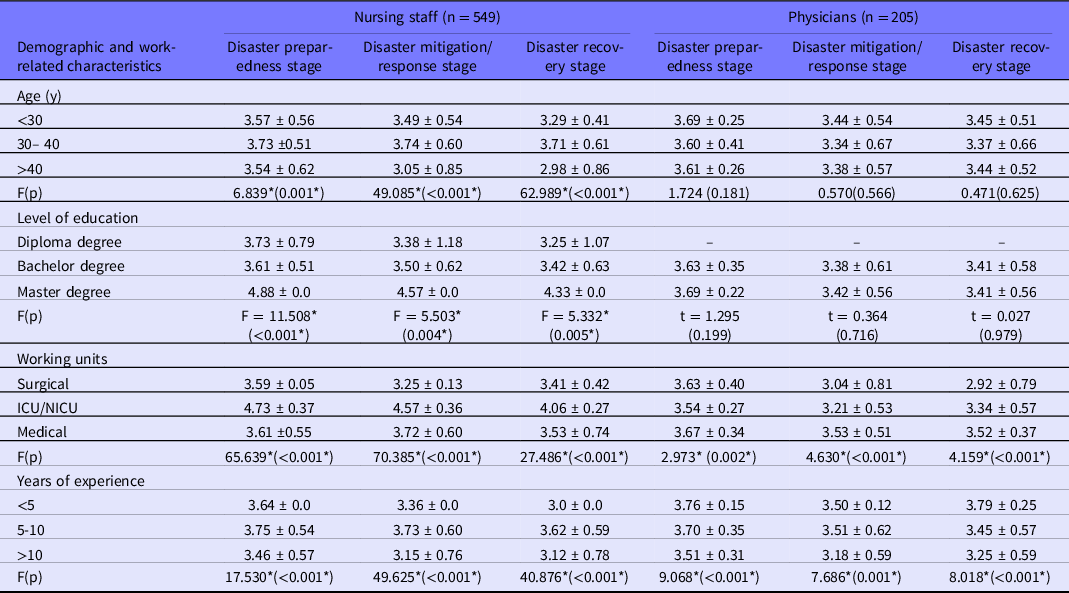
For the disaster preparedness stage, there was a significant positive relationship between nursing staff knowledge of this stage and all their demographic and work-related characteristics (P < 0.001). Physicians, had a significant positive significant relationship between their knowledge of the disaster preparedness stage and both of their working units and years of experience as P = 0.002 and P < 0.001, respectively. With regard to the disaster mitigation/response stage, there was a significant positive relationship between nursing staff knowledge of this stage and their age, level of education, working units, and years of experience as P < 0.001, P < 0.004, P < 0.001, and P < 0.001, respectively. In comparison with physicians, there was a positive significant relationship between their knowledge of disaster mitigation/ response stage and both of their working units and years of experience as P < 0.001, and P < 0.001, respectively. In the disaster recovery stage, there was a significant positive relationship between nursing staff knowledge of this stage and their age, level of education, working units, and years of experience as P < 0.001, P < 0.005, P < 0.001, and P < 0.001, respectively. While among physicians, there was a significant positive relationship between their knowledge of disaster recovery stage and both of their working units and years of experience as P < 0.001, respectively (Table 2).
Correlation between study subjects’ demographic and work-related characteristics and their knowledge of disaster management preparedness stages

Note: t, Student t-test; F, F for ANOVA test; p, P-value for association between different categories.
* Statistically significant at P ≤ 0.05.
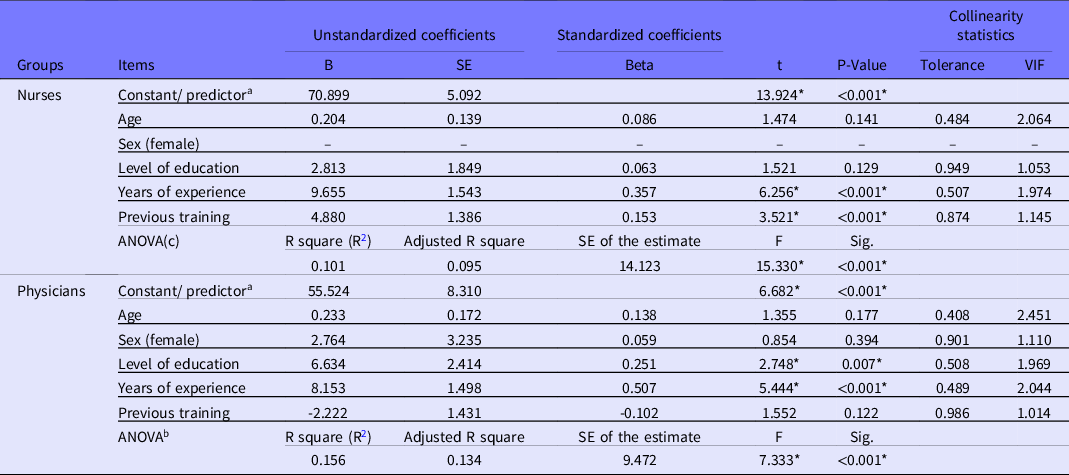
About nurses, Table 3 reflects that the regression analysis model shows that the R2 = 0.101 which means that only 10.1% of nurses’ overall knowledge is explained by their demographic and work-related characteristics with F-value = 15.330 (P < 0.001), this indicates that the model is significant. Also, there is a highly significant variance in the degree of the associations of overall nurses’ demographic and work-related characteristics (independent variables) with the dependent variable. In predicting nurses’ overall knowledge, it is found that their overall knowledge was significantly associated with their level of education and previous training experience (β = 0.357; t = 6.256; P < 0.001). This means that nurses with greater years of experience who attended previous disaster training have more knowledge of the overall of disaster management preparedness. The regression analysis model shows that R2 = 0.156; this suggests that 15.6% of physicians’ overall knowledge with disaster management preparedness is explained by their demographic and work-related characteristics with F-value = 7.333, (P < 0.001). The model is highly significant, as there was a significant variance in the degree of associations of overall physicians’ demographic and work-related characteristics (independent variable) with the dependent variable. Furthermore, in predicting physicians’ overall knowledge, it was found that years of experience is the strongest, significant variable associated with physicians’ knowledge (β = 0.507; t = 5.444; P < 0.001) followed by their level of education (β = −0.251; t = -2.748; P = 0.007).
Mixed linear regression models of demographic and work-related characteristics and overall of nurse’s and physician’s knowledge of disaster management preparedness

a Predictors: (constant), age, sex, education, experience, and training.
b Dependent variable: overall disaster management preparedness.
Discussion
The results verified that the overall mean score of the participants on the overall disaster management preparedness was 3.58 ± 0.63 with a high mean score regarding the disaster preparedness stage. This denotes that the participants had to some extent knowledge regarding the information and practices required in the disaster management process. This result is understandable when more than two-thirds of the participants in the present study claimed that they were not participated in a real disaster, and had no previous experience in dealing with disasters. However, more than two-thirds of the study subjects had previous training experience about disasters and how to manage them. Additionally, the majority of the nursing staff (88.5%) and physicians (98%) had no participation activities in the Hajj season. Also, it was not well documented how and to what extent nursing and medical schools were teaching this content in their curricula and to what extent participants learned about disaster plans in their workplace. This result is consistent with Nofal et al. Reference Nofal, Alfayyad and Khan20 and Goniewicz et al. Reference Goniewicz, Goniewicz and Burkle21 who found that overall, physicians and nurses’ revealed a satisfactory level of knowledge in disaster preparedness 6.2 ± 2.5. In contrast with findings was reported by Seyedin et al. Reference Seyedin, Abbasi Dolatabadi and Rajabifard22 who found that the average perceived knowledge was 2.43 ± 1.01. Gerber and Robinson Reference Gerber and Robinson23 found that the perceived preparedness of physicians for disaster management and response is not as high as it should be, and most of the respondents perceived their disaster preparedness as insufficient.
It was found that participants’ knowledge with the disaster preparedness stage-related activities, disaster knowledge and skills specific to preparedness, and family preparedness for disaster were recorded as the top-ranked areas for both physicians and nurses. The possible explanation of this result may be due to their awareness that they need to participate in regular disaster drills at work to increase their level of preparedness for health-care--related disasters. This result is consistent with Al-Ali and Abu Ibaid Reference Al-Ali and Abu Ibaid24 who noted that health-care providers in Jordan, had a basic understanding of disaster drills. Holding disaster drills and exercise is one of the best strategies for ensuring health-care providers to fulfill their obligations in disaster response. In addition, Halterman Reference Halterman25 stressed that it is important to have regular drills to test health-care providers’ preparedness in response to disaster events and improve their disaster plans. According to Joint Commission, 26 regular disaster management drills should be required at least once or twice a year.
Regarding the nurses’ and physicians’ knowledge of disaster management preparedness stages, according to their demographic and work-related characteristics, the results revealed that there is a significant difference between the study participants’ knowledge of disaster management preparedness, mitigation/response and evaluation stages with their level of education, years of experience, and working units. Nurses and physicians who were working in an intensive care unit (ICU) with a master’s degree in their specialty and had 5 to 10 y of experience significantly higher mean scores regarding preparedness, mitigation/ response, and evaluation stages in disaster management than other units. This result may be because emergency health-care providers play a significant role during a disaster. On the other hand, nurses and physicians in this role could be familiar with some tasks required in disasters during their daily duties. Also, disasters that are exposed in the emergency department are varied. This finding is in the same line with Nilsson et al. Reference Nilsson, Johansson and Carlsson27 who found that there was an association between nurses’ readiness for disaster and their work area. The study indicated that it is very important to work in an environment where the possibility of being exposed to disaster situations is more helpful to competence development. In contrast, Seyedin et al. Reference Seyedin, Abbasi Dolatabadi and Rajabifard22 found that no relationship was found between nurses’ demographic data (age, gender, and their experience in ED) and their level of knowledge.
Study participants significantly stated that they need training in different areas related to disaster management preparedness, representing by sequence as following: Emergency Situations Preparedness/Trauma Mass Causality/ Triage Disaster Management System, Disaster Management Process, External Disasters Preparedness/ Man-Made Disaster (ie, Terrorist Attacks Management)/ Evacuation Plans, COVID-19 Health Disaster Preparedness, Fire Management System Training, Fire and Safety Management, Patient Safety/ Risk And Hazard Management.
The policy of Disaster Management and Supply Chain Disaster Management, ACLS/ BLS, First Aid, Hajj Disaster Preparedness, and Updates of Disaster Management/ Updates in Area of Specialty. Hsia et al. Reference Hsia, Mbembati and Macfarlane28 reported similar findings that as few as 14% of hospitals (and as high as 76%) among the surveyed hospitals in sub-Saharan Africa, these hospitals require training about disaster management. Kitt et al. Reference Kitt, Selfridge-Thomas and Proechl29 found that much planning, drilling, evaluating, revising, and preplanning are required to successfully handle sudden events that injure humans, destroy property, and overwhelm responders. Hospitals must not only have an external disaster plan, but a plan for internal disasters as well. Likewise, Baack and Alfred Reference Baack and Alfred30 found that most nurses are not confident in their abilities to respond to major disaster events. The confident nurses were more likely to have had actual prior experience in disaster situations. Nurses have always been key players throughout epidemic situations by executing contact tracing and accompanying case investigations, engaging in surveillance, reporting and collecting specimens, administering immunizations, and educating the community. Because most health professionals do not react to emergencies daily, it was essential for them to identify the core capabilities required to become a part of an emergency response team and execution team. Reference Baack and Alfred30 To that effect, the International Nursing Coalition for Mass Casualty Education (INCMCE) (Vanderbilt University, 2003) was proven to take on the task of clarifying exactly what should be included in the undergraduate nursing curriculum to assure communities that their professional nurses were competent to respond when needed.
According to the mixed linear regression models related to disaster management preparedness, the results revealed that 10.1% of nurses’ and 15.6% of physicians’ overall knowledge is explained by their demographic and work-related characteristics. This result may be because participants are periodically oriented and trained to be prepared and be able to react in disaster situations moreover, they had bachelor degrees which enable them in acting professionally. These results were regular with the study by Shahzad et al. Reference Shahzad, Irfanullah and Khan31 who detected that training had a positive effect on the disaster management process. It was also supported by Park, Reference Park32 who revealed that education level and educational program improved disaster awareness and preparedness.
Implications for Practice and Management
The current results suggest that managers who support nurses and physicians to conduct a real disaster drill periodically to be prepared for facing and dealing with real health-related disasters would see greater benefits in terms of effective disaster management. The results of the current research will guide the administrators on the national health standards and protocols, and strategic and operational plans for practicing with the adequate number of qualified workforces in disaster and emergency preparedness as well as coordination between health-care organizations regarding disaster and emergency preparedness.
Limitations of the Study
However, certain limitations merit mention. First, the study sample was selected on convenience from a single site; therefore, the generalizability of the results is limited. Second, the current results are based on self-reported data, and thus, they are at risk of response bias and subjectivity. Finally, this study provides the only evidence of associations between study variables, a directionality or a causal relationship cannot be inferred.
Conclusions
The current study examined nurses’ and physicians’ knowledge of disaster management preparedness in Saudi Arabia. The results demonstrated that the participants had some knowledge regarding the information and practices required in the disaster management process. Also, 10.1% of nurses’ and 15.6% of physicians’ overall knowledge is explained by their demographic and work-related characteristics. Future longitudinal, experimental, and multi-site studies are needed among health-care professionals in Saudi Arabia.
Supplementary material
To view supplementary material for this article, please visit https://doi.org/10.1017/dmp.2022.34
Authors contributions
S.M.F.: Conceptualization, data analysis, data interpretation, and manuscript draft. N.B.: Conceptualization and manuscript draft. S.M.F. and A.A.: Data collection. S.M.F. and N.B.: Process of drafting.
Funding
This research was funded by the Deanship of Scientific Research at Princess Nourah bint Abdulrahman University through the Program of Research Project Funding After Publication, grant No (41-PRFA-P-17)
Conflict(s) of interest
The authors have no conflicts of interest to disclose.