Introduction
The first successful preservation of the facial nerve during complete excision of a vestibular schwannoma has been attributed to Sir Hugh Cairns, who reported the procedure in 1931.Reference Cairns1 McKissock reported a remarkable series of facial and cochlear nerve preservation in 1965 without the aid of magnification.Reference McKissock2 However, the introduction of the operating microscope around the same year by William House was an important milestone in vestibular schwannoma surgery.Reference House3 Microsurgical advances paved the way to fulfilling the primary goal of vestibular schwannoma surgery, which is complete tumour removal with minimal morbidity and mortality.Reference Hardy, Macfarlane, Baguley and Moffat4
Many centres throughout the world now achieve high rates of facial nerve preservation and good post-operative facial nerve function.Reference Moffat, Croxson, Baguley and Hardy5–Reference Brackmann, Cullen and Fisher12 Unfortunately, anatomical continuity of the facial nerve does not always result in good long-term facial recovery. Any corrective surgery should be undertaken relatively early for the most favourable results.
It is important when counselling patients pre-operatively to inform them of the likely outcome with regard to facial nerve function, including nervus intermedius function,Reference Irving, Viani, Hardy, Baguley and Moffat13 as this is an important pre-determinant of post-operative quality of life. It will also form part of an evidence base for the surgical modality of management in comparison with the other two modern modalities of observation with interval imaging and stereotactic radiotherapy. It is not only important for the surgeon to be able to quote his or her own facial nerve outcome figures, but also to be cognisant of the predictive factors which influence facial nerve outcome in vestibular schwannoma surgery.
This detailed study of a large series of patients over three decades was an attempt to identify patient and surgical variables which influence facial nerve outcome and quality of life after vestibular schwannoma excision.
Materials and methods
This study involved a retrospective case note analysis of a series of patients with a unilateral sporadic vestibular schwannoma and pre-operatively normal facial nerve function (House–Brackmann grade I). Patients were treated surgically, using either a translabyrinthine or a retrosigmoid approach. Surgery was carried out by the senior authors (DAM, with either DGH or RM) between the years 1981 and 2010 at Addenbrookes, Cambridge University Teaching Hospital.
Clinical data were collected from a 250-point database using Filemaker Pro 6 initially and more recently Filemaker Pro 10 software. Patients with neurofibromatosis type 2, those receiving pre-operative stereotactic radiotherapy and those patients with recurrent tumour referred from other units were excluded from this analysis.
Patients
The surgical series consisted of 652 patients with histologically proven, sporadic, unilateral vestibular schwannomas. There were 321 male patients and 331 females. The age range was 13 to 86 years, with a mean of 53.8 years and a standard deviation of 12.6 years. The age distribution in decades can be seen in Figure 1.
Age distribution in decades (n = 652).

Tumour size was assessed in terms of the maximum diameter of the mediolateral tumour including the intracanalicular portion; the series extends back to 1981 and this was the method used at that time. The authors are cognisant of the more recent measure of maximum intracranial tumour diameter,Reference Tos, Thomsen, Kanzaki, Tos, Sanna, Moffat, Kunihiro and Inoue14 where solely intracanalicular tumours (vestibular schwannoma = 0 mm) are stated as such. For the sake of consistency, we used the former measurement method throughout. Maximum tumour size was measured in centimetres for each individual tumour and also classified in increments (i.e. less than 1.5 cm, 1.5–2.4 cm, 2.5–3.4 cm, 3.5–4.4 cm and 4.5 cm or larger) (Figure 2).
Tumour size (n = 652).
There were 563 (86 per cent) translabyrinthine and 89 (14 per cent) retrosigmoid operations performed.
Outcome measures
Facial nerve function was assessed at three months, and at one, two and five years post-operatively. The final facial nerve outcome was recorded at two years post-operatively for this data analysis.
Facial nerve function was assessed using the House–Brackmann grading system.Reference House and Brackmann15 Totally normal function is classified as House–Brackmann grade I; however, in line with some recently reported series, grades I and II were both considered normal. Grades I–III were classified as a satisfactory outcome and grades IV–VI as unsatisfactory at 24 months after surgery. An analysis of the facial nerve outcome at 24 months post-operatively for the translabyrinthine approach and separately for the retrosigmoid approach was carried out for each tumour size increment (i.e. less than 1.5 cm, 1.5–2.4 cm, 2.5–3.4 cm, 3.5–4.4 cm and 4.5 cm or larger), both in total numbers and percentages. Facial nerve outcome for both approaches was tabulated based on the percentages of patients with House–Brackmann grades I and II, I–III, and IV–VI.
The rate of facial nerve anatomical preservation was recorded, and the type of facial reconstruction and functional outcome was documented in those few cases where the facial nerve was lost. Nervus intermedius function and aberrant regeneration of the facial nerve, in the form of altered taste and crocodile tear incidence rates, were assessed at 3 and 24 months post-operatively, along with the rates of symptom development and recovery.
Magnetic resonance imaging was performed at two and five years post-operatively.
Chi-square tests for trend were used to determine the individual effects of gender, tumour size (categorical) and operation approach on facial nerve outcome. (A chi-square test for trend is a version of the ordinary Pearson's chi-square test that takes into account the ordinal nature of the facial nerve outcome variable.) A chi-square test for trend was also used to compare House–Brackmann grading in the first decade (1981–1990) with that in the second and third decades (1991–2010).
Data on exact tumour size were available for 652 out of 1018 patients on the database (64 per cent); this was used to confirm the results using categories of tumour size. In order to determine whether there was a significant relationship between House–Brackmann grading and tumour size, a linear regression model was applied to the exact tumour size data, with facial nerve outcome entering the model as a predictor variable. Similarly, a linear regression method was used to evaluate the effect of age on facial nerve outcome.
Multivariate analysis was used (in the form of a multiple logistic regression) to investigate predictors of satisfactory facial nerve outcome (House–Brackmann grades I–III), and to determine if variables found to be significant univariately remained so after adjusting for other important variables.
A multiple logistic regression model was fitted to facial nerve outcome, with sex, age, operative approach and years of operation after 1981 included as exploratory variables in the model. Tumour size was also included in the model as an exploratory factor variable, wherein different levels corresponded to the pre-defined tumour size groups, with a tumour size of less than 1.5 cm as the reference category. The results were also analysed using exact tumour size. A male group was used as the reference group for gender. The translabyrinthine approach was used as the reference group for operative approach.
Odds ratios were presented with 95 per cent confidence intervals (CIs) and p-values.
It was important to determine if there was a trend in improvement over time, particularly in relation to a surgical learning curve. Outcome was thus also analysed in the form of a bar chart with three-year surgical segments, and by an assessment of facial nerve outcome according to tumour size increments for the most recent six years of surgery, in tabloid form.
The extent of the excision was classified as total, near total, subtotal or partial. Total removal was complete excision of the tumour. Near total was defined as complete excision apart from tiny remnants of capsule on a cranial nerve or brainstem. Subtotal excision meant that greater than 95 per cent of the tumour had been removed and partial excision referred to cases where less than 95 per cent of the tumour had been removed. The categorisation of the extent of tumour excision can be seen in Figure 3. The facial nerve outcome (quantified as normal, satisfactory or unsatisfactory, as previously defined), was determined in relation to the extent of the excision.
Extent of tumour excision (n = 652).
Results
The 24-month post-operative functional facial nerve outcomes following translabyrinthine surgery, for the various increments of tumour size, can be seen in Table I.
Translabyrinthine surgery outcome: HB grade by tumour size*
* Refers to outcomes at 24 months (total n = 563). HB = House–Brackmann
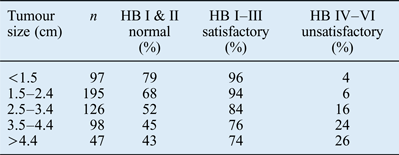
A summary of the outcomes for translabyrinthine cases in terms of House–Brackmann grades I and II classified as normal, grades I–III classified as satisfactory, and grades IV–VI classified as unsatisfactory can be seen in Table II.
Translabyrinthine surgery outcome: HB category by tumour size*
* Refers to outcomes at 24 months (total n = 563). HB = House–Brackmann
For tumours less than 1.5 cm in size, 79 per cent of translabyrinthine cases had a normal functional outcome, 96 per cent were satisfactory and only 4 per cent unsatisfactory. For tumours 1.5–2.4 cm in size, 68 per cent of cases had a normal outcome, 94 per cent were satisfactory and 6 per cent unsatisfactory. For tumours 2.5–3.4 cm in size, the rates dropped to 52 per cent for normal outcomes, 84 per cent for satisfactory outcomes and 16 per cent for unsatisfactory outcomes. For tumours 3.5–4.4 cm in size, 45 per cent of cases had normal outcomes, 76 per cent were satisfactory and 24 per cent were unsatisfactory. For very large tumours greater than 4.4 cm in size, 43 per cent of cases had a normal outcome, 74 per cent were satisfactory and 26 per cent were unsatisfactory.
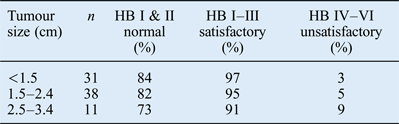
The results of a similar analysis conducted for the smaller number of retrosigmoid cases are shown in Table III. It is important to note that we reserve the retrosigmoid approach for patients with smaller tumours who have opted for hearing preservation surgery; the numbers of tumours sized 3.5–4.4 cm, or 4.5 cm or larger were too small to be meaningfully analysed.
Retrosigmoid surgery outcome: HB grade by tumour size*
* Refers to outcomes at 24 months (total n = 89). HB = House–Brackmann
A summary of the outcomes for retrosigmoid cases in terms of House–Brackmann grades I and II classified as normal, grades I–III classified as satisfactory, and grades IV–VI classified as unsatisfactory can be seen in Table IV.
Retrosigmoid surgery outcome: HB category by tumour size*
For tumours 3.5–4.4 cm, or larger than 4.4 cm in size, there were too few cases to analyse meaningfully.
* Refers to outcomes at 24 months (total n = 80). HB = House–Brackmann
For tumours less than 1.5 cm in size, 84 per cent of retrosigmoid cases had a normal functional outcome, 97 per cent were satisfactory and only 3 per cent unsatisfactory. For tumours 1.5–2.4 cm in size, the outcome rates were 82 per cent for normal outcomes, 95 per cent for satisfactory outcomes and 5 per cent for unsatisfactory outcomes. For tumours 2.5–3.4 cm in size, 73 per cent of cases had a normal outcome, 91 per cent satisfactory and 9 per cent unsatisfactory.
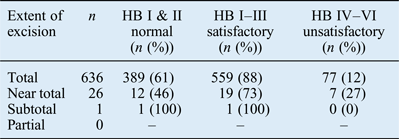
Total tumour excision was achieved in 85 per cent of cases, near total excision in 12 per cent and subtotal in 3 per cent. There were no partial excisions. The data for facial nerve outcomes categorised as normal, satisfactory or unsatisfactory, for total, near total and partial excisions, can be seen in Table V.
Facial nerve outcome: HB category by extent of tumour excision*
* Refers to outcomes at 24 months (total n = 652). HB = House–Brackmann
Total tumour excision was achieved in 636 patients: 61 per cent (n = 389) had a normal facial nerve outcome, 88 per cent (n = 559) had a satisfactory outcome and 12 per cent (n = 77) had an unsatisfactory outcome. We usually attempt total tumour excision and where there is a less than total excision it is because we wish to preserve facial nerve function and optimise post-operative quality of life. Near total excision, where remnants of tumour are left on the facial nerve, root entry zone or brainstem, indicates adherence of the matrix to one or more of these structures and reflects difficulty in dissection. This is reflected in the outcome rates of 46 per cent (n = 12) for normal facial nerve outcomes, 73 per cent (n = 19) for satisfactory outcomes and 27 per cent (n = 7) for unsatisfactory outcomes. There was only one subtotal excision and no partial excisions.
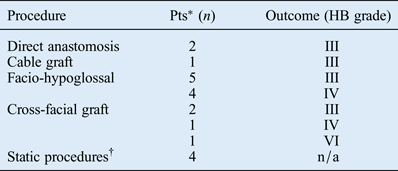
Ninety-seven per cent (n = 632) of facial nerves were intact at the end of surgery and 3 per cent (n = 20) were lost. The type of facial nerve repair, the post-operative functional facial nerve outcome and the static procedures performed can be seen in Table VI. The most satisfactory results were obtained by direct anastomosis, but it is often not possible to obtain enough length to perform this procedure without placing the nerve repair under too much tension.
Outcome of facial nerve reanimation procedures
*Total n = 20. †These were: gold weight eyelid, fascial sling and face lift. Pts = patients; HB = House–Brackmann; n/a = not applicable
Univariate analyses
Patient gender
There was no statistically significant difference in facial nerve outcome between males and females at the 5 per cent level of significance. The resulting test statistic for the chi-square test by trend was 3.54, with a corresponding p-value of 0.06.
Patient age
There appeared to be a significant increase in age with increasing House–Brackmann score, as revealed by simple linear regression analysis (t = 1.99, p = 0.047). This was significant only for univariate analysis (and not multivariate analysis).
Tumour size in increments
As expected, the facial nerve outcome was worse for larger tumours compared with smaller ones (based on analysis of 1 cm increments). The chi-square test statistic for the association between tumour size and facial nerve outcome was 82.6, with a corresponding p-value of less than 0.0001. There was thus a strongly significant relationship between tumour size and facial nerve outcome.
Exact tumour size
A linear regression model was applied to the data for exact tumour size (based on millimetre measurements) with facial nerve outcome as the predictor variable for the purposes of this test. Linear regression generated a t-statistic of 7.31 with a p-value of less than 0.0001, and there was a highly significant relationship between tumour size and facial nerve outcome.
Operative approach
A chi-square test by trend yielded a test statistic of 9.13 with a corresponding p-value of 0.003. Thus the retrosigmoid approach appeared to result in a statistically better facial nerve outcome. However, this was not the case when tumour size, age, sex and year of operation were adjusted for. This was probably because only patients with small tumours who opted for hearing preservation surgery underwent a retrosigmoid procedure.
Decade of surgery
Facial nerve outcomes following surgery in the first decade (1981–1990) were significantly worse than those in the succeeding two decades (1991–2010). A chi-square test by trend produced a statistic of 63.9 with a corresponding p-value of less than 0.0001, which was statistically significant at the 5 per cent level. An operative learning curve is the most likely explanation for this result; this is discussed further in the relevant section below.
Multivariate analyses
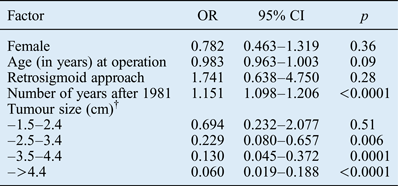
The multiple logistic regression method was used to investigate predictors of satisfactory facial nerve outcome (House–Brackmann grades I–III). The model was fitted to the data and the results are shown in Table VII.
Multiple logistic regression results for satisfactory outcome using categorical tumour size data*
* Refers to outcomes with House–Brackmann grades I–III (total n = 652). †A tumour size of less than 1.5 cm was the reference category. OR = odds ratio; CI = confidence interval
Tumour size was found to be significantly associated with satisfactory facial nerve outcome. The larger the tumour, the lower the probability of observing a satisfactory facial nerve outcome. For those patients with tumours 2.5–3.4 cm in size, the odds of satisfactory facial nerve outcome were estimated to be over 4 times lower compared with those patients with tumours less than 1.5 cm in size (odds ratio, 4.36; 95 per cent CI, 1.52–12.47). Similarly, for those patients with tumours 3.5–4.4 cm in size, the odds of satisfactory nerve outcome were estimated to be over 7 times lower compared with those patients with tumours less than 1.5 cm (odds ratio, 7.69; 95 per cent CI, 2.69–22.01). For those patients with tumours larger than 4.4 cm, the odds of satisfactory nerve outcome were estimated to be over 16 times lower compared with those patients with tumours less than 1.5 cm (odds ratio, 16.78; 95 per cent CI, 5.31–53.08). However, there was insufficient evidence of a difference in facial nerve outcome for those patients with tumours 1.5–2.4 cm in size compared with those patients with tumours less than 1.5 cm (odds ratio, 1.44; 95 per cent CI, 0.48–4.31).
Year of operation was found to be a significant predictor of satisfactory facial nerve outcome. The more recent a patient was operated on, the more likely they were to experience a satisfactory outcome (odds ratio, 1.15; 95 per cent CI, 1.10–1.21). A patient operated on 10 years after another patient was estimated to have odds of satisfactory outcome about 4 times higher than the other patient (95 per cent CI, 2.55–6.53).
As can be seen by the p-values, there is insufficient evidence that sex, age or operative approach were significant predictors of satisfactory facial nerve outcome after adjusting for the other variables.
The addition of a two-way interaction term between the significant variables tumour size and year of operation was non-significant and was therefore not included in the final model.
The Hosmer–Lemeshow goodness-of-fit test was used to evaluate the model fit. This test produced a chi-square test statistic of 12.83 (degrees of freedom = 8) with a corresponding p-value of 0.12. Hence, there was no indication of a poor model fit.
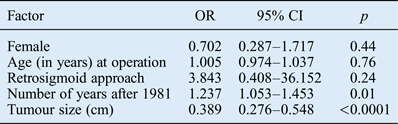
As a sensitivity analysis, the same multiple logistic regression model was fitted to the data as before, except that the categorical tumour size variable was replaced with a continuous variable representing the exact tumour sizes. Please note that only 345 patients were included in this multiple logistic regression analysis. The results can be seen in Table VIII.
Multiple logistic regression results for satisfactory outcome using exact tumour size data*
* Refers to outcomes with House–Brackmann grades I–III (total n = 345). OR = odds ratio; CI = confidence interval
These results confirmed the findings reported above that suggest tumour size and year of operation were significantly related to a satisfactory facial nerve outcome. The probability of a satisfactory outcome was significantly lower for larger tumours. For a patient with a tumour 1 cm larger than another patient, the odds of a satisfactory facial nerve outcome were estimated to be 2.57 times lower than for the other patient (95 per cent CI, 1.83–3.63). Again sex, age and operation approach were not significantly associated with satisfactory facial nerve outcome.
The Hosmer–Lemeshow goodness-of-fit test gave a chi-square test statistic of 10.49 (degrees of freedom = 8) with a corresponding p-value of 0.23. Again, this indicates no problem with model fit. The addition of a two-way interaction term between the variables of tumour size and year of operation was non-significant and therefore not included in the final model.
Operative learning curve
The effect of the surgeon's learning curve, which reflects a number of factors including evolution of technique and the surgical experience of the team, can be seen in Figure 4. The learning curve was at its steepest for the first 50 patients, which was the number operated upon in the first three-year time interval. The percentages of patients with House–Brackmann grades I–III (or satisfactory facial nerve outcome) are shown in relation to with those with House–Brackmann grades IV–VI (or unsatisfactory outcome) for the succeeding three-year time intervals.
Facial nerve outcome over 29 years.
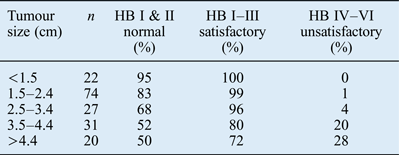
As can be seen from Figure 5 and Table IX, the facial nerve outcome for the present time is based on an analysis of the past six years of vestibular schwannoma surgery. For tumours less than 1.5 cm in size, 95 per cent of outcomes were normal (House–Brackmann grades I and II), 100 per cent were satisfactory (grades I–III) and 0 per cent were unsatisfactory (grades IV–VI). For tumours 1.5–2.4 cm in size, 83 per cent were normal, 99 per cent were satisfactory and 1 per cent were unsatisfactory. For tumours 2.5–3.4 cm in size, 68 per cent were normal, 96 per cent were satisfactory and 4 per cent were unsatisfactory. For tumours 3.5–4.4 cm in size, there was a normal outcome in 52 per cent of cases, a satisfactory outcome in 80 per cent and an unsatisfactory outcome in 20 per cent. For tumours larger than 4.4 cm, 50 per cent of outcomes were normal, 72 per cent were satisfactory and 28 per cent were unsatisfactory.
Facial nerve outcome over last six years.
Facial nerve outcome over last six years: hb category by tumour size*
* Refers to outcomes at 24 months (total n = 173). HB = House–Brackmann
Aberrant regeneration of facial nerve
Hemifacial spasm
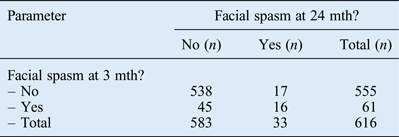
At 3 months post-operation, 61 patients (10 per cent) had some degree of hemifacial spasm (Table X). By 24 months post-operation, this hemifacial spasm had resolved in 45 affected patients (74 per cent) and persisted in 16 patients (26 per cent). However, 17 patients developed hemifacial spasm between 3 and 24 months post-operation. At 24 months, therefore, 33 patients (5 per cent) had persisting hemifacial spasm. Overall, there was a 13 per cent chance of developing hemifacial spasm at some time post-operation and a 42 per cent chance that this would have resolved by 24 months.
Hemifacial spasm at 3 months and 24 months
Mth = months
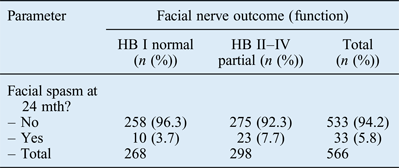
The incidence of hemifacial spasm at 24 months post-operation in patients with a House–Brackmann grade I outcome was compared with the incidence for those with partial recovery (House–Brackmann grades II–IV). The Fisher's exact test p-value was 0.049. Hence, there was a significant difference between the totally normal and partial recovery groups in terms of the percentages of patients with hemifacial spasm at 24 months (Table XI). Hemifacial spasm at 24 months appeared to be associated with House–Brackmann grades II–IV.
Hemifacial spasm at 24 months: normal versus partial function
Mth = months; HB = House–Brackmann
Metallic taste
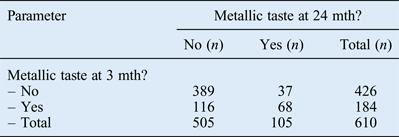
At 3 months post-operation, 184 patients (30 per cent) reported a metallic or salty taste in the mouth (Table XII). By 24 months post-operation, the metallic taste disappeared in 116 of these patients (63 per cent) and persisted in 68 of the patients (37 per cent). However, 37 patients developed a metallic taste between 3 and 24 months. At 24 months, therefore, 105 patients (17 per cent) had persisting metallic taste. Overall, there was a 36 per cent chance of developing metallic taste at some time post-operation and a 52 per cent chance that this would have resolved by 24 months.
Metallic taste at 3 months and 24 months
Mth = months
The incidence of metallic taste in the mouth at 24 months post-operation in patients with a House–Brackmann grade I outcome was compared with the incidence for those with partial recovery (House–Brackmann grades II–IV). The Fisher's exact test p-value was 0.11. Therefore, there was no significant difference between the totally normal and partial recovery groups in terms of the percentages of patients with metallic taste at 24 months.
Crocodile tears
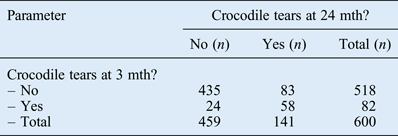
At 3 months post-operation, 82 patients (14 per cent) suffered from crocodile tears (Table XIII). By 24 months post-operation, this symptom had resolved in 24 of these patients (29 per cent) and persisted in 58 patients (71 per cent). However, 83 patients developed crocodile tears between 3 and 24 months. At 24 months, therefore, 141 patients (24 per cent) had persisting crocodile tears. Overall, there was a 25 per cent chance of developing crocodile tears at some time post-operation and only a 15 per cent chance that this would have resolved by 24 months.
Crocodile tears at 3 months and 24 months
Mth = months
The incidence of crocodile tears at 24 months post-operation in patients with a House–Brackmann grade I outcome was compared with the incidence for those with partial recovery (House–Brackmann grades II–IV). The Fisher's exact test p-value was 0.50. Therefore, there was no significant difference between the totally normal and partial recovery groups in terms of the percentages of patients with crocodile tears at 24 months.
Discussion
The modern era of vestibular schwannoma excision was catalysed in 1964 when William House used the operating microscope and developed otomicrosurgical transtemporal and middle fossa approaches to the internal auditory canal and cerebellopontine angle.Reference House3 For the first time, it was possible to remove the tumour and preserve the integrity of the facial nerve. Preservation of facial nerve function is a very important aspect of vestibular schwannoma surgery, and a good post-operative outcome is critical for the patient's quality of life. It is an indicator of surgical excellence. Unfortunately, anatomical integrity of the nerve does not necessarily result in good functional outcome. The timing of facial nerve functional assessment is also important as facial function may deteriorate several days after surgery in a significant number of patients. Should this occur, subsequent recovery is not assured, and is rarely complete.Reference Moffat, Croxson, Baguley and Hardy5, Reference Hardy, Macfarlane, Baguley and Moffat6, Reference Gardner and Robertson16, Reference King and Morrison17 The speed of recovery is variable and depends upon whether the injury is neuropraxia, in which case recovery may occur in 8–12 weeks, or whether Wallerian degeneration occurs, in which case tone will return in 5–6 months (the final facial nerve outcome will not be apparent until 12–18 months and occasionally up to 2 years later).Reference Moffat, Croxson, Baguley and Hardy5, Reference Hardy, Macfarlane, Baguley and Moffat6, Reference Morgan, Disani and Fischer18, Reference Bentivoglio, Cheeseman and Symon19
Electroneuronography is useful in the assessment of post-operative facial palsy, as patients with Wallerian degeneration have a worse prognosis than those with neuropraxia.20,21 The absence of electroneuronographic responses at one week post-operation, or an action potential less than 1 per cent of the amplitude of the contralateral response, is a predictor of poor facial nerve outcome. Incomplete degeneration with partial palsy is a good indicator of early recovery and a good prognosis. Neural regeneration provides good outcomes (House–Brackmann grades I and II), but rarely perfect recovery (grade I).22
Our facial nerve outcomes for the last 6 years of vestibular schwannoma surgery indicate that we have been able to achieve a satisfactory outcome (House–Brackmann grades I–III) in: 100 per cent of tumours less than 1.5 cm in size, 99 per cent of tumours 1.5–2.4 cm, 96 per cent of tumours 2.5–3.4 cm, 80 per cent of tumours 3.5–4.4 cm and 72 per cent of tumours larger than 4.4 cm.
Tumour size is a known predictor of facial nerve outcome.Reference Moffat, Croxson, Baguley and Hardy5, Reference Hardy, Macfarlane, Baguley and Moffat6, Reference Fenton and Fagan9, Reference Brackmann, Cullen and Fisher12, Reference Grey, Moffat, Palmer, Hardy and Baguley23–Reference Nutik25 Analysis of the factors affecting facial nerve outcome in our series revealed a highly statistically significant relationship between tumour size and outcome, in both univariate and multivariate analyses, for exact individual tumour size and increments in tumour size. Tumour size was found to be a significant predictor of facial nerve outcome even after adjusting for year of operation, operation approach, sex and age.
There did appear to be a significant correlation, on univariate analyses, between facial nerve outcome and the following variables: age, operative approach and House–Brackmann score. However, after performing simple linear regression analysis following multivariate analysis, and adjusting for the other variables, there was insufficient evidence that age or operative approach were predictors of facial nerve outcome. There was no statistically significant correlation between sex and facial nerve outcome.
The year of operation was found to be a significant predictor of satisfactory facial nerve outcome. The more recently a patient was operated upon, the more likely they were to have a satisfactory facial nerve outcome. These results confirmed our previous findings of an operative team learning curve for vestibular schwannoma surgery.Reference Grey, Moffat, Palmer, Hardy and Baguley23, Reference Moffat, Hardy, Grey and Baguley26 The present study indicated that, for a new surgical team, the surgical learning curve is steepest for the first 50 patients. As has been clearly demonstrated by this study, the percentage of good functional facial nerve outcomes has increased with experience. The effects of the learning curve could be minimised in the future with subspecialty training fellowships, and by dovetailing surgical appointments so that an experienced surgeon can work alongside a less experienced one for some time until the requisite skills have been attained. Proleptic consultant appointments can be helpful in this regard as well as the policy of only replacing one subspecialist surgeon at a time within the team. We have reported previously our experience with proleptic appointments of the neurosurgical part of the team;Reference Hardy, Macfarlane, Baguley and Moffat6 nevertheless, this transition may have been responsible for the trend to slight worsening of facial nerve outcomes in the early 2000s.
There are a number of other factors that can influence facial nerve outcome. The most important factors for good outcome are: meticulous surgical technique with identification of the nerve and gentle atraumatic handling, sharp dissection, and hydrodissection of the facial nerve from the tumour capsule. The tumour may be most adherent to the facial nerve at the porus acousticus; developing the dissection of the nerve from the tumour in the internal auditory canal first, followed by identification of the nerve at the root entry zone with debulking using the Cavitron ultrasonic surgical aspirator (CUSA), will facilitate the dissection at the porus. Facial nerve monitoring is important to help minimise trauma to the facial nerve during this dissection. Facial nerve monitoring alerts the surgeon to undue stretching, drying of the surgical field or temperature change, and also enables the surgeon to delineate facial nerve fibres from tumour capsule. A number of scientific articles have been written on facial nerve monitoring in this surgery.Reference Lalwani, Butt, Jackler, Pitts and Yingling8, Reference Morikawa, Tamaki, Nagashima and Motooka10, Reference Grey, Moffat, Palmer, Hardy and Baguley23, Reference Moffat, Hardy, Grey and Baguley26–Reference Nakao, Piccirillo, Falcioni, Taibah, Russo and Kobayashi28 The morphology of the tumour may affect outcome, especially when bosselations of tumour are present or when the facial nerve is circumferentially encapsulated by tumour (particularly in cystic lesions). The morphology and site of origin of the tumour may be affected by the position of the neurilemmal-glial junction. The position of the facial nerve in relation to the tumour may also affect outcome. Usually the facial nerve is anterior in relation to the tumour and away from the surgeon. However, it can be rostral, and rarely (in 1 per cent of cases) can be posterior and lying on the surface of the tumour, nearest to the surgeon; in such cases it is technically more difficult to achieve a good facial nerve outcome. In a previous study, we found no statistically significant difference in facial nerve outcome between solid and cystic tumours.29 The extent of the excision may affect facial nerve outcome. The degree of adherence to the brainstem can also influence facial nerve outcome. We have recently recorded that 10 per cent of tumours were significantly adherent to the brainstem (DA Moffat, personal communication).
Anatomical preservation of the facial nerve was achieved in 97 per cent of our 652 patients. In our experience, primary facial nerve anastomosis, or greater auricular or sural nerve cable grafting, are the procedures of choice if the facial nerve is lost during surgery. Primary nerve anastomosis, although technically difficult, can be achieved via the translabyrinthine approach.22 One centimetre of length can be gained by taking the facial nerve out of the fallopian canal within the temporal bone and detaching the efferent fibres from the geniculate ganglion. This will usually provide sufficient length to allow direct anastomosis of the divided ends. The anastomosis is either sutured, or wrapped in a sheath of fascia lata and sealed with fibrin glue (Tisseel; Immuno, Vienna, Austria). Facial–hypoglossal anastomosis is the most satisfactory procedure for a poor functional recovery of an intact facial nerve. However, timing is important. Although spontaneous recovery of an anatomically intact facial nerve can occur up to 2 years following surgery,19 facial–hypoglossal anastomosis should be done within 12 months, otherwise degeneration of the distal facial nerve and motor endplates in the facial muscles will compromise the success of the procedure. By utilising electroneuronography to predict those patients unlikely to recover spontaneously, facial–hypoglossal anastomosis can be undertaken early, and this may improve final facial nerve outcome. In skilled hands, cross-facial grafting can achieve satisfactory facial nerve outcome, although it usually means three further surgical procedures.
Nervus intermedius function and aberrant regeneration following vestibular schwannoma surgery are important for outcome and quality of life.Reference Irving, Viani, Hardy, Baguley and Moffat13 This study has shown that overall there was a 13 per cent chance of developing hemifacial spasm at some time post-operatively, and a 42 per cent chance that this would have resolved by 24 months. There was a 1 in 3 chance of developing metallic taste post-operatively, which was likely to have resolved by 24 months in half of the affected patients. There was a 1 in 4 chance of developing crocodile tears at some time post-operatively, and recovery was much less likely than with metallic taste, as it only resolved by 24 months for 1 in 7 patients.
• This paper reports on facial nerve outcome following vestibular schwannoma surgery in a large series of patients over the last three decades
• Outcome depends on tumour size, and various clinical and histopathological determinants
• Intra-operative technical factors and facial nerve monitoring can influence outcome
• Skull base surgical team experience is important; the surgical learning curve was steepest for the first 50 patients
• Tumour size and operation year were significant predictors of facial nerve outcome
• Nervus intermedius outcome and motor facial nerve results were analysed
In terms of aberrant regeneration, there was a greater likelihood of hemifacial spasm, metallic taste and crocodile tears for those patients with partial recovery (House–Brackmann grades II–IV) of the facial nerve compared with those patients with totally normal post-operative facial nerve function. In this analysis, however, there was only a statistically significant difference for hemifacial spasm (p = 0.049, Fisher's exact test), and not for metallic taste or crocodile tears.
Acknowledgements
The authors wish to acknowledge Mr Patrick Axon, Mr Neil Donnelly, Mr James Tysome and Mr Richard Mannion. They would also like to acknowledge consultant colleagues in the Cambridge Skull Base Surgical Team and many of the Skull Base Fellows over the years, as well as plastic surgical colleagues Mr George Lamberty, Mr Richard Price and Mr Amer Durrani for their skilled assistance.