Critical CHD includes groups of heart defects that often cause life-threatening symptoms coinciding with the postnatal closure of the arterial duct and account for more deaths than any other type of congenital malformation. This includes anomalies associated with either no or only minimal forward flow into the pulmonary artery or aorta or with poor mixing owing to discordant ventriculo-arterial connections. To prevent severe neonatal hypoxaemia, haemodynamic compromise, and death, intravenous administration of prostaglandin E1 to maintain arterial ductal patency to the time of surgery or catheter intervention is a critical part of the early neonatal treatment of these lesions. Prenatal ultrasound has been used for many years to screen for congenital abnormalities and plays an important role in identifying critical CHD. Coinciding with the recommendation that four-chamber and outflow tract views should both be part of the prenatal routine screening for fetal cardiac anomalies, 1 duct-dependent cardiac anomalies are increasingly detected before birth. On the other hand, the benefit of an antenatal diagnosis on patient outcome remains controversial.Reference Tworetzky, McElhinney, Reddy, Brook, Hanley and Silverman 2 – Reference Tzifa, Barker, Tibby and Simpson 6 This prospective single-centre study sought to clarify the impact of a critical CHD diagnosis before birth on the pre-intervention neonatal care and outcome. Unlike many of the previous studies on this topic, our tertiary care centre provides exclusive paediatric tertiary cardiac and surgical care for all neonates with critical CHD in our catchment area with >80,000 live-births per year, avoiding a potential referral bias of eligible patients.
Materials and methods
This is a sub-study of a larger prospective cohort study that compared the impact of a fetal versus postnatal diagnosis of all neonatal and fetal referrals with all types of cardiac lesions to the Hospital for Sick Children, Toronto from January, 2009 to December, 2010 (unpublished data). Written maternal or parental consent was required to participate and was obtained at the time of the fetal anomaly diagnosis or during the early neonatal hospitalisation at our centre. Families opting for pregnancy termination or abstention of postnatal care were not approached. For this sub-study, all neonates with a confirmed diagnosis of critical CHD were identified from the same database and those born ⩾36 gestational weeks with a birth weight ⩾2 kg were included in this research. Newborns with lethal non-cardiac and genetic anomalies were excluded. Infants with only a postmortem diagnosis of a duct-dependent CHD during the 2-year study period were identified from autopsy reports that had been filed in the coroner’s office of the Ministry of Community Safety & Correctional Service of Ontario. The sub-study was approved by the Ethics Boards of SickKids (REB no. 1000011104) and the coroner’s office. The need of parental consent of the sub-study was waived.
Lesions
Duct-dependent critical CHD included the following lesions: functional univentricular hearts (hypoplastic left or right heart syndrome and variants), tetralogy of Fallot with severe outflow tract obstruction, double-outlet right ventricle with severe outflow obstruction or malposed great vessels, transposition of the great arteries, critical aortic or pulmonary stenosis, and severe aortic arch obstruction including interruption.
Perinatal management
Mothers with a suspected fetal diagnosis of CHD are routinely referred to the fetal cardiac programme at SickKids for further echocardiographic assessment, parental counselling, and perinatal care. Perinatal arrangements include delivery of those babies with critical CHD in a tertiary care obstetrical facility adjacent to SickKids to allow almost immediate neonatal resuscitation if required. In contrast, postnatal transfer of prenatally undiagnosed cases is usually made by ambulance or air on prostaglandin E1 infusion and after haemodynamic stabilisation.
Methods
Collected data included the spectrum of CHD, gestational age at fetal referral, site of delivery, gender, gestational age and weight at birth, APGAR scores, patient age at cardiac critical care admission, health state at admission (serum lactate; pH; HCO3; and pCO2), mode and start of treatment (prostaglandin E1, ventilation, vasoactive therapy, extracorporal membrane oxygenation) and serious events (cardiac arrest, defined as acute loss of cardiac output requiring resuscitation; death), and age at surgery or first definitive catheter intervention. First day of life was called day ‘0’ in our analysis.
Statistics
Results were expressed as mean±SD, median with range, and frequencies, as appropriate. When there are missing data, this is reported. Comparisons among the fetal and postnatal groups were performed with the Fisher’s exact test or χ2 test for categorical variables and the Student’s t-test or Mann–Whitney U-test for continuous variables. A p-value of <0.05 was considered significant. Data were analysed with Graph Pad Prism 6.04 (Graph Pad Software Inc., San Diego, California, United States of America).
Results
The study inclusion criteria were fulfilled by 129 newborns with a fetal (n=63) or a postnatal (n=66, including five postmortem) diagnosis of critical CHD. Included in the fetal cohort are four cases with microdeletion 22q11, one with 47 XXX, and two with CHARGE association. The postnatal cohort includes two cases with 22q11 microdeletion, one with Turner syndrome, and one with Noonan syndrome. Overall 84 cases were excluded from the study, because no parental consent was obtained to participate in the study (n=74; 28 fetal; 46 postnatal), the child was born <36 weeks or with a birth weight <2 kg (n=9; 4 fetal; 5 postnatal), or had a lethal genetic abnormality (n=1, fetal).
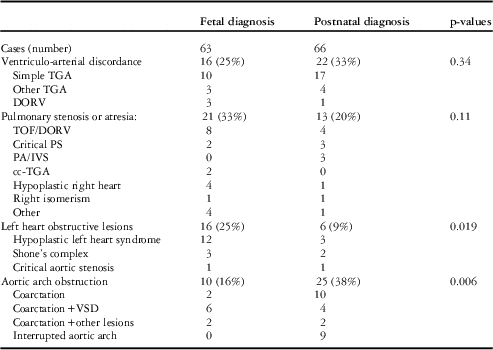
Table 1 shows the distribution of duct-dependent anomalies according to the most critical lesion for the preoperative neonatal survival. The occurrence of lesions associated with a neonatal transposition physiology or with severe pulmonary obstruction was similar in both study cohorts. In contrast, left ventricular lesions predominated in the prenatally diagnosed patient cohort, whereas obstructive aortic arch abnormalities were significantly more prevalent in postnatal cases. Finally, neonates with a fetal critical CHD diagnosis tended to have more complex rather than isolated cardiac lesions when compared with the postnatally diagnosed cohort (Table 1).
Distribution of type of duct-dependent cardiac anomalies with a fetal versus postnatal diagnosis.

cc-TGA=congenitally corrected transposition; DORV=double-outlet right ventricle; PA/IVS=pulmonary atresia with intact ventricular septum; TGA=transposition of the great arteries; VSD=ventricular septal defect
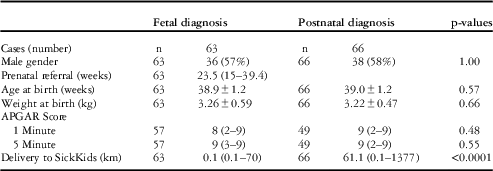
Table 2 compares the baseline characteristics of the study cohorts: weights and gestational ages at birth, and APGAR scores were not different. All but two neonates with a prenatal diagnosis of critical CHD were delivered as recommended at the time of the prenatal visit at the nearest high-risk obstetrical facility to our centre (within 100-m distance), whereas this was the case for only one child with an undiagnosed critical abnormality before birth (61/63 versus 1/66; p<0.0001).
Characteristics of study cohorts born with critical CHD.

n, number of available data for a variable.
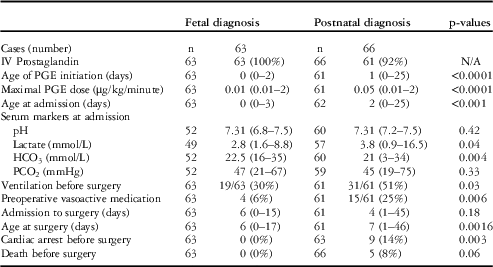
Table 3 summarises the preoperative management, the haemodynamic findings at SickKids admission, as well as the event rates of cardiac arrest requiring resuscitation and of death before surgery. There were five preoperative deaths that all occurred in prenatally undiagnosed cases and were identified postmortem. Their postmortem examination showed transposition of the great arteries (n=2), interruption of the aortic arch (n=2), and critical aortic stenosis (n=1). Both neonates with transposed great arteries died before transfer, one at 2 hours of age and the other at 9 hours of age. The neonates with aortic stenosis and interrupted aortic arch, respectively, died after discharge home from peripheral hospitals, at 6, 8, and 15 days of age.
Baseline variables at time of admission of newborns with fetal versus a neonatal diagnosis of duct-dependent critical CHD.

As shown in Table 3, a prenatal diagnosis was associated with significantly earlier prostaglandin E1 administration and lower dosages to maintain ductal patency, a shorter time interval to cardiac care admission, and a younger age at surgery or catheter intervention. Moreover, the prenatal cohort had significantly lower lactate levels at hospital admission and was less likely to require preoperative ventilation or vasoactive medication compared with the postnatal group. Finally, there were nine documented cardiac arrests that required cardiac resuscitation in the postnatal group versus no such episodes in the fetal cohort. There were no neonates within either group with renal failure requiring dialysis preoperatively. Length of hospitalisation before intervention was not affected by the timing of anomaly diagnosis.
Discussion
Previous studies that have examined the benefits of fetal diagnosis versus postnatal diagnosis have shown variable results. In a series of 60 infants with hypoplastic left heart syndrome, Sivarajan et alReference Sivarajan, Penny, Filan, Brizard and Shekerdemian 3 found that those with a prenatal diagnosis were more fit at the time of surgery than neonates with a postnatal diagnosis. No difference in mortality was found between the two groups; however, the study did not examine coroner’s data and cases that might have died before transfer to their institution would be missed in the review. Tworetzky et alReference Tworetzky, McElhinney, Reddy, Brook, Hanley and Silverman 2 found that prenatal diagnosis improved pre-surgical morbidity and mortality in a sample of 88 neonates with hypoplastic left heart syndrome. Examining the impact of a fetal diagnosis of transposition of the great arteries, Raboisson et alReference Raboisson, Samson and Ducreux 7 found no survival benefit, but this study did not account for cases that might have died before transfer to their centre. In a similar approach to this study, Bonnet et al included coroner’s data when examining the impact of fetal versus postnatal diagnosis of transposition of the great arteries in their catchment area. The authors found that there was increased mortality in prenatally undiagnosed neonates and that many of them had died before transfer to their centre. Finally, Levey et al,Reference Levey, Glickstein and Kleinman 8 in a retrospective chart review that included 294 infants with different forms of CHD diagnosed prenatally, showed a decreased use of preoperative antibiotic use, ventilation, and cardiac catheterisation with fetal diagnosis when compared with neonates with postnatal diagnosis.
This study shows that a prenatal diagnosis of critical CHD not only facilitates the neonatal management but also lowers the risk of serious neonatal events including death before surgery. When compared with cases with an antenatal diagnosis, newborns diagnosed after birth were not only admitted significantly later at our tertiary cardiac care centre, but this was also associated with higher serum lactate levels at SickKids admission, higher IV requirements of prostaglandin E1 to maintain ductal patency during transportation, higher proportions of newborns who were ventilated and treated with vasoactive drugs, as well as a higher rate of cardiac arrests before surgery. Similarly to the above studies by Tworetzky et alReference Tworetzky, McElhinney, Reddy, Brook, Hanley and Silverman 2 and Sivarajan et al,Reference Sivarajan, Penny, Filan, Brizard and Shekerdemian 3 we found that neonates with a prenatal diagnosis of various forms of critical CHD were haemodynamically more stable to surgery when compared with the postnatally diagnosed group. Our study also confirms that there is a “hidden” neonatal mortality that often goes undocumented and unreported in outcome studies of CHD, affecting those newborns who are neither diagnosed before birth nor while alive after birth. This was the outcome of five newborns in our catchment area with only a postmortem diagnosis of transposition, aortic arch interruption, or critical aortic stenosis. All cases in this study had undergone regular obstetrical assessments as advised that also included at least one obstetrical ultrasound exam to rule out fetal CHD. Transposition of the great arteries is identified by an abnormal outflow tract view, which is part of the recommended cardiac screening views at the 18- to 22-week obstetrical ultrasound examination. Aortic stenosis can significantly progress only later in pregnancy and thus may go undetected at a mid-gestational obstetrical scan. In lesions associated with aortic arch interruption, the left ventricle and the ascending aorta often appear smaller in size, but the definite diagnosis would require imaging of the aortic arch in a sagittal plane and/or a three-vessel view, which both are not part of the recommended screening views. This circumstance also explains at least partly the under-representation of obstructive aortic arch anomalies in the prenatally diagnosed cohort, whereas, on the other hand, lesions that are easily detectable in the cardiac four-chamber view predominate the fetal spectrum of abnormalities in this as in other studies. Our findings infer that imaging of the aortic arch perhaps should be included in the routine evaluation for CHD. Moreover, pregnant women with suboptimal imaging of the fetal cardiac structures should be routinely referred for a more detailed cardiac evaluation by a fetal cardiologist. The current practice in Ontario is that a referral for fetal echocardiography is at the discretion of the physician who receives the result of obstetrical screening exam. Finally, some of the neonates with postnatal death post discharge home may also have been identified as being cyanotic by monitoring of the oxygen saturation before discharge. This was not implemented as part of the neonatal discharge assessment during the study period, and it is unclear whether this would have prevented the adverse outcomes and how this would have influenced the referral of other postnatal cases.
Limitations
A strong point of this study includes that patients with intention of postnatal treatment were enrolled prospectively but, as a weakness, that this required parental consent. Reasons why families may have declined to participate include that the study also collected demographic variables and that parents with a new postnatal diagnosis of critical CHD had to be approached for consent early after admission of their acutely ill child. Nevertheless, excluded and included fetal and postnatal cases were largely comparable in disease severity of their lesions (data not shown). The median age at the first fetal echocardiogram at SickKids was 23.5 gestational weeks, which is on average a few weeks after the diagnosis of CHD was first suspected or made. Many of these patients were initially referred to another cardiologist at a different institution for confirmation of the CHD diagnosis and only then sent to SickKids, which explains some of the later referrals. Blood tests were not routinely obtained at the time of SickKids admission if the child appeared well. Finally, surgical results and postoperative outcomes were not analysed owing to the heterogeneity in complexity of the cardiac lesions. As such, our prenatal cohort had overall the more serious lesions with outcomes that are more significantly affected by other variables than the timing of anomaly diagnosis.
In summary, our study findings support that a fetal diagnosis of duct-dependent critical CHD facilitates the preoperative management and improves the chances of a serious event-free and more stable course at least to the time of the first surgical repair or catheter procedure. Of concern is that critical CHD is still frequently missed despite the recommendation to include outflow tracts as a prenatal screening recommendation. Moreover, obstructive aortic arch abnormalities, which commonly coincide with an obvious size difference between the aortic and ductal arches, go often undetected as the imaging of these vessels is currently not part of the screening protocol.
Efforts should be made to address the current shortcomings in the prenatal detection of aortic arch anomalies and transposition of the great arteries, which are lesions that face a greater morbidity and mortality before, rather than after, surgery.
Acknowledgements
The authors thank the Office of the Chief Coroner for Ontario for assistance identifying and reviewing some cases.
Financial Support
This research received no specific grant from any funding agency, commercial, or not-for-profit sectors.
Conflicts of Interest
None.