Introduction
Abiotic stresses, including frost, heat, drought and salinity stresses, can lead to a range of morphological, physiological, biochemical and molecular changes that negatively affect the development and productivity of the plant (Wang et al., Reference Wang, Vinocur, Shoseyov and Altman2000). Salinity and drought stress conditions are often associated with oxidative disturbances in the balance between the production of reactive oxygen and antioxidant defences, causing the denaturation of functional and structural proteins (Smirnoff, Reference Smirnoff1998; Betteridge, Reference Betteridge2000). Temperatures have a crucial role in seed germination, plant growth, drooping leaves, leaf senescence, fruit decolouration, yield, parthernocarpy and pollen viability (Paupière et al., Reference Paupière, van Heusden and Bovy2014). The effect of high-temperature stress (HTS) during reproduction is well understood, with much research examining the viability of pollen under heat stress conditions. At high temperatures, vapour pressure deficits are higher, causing pollen desiccation and low pollen viability. Under warm air conditions, gametophytes dry out and their delivery to the embryo sac is constrained (Hatfield and Prueger, Reference Hatfield and Prueger2015).
The principle crops grown in the Soudanian agroclimatic zone display a similar HTS threshold at flowering, e.g. 35 °C for maize (Zea mays) (Dupuis and Dumas, Reference Dupuis and Dumas1990). Studies on sorghum (Sorghum spp.) found that HTS during flowering can cause oxidative damages in leaves as well as on pollen grains, thereby reducing the plant's photosynthetic activity and negatively affecting the formation of grains (Prasad and Djanaguiraman, Reference Prasad and Djanaguiraman2011). For the fruit set of tomato (Solanum lycopersicum), there is a strong negative relationship between pollen production and pollen viability at temperatures exceeding 34 °C (Sato et al., Reference Sato, Peet and Thomas2000). For the crop of interest, quinoa, the effect of extreme environmental conditions on crop growth attributes and physiological responses are well known. Quinoa is typically halophyte, drought tolerant, frost resistant with versatile pH characteristics (Bertero et al., Reference Bertero, King and Hall1999; Jacobsen et al., Reference Jacobsen, Mujica and Jensen2003; Razzaghi et al., Reference Razzaghi, Ahmadi, Adolf, Jensen, Jacobsen and Andersen2011; Shabala et al., Reference Shabala, Mackay, Tian, Jacobsen, Zhou and Shabala2012; Adolf et al., Reference Adolf, Jacobsen and Shabala2013; Hirich et al., Reference Hirich, Choukr-Allah and Jacobsen2014a; Bazile et al., Reference Bazile, Jacobsen, Verniau, De Ron, Sparvoli, Pueyo and Bazile2017). Up until now, there is scant information on the response of quinoa to heat stress conditions. This is because the literature has predominantly focussed on freezing conditions typically found in the geographical site of origin, namely the Andean Altiplano (Vacher, Reference Vacher1998; Bertero, Reference Bertero2001; Jacobsen et al., Reference Jacobsen, Monteros, Christiansen, Bravo, Corcuera and Mujica2005; Reference Jacobsen, Monteros, Corcuera, Bravo, Christiansen and Mujica2007; Bois et al., Reference Bois, Winkel, Lhomme, Raffaillac and Rocheteau2006). However, in the last decade, the number of countries cultivating quinoa has doubled, with a rapid expansion in the MENA and Sahel region (Adolf et al., Reference Adolf, Jacobsen and Shabala2013; Hirich et al., Reference Hirich, Choukr-Allah and Jacobsen2014b; Ceccato et al., Reference Ceccato, Delatorre-Herrera, Burrieza, Bertero, Martinez, Delfino, Moncada, Bazile, Castellión, Didier, Daniel and Carlos2015; Yang et al., Reference Yang, Akhtar, Amjad, Iqbal and Jacobsen2016; Lesjak and Calderini, Reference Lesjak and Calderini2017). The MENA and Sahelian countries are known for having much higher temperatures than those found in the Andean Altiplano. Meanwhile, some studies have started looking at the effect of HTS during flowering and seed germination. For instance, experiments in Chile affirmed that HTS (34 °C) at flowering resulted in seed yield depletion (Lesjak and Calderini, Reference Lesjak and Calderini2017). Other studies found that higher temperatures (20–25 °C) could favour the growth of quinoa when compared to lower temperatures (8–18 °C) (Yang et al., Reference Yang, Akhtar, Amjad, Iqbal and Jacobsen2016). Whereas, yet other experiments did not report significant differences in terms of seed yield (cv. QQ74 and 17GR) under different temperature thresholds (optimal growing temperatures of 16–25 °C and HTS conditions of 24–40 °C between night and daytime) (Hinojosa et al., Reference Hinojosa, Matanguihan and Murphy2019).
The cv. Titicaca is now a widespread cultivar in the MENA and Sahel regions (Coulibaly and Martinez, Reference Coulibaly, Martinez, Didier, Daniel and Carlos2015; Bazile et al., Reference Bazile, Pulvento, Verniau, Al-Nusairi, Ba, Breidy and Sepahvand2016; Choukr-Allah et al., Reference Choukr-Allah, Rao, Hirich, Shahid, Alshankiti, Toderich and Butt2016; Dao et al., Reference Dao, Sanou, Yaméogo, Kando, Bakoané, Traoré, Dagnoko and Bazile2016; Gacemi, Reference Gacemi2016; Habsatou, Reference Habsatou2016; Mosseddaq et al., Reference Mosseddaq, Bounsir, Khallouq and Benlhabib2016). For instance, countries such as Algeria, Morocco, Lebanon, Mauritania, Yemen, Iraq, Niger, Mali and Burkina Faso are now cultivating quinoa as part of the Technical Cooperation Programmes launched by the FAO. These countries are not yet attaining potential yields because of HTS at flowering (35–40 °C) (Breidy, Reference Breidy2015; Djamal,; Hassan, Reference Hassan2015; Saeed, Reference Saeed2015; Alvar-Beltrán et al., Reference Alvar-Beltrán, Saturnin, Dao, Dalla Marta, Sanou and Orlandini2019a; Reference Alvar-Beltrán, Dao, Saturnin, Dalla Marta, Sanou and Orlandini2019b). However, a thorough investigation has not yet been performed on examining the effect of the most sensitive phenological phases to HTS in cv. Titicaca, namely seed germination and flowering. Outside the Sahel and MENA region, experiments conducted in Greece attributed low pollen viability to the effect of high temperatures, long days and low relative humidity (Noulas, Reference Noulas, Didier, Daniel and Carlos2015). Whereas in Italy, cv. Titicaca was shown to respond negatively to high temperatures, with a depletion in seed yields when sown in May (due to heat-stress conditions occurring at the time of flowering, around July) rather than in April (1.5 and 3.0 t/ha, respectively) (Pulvento et al., Reference Pulvento, Riccardi, Lavini, d'Andria, Iafelice and Marconi2010).
For the effect of temperature, water and salinity on seed germination, several studies reported differing results (Bois et al., Reference Bois, Winkel, Lhomme, Raffaillac and Rocheteau2006; Adolf et al., Reference Adolf, Jacobsen and Shabala2013; Hirich et al., Reference Hirich, Choukr-Allah and Jacobsen2014b; Ceccato et al., Reference Ceccato, Delatorre-Herrera, Burrieza, Bertero, Martinez, Delfino, Moncada, Bazile, Castellión, Didier, Daniel and Carlos2015). For instance, some experiments showed that 18–23 °C was the optimal temperature for maximum seed germination, but differing among cultivars (Boero et al., Reference Boero, González and Prado2000; Bois et al., Reference Bois, Winkel, Lhomme, Raffaillac and Rocheteau2006). In contrast, Jacobsen and Bach (Reference Jacobsen and Bach1998) observed the highest germination percentages at 30–35 °C. Moreover, Mamedi et al. (Reference Mamedi, Tavakkol Afshari and Oveisi2017) detected the highest seed germination percentages between 0 and 35 °C for cv. Titicaca, with a decline at 40 °C. In addition, considerable night and daytime thermal variations were shown to have negative impacts on seed germination (Boero et al., Reference Boero, González and Prado2000). The thermal time required for seed germination is 30 degree-days, but lower temperatures during germination were suggested to lead to embryo death (Jacobsen and Bach, Reference Jacobsen and Bach1998; Rosa et al., Reference Rosa, Hilal, González and Prado2004). Other authors showed a negative relationship between high temperatures, occurring a month before harvesting, and low germination rates in the succeeding growing season (Dorne, Reference Dorne1981). It was also reported that low temperatures and long photoperiods during seed formation on the mother plants could increase seed dormancy, and vice-versa (Ceccato et al., Reference Ceccato, Bertero and Batlla2011). For the storage of seeds, studies showed that seeds emerged from dormancy at a faster rate under higher temperatures, 25 °C, rather than under lower temperatures, 5°C (Ceccato et al., Reference Ceccato, Bertero and Batlla2011). Instead, ambient humidity and high storage temperatures were shown to reduce germination (Bhargava, Reference Bhargava, Didier, Daniel and Carlos2015).
There is a need to build on previous studies to provide further information about the effect of HTS on sensitive phenological phases, as well as on the crop responses in terms of seed germination, seed yield and biomass. We, therefore, investigate the response of the quinoa cv. Titicaca (the most extensively used cultivar in the Sahel, MENA and Mediterranean region) to high temperatures. The present study was a small-scale experiment under controlled climatic conditions simulating temperatures usually found in these cultivation regions. We then compared the emerging findings under controlled climatic conditions with field experiments from Burkina Faso. To some extent, this approach permits the determination of the spatiotemporal suitability of this cultivar and the development of an optimal crop calendar for quinoa in Burkina Faso.
Materials and methods
The quinoa cultivar used in this research was cv. Titicaca, developed at the University of Copenhagen and selected under Danish climatic conditions (Jacobsen, Reference Jacobsen2017). This genotype was derived from a hybridization of seeds, by crossing material from southern Chile and Peru. The seeds used in the present experiment were provided by the FAO TCP/SFW/3404 project for the promotion of quinoa in Burkina Faso. They were stored in a fridge seed bank at the Institut de l'Environnement et de Recherches Agricoles (INERA), Burkina Faso, at temperatures <11 °C, with a relative humidity of 48% and a seed germination rate of 93%.
The University of Florence, Department of Agriculture, Food, Environment and Forestry (DAGRI) provided the climatic chambers to conduct the present research. The experiment was made of one factor with different HTS levels (30, 34, 38, 42 and 46 °C), each with three replicates, respectively. During the growing season, except for flowering, plants were maintained in a climatic chamber (walk-in chamber, internal dimensions 2.5 × 2.0 × 2.5 m3 equipped with 32 Osram Fluora 36w lights, equivalent to 230 w m−2) at 25 °C during night time (10 h) and 30 °C during daytime (14 h). Once the plants reached the flowering stage, they were maintained at 30, 34, 38, 42 and 46 °C, respectively, in a separate climatic chamber (HPP 750 life chamber) for 6 h/day for 10 days (duration of the flowering period). Plants were fully irrigated during the entire growth cycle and the evapotranspiration rates were calculated using the crop coefficient (K c) values provided by Garcia et al. (Reference Garcia, Raes and Jacobsen2003) as follows: 0.52 at emergence, 1.0 at maximum canopy cover and 0.70 at physiological maturity. The reference daily evapotranspiration, ETo, was computed as follows (Hargreaves and Samani, Reference Hargreaves and Samani1985):

where R o is the extra-terrestrial solar radiation calculated by transforming mega joules (MJ) into watt-hour (W/h) (1 MJ = 277.8 W/h) (Allen et al., Reference Allen, Pereira, Raes, Smith and Julian1998). Calculated 0.82 MJ/h was then multiplied by the photoperiod (14 h/day); T mean is the mean daily temperature (27.9 °C); T max is the daily maximum temperature (30 °C); T min is the daily minimum temperature (25 °C). Finally, ETo was multiplied by the K c to obtain the crop evapotranspiration (ETc).
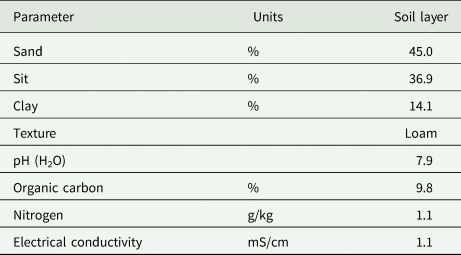
Seeds were directly sown in 25-litre plastic pots (20 × 20 cm2), each containing two quinoa plants (in total six plants per treatment) spaced by 10 cm. The pots were filled with 1 kg of clay pebbles, overlaid by 10 kg of loamy soil (Table 1). Nitrogen fertilisation in the form of ammonium nitrate (NH4NO3, 26% N), was applied 35 days after sowing (DAS) at a rate of 25 kg N/ha. The measured crop parameters after drying the plants for 48 h at 80 °C were dried seed yield and total aboveground biomass yield (including the organic mass contained in the leaves, stems and seeds, without the roots). The seed yield per plant, obtained under controlled climatic conditions, was then compared with the field observations from Burkina Faso.
Main soil physical–chemical characteristics at 0–20 cm before sowing

Seed germination tests were conducted in a sterilized plastic Petri dishes, humidified daily with distilled water. Each trial contained three replicates of 100 seeds. The seeds were germinated in one thermostatic laboratory digital chamber (6 h/day for 5 days) under night time conditions with different heat-stressed conditions at 30, 34, 38, 42 and 46 °C, respectively, as well as at room temperatures (15–20 °C). The effects of different temperature thresholds on seed-germination and flowering were analysed using a one-way analysis of variance with Minitab-18 software. Multiple means were compared using the Tukey HSD test (P ≤ 0.05).
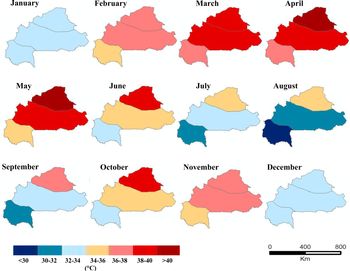
Based on the findings from the climatic chambers, 12 maps of Burkina Faso were prepared, one per month, using the maximum mean monthly temperature (MMMT, Eqn (2)) values for each of the three agroclimatic zones (Sahel, Soudano–Sahelian and Soudanian). The red tonalities were giving to MMMTs >36 °C, whereas blue tonalities were assigned to those regions with MMMTs <34 °C. These maps were prepared in ArcGIS 10.2.1 using the daily meteorological data provided by the National Oceanic Atmospheric Administration (NOAA) for the 45-year period 1973–2017 (NOAA, 2018). Each weather station corresponded to an agroclimatic zone and their locations were as follows: Sahel (Dori; 14°01´N 0°01´W; 280 m.a.s.l), Soudano–Sahelian (Ouagadougou airport; 12°21´N 1°30´W; 310 m.a.s.l) and Soudanian (Bobo Dioulasso airport; 11°09´ 4°19´W; 450 m.a.s.l)

where n is the number of days in a given month; T max is the daily maximum temperature.
Results
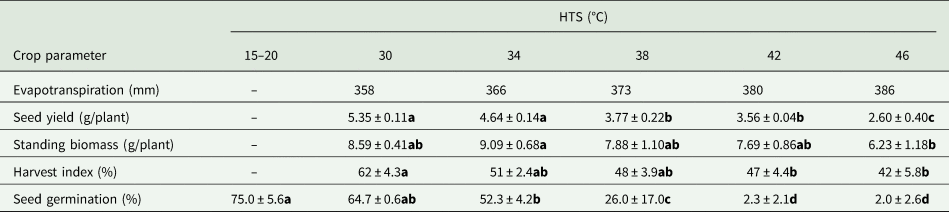
The soil used in the present experiment was characterised as having a loam texture with slightly acidic properties (Table 1). The organic carbon content was relatively high, as well as the soil nitrogen content. During the experiment, the plants were fully irrigated, thereby satisfying crop water requirements (Table 2). The observed evapotranspiration during the growing cycle increased with HTS, from 358 to 386 mm, from 30 to 46 °C, respectively (Table 2).
Evapotranspiration rates and water supply (mm/season), yield (g/plant), standing biomass (g/plant), HI (%) and seed germination (%)

Legend: means not sharing a letter were significantly different (P < 0.05).
Legend: plants were heat-stressed for 10 days, 6 h/day during flowering.
Effect of HTS at flowering and seed germination
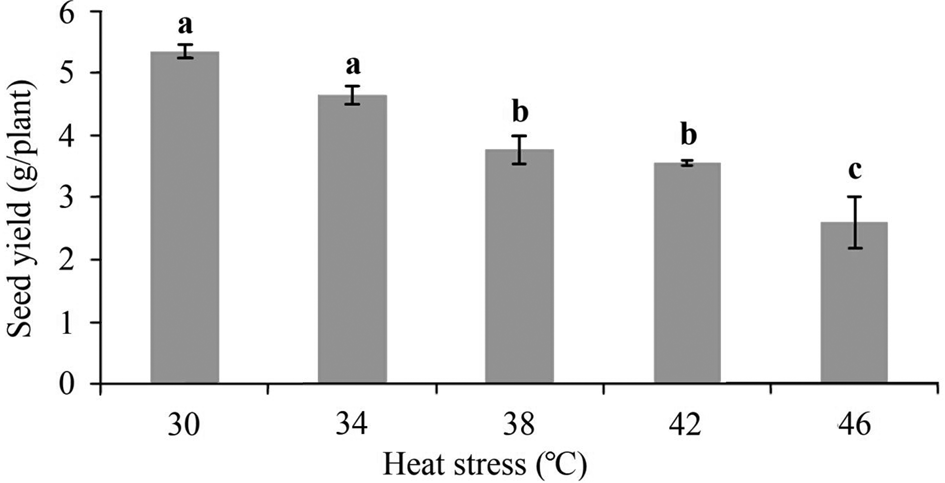
The cv. Titicaca was highly affected by HTS at flowering. A strong negative relationship was reported between HTS at flowering and seed yield at harvest. There was a two-fold decrease in seed yield from 5.35 to 2.60 g/plant, from 30 to 46 °C HTS levels (P = 0.00), respectively (Fig. 1 and Table 2). Among the different HTS levels, the greatest seed yield losses were observed between 34 and 38 °C HTS levels (P = 0.02), as well as between 42 and 46 °C (P = 0.01), with yield losses varying between 19 and 27%, respectively. No differences (P = 0.87) in seed yields were reported between 38 and 42 °C HTS levels, with yields of 3.77 and 3.56 g/plant, respectively. Although seed yields were unchanging between 38 and 42 °C, seed yields at 46 °C were significantly lower (P ≤ 0.05). During the entire experiment, mean temperatures were above 28 °C for all HTS levels with temperatures uninterruptedly surpassing the optimum growing conditions for quinoa (between 20 and 25 °C). The results displayed a low standard deviation (SD), indicating that seed yield observations were close to the mean values in all replicates.
Relationship between seed yield (g/plant) and HTS (°C) thresholds during flowering.

The highest aboveground biomass of 8.6 and 9.1 g/plant was observed between 30 and 34 °C HTS levels, respectively. A general trend showing a decrease in the aboveground biomass with increasing temperatures was reported. Statistically significant differences were depicted between 34 and 46 °C HTS levels (P = 0.03). However, no differences (P ≥ 0.05) were reported for the remaining HTS levels. This was explained by the fact that most of the biomass was produced during the vegetative stage, before the plants were exposed to heat stress at flowering. The harvest index (HI; as the ratio of harvested seed yield to the total aboveground biomass) showed a negative relationship with higher values under lower HTS thresholds. For instance, the HI was 62% at 30 °C, decreasing significantly (P = 0.00) to 42% at 46 °C HTS levels (Table 2 and Fig. 2).
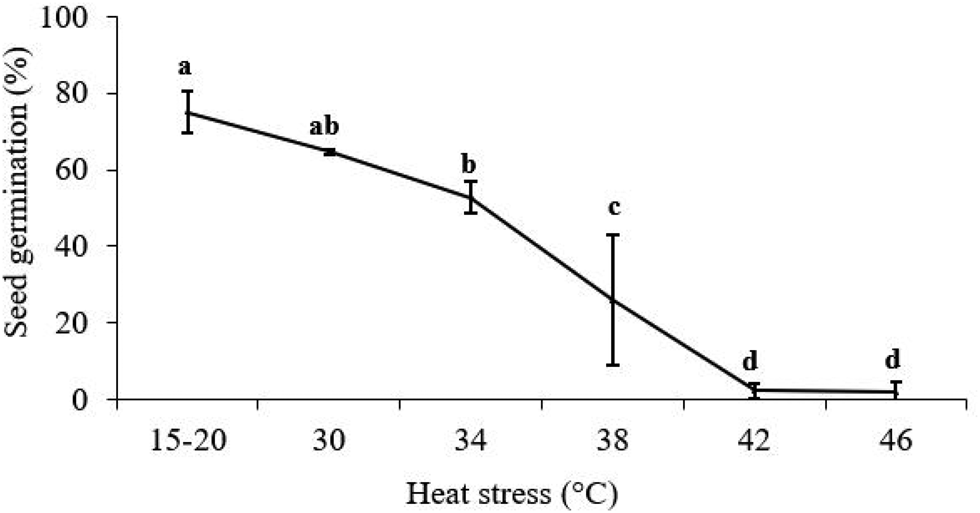
Seed germination percentages (%) under different HTS thresholds and room temperatures ( °C). Legend: means not sharing a letter were significantly different (P < 0.05); seeds were heat-stressed for 5 days, 6 h/day.

The present study showed a negative relationship between seed germination percentages and HTS levels (Fig. 2). The highest level of germination (75%) was reported under room temperatures (between 15 and 20 °C). Instead, the greatest differences (P < 0.01) were depicted between 34 and 38 °C HTS levels with seed germination declining by 5 2%. In addition, at 38 °C, the seed germination percentages were highly variable with a large SD among replicates (SD 17.0). Finally, temperatures above 42 °C were considered critical for seed germination with germination declining to 0%.
Spatio-temporal suitability of quinoa in Burkina Faso
The MMMTs during the year and throughout the country was essential for identifying both the suitable timing and location for cultivating quinoa in Burkina Faso. Figure 3 displayed, with dark red tonalities, those regions where MMMTs often exceeded 38 °C (critical HTS threshold for the pollination of cv. Titicaca). Towards avoiding HTS at flowering, as well as at seed germination, the following growing periods (from north to south) were identified. For the Sahelian zone, a first growth window was established between July and September, when MMMTs oscillated between 34 and 38 °C. A second colder growth window was established between November and February. Within that window, more specifically between December and January, MMMTs (30–32 °C) were closer to optimal growing temperatures (10–25 °C). For the Soudano–Sahelian zone, the growth window for limiting the effect of HTS at flowering extended from June to February. During this period, the lowest MMMTs were recorded between July and September (MMMTs between 30 and 34 °C) and from December to January (MMMTs between 32 and 34 °C), respectively. For the Soudanian agroclimatic zone, MMMTs were <38 °C over the course of the year, but closer to the critical temperature threshold in March and April (MMMTs of 37 °C). The coldest periods occurred during the rainy season, from July to September (MMMTs below 32 °C), as well as during the winter solstice and immediately after, from December to January (MMMTs 30–32 °C).
MMMTs in Burkina Faso's different agroclimatic zones (Sahel, Soudano–Sahelian and Soudanian, respectively, from north to south) for the period 1973–2017. Legend: Soudanian (>900 mm/year), Soudano–Sahelian (600–900 mm/year) and Sahelian (300–600 mm/year) agroclimatic zone.

A comparison was then made between the results of the climatic chambers with the aforementioned crop calendars based on MMMTs. A seed yield estimation was made according to the HTS recorded along the different agroclimatic zones of the country, from north to south as reported in Fig. 3. For the Sahelian zone, an estimated ranging between 3.77 and 4.64 g/plant could be projected for July–September and November–February growing periods, respectively. For the Soudano–Sahelian zone, an estimated 3.77–5.35 g/plant may be attained if growing between June and February. However, higher yields may be envisioned if the plants are grown between July and September. For the Soudanian zone, an estimated seed yield ranging between 3.77 and 5.35 g/plant may be projected for growth periods extending over the entire year. However, during this timeframe, yields will be likely lower between March and April, and higher if flowering occurs between July–September and December–January, respectively.
Discussion
The results of the present study showed that HTS at flowering significantly influenced seed yield. The present findings on HTS and seed yield were different from those reported by Hinojosa et al., (Reference Hinojosa, Matanguihan and Murphy2019) using different genotypes of quinoa (cv. 17GR and QQ74). The latter research did not observe a correlation between rising temperatures and seed yield at harvest (around 9 g/plant at 40/24 °C as well as at 25/16 °C day and night time temperatures), although it was acknowledged that heat stress reduced pollen viability by 30–70%. Under the conditions of the present study using the climatic chambers, quinoa did not produce sufficient pollen for self-fertilization. These results were in agreement with typical field conditions, where high temperatures were shown to inhibit anther dehiscence and reabsorption of the endosperm, resulting in low pollen production (Hatfield and Prueger, Reference Hatfield and Prueger2015; Peterson and Murphy, Reference Peterson, Murphy, Matanguihan and Murphy2015). Similar results, in terms of seed yield (cv. Titicaca), were found when comparing the present findings from climatic chambers with the reported values under field conditions in the Soudanian zone of Burkina Faso (Alvar-Beltrán et al., Reference Alvar-Beltrán, Dao, Saturnin, Dalla Marta, Sanou and Orlandini2019b). Under full irrigation-FI, a seed yield of 4.94 g/plant was reported (when sown in October–November, average FI treatments over 2018–19) by Alvar-Beltrán et al. (Reference Alvar-Beltrán, Dao, Saturnin, Dalla Marta, Sanou and Orlandini2019b), whilst in the present study 4.64 g/plant (34 °C HTS level). For that, carrying out a study using climatic chambers was a valid comparison. Furthermore, the information displaying the MMMTs for the Soudanian zone (Fig. 3) supported the higher yields observed in Burkina Faso when flowering occurred between December and January. A negative relationship between higher temperatures and lower yields was also observed in Yemen (Saeed, Reference Saeed2015). Under experimental field conditions, the highest seed yields (2.1 t/ha at 25–30 °C) were found in the highlands, while along the coastal zones, with much higher temperatures (40–45 °C), no yields were reported (Saeed, Reference Saeed2015). Under MMMTs <30 °C, similar trends were reported in Lebanon (Breidy, Reference Breidy2015), Morocco (Hirich et al., Reference Hirich, Choukr-Allah, Jacobsen and Benlhabib2012) and Italy (Pulvento et al., Reference Pulvento, Riccardi, Lavini, Iafelice, Marconi and d'Andria2012) with yields of 3.0, 1.5 and 2.7 t/ha, respectively.
The projected increases in temperature, estimated between 2 and 4 °C, in the western Sahel by the end of the century will likely reduce the growth window of quinoa, among many other cereals (Challinor et al., Reference Challinor, Wheeler, Garforth, Craufurd and Kassam2007; Niang et al., Reference Niang, Ruppel, Abdrabo, Essel, Lennard, Padgham, Urquhart, Barros, Field, Dokken, Mastrandrea, Mach, Bilir, Chatterjee, Ebi, Estrada, Genova, Girma, Kissel, Levy, MacCracken, Mastrandrea and White2014). For instance, maize, millet and sorghum yields were projected to decrease between 8 and 23% by 2050 in Burkina Faso (Jones and Thornton, Reference Jones and Thornton2003; Salack, Reference Salack2006). For that reason, it was important to focus the discussion on the spatiotemporal distribution of HTS in Burkina Faso for developing optimal growing calendars for quinoa. In western Sahel (e.g. Soudanian zone), the lowest temperatures throughout the year coincided with the inter-tropical convergence zone low pressures (June–September), as well as immediately after the winter solstice (December–January). The importance of coinciding the flowering periods with the aforementioned months was corroborated by research carried out in Burkina Faso by Alvar-Beltrán et al. (Reference Alvar-Beltrán, Saturnin, Dao, Dalla Marta, Sanou and Orlandini2019a). In that research, it was shown that yield losses were double if plants were sown in early December (0.4 t/ha) rather than early November (0.9 t/ha), as the flowering of cv. Titicaca was initiated 40 DAS and lasted for 10 days. Therefore, the late sown plants were more affected by HTS at flowering than early sown plants. Similar trends using the cv. Titicaca were reported in Sudan with a strong depletion in yields between November and January, from 1.8 to 1.1 t/ha, respectively (Maarouf and Nagat, Reference Maarouf and Nagat2016). When developing crop calendars, Dao et al. (Reference Dao, Sanou, Yaméogo, Kando, Bakoané, Traoré, Dagnoko and Bazile2016) reported considerable damages to cv. Titicaca during the rainy season in the Sudanian zone of Burkina Faso. As a result, the fragile stem of cv. Titicaca was negatively affected by both waterlogging and strong winds occurring between July and August. Finally, the mapping of MMMTs for Burkina Faso showed that all planting periods and agroclimatic zones selected consistently exceeded the optimal growing temperatures for quinoa, 15–25 °C (Garcia et al., Reference Garcia, Condori, Castillo, Matanguihan and Murphy2015).
Seed germination (at 42 and 46 °C HTS levels) for cv. Titicaca was lower than that reported by Boero et al. (Reference Boero, González and Prado2000), with similar temperature thresholds but different HTS duration and cultivars (cv. Kamiri, Robura, Sajama and Samaranti). The highest germination percentages (70–90%) were observed at 20–25 °C before decreasing to <40% at 45 °C. Similar critical temperature thresholds (20–30 °C) for maximum germination percentages were displayed by Mamedi et al. (Reference Yang, Akhtar, Amjad, Iqbal and Jacobsen2017), although in the latter study higher germination at 45 °C (88%) was shown compared to the present study (≈0% at 42 and 46 °C). Regarding storage conditions, first-generation seeds, obtained from Denmark and cultivated in Burkina Faso, had higher germination percentage to those observed in this research (93 and 75%, respectively).
Conclusions
To our knowledge, the present research is the first to examine the effect of high temperatures on cv. Titicaca, the most widely grown quinoa cultivar in the Sahel, MENA and Mediterranean regions. Tolerance to HTS was evident in quinoa, with non-negligible seed yields (2.60 g/plant) at flowering temperature of 46 °C. Most of the seed yield losses (25% reduction) occurred between 34 and 38 °C HTS levels. For that reason, 38 °C was considered the maximum temperature threshold at flowering. Often though, farmers are either willing or forced to incur high losses if flowering periods coincide with temperatures exceeding 38 °C. The same pattern was evident for seed germination with higher germination percentages occurring at temperatures below 30 °C. At temperatures exceeding 34 °C, seed germination declined by more than 50%.
In conclusion, this work evidenced the response of cv. Titicaca to high temperatures, thereby opening new research avenues for examining the effect of increasing temperatures on many other thermo-tolerant crops (e.g. millet). Based on the recent report on the genome sequence of quinoa (Jarvis et al., Reference Jarvis, Ho, Lightfoot, Schmöckel, Li, Borm and Kharbatia2017), breeding approaches should target cultivars of quinoa with a higher tolerance to increasing temperatures. Given that breeding experimentation is time-consuming, the use of growth calendars in the interim is shown to be ideal towards attaining the highest yields in the country's different agroclimatic zones.
Acknowledgements
We would like to thank both the Food and Agricultural Organisation of the United Nations (FAO), through the projects TCP/SFW/3404 and TCP/RAF/3602, and the Institut de l'Environnement et de Recherches Agricoles (INERA), Burkina Faso for the provision of quinoa seeds necessary for conducting this research.
Financial support
This research received no specific grant from any funding agency, commercial or not-for-profit sectors.
Conflicts of interest
The authors declare there are no conflicts of interest.
Ethical standards
Not applicable.